



Abstract
This research examined the collaborative processes of making theatre inspired by science through the analysis of 16 semi-structured interviews with individual collaborators (eight theatre practitioners and eight scientists). Interviews explored experiences, including their motivations, working processes, challenges, learning and understanding. Roles of scientists in the collaboration ranged from expert advisor to equal creative collaborator. Factors affecting partnerships included curiosity for each other’s practice, social interaction and mutual respect. The research suggests that scientists could be motivated to undertake ‘Sci-Art’ collaborations through personal interest, as well as previously identified motives such as encouragement from their department. The project also identified benefits to researchers from such collaborations, including developing new perspectives on their own practice.
1. Introduction
Science has long been a subject for theatre performance, with many examples from well-known playwrights, including Michael Frayn’s Copenhagen and Tom Stoppard’s Arcadia. The writing and development of these plays was driven by the playwright but there has been a recent movement toward collaborative science theatre, where scientists are actively involved in the development of the performance. In the UK this movement, stimulated in part by dedicated funding available from sources such as The Wellcome Trust, draws on a more general move toward collaboration between artists and scientists, the so-called ‘Sci-Arts’ movement (see, for example, Barnett and Whittle, 2006; Ede, 2000, 2002, 2005; Wright and Linney, 2006).
Despite the growth in science theatre, little research or critical attention has been focused specifically on the collaborations between theatre practitioners and scientists. Judy Kupferman (2004) suggests that a direct collaboration between theatre practitioner and scientist ‘seems an ideal combination which overcomes the limitations found earlier in plays written by non-scientists, which generally deal superficially with scientific concepts’ and praises director Luca Ronconi (who collaborated with mathematician John Barrow on the production Infinities (Barrow, 2003)) for his decision:
to work with a real scientist, because his respect for the complexity of the ideas led him to collaborate with somebody who really knew and did not just emotionally feel what they meant. (Kupferman, 2004)
Theatre is an inherently collaborative art form demanding the cooperation of large teams of performers, directors, designers, writers, musicians, technicians and many other possible practitioners. The purpose of this project was to look at the integration of a scientist into this team. This included an exploration of the reasons why scientists were involved (both from the perspectives of theatre practitioners and scientists) and the nature of that involvement. The focus of the research is ‘devised theatre’ defined by Heddon and Milling (2006: 3) as ‘a process for creating performance from scratch, by the group without a pre-existing script’. For the purposes of this research, devised theatre is defined as theatre where the performance is developed through collaboration and workshops between performers, directors, designers and writers, and in the case of science theatre, practising scientists. This collaborative approach to the creation of theatre contrasts with a more traditional playwright-driven approach where performance is based on a pre-written script. The project recognizes that collaboration can take a variety of forms, from involving the scientist as a ‘consultant’, someone who checks the facts or accuracy of the science presented (see, for example, Frank, 2003; Kirby, 2003a), to more immersive approaches where the scientist is intimately involved in the development of the performance.
Interdisciplinary collaboration and social creativity
The fusion of theatre and science has been particularly striking, described by Kirsten Shepherd-Barr (2006: 1) as an ‘interdisciplinary phenomenon’. When people come together from different perspectives to work towards a common goal they are able to generate outcomes that they could not have achieved alone proving that, ‘When expertise is shared, it makes the sum stronger than the parts’ (Plautz, 2005: 307). An extension of this premise is Fischer’s (2000) conclusion that the power of the unaided, individual mind is highly overrated and creativity grows out of the ties between an individual and other human beings.
Interdisciplinary collaboration and social creativity hold great potential, but the processes involved are not necessarily smooth. Negotiating the sharing of meaning, knowledge and responsibility involves taking risks and trusting others (Hara et al., 2003) and obstacles arise in the form of contrasting communication styles, working processes, priorities and temperaments (Pearce et al., 2003). More fundamentally collaborators may need to shed powerful beliefs in the independent self and individual achievement (John-Steiner, 2000).
Through collaborative partnerships people learn from each other, developing new skills and understanding and this may explain the appeal of such approaches to theatre practitioners seeking to create new and innovative performance. Yet the question could be asked, what motivates the scientists? And what do they gain from such collaboration?
Scientists as collaborators in theatre
Scientists are beginning to see the benefits to their scientific practice of participating in science communication activities, whether with an arts or another genre focus. Poliakoff & Webb (2007) identified three key factors (in addition to past experience of public engagement) that motivate scientists to participate in public engagement activities: a positive attitude towards public engagement; perceived control over their participation; and descriptive norms (whether other scientists are perceived to participate in public engagement). The (negative) views of peers toward public engagement has also been noted as a barrier to participation in other studies (Royal Society, 2006).
A few studies have begun to explore the benefits to individual scientists of being involved in public engagement activities. A recent CAISE report highlights the potential benefits of public engagement in terms of scientists acquiring new ways of thinking about their research, prioritizing research and understanding the cultural context or societal issues that affect research (CAISE, 2009). Kirby (2003b) argues that scientists become involved with fictional films in order to explore and visualize scientific concepts. Both Kirby and CAISE argue that motivations may not only reside in a desire to communicate science to the wider public, but may reflect a view that public communication can also facilitate dissemination of ideas to the wider scientific community.
Few studies have directly explored collaboration between scientists and theatre practitioners, though those perspectives available in existing literature suggest that partnerships are revealing and rewarding. Biologist Alain Prochiantz describes his collaboration with theatre practitioner Jean Francois Peyret as:
an occasion to do science differently, to show its hidden side, the one that never appears in the official discourse. What scientific discovery owes to imagination is often hidden and neglected and the organisation of scientific work does not leave space for games of reflection. (quoted in Frazzetto, 2002: 819)
2. Methods
This research analyzes 16 individual perspectives from collaborative relationships between theatre practitioners and scientists. Qualitative, semi-structured interviews allowed a flexible approach to gather insight into each individual’s unique experiences. A social-constructivist research philosophy was applied, acknowledging the constructed, social and relative nature of collaborations. The research was underpinned by Vygotsky’s theories that knowledge formation, creativity and human development are social processes (Wertsch, 1985).
Identification of research participants
Research participants were identified by their involvement in devised theatre productions. The reason for concentrating on contemporary, devised approaches to theatre-making was the presupposition that it might be possible for scientist collaborators within these projects to have as integral a role as any other member of the team; a role not purely as an external advisor but as an equal creative partner with a clearly defined skill.
Scoping strategies used to identify devised theatre projects included internet searches, theatre company websites, online arts/science databases and the websites of funding bodies, (e.g. Wellcome Trust). Projects were considered for inclusion if they met the following criteria: explored a scientific subject, had a scientific collaborator, were developed by a professional theatre company within the past five years, were not targeted at the education sector, were based in the UK and held public performances. Twelve science/theatre projects were identified and the lead theatre practitioner and primary scientist collaborator were identified.
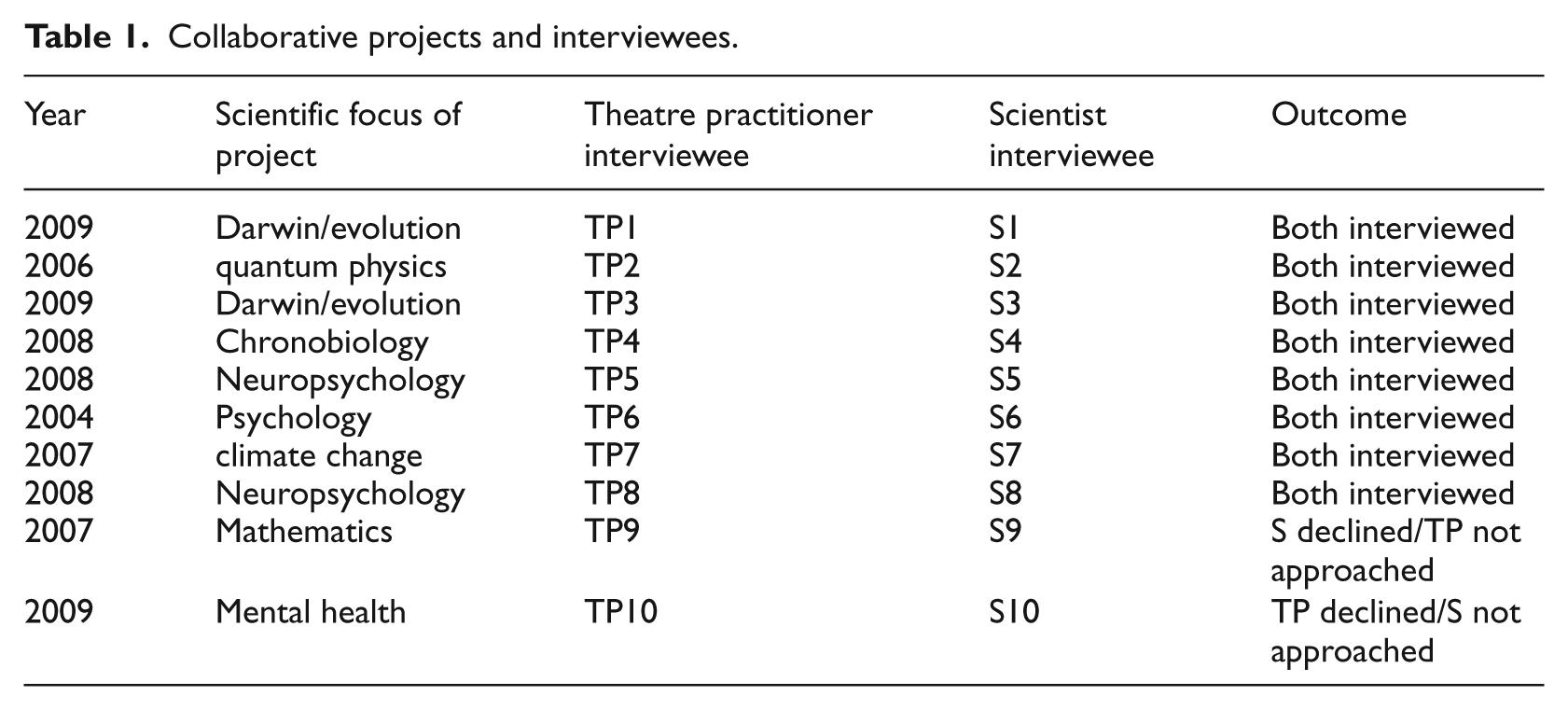
A final shortlist of 10 projects was chosen to represent the greatest diversity of scientific subjects explored. Theatre practitioners and scientists from these projects were approached via email and 16 collaborators (eight theatre practitioners and eight scientists) agreed to participate in interviews. These were matched pairs representing two collaborative perspectives from eight projects (see Table 1).
Collaborative projects and interviewees.
Interview methods and data analysis
Separate topic guides were developed to investigate the specific experiences of theatre practitioners and scientists. Interviews began with a broad opening question encouraging collaborators to tell their stories (Hara et al., 2003). The topic guides included probes that recognized different aspects of experience including the person’s behavioural response, feelings, perceptions and beliefs, and their evolving interpretations of the experience under exploration (May, 2002). The sequencing of the topics of conversation reflected the importance of chronological ordering to provide a structure for recounting coherent narrative and the unfolding of events, perceptions and feelings over time (May, 2002). Key topics covered in the interviews were: motivations, role of the scientist, working processes, problems/challenges and solutions, new knowledge/learning, personal experience and creative product.
All interviews were conducted face to face with individual collaborators and averaged 37 minutes (range 20 minutes to 1 hour 10 minutes). The interviews were audio-recorded and transcribed. As well as discussing the collaborative project identified during the scoping and interviewee selection process, a number of people also discussed their experiences of other projects. Data relating to these additional collaborations are included in the findings reported here (labelled as ‘secondary collaboration’) as they provide relevant additional insights, albeit from only one partner in the collaboration.
Transcripts were analyzed for comments relating to motivations and collaborative processes and both descriptive and interpretive codes were developed. Descriptive codes identified what interviewees had said and done, whereas interpretive codes were used to find patterns in the data (Zhang and Candy, 2006).
3. The context of collaboration: Project, process, participation
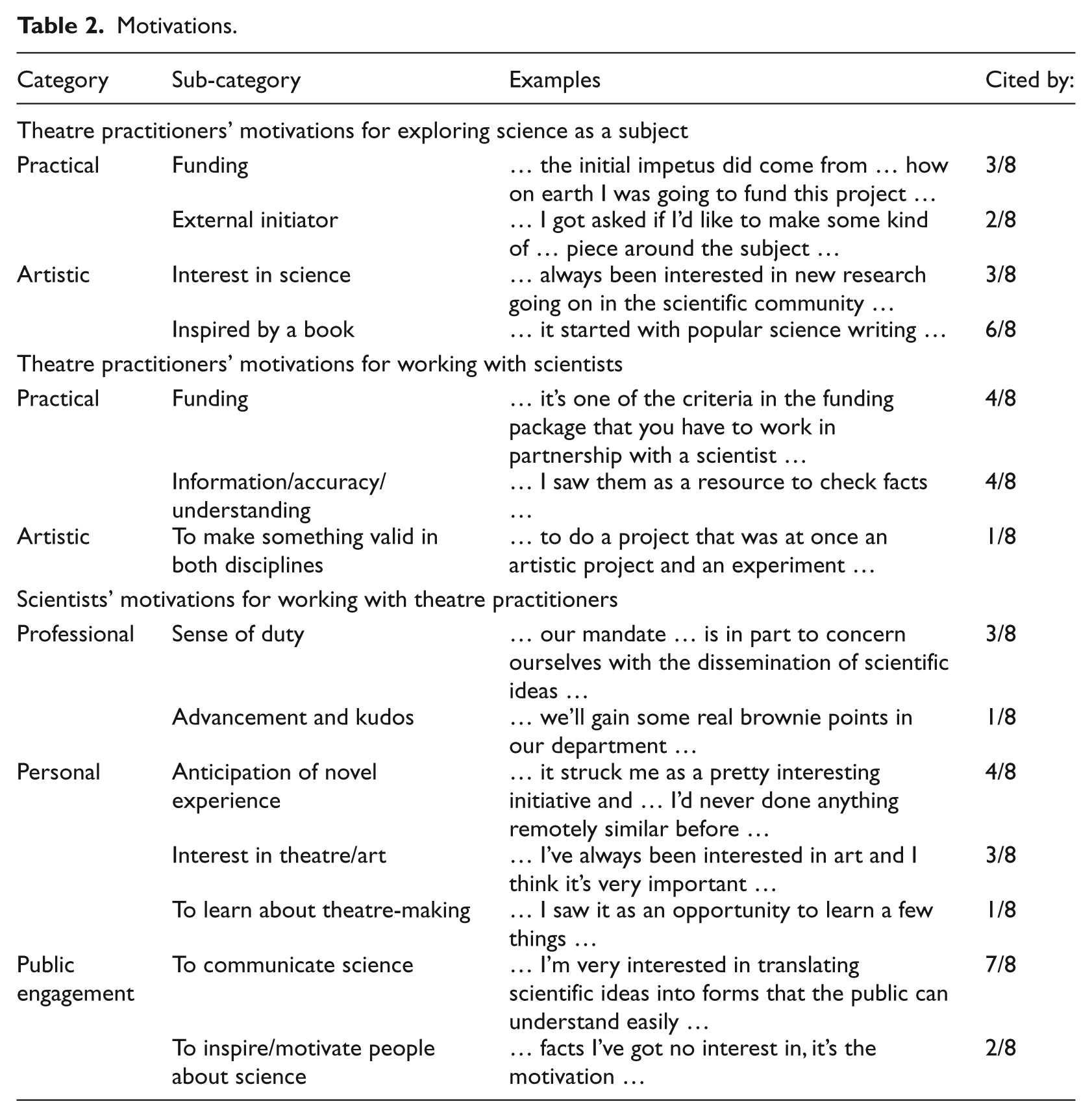
Two types of motivations were identified for theatre practitioners: motives for exploring science as a subject; and motives for working directly with a scientist (see Table 2). The motive ‘Availability of funding’ highlights the power of funders to influence the landscape of public engagement activities and to encourage partnership between scientists and theatre practitioners. The UK has seen a number of funding schemes specifically designed to encourage collaboration between scientists and artists or others involved in science communication (e.g. The Wellcome Trust, Arts Awards and the Engineering and Physical Sciences, Partnerships for Public Engagement) and it is clear from our research that such schemes are a stimulus for devised science theatre projects.
Motivations.
The most common reason for theatre practitioners to collaborate with scientists was to gain an in-depth understanding of the subject, to ensure that they did not misrepresent scientific ideas and to give them the confidence to respond creatively to the subject. The role of the scientist was, first and foremost, to help the theatre practitioners understand the topic using the language of science; the theatre practitioners responded creatively to the science using their own language of metaphor, image, poetry and symbolism. At this point in the process there is a need for compromise where the scientist and the theatre practitioners try to understand each others’ perspective and negotiate between how the scientist would ideally like the science to be represented and how the theatre practitioner would ideally like to engage the audience:
I think what they’re aiming for and what we’re aiming for are slightly different things … [for us] things have to be precise and unambiguous whereas I think they’re happier to live with the ambiguity of things and just to pose questions whereas I suppose we’re trying to resolve questions. (S6) the nature of the way we articulate things is different because the scientist necessarily articulates verbally and analytically and we necessarily articulate visually and symbolically and metaphorically … (TP5)
What was interesting was that the theatre practitioners clearly saw the scientists as filling a knowledge gap, providing them with information and understanding that they lacked. This was likened to the role of a teacher, as TP6 suggests: ‘we were probably quite like keen students at times’. Filmmakers express a similar desire to have scientists assure the accuracy of the science portrayed in film (Kirby, 2003a). Yet in both cases, the dramatic needs of the production would take priority over scientific accuracy; the consideration of accuracy is only up to the point at which the details start to adversely affect the drama. Topics with social and ethical issues or where there is no clear scientific consensus may offer greater dramatic opportunity, allowing theatre practitioners greater freedom to focus on what might interest the audience.
Accurate representation of science was a clear priority for all scientists interviewed. Working alongside theatre practitioners and including scientists in the process means that gradually the scientist realizes that the precise and unambiguous and perfectly qualified and accurate ‘language’ of science does not make good theatre. With theatre it is often more effective to ask a question rather than answer it. By gaining an in-depth understanding of what makes a good piece of theatre scientists usually revealed a relaxation of this priority in favour of dramatic success. S3 described this attitude change:
I began by saying this is going to be scientifically spot on … because we don’t want to have any misunderstandings about the science and very quickly we realized that actually that wasn’t going to make a really good story …
The premise underpinning involvement of scientists would superficially appear akin to the ‘deficit model’ of public engagement. However, on further investigation it is clear that theatre practitioners sought information as a stimulus for ideas that would later be contested and interrogated. Once the theatre practitioners understood the information, they questioned it, placed it in social, ethical and political contexts and underwent a creative process of discovering the drama. As TP2 explained:
we’re being slightly more provocative and saying ok master we’ve learnt all of this stuff from you, we think that the implications for it could be these things, would that work, yes, what’s your attitude towards that?
Scientists’ motivations
Scientists’ motivations were a mixture of professional responsibilities and benefits, personal interest and a desire to engage public audiences with science (see Table 1). These are not dissimilar to the motivations identified by Poliakoff and Webb (2007), in that our respondents had a positive attitude toward public engagement and one respondent indicated that public engagement activities were looked upon favourably by his peers (Poliakoff and Webb’s descriptive norms). However, respondents to our study also highlighted personal reasons, such as an interest in theatre or learning about theatre. This suggests two things, first, that participants see their involvement in the project as personally rewarding and secondly that they will also gain from the experience. Tapping into these positive reasons to participate may, therefore, offer a strategy to encourage greater participation from scientists in public engagement.
Despite these personal motives, the participants in this study most often mentioned communicating science to the public as a key reason to become involved in devised theatre about science. The language used by scientists tended to represent a top down or ‘deficit’ model of science communication with knowledge and understanding being imparted to the public. S4 explained: ‘I thought it would be a good opportunity because in the theatre you can get information to people without them realizing you’re feeding them science’.
Only two scientists made the clear distinction that they were motivated by inspiring and motivating people about science rather than communicating and disseminating scientific ideas. As such, the scientists interviewed appeared to see public engagement as about imparting information, rather than embedding science within culture or more generally inspiring an interest in science. This suggests that despite the efforts of the science communication community to encourage scientists to think more widely about the value of public engagement, many scientists continue to talk about these activities as primarily filling an information need.
Collaborative working processes
The working processes employed within collaborations were many and varied but there were significant commonalities between projects, with a strong emphasis on discussion and dialogue (Figure 1). Regular communication, meetings and updates were important and interviewees stressed the importance of a ‘to and fro of ideas’ (S8) or ‘batting it backwards and forwards between us’ (TP1). The majority of collaborators used draft versions of the performance script as a way of interacting and discussing the piece. One scientist explained:
they had written a draft script that I read through and I said what I’d do is I’d treat it as a scientific paper in a sense, in that I would re-write it as I would want it written as long as they treated it as suggestions … (S5)
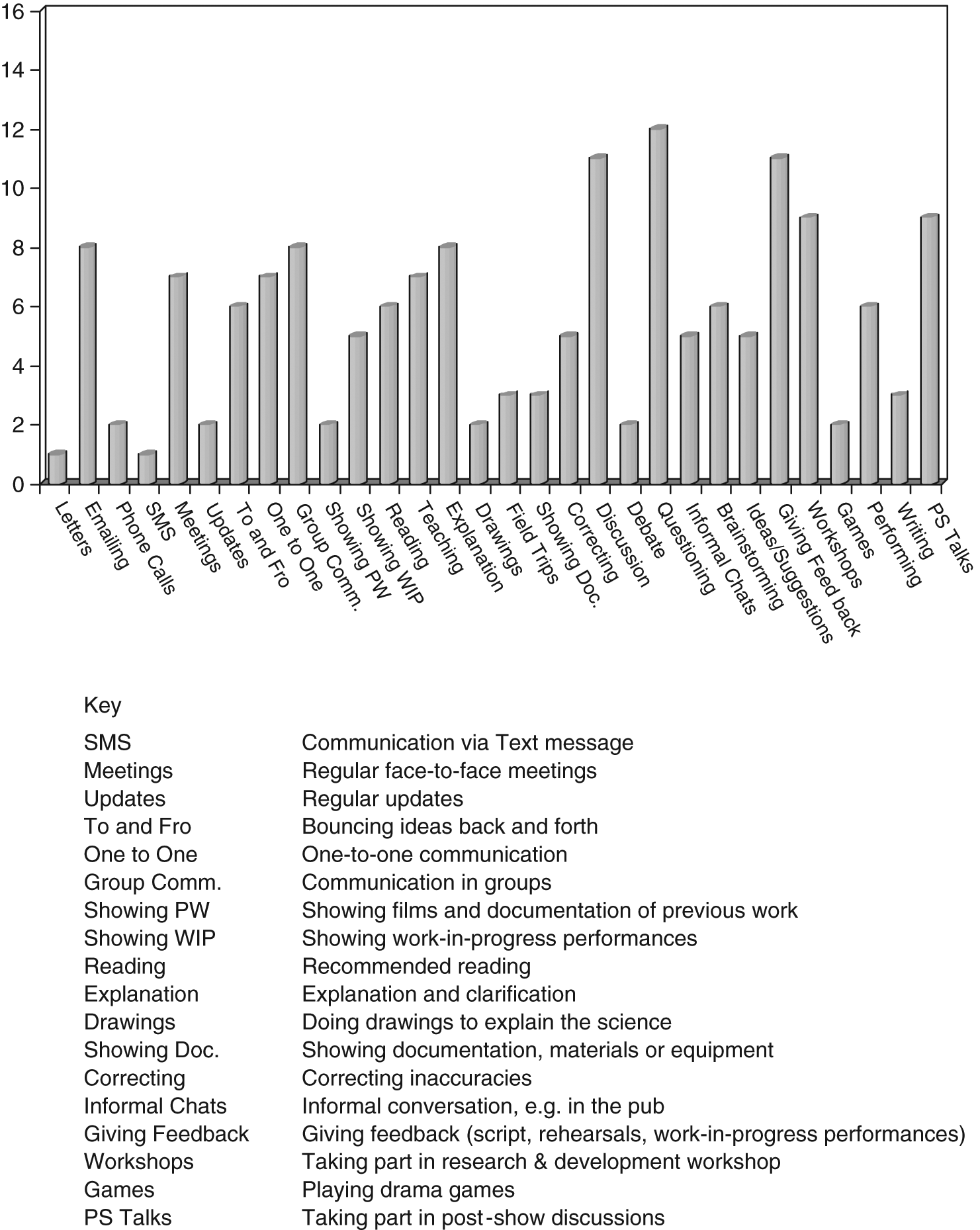
Working processes (representing number of interviewees who cited each process).
This two-way flow of information can be seen as facilitating both the creative insight and also compromise over issues, such as scientific accuracy, which were important reasons given by interviewees both to involve scientists and for scientists to become involved. Scientists were frequently involved in more than merely commenting on the accuracy of science (or scientists) represented in a script, and it was, for example, common for scientists to participate in research and development workshops with theatre practitioners and performers. These took a variety of formats from discussions and brainstorming to practical exercises that were less familiar to scientists, but also provided an opportunity for scientists to learn about theatre practice. As S1 explained: ‘it’s not often that I would find myself on a Tuesday morning making newspaper puppets on the floor’. In one workshop the actors found themselves unable to improvise the scientific content and so the scientist played the role himself. TP8 explained: ‘the expert was put in the situation with an actor … and we elicited our material from him that we later dramatized’.
Most partners interacted to a greater or lesser extent as creative collaborators and some partnerships underwent a clear shift ‘from much less of a consultant relationship to more of a collaborative artist relationship’ (TP5). For the scientist there was a scale of involvement ranging from the relatively minimal participation of a consultant or advisor to a much greater creative input sometimes encompassing clearly defined roles such as writer or performer. Figure 2 shows this range of collaborative styles.
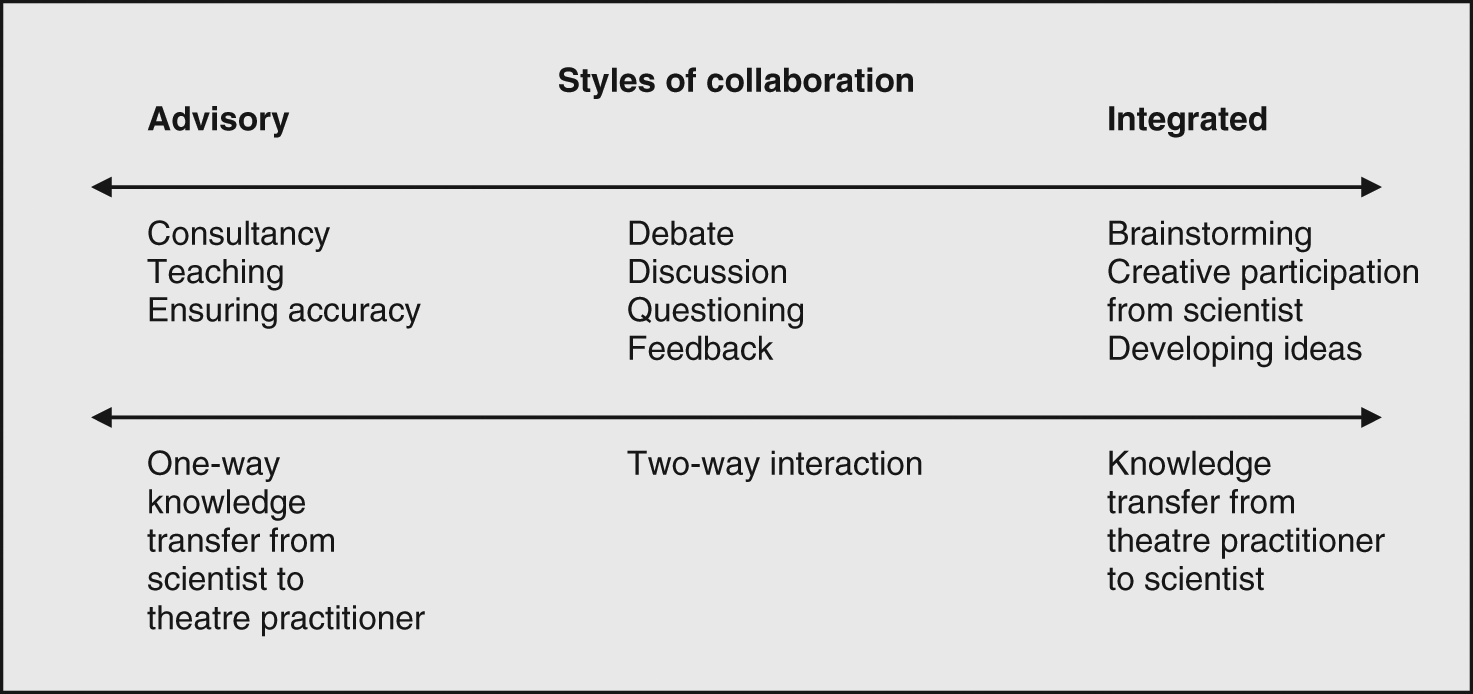
Styles of collaboration.
The fact that a spectrum of approaches was identified is encouraging for scientists interested in exploring theatre as a method of public engagement, as it allows scientists to play a variety of roles in the process, depending on their own interests. Nevertheless, it does highlight the need to clearly manage expectations about the level of involvement at the project inception and both theatre practitioners and scientists should be clear about the role of each party in the development of the performance.
4. Learning: Knowledge, attitudes, ideas
There was a very tangible knowledge transfer in all collaborations from the scientist to the theatre practitioner. This knowledge was not confined to explanations and information about scientific ideas but extended to a wider understanding of scientific culture such as the development of theories, the testing of hypotheses and the nature of scientific competition. Finding ways to communicate these ‘process’-oriented aspects of science has been a challenge for many involved in public engagement. That closely working with a scientist is able to convey the scientific process and challenge stereotyped perceptions of scientists is encouraging. This study did not explore the final theatrical performances, so it remains to be determined whether these process elements were retained or communicated through the final artistic product. However, the challenge to stereotypes, illustrated below, seems likely to positively influence the presentation of scientists in artistic works:
I learnt that scientists aren’t all 60-year-old men with wiry grey hair who sit in leather clad studies or with test tubes or something muttering to themselves … (TP4)
There was evidence of scientists’ attitudes towards communicating science shifting as a result of taking part in collaborations. Two scientists made very clear statements saying that doing the project opened their eyes to the potential for interest and understanding in the public:
there is a huge amount of demand out there … I think we are in fact underestimating the level of understanding that normal people can achieve … So that’s certainly the biggest lesson for me and it tells me that we scientists should probably be much more proactive as well … (S2)
S3 experienced a clear shift in attitude from ‘public understanding’ to ‘public engagement’, as he explained:
when I first got into science communication I was thinking it was all about … being the scientist who told the audience what was going on … but having worked on these projects I can see … it’s not just about explaining the science but it’s about persuading the public to engage with concepts … not necessarily understanding them but getting them to appreciate that there’s a beauty or an elegance involved.
This shift in attitude toward science communication amongst the scientists interviewed is encouraging. Perhaps encouraging scientists to participate in projects with collaborators more used to considering the needs of the ‘audience’ would further facilitate a move to more audience-centred communication approaches.
5. Conclusions
It is a certain type of theatre practitioner and a certain type of scientist who, through their self-selecting motivations, choose to work on collaborative projects. Theatre practitioners tended to be ‘science friendly’ with a keen interest in learning about new ideas and were unafraid of tackling complex subjects. Scientists were curious about the novel experiences that collaborations with theatre practitioners offered, they were passionate about discussing their scientific discipline and generous with their time and expertise. The findings support the recent evaluation of the Wellcome Trust’s Sci-Art programme which stated: ‘the attraction of entering into art–science collaborations was a sense of the beguiling mystique attached to the other discipline’ (Glinkowski and Bamford, 2009: 64). Tapping into this curiosity could be a new approach to encourage scientists to participate in public engagement activities and might, in some cases, overcome or at least ameliorate the barriers to participation that still clearly exist (see, for example, CAISE, 2009; Royal Society, 2006).
The issue of scientific accuracy was raised by both theatre practitioners and scientists as a reason for involving scientists in devised theatre about science. For theatre practitioners, this was more about providing guidance and facilitating understanding so that science could be realistically incorporated into the drama; similar reasons were seen in studies of filmmakers’ use of science consultants (see, for example, Frank 2003; Kirby 2003a; LaFollette, 2008). Scientists brought with them notions of ensuring the accuracy of science represented and preventing ‘dumbing down’ of the contents. However, as collaborations developed, scientists began to recognize the importance of dramatization and context and to accept the need for compromise. Two-way interactions, discussion, questioning and a ‘back and forth’ exchange of ideas and feedback gradually built this shared understanding. It would seem that the potential impact of working closely on a devised theatre project can be significant for the individuals involved (both theatre practitioners and scientists).
As with the studies of Kirby (2003a, 2003b) and LaFollette (2008), this work highlights the potential role of scientists in co-creating cultural productions. Some scientists are engaging with the wider cultural milieu to place science and scientific issues in a social context and devised science theatre, such as art installations, film and radio, is one place where this is happening. By working with artists, as historians and other experts have in the past, scientists can facilitate the exploration of scientific ideas by wider range of people. Theatre practitioners cast a fresh view on science, and while this may challenge scientists to think outside the box, it may also place a unique cultural perspective on the science explored, further embedding it within the cultural milieu and ultimately widening access to ideas and facilitating social critique.
Footnotes
Author Biographies