



Abstract
This article tested the assumption that functional magnetic resonance imaging (fMRI) images in popular science news articles make those articles appear more reasonable and persuasive to readers. In addition to fMRI images, this study also examined the potential impact of science fiction and artistic images commonly found in popular news articles. 183 undergraduates were asked to evaluate one of four versions of an article, each with a different image. The researchers discovered no significant differences between readers’ evaluations of the news article with the images isolated as the only independent variable. This suggests that images alone may not have a strong effect upon evaluation, that no image is necessarily more persuasive than another as implied by earlier studies and that further research is needed to determine what, if any, role images play in conjunction with the text to create a persuasive effect.
1. Introduction
Advancements in medical imaging technologies over the last twenty years have prompted a rapid expansion of research into the inner workings of the human brain and have subsequently made appeals to brain images common in contemporary discussions on just about everything from the causes of gambling addiction (Preuschoff and Bossaerts, 2007) to debates about why music stirs the emotions (Koelsch, 2005). Indeed, there remains little doubt that brain images in the popular media have come to “occupy a significant place in the cultural imagination… [They] evoke a sense of wonder and excitement, as well as the idea that the fleshy, unruly material known as the body has been directly accessed” (Joyce, 2005: 437). Brain images appear in newspapers, television shows, and popular science magazines as specific kinds of “models” that fix a biological reality and serve as explanatory support for human behavior and the detection of psychosis (Prasad, 2005: 292). As Joseph Dumit (1999) noted, “brain images in particular are more than mere illustrations when they enter popular culture” because they are often not viewed by audiences as “prejudiced, stylized representations of correlation, but rather as straightforward, objective photographs” (p. 174).
These observations have led to a number of social scientific studies regarding the power of brain images. For instance, Racine et al. (2005) point out that brain images—despite being formed through multiple processes of construction and being selectively colored in software programs—deserve to be treated as especially influential objects since they often appear “uncritically real, objective or effective in the eyes of the public” (p. 160). Racine et al.’s study of over one-hundred-and-thirty news articles shows that the deployment of images from functional magnetic resonance imaging (fMRI) in the popular media highlights activation in the brain such that “when subjects ingest high fat foods” one looks at the image and concludes, “‘Fat really does bring pleasure’” (p. 160). In several other studies, brain images have been isolated as a factor in interfering with judgments of scientific claims (Hensen, 2005; McCabe and Castel, 2008; Beck, 2010). In short, brain images are currently understood as contributing to the “seductive allure” of the neurosciences (Weisberg et al., 2008) and lending “a particular persuasive potential in conferring credibility to neuroscience data” (Ramani, 2009: 4–5). As a result, it is now presumed that “part of the scientific credibility of brain imaging as a research technique lies in the images themselves” (Ramani, 2009: 5).
2. Study objectives
Research into the role and the persuasiveness of brain images seems supportive of McCabe and Castel’s (2008) study, which finds that the inclusion of brain images in popular science news articles increases audience perceptions of scientific reasonableness (p. 345). The present study extends the research on this topic, further investigating the role of images in public perceptions of popular news reporting about neuroscience findings. We build from McCabe and Castel’s research by testing various kinds of images placed above a popular neuroscience article. As for McCabe and Castel’s work: they tested one-hundred-and-fifty-six university students’ judgments of scientific reasoning from a survey tool asking whether the article was well-written, whether the title was a good description of the results, and whether the scientific reasoning in the article made sense (2008: 345). In the end, they argued that “brain images influenced the perceived credibility of cognitive neuroscience research,” and made the case that the results revealed ethical implications since brain images may “play an important role in funding decisions and the direction of scientific discovery” (McCabe and Castel, 2008: 351).
This study presumes McCabe and Castel’s general argument to be correct but also tests the effect of popular cultural representations of the brain on the way audiences might evaluate neuroscientific findings. Put differently: media and popular culture can also be taken into account as “significant sites for the negotiation of scientific meaning in general” (Hamilton, 2003: 268). After all, brain images are not the only persuasive images in neuroscience settings, and television viewers are primarily exposed to science through dramatic programs rather than news or informational programs (Gerbner, 1987). Images and metaphors of science in film can also be reflections of popular understandings of science that are, in turn, used to reinforce those understandings. Therefore, this study explores how popular science is visualized through brain scan images and through science fiction film images in an effort to test the power of brain images against other potentially persuasive images as well as to “reveal expectations and anxieties directed at science” (Weingart, Muhl and Pansegrau, 2003: 281).
Although some may dismiss representations of science in popular culture as unimportant or unpersuasive, popular culture texts are a primary site of struggle for power and representation (Hall, 1981; Grossberg, 1997) and exposure to such texts is unavoidable. In fact, Hamilton (2003) points out that science fiction, as a genre, is commonly invoked in popular news reporting on scientific advancement and has both positive and negative effects. Weingart et al. (2003) found that medical research, including research involving fMRI technology, is presented with the highest level of skepticism among all of the scientific fields portrayed in fiction film. In short, contemporary cultural understandings of the brain cannot be divorced from popular representations of the brain and brain science (Gere, 2004). Therefore, they must be accounted for when exploring how audiences are influenced by and/or interpret information about the neurosciences, a central aim of this study.
The present study asks the following research questions:
RQ1: Does an fMRI image have a significant persuasive effect if evaluated in comparison to no image situated above a single, unchanging body of text? RQ2: Do other images, specifically artist renderings that appear above the text of a neuroscience article, have a significant persuasive effect? If so, how do they compare to an fMRI image and to no image when placed over the same body of text? RQ3: Do science fiction film images that appear above the text of a neuroscience article have a significant persuasive effect? If so, how do they compare to an fMRI image, to an artist’s rendering, and to no image when placed over the same body of text?
Because we recognize the frequency and role of artists’ renderings and still-frame images from science fiction films in framing popular news articles about neuroscience, and recognize as well the importance of popular representations of scientific advancement, these images are of particular interest. The commonality of those sorts of images can be evinced by looking at artist renderings and science fiction film images placed above the following prominent publications: the March 2007 Engadget.com article on fMRI “mind reading” (Blass, 2007), the June 2008 Scientific American article about creativity (DiChristina, 2008), the November 2009 PopSci.com article on brain implants (Hsu, 2009), the December 2010 TopNews article exploring the suppression of automatic behaviors (Joshi, 2010), the January 2011 Psychology Today article about how people fall in love (Malkin, 2011), and the March 2011 National Post article on detecting feelings of hostility (McLeod, 2011), among many others. The question of the significance of these sorts of images in juxtaposition to fMRI images would offer a better sense of the relative persuasiveness of fMRI images if, in fact, fMRI images prove particularly compelling on a regular basis as compared to no image at all.
Ultimately, this study extends other similar studies (Hensen, 2005; McCabe and Castel, 2008; Weisberg et al., 2008; Beck, 2010), suggesting from the results obtained that the persuasiveness of different kinds of images remains relatively uniform and shows no statistically significant deviations. In other words, if brain images are persuasive, then these results imply that brain images are likely not much more persuasive in the popular science news context than an artist’s rendering of a futuristic-looking human head or a freeze-frame image from a science fiction film. Although this study does not intend to doubt McCabe and Castel’s assertion that brain images have some effect or that they “may influence a less consciously controlled aspect of ratings” (2008: 351), it does entertain the notion that artists’ renderings and science fiction film images have their own persuasive appeals for their own particular reasons, as do articles with no images at all. Consequently, it is important to question whether brain images should be singled out independent of other images or separated from the persuasive elements in the formation of a text as a whole.
3. Methods
Our study design largely mirrors that of McCabe and Castel’s earlier work, described above. We make only a few changes to their experiment—adding open-ended questions that ask participants why they rated the article the way that they did, adding questions about credibility in addition to reasoning, and keeping the text of the article consistent across all images. As noted earlier, we are interested in how audiences might evaluate popular science reporting differently based on the type of image attached to a particular news article. In reference to evaluating an article’s credibility in addition to its reasoning, we felt the addition was warranted since the latter refers to logical consistency, while the former, at least within the rhetorical tradition, refers to having enough trustworthiness to be persuasive to members of a community (Miller, 2004). A particular article may include very strong logical reasoning, but still not be evaluated as credible by its audience, and vice versa. Distinguishing between those two layers of evaluation can provide additional insight into whether the article is viewed as credible as well as reasonable.
Study participants
Participants for this study were undergraduate students at a large, public Southeastern state university enrolled in all levels of classes in either English or Communication departments. Students were not required to participate, nor did they receive any compensation for doing so. A total of 183 students participated in the study, all of whom maintained complete anonymity. The study complied with the university’s Institutional Review Board’s requirements for exemption. Participants were split into four groups according to the class they were attending at the time of their participation. Classes were assigned randomly by the researchers to read an article with one of three images or no image, and no single class formed the responses collected for any single article. In other words, no group was composed of only one class, hopefully minimizing any bias that may have arisen due to similarities in age or interest within a single class. Each group was given a version of a sample popular news story on an advancement in neuroscience. Each version contained the same text, but was accompanied by a different image.
The experimental protocol
The article, a fake news story written by the researchers, was titled “Scientists Can Reconstruct Our Dreams.” We chose to ask participants to evaluate a fake news story so that we could guarantee a baseline of zero exposure prior to the study. Additionally, the end of the article made a claim not directly implied by the data, giving participants a potential reason to be skeptical of the article had they spotted the error in reasoning. The article claimed that neuroscientists from a university laboratory were able to accurately determine the content of subjects’ dreams by reading brain activity using fMRI technology. The article included quotations from a purported scientist, gave an example of the technology in action, and claimed that the study had been published in the journal Nature.
One group of participants evaluated the article with no image attached; another group viewed a version of the article with a brain scan image under the headline. Since we were also interested in the influence of other types of representations of science in the popular media, we felt it prudent to include images similar to those commonly found in popular science news articles. Thus, the third group was given a version of the article with a fantastical, artistic image of a human head and a cyberspace-esque background with swirly lines. The final group was given an image from the popular science fiction film Minority Report in which three children’s dreams of the future are projected on a screen and used to prevent crime.
After reading the article, participants were asked to complete a short survey consisting of five four-point Likert-scale questions and two open-ended questions. The instrument duplicates and expands upon that used in the earlier published study (McCabe and Castel, 2008). Since that study included three separate experiments with similar results, we hold that instrument to be valid. The three original questions were: 1) The article was well-written, 2) The title was a good description of the results, and 3) The scientific reasoning in the article made sense. As already noted, we added two additional Likert-scale questions to the instrument: 4) The article contained credible information, 5) The article was authoritative. Finally, the survey concluded with two open-ended questions: 6) I found the information credible or not credible because, and 7) The part of the article most helpful to my understanding was. These open-ended questions were used to potentially add some clarification to how the article was evaluated.
Hypotheses
In order to answer RQ1, a question about persuasiveness, we set out to test how readers evaluate both the “credibility” and “reasoning” of an article. We operate from the hypothesis that McCabe and Castel’s conclusion holds, i.e. that the presence of fMRI images is positively correlated with higher audience evaluations of the survey questions. Thus, our hypothesis is as follows:
H1: An article with an fMRI image will appear more reasonable and credible than an article with no image.
To test this, we conducted a series of t-tests on the results of each question, comparing the evaluations of the version of the article with the brain scan image to those of the article with no image.
In order to address RQ2 and RQ3, we explore the potential differences in readers’ evaluation of an article containing either a familiar image from a popular science fiction film or an artistic rendering. Those evaluations are then compared to one another and to an article containing an fMRI image. Thus, for these questions, we propose the following hypotheses:
H2: All non-scientific images will have just as much reasonability and credibility as fMRI images. H3: Images with recognizable popular culture referents, such as the image from a science fiction film, will be evaluated as more reasonable and more credible than images without such referents, such as the fantasy artist rendering.
To test H2, we conducted a series of t-tests on the results of each question, comparing the evaluations of the version of the article with the fMRI image to those of the versions that included the fantastical image and the sci-fi image. In order to test our third hypothesis, we conducted t-tests to compare the differences on each question between respondents who evaluated the version of the article with the sci-fi image and those with the fantasy image.
Finally, since our survey also contained some open-ended questions to allow respondents to be specific in why they evaluated the article in a particular way, we examine those results and propose this final hypothesis:
H4: Readers will not report having been influenced by the image attached to the article.
In order to test this hypothesis, we conducted t-tests to compare the differences on each question between respondents who evaluated articles with images as well as with no image.
4. Results
In order to compare the participants’ evaluations of each version of the article, we conducted a number of t-tests to discover if there were any significant differences between responses to any of the questions, maintaining differences in image as the independent variable. Since the N-value and means of each of these tests remain the same, they have been placed in Table 1.
N-values and means for each question, by image type.
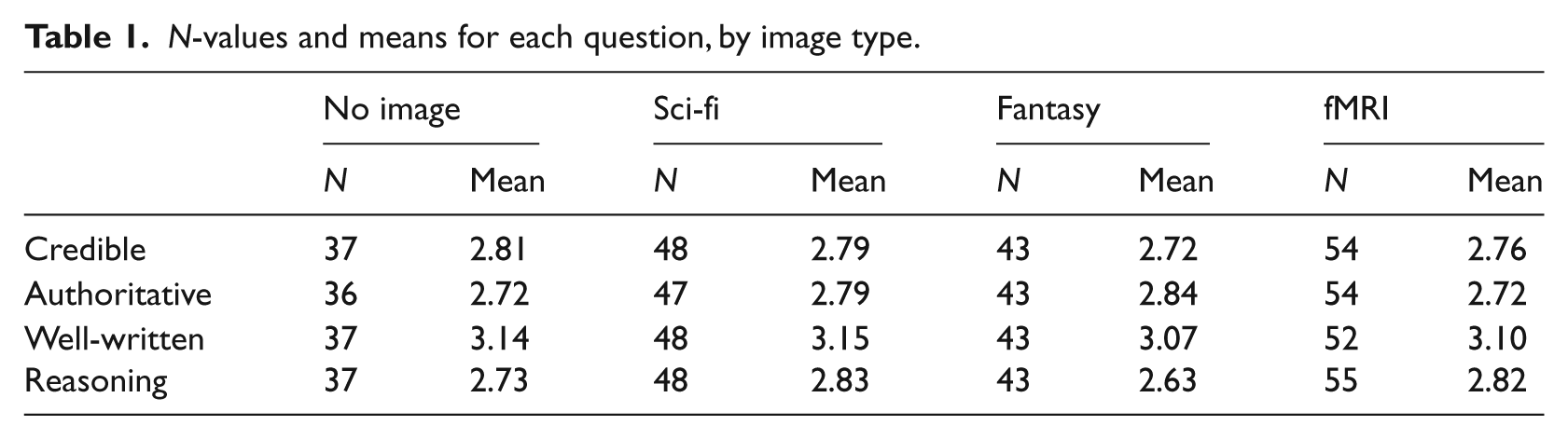
Our first hypothesis compared an article with an fMRI image to one with no image. There was no significant difference between respondents’ evaluation of the article’s credibility, t(89) = .295, p > .05. Responses to whether or not the information in the article was authoritative were also not significantly different, t(88) = .000, p > .05. Responses to whether or not the article was well-written showed no significant difference, t(87) = .266, p > .05, nor did responses to the question evaluating the scientific reasoning of the article, t(90) = −.521, p > .05. Since none of the above results show significant differences, our first hypothesis was not supported.
Our second hypothesis compared articles with non-scientific images to one including an fMRI image. Responses to the question on credibility were not significantly different for either comparison: t(95) = .248, p > .05 for the former and t(100) = −.219, p > .05 for the latter. Responses also were not significantly different for the question on authoritativeness, t(95) = −.820, p > .05 for fantasy and t(99) = −.485, p > .05 for sci-fi. Responses to the question of how well-written respondents found the article were not significantly different, t(93) = .172, p > .05 for fantasy and t(98) = −.339, p > .05 for sci-fi. There were also no significant differences in responses to the question on scientific reasoning, t(96) = 1.143, p > .05 for fantasy and t(101) = −.102, p > .05 for sci-fi. Since the article with the fMRI image did not score significantly higher than either the fantasy or the sci-fi images on any of the questions, our second hypothesis was supported. However, since our first hypothesis did not find a significant effect for fMRI images, we cannot say that support for H2 demonstrates that sci-fi or fantasy images had or did not have an effect—only that any effect they had on evaluations of credibility and reasonableness was no different from that of fMRI images.
H3 compares an article with an image from a science fiction film to those with images without real-world referents. In response to the question on credibility, there was no significant difference, t(89) = −.466, p > .05. There was no significant difference between responses to the question on authority, t(88) = .394, p > .05. The difference between evaluations of the article being well-written were not significant, t(89) = −.549, p > .05. Finally, there was no significant difference between responses to the question about the article’s scientific reasoning, t(89) = -1.322, p > .05. Since there were no significant differences found, H3 was not supported.
Our final hypothesis stated that readers will not report having been influenced by the image attached to the article. To test this hypothesis, we examined the responses to the open-ended questions. There were a total of 171 responses to the question asking what part of the article was most helpful to the participant’s understanding. None of these answers referred to the accompanying image. There were a total of 171 responses to the question asking why the respondent found the article to be either credible or not credible. A total of two of those responses (1.2%) mentioned an accompanying image. In the case of a response to the article with the fMRI image, the respondent expressed that more images would make the article more credible. In a response to the article with the fantasy image, a participant stated that the article would be more credible if it included images from the study. Despite these two statements, since there were so few responses that referred to an image’s potential influence, H4 is supported.
5. Discussion
This study suggests that images that represent activity in the brain are not necessarily evaluated as more credible or reasonable than other types of images placed above popular science news articles about neuroscience findings. In fact, images of any sort do not appear, at least in this study, to have an impact on readers’ evaluations of popular science news. The lack of a statistically significant effect between an fMRI image of the brain as compared to an artist’s rendering of a “futuristic” human head, a science fiction film image, and no image at all suggests a need to re-think the oft-repeated and unmitigated declaration that brain images hold more persuasive power than other images in terms of their ability to inflate judgments of scientific reasoning, authoritativeness, or credibility. Although McCabe and Castel found some evidence to support that position, this study suggests that images other than those of fMRIs may have similar effects. Indeed, it may be the case that judgments of popular science news articles may not be very dependent at all on the images used to frame them. This requires further exploration.
However, it is important to note that one limitation of our study—and many other studies dealing with popular science news—is that we cannot be sure that our participants, undergraduates who may or may not be familiar with the sciences, are equipped with the knowledge necessary to accurately judge the credibility of science reporting. In other words, if the study participants did not spot the error in reasoning, they may have had no reason to doubt the credibility of the article since they have little to no background in the subject. This may be alleviated in future work by purposefully seeking participants who have the knowledge necessary to place judgment and, perhaps, comparing their evaluations to those of participants without that knowledge. Another limitation regarding participants is the researchers’ presumption of participants’ homogeneity due to the similarity of the courses from which they were chosen. It is possible that unintended levels of heterogeneity may account for a lack of significant results. Although this is possible, we are skeptical of the influence of a heterogeneity effect only because first, second, and third year students at a large state university in classes ranging from Digital Media Production to Basic College Writing were surveyed. Even so, this potential issue can be avoided in future research by testing participants for similarity in their ability to evaluate the reasonableness of scientific claims.
Despite these limitations, our study design suggests the need to consider the influence of text when exploring the influence of images in popular science news. That is to say, content differences make a difference; a popular news article about scientists reconstructing dreams, as used in this study, may be a central and significant factor in determining whether survey participants respond to one image over another and see it as connected to the text—bolstering credibility or reasonableness—or not. To our knowledge, images in relation to content differences have not been studied in the popular science context, but very different texts might portray one article’s content as more or less reasonable and could affect the results. For example, a reader possessing negative preconceptions about meditation may possess a belief bias in which they are predisposed to rate an article citing meditation’s benefits as less reasonable because they do not believe that meditation can be beneficial, regardless of the actual logical validity of the article (see, for example, Klauer, Musch and Naumer, 2000). From a rhetorical perspective that understands both the importance of analyzing how discursive formations intersect with audience—in this case, college students—as well as the importance of recognizing that neuroscientific information is animated from and between socio-cultural categories, popular arguments, and situated histories that make a big difference to meaning and reception (Jack, 2010: 408), all studies on the power of images would benefit from close attention to textual content.
Overall, this study demonstrates a need for additional research into the ways that science becomes persuasive as a combined effect of the text and the image together at a particular cultural moment. If an image, when isolated as the sole independent variable as in this study, does not significantly alter readers’ evaluations of an article’s credibility or reasoning, then researchers must explore other ways in which popular science news may be persuasive. Such exploration must be careful not to overlook the image in favor of the persuasive potential of the text. Instead, future researchers must evaluate how the text may be persuasive as well as how it interacts with the image and how the image may possess its own rhetorical qualities, such as an emotional appeal, and lend those qualities to the article.
We believe that images are rhetorical and that their association with popular science news articles may be persuasive. We do not intend this study to discount the suggestion that “brain images may be more persuasive than other representations of brain activity because they provide a tangible physical explanation for cognitive processes that is easily interpreted as such” (McCabe and Castel, 2008: 349). However, we do contend that any persuasive influence such images may have is not based on credibility (ethos) or reasoning (logos), or at least not those two elements alone. That is not to say there is no possible emotional appeal (pathos) of the image or that the image did not utilize one or more of those three rhetorical appeals in conjunction with the text to work persuasively; we did not specifically test for such an effect. Yet, the point remains: brain images may not be any more persuasive than an artist’s rendering that evokes the imagination and builds from a visual rhetoric of popular science, nor may brain images be more persuasive than a snapshot from a fiction film. If fMRI images are likely persuasive because they maintain a “seductive allure” (Weisberg et al., 2008) or appeal to an apparent obviousness of materiality that confirms the claims of the neurosciences, then it might also be the case that an intuitive, reductive approach is encouraged by these other types of images as well.
Whatever the case, when an image is paired with a text located within a particular genre, the text enters into a semantic relation with the image (Martinec and Salway, 2005), and the text serves as a constitutive element that shapes the “seeing” of the image (Jack, 2009). Artist renderings, for example, may incorporate strong light sources, translucence, open space, the presence of symmetry, and an emphasis on mathematics (Bolter and Gromala, 2006; Fishwick, 2006), all of which are indicative of the aesthetics of computing marketed for decades by corporations like Apple and may, thereby, lend a certain emotional or associative effect, for good or for ill. Similarly, science fiction film images, as Telotte (1993) notes, can present an inherent relation between amusement and technology since science fiction is often “intent on ‘selling’ a certain pleasurable experience of the scientific and the technological” (p. 29) and may also be understood as predictive projections of the future. In brief, images likely grow in their persuasiveness, as Kimble and Olson (2006) show, to the extent that they are able to project our sentiments and shared cultural lenses (pp. 561–562). The details of these various processes require further exploration in future research.
6. Conclusion
This study used different kinds of images as an independent variable in a study of the credibility and reasoning of a popular news article about a neuroscience finding. We found that there is no significant difference between readers’ evaluations of an article regardless of the associated image. We also found that other types of images, specifically artistic renderings and science fiction film stills, had no significantly different effect on the perceived reasonableness or credibility of an article, despite the fact that those images may be persuasive for their own reasons. In short, we found that images, as an independent variable, appear to have equal impact or no impact of their own on the perceived credibility or reasonableness of popular science news in a story about the neuroscience of reading dreams.
Although other research suggests that there may be some danger of “artificially inflating the credibility of cognitive neuroscience research” by including fMRI images in popular news reporting (McCabe and Castel, 2008: 351), we do not believe that the inclusion of one type of image would necessarily be judged to have a significantly negative effect independent of an evaluation of an article’s topic and the other images circulating in the genre. We, therefore, assert that it is wise to consider how images may interact with the text and the role they may play in the audience’s level of understanding of the article’s topic. Asking how these multiple variables interact and how they might be used to responsibly and ethically improve public perception of neuroscience research will prove important in future research. Indeed, as McCabe and Castel rightly point out, one of the major stakes here is the role that the public perception of science plays in funding decisions. As researchers, then, it is necessary to further explore the question of persuasive presentations and to help insure that scientific research is responsibly, accurately, and effectively communicated.