



Abstract
This research provides secondary data analysis of two large-scale scientist surveys. These include a 2009 survey of American Association for the Advancement of Science (AAAS) members and a 2006 survey of university scientists by the United Kingdom’s Royal Society. Multivariate models are applied to better understand the motivations, beliefs, and conditions that promote scientists’ involvement in communication with the public and the news media. In terms of demographics, scientists who have reached mid-career status are more likely than their peers to engage in outreach, though even after controlling for career stage, chemists are less likely than other scientists to do so. In terms of perceptions and motivations, a deficit model view that a lack of public knowledge is harmful, a personal commitment to the public good, and feelings of personal efficacy and professional obligation are among the strongest predictors of seeing outreach as important and in participating in engagement activities.
Keywords
1. Introduction
A substantial body of research explores why citizens engage in public life and civic-minded activities (for reviews, see: Delli Carpini, 2004; Delli Carpini, Cook and Jacobs, 2004). Science and risk communication scholars have also developed their own deep literature on public engagement that is rich with theory and examples (for reviews, see: Beierle and Cayford, 2002; National Research Council, 2008; Nisbet and Scheufele, 2009). Work in both the risk and political communication sub-fields has included a range of methodological approaches, including substantial survey work based on questions built into large-scale and high quality surveys such as the General Social Survey (e.g., Putnam, 2000; Uslaner, 1998), the National Election Study (Holbert, 2004), and the European Social Survey (e.g., Besley, 2008).
The science communication literature, however, is somewhat unique in its focus on both public attitudes as well as the views of science decision-makers who sponsor engagement. This emphasis on the “understanding of the public by scientists” (Levy-Leblond, 1992: 20) reflects a now-common critique of the scientific establishment’s failure to communicate with the public in meaningful ways and a perceived corresponding decline in public trust of science (Bauer, Allum and Miller, 2007). Until recently, this critique has been largely confined to qualitative research or quantitative research using small samples (for a review, see: Besley and Nisbet, in press). A recent special issue of this journal, however, also includes several large-scale studies of engagement and its precursors (Bauer and Jensen, 2011). Several of these manuscripts were descriptive (Torres-Albero et al., 2011) while others included multivariate analyses focused on demographic predictors of engagement with limited attention to attitudinal predictors (Bentley and Kyvik, 2011; Jensen, 2011). Rather than focus on the individual scientist, one study also focused on institutional characteristics as the key determinant of engagement activity (Neresini and Bucchi, 2011). The current study is unique its inclusion of both demographic and attitudinal predictors of engagement in two large-sample, multivariate contexts.
Below, we briefly review past research on the relationship between scientists’ attitudes towards the public and their willingness to engage. This is followed by the analysis of two large-scale surveys of scientists. These two surveys – one by the Pew Research Center for the People and the Press in cooperation with the American Association for the Advancement of Science (AAAS) (Pew Research Center for the People and the Press, 2009) and the other by the United Kingdom’s Royal Society (Royal Society, 2006) – do not appear to have been used previously to model the potential predictors of engagement (see, however: Bauer and Jensen, 2011). While the two studies originate in different countries with somewhat different histories, the scholars involved in debates about scientists’ engagement with the public share a common literature. Indeed, the last four editors of Public Understanding of Science have included two Americans, a Canadian and a citizen of the United Kingdom. More generally, while the two nations are obviously quite different in many ways, the data here do not allow for a meaningful comparison of the two countries. Rather, the focus is on the range of individual-level measures in each survey that appear to provide an opportunity to better understand scientists’ engagement-related motivations and behaviors. The final discussion section, however, includes a critique of the two surveys aimed at suggesting how future surveys of such populations might be improved.
Scientists’ understanding of the public
Broad-based engagement between decision-makers and the public is often described as a tool for maintaining and building public trust in scientific endeavors involving potential health and environmental risks (Bauer et al., 2007; Fischhoff, 1995), as well as for other topics (Barber, 1984; Gastil and Levine, 2005). The goal here, however, is not to re-iterate debates about the value of engagement or to suggest best practices. It is instead to explore the degree to which scientists’ views about the public and other facets of civic life are associated with engagement-related attitudes and behavior.
An important part of the literature on scientists’ understanding of the public includes research on scientists’ reticence to engage meaningfully with non-scientists, including both decision-makers and different segments of the public (hereafter, the “public”). This can be seen in, for example, the discussion of the “imagined lay person,” whom scientists are said to construct as a precursor to any public communication (Maranta et al., 2003). The dominant view sees a homogeneous public (Cook, Pieri and Robbins, 2004), that knows little about science, and is generally uninterested in learning anything new (Blok, Jensen and Kaltoft, 2008; Burningham et al., 2007). Such work suggests a deficit model of science communication that emphasizes the public’s lack of scientific knowledge as the cause of public rejection of science and associated risks. This model primarily suggests the need for education and the careful design of messages such that they can compete in a competitive media environment (for reviews, see: Davies, 2008; Nisbet and Scheufele, 2009; Peters et al., 2008; Sturgis and Allum, 2004). Such research has further noted scientists’ belief that the public are often irrational (Cook et al., 2004; Davies, 2008; De Boer et al., 2005; Krystallis et al., 2007; Michael and Brown, 2000; Moore and Stilgoe, 2009; Petersen et al., 2009; Young and Matthews, 2007) or, conversely, inappropriately self-interested (Burningham et al., 2007; Young and Matthews, 2007).
While scientists’ actual experiences with journalists are largely positive (Peters et al., 2008), scientists often point to the news media as the prime reason for the public’s presumed knowledge deficit and irrational beliefs (Blok et al., 2008; Burchell, 2007; Burningham et al., 2007; De Boer et al., 2005; Krystallis et al., 2007; Young and Matthews, 2007). Scientists see additional training for journalists as key to improved performance (Burchell, 2007; Petersen et al., 2009).
Scientists’ role and function in the public sphere also appears to be a relatively minor topic in most discussions of their views. Scientists appear to believe that the public needs to pay more attention to experts’ suggestions and feel that scientists are often inappropriately marginalized in debates involving science (Davies, 2008; Gamble and Kassardjian, 2008; Stilgoe, 2007). In some cases, scientists may publicly voice support for public discussion while expecting little meaningful content to emerge (Burningham et al., 2007; De Boer et al., 2005). The primary motive identified by scientists for engagement appears to be to increase science literacy (and thereby reduce public deficits in knowledge) (for a review, see: Besley and Nisbet, in press).
In summary, the literature on scientists’ understanding of the public speaks to both the importance of understanding scientists’ own views about civic topics as well as the need to consider different types of engagement.
Predicting public engagement
Delli Carpini and his colleagues provide an excellent overview of previous research aimed at modeling public engagement, as well as a review of the normative and empirical justification for such engagement (Delli Carpini et al., 2004). For the current study, the most relevant component of these reviews is the definition of engagement and the variables he says are most relevant to predicting engagement.
Delli Carpini (2004) opts for the term “democratic engagement” and includes community-level civic behavior (e.g., volunteering for a non-profit) that may not be specifically political. He also includes, however, political behavior aimed at having an effect on public decision-making (e.g., contacting officials, attending a public meeting). He argues that the public can sometimes engage in a mediated way through communication channels such as the news media and interpersonal communication (see, also: Besley and Roberts, 2010; Besley and Tanner, 2011; Nisbet and Kotcher, 2009; Page, 1996; Xenos, 2008). The dependent variables discussed below therefore include both views about direct engagement with members of the public as well as views about mediated engagement, which includes not only being interviewed by journalists (Peters et al., 2008) but also producing content for a non-scientist audience (Bentley and Kyvik, 2011).
Efficacy
According to the Delli Carpini et al. review (2004), feelings of efficacy are a major predictor of civic engagement and participation. Efficacy includes the belief that decision-makers will respond to your efforts (external efficacy) and that you have the personal skills to make a difference (internal efficacy). Efficacy has been part of formative research on engagement (e.g., Rosenstone and Hansen, 1993; Verba, Schlozman and Brady, 1995) and has been used in a range of communication studies (e.g., Baumgartner and Morris, 2006; Moy and Scheufele, 2000). Efficacy is also a central component of the Theory of Planned Behavior (TPB) (Ajzen, 1991; Conner and Armitage, 1998), one of the models used frequently in the science and health communication literature to predict behavior (e.g., Lapinski et al., 2007; Trumbo and O’Keefe, 2001). Indeed, one of the few quantitative studies that focused on scientists’ engagement behavior used the TPB and found that efficacy was a significant predictor of intention to engage (Poliakoff and Webb, 2007). The Royal Society data include several sets of questions that speak to the concept of efficacy that will be described below. The Pew/AAAS data do not include questions related to efficacy. Overall, it should be expected that more efficacy will result in positive engagement outcomes.
H1: Views about capacity to engage (internal efficacy) and the belief that such engagement will have an impact (external efficacy) will be associated with positive views about engagement, increased willingness to engage, and increased levels of actual engagement by scientists.
Views about engagement
Consistent with the TPB, the other three significant variables included in Poliakoff and Webb (2007) were respondents’ past engagement behavior, views about engagement itself, and the belief that other scientists were taking part in engagement (norms). Of these, past behavior has been noted as a key factor in general engagement research (Delli Carpini, 2004; Verba et al., 1995). Some qualitative evidence also suggests that engagement experience improves scientists’ attitudes toward citizens and engagement itself (Blok et al., 2008; Pearson, Pringle and Thomas, 1997). Several questions related to actual behavior are included in the Royal Society data sets and therefore included in the model. These are described below.
H2: Past engagement behavior among scientists will be associated with positive views about engagement, future willingness to engage and levels of actual engagement.
Similarly, it should be expected that there is at least some link between general attitudes about engagement and that behavior. The Pew/AAAS data include questions on scientists’ views about science’s place in society. In contrast, consistent with a rational choice argument for engagement, the Royal Society data include several variables that emphasize scientists’ expectations about personally benefitting from engaging with the public or the news media.
H3: Positive attitudes about engagement and a belief in the need for a central role for science in society will be associated with positive views about engagement, future willingness to engage and levels of actual engagement.
Disciplinary field and subjective norms
Finally, Poliakoff and Webb (2007) included several variables that turned out to be insignificant, including perceptions about what other scientists and friends/family thought was important (injunctive norms), fear of engagement, time and money constraints, and perceptions about whether their research would be of interest to the public. The study however, had such a small and unrepresentative sample (n = 169 from a population of nearly 10,000 from a single university) that it does not yet seem prudent to reject these types of variables (see also: Peters et al., 2008). Unfortunately, the closest the two data sets here have to questions addressing constraints involve respondents’ field of study. Scientists in some fields – mathematics, for example – might perceive that their focus is of a less political nature than other fields and therefore see less value in engagement. On the other hand, it might be that some fields feel they receive too little attention, despite their underlying value to society. Whichever the case, it seems reasonable to ask where the field variable might be relevant to views about engagement and engagement behavior (Bentley and Kyvik, 2011; Torres-Albero et al., 2011). The specific fields included in each study are described below but the following general research question is proposed.
RQ1: Is scientists’ field associated with views about engagement and engagement behavior?
The Royal Society data also include a handful of questions that might get at a sense of subjective norms in the form of questions about the degree to which the respondent believes their institution would value engagement. One question specifically asks about the degree to which more support from a supervisor were to help while another set of two questions asks about the degree to which more support from funding institutions would help. Indeed, the need to provide a supportive environment is one of the key conclusions of the report developed by the Royal Society based on the data used here (Royal Society, 2006). A fourth hypothesis is thus ventured.
H4: Views that suggest that engagement is valued by respondents’ institutional structure (subjective norms) will be associated with positive views about engagement, increased willingness to engage, and increased levels of actual engagement by scientists.
Available controls (e.g., age, gender, years of research experience and views about government) are also included in the models presented, when available. Such variables deserve substantial attention of their own inasmuch as variables such as age or gender may speak to problematic issues built into the structure of scientific institutions (e.g., Bauer and Jensen, 2011) but the focus here is on the attitudinal and behavioral predictors of engagement.
2. Methods
The data analysis below is divided into two studies. Both seek to assess the hypotheses and research question above. Study 1 draws on the Pew/AAAS data while Study 2 draws on the Royal Society data. The Pew/AAAS data are more limited and therefore not all of the hypotheses can be addressed, but in both cases, similar data analysis techniques are used. Consistent with much of the past literature on engagement (e.g., Norris, 2000) and the relatively normal distribution of the key variables, Ordinary Least Squares (OLS) regression models are used with hierarchical blocks entered in steps to enable discussion of the relative variance explained by the addition of different types of variables (Cohen et al., 2003).
Data background
As noted above, the data for Study 1 come from interviews conducted as part of a partnership between Pew and the AAAS during the early summer of 2009, and involved the collection of 2,533 surveys from randomly selected U.S.-based AAAS members. Only those who had identified themselves as primary- or secondary-school educators in their membership profile were excluded from the sample. Both online and traditional mail contacts were used to achieve a final response rate of 25% and the final data set was weighted to reflect AAAS membership (sampling margin of error of about ±2% at the 95% confidence level). While more recent, the Pew/AAAS data have fewer questions than the Royal Society data and many of the questions were asked using limited response scales (i.e., 3-point scales rather than 5-point scales). While the AAAS is a well-respected organization and publishes the widely-cited journal Science, it is also important to recall that the organization has a science-outreach mission that includes a focus on educating policy makers, the media, the public, and the science community on issues on the political agenda such as climate change and stem cell research. This means that the U.S. scientists in the sample may be more likely to hold unique views about outreach. Also, a central benefit of AAAS membership is a subscription to Science and many potential members may forgo membership because they already receive access to the journal through their employer.
Study 2 relies on a survey conducted for the Royal Society with funding from Research Councils UK and the Wellcome Trust – all key, respected actors in the United Kingdom’s science community (Royal Society, 2006). This survey used online data collection with a representative sample of scientists and engineers from 50 higher education institutions. The survey had a response rate of 52% and included 1,377 scientists (sampling margin of error of about 2.6% at the 95% confidence level). The data were also weighted to ensure that the demographics of the sample reflected the underlying population. The Royal Society data include a broader range of questions and included more response options (i.e., 5-point Likert scales) than the Pew/AAAS data. Additional details of the measures used are provided below.
Study 1: Measurement
The Pew/AAAS data are somewhat more limited than the Royal Society data but there were, nevertheless, a range of variables relevant to our hypotheses and research question. Table 1 provides information related to respondents’ age, gender and research years. These were included as controls. The actual models used include an additional squared version of the age variable because an inspection suggested a curvilinear relationship with several dependent variables. Table 1 also includes percentages for the sub-fields asked about within the Pew/AAAS survey (RQ1). It is noteworthy that the average age of the sample is quite high and this may partially reflect the nature of the AAAS as a high-level, general science organization that many scholars may not become more engaged with until they take on leadership roles in their respective fields.
Means and standard deviations for demographics, research experience, and research field.
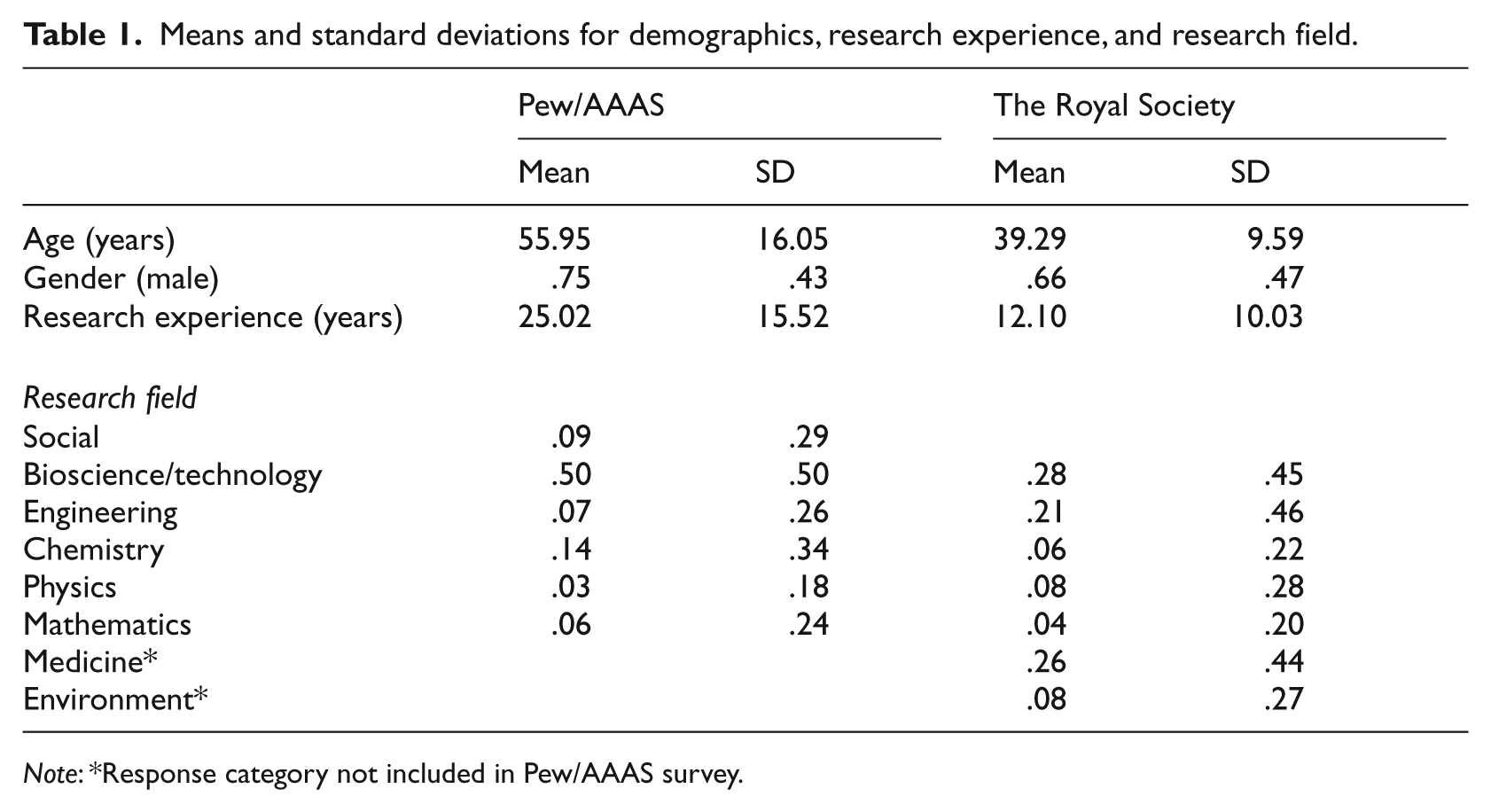
Note: *Response category not included in Pew/AAAS survey.
A number of additional variables are also included in the analysis with full question wording provided in Appendix Table A1 (see Online Appendix). These include a control variable related to views about government that consists of four questions. These were summed together to create a scale, although the reliability for the scale is somewhat low (DeVellis, 2003). Also in Appendix Table A1 are questions used as single-item independent variables that relate to views about the place of science in society (H3), including how respondents feel about citizens’ capacity to understand scientific topics on the public agenda (i.e., deficit model thinking). A four-item measure meant to assess views about the news media can also be found in Appendix Table A1. These questions were asked using two different response scales and were therefore standardized prior to be being summed to give each variable equal weight. The focus on media performance is also relevant to H3. The Pew/AAAS data do not have any questions that relate to willingness to engage (H2 and H3), or perceived institutional support (H4).
The four dependent variables created using the Pew/AAAS data are described in Table 2. These include questions assessing the degree to which respondents have heard about public meetings designed to discuss science and, for those who have heard about such meetings, their perceived usefulness. Also included are questions asking about frequency of science-oriented interaction with “non-scientists” and “reporters.” Usefulness is measured with a four-item scale, while the other three dependent variables are assessed using single-item measures.
Means and standard deviations for dependent variables (Pew/AAAS).

Notes: a The original question used a 4-point scale where 1 = “A lot,” 2 = “Some,” 3 = “Not too much,” and 4 = “Nothing at all.” The scale was reversed for analysis.
All questions used a 3-point scale. Range from 1 (“not useful”) to 3 (“very useful”). Variables were summed to create a measure of town hall meeting perceptions. Only those who indicated that they had heard about such meetings were asked question. Range: 4–12.
This question used a 4-point scale from 1 (“never”) to 4 (“often”).
Study 1: Results
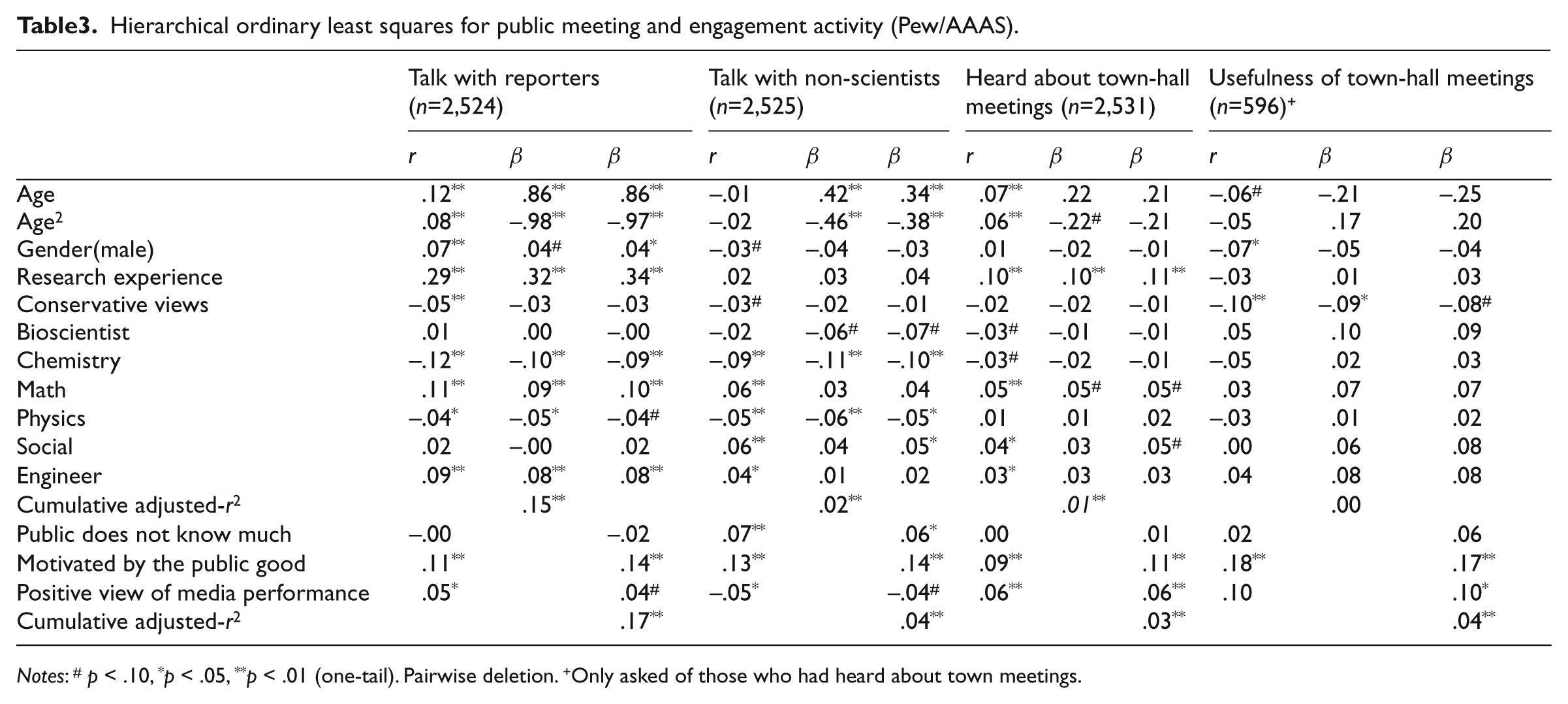
The results from the Pew/AAAS data are primarily interesting to the degree that few of the available predictors identified in past research provide explanatory power. The most variance explained for any of the potential dependent variables is 17%, although most are lower (Table 3). Models for the four dependent variables are described in turn.
Hierarchical ordinary least squares for public meeting and engagement activity (Pew/AAAS).
Notes: # p < .10, *p < .05, **p < .01 (one-tail). Pairwise deletion. +Only asked of those who had heard about town meetings.
Demographically, it appears that talking to the media is done primarily by those in the middle of their career (as denoted by the curvilinear relationship), men, and those with more research experience. A focus on chemistry (including chemical engineering) is associated with less overall media interaction while those involved in math and engineering are more likely to report talking to the media (RQ1). Together, these variables explain 15% of the underlying variance. The second block of variables adds an additional 2% of explained variance but the only significant relationship is related to reporting that one has pursued a scientific career to advance the public good (H3). While views about the quality of media reporting are significant at the bivariate level, this relationship is only marginally significant after controls (H3).
Experience talking to the public has a similar pattern of results. Those in the mid-career range are more likely to engage with the public while those involved in chemistry or physics are less likely to do so. Math, engineering and social science are correlated with engagement at the bivariate level but only social science remains significant in the final model (RQ1). The initial blocks again, however, explain only 2% of the variance in engagement behavior and the addition of the second block adds only an additional 2%. To the extent that a scientist “seeks to advance the public good,” this outlook is again positively associated with public engagement (H3). Deficit model thinking – the belief that a lack of public knowledge hurts science – is weakly associated with additional engagement behavior (H3).
The model predicting the degree to which scientists have heard about public meetings aimed at bringing scientists and the public together is the least explanatory of those presented, explaining just 3% of the overall variance. Years of research experience and being involved in either a mathematical or social science field are weakly predictive of having heard of public meetings but the overall block just 1% of overall variance (RQ1). Those scientists who report seeking to advance the public good and those who hold a positive view of media performance are more likely to have heard about public meeting-related activities (H3).
Among those who have heard about public meetings, only the desire to pursue the public good and a positive view of media performance predict (H3). More conservative-leaning scientists see such events as less useful, but only marginally. Men also saw such events as less useful, but only at the bivariate level. More conservative-leaning scientists see such events as less useful, but only marginally. Men also saw such events as less useful, but only at the bivariate level. The final model explains just 4% of the overall variance in views about public meetings.
Study 1: Discussion
The fact that the variables available in the Pew/AAAS are relatively poor predictors of media and public engagement behavior and related views may indicate how little we know about this subject. Nevertheless, the data suggest that a scientist’s disciplinary field is only weakly related to engagement (RQ1). Age was a somewhat important variable in predicting actual behavior but, ultimately, what mattered across the models was scientists’ intrinsic motivation for choosing a scientific career. It may also be that the design of the Pew/AAAS survey – which includes few opportunities for the creation of multiple-item indicators along with the use of questions with few response categories – dampens the explanatory capacity of the specified regression models.
Study 2: Measurement
The Royal Society data include a broader range of measures suitable for testing the hypotheses and research question laid out above. Table 1 includes relevant demographic information, including sub-field (RQ1). One key difference is that inspection of the relationships between the independent and dependent variables suggested no reason to square the age variable.
Several measures are available to test this study’s hypotheses. Full question wording and descriptive statistics are available in Appendix Table A2 (see Online Appendix). Generally, single-item measures assessed respondents’ views about the ease of becoming engaged with the public as well as their personal capacity to do so. Both of these items reflect aspects of internal efficacy (H1). An additional multi-item measure of the degree to which respondents feel that their organizational or institutional setting supports, encourages, and funds engagement activities is also relevant to internal efficacy (H1). Other questions included in the survey provide assessments of views about engagement (H3), including a three-item measure of the degree to which respondents feel that they will receive personal benefits from engagement and the degree to which they view engagement as “someone else’s job.” The scale reliability for this two-item measure is not unexpectedly relatively low (r = .31, p = .00). Two final variables were created to assess the degree to which the respondent felt that a more supportive environment would lead to more engagement activity (H4). A single-item measure addressed the potential role of supervisor support while a two-item measure addressed funding support.
Table 4 includes single-item and multi-item measures used as both independent and dependent variables. The single-item measures involve assessment of both perceived importance of engagement and willingness to engage. As independent variables, these variables were seen as providing evidence about overall views of engagement (H3). The multi-item measures were also used as both independent and dependent variables. These include one for views about importance of engaging the public via the media (H3) and one for actual engagement (H2). Both have relatively strong reliability but it is noteworthy that the engagement variable includes a combination of questions about both mediated and direct engagement. These four variables were used for both independent and dependent variables because each appeared to have the potential to impact the other. For example, actual engagement is included as the final variable of interest but it also has the potential to impact views about engagement and so is included in the previous models.
Means and standard deviations for dependent variables (Royal Society).
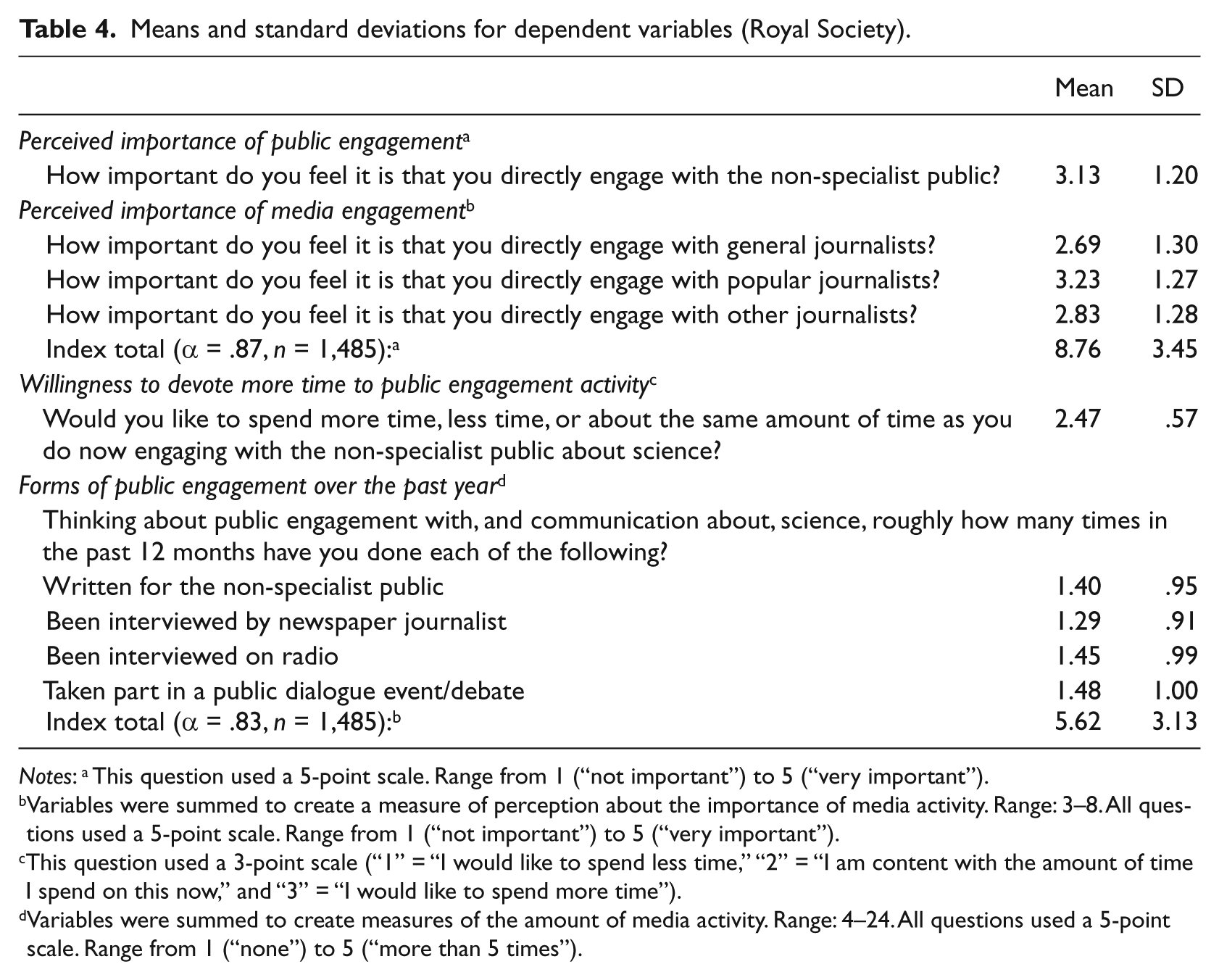
Notes: a This question used a 5-point scale. Range from 1 (“not important”) to 5 (“very important”).
Variables were summed to create a measure of perception about the importance of media activity. Range: 3–8. All questions used a 5-point scale. Range from 1 (“not important”) to 5 (“very important”).
This question used a 3-point scale (“1” = “I would like to spend less time,” “2” = “I am content with the amount of time I spend on this now,” and “3” = “I would like to spend more time”).
Variables were summed to create measures of the amount of media activity. Range: 4–24. All questions used a 5-point scale. Range from 1 (“none”) to 5 (“more than 5 times”).
Study 2: Results
The Royal Society data allowed for dependent variables about the importance of engagement with the news media, the importance of public engagement, willingness to engage and actual engagement. Each of these is addressed in turn and summarized in Table 5.
Hierarchical ordinary least squares for engagement importance and willingness, and media importance and activity (Royal Society).
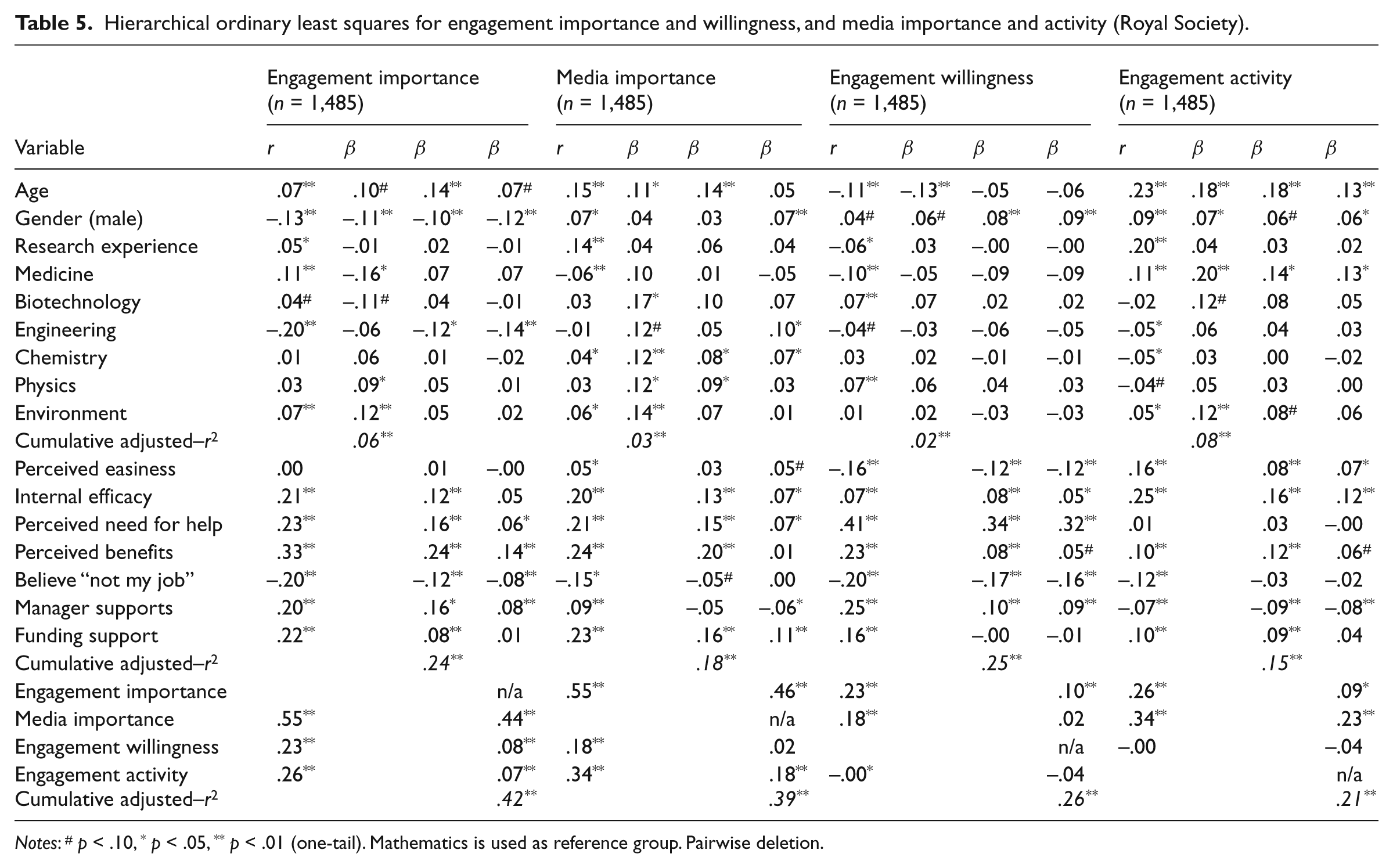
Notes: # p < .10, * p < .05, ** p < .01 (one-tail). Mathematics is used as reference group. Pairwise deletion.
Demographically, the data suggest that women see the most value in public engagement. In terms of field, engineers are less likely to perceive the importance of engagement (RQ1). Believing that scientists need help to engage and believing that engagement provides individual benefits to the researcher are also associated with more positive views (all H1). Seeing engagement as someone else’s job was associated with less positive views while viewing media engagement as important, being willing to engage (all H3) and actual engagement (H2) are all predictive of how important scientists consider such activities to be. Both measures of desired institutional support – managerial support and funding support – are initially significant but only managerial support remains significant in the final model. The overall model explains about 42% of the variance specific to favorable views about engagement. The numerous changes in the significance in variables between blocks suggests the possibility of mediation.
Turning to views about the importance of media engagement, men, engineers and those involved in chemistry appear to see such engagement as relatively more important. Similarly, feeling that support should be provided for engagement (all H1) is associated with seeing value in media engagement (H3). The perceived ease of engagement (H1), and a sense that others should engage (H3) are not substantially associated with views about the importance of engaging with the news media. The perceived need for more managerial support is negatively associated with viewing the news media as important. In contrast, the belief that funding support is available is positively related to news media views (both H4). Together, the variables in the model account for about 39% of the variance. The decline of the significance in several variables between blocks again suggests the possibility of future research focused on mediation.
For willingness to engage, men appear to be more amenable to spending additional time interacting with the public (RQ1). Viewing engagement as less easy (H1) and preferring that others be responsible for engagement (H3) are associated with less willingness to engage. Those who feel personally equipped to engage and those who believe support needs to be provided for engagement (both H3) are more willing to engage. Those who feel they would benefit from more managerial support are also more willing to engage (H4). Viewing engagement as important (H3) is associated with greater willingness to engage. The model explains about 26% of engagement willingness. In this case, the estimates stay relatively stable with the addition of each new block, suggesting limited mediation.
Finally, older respondents, men and those involved in medicine are more likely to have actually engaged (RQ1). Other significant predictors include a sense that talking with journalists is relatively easy and those who feel more skilled at engagement are also more likely to engage (H1). Those who say they would benefit from more managerial support were somewhat less likely to have engaged (H4). Perceptions about the importance of both public and media engagement are positive predictors of actual engagement. This model explains about 21% of views about the actual engagement. The relative stability of the estimates suggests little mediation for most variables except the one dealing with personal benefits.
Study 2: Discussion
As with the Pew analyses, demographic factors, including sub-field (RQ1), are inconsistently associated with views about engagement. It is noteworthy, however, that female scientists appear to believe that engagement is more important than men, but male scientists appear to be more willing to engage and more likely to engage. The reason for this difference – whether it is something to do with resources such as time or personality factors – deserves additional attention. Also noteworthy is the degree to which scientists’ views about the relative ease of engaging, the capacity to engage and views about organizational support (all H1) all matter. The fact that these efficacy variables predict willingness to engage and actual engagement, but not belief that engagement is important, points to the value of developing individual and institutional capacity to help facilitate engagement and outreach among scientists. The impact of views about the value of engagement on their careers (H3) suggests that we also need to more clearly value service to society if we want scientists to engage in outreach. This issue is raised in more detail below. Finally, the finding that belief in the need for more managerial support is associated with a greater sense of the importance of public engagement – but not media engagement – may reflect the fact that those who see the value of engaging through the media feel like they are able to do so on their own, and/or that their organization already supports such activities, or that media engagement requires less time or effort. In other words, it may be that respondents felt that where they really need their manager’s support is when they seek to participate in face-to-face forms of engagement with the public. The further finding that belief in the need for managerial support is associated with a greater willingness to engage but less actual engagement highlights the potential barrier that some institutional factors may pose. While the overall size of the relationships between these variables is small, further research might be helpful to explore how individuals interpret messages about engagement from both supervisors and broader communities such as funding agencies, academic societies, and their professional peers.
3. Overall discussion and conclusions
Our analysis used the best available recent surveys of scientists to model and predict attitudes and behaviors related to forms of media and public engagement. Overall, the research suggests that sub-field (RQ1) and demographic factors such as gender and age are relatively minor predictors of such engagement and instead points to the importance of more proximate variables related to how scientists view the act of engagement itself (H1–H4). The Pew/AAAS data, for example, point to the importance of scientists’ belief in the role of science in promoting the public good (H3), while the Royal Society data emphasize factors associated with scientists’ capacity to engage, whether it is their personal capacity or their institutional context (H1 and H4). The Royal Society data also provide evidence that scientists make assessments about what will benefit their own careers when deciding how to behave (H3). Overall, our analysis provides quantitative evidence that, if the goal is to increase and improve the media and public outreach activities of scientists, more research is needed on how individual- and organizational-level factors shape the views and behaviors of scientists. This research can then be used to develop programs and resources that motivate and enable scientists to participate in civic life.
Practically, this might involve efforts to improve internal efficacy through training and efforts to provide real support for engagement endeavors through the various funding programs on which scientists currently rely. The Pew/AAAS data also point to the potential value of identifying scientists who are primarily motivated by doing science that serves the public good. In the U.S. setting especially, it is important to also recruit scientists who hold a diversity of political views and outlooks (Besley and Nisbet, in press). The role of perceived importance suggests we also need to find ways to demonstrate that engagement is valued by those who fund scientists and those who make decisions about their career advancement.
With regard to future research, the task of putting together coherent models using the Pew/AAAS and Royal Society data was made difficult by the fact that the measures available do not seem to readily fit within any theoretical framework aimed at predicting behavior. The data sets provide fascinating descriptive details about scientists’ views but it seems reasonable to expect a more strategic selection of variables in future research. Indeed, the cost of data collection, the difficulty of surveying these types of specialized samples, and contemporary scholarly interest in the views and behavior of scientists around engagement all suggest additional care should be made to make future data even more valuable. Poliakoff and Webb (2007) showed that the Theory of Planned Behavior model, for example, offers a valuable conceptual framework for thinking about engagement but other models might also be relevant, including past research on why individuals more generally become involved in civic activities (Scheufele, Nisbet and Brossard, 2003). Just as communication scholars conduct regular surveys of journalists (Weaver, 2007), it may be time for systematic surveys of scientists as well as other groups of professional experts such as economists or public health officials who are often called upon to engage the public. The AAAS, the Royal Society, and other leading professional societies are potential key actors in any such development in research. The use of common design, models and measurement would also allow for meaningful country-level comparisons, something that was not possible here. Finally, as with most studies on engagement, the correlational nature of the current data means that it was not possible to make statements about causation and, as such, we further look forward to research that might seek to track a panel of scientists over time. Such a design might allow for substantial insight into the dynamics of how attitudes and behavior associated with public engagement develop and shift over a scientific career.
Footnotes
Funding
This research received no specific grant from any funding agency in the public, commercial, or not-for-profit sectors.
Author biographies
References
Supplementary Material
Please find the following supplemental material available below.
For Open Access articles published under a Creative Commons License, all supplemental material carries the same license as the article it is associated with.
For non-Open Access articles published, all supplemental material carries a non-exclusive license, and permission requests for re-use of supplemental material or any part of supplemental material shall be sent directly to the copyright owner as specified in the copyright notice associated with the article.
