




Abstract
This research reports on rural people’s beliefs and understandings of climate change in the Saurastra/Kutch region of Western India. Results suggest that although most rural respondents have not heard about the scientific concept of climate change, they have detected changes in the climate. They appear to hold divergent understandings about climate change and have different priorities for causes and solutions. Many respondents appear to base their understandings of climate change upon a mix of ideas drawn from various sources and rely on different kinds of reasoning in relation to both causes of and solutions to climate change to those used by scientists. Environmental conditions were found to influence individuals’ understanding of climate change, while demographic factors were not. The results suggest a need to learn more about people’s conceptual models and understandings of climate change and a need to include local climate research in communication efforts.
Keywords
1. Introduction
Scientific knowledge and understanding of climate change 1 has increased significantly in the last two decades. Similarly there is also an increase in media coverage, government policies and actions about climate change. However, despite growing media attention, findings from recent studies conclude that there is considerable misunderstanding regarding the issue of global climate change among the public, with less concern with taking any action (Leiserowitz et al., 2010; Lorenzoni and Pidgeon, 2006; Reynolds et al., 2010). Researchers mention that the societal response to climate change depends on individuals’ understanding (Bostrom et al., 1994). Some scholars suggest providing more information and education to overcome such misunderstanding, so as to encourage societal response to climate change (Bord et al., 2000; Lorenzoni et al., 2007). However, recent research suggests that additional information is not necessary to increase public understanding, concern or action with respect to global climate change (Bulkeley, 2000; Kellstedt et al., 2008). Scholars have examined public understanding of climate change which draws on and is mediated by local knowledge, values, moral responsibilities (Bulkeley, 2000), lay interest, beliefs (Zehr, 2000), and social trust (Lorenzoni and Pidgeon, 2006; Priest, 2001). They conclude that public understanding of climate change does not rely only on external sources of information but that it is filtered through people’s experience and their interactions with the local environment (Bulkeley, 2000; Lorenzoni and Pidgeon, 2006). People can draw knowledge from personal experience and others’ experience through social networks such as peers, family and friends, media, movies, and books (Moser, 2010; Nisbet, 2009; Stamm et al., 2000).
We have a growing literature on rural understanding of climate change (Byg and Salick, 2009; Crate and Nuttall, 2009; Deressa et al., 2009; Mortreux and Barnett, 2009; Petheram et al., 2010; Roncoli et al., 2002) but it is a little studied subject in India with only a handful of studies available (Sarkar and Padaria, 2010; Vedwan and Rhoades, 2001). This is an unfortunate condition given India’s vulnerability to climate change, its largely rural population, and the high level of cultural diversity which makes it impossible for any one study to portray India’s perception of climate change as a whole. India is frequently covered in global polls on environmental attitude or climate change, but the majority of such polls are disproportionately focused on urban populations (Beck, 1996; PEW Global Attitudes Project, 2007, 2009; World Bank, 2010). India is primarily a rural country with almost 70% of its population still living in rural areas (United Nations, 2010); hence a greater understanding of rural perspectives is important for the success of government actions. The primary objectives of this research are to assess public understanding of climate change in rural Saurastra and Kutch, and to determine the extent that this understanding is consistent or inconsistent with scientific views on this topic.
Studies indicate that a large majority of the respondents in developed countries have heard about global warming, while awareness remains low in developing countries, especially in rural parts of India (Leiserowitz, 2007). Some studies reveal that awareness about climate change may have increased, but public understanding varies tremendously and is different from that of scientists and policy makers (Brechin, 2003). In a recent poll undertaken by the British Broadcasting Corporation (BBC) World Service (2007) across 21 countries, more than two thirds of all respondents were found to believe that “human activity is a significant cause of global warming” (ranging between 66% and 94%), with the exception of India where only 47% of respondents agreed with this statement (WorldPublicOpinion.org, 2007). A recent study in Tibet indicates that people in the study villages were not aware of the global phenomenon of climate change and they assumed the changes were local. However, the majority of respondents had a strong belief that human actions are the root cause of climate change, directly or indirectly by angering or weakening gods or deities (Byg and Salick, 2009). Similarly, the study undertaken by Sarkar and Padaria (2010) in West Bengal, India indicates that most respondents considered rapid industrialization as the major cause of climate change.
Analysis of cross-country polls suggests that the public have radically different views of climate change from scientific views of the subject (Brechin, 2003; World Bank, 2010). Lorenzoni and Pidgeon (2006) reported that the public in the US and Europe have a limited understanding of the causes of, and solutions to climate change. Many respondents (42%) in India identified a loss of forests as the main cause of climate change (Leiserowitz, 2007). In an anthropological study in northeastern Siberia, elderly people also associated natural causes such as the “changing direction of the earth” and “breaking of the atmosphere by rockets and bombs” with climate change (Crate, 2008). People in the US and UK believed reducing deforestation, less air pollution, use of renewable energy, and driving less would help tackle the issue of climate change (Bensch, 2008; Bibbings, 2004; Bostrom et al., 1994; Kempton, 1997; Leiserowitz et al., 2010). Other studies indicate that people often conflate concepts of climate and weather, and misunderstand ozone depletion as the cause of global warming (Bell, 1994; Bostrom et al., 1994; Bulkeley, 2000; Scottish Executive Social Research, 2005).
Some researchers have concluded that an accurate understanding of climate change is a primary requirement for developing attitudes and behavior conducive to making informed decisions with respect to solutions, and to scientific and policy matters related to climate change (Bord et al., 2000; Dunlap, 1998). In supplementing this conclusion, they suggest providing more information to the public to improve understanding of the issue. However, others have examined public understandings which do not rely only on scientific information, but also on local knowledge, values and moral responsibilities (Bulkeley, 2000; Lorenzoni and Pidgeon, 2006). Beck (1996) suggests that public understanding of environmental issues should take into consideration social and institutional contexts. So in order to make people more aware of the scientific concepts of climate change and engage them in action for its solution, it is necessary that we should have comprehensive understanding of people’s beliefs about climate change and how this understanding is formulated and built on. This research aims to increase our understanding about rural people’s perspectives of climate change in Saurastra and Kutch of Western India.
2. Methodological approach
A quantitative survey-based methodology, supplemented by a small number of qualitative interviews was used to collect the data. The questionnaire was piloted with three people among residents of the study area. In total, 447 questionnaire surveys and six qualitative interviews were administered during June to August 2008 in 16 villages across the eight districts of the Saurastra and Kutch region in the Gujarat state of Western India. Multistage random sampling was used for selection of survey respondents. The primary sampling unit of the research was eight districts of the Saurastra and Kutch peninsula. We randomly selected two blocks (tehsils) within each district which served as the secondary sampling unit. In the second stage, one village was selected randomly for each selected block. Thus, a total of 16 villages were selected randomly across the Saurastra and Kutch peninsula. In the final stage, household population frames were developed for each selected village and ten percent of households were selected randomly as potential respondents. On average, the survey respondents were 45 years old, age ranging from a minimum of 20 years to a maximum of 85 years. The majority of respondents were illiterate to semi-literate. Respondents’ average land holding was 8.08 acres, varying from nil to a maximum of 70 acres, and the mean annual income was Rs. 101040.00 ($2062.00). 2
Qualitative interviews were administrated by convenience sampling by spontaneously asking any one person from the survey village. Both questionnaire surveys and qualitative interviews were administered in the local Gujarati language and then information was translated into English for further analysis.
Measures
The questionnaire consisted of five parts. The first part assessed familiarity with the concepts of climate change. It consisted of three questions: 1. “Have you heard or read anything about global climate change?” 2. “What do you mean by climate change?” 3. “Do you think that your local climate has changed significantly or is changing?” Questions 1 and 3 were measured using “Yes” and “No” boxes to be checked by respondents, while question 2 was an open answer question. We used the English phrase “global climate change” as well as the local Gujarati language phrase “abohava badlav” while investigating people’s familiarity with global climate change. The majority of survey respondents tended to conflate important concepts of weather and climate in response to the question “What do you mean by climate change?” To avoid this conflation we rephrased the question using local context such as age. We rephrased it as “Have you observed any change in your climate that you can recall in your memory from a young age to today? If yes, then what changes have you seen/observed in your climate since your childhood?” Responses for the rephrased question were recorded for data analysis.
The second part assessed knowledge and/or understanding of climate change. It was assessed by seven true and one false statements relating to physical causes and eight true and two false statements relating to mitigation measures of climate change. Respondents were also presented with an open answer question “other” to identify any other causes or mitigation measures associated with climate change. These statements were based on expert reports such as the fourth report of the Intergovernmental Panel on Climate Change (IPCC) and the climate change expert model developed by Morgan et al. (2002). Each statement was measured on a binary scale of “Yes” (1) for agreement, otherwise “No” (0) for disagreement with the statement. Furthermore respondents were asked to select a statement from each set of physical causes and mitigation measures to assess their belief about the most important cause and mitigation measure of climate change to them.
The third part assessed respondents’ perspectives about impacts of climate change. It consisted of six open-ended questions asking respondents to describe their experience and observations of impacts of climate change on each of the following components: the plants and ecosystem, agriculture, cattle, human health, property, and any other impacts. Responses were assigned to different impact categories and frequency analysis was performed for each component to understand people’s perspectives about impacts of climate change.
The fourth and fifth parts of the questionnaire assessed respondents’ risk perception of and adaptation responses to climate change. Those parts are not reported in this article.
There were seven demographic questions concerning respondents’ gender, age, income, land holding, level of education, “off farm” income if any, and membership in any village institution. Respondents’ age, income, and size of land holding were measured in actual values as continuous variables. The level of education was measured on a five-point scale ranging from illiterate to Master’s degree and higher education.
Statistical analysis
Questionnaire data were analyzed using the SAS version 9.2 statistical software. The respondents’ agreement/disagreement with knowledge statements was grouped into a knowledge index by averaging scores for all the statements in the study. The scores for false statements were reversed for statistical analysis. The knowledge index was tested for reliability and consistency using Cronbach’s alpha analysis. Owing to inconsistent responses, two statements were excluded from the analysis. Villages were assigned to environmental area categories consisting of cyclone prone, drought prone, and normal 3 areas. We used maps and other information from government departments of the Gujarat state to classify the study area into the above-mentioned three categories. For each demographic domain and environmental condition, a mean value of knowledge index was calculated. ANOVA and regression analysis were performed for dependent variable knowledge index with independent demographic and environmental area variables. Frequency analysis was done for climate change impact categories, familiarity with climate change, and parameters of climate change as identified by respondents. We transformed some continuous variables such as age, income, land holdings, and knowledge index into categorical variables for frequency and descriptive analysis to enable easy understanding of the results. Original variables were used for correlation, regression, and all other analysis. Open source software “Weft QDA” was used for thematic analysis of qualitative interviews. The qualitative data were used to explore people’s understanding and meanings associated with key words.
3. Results
Familiarity with the concept of climate change
This study investigated whether survey respondents had heard or read anything about scientific theories of global climate change. Survey results revealed that only 33.1% of the total respondents had heard about the scientific concept of global climate change. More respondents in “cyclone prone” areas (36.51%) and “drought prone” areas (38.89%) had heard or read about global climate change than people living in “normal” environmental areas (24.53%) (χ2 (2 N = 447) = 8.39, p = 0.015). Significant differences were also observed between different age groups (χ2 (3 N = 447) = 17.87, p = 0.0007) and levels of education (χ2 (4 N = 447) = 31.86, p ≤ 0.001). Familiarity with the scientific concept of climate change was found to increase with levels of education, and decrease with age. Although the majority of survey respondents had not heard or read about global climate change, they believed that their climate has changed or is changing.
Misunderstanding of concepts associated with climate change
Initially, the majority of survey respondents tended to conflate important concepts of weather and climate, but then later on they clearly made the distinction between weather and climate in response to rephrased questions. Respondents were able to detect changes in climatic parameters. Based on their experience and observations, the majority of respondents (92.62%) identified increase in temperature over the years as the most common change in climate they had observed, followed by an increase in rainfall (24.38%) or uncertainty of rainfall (12.98%). The analysis of qualitative interviews further revealed that participants also identified micro level changes in cyclic patterns of rainfall as well as irregularity and changes in intensity of rainfall. A small percentage of respondents also associated an increase in wind speed (3.58%), increase in pollution level (1.34%), increase in uncertainty/irregularity of rainfall (12.98%), and increased intensity of rainfall (1.57%) with climate change.
Views about climate change
Even though the majority of respondents have not heard about scientific concepts related to climate change, they believed that their climate has changed significantly or is changing. Survey results reveal that the majority of respondents believed human activities are the root of climate change. When “strong believers” and “somewhat believers” are combined together, more than 97 percent of respondents believed that human activities including industry and transportation are responsible for their climate changes. Qualitative interviews, although few in number, also indicated that participants supported the scientific view that climate change is anthropogenic. Interviewees also considered population increase and human activities such as deforestation, industrial activities or increased numbers of vehicles as drivers of climate change. They consider human selfishness as the primary reason for climate change.
Knowledge and understanding
Our results suggest that respondents’ beliefs about causes and mitigation measures of climate change (M = 0.80, SD = 0.14) are in accordance with scientific views. The majority of respondents hold a good (29.31%) to a very good understanding (67.11%) about causes and mitigation measures of climate change
One-way analysis of variance for the knowledge index (Table 1) suggests that there are significant differences in levels of understanding among residents of different environmental areas (F(2, 435) = 4.01, p = 0.018). Post hoc analysis using Tukey’s criterion for significance indicated that residents of drought prone areas possess significantly more understanding about causes and mitigation measures of climate change (M = 0.82, SD = 0.16) than residents of the cyclone prone areas (M = 0.77, SD = 0.14). No significant differences in understanding of climate change were observed among respondents belonging to different levels of education (F(4, 435) = 0.62, p = 0.6453) or respondents’ membership status (F(1, 435) = 0.02, p = 0.8766) in local institutions.
ANOVA for climate change knowledge.
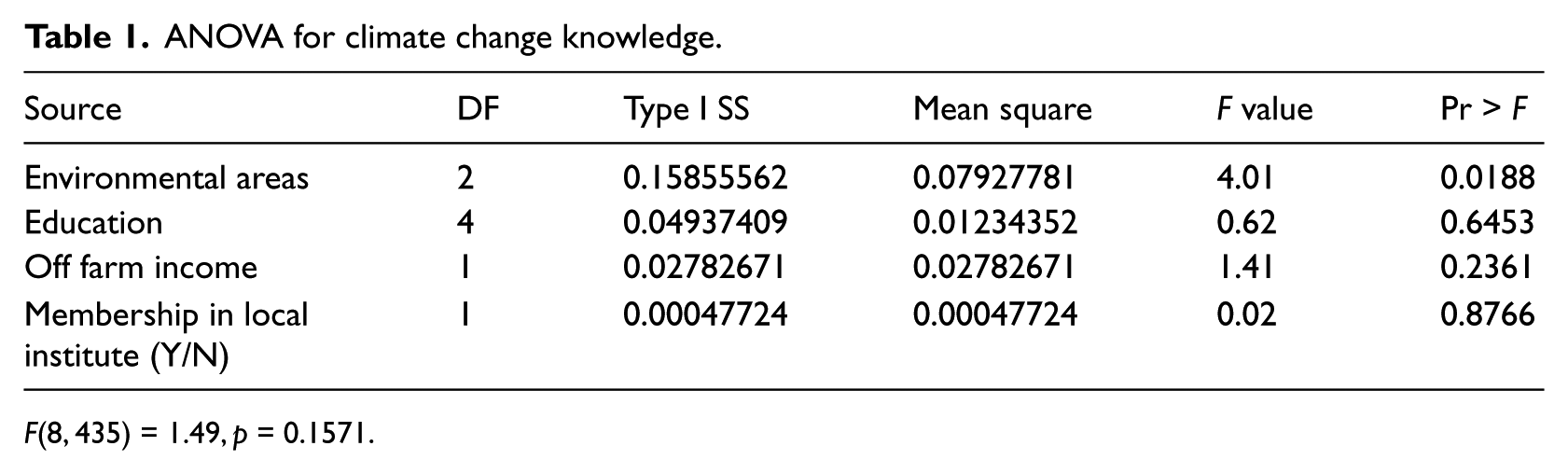
F(8, 435) = 1.49, p = 0.1571.
Bivariate correlations indicated that the correlation between respondents’ understandings about causes and mitigation measures of climate change and demographic factors such as age, level of income, education, and land holding was not significant.
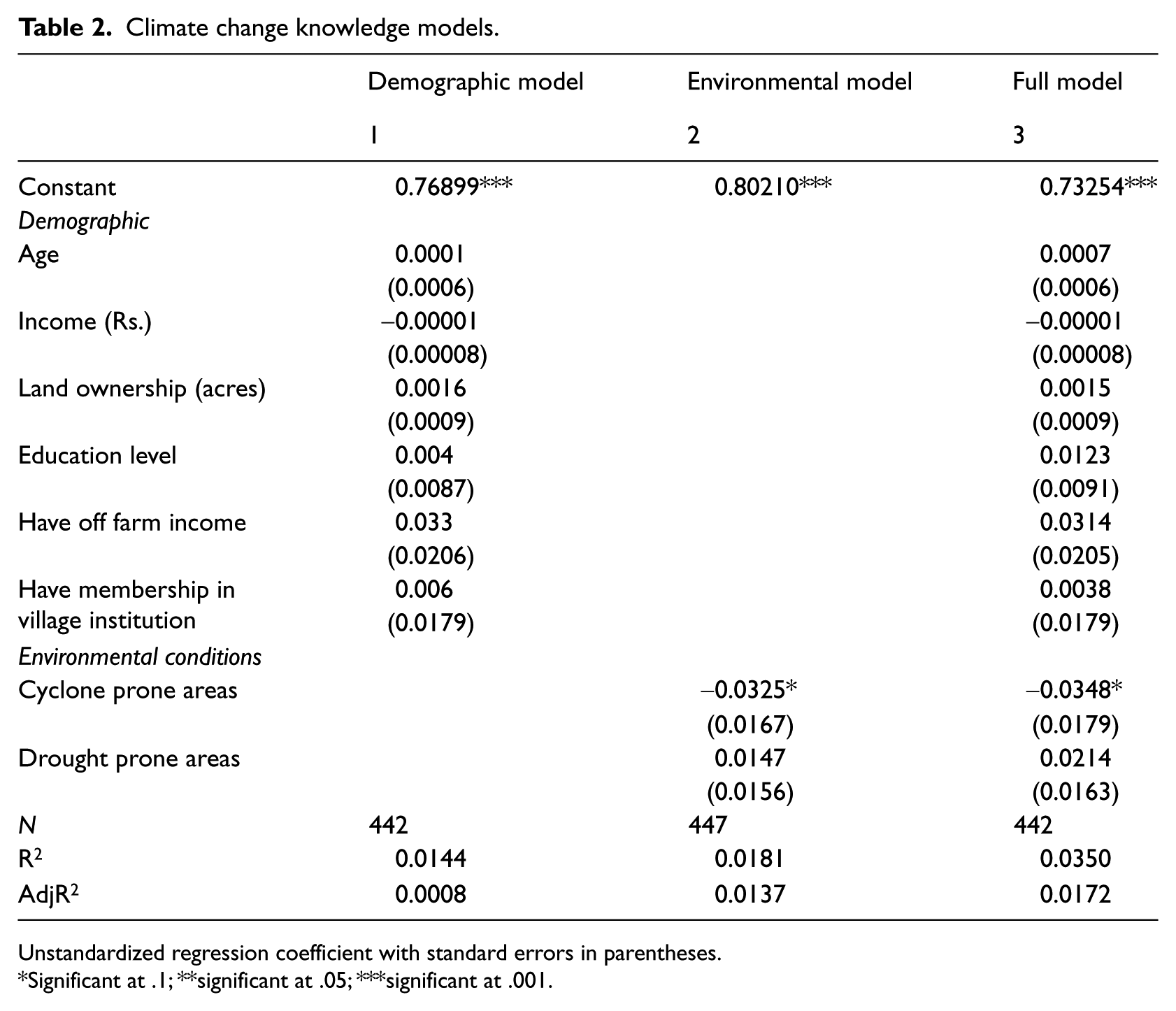
We also regressed the knowledge index with demographic and environmental variables to test if they have any statistically significant impacts on individual understandings of climate change. Table 2 presents three models predicting people’s understanding of climate change. The first model utilized socio-demographic variables, the second only the environmental areas representing different environmental conditions, and the third was a full model with all the variables entered into the first two models.
Climate change knowledge models.
Unstandardized regression coefficient with standard errors in parentheses.
Significant at .1; **significant at .05; ***significant at .001.
The environmental (F(2, 444) = 4.10, p = 0.0172) and full models (F(8, 433) = 1.97, p = 0.0493) were statistically significant at the 0.05% level of significance while, the demographic model failed to meet requirements for statistical significance. The demographic variables accounted for only 1 percent of the variance (R2 = 0.0144, F(6, 435) = 1.06, p = 0.3872) in model 1. No demographic variable was statistically significant at explaining individual understandings of climate change.
Environmental condition variables explained only 2 percent of the variance (R2 = 0.0181, F(2, 444) = 4.10, p = 0.0172) in model 2. When the environmental condition variables were entered into the demographic model, the explained variance (model 3) increased only by 2% (R2 = 0.0350, F(8, 433) = 1.97, p = 0.0493). Both “cyclone prone” and “drought prone” environmental conditions were not statistically significant in either model at the 0.05 level of significance. However, the “cyclone prone” condition was significant at the 0.1 level of significance in both models (model 2 and model 3). Test statistics for regression coefficients revealed that the difference in the understanding of climate change causes and mitigation measures was statistically significant between respondents of “cyclone prone” and “drought prone” areas (F(2, 433) = 4.63, p = 0.0102). Interestingly, a person living in “cyclone prone” areas possessed lower levels of understanding (β = -0.0348, p = 0.0527), whereas a person living in “drought prone” areas possessed higher levels of understanding of climate change causes and mitigation measures. This suggests that environmental conditions influence an individual’s understanding of climate change.
Causes
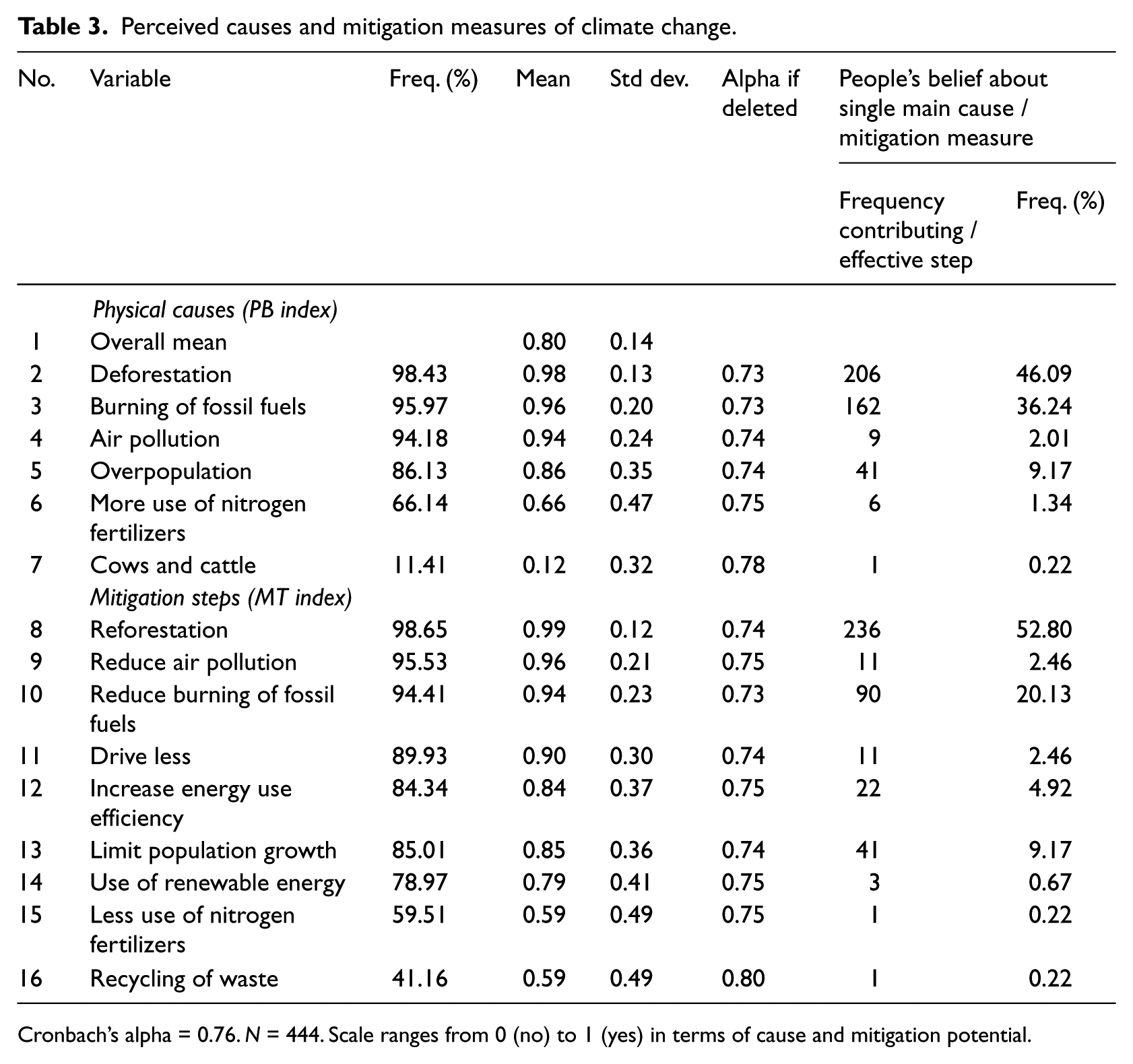
Quantitative analysis revealed that people’s understandings of physical causes of climate change (M = 0.75, SD = 0.15) in rural Saurastra and Kutch were in accordance with scientific views. The majority of respondents considered almost all factors within the survey as contributors (M = 0.98 to 0.66, SD = .47 to .13, Table 3, points 1 to 7) except cattle (M = .12, SD =0.32). Though cattle are one of the important contributors to greenhouse gas (GHG) production, the majority of respondents (88.59%) do not think of them as a cause of climate change. Some respondents also mentioned other causes such as increased use of pesticides, brick furnaces, nuclear experiments in soil, increased use of technology, coal mining, modern life style, decreased use of organic fertilizers, and increased use of plastic.
Perceived causes and mitigation measures of climate change.
Cronbach’s alpha = 0.76. N = 444. Scale ranges from 0 (no) to 1 (yes) in terms of cause and mitigation potential.
Survey respondents were further asked to select one from the above seven factors which they consider as the main factor that contributes to climate change. Frequency analysis presented in Table 3 shows that deforestation was the main contributing factor for the majority of respondents (46.09%) in Saurastra and Kutch, followed by the burning of fossil fuels (36.24%) and overpopulation (9.17%). Interestingly, more than 94 percent of respondents regarded air pollution as one of the contributors to climate change, but only 2 percent considered it as the most effective contributor.
Some interview participants associated a few cultural aspects with climate change. Interview participants mentioned bad karma, human nature and thoughts or “God knows” as other reasons for climate change. The following example demonstrates interviewees’ association of cultural aspects with causes of climate change.
God knows what the reason is. We do not understand whether it is a Kaliyug [a mythological time period in which bad things happen because of unruly behaviors of humans] or a sign of downfall. (Farmer from drought prone area, July 2008)
Mitigation
Again, the MT index (mitigation measure index) in Table 3 reveals that, to a large extent, people’s understandings about mitigation measures of climate change (M = 0.83, SD = 0.15) were in accordance with scientific views. The majority of respondents chose almost all steps in the survey as mitigation measures (M = 0.99 to 0.59, SD = 0.49 to 0.12, Table 3, variables 8 to 16), except for the recycling of waste. Scientifically, recycling of waste is not considered a mitigation step and many participants (58.84%) did not choose it either. Other mitigation steps suggested by survey respondents were to stop multinationals operating in the country, reduce the population of Prosopis juliflora tree species, stop desertification, and promote protection of wildlife.
Survey respondents were further asked to select one from the above measures which they consider as the most effective mitigation for climate change. Frequency analysis showed that reforestation was the main effective mitigation measure chosen by the majority of respondents (52.80%) in Saurastra and Kutch, followed by reducing the burning of fossil fuels (20.13%), and then limiting population growth (9.17%).
Although survey respondents and interview participants reported good understanding of the causes and mitigation measures of climate change, their explanations of these causes relied on very different reasoning. Their causations were radically different from scientific views, but culturally intertwined.
Probing 4 in survey interviews also revealed different theories of climate change causations which are at odds with scientific understanding. Survey probing indicates that a few respondents linked overpopulation with human heat. They connected it as “human heat is increasing due to population” or “more population spreads more heat”. Similarly, some respondents connected deforestation with decreased oxygen, the creation of empty space or the destruction of support to prevent the soil from getting heat, and reforestation with increased flow of cold air or absorption of heat by trees. While fewer respondents linked use of nitrogenous fertilizers with the release of hot vapor or heat in the environment. Some survey respondents and interview participants cited light bulbs that emit heat into the atmosphere, so having less lighting from a bulb means less heat.
Different perspectives about causes and mitigation measures of climate change
Quantitative analysis suggests that most people surveyed in Saurastra and Kutch considered deforestation as the main cause of climate change, followed by burning of fossil fuels. Interestingly, many people, irrespective of their belief about the main cause of climate change, see reforestation as the main solution. Many respondents identified burning of fossil fuel as the main cause of climate change but for many of them burning less of it was not a primary solution.
Figure 1 indicates that 30 to 40 percent of respondents in Surendranagar and Rajkot, and 40 to 50 percent of respondents in Jungadh districts (causes map, Figure 1) believed the burning of fossil fuels to be the main contributor to climate change. Contrary to this, fewer than 20 percent of respondents in the same districts considered less burning of fossil fuels as the most effective solution for climate change (solution map, Figure 1). Figure 2 shows a similar but reverse trend of responses for forestation levels as the cause of and the solution to the climate change problem.

People’s responses for fossil fuel as the cause of and solution to climate change.
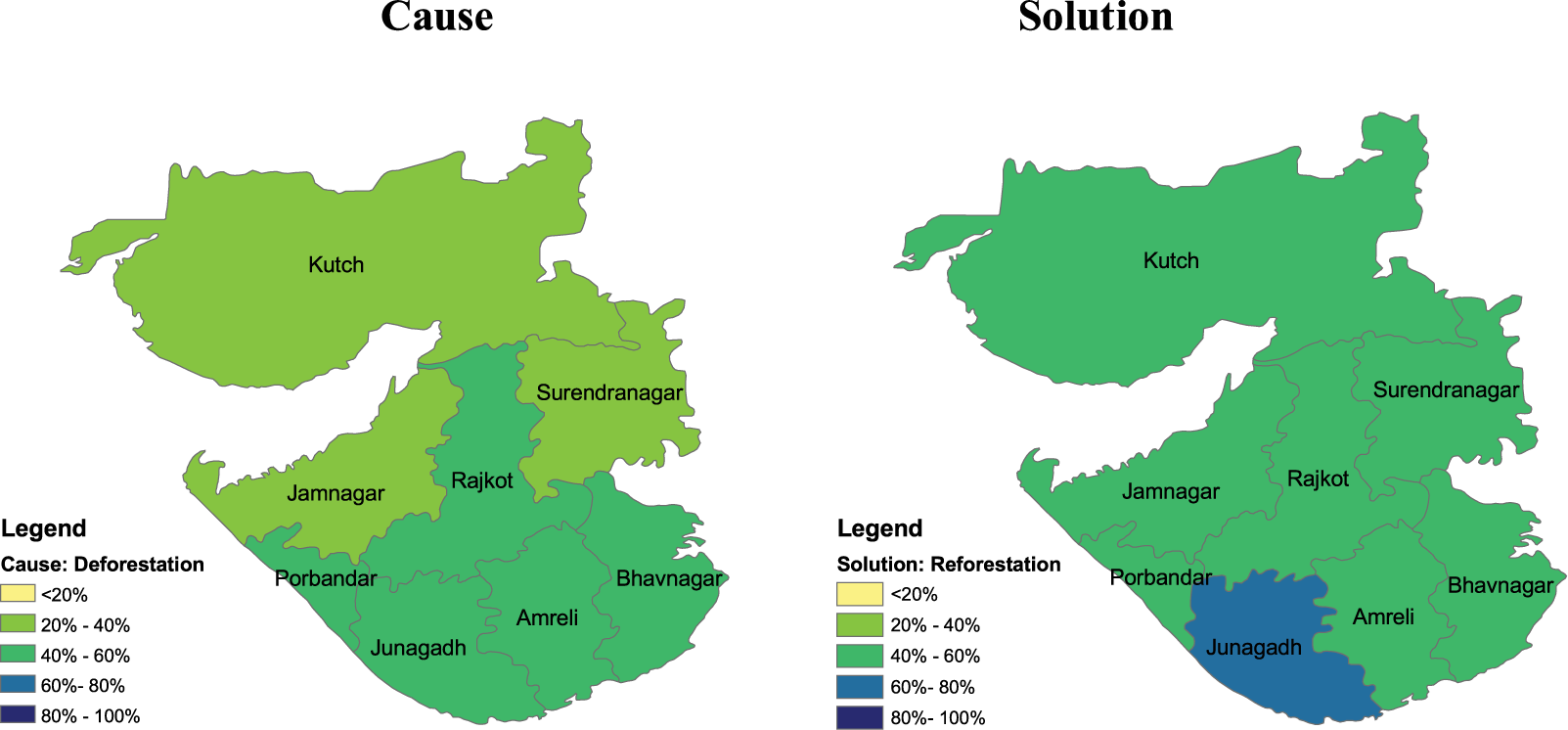
People’s responses for forestation levels as the cause of and solution to climate change.
Impacts
Survey respondents were asked open-ended questions for specific impacts of climate change on trees and vegetation, agriculture, cattle, human health, their properties, and other impacts they could think of. Respondents identified multiple impacts on each item as described below.
Crop wilting (48.31%), crop burning (13.77%), and new or increased crop pests and diseases (15.35%) were the major climate change impacts respondents identified on their agriculture. Respondents associated a decrease in soil fertility and the quality of production as well as an increased requirement for irrigation with changes in climatic conditions.
Similarly, survey respondents also observed some prominent negative impacts of climate change on their cattle such as increased disease (43%), decreased milk production (28%), and a disturbance in conception and deliveries (9%). Other observed impacts included a decrease in work efficiency, cattle anger and violence, cattle looking dizzy, and cattle having decreased food intake. Yet, some respondents (6.15%) plainly denied any impacts on cattle.
The most pronounced impact respondents observed on human health were increased incidences of heart attacks, skin diseases, cancer, and the prevalence of new diseases like dengue fever and chicken guinea (87.47%). Increased weakness and decreased work efficiencies were other observed impacts on human health. Interestingly, respondents associated increase in kidney stone diseases with increase in temperature.
What type of diseases came?
Kidney stone diseases increased.
Is that because of increase in temperature?
Yes, it is and because water became saline. Population increased and it drinks all the water, makes ponds and dams empty. Earlier water was sweet [good quality]. Population was less so use was less. (Farmer from cyclone prone area, June 2008)
Further analysis suggests that the majority of respondents either were not familiar with (51.13%) or did not believe in (13.51%) the impact of climate change on property. Others identified damage to property as a major impact followed by reduced material durability and the development of cracks in roads and buildings. Also, some respondents mentioned water shortages and desertification as other important impacts.
The most important aspect of climate change impacts is that there were no associations of climate change to a sea level rise and non-human nature or ecosystems. Respondents neither believed that a rise in sea level is happening due to climate change nor considered it as a future reality.
4. Discussion
Awareness
Our results indicated that familiarity with the scientific concepts of global climate change in Saurastra and Kutch was very low. This low level of awareness is similar to the finding of Sarkar and Padaria (2010) who reported only 38 percent of respondents have heard about climate change in the West Bengal state of India. However, the result was contradicted with the findings of a study by WorldPublicOpinion.org (2006) which states that majority of the Indian respondents (72%) have heard a great deal or something about global climate change.
Awareness of the scientific concepts of the global climate change phenomenon varied by age, educational level, and spatial differences in the environment. Younger people, those who are educated, and people living in “drought prone” and “cyclone prone” areas were more aware of the global climate change phenomenon than older people, those who are illiterate, and people from normal areas. An opposite trend of awareness was observed for age and education variables. Familiarity with global climate change was found to increase with levels of education, and decrease with age. Hasan and Akhter (2011) reported similar differences in awareness of climate change among different age groups and residents of different environmental areas in Bangladesh. They reported that people who are educated and people who live in environmentally fragile areas that are frequently affected by floods or cyclones are more likely to be aware of climate change than people not having any formal education and people who do not have experience of living in fragile areas.
Although the majority of respondents have not heard or read about scientific theories of global climate change, they believed that their climate has changed significantly. This suggests that the majority of people regard the changes they experienced and observed as local phenomena. Such beliefs about climate change’s happening by the majority of people are also reported by Bulkeley (2000), Byg and Salick (2009), Dunlap (1998), and Kempton et al. (1996).
Initially people tended to conflate seasonal changes in weather parameters with longer-term climate change. However, rephrasing of the question using the local context helped people to process background information and to make a clear distinction between these two concepts. It is obvious that a question framed for one population may not be appropriate for another. Sometimes cultures might not have two distinct words that neatly distinguish between western concepts of climate and weather (Rudiak-Gould, 2012). In the study area, “abohava” and “havaman” are two distinct words to distinguish climate and weather. However, use of the word “abohava” is not common among rural Saurastrians and Kutchies and that might be one of the reasons for people to conflate these two concepts initially. The conflation of climate and weather was also reported in other countries such as the United States and the UK (Henry, 2000; Leiserowitz et al., 2010; Papadimitriou, 2004; Whitmarsh, 2005). Similarity in the measurement parameters of climate and weather such as temperature, precipitation, humidity, wind etc. may be another reason for people to conflate these two concepts (Sundbald et al., 2009).
Our results indicate that respondents in Saurastra and Kutch had good understanding of long-term changes in climatic parameters. Results indicated that more than 92 percent of respondents associated climate change with an increase in temperature over time, with some respondents also mentioning rainfall uncertainty (12.98%) and long-term shifts in wind speed (3.58%). More than 24 percent of respondents also identified a trend of increasing rainfall as local evidence of climate change. Qualitative interviews revealed a complex pattern regarding the local patterns of climatic fluctuation. Participants often stated that annual rainfall was higher 30 to 35 years ago, and then decreased for an extended time period. It increased only in the past 10 to 12 years. Similar results were also reported by Meddison (2007) in Egypt, Ghana, Kenya, South Africa, Nigeria, and Senegal, where farmers were very good at detecting climate change. They associated increasing temperature and decreasing rainfall with climate change. Analysis of the last 40 years (1969–2008) of regional climate data by Ray et al. (2009) also shows an increasing trend in annual mean temperature and rainfall in the study region. Such scientific studies reinforce the fact that rural people observe and perceive changes in their local climate correctly.
Views about climate change
Our results indicated that more than 97 percent of respondents believed that human activities including industries and transportation are responsible for changes in their climate. Controversies have been reported in the literature about people’s belief that climate change is mostly because of human activities or because of natural patterns in the earth’s environment. WorldPublicOpinion.org (2007) reported that in the 2007 BBC/GlobeScan/PIPA poll only 47 percent of people in India attributed climate change to human activities, while Sarkar and Padaria (2010) in their study in West Bengal, India reported that the majority of respondents perceived climate change is due to rapid industrialization by human beings.
Knowledge
Our results suggest that people of Saurastra and Kutch seem to have good information about causes and solutions of climate change. Survey results indicated that more than 96 percent of respondents identified physical causes and mitigation measures of climate change in accordance with scientific views. However, individual understanding of physical causes and their contribution to the processes of climate change is also important for public actions (Bord et al., 2000).
Climate change understanding did not vary between respondents of different education levels, or by membership status in local institutions; however, there were spatial differences based on climatic differences. Respondents in drought prone areas were more knowledgeable about causes and solutions of climate change as compared to residents of cyclone prone areas. During our field survey, respondents in two villages within drought prone areas informed us that they had climate change information meetings in their villages conducted by a local NGO (non-governmental organization). Exposure to climate change information meetings might have contributed to a higher level of climate change understanding among respondents of drought prone areas. Our analysis suggests that demographic factors did not contribute to an individual’s understandings of climate change, but environmental conditions did.
Our results suggest that people have different priorities about causes and solutions of the climate change issue. When respondents were asked to select the most important cause and the most effective mitigation measure of climate change, many respondents identified reforestation as the main solution. For many respondents the burning of fossil fuels was the main cause of climate change but burning less fuel was not the main solution.
Gupta’s study (1988) of local agricultural knowledge in northern India concluded that it contained to some extent “a mix of hybridity”, reflecting an uneasy blending of ideas from a wide range of sources. This “hybridity” is reflected in our interviews and probing of survey questions regarding climate change. Some respondents cited overpopulation as the main cause of climate change, while some others believed reforestation and efficient use of energy are solutions to climate change. In all three cases they are scientifically correct, since carbon emissions are connected to overall human consumption of resources and their use of energy and the status of forested areas. However, some respondents’ explanations of these causes of and solutions to climate change relied on a very different reasoning from that of scientific views. It should be noted that rural Indians are not alone in having such different theories of climate change causation which are at odds with scientific understanding. Bostrom et al. (1994) in their mental models study in the USA reported people connecting forestation with climate change phenomena in terms of its air cleaning capacity rather than its role in carbon dioxide sequestration. Similar causation was also reported by Leiserowitz et al. (2010) in their recent study in the USA and by Crate (2008) in northeastern Siberia. At first consideration these causations seem irrelevant to scientific concepts of climate change, however, their ideas are culturally intertwined and relevant.
Agriculture is considered by scientists as one of the sources of greenhouse gas (GHG) emissions responsible for climate change. Methane from the rice fields, decomposing farm waste, and cattle dung is cited as a significant contributor. Gibbs et al. (1989) estimate that 60 percent of methane emissions are due to agriculture with 15 percent from livestock. Rural people of Saurastra and Kutch, however, do not believe agriculture is a contributor to climate change. Even though GHG emissions from agriculture are subject to farm management practices and land use change, for rural people it might seem to be a natural process. People might consider only those factors responsible for climate change that are considerably altered due to human interventions and directly visible to them, such as air pollution, and deforestation. Unlike emissions from the fossil fuel burning in vehicles or industries, methane emissions from rice fields or NO2 emissions from agriculture are very slow and invisible processes. That might be one of the reasons that the majority of people in rural Saurastra and Kutch do not consider agriculture as one of the contributing factors to climate change. A somewhat similar result was also reported by Bell (1994) in New Zealand where people rejected sheep or cow belching and flatulence as the cause of the greenhouse effect.
Our study shows that, in the short run, these rural Indian communities correctly detect climate change, have good understanding about causes and solutions, but also have views about climate change causation that are different from scientific perspectives.
Impacts
Our results suggest that respondents observed and experienced substantial impacts of climate change on their surroundings, agriculture, and human health. They identified a decrease in crop production and increased incidence of crop pests and diseases as the major impacts on their agriculture. Respondents associated decrease in milk production, increased incidences of conditions such as misconception and difficulty in delivery, and decreased food intake in cattle with changes in the local climate. The majority of respondents attributed increased incidences of heart attack, cancer, and skin diseases in humans to climate change. Similar potential impacts of climate change were also reported by the IPCC (2007), Mall et al. (2006), and Sirohi and Michaelowa (2007) in India and Gujarat.
Respondents associated negative connotations with almost all impacts, except the increase in crop production. Negative connotations to impacts demonstrate that people of Saurastra and Kutch see climate change as an overall negative phenomenon. People’s negative feelings about climate change are also asserted by their use of the cultural metaphor “deterioration” in describing local climate change. Many respondents described the climate as “deteriorated” instead of the climate as “changed”.
It is interesting to note that not a single respondent identified ice melting or sea level rise as a current or a potential reality of climate change. Even though many respondents live in coastal areas, they do not believe in any current or potential threat of sea level rise. Melting ice water that mixes with ocean water might be a distant thing for them. Even though people reported many negative impacts of climate change on their agriculture and health, such a disconnection to distant phenomena may undermine the issue of climate change.
5. Conclusion
Our study results suggest that the majority of rural people in Saurastra and Kutch have not heard about scientific theories of global climate change. However, they believe that their climate has changed. These rural people identify changes in their local climate; however, they have different views about causes and solutions of climate change which are at odds with scientific views. This suggests that although people know the root causes and solutions of climate change, they do not understand some scientific concepts of climate change processes. They interpret these causes and solutions differently. Because of the limited extent of formal schooling among many rural people in the region, they often lack the background information necessary to process detailed scientific views on climate change. Even if people have scientific information, as noted by Gupta (1988), such information may be reinterpreted or treated as not comprehended due to cross-cultural incommensurability. On the other hand, quantitative assessment by the knowledge index indicates that these rural people are very good at identifying causes and solutions of climate change. This disparity between high levels of understanding and different interpretations of causes and solutions of climate change from that of scientific concepts suggests that only recorded levels of knowledge are not sufficient, but correct underlying thoughts and beliefs about understandings of causes and solutions of climate change are very important for public actions and government policy support (Bord et al., 2000).
According to the information deficit model, the public needs to be given more knowledge about environmental issues such as climate change in order to initiate actions (Burgess et al., 1998; Macnaghten and Jacobs, 1997). Although information is important, our results and Bulkeley’s (2000) study suggest that lack of information is not necessarily the most significant barrier to public understanding or actions with respect to the global environment. Public understanding of climate change is based not only on scientific information of its physical causes and solutions, but also on local knowledge, values, moral responsibilities (Bulkeley, 2000), and cultural interactions with nature. This suggests that there is a need to increase the emphasis on analysis of public understandings in terms of underlying thoughts and ideas, instead of merely a quantitative assessment of climate change knowledge. Unless we show local scientific evidence, as opposed to global, and integrate it with people’s experience, people might not be as concerned with local climate change and its impacts.
Footnotes
Acknowledgements
Many thanks go to the NGOs of the study area for logistic support and rapport building in the study villages. Grateful thanks also go to the survey respondents and interviewees who devoted their time to make this research possible.
Funding
This paper is based on Ph.D. research funded by a generous fellowship and research grant from the Ford Foundation International Fellowship Program, New Delhi, India and the Randolph G. Pack Environmental Institute at SUNY College of Environmental Science and Forestry, Syracuse, New York.
Notes
Author biographies
References
Supplementary Material
Please find the following supplemental material available below.
For Open Access articles published under a Creative Commons License, all supplemental material carries the same license as the article it is associated with.
For non-Open Access articles published, all supplemental material carries a non-exclusive license, and permission requests for re-use of supplemental material or any part of supplemental material shall be sent directly to the copyright owner as specified in the copyright notice associated with the article.
