




Abstract
In recent years, researchers have examined how numerical ability may moderate an individual’s response to different types of numeric information, but there is scant research examining how numerical ability may moderate responses to non-numeric vs. numeric information. The present study uses an experiment (complete data for 120 participants) to examine a moderated-mediation model that tests how numeracy may moderate the impact of numeric and non-numeric descriptions of climate change risks on worry and concern for victims, which may, in turn, impact willingness to donate to relevant organizations. The inclusion of numeric instead of non-numeric descriptors significantly increased both concern for victims and willingness to donate for low numerate individuals while there was no difference for highly numerate individuals.
Keywords
1. Introduction
The question of how evidence can be most effectively presented in messages is a critical area of research for understanding how individuals interpret information about science and risk issues such as global climate change. Within this research domain, a number of studies have investigated how the use of statistics impacts understanding, attitudes, and behavioral change in a variety of contexts. While there have been a number of studies examining what type of numeric evidence (e.g. percentage vs. raw frequency) may be most effective, there has been a dearth of research investigating the impact of using numeric compared to non-numeric descriptors when providing scientific and risk information to the public.
In addition to a dearth of studies examining the effects of using numeric vs. non-numeric risk descriptors, there is a great need to investigate how the effects of these messages are moderated by numeracy. Numeracy has been defined as “the ability to process basic probability and numerical concepts” (Peters et al., 2006: 407) and can have significant impacts on how information is interpreted (Peters et al., 2006). Research in this area provides practical insights into the differential impacts that varying presentations of scientific evidence may have on public opinion about the critical issues of our day, such as global climate change.
The present study uses a moderated-mediation model (Preacher, Rucker and Hayes, 2007) to investigate how numeracy may moderate the impact of numeric or non-numeric descriptors of climate change risks on worry and concern for victims, which may, in turn, impact willingness to donate to organizations working on the issue. To the best of my knowledge this is the first study to investigate an interaction between the presence and absence of statistics in a climate change message with the numerical ability of the message receiver. In addition to providing a novel investigation of message impacts, the study helps address a critical area of applied research as science communicators are faced with the choice of whether, and in what format, numeric information may be included in messages about science issues such as climate change.
2. Communicating about climate change
The present study complements recent research on how best to communicate about global climate change. To date, the majority of research examining climate change communication has focused on what narratives have been adopted in the mass media (Boykoff and Boykoff, 2004; Dunlap, Xiao and McCright, 2001; Hart and Leiserowitz, 2009; McCright and Dunlap, 2000, 2003; Nisbet, 2009; Trumbo, 1996; Weingart, Engels and Pansegrau, 2000). In addition, multiple scholars have used survey based approaches to assess potential media impacts (McComas and Shanahan, 1999; Weingart et al., 2000) and public opinion about climate change (Krosnick, Holbrook and Visser, 2000; Leiserowitz, 2005; Maibach, Roser-Renouf and Leiserowitz, 2009). This research has been complemented by a limited number of studies that have examined how best to communicate about climate change (Hart, 2011; Hart and Nisbet, 2012; Maibach, Roser-Renouf and Leiserowitz, 2008; Moser and Dilling, 2007); however, there is still a critical need to better understand how changes in message structures (e.g. using numeric or non-numeric descriptors) may influence the public perception of climate change. The present study helps fill this research gap by investigating how different levels of numeric ability may interact with the numeric presentation of risk information to impact emotional response, and how this emotional response, in turn, may impact donation behavior.
3. Statistics, numeracy, and decision making
A substantial amount of research has examined what type of numeric formats are most effective in aiding the understanding of an issue (e.g. Avorn and Shrank, 2009; Gigerenzer et al., 2008; Halvorsen, Selmer and Kristiansen, 2007; Schwartz et al., 1997; Schwartz, Woloshin and Welch, 2009). However, there has been a limited amount of research that examines the impacts of using numeric or non-numeric descriptors, instead of different types of numeric descriptors, for communicating about risk issues such as global climate change.
The first studies examining the influence of numeric and non-numeric evidence compared specific frequencies or percentages to non-numeric generalizations (Knouse, 1983; Yalch and Elmore-Yalch, 1984). Scholars have generally considered message explicitness, including the higher levels of specificity that quantitative descriptors may provide, to be normatively desirable because it makes evidentiary claims more accessible for critical analysis (O’Keefe, 2007). Looking at the effect of using or not using numeric representations, inconsistencies have been found in studies examining how messages are processed and their subsequent effect. For example, Yalch and Elmore-Yalch (1984) suggest that numeric information is more difficult to process than non-numeric information while Viswanathan and Childers (1996) find the opposite results. Looking to the persuasive impact of numeric information, a meta-analysis performed by O’Keefe (1998) did not find reliable significant effects.
The limited number of studies examining the impact of the presence or absence of numbers in a science message have generally not accounted for the moderating impact of the numeric ability of the message receiver. This is a critical factor—when individuals are given risk information about an issue such as climate change, they are asked to interpret and utilize information regarding the benefits and risks associated with different choices and potential outcomes. Risk information is often provided in numeric form through a variety of mediums, such as text, tables, and charts. An individual’s ability to understand and use this kind of numeric information is termed numeracy (Peters et al., 2006; Schwartz et al., 1997).
Numeracy has been found to significantly impact decision making in a variety of domains (Dieckmann, Slovic and Peters, 2009). Black, Nease, and Tosteson (1995) found that individuals who were low in numeracy felt that they were at a higher risk of breast cancer than did individuals high in numeracy. Schwartz et al. (1997) found that individuals with high numerical ability were better able to use information about breast cancer risk reduction associated with mammography than those who are low in numeracy. Peters et al. (2006) found that individuals high in numeracy tended to extract more precise and stronger affective information from numbers and were more likely to use correct number principles when interpreting numeric information, making them less susceptible to framing effects than individuals low in numeracy. For example, low numerate individuals were sensitive to whether risk information was presented in a percentage (10% of 100) or raw count (10 out of 100) format, while high numerate individuals were not. These changes in affective responses and concern for victims of risks can significantly impact behavioral predispositions (Peters et al., 2006, 2007; Slovic, 2007; Slovic et al., 2002, 2004).
While numeracy is a critical skill in decision making, national surveys have found that between one-quarter and one-half of Americans are not capable of more than basic quantitative tasks (Reyna and Brainerd, 2007). For example, in one survey a random sample of female veterans in New England was asked to a) convert a percentage to a ratio (1% to 10 in 1,000), b) convert a ratio to a percentage, and c) correctly identify how many heads one would expect to come up in 1,000 coin flips with a fair coin (Schwartz et al., 1997). These questions were respectively answered correctly by 54%, 20%, and 46% of the respondents. The surveys indicate that there is a large amount of variance in numeracy across the general population. It is also important to note that numeracy varies independently of education (Reyna et al., 2009) and is best considered a specific type of intelligence, but not a proxy for intelligence in general (Peters et al., 2006).
Some researchers (e.g. Gigerenzer et al., 2008) have called for statistical literacy initiatives to help improve the public’s ability to interpret and use numbers. While education initiatives may eventually improve general numeracy, it is likely that there will continue to be a large variance in the public’s numeric ability in the foreseeable future. In light of this, it is necessary to understand how numeracy may influence communication processes and outcomes.
4. Present study
The present study examines how individuals with different levels of numeracy are predisposed to make donations in response to numeric and non-numeric descriptions of the potential impacts of global warming on polar bears. The study focuses on how messages may influence worry and concern for the victims, which previous research has identified as a critical driver that guides donation behavior (Slovic, 2007; Small, Loewenstein and Slovic, 2007). While previous literature has established the link between worry and concern for victims and donation behavior, previous research has not examined how numeracy may interact with numeric and non-numeric risk descriptors to influence worry and concern. Based on previous findings that individuals low in numeracy are more sensitive to numeric framing than individuals who are high in numeracy (Peters et al., 2006), it is predicted that low numerate individuals will be more sensitive to numeric presentation of risk information in their response of worry and concern for the victims, which, in turn, will directly influence predispositions to make donations to help support the victims. Within this moderated-mediation model, two sets of relationships are formally hypothesized:
Hypothesis 1 (H1): Numeracy will moderate the impact of using numeric or non-numeric descriptions of climate impacts on worry and concern for the victims of climate change. This moderation will be driven by individuals who are low in numeracy having a greater sensitivity to the numeric presentation of risk than individuals high in numeracy.
Hypothesis 2 (H2): Worry and concern for victims of climate change will positively influence predispositions to donate to relevant organizations working on the issue of climate change.
5. Method
Procedure
Participants (N = 120; mean age = 39.8; age range = 18–84; 49% female) were recruited from shopping malls in upstate New York with a sign that stated they would receive $5 in compensation for completing an experimental study. Every participant signed a consent form before being directed to a private location to complete the study. All participants in a stimulus condition first read a story about the effects of climate change (the story differed by condition) and then filled out a questionnaire. Participants in the control condition only filled out the questionnaire. No participant took longer than 15 minutes to complete the experiment.
In order to investigate the specified hypotheses, a moderated-mediation model was tested using the MODMED macro outlined in Preacher, Rucker, and Hayes (2007). 1 A moderated-mediation model examines how a mediated effect of an independent variable on a dependent variable may be conditional on varying levels of moderator. In other words, a mediation model examines how an independent variable may impact a mediator, which, in turn, may impact a dependent variable. A moderated-mediation model adds to this by investigating how the mediated relationship may be conditional on the value of a moderator to the relationship; for example, it may be possible for the mediated relationship to exist when a moderator has a low value but not be significant when the moderator has a high value. In this study, the moderated-mediation model investigated how numeracy may moderate the impact of non-numeric or numeric risk descriptors on worry and concern for polar bears (H1) and how worry and concern for polar bears may subsequently impact willingness to donate to organizations working on the issue of climate change (H2). The model is visually depicted in Figure 1. Because the MODMED macro only allows for a dichotomous comparison of categorical independent variables, the hypotheses were tested by comparing the numeric to the non-numeric stimulus conditions.
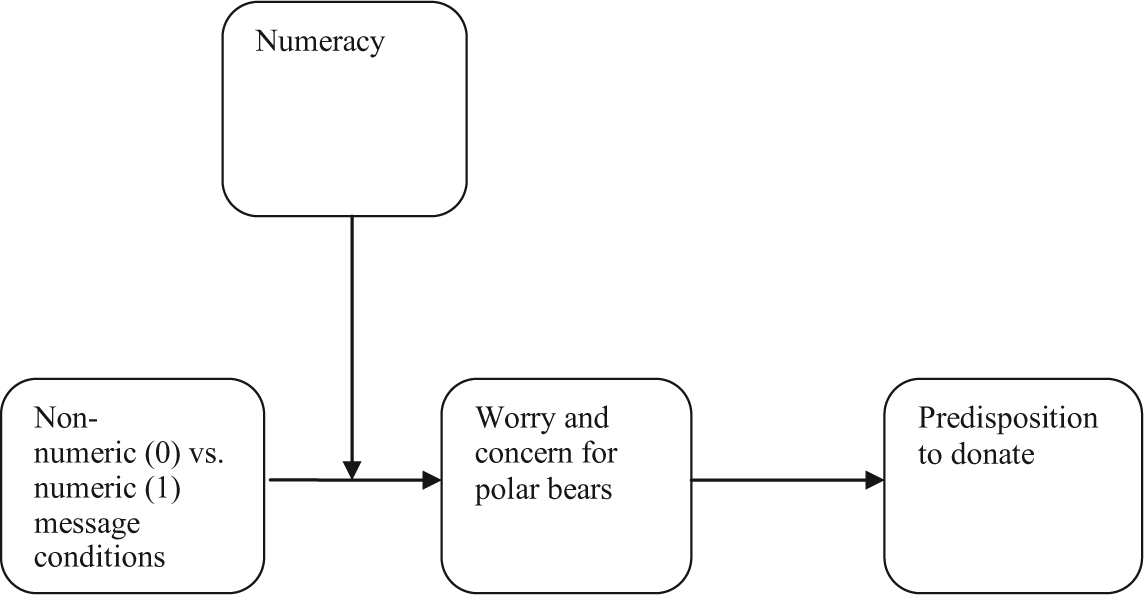
Proposed moderated-mediation model.
The MODMED macro allows for moderated-mediation effects to be examined through bootstrapping, which is increasingly recommended as the optimal approach for investigating indirect effects (Hillis and Bull, 1993; Preacher and Hayes, 2004, 2008; Preacher et al., 2007; Shrout and Bolger, 2002). The bootstrapping approach has greater power and a lower risk of Type I errors than the Sobel test or causal steps approach (Preacher and Hayes, 2008). One of the primary advantages of bootstrapping is that it is not necessary to make assumptions about the normality of sampling distributions; this is critical for investigating moderated indirect effects as interaction terms typically do not have normal distributions. Instead of assuming that the data sample is normally distributed, with bootstrapping the sample is conceptualized as a “pseudo-population” (Preacher et al., 2007: 190) that represents the larger population of interest. In other words, the sample of data is thought to serve as a better representation of the distribution of the larger population of interest than a normal or other assumed pattern of distribution. Sampling distributions are calculated by resampling the data set multiple times (resampling is typically conducted thousands of times).
Experimental design and stimulus
The hypotheses were investigated using two experimental conditions (numeric vs. non-numeric descriptors) plus control design. Participants were randomly assigned to one of the three conditions, with 40 individuals in each condition. Participants assigned to one of the two experimental conditions read a constructed news story about the effect of climate change on polar bears, while participants assigned to the control condition did not view a news story. While the story presented to the participants was constructed for this experiment, the information used was taken from news stories that had been run by the Associated Press. The two experimental conditions differed by whether they presented a numeric or non-numeric description of the impact of climate change on polar bears. The non-numeric condition included statements such as “scientists predict that most polar bears in the world may be killed off in the near future because of thinning sea ice from global warming in the Arctic” while the analogous statement in the numeric condition was “scientists predict that 12,000 of the 18,000 polar bears in the world may be killed off in the near future because of thinning sea ice from global warming in the Arctic.” The complete text of the stimulus for each condition is included in Online Appendix A and Appendix B.
Variables
Independent variable
The independent variable was the experimental condition (numeric description, non-numeric description, control) that participants were randomly assigned to.
Moderator variable
Numeracy was measured as a potential moderator of the impact of using numeric or non-numeric descriptors. Numeracy was measured with the following seven questions taken from scales developed by Lipkus, Samsa, and Rimer (2001) and Frederick (2005).
From Lipkus et al. (2001):
1. Which of the following numbers represents the biggest risk of getting a disease? ___ 1 in 100, ___ 1 in 1000, ___ 1 in 10 (Answer: 1 in 10)
2. If the chance of getting a disease is 10%, how many people would be expected to get the disease out of 100? (Answer: 10)
3. In the BIG BUCKS LOTTERY, the chances of winning a $10.00 prize are 1%. What is your best guess about how many people would win a $10.00 prize if 1,000 people each buy a single ticket from BIG BUCKS? (Answer: 10)
4. Imagine that we roll a fair, six-sided die 1,000 times. Out of 1,000 rolls, how many times do you think the die would come up as an even number? (Answer: 500)
5. In the ACME PUBLISHING SWEEPSTAKES, the chance of winning a car is 1 in 1,000. What percent of tickets of ACME PUBLISHING SWEEPSTAKES win a car? (Answer: 0.1%)
From Frederick (2005):
6. In a lake, there is a patch of lily pads. Every day, the patch doubles in size. If it takes 48 days for the patch to cover the entire lake, how long would it take for the patch to cover half of the lake? (Answer: 47 days)
7. A bat and a ball cost $1.10 in total. The bat costs $1.00 more than the ball. How much does the ball cost? (Answer: $0.05)
This resulted in a scale that had a range of 0–7 (Mean = 3.53; SD = 1.71). Cronbach’s α for the scale was .68, which is typical for abbreviated numeracy scales (e.g. Weller et al., 2012).
Control variable
Political party was used as a control variable in the moderated-mediation model. Climate change is a politically polarizing issue in the United States (Dunlap and McCright, 2008; McCright and Dunlap, 2003) and previous studies have found that individuals with varying political orientations are likely to engage in motivated reasoning when exposed to climate change messages (Hart and Nisbet, 2012). Thus, in order to better isolate the moderating effect of numeracy, political party was controlled for across conditions. Political party was measured by asking respondents to answer the question “Generally speaking, when it comes to political parties in the United States, how would you describe yourself?” The question was measured on a 7-point scale ranging from 1 (strong Democrat) to 7 (strong Republican) (M = 3.8; SD = 1.73).
Mediator variables
Worry and concern for polar bears was used as the mediator variable. This was measured by asking respondents in the stimulus conditions 1) “Overall, how worried are you about the polar bears featured in the story?” and 2) “Overall, how concerned are you about the polar bears featured in the story?” In the control condition, participants were asked how worried and concerned they were about polar bears in general. The questions were measured on a 7-point scale ranging from 1 (not at all) to 7 (very). The two questions were strongly correlated (r = .95, p < .001) and added together into a scale -ranging from 2 to 14 (M = 10.15; SD = 3.11).
Dependent variable
The impact of the message on experimental participants was measured by asking participants “How much would you be willing to contribute to organizations working on the issue of climate change?” Participants were provided a 6-point scale that ranged from $0 to $5, and a blank next to the $5 option to allow for larger donations. The responses measured a stated willingness to pay rather than actual donations, and any answer greater than $5 was coded as $6 to minimize the impact of outlier donations. This resulted in a willingness-to-pay scale that ranged from 0 to 6 (M = 3.09; SD = 2.40).
6. Results
First, a one-way ANOVA was employed to examine the representation of the respondents across the conditions, there were no significant differences between conditions for political party F(2, 118) = .501, p = n.s., numeracy F(2, 118) = 1.155, p = n.s., age F(2, 118) = .025, p = n.s., or gender F(2, 118) = 1.567, p = n.s. Next, general descriptive statistics were assessed for the mediator and dependent variable across conditions at low and high levels of numeracy. While a continuous numeracy scale was used for all tests of indirect effects, a categorical low/high split is used here for reporting the descriptive statistics such that “low” numeracy represented individuals with numeracy scores of 0–3 and “high” numeracy represented individuals with numeracy scores of 4–7. Looking first to the mediator (worry and concern for polar bears), low numerate individuals in the control, non-numeric, and numeric conditions respectively had mean responses of 8.8, 11.52, and 12.75. High numerate individuals in the respective conditions had mean responses of 9.00, 9.86, and 9.74. Looking next to the dependent variable (predispositions to donate), low numerate individuals in the respective conditions had mean responses of $3.22, $3.55, and $5.10. High numerate individuals in the respective conditions had mean responses of $3.45, $3.05, and $2.38.
The significance of these descriptive statistics was assessed looking at the moderated-mediation model visually represented in Figure 1. The pattern of results from the moderated-mediation test found support for H1 and H2 when comparing numerical against non-numerical descriptors (see Table 1); numeracy moderated the impact of numeric vs. non-numeric descriptors on worry and concern for polar bears impacted by climate change (B = -.721, p < .05), and this worry and concern had a direct impact on stated willingness to make a donation to address the issue (B = .238, p < .05).
Results from moderated-mediation analysis of numeric vs. non-numeric descriptors.
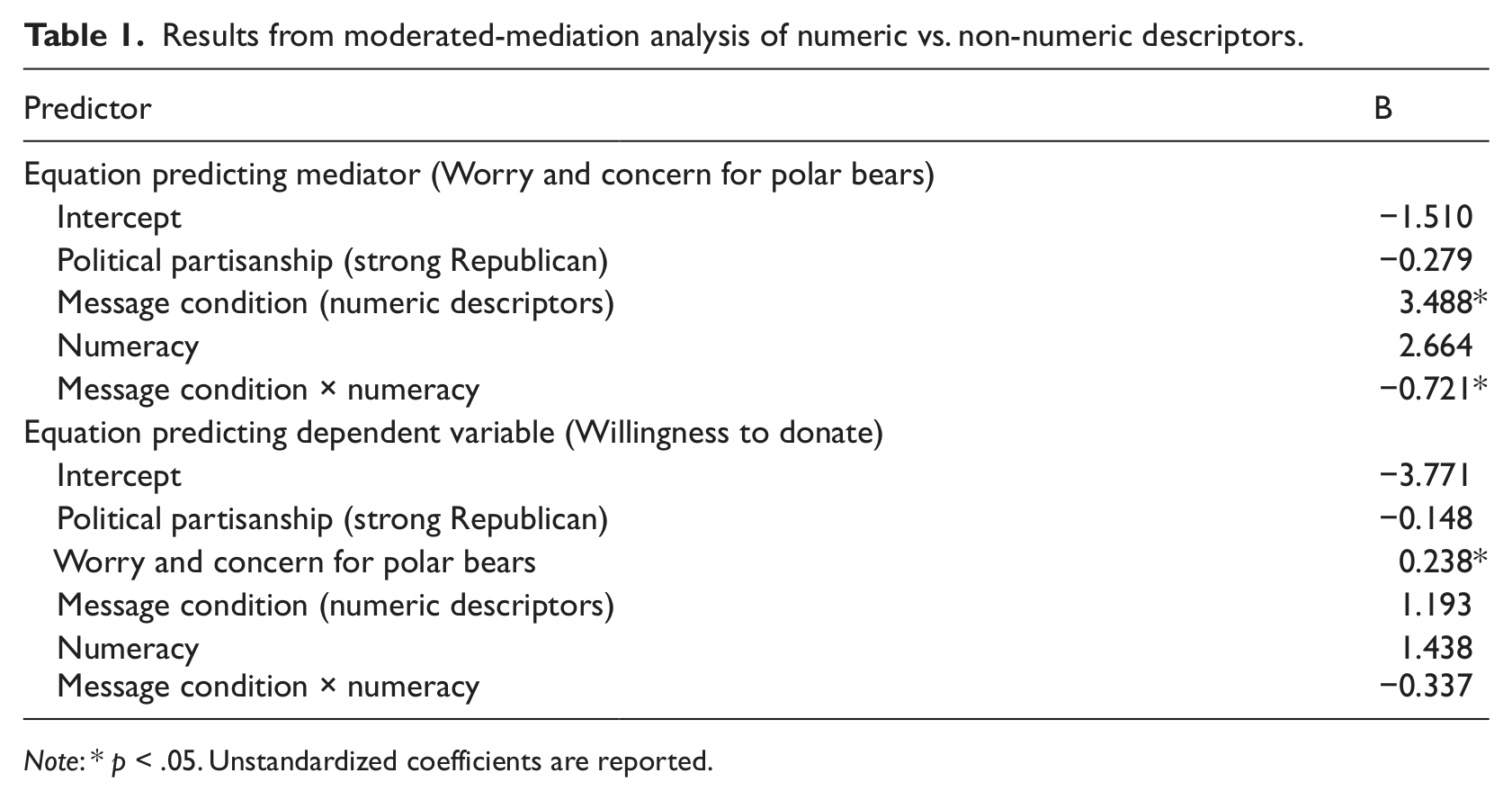
Note: * p < .05. Unstandardized coefficients are reported.
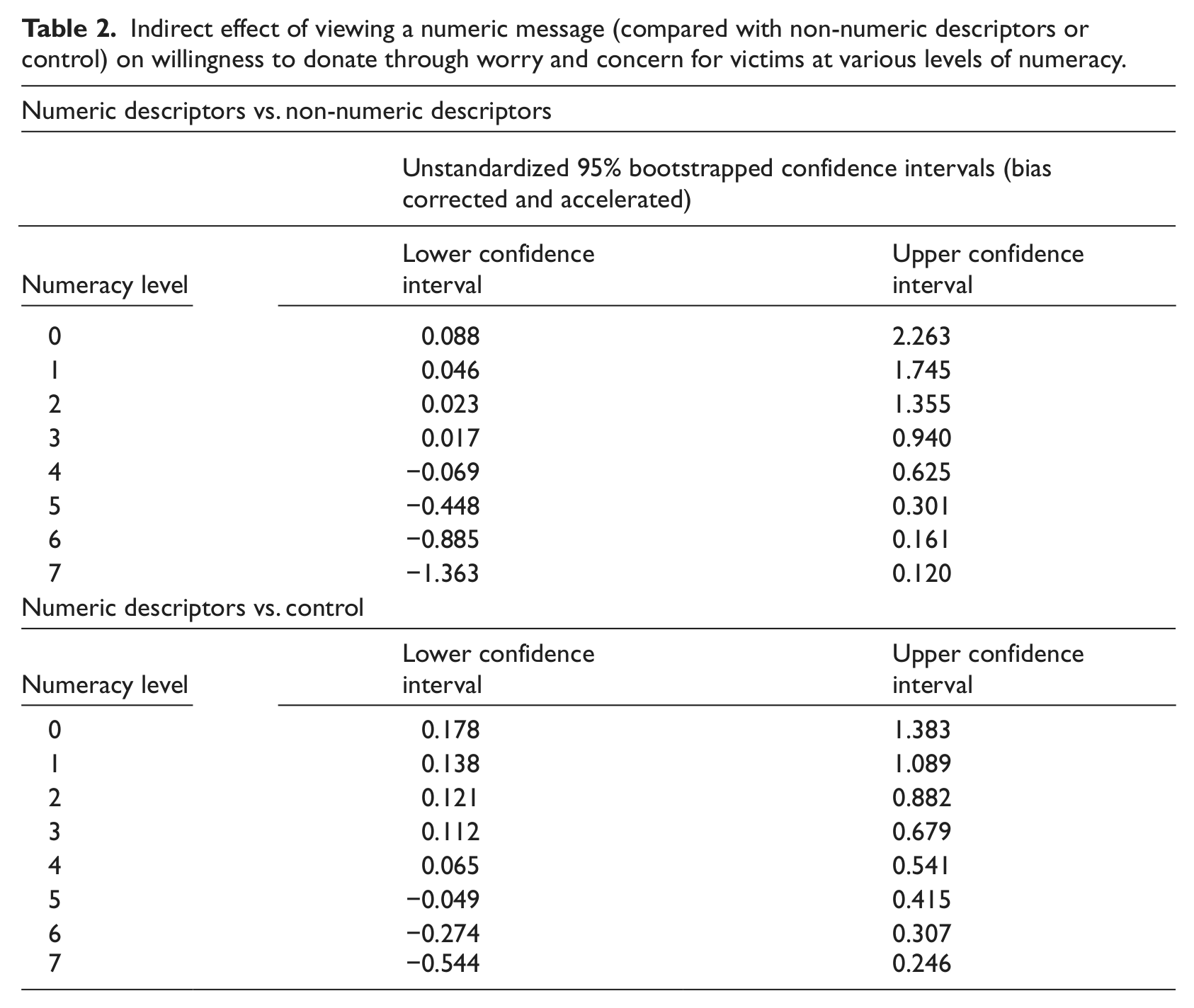
The nature of the moderation of numeracy on the impacts of the stimulus when comparing numeric to non-numeric descriptors was further probed by testing bootstrapped conditional indirect effects at different levels of numeracy. For the comparison of numeric to non-numeric descriptors, the bootstrapping calculation was bias corrected and accelerated with 5,000 iterations. The results show that individuals with higher levels of numeracy (numeracy scores of 4, 5, 6, or 7) were not sensitive to the presence or absence of numbers. However, for individuals with lower levels of numeracy (numeracy scores of 0, 1, 2, or 3), numeric descriptors of the impact of climate change, compared to non-numeric descriptors, increased worry and concern for polar bears, which in turn increased predispositions to donate to relevant organizations. These results are depicted in Table 2; Table 2 may be interpreted such that if the lower end and upper end of the 95% confidence interval are either both above zero or both below zero there is a significant indirect effect, whereas if the lower end of the 95% confidence interval is below zero while the upper end of the 95% confidence interval is above zero no significant indirect effect is present. Thus, Table 2 shows that individuals low in numeracy were sensitive to the numeric presentation of the risks while individuals high in numeracy were not.
Indirect effect of viewing a numeric message (compared with non-numeric descriptors or control) on willingness to donate through worry and concern for victims at various levels of numeracy.
The impact of the stimulus conditions was probed further with two additional moderated-mediation models that respectively offer 1) a comparison of numeric descriptors against control, and 2) a comparison of non-numeric descriptors against control. As shown in Table 3, numeracy was a significant moderator of the impact of the numeric stimulus against control (B = -.491, p < .05), but, as shown in Table 4, numeracy was not a significant moderator of the impact of the non-numeric stimulus against control (B = -.237, p = n.s.). In both models worry and concern for polar bears had a significant impact on willingness to donate (for numeric stimulus vs. control, B = .218, p < .01, see Table 3; for non-numeric stimulus vs. control, B = .285, p < .01, see Table 4).
Results from moderated-mediation analysis of numeric descriptors vs. control.
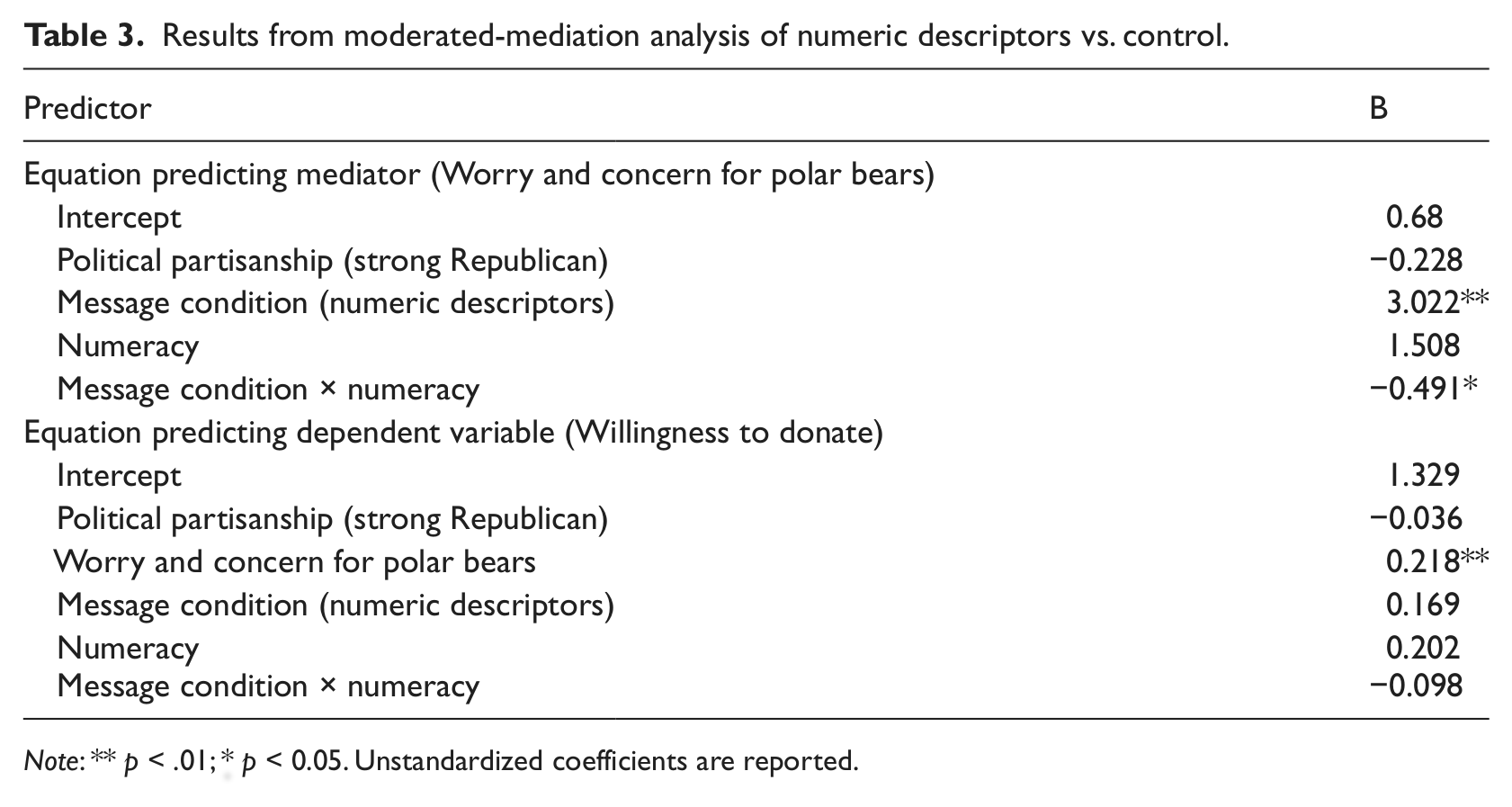
Note: ** p < .01; * p < 0.05. Unstandardized coefficients are reported.
Results from moderated-mediation analysis of non-numeric descriptors vs. control.
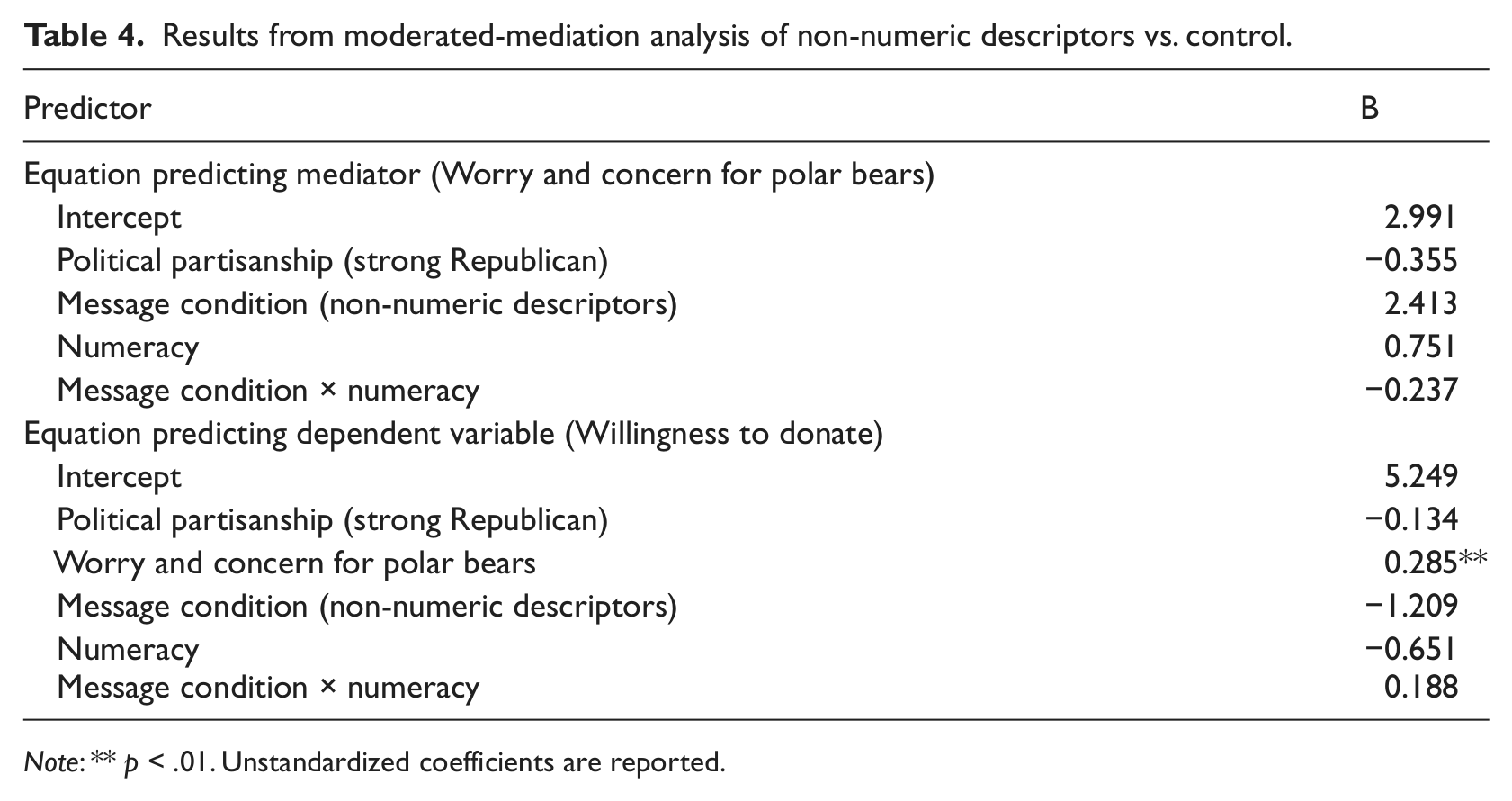
Note: ** p < .01. Unstandardized coefficients are reported.
The nature of the moderation of numeracy in the impact of numeric descriptors against the control group was examined further by testing bootstrapped (bias corrected and accelerated with 5,000 iterations) conditional indirect effects at different levels of numeracy. The results reveal a pattern that is similar to the comparison of numeric against non-numeric descriptors. Individuals with higher levels of numeracy (numeracy scores of 5, 6, or 7) were not sensitive to the differences in the stimulus. Individuals with lower levels of numeracy (numeracy scores of 0, 1, 2, 3, or 4), however, were sensitive to the numeric stimulus, responding with higher levels of worry and concern for the polar bears, which increased predispositions to donate to relevant organizations (see Table 2).
7. Discussion
Scholarship on numeracy and framing effects has focused primarily on how individuals with varying levels of numeracy differentially interpret different types of numeric information; there is a dearth of research, however, examining how numeracy may moderate the impacts of messages that contain numeric descriptors of risk compared to non-numeric descriptors of risk. By focusing on how numeracy may moderate the interpretation of numeric and non-numeric information about the impacts of climate change, this study offers a greater understanding of how numeracy impacts message interpretation in general while providing science communicators critical information on how alternate presentations of climate evidence may alter the public response.
In this study, the results demonstrate that numeracy moderated the impact of numeric and non-numeric descriptors on worry and concern for polar bears such that low numerate individuals were sensitive to numeric vs. non-numeric framing while highly numerate individuals were not (in support of H1). Worry and concern, in turn, positively influenced predispositions to donate to organizations working on the issue of climate change (in support of H2). The results revealed that numeracy moderated how individuals responded to numeric descriptors of climate impacts compared to the control group, but did not moderate responses to non-numeric descriptors compared to control. For both of the significant interactions, individuals low in numeracy were more worried and concerned about polar bears when exposed to numeric descriptions of climate impacts compared to non-numeric descriptions or the control group. The finding of a significant interaction with numeracy when comparing numeric descriptors against non-numeric descriptors or control, but not when comparing non-numeric descriptors against control, suggests that low numerate individuals were particularly sensitive to numeric risk information rather than just risk information in general.
In addition to increasing our understanding of how numeracy may moderate the interpretation of science messages in general, the present study also has implications for science communicators seeking to convey science and risk information to the general public. This study demonstrates that numeracy is an important dimension that science communicators must be cognizant of when developing science messages, as individuals with varying levels of numeracy are likely to interpret science messages in different ways. Looking to climate change communication, a number of studies have examined how climate change has been covered in the media, investigating questions such as the bias in the representation of the scientific consensus on climate change (Boykoff and Boykoff, 2004), how coverage of climate change follows Downs’ issue-attention cycle (Trumbo, 1996), and dramatization of climate change coverage in the media (Boykoff and Boykoff, 2007). Others, looking at the influence of climate change messages on the public, have examined questions such as what frames, for example a health or national security frame, of the issue will resonate most with the public (Maibach et al., 2008; Nisbet, 2009) and how competitive framing discourse by liberals and conservatives has impacted the political feasibility of proposed climate mitigation actions (Dunlap et al., 2001; McCright and Dunlap, 2000). To date, however, there has been a dearth of research on the structure of climate messages both in terms of the content of media coverage, political discourse, and general science messages and in terms of how the adoption of different message structures may differentially impact the public response.
Thus, the present study adds to previous research on climate change messages by examining how the structure of climate messages may influence message impacts. That is, the present study provides information about how using numeric or non-numeric descriptions of risk may impact the responses of message recipients. The findings suggest that when science communicators adopt a thematic frame to describe science issues such as climate change, the inclusion of numeric risk information is likely to increase message resonance amongst low numerate recipients, while having a minimal effect (compared to non-numeric risk information) for highly numerate recipients.
It is important to note that these findings should not be taken as a prescription for how one ought to construct climate change messages. Instead, the results are offered to provide additional information on the implications that different decisions may have when constructing science messages for issues such as climate change. This is in line with recent calls for science communicators to be aware of how different approaches to presenting risk information may impact attitudinal and behavioral responses, as no message format is “neutral” (Thaler and Sunstein, 2003). Even when science communicators attempt to create “objective” messages that simply convey the facts, choices must still be made on what aspects of an issue are focused on and how the information is presented; these choices have the potential to “nudge” (Thaler and Sunstein, 2009) responses in different directions. While the prospect of designing science messages that may affect message recipients’ responses one way or another may make some science communicators uncomfortable, the alternative is to still make choices about what information formats to include in science messages but remain ignorant of the impact that the formats have compared to alternatives. Thus, while using numeric or non-numeric risk descriptors can both be seen as normatively acceptable, it is important that science communicators consider how using these different types of descriptors may shift the public reaction to science information.
Of course, this is only one study, and caution should be taken when generalizing in light of several limitations. The experiment presented here is based on a comparison between numeric and non-numeric information about the impacts of climate change on polar bears; it is possible that similar inquiries into alternate substantive domains may yield different results. The sample used in the study is not representative of the general U.S. population as participants were recruited from a mall setting in upstate New York. In addition, individuals who commonly frequent malls may have differences compared to the general public, such as having a higher need than others for a sense of belonging and warm relationships (Swinyard, 1998). Thus, future studies building from this experiment should recruit from more heterogeneous populations.
With these limitations in mind, the finding that individuals low in numeracy are more sensitive to framing effects is consistent with previous research and is probably robust. This study marks a novel, exploratory examination into how numeracy moderates the interpretation of verbal and numeric descriptors around a science issue such as global climate change, an area that deserves additional investigation that may build from these results. Future research may build on the present study to examine how the moderating impact of numeracy on the inclusion or absence of numbers may be mediated by variables such as perceptions of credibility, and how the interaction between numeracy and the use of statistical evidence may influence dependent variables such as message comprehension and recall. In addition, this study included a combination of raw count and percentage formats in the numeric format. Peters et al.’s (2006) findings suggest that low numerate participants may have different responses to percentage and raw count formats; future research may also work to isolate the separate impact of raw count and percentage formats compared to each other and non-numeric formats.
Footnotes
Funding
This research was supported by National Science Foundation Grant SES-0752876. Although this research was supported by the National Science Foundation, any opinions, findings, conclusions, or recommendations expressed in this publication are those of the author and do not necessarily reflect the views of this organization.
Notes
Author biography
References
Supplementary Material
Please find the following supplemental material available below.
For Open Access articles published under a Creative Commons License, all supplemental material carries the same license as the article it is associated with.
For non-Open Access articles published, all supplemental material carries a non-exclusive license, and permission requests for re-use of supplemental material or any part of supplemental material shall be sent directly to the copyright owner as specified in the copyright notice associated with the article.
