



Abstract
In September 2012, graduates of Imperial College’s science communication Master’s courses gathered to celebrate 21 years of the programme. The MSc in Science Communication was the first of its kind in the UK and one of the first Master’s courses in the world to offer a combination of practical and theoretical studies of science communication across a range of media. This commentary reflects on the longevity of the programme, the reasons for its success, and the opportunities and challenges facing science communication courses today.
1. Introduction
In October 1991, the first students arrived on a new MSc in Science Communication at Imperial College of Science and Technology, then part of the University of London. Twenty-one years on, and now with an additional MSc in Science Media Production, the programme has produced over 700 graduates and recruits up to 50 new students each year. 1 Some two hundred of these graduates returned to Imperial in September 2012 to attend a day-long conference to mark the programme’s 21st anniversary. 2 The conference was an opportunity to bring together practitioners from a wide range of fields to discuss current issues in science communication and to reflect on how their studies had helped shape their careers. The undimmed enthusiasm of the conference participants, the breadth of their science communication experience, and the high level of discussion in the conference sessions, confirmed that the programme has produced a large body of highly employable science communication professionals – including broadcasters, journalists, press officers and exhibition developers – jokingly referred to in the run-up to the conference as ‘the Imperial mafia’.
In the years since the Imperial MSc was launched, many other degrees in science communication have been started in the UK and around the world and the first such courses are being planned in a number of countries. 3 At the same time, other UK courses that launched in the 1990s have closed down. The following account of the Imperial programme is aimed at helping to build an understanding of what such courses can deliver and what challenges they face. I first discuss how the Imperial course was established and describe its key features. I then present data about the employment of graduates from the course. I finish by drawing on the discussions at the anniversary conference to examine some of the changing features of the science communication landscape to which courses like Imperial’s must respond.
2. Origins
Imperial’s MSc in Science Communication was started by John Durant, who then held a joint appointment as the UK’s first Professor of the Public Understanding of Science at Imperial College and as Assistant Director and Head of Science Communication at the neighbouring Science Museum in London. As Durant tells it, during a meeting at the Leverhulme Trust in the autumn of 1989, just days before the Trust’s deadline for grant applications, he was asked about possible science communication projects the Trust could fund (Durant, 2012). Among other ideas, he suggested a Master’s programme. The Director of the Trust liked the idea, so over the next few days Durant sketched out what such a course might look like and, going direct to the Rector of the College, managed to secure Imperial’s support in time to submit a formal application to Leverhulme. The application was successful and preparation began to launch the new course in autumn 1991.
Although science communication was not yet widely taught, there were already some similar courses from which Durant and his colleagues could take some inspiration. In 1988, the Australian National University in Canberra had started what Trench identifies as the world’s first science communication Master’s course, and in the United States, a number of courses specialised in science journalism (Trench, 2012). At Imperial, the Humanities Programme, where the new MSc would be based, offered a suite of modules aimed at broadening the education of the College’s science and engineering undergraduates, including a module on ‘the communication of scientific ideas’. Unusually for the time, this was an assessed module that contributed towards the students’ final degree results. It had been established shortly before the development of the MSc programme by Durant’s then PhD student, Jane Gregory, who had also recently completed an introductory book on the subject based on a short training course she and her co-author had run at the University of Oxford (Shortland and Gregory, 1991).
The Leverhulme award secured by Durant enabled the appointment of a former science journalist, Ros Herman, to run the new MSc, with other teaching contributed by Jane Gregory and Martin Bauer, then a PhD student at the London School of Economics, and by communication professionals from outside Imperial. In 1994, Nick Russell took over from Herman and set about consolidating the organisation of the course, refining the curriculum and gradually building up the number of dedicated staff in what soon became known as the Science Communication Group. An early recruit was Joan Leach, a specialist in the rhetoric of science, who helped shape the academic component of the degree (and whom I replaced when she left in 2001). Today, the group, recently renamed the Science Communication Unit, compromises 6.5 staff, although two of these are largely concerned with undergraduate teaching.
From an initial intake of 21 students in 1991, recruitment averaged 26 students a year for the first decade of the course, growing to an average of 35 students a year in its second decade. The MSc is available through both full-time and part-time routes, though there are typically only two or three part-time students each year.
In 2001, a second course was introduced. The MSc in Science Media Production, designed and led by broadcast lecturer Robert Sternberg, recruits an average of 13 students a year. The two courses share some modules, but where the Science Communication students can choose from a broad range of options – with practical modules in print, documentary film, radio, web design and exhibitions – the Science Media Production students’ practical work focuses entirely on broadcast media and they undertake a final film project in place of an academic dissertation. A third course, the MSc in Creative Non-Fiction Writing led by Jon Turney, was introduced in 2005. This was aimed at aspiring non-fiction authors and focused on book-length writing, but it failed to recruit sufficient numbers of students and was discontinued after three years.
3. Key features of the programme: Character, recruitment and aims
Reviewing different types of science communication courses, Turney (1994) distinguished courses which emphasise skills training from those which deal with ‘the big picture’. From the start, the Imperial MSc was a ‘big picture’ course with a balance between academic and practical work. The academic component introduces ideas from the philosophy of science, the sociology of science, media theory and communication studies in order to encourage students to think critically about both science and the media. The aim is to produce reflexive practitioners; that is, science communicators who are not only able to speak for science, when that is appropriate, but who are also able to question science and to interrogate the role of science in society. In the practical component, students develop skills relevant to a variety of science communication jobs, particularly in the media and museums, but here too the emphasis is on the conceptual challenges of treating a topic in a given medium, rather than on technical skills. Practical skills are consolidated in a short summer work placement, which also helps the students make contacts in their chosen field.
Both the MSc Science Communication and the MSc Science Media Production are aimed at science graduates. Typically only two or three students each year have first degrees in humanities or social sciences and these students tend already to have experience working in science communication (for instance, as journalists who find themselves frequently assigned to science or environment stories). Recruitment is selective; for instance, the MSc Science Communication receives on average 120 applications a year for 35 places with the application rate varying little (±15) over the last ten years. Only a minority of students come to the course straight from their first degrees and about ten per cent of students have completed higher degrees, usually in the sciences. The mean age of students is 25. There is a wide range of experience within each cohort and students are able to learn a lot from each other, something which is encouraged by the interactive teaching methods used on the programme.
Only about a sixth of students come from outside the UK. Male students are also in a minority. In some years as many as 70% of students on the MSc Science Communication are female, though the Science Media Production course tends to have a slightly higher proportion of males. The proportion of females applying to the programme is higher still, so the skewed male/female ratio does not appear to be a result of selection criteria. Rather, it is likely that the multiple factors that make women more likely than men to leave science, also mean that there are more female science graduates looking for alternative, but related, careers. Science communication offers one such alternative. A cursory glance at science press offices, science outreach organisations and the museums sector suggests that women also predominate in many science communication jobs.
A desire to find a career that keeps them in touch with science without the specialisation required of scientific research appears to be shared by most of the students. When asked at interview why they want to study science communication, applicants frequently reply that the narrowness of a research career is not for them, but that they remain passionate about their science and wish to make use of it in their work. Their experiences in student journalism, outreach activities or voluntary work, lead them to consider science communication as an alternative career path. In other words, most applicants do not yet have a burning desire to become, say, journalists or filmmakers or exhibition developers because of their passion for that medium or the imagined glamour of a career in the media (or at any rate, they are intelligent enough not to confess to the latter at interview). Indeed, many, especially on the broader MSc Science Communication, are unsure what precisely they want to do or what medium they want to work in. Rather, it is their feelings about science (both positive and negative) that motivate their move to science communication.
One aim of the academic component of the programme is to constructively scrutinise these feelings in order to ensure that students’ passion for science does not equate to blind faith in science. Students draw on their own, varied, experiences of science to develop a more nuanced understanding of the nature of science and its place in the wider society. We also stress that although science communication is, of course, concerned with science, to study the subject and to become a professional science communicator is to cease to be a scientist. Our students are humanities students, their scientific qualifications notwithstanding. Some resist this abrupt change of identity in the first few weeks on the course, but soon they find that they are able to construct a new identity around science communication. In the long run, it is this intellectual re-orientation that graduates recall when asked what they got from the course. As the Guardian newspaper’s science correspondent, Alok Jha (a 1998 graduate), has put it: The MSc course took apart my rigid scientific view of the world and helped me realise that, while it’s useful to think like a scientist if you want to be one, it’s impractical for journalists writing for general audiences. You need to look at science from the outside, understand how non-scientists see it, to best communicate it.
4
Interviewed for the anniversary celebrations, Melanie Smallman, a graduate from 1993, made a similar point: I was attracted to the course because of the amazing contacts in the field, as well as the skills it offered. But surprisingly it has been the academic underpinning that I’ve drawn on most strongly in my career since. (Imperial College, 2012)
The success of the Imperial programme, whether in terms of continuing recruitment of students or in terms of the employment record of its graduates, may be attributed to a number of factors. The inclusion of a work placement, especially one arranged by the teaching team, is often cited by applicants as an attractive element of the programme. Imperial’s location in central London is an asset here, providing easy access to media production companies, major scientific institutions and national museums. In addition the number of applicants is high enough that we are able to recruit the most able students, most of whom already have some experience in science communication or student journalism.
Also important to the longevity of the course is the presence of a core team of staff, including both professional media producers and academic researchers, all of whom specialise in science communication. The programme shares no modules with other degree programmes and it is the main teaching priority of the core staff. This enables students to develop a close rapport with each other and to feel well supported by their lecturers. Since the end of the Leverhulme grant, the existence of a dedicated team of staff has been made possible by College support. Whilst this support has benefited the programme over the last two decades, it is also a source of vulnerability, as will be discussed in the final section.
4. Graduate careers
A programme such as this, with its vocational justification, lives or dies by the success of its graduates in finding relevant employment. As the above example of Alok Jha illustrates, some of our graduates hold relatively high-profile positions as science specialists in the media. Others have gone on to secure senior management positions in organisations with a national, and in some cases international, reach. Examples include: Head of Science at the BBC; Chief Executive of the British Science Association; Head of Corporate Partnerships at the National Trust; Chief Online Editor of the journal Nature; Deputy Editor of New Scientist magazine; Head of the National Media Museum; and Head of Communications for Médecins Sans Frontières UK.
As these examples suggest, graduates find science communication jobs in a range of different types of organisation. An internet search for the first two decades of graduates confirms this picture. The search identified the current jobs of 68% of the graduates from the programme; 150 (58%) who graduated before or in 2001 and 342 (74%) who graduated after 2001. Although a search of this type is unlikely to locate those who are unemployed or who have left the job market, 5 it does give some indication of the proportion of graduates employed in the different sectors (see Table 1). 6
Results of web survey of current employment of graduates from the Imperial College MSc Science Communication, MSc Science Media Production and MSc Creative Non-Fiction Writing.
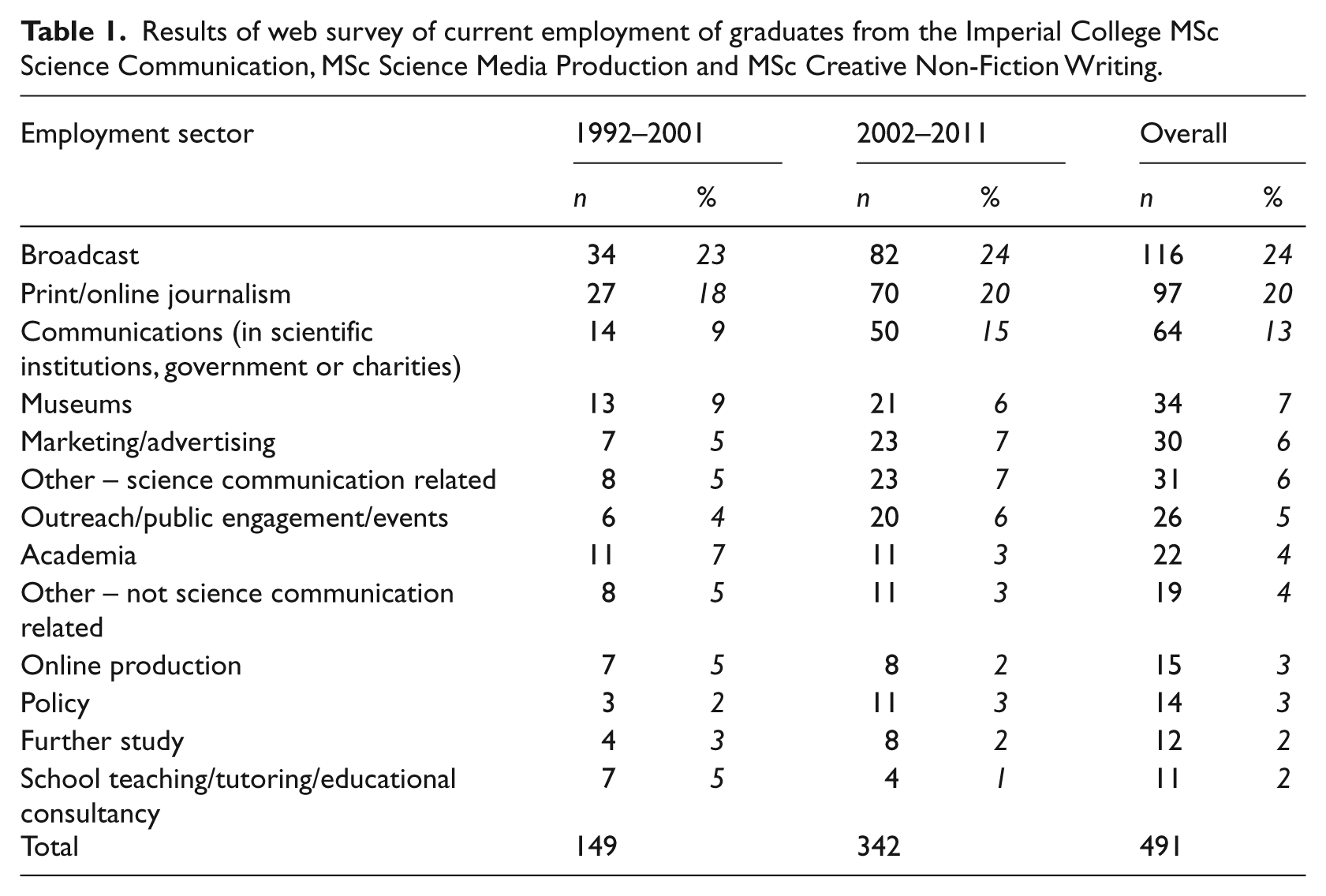
The largest proportion of graduates work in television and radio. As would be expected, the majority of graduates from the MSc Science Media Production (66%) find work in this sector but the introduction of this second degree has not altered the overall proportion of graduates from the programme working in broadcasting. Those graduating since 2001 are more likely to be working as communications or media relations officers than those who graduated before 2001 and are less likely to be in academia. Those in broadcasting tend to work for many different production companies, employed on a project basis rather than on long-term contracts. Likewise, 9% of graduates are freelance writers, typically going freelance after some years as a staff writer or editor on a magazine.
For the 48 students who graduated in 2011, any not found in the web search were contacted by email to complete the data set for employment destinations nine months after graduating. The results (Table 2) are broadly similar to those for the web search of all graduates, but with a slightly higher proportion working in TV, fewer working in journalism and proportionally almost twice as many working in communications.
Results of combined email and web survey of employment nine months after completing the course of the 2011 cohort of graduates from the Imperial College MSc Science Communication and MSc Science Media Production.
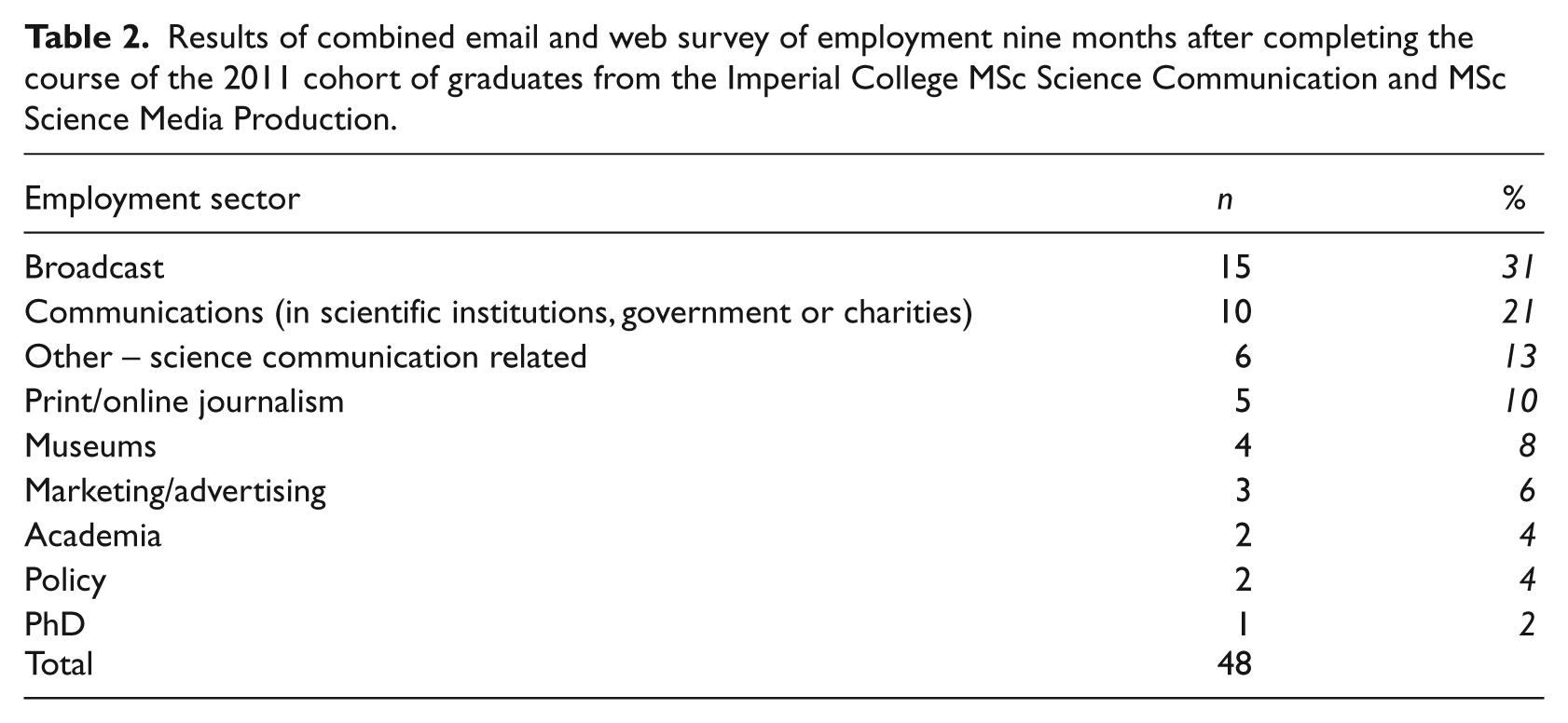
Overall, these results are somewhat different to the results of a 2011 survey of graduates of the MSc in Science Communication at Dublin City University, which has been running since 1996 (Trench, 2011). 7 That survey found that the largest proportion of graduates (just over a fifth) went on to teaching or training roles or other jobs in the education sector, with just under a fifth working in communications, public relations or outreach. A smaller proportion were working as journalists or media producers. A survey of graduates from the science communication Master’s programme at Trieste in Italy also found that only 9% were working in broadcasting, with a fairly even spread across all employment sectors (Ramani and Pitrelli, 2007). It is noteworthy that, whilst eight graduates from the Dublin course (10% of those who responded to the survey) had gone on to study for PhDs in science communication, just 1.6% of graduates from the Imperial programme were studying for PhDs in science communication or related fields at the time of the survey. However, the two sets of data are not strictly comparable since the Imperial survey did not record completed PhDs.
5. Opportunities and challenges
In the 21 years since the programme began, much has changed in the world of science communication. In his opening address to the anniversary conference, John Durant warned against the lazy assumption that there is now more science communication. Rather, he suggested, there is greater diversity, and science communication is now more firmly embedded within scientific institutions. These changes impact on the employment opportunities of graduates from science communication courses and also, although perhaps to a lesser extent, on course curricula.
Durant’s warning notwithstanding, the institutional embedding of science communication practice does mean that today there is more science communication involving input from a professional communicator with a specialism in science or a science-related area – be that a news journalist on the environment beat, a press officer at a medical charity, or an events organiser at a scientific organisation. In other words, the practice of science communication is more widely professionalised now than it was two decades ago, a change which may, arguably, be partly attributable to the supply of a steady stream of potential employees with a denominated qualification in the subject.
In the UK, this proliferation of specialist communication jobs within scientific institutions has also been underpinned by a shift away from the conventional lecture format for public communication to more interactive modes of engagement; a move summed up in the influential Lords Report as a ‘new mood for dialogue’ (House of Lords, 2000). This implied a need for communication professionals skilled in creative and participatory forms of communication. The press officers who have long been based in universities and other scientific organisations have now been joined by engagement officers and outreach officers.
A similar transformation, albeit one that started somewhat earlier, occurred in the museums sector with the establishment of a number of science and discovery centres. Already by 1991, the Science Museum in London had been joined by Techniquest in Cardiff, Catalyst in Cheshire and the Exploratory in Bristol. Whilst the Exploratory closed in 1999, other science centres have opened around the UK, including the Centre for Life in Newcastle, at-Bristol, Thinktank in Birmingham, the Eden Project in Cornwall, and many others. From the start, the museum sector has been a source of employment for graduates from the Imperial programme, not surprisingly given John Durant’s joint appointment at the Science Museum. As with press offices, roles at museums have diversified, from traditional curating posts to roles for events organisers, informal learning specialists and contemporary science content development.
In journalism, too, there has been a growth in science-related specialists, with numbers in the UK national news media doubling from 43 to 82 between 1989 and 2009 (Williams and Clifford, 2009). Whilst these numbers have been relatively stable in the UK in recent years, in other countries there are fears that science journalism is in decline, as symbolised in the US by the laying off of the entire science and environment news desk at CNN in December 2008. Even in the UK, the numbers of science journalists in the national news media remain low relative to other employment opportunities and the majority of our graduates who become print journalists work for special interest magazines, such as New Scientist, or for trade publications.
Print journalism as a whole is facing new pressures with the rise of online journalism. A recent study of the global state of science journalism found that although 75% of science journalists thought claims about ‘the death of journalism’ were exaggerated, 78% felt the internet was changing journalism (Bauer et al., 2013). Although online competition may mean that some news outlets will disappear, it also means that those journalists who remain will be required to work across a number of platforms. Multi-platform production implies a broadening of skills. It is no longer enough for aspiring science journalists to be able to write well; they now also need to maintain a Twitter feed and produce regular podcasts. Similarly, press officers are no longer reactive and focused on liaising with journalists; they now also source, write and publish their own news stories on their institutional websites. 8 On Imperial’s MSc Science Communication, a web design option was introduced in 2003 to encourage students to think about online production. However, the more significant way in which the course addresses the convergence of media production is through the mix of practical modules offered in different media.
It is plausible that the impact of online competition may actually generate more science specialist jobs, or at least consolidate current jobs. At the anniversary conference, Alok Jha explained that his newspaper’s response to the challenge of constant online news has been to move away from short news reports to providing ‘canonical’ stories. Although a response to the need to ‘do less with less’, as Jha put it, a new emphasis on in-depth analyses makes the expertise of a specialist journalist even more essential. At the same time, the increase in science public relations, together with increasing pressures on scientists to produce high-impact research and the large profits at stake in some science-based industries, also heighten the need for investigative science journalism. Journalist Deborah Cohen explained to the anniversary conference how the British Medical Journal has responded to this by creating her post of Investigations Editor.
Whilst the diversification and professionalisation of science communication jobs suggests good employment prospects for graduates in this field, the position of science communication courses within universities remains vulnerable. As noted above, some of the courses that opened shortly after the Imperial course have since closed down. Other Master’s courses do survive across the UK, and new ones continue to be launched, but they are located in many different types of department – some in journalism schools, some in science departments, and some are associated with research centres for the history of science. Not surprisingly, the focus of each course, and its mix of academic and practical content, varies with the institutional location.
The science communication community benefits from this variety and the consequent range of different skills and interests the different courses promote. However, it can also be interpreted as a sign of institutional instability; an indication that, arguably, science communication has failed to be institutionalised as a recognised specialism within academia, despite the founding of this journal shortly after the Imperial Master’s programme was launched. 9 The failure of the Imperial programme to produce many PhD students is perhaps another indication of this academic dislocation.
Trench (2012) argues that the same sources that generate the field’s vitality are also a source of vulnerability for its position within universities. Interdisciplinarity, he suggests, is a source both of intellectual stimulation and of institutional instability. Similarly, the perceived role of science in driving the economy has encouraged science communication initiatives at the same time as the economic crisis, through its effects on universities, may be stalling the development of academic study of the subject. Trench (2012: 243) identifies ‘accountability pressures and viability audits’ as potential threats to the longevity of science communication at universities in the developed world.
Institutional instability can manifest in terms of conflicting expectations as well as economic vulnerability. That some science communication courses are located within science departments corresponds to a frequent assumption that the field is ‘owned’ by science. This can lead to expectations among scientist colleagues and managers that science communication courses should be aimed at facilitating the promotion of science. The reduction of science communication to science promotion sits uncomfortably both with the academic agenda of Master’s programmes (i.e., the need to develop critical analyses of the role of science in society) and with the ideal of public interest science journalism (see Bauer and Gregory, 2007).
Scientists’ sense of ownership of science communication courses may be reinforced by the need for institutional support if, as with the Imperial programme, a course is not always fully self-financing; i.e., income from student fees does not cover all the staff and other costs. The viability of such a programme therefore partly depends on a recognition that the common good such courses provide outweighs any financial shortfall.
In some respects, the location of the Imperial courses in a Humanities Programme (later a Department of Humanities) at a science-based university has been ideal, enabling both the critical approach common to the humanities and a focus on professional media production (also usually located in humanities or arts faculties), at the same time as giving students easy access to top research scientists. Paradoxically, perhaps, an interdisciplinary approach to the humanities was able to flourish at a science-based institution thanks to the relative absence of strong disciplinary interests, and thus potential competing interests, in humanities. However, humanities is inevitably marginal within such an institution; something that was firmly signalled by the closure of Imperial’s Department of Humanities in 2012 and the relocation of the Centre for the History of Science, Technology and Medicine (formerly part of the Department of Humanities) to King’s College in 2013. The Science Communication Unit now sits in the Centre for Co-Curriculum Studies, a newly created non-academic centre concerned with the broadening of the education of science undergraduates.
6. Conclusion
In the 21 years since Imperial launched its science communication programme, postgraduate courses in this field have multiplied, both in the UK and elsewhere. The experience of the Imperial programme shows that graduates from such courses can go on to enjoy successful careers in a range of communication jobs. The diversification of science communication roles and the opportunities presented by new media suggest that there will continue to be demand for well-trained professionals who are able to work in a range of media and who bring to their communications work a critical understanding of the relationship between science and society. However, pressures within universities and the marginal status of science communication studies, may mean that such courses are vulnerable despite their successes.
Footnotes
Acknowledgements
My thanks to Nick Russell, Jane Gregory and John Durant for providing information about the early history of the Imperial programme. Thanks also to Stephen Webster for comments on a draft of this paper.
Declaration of conflicting interest
The author is the course director of the MSc in Science Communication.
Funding
This research received no specific grant from any funding agency in the public, commercial, or not-for-profit sectors.