




Abstract
Understanding the dialogue between museums and their visitors enables museums to subsist, undergo transformations and become consolidated as socially valued cultural venues. The Museo de La Plata (Argentina) was created in the late nineteenth century as a natural history museum, and this study shows that currently the museum is valued socially as a venue for family leisure and education, at which people make sense to the objects exhibited through characteristics conferred upon them by both the institution and the visitor. Nevertheless, such dialogue is somehow affected by the museographic proposal and the public interpretation of the institutional narrative, which could be analysed within the frame of contextual learning. As a consequence, the evolutionary idea that the museum aims to communicate is distorted by the public. This article highlights the importance of considering the visitors’ interpretations when planning museum exhibitions, a perspective that has been rather absent in the Argentinian museums.
1. Introduction
Ever since natural history museums came into existence, they have been privileged settings for transmitting knowledge of natural science – including palaeontology – to the public and, with the advent of the Darwinian evolution in the mid-nineteenth century, museums became venues for exhibiting empirical evidence of evolution. Exhibitions have certain strengths for presenting palaeontology, such as ‘a wide range of outstanding specimens, specimens in interpretive concepts, interdisciplinary connections among natural sciences, interdisciplinary connections between science and art, experiences to learn about teaching’ (Allmon et al., 2012: 233). From the standpoint of communication, the exhibitions at Museo de La Plata are interpreted herein as means of communication (Hooper-Greenhill, 2000) and settings for dialogue between the institutional narrative and the visitor’s meaning making.
Palaeontological exhibitions in motion
Museo de La Plata was created in the late nineteenth century as a natural history museum located in La Plata, the capital of Buenos Aires Province in Argentina, and it was conceived as a state-of-the-art institution inspired in the latest museographic and conceptual trends (Lopes and Murriello, 2005; Podgorny, 2000). Today, its 21 ground-floor and first-floor exhibition rooms open to the public display biological, archaeological and palaeontological objects obtained through acquisitions, donations and field collections made by the museum’s scientists all along its history. As it is shown in documents and historical analyses of the first phase of the development of the museum (Podgorny, 1995, 2000; Ward, 1890–1891), the palaeontological collections and exhibitions are what have garnered its highest recognition. Of these, special attention is bestowed on South American fossils of the Cenozoic Era. As a traditional natural history museum, the exhibition is based on its objects and its eight palaeontological rooms (numbered in roman numbers) are organised around topics and guided by a disciplinary logic:
II-Evolution (historical/relational/environmental);
III-The Earth as a system (historical/relational/environmental);
IV-Paleozoic/Argentine Triassic (chronological/taxonomic/biodiversity/environmental/sites);
V-Jurassic and Cretaceous (taxonomical/biodiversity/environmental);
VI-Cenozoic (taxonomical/biodiversity);
VII-Fossil mammals Edentata (taxonomical/anatomical/environmental);
VIII-Exchange in the Americas (taxonomical/biogeographic);
IX-Pampeano Palaeontology (environmental/taxonomic).
In order to comprehend, in the context of the original thesis research, 1 the history of the palaeontological exhibitions of the museum, its evolution was analysed based on written and photographic documents and oral interviews with key players. As a result, five historical periods of organisation were proposed as a framework within which to analyse the political and scientific criteria leading to the narrative and museographic changes (Table 1); most of them were partial and retained features from previous periods. It is necessary to say that the objects gain different meanings within these changes but here we focus on the actual arrangement and its possible interpretation.
Historical periods proposed for the development of the paleontological exhibitions and their main characteristics.
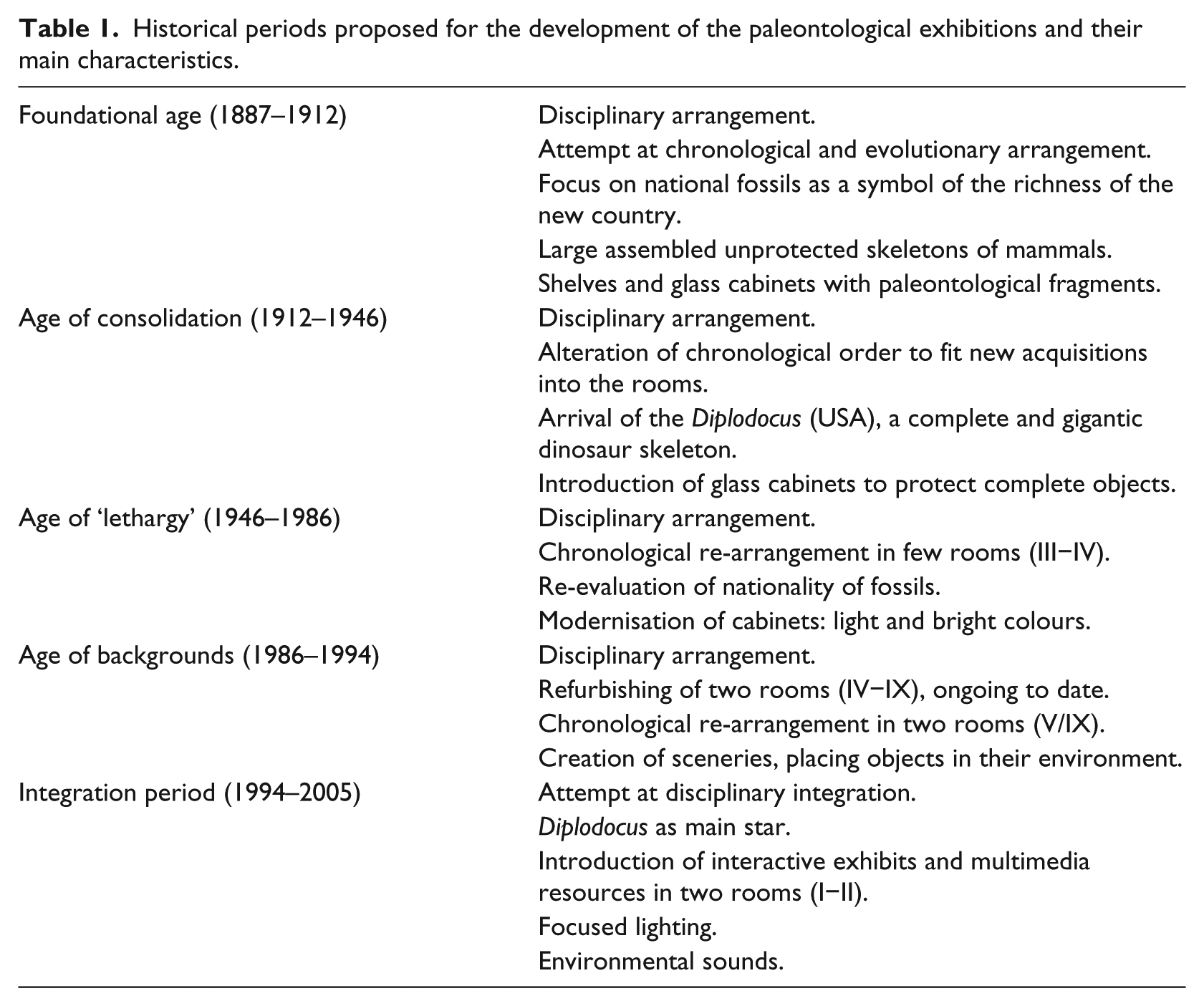
These periods are indicated here just to show that even though there were important museographic changes, the foundational principles of the museum were maintained as leading points of the institutional discourse over time: the progressive evolutionary approach target the museographic order and the priority assigned to South American/national objects. This is a key factor to understand the institutional proposal which, as shown here, is in conflict with the meaning making of the visitors. In the internal organisation of the exhibitions, there is a predominance of disciplinary logic over communicational and pedagogical criteria which began to change to a multidisciplinary proposal during the latest historical period (Table 1).
2. Theoretical background
The plentiful, wide-ranging collection of palaeontological objects in the exhibitions at Museo de La Plata is supported by other visual resources – signs, pictures, labels, diagrams and dioramas – through which the curators seek to provide meaning. It is worth noting that the two thematic rooms refurbished during the last period (Table 1) include some interactive and multimedia equipment, but in the rest of the rooms, the objects themselves are still the main attraction. Leinhardt and Crowley (2001) claim that it is in fact the objects and their features which make museums privileged venues, irreplaceable by other media. They identify resolution and density of information, scale, authenticity and value as the features that make the objects unique nodes for ideas and their elaboration, and for creating dialogue with visitors. Thus, the features do not belong to the objects, but are constructions of the sociocultural interaction of each individual and his or her expectations and prior knowledge regarding the observed object.
From this standpoint, and through detailed analysis of past and present palaeontological rooms at Museo de La Plata and the museum’s promotional materials, for this study it was considered that objects and collections have five attributes which are repeatedly highlighted by the institution: size, territoriality/nationality, diversity, authenticity and antiquity. It may be said that the museum has emphasised the construction of its evolutionary discourse by proposing a route through time and highlighting – in the exhibitions and in the promotional materials – the impressive size of some of its objects (on a human scale), the value of its American mammals collection, the diversity of life forms in the past, the value of authentic or ‘real’ objects and the fact that they are so ancient.
But, what do visitors think viewing the palaeontological exhibits on their own today? How do the exhibits enable construction of the past and understanding of the process of evolution? Numerous studies have assessed the difficulties in understanding evolution in different age groups and contexts (Diamond and Evans, 2007; Gregory, 2009; Spiegel et al., 2006, 2012), and it was considered that the difficulties arise from the counter-intuitive character of evolution. As the studies showed, intuitively, people assume that the boundaries between species are fixed and the world is unchanging (Sinatra et al., 2008). In addition, usual representations of the past, as Rudwick (1992) criticised, lead to oversimplified, unreal interpretations. Therefore, showing evolution throughout the history of life in an exhibition requires overcoming the obstacle of the way in which most of people imagines deep time. In this context, we wondered how the palaeontological exhibitions of the museum were read by the visitors. So, this study is the first approach to understanding the way current autonomous visitors to Museo de La Plata interpret the past.
The contextual learning model suggested by Falk and Dierking (2000) provides a reference system for approaching the multi-dimensionality of the museum experience while assessing the personal, sociocultural and physical context over time. By contrasting the institutional proposal and the experiences of visitors in the museum, we may identify the understandings and misunderstandings in the silent dialogue taking place in museum rooms.
3. Methodology
With the aim of learning about the experience of non-school visitors to Museo de La Plata, we designed an inquiry based on different instruments: questionnaires, interviews and trajectory analysis and applied them in samples from 2002 to 2005 during school holidays (Easter week and winter vacation).
In order to design these instruments, we analyse the previous (but not systematic) surveys run by the museum. Is necessary to say that these surveys were the only institutional attempt to know the visitors’ opinions about the exhibition, they were applied in 2000 and 2001 and they were never analysed. They showed that the palaeontology rooms were highlighted as the favourites (30%−40%) and, at the same time, was clear the visitors’ preference for ‘dinosaurs’ (60%−70%). Meanwhile, fossil megamammals – large mounted skeletons of Megatherium, Glyptodon, Smilodon, Toxodon and so on, of which there are many on show – were hardly mentioned. This preference raised doubt about whether the megamammals are interpreted as dinosaurs, fixing the image of the past with fossils.
Written questionnaires (Appendix 1) were made available to visitors at the palaeontological rooms and a collection point was located in the last one (Room IX). A sample of 361 questionnaires was answered voluntarily and anonymously. The questions were about the visitor’s relationship with the palaeontological exhibition according to four parameters: attention, novelty, difficulties and lacks. The answers were analysed quantitatively according to four categories: objects, concepts, setting (building and exhibition proposal) and general (when confused or not answered) and the most mentioned objects and concepts were ranked.
Interviews (Appendix 1): 121 anonymous interviews were conducted with randomly selected visitors in Room IX, to find out the visitor’s emotions by means of a qualitative analysis of lexical choice, gestures, expressions and attitudes. The parameters attention, novelty, difficulties and lacks were used in the qualitative and quantitative data analysis.
Trajectory analysis was performed in Room VI, where the visitor is introduced to the Cenozoic with valuable, attractive megamammal specimens. This room was selected for this analysis because of its key role to understand the transition from the dinosaurs’ to the mammals’ time. In order to identify the power of attraction and retention of objects and scenarios, 67 visitor trajectories were analysed including number and length of stops and evident attitudes (introspective/individual, interactive/social, recording).
4. Results
By integrating the results of the tools used during this study, we analysed the understandings and misunderstandings between the public and the museum and recognise the role of physical, personal and social context in visitor experience. Only a few of the results of the original thesis research are presented here, in particular those regarding what the public says and does in the palaeontological rooms, as elements revealing the meaning they assign to them, which may be useful for reflecting on dialogue at palaeontological exhibitions.
A general profile shows prevalence of children (under 12 years old) accompanied by adults (20–59 years old) of medium-level education (high-school graduates), and absence of teenagers (13–19 years old) and senior citizens (more than 60 years old). The analysis of the motivations of the visit shows that the museum attracts visitors seeking a pleasure-educational-family venue, showing that social context is of decisive importance in the choice of visiting. Occasional, frequent and assiduous visitors were identified, depending on the frequency of visits. The absence of elderly persons could be explained because of physical context’s problems: the huge size of the museum, the lack of seats in the rooms, and the cold environment; at the same time, teenagers are an audience typically absent in Argentinian museums, probably because of the lack of attractive experiences for them.
The questionnaires were answered mainly by females (59%), many of whom were 10–12 years old (46%) because of the important presence of children during holiday time. They classified the visit as a family outing, which once again highlights the importance of the social context. As is possible to visualise in Figure 1, attention is attracted by the objects, among which the most frequently mentioned are dinosaurs (60%); children, in particular (74%), mention a marked preference for the Diplodocus and the Iguanodon, two very large mounted skeletons. As novelties objects are in second place among which dinosaurs represent 37% of the choices, especially by children; the size, the authenticity and the national precedence are also mentioned. Mummies exposed in the archaeological rooms were also mentioned (40%) – showing the imprecise limit between palaeontology and archaeology for visitors – but they were considered in the general category as they are not palaeontological objects. The importance of the physical context is reflected in the opinion of adults regarding the attraction of the Museum setting, in particular, its neo-classic building (25%). Difficulties and lacks focus on other aspects of the physical context: dirtiness, empty display cabinets, neglected objects, the cold environment and the lack of rest areas. Lack of clear information was also mentioned. These categories are cited most by adults; and 36% of children said that nothing is disturbing, showing different perceptions of the environment. Concepts are underrepresented in all the categories.
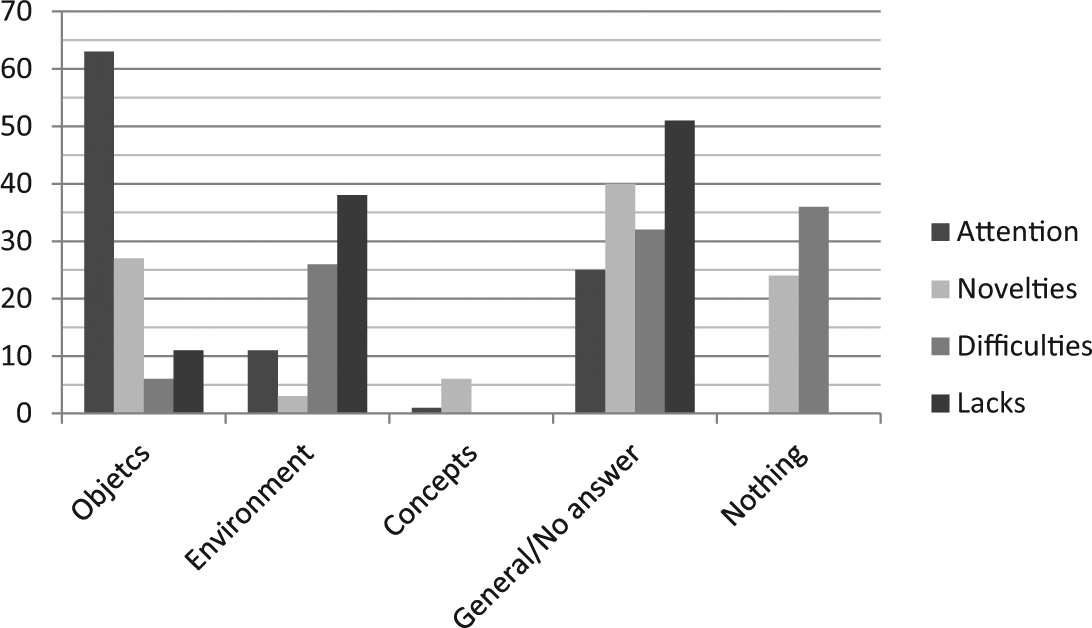
Frequency in % of the categories proposed (from the questionnaires).
The interviews provided depth to the quantitative data, showing that the same five attributes highlighted for the institution previously mentioned can be recognised in visitors’ assessment of the objects. A few quotes are provided below as examples:
Size (‘the biggest ones are impressive, it’s hard to believe they ever existed’/‘how big the dinosaurs was’).
Authenticity (‘it’s very hard for us to tell which are copies and which are original’/‘everything seems so real!’).
Nationality (‘they were native’/‘the extinct species of South America’).
Antiquity (‘how old the Earth is’/‘see so old things is incredible’).
Diversity (‘seeing the variety of animals there was’/‘very diverse!’).
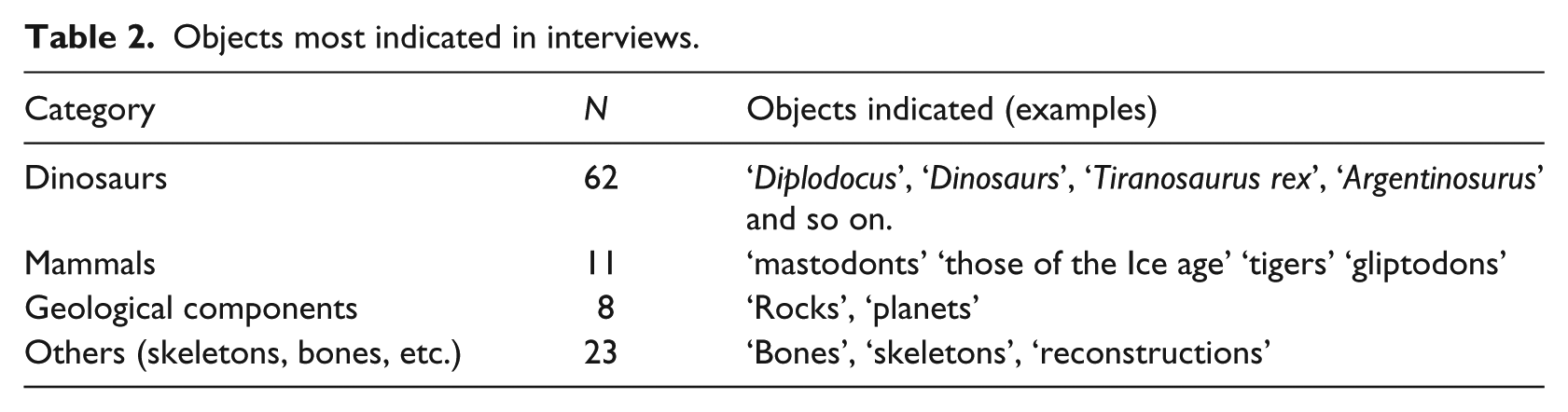
Among the most often mentioned objects, measured in number of quotes (Table 2), dinosaurs once again take first place, followed by ‘skeletons’ in general and to a lesser extent, megamammals. In general, adults were not able to remember the name of the objects meanwhile children could mention the scientific names, in particular those of dinosaurs probably as a consequence of the ‘dinosaur mania’ raised in the last decades (Gould, 1993). The interviews also revealed that the museum is perceived as a whole and people tend to compare it to other museums they have visited to criticised or to feel proud to recognise it as a national icon. Visitors, in particular children, appreciate the new exhibition modules of the rooms refurbished in the last period (Table 1), some of which are interactive; adults tend to compare the style of the exhibitions in the older and newer rooms.
Objects most indicated in interviews.
Trajectory analysis of two samples (2002–2003) showed how visitors used the exhibition area of the Room VI (Figure 2). The scenario with Cenozoic megamammals which takes up part of the room has the greatest power of attraction; visitors approach it upon entering, moving in the opposite direction to that indicated by the sign at the entrance. After this first stop, there is no single path, so reading order is clearly random and six stopping areas were identified but most of the visitors made only one (26%) or two stops (29%), always in the exhibits with big objects, spending no more than 60 or 120 seconds, respectively. Most of the visitors observed (86%−92%) were in family group.
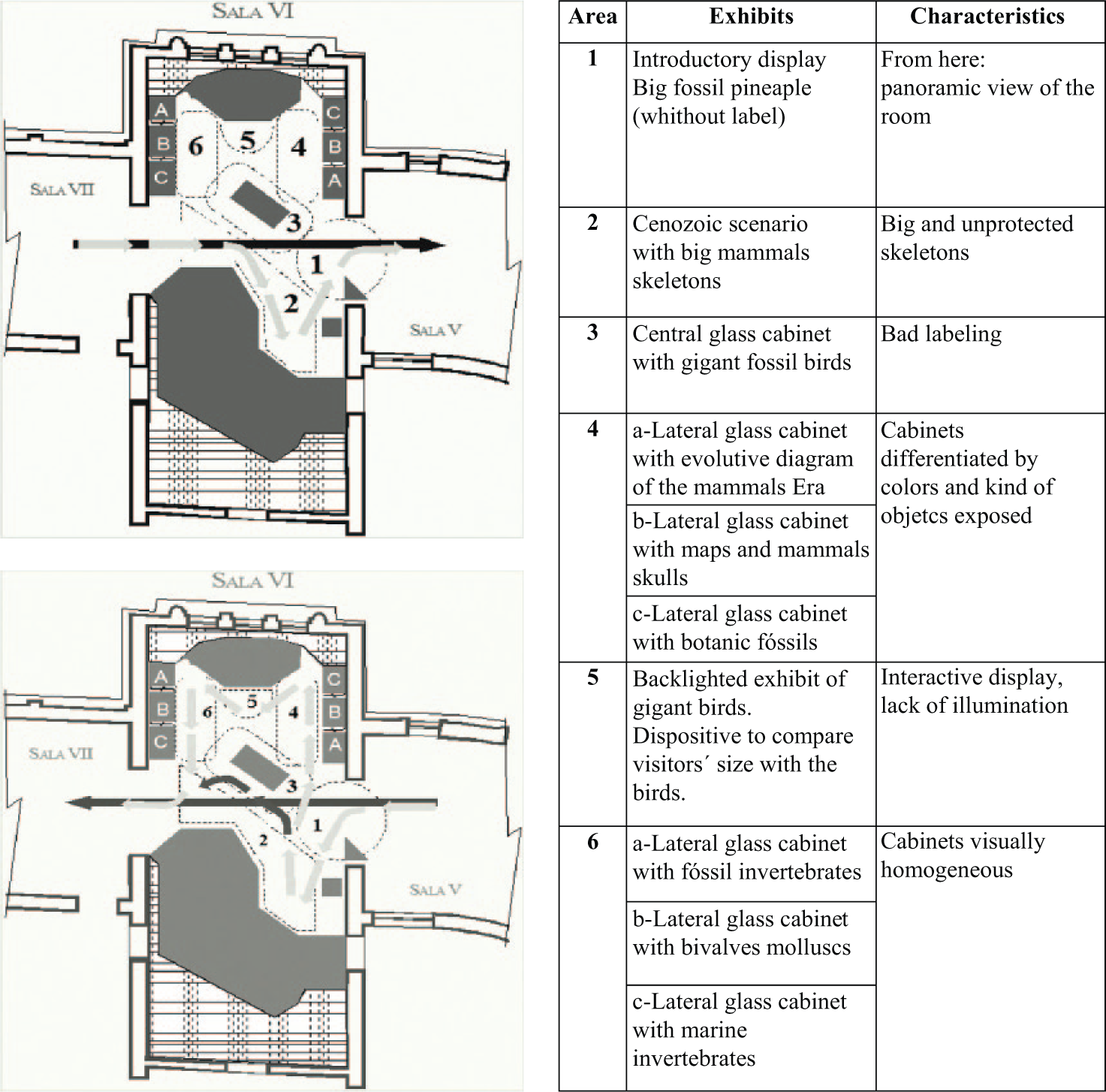
Trajectories and stop areas in Room VI.
During their trajectory, the visitors showed different attitudes: clearly most (69%−85%) were individual/introspective (read in silence, try to touch, observe, and watch with attention), others (15%−24%) were socially interactive (comment with others, join a guided visit, show to other, read in loud voice) and some attitudes (7%) were based on audiovisual recordings. The most frequent attitude ‘was watch with attention’, an individual behaviour.
The results of these instruments showed that the visitors studied understand ‘dinosaur’ to mean any large, ancient and mounted skeleton. Although this is not surprising, as other studies in museums have found similar situations (Mortara Almeida, 2004; Valente, 1995), and in social imaginary, the very idea of the past has been linked to dinosaurs since the mid-nineteenth century (Rudwick, 1992), it has deep conceptual consequences that here are considered as ‘invisible’ by the museum. This ‘taxonomical misunderstanding’ – the dinosaur-megamammal association – is rooted in the personal context of the visit, according to which it is understood that the visitor will always tend to associate what he/she sees with what he/she already knows, much to the chagrin of exhibition designers (Falk and Dierking, 1992; Leinhardt and Crowley, 2001). Thus, the megamammals, which are the object of institutional pride because of their value and international recognition, are interpreted as dinosaurs and become rather ‘invisible’ in the palaeontological rooms. Moreover, the Cenozoic, which takes up nearly half the rooms, and means millions of years, becomes integrated with the Mesozoic, blurring the concept of evolution in the narrative. Moreover, visitors’ words include no reference showing any interpretation about the process of evolution, but rather contain references to fragmented past and isolated objects, identifying only a few particular moments and representations. The fossil past is thus simplified, as Rudwick (1992) says usually happens, and the evolutionary approach fostered by the museum becomes distorted.
But there are other misunderstandings between the museum and its visitors: display problems (i.e. lack of light or labels, dirtiness, bad or old design), bad signage (i.e. old labels, long texts, taxonomic labels without explanation), ergonomic problems (i.e. high displays, labels difficult to read, uncomfortable settings), despite all of which Museo de La Plata is still a venue with many visitors, a place well-loved and valued by the local community. And this is the place of understandings. There are attributes of the objects and exhibitions that fit in with both what the institution is showing and what the visitors are seeking. In the museum rooms, there is surprise, impact, abundance, diversity, antiquity, real objects and national reference points. There is dialogue, which may improve if all voices are recognised, a road that Museo de La Plata seems to have just begun to travel in recent years, in what here is called an Integration Period (Table 1).
5. Conclusion and discussion
This study aims to lead to reflection on the importance of taking into account visitors’ perspectives when designing and refurbishing exhibitions which, understood as venues for interaction for institution-visitor/object-visitor dialogue, are places where understandings or misunderstandings take place. Although museum studies have emphasised the importance of considering the complexity of the museum experience during the last decades, it is necessary to highlight that this perspective is rather absent in the Argentinian museums. In this way, visitors are ignored and exhibitions are planned following disciplinary logic and the experts’ point of view. In addition, the practice of evaluation is not frequent, so visitors remain unknown.
From a didactic and a communicational standpoint, it is important to consider that the association between the new and the known, supported from a constructivist perspective as a strategy for knowledge, is also applicable in museums (Falk and Dierking, 2000; Hein, 2001). Thus, the educational role of museums requires specific planning, not only by creating special educational activities and offering guided tours, but also in the conception, design and mounting of exhibitions considering the visitors’ point of view. As showed here, museums, as locus for the exhibition of material objects, are unique and irreplaceable, and even in competition with other venues of education and pleasure continue to attract visitors who seek this understanding. Objects are thus essential, but polysemic. The (re)signifying of objects is in the hands of the visitors, who arrive with their personal representations – understood as part of the personal context of the Falk and Dierking (1992) model – which will be helped or hindered by the approach offered by the museum as a whole to the visitor.
In the particular case of palaeontological objects, the focus of this study, it may be said that the multiple (re)significances interact with the formation of the idea of the past, evolution and palaeontological science proposed by Museo de La Plata. As mentioned, this institution is a foundational space for sciences in Argentina and still today is an icon for biological evolution because of its collections and research. It is also a highly visited museum, but its public does not make meaning of its exhibitions as expected by the institution.
That is no small thing, for we have been trying for over 150 years to understand and teach the evolution of species, for which natural history museums are key. These ideas are not necessarily understood just because they have been around a long time (Falk and Needham, 2011); it is necessary to understand the obstacles in order to modify mental representations of the past indicated by Rudwick (1992) and Spiegel et al. (2006, 2012). If the natural history museums want to play a key role in making meaning about evolution, they must consider the personal context of their visitors.
Footnotes
Acknowledgements
I would like to thank Professor Doctor Margaret Lopes, who directed my PhD thesis, CAPES (Coordenação de Aperfeiçoamento de Pessoal de Nível Superior) of Brazil for providing financial support for the study and Instituto de Geociencias de la Universidade Estadual de Campinas (UNICAMP) for accepting me as a postgraduate student.
Funding
This research received no specific grant from any funding agency in the public, commercial or not-for-profit sectors.