



Abstract
This research note presents the results of a content analysis of 234 letters to the editors that discuss evolutionary theory and were published in American newspapers. We find that letters to the editor both support and hinder the cause of teaching evolutionary theory in American secondary schools. On the one hand, anti-evolutionary theory messages are marginalized in the letters section. This marginalization signals a low level of legitimacy for creationism. It might also contribute to the sense of tension that sustains creationist identities. On the other hand, relatively few letters explicitly note the fact that scientists or the scientific community accept evolution. Interestingly, the obscuration of the scientific community’s support for evolutionary theory occurs both in letters supporting and opposing evolutionary theory.
1. Introduction
Resistance to teaching evolutionary theory (ET) in public schools is complicated by the paradox that Americans accept scientists but reject their stance toward ET. Acceptance of ET by the scientific community has led to numerous courtroom victories, and the controversy has provided scientists with an opportunity to construct their professional authority (Allgaier, 2010; Gieryn et al., 1985). In response, anti-evolutionists have long sought to demonstrate ET as “scientifically controversial” (Branch et al., 2010: 319). In many ways, scientists enjoy significant respect from the public (Kohut et al., 2009). This legitimacy, however, is limited (Gauchat, 2012; Merton, 1973). For instance, the concept of human evolution is rejected by 42% of Americans (Newport, 2014 see also Berkman and Plutzer, 2008, 2010; Kohut et al., 2009). Likewise, a majority of Americans support reducing ET’s place in the classroom (Berkman and Plutzer, 2008, 2010). Finally, a majority of high school science teachers ignore the recommendations of mainstream scientists by undermining ET in their classes and a minority even teach creationism (Berkman and Plutzer, 2010).
According to symbolic interactionism (Blumer, 1969), scholars can better untangle this paradox by examining conversations about ET. Interactionism maintains that conduct (such as teaching ET) is based on individuals’ interpretation of their situation (Blumer, 1969). Moreover, one forms their definition of reality by reflecting on the perspectives of others and/or the community (i.e. the generalized other) (Mead, 1934). One factor that allows Americans to reject ET without rejecting scientific authority, then, is to be aware of others who reject it and/or claim that scientists are unsure that evolution occurred. Media coverage provides one way for the public to learn how people outside their social networks define evolution and scientists’ opinions of it.
While the media can deliver examples of how others define reality, it can also provide members of homogenous networks the opportunity to experience conflicts that might not occur in everyday life. Religious groups are strengthened by a “clear distinction from and significant engagement and tension with relevant outgroups” (Smith et al., 1998: 118–119). Anti-evolutionism is associated with belonging to homogenously conservative Protestant networks (Hill, 2014). The media can supply the material for the boundaries that creationists draw between themselves and those with whom they would rarely interact.
Beyond influencing how people define reality and build identities, the media signals the cultural acceptability of ET. The relative percentage of statements favoring a position is associated with its legitimacy, which, in turn, facilitates political action (see Koopmans and Olzak, 2004). Perhaps the media is legitimizing creationism.
While some studies have shown media coverage to be pro-ET (Allgaier, 2010; McCune, 2003; Martin et al., 2006; Shortell, 2011), others suggest that journalistic norms of neutrality serve to legitimate anti-evolutionists (Rosenhouse and Branch, 2006; Taylor and Condit, 1988) or that deficiencies in the presentation of evolution provide opportunities for creationist arguments (Dingwall and Aldridge, 2006). This study builds on existing scholarship by focusing on letters to the editor, which are more likely to accommodate marginalized perspectives such as anti-evolutionism.
Letters to the editor exemplify the “mediated public sphere” (Perrin, 2005: 171) where non-elites present their definitions of reality to others. Letters might be one of the mechanisms that sustain anti-evolutionist opinion despite the support of scientists. Readers use letters to take the role of other community members (Wahl-Jorgensen, 2004). As such, readers are able to learn about, and potentially be influenced by, how members of their community who are outside of their immediate network define reality. When reading an anti-evolutionist letter, one learns that it is possible to reject the findings of the scientific community. Additionally, it is an open ended forum (Wahl-Jorgensen, 2004). Letters about ET reach those who are not pursuing this topic.
Letters are only a section of the discursive space (Snow, 2008) taken up by the struggle over how to teach ET. Newspaper readership has declined over the past two decades, but 49% of Americans claim to regularly read online or print newspapers, and 29% said they read an online or print newspaper yesterday (Kohut et al., 2012). Letter authors are disproportionately older White males (Cooper et al., 2009). While only 3% of Americans have sent a hard copy letter to the editor and 4% have done so electronically (Smith, 2013), these letters have consistently been a popular feature of newspapers (Wahl-Jorgensen, 2007).
Letters provide imprimatur to arguments that are otherwise excluded from mainstream media discourse (Young, 2011). In general, media coverage does not perfectly reflect objective reality, but instead is impacted by the gatekeeping role of media organizations (Shoemaker and Reese, 1996). Letters are no different. While letters to the editor are a component of political culture (Perrin, 2005), certain opinions might be more or less prominent in the letters section than they are among the public (Reader et al., 2004; but see Sigelman and Walkosz, 1992). Wahl-Jorgensen (2002) notes that editors’ selection criteria serve to exclude certain points of view. Despite their gatekeeping function, editors seek to provide an array of viewpoints (Nielsen, 2010; Wahl-Jorgensen, 2004). Moreover, acceptance rates at newspapers range from very low to very high (Wahl-Jorgensen, 2004). Wahl-Jorgensen (2002) has found that editors prefer letters that are topical, entertaining, succinct, well written, and from community members. Additionally, those that contain libelous claims and bigotry are rejected, but otherwise “editors suggest that if a contribution can further public debate and generate counterarguments, it has a legitimate place in the letters section” (Wahl-Jorgensen, 2004: 102). Ultimately, letters provide a space for non-elites to engage in public debate (Perrin, 2005; Silva, 2007; Young, 2011). Accordingly, the discourse in letters to the editor differs qualitatively and quantitatively from elite discourse (McFarland, 2011; Young, 2011). That is, letters allow institutionally marginal views to enter the public sphere.
While media coverage tends to favor scientific opinion, to what extent does the letters to the editor section provide an opportunity for anti-ET definitions of the situation to reach audiences with the potential legitimacy that comes with an appearance in print? Some scholarly attention has been paid to how ET is discussed in letters to the editor. Martin et al. (2006) found that letters were more likely to cast the anti-evolutionist concept of intelligent design as a scientific movement than were other types of newspaper articles. In the first author’s qualitative research, he found that 54.1% of letters were pro-evolution (Silva, 2013). The coding for that study, however, was meant to demonstrate basic qualitative properties of framing in the discourse, and not to establish quantitative estimates.
The specific questions posed by this research note are as follows: To what extent might letters to the editor provide a safe haven for anti-ET discourse? Are readers more likely to encounter framings that undermine or support it? Are readers seeing community members who reject the theory? If so, that could bolster their misgivings. Correspondingly, because media content might be influenced by the attributes of the surrounding community (Shoemaker and Reese, 1996), we will explore whether or not the opinions expressed in letters are correlated with the attitudes toward ET in the surrounding area. We also examine the extent to which the scientific opinion is evident or hidden in this corner of the public sphere. These questions are exploratory insofar as there are no hypotheses to test and no benchmark with which to compare. Answering this question, however, will provide such a benchmark.
2. Data and measurement
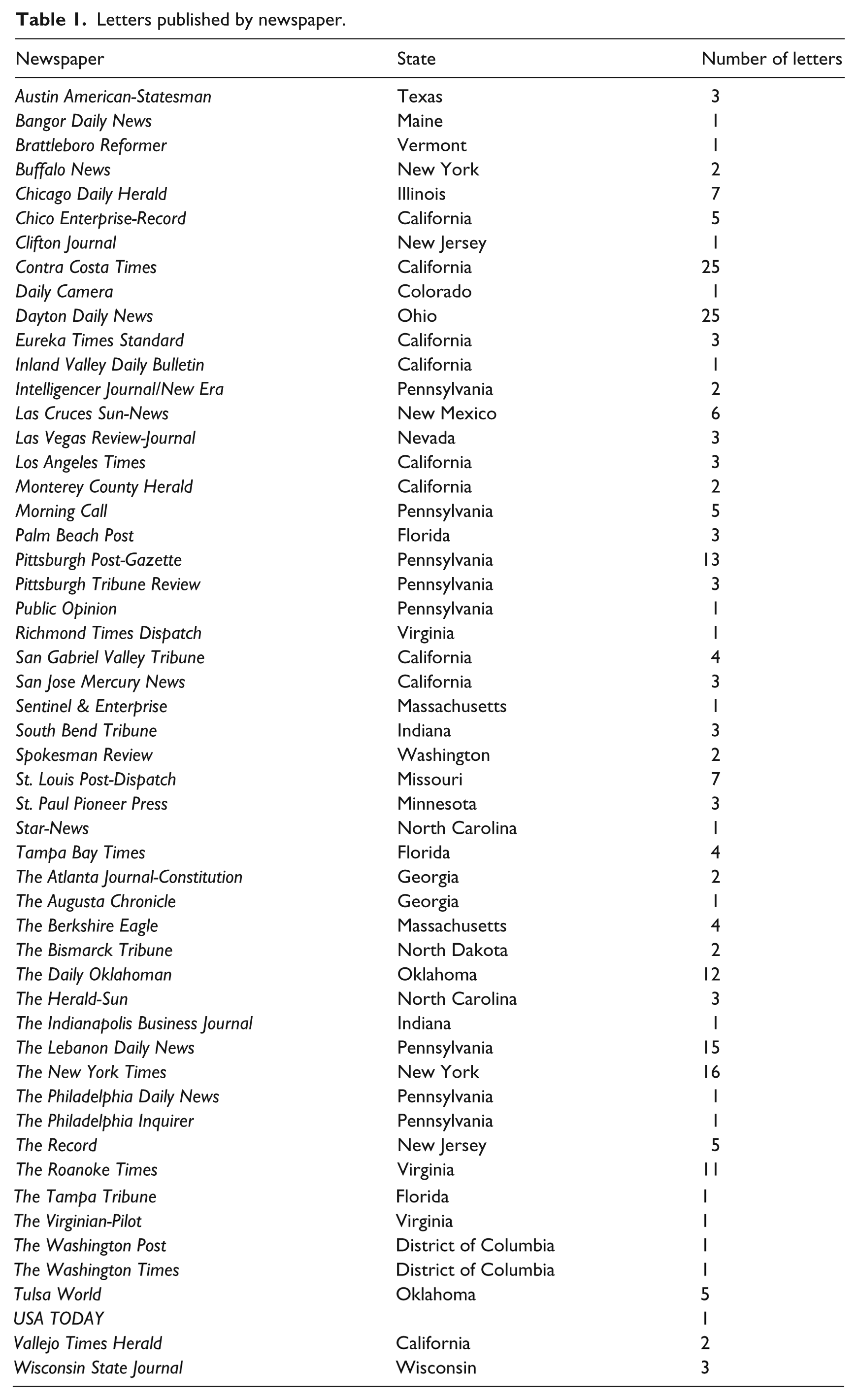
Letters to the editor were collected from the LexisNexis Academic database on 25 August 2013. Using the search terms intelligent design, evolution, creationism, creation science, Darwin, and letter, we obtained 234 letters to the editor published in 24 states and Washington, DC between 26 August 2012 and 23 August 2013. Table 1 lists number of letters published by each newspaper.
Letters published by newspaper.
The groundwork for this content analysis comes from an ongoing qualitative analysis wherein the first author (E.O.S.) has explored the more general framing processes that occur in discourse over ET in the public sphere (Silva, 2013, 2014). After a period of training, we established a codebook for measuring the position taken toward ET within the letters and the extent to which the letters depicted scientists as supporting or opposing ET. One insight taken from previous research is that the discourse has many permutations. There are points on which some creationists agree with evolutionists and disagree with their allies. Compounding matters is the fact that letters do not all address the same issues. For instance, some directly address educational policy while others debate the definition of science. Finally, letters are variably articulate. Patterns, however, do emerge.
To measure the position of the letter regarding ET instruction, we accounted for a number of factors that were discovered in the qualitative analysis of evolution discourse. One factor is whether the letter acknowledged the controversy. Another factor is whether the letter offered an opinion on ET, advocates for or against ET, and/or the way in which ET should be taught. From these factors, we established four codes: hegemonic ET, pro-ET, neutral, and anti-ET. If a letter discussed evolution without acknowledging that there is opposition to it, the letter was coded “hegemonic ET.” For example, a letter takes ET for granted while discussing new research. If a letter included a mention of ET, but did not offer an opinion discriminating between the two sides, it was coded as neutral, for example, a letter briefly referring to the controversy before moving on to other matters. The remaining codes were for letters that discussed ET, acknowledged the controversy, and offered an opinion. If a letter opposed any move to limit ET in the classroom or to promote alternatives in the classroom, it was coded pro-ET. Some letters provide indirect support for teaching the theory, that is, the letters contain arguments that are used in the discourse to justify teaching it, even if the letter itself does not mention education policy. For example, a letter that includes the claim that ET is supported by evidence, or a letter that uses the label “creationist” to discredit conservative politicians. Conversely, if a letter advocated undermining ET in the classroom, it was coded as anti-ET. For example, the assertion that ET should be taught along with creationism or that evidence for and against ET should be taught. Letters were also coded anti-ET if they offered justifications for rejecting the theory without explicitly addressing educational policy. For instance, if a letter argued that ET lacks evidence. Confidence intervals were used to establish the statistical significance of differences in proportions.
We used cross-tabulation to determine whether there was a statistically significant relationship between statewide opposition to ET and the relative frequency of pro- and anti-ET discourse. The statewide opposition variable is drawn from Berkman and Plutzer (2010). We combined pro-ET and hegemonic ET into one category and used anti-ET as the second category. Neutral letters were excluded and one letter from USA Today was not included because the paper is not associated with a particular state.
We also measured for whether or not letters claimed that scientists accept or reject ET. There are a number of gradations to the claim to scientific authority. For our purposes, we counted letters as including a claim that scientists support or oppose ET if it mentioned the opinion of a person who has post-graduate training in a field that is relevant to biological origins (i.e. natural science, anthropology, psychology, medicine). We did not include citations of those who are scientifically minded, engineers, secondary science teachers, undergraduate science majors, or Darwin. Additionally, we did not count instances where scientific credentials of a person being cited were undermined. The scientists were cited in many ways. Below we present two codes: any scientists and many scientists. The first measure is any claim that any scientist(s) support (or oppose) ET. This code applied to letters mentioning the opinion of one scientist, particular scientists, and/or all scientists. The second measure of scientific support is that many scientists support (or oppose) ET. That is, the letter mentions the opinion of scientists in general, the majority of scientists, a large number of scientists, or scientific organizations. Confidence intervals were used to test the statistical significance of differences between anti-evolutionist and pro-evolutionist letters’ tendency to cite scientists.
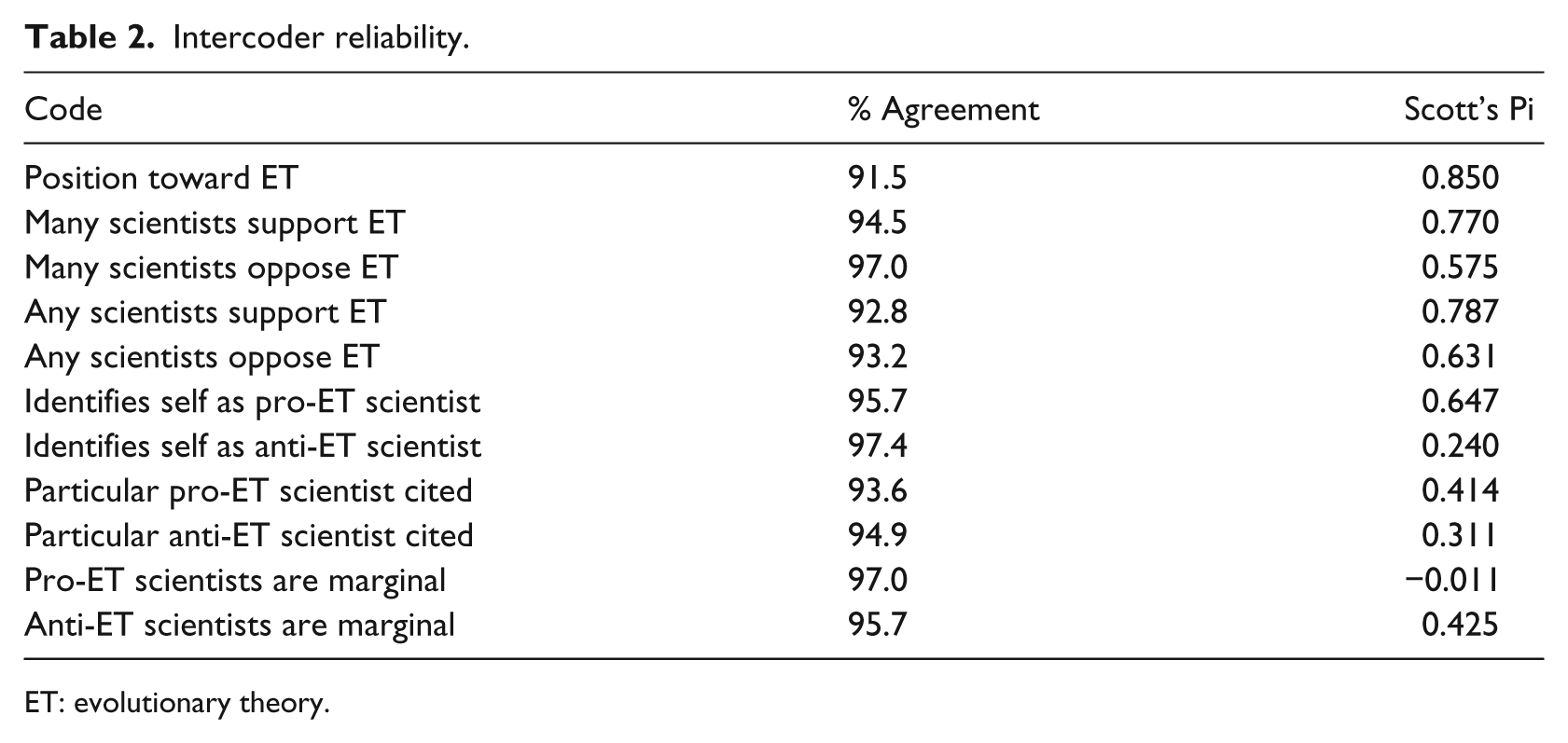
Each author independently coded all of the letters. ReCal was used to assess intercoder reliability (Freelon, 2010). Table 2 lists the percent agreement and Scott’s Pi for each code. Given the exploratory nature of this study and the conservative nature of Scott’s Pi, 0.7 was deemed as an appropriate minimum level of intercoder reliability (see Lombard et al., 2002; Neuendorf, 2002). Three of the codes (position toward ET, many scientists support ET, and any scientists support ET) had sufficient intercoder reliability. Two codes, many scientists oppose ET and any scientists oppose ET, were also kept despite having suboptimal reliability because they complement codes that had sufficient reliability, there was a high percentage of agreement, and there is some support for accepting reliability coefficients between 0.4 and 0.75 (Neuendorf, 2002). The other codes for measuring claims to scientific support or opposition to ET that lacked sufficient intercoder reliability (e.g. author claims to be an anti-ET scientist) were excluded from the analysis. The low intercoder reliability for all but three codes does suggest that more qualitative work is needed to create an improved codebook and to better understand how scientists are cited in the public sphere. We then collectively re-analyzed the letters that had received different codes. Finally, we performed a qualitative analysis of the data to examine how letter writers managed to “unacknowledge” (Silva, 2014) the support of the scientific community. The results of this analysis will be presented in a separate paper. In doing so, we found seven additional instances where scientists were cited and one case where a letter coded as citing a scientist was only a partial citation.
Intercoder reliability.
ET: evolutionary theory.
3. Results
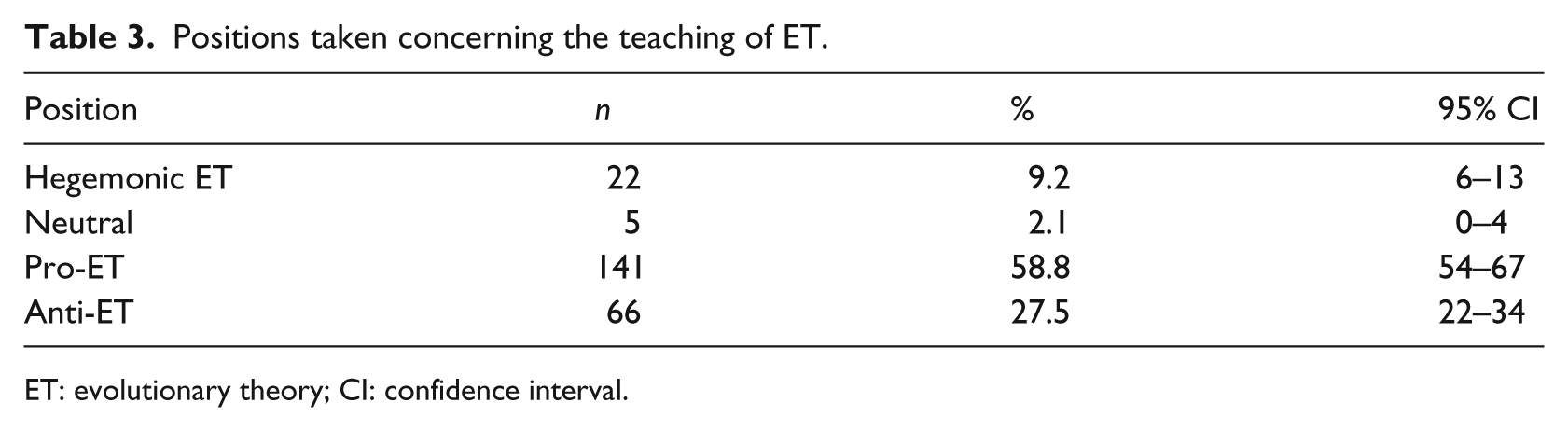
The positions taken toward the teaching of ET in the letters are presented in Table 3. A majority, 58.8% of the letters, either explicitly supported the unadulterated teaching of ET in public schools and/or they included arguments that supported the status quo. Another 9.2% of the letters accepted ET as a given without recognizing any controversy. Only 2.1% of letters did not lend support to either side of the debate. Finally, 27.5% of the letters sought to weaken the teaching of ET or used arguments that lent support to such a position. The difference between pro-ET and anti-ET letters is statistically significant.
Positions taken concerning the teaching of ET.
ET: evolutionary theory; CI: confidence interval.
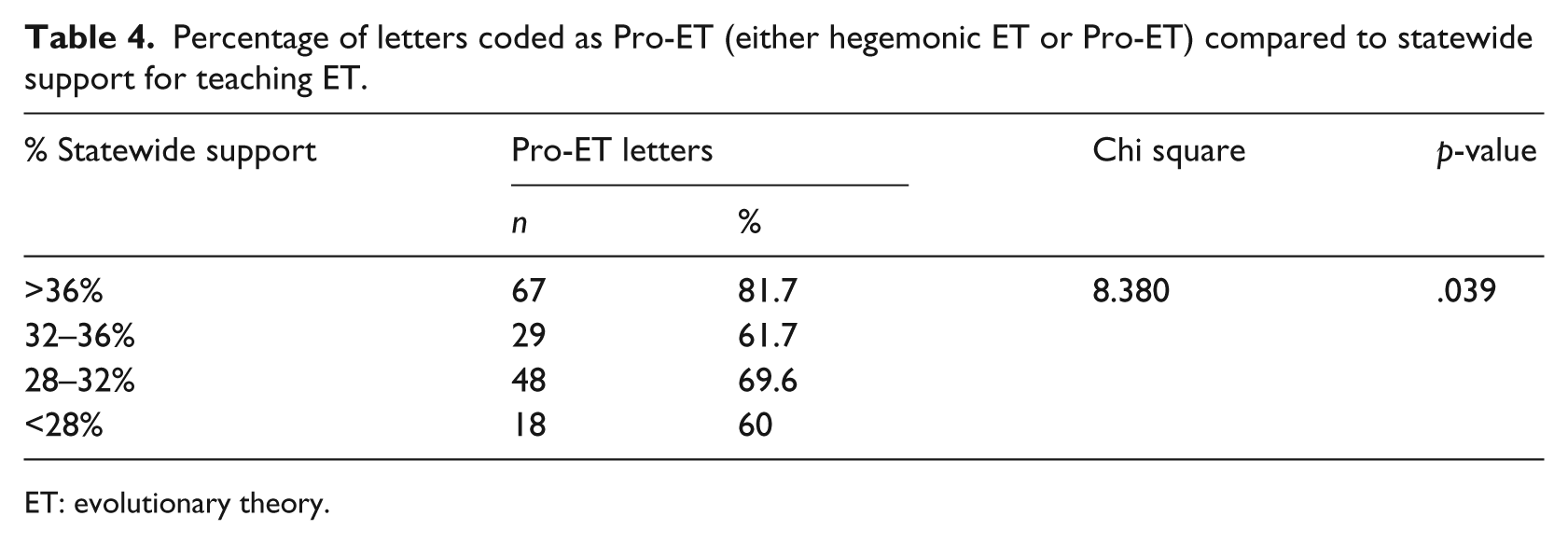
Table 4 outlines how the support for ET in the letters to the editor section varies by the public support for ET instruction in public schools. While there is a statistically significant difference between the positions toward ET taken in letters published in states that have comparatively high support for ET and letters published in states with less support, the discourse is decidedly pro-ET regardless of statewide opinion.
Percentage of letters coded as Pro-ET (either hegemonic ET or Pro-ET) compared to statewide support for teaching ET.
ET: evolutionary theory.
Table 5 shows the results of the coding for citations of any and many scientists. Relatively few letters, 14.1%, claim that many scientists accept ET, while 23.5% mention any scientists support ET. Interestingly, there was no statistically significant difference in the likelihood that anti-ET and pro/hegemonic ET letters would mention the support of many scientists for ET (10.6% vs 16%, respectively) or any scientific support (19.7% vs 25.8%, respectively). Only 2.1% of letters mentioned that many scientists are anti-ET. Unsurprisingly, all such mentions are found in anti-ET letters. A mere 8.1% of the letters made any mention of scientific opposition to ET. Anti-evolutionists were statistically more likely to do so (15.2% vs 5.5%).
Appeals to the authority of the scientists as being supportive of, or oppositional to, ET.
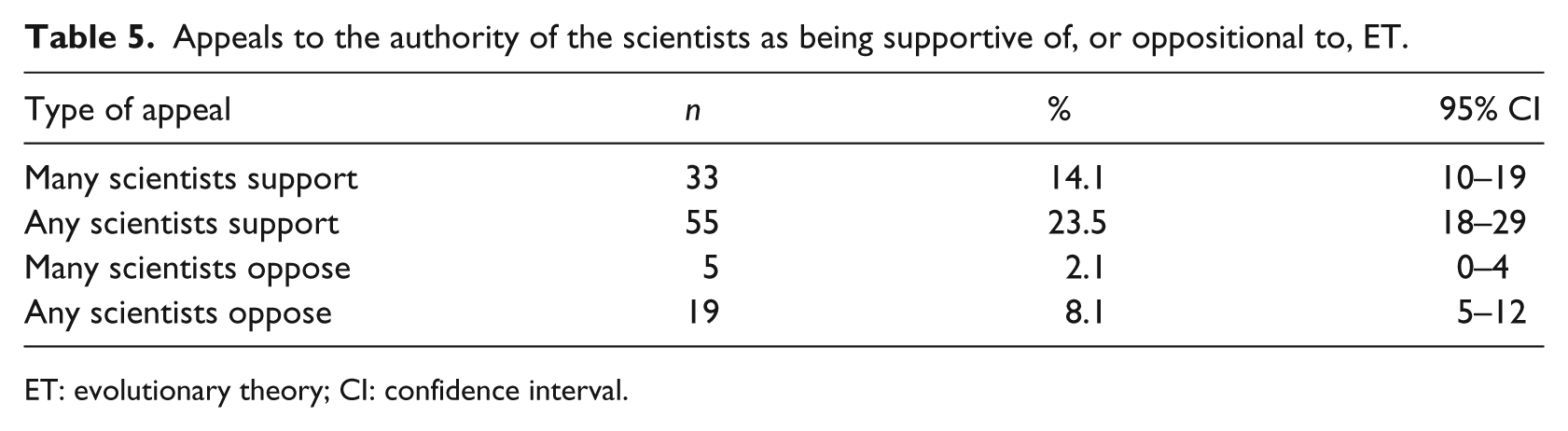
ET: evolutionary theory; CI: confidence interval.
4. Discussion
When these findings are considered alongside other studies of the media (Allgaier, 2010; McCune, 2003; Martin et al., 2006; Shortell, 2011), it would seem that there are comparatively few positive definitions of creationism in the media. The fact that scientists accept evolution, however, is often absent from the letters. The findings of this exploratory study provide some insights about the persistence of anti-evolutionism in a society where people claim to respect scientists.
The supremacy of pro-evolution arguments contributes to the impression that the generalized other (Mead, 1934) accepts evolution. This finding is significant for two reasons. First, the preponderance of arguments supporting evolution suggests that creationism lacks public legitimacy (see Koopmans and Olzak, 2004). If one believes that one’s neighbors or the generalized other are pro-ET, then, she might be less willing to actively oppose it. That said, the letters section might provide enough of a sanctuary for anti-evolutionist messages to help sustain anti-evolutionist opinions (see Young, 2011).
Second, an evolutionist generalized other might strengthen anti-evolutionist identities by amplifying the ideological distance between themselves and their neighbors. Creationism is sustained, in part, through belonging to networks that are homogenously anti-evolutionist (Hill, 2014). Media coverage, including letters to the editor, allows anti-evolutionists to experience a tension with people that they do not typically encounter. Such tension can strengthen a religious identity (Smith et al., 1998). Even in the most anti-evolutionist regions of the United States, the discourse in letters to the editor was pro-ET.
While the letters tend to support the acceptance of ET, they often fail to note that scientists accept it. Importantly, the scientific support is obscured by evolution advocates and opponents. Dingwall and Aldridge (2006) argue that weaknesses in scientific educational programming provide an opening for creationist discourse. Similarly, it could be that letters support anti-evolutionism not only by providing a microphone to anti-evolutionists but also by presenting an impoverished pro-ET perspective. Symbolic interactionism suggests that the absence of citations of scientists would make it easier for anti-evolutionists to reject ET without having to define oneself as anti-scientist.
The results of this project suggest some new directions for the study of the conflict over teaching evolution. Other sites in the public sphere should be explored. It would be interesting to measure the support for ET in online forms of communication (e.g. blogs, online comments sections), which have even less editorial constraint than letters to the editor. Also, as noted in the methods section, there is a need for more qualitative analysis of how creationists neutralize scientists’ opinions. Doing so will help us further understand the mechanisms by which anti-evolutionists sustain their disagreement with the scientific community.
Footnotes
Acknowledgements
We wish to thank William Smith and the anonymous reviewers for their comments.
Funding
This research received no specific grant from any funding agency in the public, commercial, or not-for-profit sectors.