



Abstract
We empirically examine the reporting on biotechnology in Kenyan and international newspapers between 2010 and early 2014. We identify news articles that reported on biotechnology and analyze their use of words to determine whether there is a balance in the reporting of perceived risks and benefits. We also consider how the sources used in news articles and how the publication of the Séralini study of rats fed genetically modified maize affect the balance of reporting of perceived risks and benefits. We find that in Kenyan news reporting, more articles mention perceived benefits than risks, but when risks are mentioned, new articles contain more references to risks than to benefits. We also find that sources affect the reporting of perceived risks and benefits and that the Séralini study increased the likelihood that perceived risks are reported in Kenyan news reporting, but not in international newspapers.
1. Introduction
There is ongoing debate about whether biotechnology, and more specifically, genetically modified (GM) crops, must contribute to Africa being able to overcome food insecurity (Hazell, 2013; Quaye et al., 2012). How biotechnology is reported in the news media affects the attitudes and opinions of members of society (Marks et al., 2007; Vilella-Vila and Costa-Font, 2008).
Numerous studies have documented variations in how the media report on the benefits and risks of GM crops and foods in developed countries such as the United States, Canada, and Europe (e.g. Bauer, 2005), and have concluded that coverage themes changed in the late 1990s from opportunity and scientific progress to perceived risks and threats (Bauer et al., 2001). For example, Marks et al. (2007) asked whether media in the United States and United Kingdom emphasized coverage of the risks or benefits of GM crops and concluded that coverage was generally negative. Augoustinos et al. (2009) analyzed how different stakeholders in the GM foods discussion were represented in stories from six British newspapers and found the British public generally opposed them. Additional studies looked at how the use of sources impacted stories. For example, Maeseele and Schuurman (2008) found that news articles in Belgium on GM crops relied more on environmental and social actors rather than science and industry over time, which correlated with a greater reporting on perceived risks than benefits.
While some research has focused on biotechnology reporting in a few developing countries, such as Colombia (Parales-Quenza, 2004), China (Zhong et al., 2002), and India (Yamaguchi and Harris, 2004), little research has focused on media reporting in Africa, and what research exists tends to be primarily descriptive. For example, Kameri-Mbote (2005) provides examples of statements about GM foods in Kenyan newspapers between 2002 and 2004, but gives no formal analysis of the content. Recently, Lore et al. (2013) examined the frequency and nature of coverage of GM foods in Kenya between 2007 and 2009. They found that there has been relatively low coverage of biotechnology issues in Kenyan newspapers and that a majority of published news articles emphasized either perceived benefits or risks of biotechnology.
Research and development of GM cassava is currently being undertaken in Kenya in hopes of improving food security. Cassava is a staple food for many Kenyans, and has been GM to be resistant to cassava mosaic virus and cassava brown streak disease (Taylor et al., 2012). The Kenyan Parliament introduced a Biosafety Bill in 2005 to bring regulation and oversight to research on genetically modified organisms (GMOs). After years of delays, the bill went into effect in 2010 (Njagi, 2010) and established the National Biosafety Authority so as to provide research guidelines for GMOs in Kenya, particularly focusing on minimizing risks. However, a paper by Séralini et al. (2012) linking consumption of GM corn to cancer in rats led Kenya’s Minister for Public Health to call for a ban on growing or importing GM crops without consulting the National Biosafety Authority. Kenya enacted the ban later that year, and it remains in place despite the Séralini paper’s retraction in 2013 (Willingham, 2012). The United States Department of Agriculture’s (USDA’s) Foreign Agricultural Service predicted the ban would seriously affect Kenya’s ability to address the public’s demand for maize (Snipes and Kamau, 2012). Some also suggested that Kenya’s bypassing of its GM regulatory body could set a dangerous precedent for other countries deciding their GM policies (Nordling, 2012). As of 2012, only four African countries—Burkina Faso, Egypt, Sudan, and South Africa—have approved commercialized GM crops (AllAfrica, 2013).
In this context, we initiated a study to explore how the perceived risks and benefits of the development of GM cassava were being communicated to stakeholders (see James et al., 2014; Valdivia et al., 2014). We examined articles in Kenyan and international newspapers between 2010 and early 2014 that reported on biotechnology in Kenya and Africa to assess their reporting of perceived risks and benefits. By comparing coverage in Kenya with a sample of international newspapers, we are able to answer the following research questions:
Have the Kenyan news media provided a balanced reporting of perceived risks and benefits of GMOs compared to international newspapers?
Do the sources that media use affect the balance of reporting of perceived risks and benefits of GMOs in Kenya?
Has the publication of the Séralini study affected the balance of reporting in Kenya?
We use the term “balance” to assess the number of times items of risks compared to items of benefits are reported in news articles. Balance does not refer to an equal treatment of partisan perspectives, even though research suggests that “partisan groups … appear to see mass media content as biased against their own point of view” (Schmitt et al., 2004: 623). Balance also does not mean that news articles have a neutral “tone,” as we explain in more detail below, in contrast to an article that can be interpreted as negative or positive. Therefore, we use the word “bias” to mean an overweighting of references to either benefits or risks in news articles. We also use the terms “biotechnology” and “genetic modification” interchangeably.
Our study contributes to the literature by improving our understanding of how media report on GMOs in African nations and also provides a comparative analysis to the international community—an approach that is absent from media bias studies. This comparative approach facilitates a relative assessment of bias as well as an assessment of the impact of widely publicized research on biotechnology and the importance of sources of information on media reporting in Africa. Our study also contributes to an understanding of the balance of reporting risks and benefits of new technologies. The publication of the Séralini study is important because it appears to have affected government policy in Kenya. If there is a disconnect between science and public policy and understanding as some scholars note (see, for instance, Clough, 2011), and if media is a bridge, then it is useful to determine what affects the balance of media reporting.
2. Research context and framing
Newspapers in Kenya
Print newspapers in Kenya reach about a quarter of the population weekly. The majority of readers are relatively young (between ages 18 and 34 years), affluent, male, and live in major urban centers such as Nairobi (Mzungu, 2013). The sharing of newspapers is common, with an average pass along rate of 15 people per paper (Obonyo, 2011), as is the reading of headlines for free. Part of the reason why wealthier Kenyans are the majority of readers could be the cost of purchasing a daily copy. The Daily Nation, for example, costs 60 Kenyan shilling cents per issue, or approximately 70 cents in US dollars—a nontrivial amount given the country ranks 152 out of 182 in per capita national income (World Bank, 2014). In addition to their urban reach, government officials in Kenya consider newspapers better news sources than television or radio for deciding how to shape their policy ideas (InterMedia, 2010). Some of the country’s most significant newspapers include The Nation, the country’s biggest daily paper, with a combined daily and weekly readership of more than 5 million (Nyabuga and Booker, 2013); The Star, Kenya’s third-largest paper; Business Daily, Nation Media’s business-specific title; and the East African, Nation Media’s weekly paper covering Kenya, Tanzania, Uganda, and Rwanda.
In contrast, radio and television have expanded in rural areas thanks to growing access to electricity and the lowering cost of broadcast receivers (Mzungu, 2013). Radio is important in rural areas because of high levels of illiteracy among rural residents. That said, newspaper articles are an important influence in rural as well as urban areas of Kenya and other east African countries. The reason is that many radio programs, especially talk radio, rely on newspaper articles as sources for topics of discussion, often reading news articles directly on the air (Mwesige, 2004).
Media and public opinion
Two closely related theories form the backbone of research in the ways media influence public opinion: framing and agenda setting. Agenda setting is the mass media’s ability to direct public attention to specific issues or people by what it chooses to cover or not cover. The idea was crystallized by McCombs and Shaw (1972), who found a strong correlation between what issues news media emphasized in their coverage and what voters in the 1968 presidential campaign judged to be important. Although both framing and agenda setting were examined early on in political news, later research applied the theories to contexts such as climate change coverage (Dirikx and Gelders, 2010) and knowledge and interest in foreign affairs (Aalberg et al., 2013). Framing uses techniques to organize language and thoughts to give certain pieces of information higher priority (Fairhurst and Sarr, 1996). According to Entman (1993), “Journalists may follow the rules for ‘objective’ reporting and yet convey a dominant framing of the news that prevents most audience members from making a balanced assessment of a situation.” (p. 56)
The concept of framing in media is, in essence, about selection. Journalists construct frames by deciding which ideas or perspectives appear earliest and most often in a story. An important part of framing is word choice, as evidenced by Fairhurst and Sarr’s (1996) list of framing techniques, which included metaphor, jargon, contrasts, and spin. Whether written or spoken, the words chosen by news media to convey information can affect how that information is received.
The category of framing that affects decision-making positively or negatively is known as valence framing effects. Three kinds of valence framing effects exist. The first is risky choice framing, in which the decision-maker is presented with “sure thing” and risky options, with the pair either framed positively or negatively (Tversky and Kahneman, 1981). The second kind is goal framing, in which the outcomes of a choice are described as receiving gains or avoiding losses (Levin et al., 1998). The third is attribute framing, in which a particular characteristic of an object or event (e.g. the fat content of ground beef) is described in a negative (e.g. contains 5% fat) or positive (e.g. 95% fat-free) manner (Holleman and Pander Maat, 2009).
Coverage of the GM discourse seems to most closely follow the attribute framing model; in this case, the characteristic is the genetic modification of crops and the words shaping the frames are defined in terms of perceived benefits and risks. For example, Lore et al. (2013) identified articles searching for specific words related to risks and benefits, such as “genetically modified food is harmful …” (p. 141). However, unlike Lore et al. (2013), who coded these attribute words for positive, negative, or neutral tone, we seek only to identify the attributes. That is, we identify only whether the words used in media coverage of biotechnology are those reflecting risks, benefits, or both, consistent with our definition of balance as having a generally equal presentation of risks and benefits. There are several reasons for this. First, it is often difficult to assess overall tone from a short list of words. For example, the word “harmful” could be used to express a negative tone, as in “GM crops are harmful to humans.” However, it is not clear that the opposite statement, “GM crops are not harmful to humans” is necessarily a positive tone. Second, “people can accept risks … if there are tangible benefits associated with them” (Marks, 2001: 153). Moreover, different readers might attribute a different tone to a given statement depending on their understanding and preconceived expectations about GM technology. Third, words such as risk and harm are unipolar—meaning they have no single, natural opposite—as opposed to bipolar words such as “hot” and “cold,” which do have clear opposites. As a result, when the former are framed as negations (e.g. “not harmful”), they may cause the reader to think of associations with what is being negated (“harmful,” in this case) rather than with the intended meaning (Schul, 2011).
Source selection in GMO reporting
Sourcing is a significant area of influence in journalism. Journalists typically choose sources according to three criteria: source availability, the journalist’s adherence to objectivity, and the context surrounding the interview, including prior research (Seo and Lim, 2008). This can give some sources an advantage over others in being heard by the public. Gans (1979) said government officials tend to be the easiest for journalists to access because of frequent contact and their accountability to the public. Access can also work the other way; sources in positions of political or economic strength tend to get easier access to journalists when they have a message to get out. As long as the source has the right “standing”—in other words, is seen by the media as having a “voice” on the subject—and frames its views to journalists well, the odds of successfully getting its message out improves (Ferree et al., 2002). Official sources further increase their chances by tailoring their language and thought process to match those of the journalists’ newsrooms and conventions (Sigal, 1973).
Another major influence on the media can be the audience they are trying to serve. Gamson and Modigliani (1989) said policy issues have their own culture and viewpoint “packages,” which are sponsored by groups such as government entities, non-governmental organizations (NGOs), and corporations. They also have their own media discourse, which interacts with public opinion (a two-way influence) rather than dictating or setting it (a one-way influence). As a result, the more available a sponsor makes its viewpoint “package,” the more likely it is to have that package prevail with the media.
Research exists looking at how source choices impact the frames of biotechnology stories (e.g. Parales-Quenza, 2004), along with examples in specific nations, such as India, (Yamaguchi and Harris, 2004) and Belgium (Maeseele and Schuurman, 2008). While analyses of Kenyan media also take sourcing into account, the studies tended to be descriptive rather than analytical. Kameri-Mbote (2005) found “many pronouncements made by diverse actors at diverse fora” (p. 20). The Panos Institute (2005) showed scientists and government officials in Brazil, India, Kenya, Thailand, and Zambia to be the most quoted sources while farmers were left out almost entirely. Finally, Lore et al. (2013) studied GM coverage in three of Kenya’s daily newspapers—the Daily Nation, The Standard, and Taifa Leo—from June 2007 to August 2009 and found scientists and government officials were by far the most represented sources.
Summary
The GM debate in Kenya has undergone significant development, especially since the publication of the Séralini study that helped motivate a government ban on GM crops in the country. Our research thus aims to give a more up-to-date picture of the media reporting in Kenya’s newspapers, particularly looking at the time immediately before and after the Séralini study was released. Although there is a growing body of research on media reporting of biotechnology, very little research examines media reporting in Africa generally or Kenya in particular. What Kenya-specific findings exist are now dated, and the country’s demographic, media, and GMO legislation circumstances have all changed. Past research also concentrated either on an individual country or a group of countries compared against one another. In this article, we fill these gaps by examining the media reporting and source use in present-day Kenya while comparing it to a benchmark global perspective as found in major print media worldwide.
3. Methods and procedures
Using LexisNexis and Factiva newspaper databases, we conducted Boolean searches to collect digital samples of news articles containing words associated with biotechnology, genetic modification, and their variations. Specific keywords used in our search were, biotechnology, agrobiotech, genetically engineered food, genetically engineered organism, GMO, and GMO and their variations. We also confined our search to news articles that referred to Kenya, Africa, or African. We focused our study in the January 2010–March 2014 time period, in part to extend the Lore et al. (2013) study, which ended with news articles in August 2009. We divided all news articles that fit these search criteria into two groups—articles from Kenyan and east African newspapers and articles from non-East African and international newspapers. There are four Kenyan newspapers in our sample: The Nation, the Nairobi Star, East African, and the Business Daily. Of note is that The Standard, Kenya’s second-largest newspaper by circulation, was not included in our sample because it is unavailable in the database used for this study. Newspapers remaining in our international sample included USA Today, The New York Times, Associated Press, and the Financial Times, as well as 28 other newspapers (most of the 28 other newspapers contained only one article that met our search criteria; see Table 1 for a complete list of newspapers). Our sample contains 164 articles from Kenyan newspapers and 100 articles from the international set. We note that our sample of news articles and the newspapers containing them did not include all news articles published during the time period on biotechnology. Rather, the news articles were those that focused on Kenya or Africa. In other words, all news articles in our sample included at least one word relating to biotechnology and one word relating either to Kenya or Africa. The reason was that we wanted articles that would have been relevant to the GM debate in Kenya. By retaining an international sample of similar articles, we seek to determine whether there is any bias in the reporting of biotechnology in Kenyan newspapers; the international sample thus gives us a benchmark for comparison.
Variable descriptions and summary statistics.

SD: standard deviation; GMO: genetically modified organism; NGO: non-governmental organization.
Mean values in bold are statistically different at the 5% level in two-tailed difference of means tests comparing the Kenyan with the international sample.
Once articles were retrieved from the searches, they were saved as text files and then imported into SimStat to construct Kenyan and International media databases. We used SimStat/WordStat software to identify specific words in each article, focusing on economic and environmental risks and benefits. In particular, we used the Keyword-In-Context tool of WordStat to identify the frequency of words related to risks and benefits (and their plurals and variations), as well as source types and newspaper for each article. Words coded as risks included “risk,” “contaminate,” and “harm/harmful.” Words coded as benefits included “benefit” and “safe” and phrases relating to “increased crop yields” and “reduced production costs.” In order to identify sources used in news articles, we used SimStat/WordStat to identify all articles containing the words “according to,” “said,” or “says.” Then, two researchers made an evaluation of whether the source referred to was one of the following five sources: Governments, NGOs, scientists, businesses, and others. Governments and NGOs were identified or recognized by name of governmental agency or NGO. Businesses were identified by name of the business. Scientists were identified by title of “professor” or “doctor,” except when they were speaking on behalf of a government agency, business, or NGO for whom they worked. News sources that did not fit one of these criteria were listed as “other.” For newspapers, we coded articles according to the name of the newspaper from which the article was published. We also identified the publication date for each article. We inputted the data into a spreadsheet file and used SAS to conduct the statistical analysis.
Our empirical strategy follows the following steps. First, we model the differences in reporting of benefits and risks using the following econometric model based on Marks et al. (2007)

where DIF measures the difference between the number of times words associated with benefits and risks occur in each article, SÉRALINI codes articles published since the release of the Séralini study, log(TIME) measures the time trend in months, SOURCE refers to the source type (whether the article referenced Government, NGOs, scientists, businesses, or other), NEWSPAPER denotes the newspaper in which the article was published, β’s are parameters to be estimated, and ϵ is the error term. We estimated the model using ordinary least squares (OLS), checking the variance inflation factors (VIFs) to ensure there was minimal multicollinearity in the data.
Second, to investigate how the right-hand-side variables affect the probability of reporting of benefits and risks, we estimated Probit models for benefits and risks separately using the following models


where BENEFICIAL denotes a dichotomous variable equal to 1 if an article had at least one reference to benefits (and its variants), 0 otherwise; and RISKY denotes a dichotomous variable equal to 1 if an article had at least one reference to risk (and its variants), 0 otherwise.
4. Results
Table 1 presents the variables used in the study, as well as their descriptions and summary statistics. Articles in Kenyan and international newspapers about biotechnology contained, on average, more references to perceived risk than benefits, with Kenyan newspapers reporting statistically fewer benefits than articles in the international sample in a two-tailed t-test. Moreover, a greater percentage of international newspaper articles contained at least one reference to risk (44%) and at least one reference to benefits (58%) compared to Kenyan newspapers (31% and 48%, respectively); these differences are statistically significant. In both cases of Kenyan and international newspapers, articles were more likely to contain a reference to a benefit than to a risk. Thus, in the Kenyan sample of newspapers, media reports were more likely to contain a reference to perceived benefits of biotechnology than to references about risks, but when risks are mentioned there are more of them described per article than those of benefits. In contrast, while international newspapers were also more likely to contain a reference to benefits from biotechnology than a reference to risks, when benefits and risks are reported, the average number of occurrences per article is approximately the same.
When considering sources for information about biotechnology, Kenyan newspapers, compared to the international sample, were less likely to cite NGOs and businesses, but more likely to refer to government sources. Both Kenyan and international newspapers relied approximately equally on scientists as sources for information.
Figure 1 shows the total number of articles by month for Kenyan and international news articles between January 2010 and March 2014 that reported on biotechnology and also referenced Kenya, Africa, or African. The data reveal several interesting patterns. The peak in Kenyan coverage in July and August 2011 coincides with the date on which the Biosafety Act came into effect. A similar peak occurs in the international sample but emerges several months earlier. The peaks near the end of 2012 and 2013 in international media coincide with the release and subsequent retraction of the Séralini study. While both Kenyan and international newspapers referenced the Séralini study, the distribution of articles in our sample of newspapers differed. In particular, eight Kenyan news articles and 21 international news articles specifically mentioned the Séralini study. However, while more than half of the international news articles published in November and December of 2012 and 2013 referred to the Séralini study (thus contributing to the peaks), the articles in Kenyan newspapers that mentioned the Séralini study were more evenly distributed during 2013 and early 2014.

Total monthly reporting on GMOs in Kenyan and International newspapers from January 2010 to March 2014.
Table 2 shows the number of articles reporting on GMOs in Kenya and in the international sample by newspaper type, as well as the frequency of articles containing references to risks and benefits. Patterns of sources are reported in Table 3. In Kenya, The Nation had the largest number of articles on GM topics, containing about 43% of the total number of articles in the Kenyan sample. In contrast, the international newspaper with the largest number of articles on biotechnology was the Financial Times, with 26% of the articles in that sample. We also observe the following. First, while one-third of Kenyan news articles specifically referenced one of our indicators of risk, and slightly less than half mentioned one of the indicators of benefits, the distribution among newspapers was not even. For example, of the four Kenyan papers in our sample, the Nairobi Star reported the least often on benefits of GMOs—in one-fourth of their news stories—while the Business Daily mentioned benefits of some type in at least two-thirds of their news articles. There was also a relatively large distribution of reporting of risks and benefits in the international newspapers. For example, USA Today mentioned benefits in about one-third of the articles it published during the time period on GMOs, and mentioned some type of risk in only two news stories. In contrast, the Financial Times referred to benefits in nearly 77% of the articles it published, while mentioning one of our indicators of risk less than half the time. Second, as suggested in Table 1, none of the four Kenyan and four main international newspapers listed in Table 2 referred to risks in more articles than to benefits. Third, while on average newspapers in Kenya and internationally cited sources at least 80% of the time, there was variation in the types of sources used. Kenyan newspapers cited government most often, followed by scientists and then NGO sources. In contrast, the international newspapers in our sample referred to NGOs as sources in nearly half of the news articles on GMOs, with the use of scientists slightly less often (at 44% of the time). Of the Kenyan newspapers, the East African utilized sources in the largest number of GMO news articles; in this case, more than 90% of the time. The Nation referred to sources the least often of the four Kenyan newspapers in our sample, referring to them roughly 74% of the time.
Article frequency and percent by frame and newspaper for Kenya and the international sample.
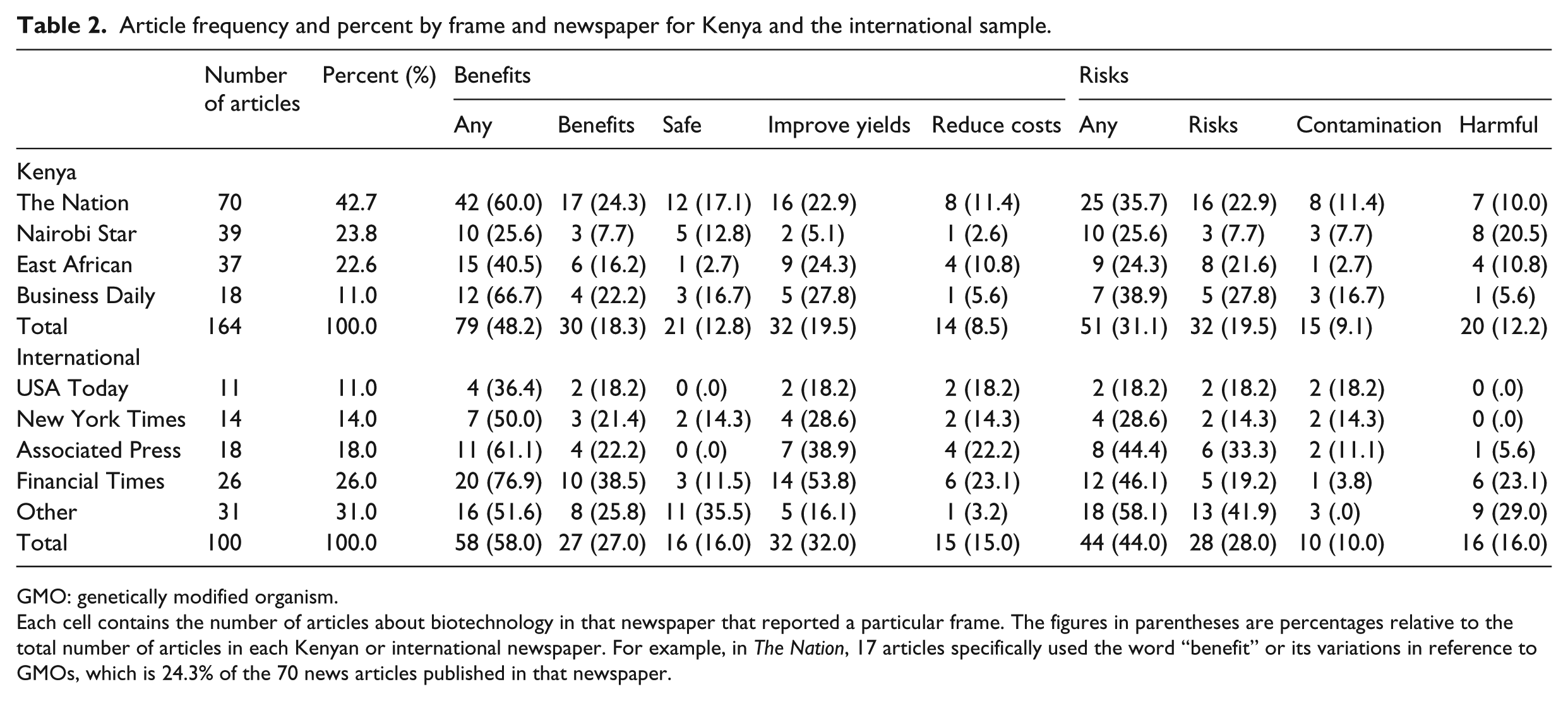
GMO: genetically modified organism.
Each cell contains the number of articles about biotechnology in that newspaper that reported a particular frame. The figures in parentheses are percentages relative to the total number of articles in each Kenyan or international newspaper. For example, in The Nation, 17 articles specifically used the word “benefit” or its variations in reference to GMOs, which is 24.3% of the 70 news articles published in that newspaper.
Article frequency and percent by source type and newspaper for Kenya and the international sample.
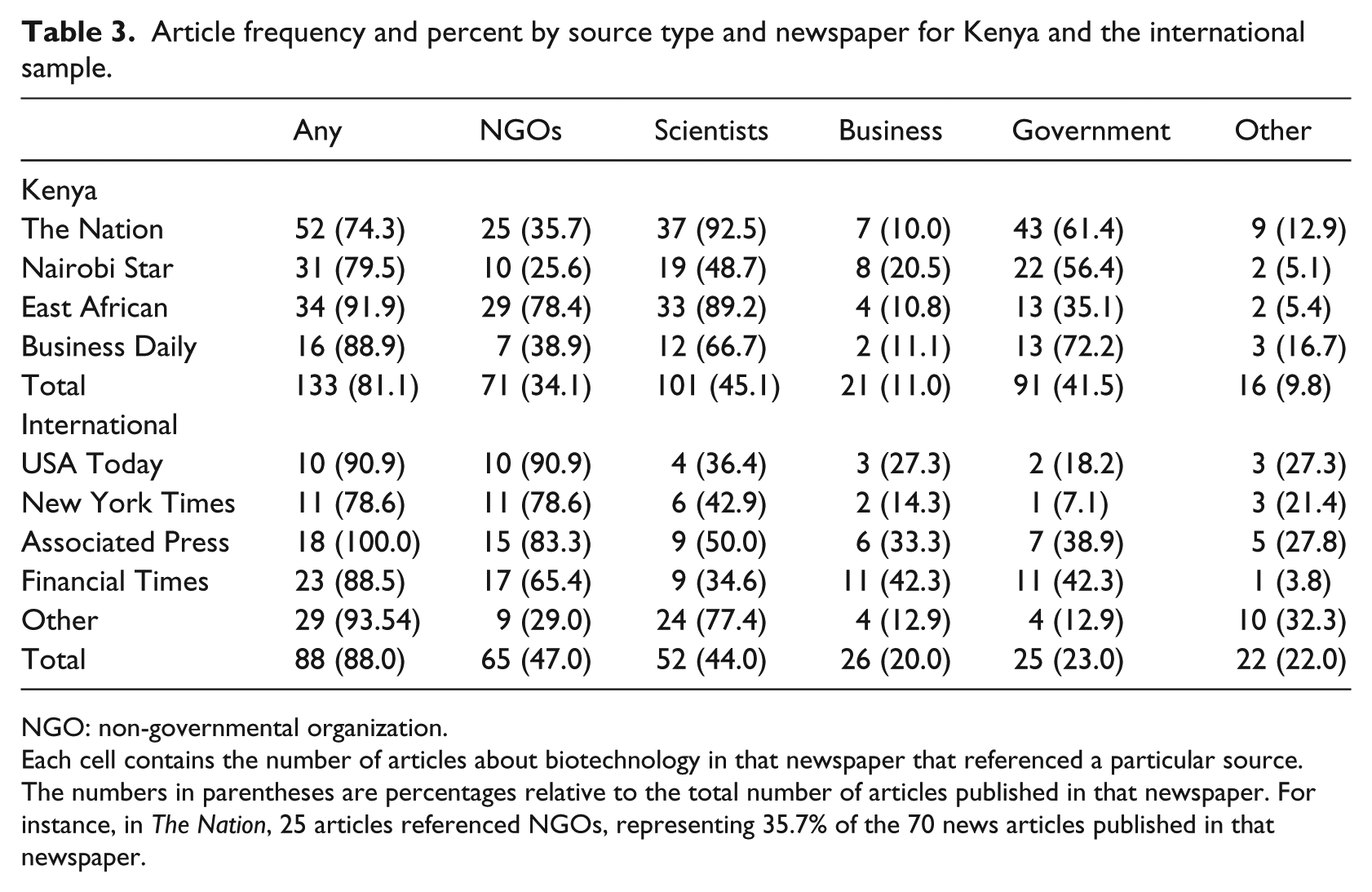
NGO: non-governmental organization.
Each cell contains the number of articles about biotechnology in that newspaper that referenced a particular source. The numbers in parentheses are percentages relative to the total number of articles published in that newspaper. For instance, in The Nation, 25 articles referenced NGOs, representing 35.7% of the 70 news articles published in that newspaper.
Table 4 details results of OLS regressions when the difference in reports of benefits and risks is regressed on publication of the Séralini study, time trend, source type, and newspaper, for both Kenyan and International media. The only significant effect we can identify in the difference model is a slightly positive time trend in the number of perceived benefits relative to perceived risks mentioned in Kenyan newspapers. Moreover, the difference model is a poor fit for the data, as evidenced by the low fit statistics. We find no significant effect of the Séralini study on the relative number of benefit and risks references in Kenyan and international media. For both the Kenyan and international samples, we find no significant effect of source type on the reportage.
OLS and Probit analysis of the factors expected to affect the balance of benefits and risks of GMOs reported in Kenya and international newspapers.

GMO: genetically modified organism; OLS: ordinary least squares; NGO: non-governmental organization; df: degree of freedom.
Dependent variable in the OLS regressions is DIFFERENCE, which is the number of times benefits and risks are mentioned in an article. Dependent variables in the Probit models are the dichotomous variables BENEFICIAL and RISKY, which take the value of 1 if an article contained at least one reference to a benefit or risk, respectively. Standard errors are in parentheses. Estimated slopes in Probit models in brackets, calculated by multiplying the coefficients by the average density. The Durbin–Watson (DW) statistic to test for autocorrelation in the OLS model was 2.06 and 2.15 for the Kenya and International samples, respectively, suggesting that autocorrelation is not significant for these models. A Durbin–Watson test of a linear probability model corresponding to the Probit models also showed no statistical evidence of autocorrelation (range of DW statistic is 1.73–2.06). N = 164 for Kenya and N = 100 for the international newspapers.
Significant at 10%, **significant at 5%, and ***significant at 1%.
We also consider whether the variables in our study affect the probability of reporting on the perceived benefits or perceived risks of GMOs both in Kenya and internationally. To this end, as presented in Table 4, we ran Probit models separately for benefits and risks for both samples, where the dependent variable takes a value of 1 if the news article reported at least one benefit (for the variable BENEFICIAL) or at least one risk (for the variable RISKY). We find that the publication of the Séralini study significantly increased the likelihood of reporting on the perceived risks of GMOs in Kenya. Specifically, articles published after the release of the Séralini study had a 47% greater probability of reporting on risks of GMOs than prior to the release of the Séralini study. In contrast, we find no evidence of a change in the probability of reporting benefits in Kenyan news media after the Séralini study. We also do not find an effect of the Séralini study on the reporting of benefits and risks in the international sample of news articles. Time is a significant factor affecting reporting of GMOs in international media. The negative coefficient on the log of time suggests that over time, the international newspapers were generally less likely to report on both benefits and risks of GMOs. With respect to source type, we find that articles referencing scientists increase the likelihood that it will report on the benefits of GMOs in Kenyan newspapers by approximately 9%. Furthermore, sourcing businesses or the government increases the likelihood that risks are referenced in Kenyan newspapers by 16% and 11%, respectively. We find no significant effect of source type on the reporting of risks and benefits in the international newspapers.
5. Commentary
In this study, we examine the reporting of perceived risks and benefits of GMOs in Kenyan news media, and we compare the balance of this reporting with a representative sample of international newspapers. We consider these three specific questions: (1) Have the media provided a balanced reporting of perceived risks and benefits of GMOs in Kenya compared to international newspapers? (2) Do the sources that media use affect the balance of reporting of perceived risks and benefits of GMOs in Kenya? (3) How has the publication of the Séralini study affected the balance of media reporting of perceived risks and benefits of GMOs in Kenya?
First, by comparing the number of times that news articles discussing biotechnology mention risks, benefits, and terms relating to them, and by comparing the coverage of biotechnology in Kenya to an international sample of newspapers, we find that the media in Kenya generally do not provide a balanced reporting of risks and benefits relative to the international newspapers in our study. Like Lore et al. (2013), we find that there is variation among Kenyan newspapers in their reporting of perceived risks and benefits. However, we find that more news articles contain references to benefits than to risks of GMOs. Moreover, like Marks et al. (2007) who find that media framing tends toward the negative when reporting on agricultural biotechnology, we find that when news articles do report risks, they report a greater number of them than references to benefits per article. Importantly, these findings contrast with findings from the international sample of newspapers. While the international newspapers tend to cover relatively more benefits of GMOs than risks, when benefits and risks are mentioned, they are reported roughly an equal number of times.
Second, we find differences in the sources used in Kenyan and international newspapers and that these differences appear to affect the balance of reporting on benefits and risks of GMOs. For example, Kenyan newspapers rely more on scientists than on NGOs, government, and businesses when reporting on biotechnology issues. This reliance on scientists also affects the likelihood that Kenyan news articles will mention benefits from the technology. References to business and government, however, increase the probability that Kenyan media report on risks of GMOs. These findings contrast with those from the international newspapers, in that sources used do not appear to have an effect on the balance of reporting of risks and benefits within articles and on the likelihood that a particular news article will refer to either benefits or risks. We also note that Kenyan media relied more on representatives from government agencies as story sources than the papers in the international sample but used more references to risk than benefits than their worldwide counterparts. This contrasts with the results of Maeseele and Schuurman (2008), who found in Belgium that government and business sources tended to report in positive frames for biotechnology stories.
Third, by controlling for articles published after the release of the Séralini study with articles published previous to that report, we find that the Séralini study influenced the reporting of perceived risks of biotechnology in Kenyan newspapers, but did not have an effect on the reporting of benefits. Thus, our results concur with those of Marks et al. (2007) who show that memorable events—in this case the release of the Séralini study—can have an effect on media reporting. Marks et al. (2007) also show that the same event can be framed differently, which supports our finding that, in contrast to our Kenyan sample, there appears to be no Séralini effect on the reporting of risks and benefits in the international news media.
An important issue raised in this study is the question of how “balance” is defined. In this study, we define balance as an “equal” presentation of words associated with risks and benefits. However, since risks and benefits do not directly align with negative and positive, a more careful examination is needed on how words used in media align with perceptions of positive and negative effects, especially in the context of Africa but also relative to other reporting areas (such as internationally). It is also necessary to consider other words or terms relating to risks and benefits, since the selection we considered here is not comprehensive.
This article represents a step forward in several facets of the analysis of reporting on biotechnology and GMOs. First, this research analyzes the risks and benefits discussion during the time of the Séralini report’s release and subsequent fallout and answers whether Kenya’s media coverage could have been affected by it. An empirical examination of how the study affected media reporting is important since the report appears to have led to the ban on GMOs in Kenya and was highly publicized worldwide. Second, this research presents a quantitative breakdown of the tendencies and biases in media coverage of GMOs in Kenya, whereas previous work was mostly descriptive, and it assesses bias through a comparison to an international sample of newspapers that serve as a benchmark. Finally, this research provides a more detailed look at how source use affects the prevalence of risks or benefits references in coverage in Kenya, including patterns found before and after the Séralini report.
Although we do not look at the relationship between bias in news media reporting and the actual perceptions and opinions of Kenyan citizens about GMOs, our results suggest that if there is a connection, then greater attention needs to be placed on how news media in Africa report on risks and benefits of biotechnology, as suggested by the attribute framing model. In this case, attribute framing can be seen in the relative prevalence of keywords relating to perceived risks and benefits as found in our search. Attribute framing is important in Africa because GMOs are only beginning to be introduced and considered for use in African nations. Accordingly, it is necessary that stakeholders and decision-makers be adequately informed about the risks and benefits of GMOs, and an important prerequisite for being informed is unbiased information about risks and benefits.
While the use of certain source types in Kenyan newspapers appears to affect whether benefits or risks will be reported, the categorization of these sources exposes a limitation of this research. Different kinds of sources exist within each category, as well as different viewpoints. For example, the category “scientists” could include academic researchers, scientists employed at biotechnology firms, medical doctors, and others. Also, while the majority of scientists quoted in stories may mention the benefits associated with GM crops, there will still be some who bring up risks, a result that could come from their own opinion or from the way reporters phrase their questions. Balanced reporting would need to take these variations into account to give readers, viewers, and listeners a clear and complete story. Future research could examine them in closer detail to provide a more nuanced picture of source use in African countries and to what extent journalists are seeking balanced coverage. Similarly, a careful textual analysis of Kenyan (and African) news articles is needed to provide a more in-depth understanding of the way risks and benefits are expressed, and in the context such presentations are made in news articles. This is important because smallholder farmers, including those who are vulnerable because of food insecurity, need and want information about GMOs, and so how information about biotechnology is communicated in news media and other outlets will affect their decisions to adopt or not to adopt GMOs if or when such crops become available to them (Valdivia et al., 2014).
Why is there a bias in the reporting of risks and benefits of GMOs in Kenya compared to an international sample of newspapers? Our study does not provide a direct answer to this question. While numerous factors appear to influence media reporting (Shoemaker and Reese, 1996), two possibilities seem relevant here. One possibility is that reporters in Kenya are not trained in the same way as journalists in other countries are trained, including education in the science underlying GMOs. For example, research shows many journalists lack the understanding needed to effectively report science stories, with the problem appearing with such subjects as climate change (McIlwaine, 2013). In other words, while Kenyan news media might seek out scientists for their reporting, the extent to which Kenyan journalists are able to evaluate and explain the science that is being explained to them, including references to risks and benefits, might be affected by the nature of the journalistic training they received. One evidence that there is a concern about the training of African journalists is that there are NGOs who seek out these journalists for training in biotechnology science. For example, the NGO Biosciences for Farming in Africa (B4FA) (2014) provides professional training to journalists in four African countries—Ghana, Tanzania, Nigeria, and Uganda—with a particular focus on the science of plant breeding.
Another possibility points to the process of how journalists seek out information about news stories they report. For example, Machill and Beiler (2009) found with reporters in Germany that many of them preferred easily accessible, Internet-based research for their stories instead of classical, more in-depth methods. In addition, the reporters almost exclusively used the Internet search engine Google for online research, leaving them vulnerable to a possible “distorted reality” created by which search results the site prioritizes through its algorithm. We note that since problems with training of journalists and the methods they use to seek out information are not directed solely at Africa, if they help explain the imbalance of reporting of risks and benefits of GMOs in Kenya, then more research is needed to tease out precisely why the effect is more pronounced in Kenya than elsewhere. Greater attention is also needed in understanding how journalists, especially in Africa, acquire and make use of story sources, particularly in articles on GMOs and other scientific issues. Successful journalism, work that speaks truth to power and presents all sides of an issue so its audience can come to its own conclusions, requires diligence and asking the right people the right questions, and in expressing in print accurately what people say. Improvements in professional training and science literacy for journalists—beginning in print and television, as radio news has historically followed a “rip-and-read” approach of reading written work verbatim (Sterling, 2009)—are necessary for the public’s understanding of GMOs’ risks and benefits as well as for that of all other stakeholders.
Footnotes
Acknowledgements
We thank anonymous reviewers for their helpful suggestions.
Funding
Funding for this study was provided by the John Templeton Foundation, grant number 29728, “Assessing and Communicating the Risks and Benefits of GM Cassava in Kenya.”