



Abstract
Using the immediate release of the Working Group 1 Summary for Policymakers of the Intergovernmental Panel on Climate Change Fifth Assessment Report as a case study, this article seeks to describe what type of actors were most active during the summary release, the substance of the most propagated tweets during the summary release, and the media sources that attracted the most attention during the summary release. The results from the study suggest that non-elite actors, such as individual bloggers and concerned citizens, accounted for the majority of the most propagated tweets in the sample. This study also finds that the majority of the most propagated tweets in the sample focused on public understanding of the report. Finally, while mainstream media sources were the most frequently discussed media sources, a number of new media and science news and information sources compete for audience attention.
1. Introduction
On Friday, 27 September 2013, the world’s top climate scientists met in Stockholm, Sweden to finalize Working Group 1 (WGI) of the United Nations Intergovernmental Panel on Climate Change (IPCC) Fifth Assessment Report (AR5). WGI established the current physical science bases for climate change, warning that the impacts of climate change are accelerating and expressed with near certainty that human activity is the main cause (IPCC, 2014).
The release of each working group report is a key event in the public debate about climate change. However, since the release of the last report in 2007, the context through which news and information is consumed by the public has shifted. The prominence of the Internet, and the rise of online social media platforms, has transformed how audiences engage with media representations on the issue. This new communication context presents both challenges and opportunities for the consumption and production of climate change media (see Auer et al., 2014; Schäfer, 2012), and more specifically, the IPCC reports (Hickman, 2015).
The purpose of this study is to contribute to the growing literature by offering an empirical assessment of the nature of social media discussion surrounding the IPCC AR5 report. Focusing on the social media platform, Twitter, this study analyzes an original sample of tweets following the immediate release of the WGI Summary for Policymakers.
Using an original dataset of tweets retrieved from the Twitter Application Programming Interface (API) following the immediate release of the WGI Summary for Policymakers, this study will rely on both quantitative and qualitative methods to examine which users attracted the most attention during the release of the Summary for Policymakers; to assess the arguments made by the most propagated tweets during this period; and to identify the media sources that attracted the most Twitter attention.
2. Focusing the public’s attention to climate change
Media attention to climate change, and the issues discussed, is significantly affected by “focusing events” (Boykoff, 2011; McComas and Shanahan, 1999). The release of IPCC reports is one such event that focuses both media and the public’s attention, and thus a key event in the public debate about climate change. Scholars have examined television (Painter, 2014), print (O’Neill et al., 2015), and most recently, social media coverage (O’Neill et al., 2015; Pearce et al., 2014). While each of these media representations help audiences to define social problems, identify causes, and suggest solutions, the media always do so in a specific social, political, and cultural context. Therefore, what drives news stories, their content, and the influence they have on audiences change within the media context.
3. Discussion and engagement on Twitter
One of the increasingly significant media contexts of empirical examination are social networking sites, such as Twitter. With more than 300 million active users and over 500 million tweets sent per day (Twitter, 2015), Twitter is unique among the social media platforms in that it has become an intermediary for linking anonymous users to one another as well as a space to break and contextualize news (Hermida, 2010).
Unlike other social media platforms, Twitter users are more likely to follow persons and/or organizations generally associated with a specific topic or interest (Jansen et al., 2009). Previous research also demonstrates that the composition of Twitter users indicates a highly skewed composition, where the majority of users (90%) only send out a very few tweets, while a small percent (10%) are highly active (Bruns and Stieglitz, 2012).
The highly skewed nature of Twitter use also relates to what kind of Twitter users receive the most attention. While some scholars point to the heavily skewed nature of attention online (Hindman, 2008), the majority of scholars suggest that affordances of social media enable the exposure of nontraditional political voices, including celebrities as well as average citizens, to larger audiences (e.g. Castells, 2013). This contrasts with findings to the effect that political elites, such as politicians, officials, and journalists, are primarily information producers and nontraditional political actors are mainly information consumers (e.g. Velasquez, 2012). Rather, in today’s hybrid media landscape, the commenters who weigh in via social media incorporate a variety of different types of users.
Another key dimension of Twitter is the ability to track and analyze online user activity, which is referred to as “digital traces” (Freelon, 2014). Some examples of digital trace data frequently analyzed on Twitter include hyperlinks and “retweets.” For example, hyperlinks are connective tools that allow users to direct each other in digital spaces while demonstrating their own interests in specific types of content (De Maeyer, 2013).
Moreover, analyzing the sources of hyperlinks provides insight into the extent to which and in what way traditional theories of media influence exist in online environments (Meraz, 2009). For example, do the elite media hold as much influence online as offline? Online media outlets, including blogs and not-for-profit news ventures, are filling the gap in science reporting traditionally carried out by elite news entities (see Fahy and Nisbet, 2011). Therefore, it is important to understand if the elite media are less influential within social media networks.
In addition to hyperlinks, the retweet function on Twitter is understood as a form of data sharing and as a system for shared conversations. Boyd et al. (2010) describe the practice of retweeting as a way for Twitter users to be peripherally aware of discussions without being contributors, among other uses. The retweet function may also attribute authority in that the more people who mention or retweet a specific account, the more authority that is attributed to it (Ausserhofer and Maireder, 2013).
4. Methods and analysis
The IPCC report was released on Friday, 27 September 2013. Beginning 24 September 2013, the spreadsheet-based Twitter data collection program, Twitter Archiving Google Spreadsheet (TAGS), was used to collect tweets on an hourly basis ending 30 September 2013. For the purposes of this study, the hashtags #IPCC, #AR5, #climatechange, and #climate were entered into TAGS. This resulted in a total of 55,129 tweets. From this population of Tweets, only those tweets identified as “English” language and containing the hashtag and/or keyword “IPCC” were included in the sample. 1 After applying these filters, this generated a final sample of 13,088 tweets (see Figure 1).

Timeline of analyzed tweets.
A mixed-methods framework inspired by Freelon and Karpf (2015) was used in order to identify which users attracted the most attention, the substance of the most propagated tweets, and which type of media sources attracted the most attention. Due to the small number of data points and high degree of granularity in the conceptual categories, these messages are analyzed qualitatively rather than conducting a standard content analysis (see Schreier, 2012).
First, to assess which users attracted the most attention, all retweeted usernames were extracted from individual tweets in the sample. These usernames were then ranked in descending order by prevalence, with the top 100 usernames used for the analysis.
Second, to evaluate the substance of the commentary of the most propagated tweets, all tweets within the sample were ranked in descending order of prevalence. Since the most popular way to duplicate a tweet is through the retweet function, the most duplicated tweets are also the most retweeted. From this sample, the top 100 tweets were selected for more in-depth analysis.
Third, to identify which media sources garnered the most attention, uniform resource locators (URLs) were extracted from each tweet in the sample and copied into a separate document for analysis. Of the 13,088 tweets in the sample, 8166 contained a URL. However, a number of the URLs in this sample, 2885, contained URL shorteners, including bit.ly and ow.ly. Of the 2885 tweets that contained a URL shortener, only 680 were unique. In total, 357 of the unique, shortened URLs were expanded and included for analysis; the remainder had been deleted from the web and could not be retrieved. All domain names were then separated from the URLs and were ranked in descending order of prevalence. The top 100 most frequently occurring domain names were used for the analysis.
Which users attracted the most attention?
In order to determine which types of users attracted the most attention, each of the usernames of the top 100 tweets was categorized into one of six categories based on an inductive reading of the bios on each user’s Twitter account (see Figure 2). These categories include: “journalist,” “media,” “governmental/NGO,” “political/advocacy,” “scientist,” “non-elite,” or N/A.
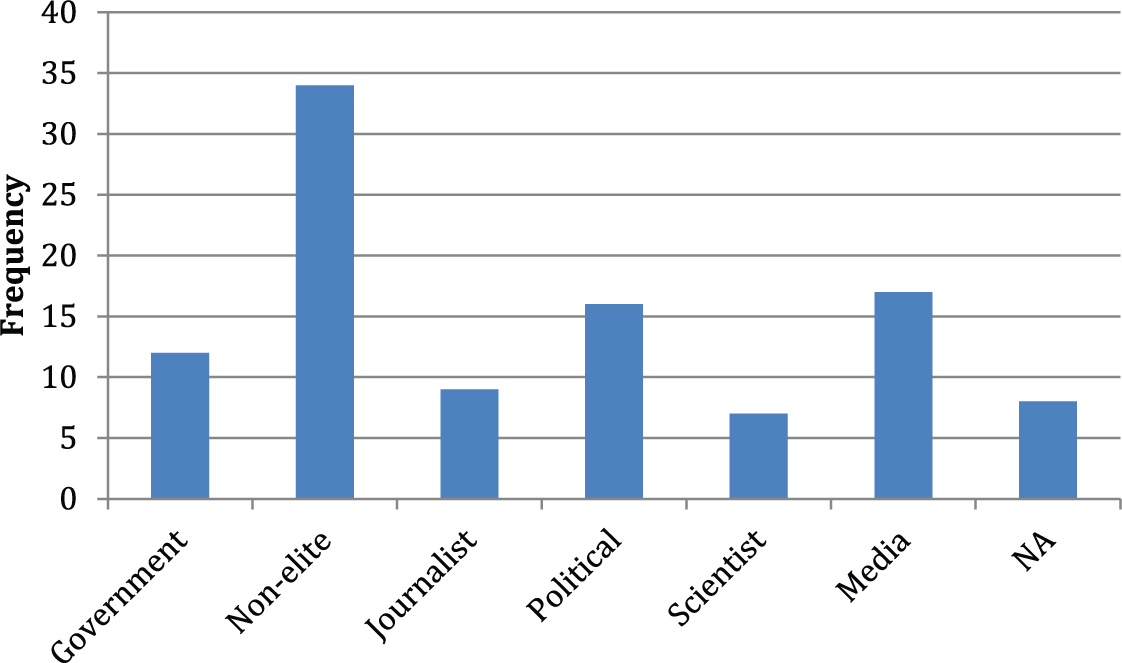
Major user type by prevalence.
“Journalist” refers to individuals who indicate that they are affiliated with a particular media outlet on their bio. “Media” refer to accounts of formal news media organizations, such as The Guardian or The New York Times, as well as science-related media outlets, such as New Scientist. “Governmental/NGO” refers to the accounts of governmental agencies and intergovernmental organizations, such as the United Nations or IPCC. “Political/advocacy” refers to accounts of environmental advocacy organizations, such as the World Wildlife Foundation or National Resources Defense Council, as well as political advocacy organizations and networks. “Scientist” refers to those individuals who indicate they work in the science profession. “Non-elite accounts” are classified as users that do not have an affiliation with a particular media, nonprofit, or scientific organization. Most of these individuals are independent bloggers, activists, or concerned citizens. Finally, N/A refers to bots or users who had deleted/suspended accounts.
Overall, non-elite users accounted for most of the top 100 retweets in the sample (35%), followed by media organizations (17%). Political/advocacy organizations were more active than governmental organizations (16% and 12%), while journalists were slightly more active that scientists (9% and 7%).
However, like many other attention structures online, this retweet network indicates a heavily skewed distribution, with a short head and a long tail. For example, among the top 100 most retweeted messages, the most retweeted message received over 100 retweets, while those at the tail received fewer than 15 retweets. Given this structure, it is important to look specifically at the users who are at the short head of the retweet sample.
For example, although non-elite users appeared most frequently among the top 100 most retweeted users, they did not account for any of the top five most retweeted users. The most retweeted user in the subset was @PeterGleick, a climate scientist with over 17,000 followers. The second and third most retweeted users in the sample were @GreensMPs and @fionaharvey. The former is the Twitter account affiliated with the Australian Green Party, with approximately 27,000 followers, while the latter is the account of The Guardian environmental reporter, Fiona Harvey, who has over 14,000 followers.
Finally, the fourth and fifth most retweeted users in the subset are affiliated with the IPCC. @IPCC_CH and @UN_ClimateTalks refer to the official twitter account of the IPCC, and the official twitter account of the United Nations Framework Convention on Climate Change (UNFCCC), respectively. Interestingly, the sixth most retweeted user in the sample was actor, Leonardo DiCaprio (@LeoDiCaprio).
Further examination into the way the report was discussed among the most retweeted users revealed several patterns. For example, the majority of tweets from @PeterGleick and @LeoDiCaprio focused on the unequivocal and conclusive findings of the report. In comparison, the most retweeted messages from @IPCC_CH, @UN_ClimateTalks, and @fionaharvey directed others to ways in which they can learn more about the reports findings. Finally, while @GreensMPS received the most retweets for a message focused on government action to reduce fossil fuel use in Australia, the majority of their messages focused on the conclusiveness of the reports findings.
What was the message content of the most propagated tweets?
The top 100 most propagated tweets in the sample were classified in regards to the issue focus of the tweet (see Figure 3). The conceptual categories, which are mutually exclusive, are based on an inductive reading of the top 100 most propagated tweets as well as a deductive reading of similar studies that have examined discussion of the IPCC report on social media networks (O’Neill et al., 2015; Pearce et al., 2014) as well as climate change issue frames (Nisbet, 2009). These categories include “impacts/risks,” “political,” “public understanding,” “settled science,” “technology,” “transparency,” “uncertainty,” and N/A.

Message content by prevalence.
“Impacts/risks” refer to those tweets that discuss the risks associated with increased temperatures as well as specific risks to the natural and physical environment. “Political” refers to those tweets that discuss government actions, or the lack thereof, and specific calls to take action. “Public understanding” refers to those tweets that provide a summary of the report or other ways in which the public can learn more about the report’s findings. “Settled science” refers to the consensus of the report’s findings, such as the role of human influence on the climate system. “Technology” refers to any discussion of technological solutions to address climate change. “Transparency” refers to the accuracy of the report’s findings and public accountability of the decision-making among scientists. Finally, “uncertainty” refers to any discussion dismissing or questioning the report’s conclusions.
The most frequently occurring type of tweet was public understanding (27%). This category refers to tweets that are relaying news and information to a wider audience. For example, many of these tweets reflect the strategies of journalists and organizations to condense the report’s findings for the digital media environment, including list-based, take-away style coverage:
RT @kellyrigg: 15 Things You Should Know About The New IPCC Report On #Climate Science http://t.co/ZizAru8Pf9 via @climateprogress
RT @HeidiCullen: 5 Things to Watch for in Friday’s IPCC #Climate Report: http://t.co/WNtwOQOGLD
Other tweets within this category reflect the online strategies of the IPCC to provide virtual access to key press conferences and events:
RT @IPCC_CH: Follow Friday’s #IPCC press conference live by webcast http://t.co/DUuGbQ8EqN #AR5 #climatechange
RT @UN_ClimateTalks: Save the date: #IPCC Stockholm #AR5 press conference webcast LIVE on 27 Sept, 10 a.m. CEST http://t.co/8PmOXPJSnz #cl …
Finally, other frequently occurring tweets within this category refer to scientists and other scientific organizations answering questions form the public or providing resources to help audiences comprehend the report:
RT @NASA: Questions about #IPCC, #climatechange? Talk with climate scientists Sept. 30 at noon ET Google+ Hangout. http://t.co/1C4qH1hkNG # …
RT @VicUniResearch: How to read an #IPCC report. Good clear run down by #VicUni experts. READ: http://t.co/PGL0wi4r0W via @SBSNews #climate …
The second most common issue focus among the top 100 retweets is settled science (18%). This finding is consistent with other studies that find settled science was the most frequently occurring issue theme across social media discussion of the IPCC AR5 report (O’Neill et al., 2015). Moreover, the prominence of this theme reflects general media attention to the bump from 90% certainty in 2007 that humans are the main cause of current global warming to 95% certainty in the most recent report.
The third most common issue themes within the sample are tweets focused on political conflict (12%) and transparency (12%). The majority of the political conflict tweets focused on Australian politics and the need for immediate action. As Pearce et al. (2014) discuss, the prominence of Australian politics within the social media discussion of the IPCC AR5 report may reflect the close overlap with the federal election on 7 September 2013, as well as the political polarization around repealing the carbon tax that was passed in 2011. The tweets that focused on transparency generally focused on the accuracy of the science, including a number of tweets focused on exposing climate “myths” or “conspiracies.”
Finally, impacts/risks and technology accounted for 9% and 3%, respectively. The tweets within the impacts/risks category generally focused on connecting increased temperatures with climate risks, while the few tweets on technology focused on geoengineering.
Which media sources attracted the most attention?
In addition to analyzing which type of users attracted the most attention as well as the content of the most propagated tweets, this study also examined the hyperlinks that users embedded in their tweets. The top 100 most frequently occurring domain names were included for analysis (see Figure 4). These domains were categorized based on an inductive reading of the types of media sources that occurred most frequently. These include “science news and information,” “mainstream media,” “new media,” “government/academic,” and “advocacy.”

Media source by prevalence.
“Science news and information” refers to the websites of legacy journals such as Nature, legacy science magazines such as Scientific American and Discovery, as well as environmental focused news websites such as Climate Central and Grist. “Mainstream media” refer to media outlets such as CNN or The Washington Post, as well as magazines such as The Atlantic or US News. “New media” refers to individual blogs as well as online-only media platforms, such as The Huffington Post or Buzzfeed. “Government/academic” refers to governmental agencies, such as NASA, as well as universities or research institutes. Finally, “advocacy” refers to advocacy-oriented websites, such as Azaaz.org or Reality Drop, as well as environmental advocacy organizations, including Sierra Club and Friends of the Earth.
Overall, the majority of the most frequently occurring domain names in the sample are from mainstream media sources (35%). New media sources account for 23% of the most duplicated domain names, while science news and information websites account for 20%. Government/academic websites account for 12% of the most duplicated domain names, and advocacy websites account for 9%.
A closer look at the top five most frequently occurring domain names reveal more insight into the skewed distribution of the sample. For example, only seven domains appeared 100 or more times. The most duplicated domain name in the sample was avaaz.org, a campaign to put pressure on the editors of large mainstream media organizations. This domain appeared close to 1000 times. The website provided a template for users to select a news organization editor and send out a pre-packaged tweet. The prominence of this website within the sample demonstrates not only the push for increased media coverage but also the use of organized political campaigns on Twitter. 2
The other top domain names in the sample include several mainstream news organizations, including The Guardian, which appeared 670 times, BBC, which appeared 185 times, and the Australian Broadcasting Corporation (ABC), which appeared 120 times. Two new media websites, including The Conversation and Thinkprogress also appeared in the head of the sample, appearing 154 and 254 times, respectively. Finally, the domain associated with the IPCC also was duplicated over 100 times.
5. Conclusion
The release of the IPCC AR5 report presents an important case study for climate change communication, as it is the first IPCC report to take advantage of the digital environment. This study sought to contribute to the existing literature by providing an in-depth examination of online discussion following one of the reports most significant releases, the WGI Summary for Policymakers, within the context of the social media platform, Twitter.
First, within the sample of the most propagated tweets, non-elite users, including independent bloggers, concerned citizens, and activists attracted the most attention. While non-elite users did not receive the most retweeted messages within this sample, the findings suggest that at least within the immediate release of the WGI Summary for Policymakers, exposure of nontraditional voices to large audiences was quite common.
This provides further evidence to the effect that attention dynamics online are often not dominated by a small number of elite actors, as is traditionally understood, but rather a diverse array of actors, including non-elites. As Chadwick (2013) describes, many non-elite actors now interact online exclusively to advance or contest news frames and fragments of information. As this study demonstrates, these interactions are quite successful. The more that professional broadcast and press media rely on digital media platforms, the more likely it will be that active citizens who use the same tools influence media coverage.
Moreover, as non-elite actors carefully time their interaction with elites online, including politicians and journalists, this interaction may play a role in how news coverage is shaped. The findings of this study indicate that even during the immediate release of the report, non-elite users were highly active in weighing into the online discussion. This suggests that models of journalist decision-making (e.g. Donsbach, 2004) need to incorporate the role of social media platforms, such as Twitter, as a factor of increasing importance.
Taken together, these findings suggest that climate change media focusing events, such as the release of an IPCC report, present an opportunity in which online information flows are affected by a range of diverse and decentralized actors. First, the indirect communication flows on Twitter present opportunities in which elites are more likely to have their message rebroadcasted to primary and secondary audiences, thus expanding their reach and scope. For example, the most retweeted users during the reports release focused on the consensus of the reports findings, as well as educational resources for individuals to learn more about the report. At the same time, the decentralized and networked context of social media platforms allow for traditional power relations to be contested. Non-elite users are actively, and successfully, engaged in interacting with information cycles online.
This study also revealed that the content of the most propagated tweets focused on public understanding. Rather than focusing on a specific issue, these tweets focused on providing the public with key takeaways or summaries of the report by experts. 3 The prominence of list-based, take-away style coverage of the report reflects the media shift toward faster and shorter web-based reporting by a variety of outlets (Russell, 2013).
This shift is representative of many media organizations recognition of the changing patterns of audience information consumption and participation, as well as the IPCC’s strategy for taking advantage of virtual access to key press conferences, events, and documents. For example, through virtual conferences, Google Hangouts, and expert question and answer forums, the science–public interface is more active and engaged than the traditional one-to-many engagement exercise of previous IPCC reports.
Third, the analysis of hyperlink content suggests that while mainstream media sources were the most discussed sources within the immediate release of the Summary for Policymakers report, the extent of the mainstream media’s influence within the sample is not universal. Instead, over 40% of the hyperlinks consist of new media sources, including blogs and online-only media outlets such as Buzzfeed and The Huffington Post, as well as science news and information websites, including websites for environmental news, such as Grist or Climate Central, and traditional science magazines, including Discover and National Geographic.
Finally, the highly skewed distribution of hyperlinks reveals that the top five discussed media sources include three mainstream media sources and two new media sources. Future research may look to address the relationship between message content and source of hyperlink. For example, is there a relationship between the issue focus of the message and what type of source the tweet links to? This type of analysis may provide important insight into dynamics of media consumption and information sharing that just focusing on source frequency cannot capture.
Footnotes
Acknowledgements
The author would like to thank Deen Freelon, Matthew Nisbet, and two anonymous reviewers for their guidance and comments on this article.
Funding
The author(s) received no financial support for the research, authorship, and/or publication of this article.