



Abstract
Societal adaptation to flooding is a critical component of contemporary flood policy. Using content analysis, this article identifies how two major flooding episodes (2009 and 2014) are framed in the Irish broadsheet news media. The article considers the extent to which these frames reflect shifts in contemporary flood policy away from protection towards risk management, and the possible implications for adaptation to living with flood risk. Frames help us make sense of the social world, and within the media, framing is an essential tool for communication. Five frames were identified: flood resistance and structural defences, politicisation of flood risk, citizen as risk manager, citizen as victim and emerging trade-offs. These frames suggest that public debates on flood management do not fully reflect shifts in contemporary flood policy, with negative implications for the direction of societal adaptation. Greater discussion is required on the influence of the media on achieving policy objectives.
Keywords
1. Introduction
Adaptation to flood risk
Flooding accounts for nearly one-third of all natural disasters globally (United Nations Office for Disaster Risk Reduction, 2012), with implications including disturbance to individual and community well-being (Hajat et al., 2005; Tapsell et al., 2002), and costs to public services, infrastructure, private and commercial property (Efobi and Anierobi, 2013; Lall and Deichmann, 2012). Contemporary changes in flood policy place greater emphasis on the role of citizens, private businesses and non-government agencies in adapting to flood risk, by taking on some responsibility for flood risk management (Butler and Pidgeon, 2011; Johnson and Priest, 2008; Scott et al., 2013). This is partly related to the large costs involved in flood prevention, resulting in a paradigm shift away from flood prevention towards living with flood risk (Butler and Pidgeon, 2011; Scott et al., 2013). Adaptation – the ‘process of deliberate change in anticipation of or in reaction to external stimuli and stress’ (Nelson et al., 2007: 295) – can involve the use of forecasting, preventing and protecting against flooding through structural and non-structural measures, accommodating flooding through flood-proofing measures, or population retreat away from vulnerable, flood-prone areas (Few et al., 2007; Wilby and Keenan, 2012).
Nevertheless, a limited definition of risk and overemphasis on technological framing as a solution to flood risk management can reduce adaptive potential (Adger et al., 2011). This can also augment vulnerability to hazard exposure and prevent wider debate on how risk and related vulnerabilities differ across time and space (Adger et al., 2009, 2011; Jeffers, 2011; O’Brien et al., 2009).
In Ireland, despite flooding having a strong historical basis in certain locations, flood narratives often frame flooding as a surprise, unprecedented event, with the primary response being prevention through engineering and technological means (Jeffers, 2013, 2014). However, the framing of flooding as preventable through controls such as levees, drainage and flood walls is critiqued for often having the effect of increasing vulnerability to flooding (Liao, 2012; Smits et al., 2006). Householders living near structural flood defences can adopt a false sense of security because of the perceived effectiveness of structural measures in protecting against flood risk. This results in a population less willing to take protective measures who may exhibit a limited understanding of flood risk, as protection is delegated to structural defences (Bradford et al., 2012; Ludy and Kondolf, 2012; Terpstra and Gutteling, 2008). Furthermore, a reliance on state support can create a void when support retrenches (Adger et al., 2012; O’Brien et al., 2009). Focusing on Ireland, Adger et al. (2012) observed that retrenchment of state support resulted in a sense of helplessness and unwillingness among citizens to take individual action for flood risk management. Indeed, citizens may not always see it as their responsibility, or within their power to undertake risk management actions (Butler and Pidgeon, 2011). Moreover, such actions are frequently regarded as being outside the control or agency of individual citizens; instead, power, agency and responsibility are typically attributed to governing bodies (Butler and Pidgeon, 2011).
Framing of flood risk also has implications for policy implementation. Public expectations around flood protection may present challenges to adopting measures that go against the commonly held view of what is acceptable for risk management (Harries and Penning-Rowsell, 2011; O’Riordan et al., 2008). When flooding is narrowly defined as a hazard that can be resisted, public pressure will favour flood-prevention measures. Consequently, this can cause decision-makers to diverge from policy goals, as they respond to pressure applied by those directly exposed to the hazard (Harries and Penning-Rowsell, 2011; O’Riordan et al., 2008).
Media framing and the role of the media in risk articulation
Frames are the presumed norms that structure and shape how topics and events are evaluated, prescribed and communicated (Gamson et al., 1992). To frame ‘is to select some aspects of a perceived reality … make them more salient in a communicating text … to promote a particular problem definition, causal interpretation, moral evaluation, and/or treatment recommendation for the item described’ (Entman, 1993: 52). Historically, framing is linked to experimental work conducted by Kahneman and Tversky (1979, 1984) into how different forms of message delivery affect how people choose options available to them. Goffman (1974) advanced the sociological understanding of framing by arguing that in order to efficiently make meaningful sense of the world, individuals rely on ‘primary frameworks’. These frameworks are taken-for-granted cultural scripts that help us interpret the vast amounts of information we absorb and experience in our everyday interactions. Framing describes the approaches used to communicate information in a manner that complements the particular cognitive frameworks guiding how individuals perceive and respond to communication content (Entman, 1989, 1991). Thus, framing is essential for effective communication, particularly when communicating complex information (Gans, 1979).
The defining characteristics of media framing relate to the topic of selection and the degree of saliency attached (Entman, 1993). Although not necessarily intentional or explicit, by giving salience to certain topics over others, a media frame exposes what communicators regard as important about a topic. This is reflected through the existence or absence of specific words, phrases and portrayed images which reinforce particular viewpoints and beliefs (Entman, 1993; Gamson and Modigliani, 1987). Theoretically, analysis of media framing is underlined by the premise that ‘how an issue is characterized in the news reports can have an influence on how it is understood by audiences’ (Scheufele and Tewksbury, 2007: 11). According to Entman (1993), the effectiveness of framing lies in its ability to draw attention to particular aspects of communication, directing focus away from alternatives. However, while the frame may cognitively influence many of the target audience, this influence is not necessarily universal. First, the nature of the frame will influence response to it; if the audience holds little or no information about alternatives, the frame within which the topic is being communicated will have a greater affect (Entman, 1993). Second, the relationship between the media and the public is not straightforward; instead, the public help shape media frames as much as they are influenced. This complex interaction between media framing (i.e. the attributes of the news) and individual framing – cognitive frameworks – is important: media frames can simultaneously influence policy and decision-makers by reflecting public opinion (as influenced by individual’s normative frames) (Gamson and Modigliani, 1989), while also shaping public perceptions and opinion via the translation of scientific knowledge and political discourses through framing effects (Carvalho and Burgess, 2005; Miles and Morse, 2007). It is reasoned therefore that media coverage can also be understood as a barometer for public opinion (Escobar and Demeritt, 2014). In terms of risk communication, media frames play an important role in influencing how society responds to risk (Escobar and Demeritt, 2014; Kitzinger, 1999). Media frames also contribute to either inhibiting or propelling societal perceptions and actions of responsibility towards risk management (Kasperson et al., 1988).
Flooding in the media
Traditionally, media coverage on environmental hazards has often limited itself to descriptive reporting (Escobar and Demeritt, 2014; Gavin et al., 2011; Wilkins, 2000). However, a number of studies exploring the framing of flooding in the media show that increasingly, the reporting of flood events has become more contested. Analysing flood stories in the British media over a 25-year period, Escobar and Demeritt (2014) observed that although descriptive reporting of flood events remains the predominant focus, there has been a gradual increase in stories on issues of insurance and public policy critique. Four main frames that explain this shift are identified. Urbanising of flood risk explains the shift in the framing of flooding as a problem for agriculture to being one of concern for urban areas. Flooding as a problem for private insurance emphasises a reliance of individuals on private insurance as a means of offering protection against flood-related costs. Property and the individualisation of flood risk illustrates an emphasis placed on individual citizens’ responsibility for flood risk management, widening from the role of citizens in acquiring insurance in the 1980s and 1990s to include stories on how citizens could take flood preparedness and protective action at home. The final frame – climate change, policy and the blame game – describes the increasing critique of government flood policy which shifts flooding from an environmental concern to a contested political issue. This encompasses an emerging frame that associates flooding and climate change, a linkage used to often justify the limitations of government flood policy.
Bohensky and Leitch (2014) observed that linkages between flooding and climate change, management trade-offs and a focus on blame and political responsibility within the media can influence the potential for adaptive capacity. These, and studies from elsewhere (Ewart and McLean, 2014; Gavin et al., 2011; Rinne and Nygren, 2015; Wood, 2015), highlight the increasingly contested nature of flood-related frames in the media, particularly around the saliency applied to issues of blame and governance and the effectiveness of flood policy within the context of climate change.
Content analysis
Quantitative and qualitative approaches to media content analysis have been employed over recent years to analyse the framing of flooding and climate change. Some studies take a longitudinal approach, using content analysis to analyse media over a period of time (Carvalho and Burgess, 2005; Chetty et al., 2015; Escobar and Demeritt, 2014; Gavin et al., 2011; Leitch and Bohensky, 2014). Others focus on media content surrounding a single or a small number of discrete events (e.g. Davis and French, 2008; Miles and Morse, 2007; Poberezhskaya, 2015), or take historical comparisons of single events (Rinne and Nygren, 2015; Rojecki, 2009). Our study seeks to build on this body of work by employing a qualitative approach. Hsieh and Shannon (2005) suggest three approaches to qualitative content analysis, one of which is applicable to this study and involves the development of coded categories derived directly from the text. For this process, our study used thematic analysis (Attride-Stirling, 2001) discussed below.
Study aim
Our case study was driven by three questions:
How are major flood episodes framed in the daily broadsheet news media in Ireland?
To what extent do these frames mirror contemporary shifts in flood policy?
What are the possible implications of these frames for societal adaptation to living with flood risk in Ireland?
The authors anticipate that results will contribute to the small but emerging discussion on adaptation to living with flood risk, with lessons arising for policy makers in Ireland and internationally. This article does not seek to verify a particular theoretical perspective, but rather builds upon methodological and analytical guidance from previous research, applied to the analysis of flood-related media frames in Ireland.
2. Method
Data collection
Ireland’s three main broadsheet newspapers, the Irish Independent (II), Irish Times (IT) and Irish Examiner (IE), were selected. The II and IT have higher circulation than other newspapers (such as The Herald, Irish Daily Star and The Irish Sun); the IT has a readership (print and digital) of almost 400,000; the II nearly 650,000; and the IE readership over 200,000 (National Newspapers of Ireland, 2013). Broadsheet newspapers were chosen over tabloids based on the premise that broadsheets typically exert greater influence on other media sources and on policy arenas (Carvalho and Burgess, 2005). LexisNexis, the online newspaper archive database, was used to gather the newspaper sample using the search terms flooding or flood(s). Searches were customised according to the chosen newspapers and time periods; story count also included duplicate entries. Articles only tangentially describing flooding or floods were excluded, as were articles pertaining to flooding in other countries.
Flood coverage in the Irish broadsheet news media
Figure 1 presents the frequency of flood-related broadsheet media coverage over a 10-year period (2004–2014) and related insurance industry costs of large flood-related weather events (total claims, source: Insurance Ireland, 2014, 2015), and designated as such by Met Eireann (Ireland’s meteorological service). Despite fluctuations, flooding news stories have increased over the 10-year period, peaking during significant weather events. This trend mirrors similar patterns in flood-related reporting observed elsewhere (e.g. Escobar and Demeritt, 2014; Gavin et al., 2011), with the increase arguably reflecting a growing public and media response towards flooding, rather than an actual increase in flood events (Escobar and Demeritt, 2014).
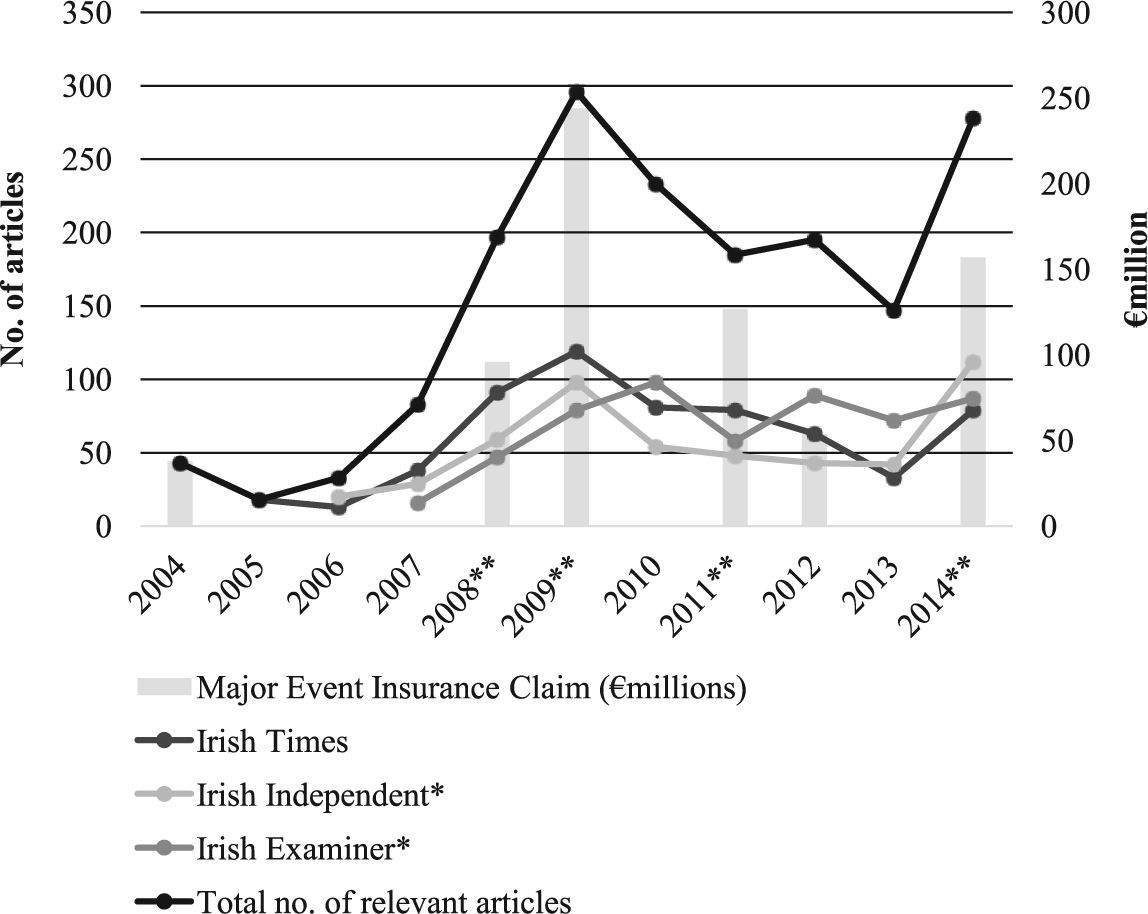
Number of flood stories in sections of the Irish media, 2004–2014.
Case studies
Similar to the methodological approach employed by Miles and Morse (2007), this study seeks to analyse media coverage concerning two discrete flooding episodes from two separate time periods. Taking an analogous case study selection approach as used by Gavin et al. (2011), two time periods during which significant flooding occurred with nationwide impacts were identified from Met Éireann’s (Ireland’s meteorological service) list of major weather episodes. Insurance Ireland similarly classifies these episodes as major weather events. These periods were 1 November to 31 December 2009, and 1 January to 31 March 2014. See Supplementary Appendix (available at http://pus.sagepub.com/content/by/supplemental-data) for additional information.
Newspaper sample and data analysis
Using LexisNexis, searches of the relevant newspaper archives were customised according to the case study time period (i.e. late 2009 and early 2014). Search criteria followed the same process used to generate the frequency of stories for a 10-year period. A total of N = 947 newspaper articles (N = 579 for 2009 and N = 368 for 2014) containing the search words were generated. These articles were assessed for relevancy to the research question. Applying the same criteria for determining the final sample, as detailed above (see Data Collection), the sample for analysis was reduced to N = 271 articles (n = 160 for 2009 and n = 111 for 2014, Table 1).
Refined newspaper sample for data analysis. N = number of newspaper articles.

Data were analysed inductively in line with what Hsieh and Shannon (2005) describe as conventional content analysis – whereby a study sets out to describe the phenomenon, and resulting theoretical implications are outlined in the study discussion. Inductive analysis is useful when the study is of an exploratory nature (Elo and Kyngäs, 2008). To bolster this approach, the authors followed more specific guidelines for carrying out data analysis thematically. Thematic analysis is the most common form of analysis in qualitative research (Attride-Stirling, 2001), and has been employed in a small number of environmental risk-related media content analysis studies, particularly relating to climate change (Jaspal and Nerlich, 2012; Smith and Joffe, 2009).
Based on a review of prior studies on framing and flooding in the media, the initial steps of analysis were generally informed by a preconceived understanding of what frames may emerge from the data. The authors were particularly cognisant of research documenting flood-related media frames and the increasingly contested nature of flooding within public discourses – for example, by Escobar and Demeritt (2014) – and studies pertaining to flood risk in an Irish context (Jeffers, 2011, 2013). However, the authors were also keen to ensure a level of openness when approaching the data initially, to allow for new themes to emerge. Three linear stages were involved in analysis: application of basic codes, development of organising themes and grouping of global themes. First, the final sample of newspaper articles was imported into NVivo-8 (QSR-NUD*IST International). A preliminary process of familiarisation with the raw data helped inform development of simple, basic codes – single words and brief summaries reflecting what was being discussed within a unit of data (i.e. a sentence) – using tools available in NVivo-8. The complete list of basic codes was exported from NVivo, subsequently reviewed for identification of commonalities, and grouped analytically into organising themes, that is, second-level categories or clusters summarising ideas and sentiments expressed in the basic codes (Coffey and Atkinson, 1996). This involved some level of analytical interpretation to identify and assess any possible overarching conceptual relationship within the list of basic codes. For example, the three basic codes, ‘call for action’, ‘government failure’ and ‘anger response’, were grouped into the organising theme ‘expectations for government support’. Organising themes were recorded in NVivo to accompany the relevant data unit, and as recommended by Morse and Field (1995), a tree diagram was developed to help conceptually structure the data. The last step involved the development of global themes. These are the conclusive interpretations of the data, analytically grouping organising themes to create thematic networks that define a theoretical framework for the data. To illustrate, the organising themes of ‘government commitment’, ‘expectations for government support’ and ‘government responsibility and accountability’ were grouped into the global theme ‘politicisation of flood risk’. Beneficial for the purpose of presenting the findings, using NVivo allowed the authors to draw out exemplars relevant for each category.
Although external inter-coder reliability was not sought on the data, both authors discussed and refined the themes. Analysis was carefully conducted in line with recommendations from Elo and Kyngäs (2008) on the need for transparency in the analysis process and reporting of data when using content analysis methods. Five key themes or frames were identified from an analysis of 306 newspaper articles: Flood resistance and structural defences, The politicisation of flood risk, The citizen as risk manager, The citizen as victim and Emerging trade-offs.
3. Results
Flood resistance and structural defences
Despite contemporary flood policy embracing a combination of structural and non-structural flood management measures (Scott et al., 2013), data analysis of media frames suggests that engineering and technological-based fixes remain the preferred option to managing flood risk in Ireland. Flood resistance through such structural measures formed a recurring frame in news stories during 2009 and 2014. This was evident in articles documenting calls for repair of damaged flood defences – for example, in ‘OPW [the Office of Public Works is the state body responsible for flood risk management in Ireland] wants quay walls repaired’ (IE, 8 December 2009), ‘200-year-old walls “must be replaced” to halt waters’ (II, 12 December 2009) and ‘€20m paid out to councils for vital flood-defence repairs’ (II, 12 March 2014). As a frame, flood resistance through structural defences was also evident in government discourse on the need to implement emergency and long-term structural defences in urban areas to deal with continued storm activity, and as a response to the emerging implications of climate change, featuring particularly in 2014:
Minister for Public Expenditure … said severe weather caused by climate change meant that serious consideration would have to be given to flood defences. (IT, 4 February 2014)
Local and government officials were often quick to single out existing defences that were perceived as contributing extensively to flood prevention in predominantly urban areas. During both study episodes, an association was made between successful flood prevention and structural defences:
Flood defences proved crucial in protecting the centre of Ennis … Town engineer […] revealed that had the first phase of the €25m flood defences not been in place along the River Fergus, the flooding would have reached … O’Connell Street, the Market area and Parnell Street. (II, 9 December, 2009) Flood relief barriers have helped protect two of Ireland’s most flood-prone towns … Mallow and Fermoy … avoided major damage … despite torrential rainfall and the river breaking its banks … (II, 3 January, 2014)
Faith in structural defences and the association between adequate defences, investment and flood resistance is sustained throughout news reports, drawing on official government sources and members of the public, even when such defences were temporary or weakened by repeated storm activity. For both study periods, however, there was little media attention given to the role of non-structural measures and their protective potential.
Politicisation of flood risk
Although descriptive stories were predominant in the immediate aftermath of flooding, this focus quickly shifted towards government commitment towards flood prevention. In a series of stories underlying both flood episodes, an explicit association was made between government commitment and the provision of sufficient humanitarian relief to flood victims. Similarly, associated with the framing of flooding as preventable, the presumed effectiveness of flood control was often explicitly linked with levels of financial investment made in structural defences:
[Minister for Finance] said more money would be spent on defences … he pointed to the fact that Clonmel and Kilkenny had not been affected this time due to the money that had been spent on flood defences. (IT, 8 February 2014)
While there is some evidence of a cautious government response to funding flood relief (in terms of humanitarian relief and defence investment) in 2009 – for example, ‘Cowen holds off on extra funding until damage evaluated’ (II, 29 November 2009) – reoccurring storm activity in early 2014 revealed the increasing salience of contradicting messages on government commitment to flood protection. Although the government explicitly committed to financing repair costs in early 2014, an acknowledgement was made that further additional government investment was required in order to improve flood protection across the country. This was evident, for example, in ‘Minister for Public Works Brian Hayes said he believed the Government will have to stump up extra funds to deal with the scale of the storm’ (IE, 7 January 2014), and ‘State will double flood-defence spending to €100m by 2019’ (II, 2 February 2014). Yet simultaneously, the government acknowledged funding limitations, particularly for defence works addressing future flood risk.
Sustained throughout both flood episodes, government responses contrasted sharply with critical coverage of government actions from local authorities, interest and business groups, and the general public calling for greater action and investment in flood resistance. Public expectations around flood risk management were evident in 2009, for example, from local authorities: ‘… there will be angry scenes at next Monday’s county council meeting as councillors vent anger at the Government’s failure to fund flood relief works in recent years’ (IE, 21 November 2009).
These criticisms were amplified in 2014 from communities experiencing regular flooding, and from engineers and insurers (‘Report warns failure to implement flood strategy will harm economy’ (IT, 10 February 2014)). Seemingly partisan contributions also played a part in articles such as ‘Kenny [Enda Kenny, Irish Prime Minister] claims €320m went on flood defence; Fianna Fáil and Sinn Féin [political parties] call for greater response from Government’ (IT, 6 February 2014). The association between flood resistance, structural defences and expectations for government support meant that when flooding occurred, a critical focus shifted towards levels of government investment into flood defences: ‘Government, once again, promised to resolve the issue but like most of government’s promises it never happened. So widespread flooding happens again this year and the promises are coming hot and heavy’ (IE, 13 February 2014). This association often took on a blame discourse, occurring when presumed responsibilities and related accountability for land-use control were not met.
Notably in 2009, as Ireland entered into a period of economic recession augmented by an unsustainable property sector, public criticism extended to include property developers and the role of local authorities in permitting development on flood plains. Articles such as ‘Floods should be a major wake-up call for planners’ (II, 21 November 2009), ‘Minister admits poor planning to blame for devastation’ (IE, 1 December 2009) and ‘Official denies house building caused flood’ (IT, 15 December 2009), focused on the role of planning in contributing to flooding. High-profile cases such as the release of high volumes of water from the Inniscarra dam in Cork in 2009 and flooding in the Shannon region in 2009 and 2014 were also accompanied by criticism directed at the government and OPW for failing to put in place a single agency responsible for river management: ‘The Government must learn from this repeated occurrence and give authority to one agency with clear guidelines and responsibility to undertake flood prevention and relief measures’ (IE, 8 December 2009), ‘Councillor calls for single agency to deal with flood threat on waterways’ (IE, 22 December 2009) and ‘More action and fewer “surveys” needed to stop future flooding’ (II, 25 February 2014).
Citizen as risk manager
Focus on insurance stories during both years in the Irish broadsheet news media framed citizens as having responsibility for managing risk through private insurance. Stories comprised articles citing insurer-sponsored recommendations advising citizens on how to make a claim, while providing information on how to flood-proof private property. During both years, significant attention was given to the ability of citizens to acquire insurance cover: ‘This was the worst – we’re in a flood area with no insurance’ (II, 27 November 2009), ‘Heavy losses on many uninsured properties expected’ (IT, 24 November 2009) and ‘More than half of flood victims did not have insurance’ (II, 15 February 2014). Particularly in 2009, the government emphasised the role of insurance as the primary mechanism for financing recovery from flood damage, often taking precedence over explicit government commitment on humanitarian and flood action – for example, in ‘Cowen holds off on extra funding until damage evaluated’ (II, 29 November 2009).
In spring 2014, a memorandum of understanding between government and insurers was carried in news stories. This memorandum aims to facilitate the sharing of information between government and insures to improve access to insurance cover for householders protected by permanent defences: ‘Insurance firms: we’re close to deal to help flood victims’ (II, 19 March 2014), ‘State in flood deal with insurers’ (IT, 25 March 2014) and ‘Deal raises hope more homes will get flooding cover’ (II, 25 March 2014). Despite these new developments, however, there existed a dearth of critical focus assessing the appropriateness of reliance on private insurance as a primary mechanism for at-risk households.
Citizen as victim
Throughout both episodes, news stories such as ‘I can’t deal with it on my own – tearful victim’ (II, 27 November 2009) and ‘Surely there is something that could be done for us, say Limerick flood victims’ (IE, 15 February 2014), overwhelmingly portrayed the citizen as flood victim. Stories took a predominantly biographical and, at times, emotive nature detailing personified characteristics and flooding experiences which often presented flooding as a surprise, unprecedented episode occurring external to, yet affecting, society.
There was a notable absence in the media (during both years) of discussion about living with flood risk, despite its articulation in the policy landscape. However, in the latter half of the 2014 study period, the minister with responsibility for the OPW cited the need to develop coping strategies to deal with climate change, emphasising that the role of the OPW was to ‘help people who want to help themselves and their property’ (II, 19 March 2014). This perhaps reflects the early signs of the direct translation of policy into informing public expectations. Overwhelmingly, however, for both years, the citizen as victim was amplified in media coverage through a critical focus on the governments’ provision of humanitarian relief. This portrayal was intensified by a lack of discussion on the role of citizen agency in flood risk management, beyond the association between agency and the use of sandbags, and the citizen’s role in acquiring property insurance cover.
To illustrate this point, in ‘Residents prepare to evacuate as water level soars’, a homeowner noted how sandbags proved ineffective in protecting her house, contributing to a sense of helplessness. She proceeded to communicate her frustration, referring to a lack of support from local government: ‘It [flooding] is after getting worse … We weren’t told what to do. No-one has come near us to say that if it does get worse here’s a number. The council hasn’t come near us at all …’ (IT, 26 November 2009). When referred to, individual or community action occurs out of necessity attributable to a perceived absence of national and local government intervention:
There is no shortage of stories of inaction or apparent indifference by officialdom on the ground. There are the villages who say they were forced to fend for themselves; others talk of being stranded to fend off raging floodwater with just a few sandbags. (IT, 3 December 2009)
The association between individual agency and government inaction is further echoed elsewhere in stories such as ‘Flood victims being left to fend for themselves’ (IT, 1 December 2009), and expanded upon in 2014: ‘Elderly couple dig moat around house to save it from the floods’ (II, 19 February 2014) and ‘Locals forced to build own defences’ (II, 5 February 2014).
Emerging trade-offs
Driven by an explicit acknowledgement from government and academic opinion, a new narrative emerged in news stories in early January 2014 around the need to prioritise specific places (usually urban) and funding objectives. Evident in articles such as ‘Only certain parts of coast can be saved from sea, says environmental expert; Coastal defences too expensive to protect all areas that are vulnerable to erosion’ (IT, 9 January 2014), this prioritisation was attributed to funding limitations, the need to prioritise repair work over implementing new defences and perceived uncertainties over future flood risk arising from climate change:
… We cannot defend every yard of coastline, every beach … every field. In some locations, the most cost-effective solution may be a tactical retreat … we must also plan for the future. The debate about climate change is over. It is happening. (II, 19 March 2014)
The association between climate change, flood risk and the need to prioritise place and funding reflects government attempts to instigate debate, manage expectations and plan for future uncertainties by adopting a risk-based approach. In March 2014, the Minister for State was cited as stating,
what is needed is a major national debate … climate change in Ireland is likely to express itself in more frequent storms, higher rainfall levels and more intense bursts of rainfall. The risk of flooding will increase … The OPW is working in partnership with local authorities and other stakeholders to … manage and mitigate flood risk … This strategic approach recognises the need … to move to a more sustainable, planned and risk-based approach to dealing with flooding problems … (II, 19 March 2014)
Discussion around the need to plan for and manage flood risk contrasted with apparent expectations of the wider public, as evident in the fears expressed in one article citing island residents:
[we] may be forgotten about … particularly amid the post-storm commentary about the cost of coastal protection and the need to make ‘hard decisions’ about ‘surrendering parts of the coastline’ … ‘If we are only to be judged in economic terms, we generate so much in tourism revenue’, … ‘For a population of less than 200, we must make a substantial contribution per head to State coffers, and it’s only reasonable to expect some support for that’. (IT, 22 February 2014)
4. Discussion
This study analysed how two flood episodes (in late 2009 and early 2014) were framed in sections of the Irish broadsheet news media. Five frames were identified: Flood resistance and structural defences, Politicisation of flood risk, Citizen as risk manager, Citizen as victim and Emerging trade-offs. The politicisation of flood risk in the media complements findings from Escobar and Demeritt (2014), Bohensky and Leitch (2014) and Rinne and Nygren (2015). Similarly, the framing of the citizen as risk manager is in line with the salience attributed to property and the individualisation of flood risk and a problem for private insurance in the UK media (Escobar and Demeritt, 2014). Emerging trade-offs are consistent with stories elsewhere linking flooding with climate change, and subsequent government limitations (Bohensky and Leitch, 2014; Escobar and Demeritt, 2014).
This study was also interested in considering (1) the extent to which frames mirror contemporary shifts in flood policy and (2) implications for societal adaptation to living with flood risk. Supporting other research on flood risk narratives in Ireland (Jeffers, 2011, 2013, 2014), our analysis reveals a continuation and amplification between 2009 and 2014, of particular flood-related media frames (Table 2).
A review of content themes for 2009 and 2014.
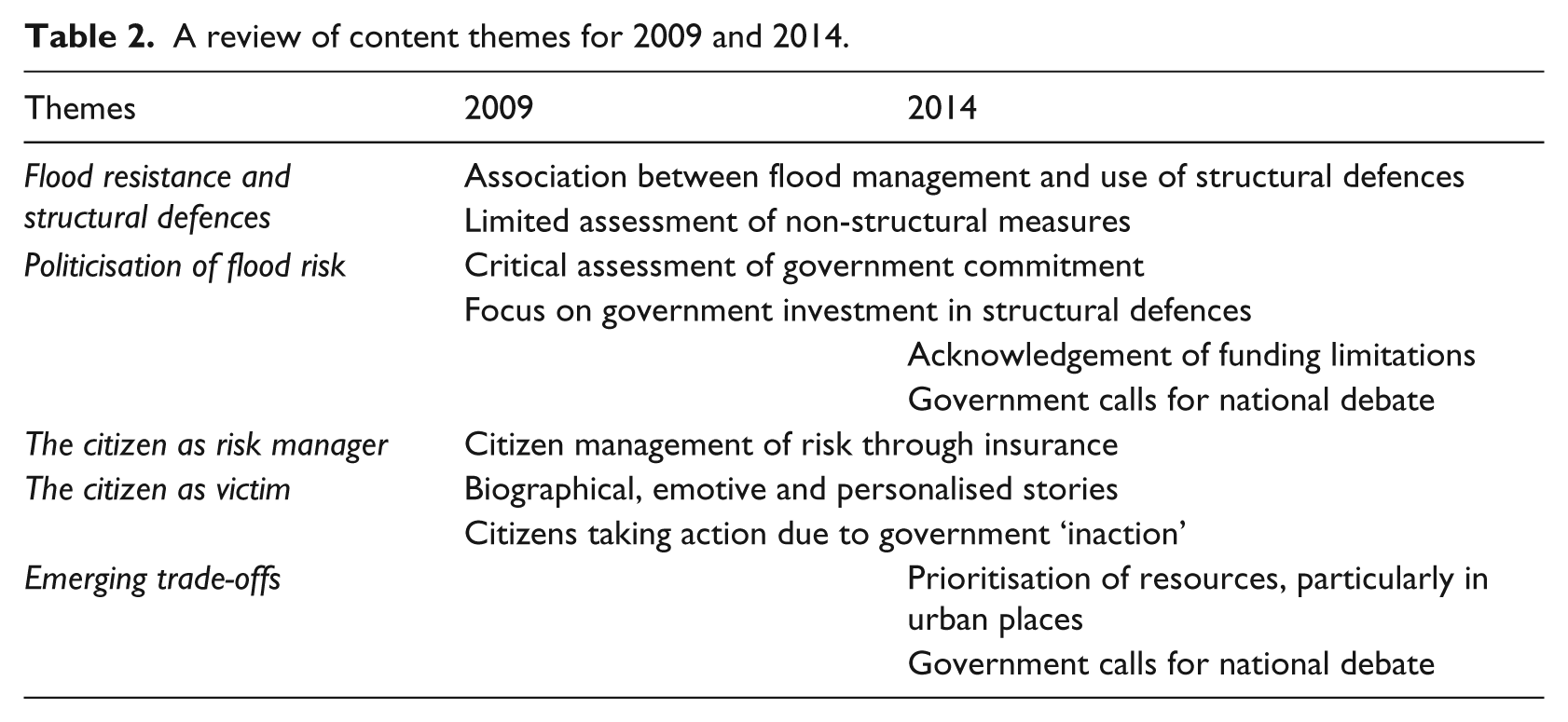
Findings suggest that the focus on structural flood defences, politicisation of flood risk and positioning of citizens, rather than acknowledging and discussing the long-term policy shifts that have been adopted, reduces the ability of citizens to either:
Challenge or discuss their now formalised positioning in the flood risk management system by becoming more informed and participating in a national debate, or
Empowering themselves to recognise their vulnerability to flooding and take preparedness actions.
The outcome of the former reflects a failure to achieve a national consensus about a way forward, and postponement of an important national debate with consequential impacts about patterns of development and resource prioritisation. The impact of the latter, however, is an effective increase in individual vulnerability and reduced effectiveness of policy implementation where individual preparedness now plays an important role. Although the theme of Emerging trade-offs provides some evidence of the implications of contemporary policy being communicated by government, this is limited to portraying the need for resource prioritisation rather than progressing to a discussion about the ‘nature’ of adaptation being espoused. In the absence of reporting on alternative frames, what is presented will have a greater effect on how audiences respond to prevailing frames, reducing the quality of public debate on the way in which flood risk is managed in Ireland. The remainder of this article discusses the implications in more detail.
Flood resistance, structural defences and government action
The predominance of frames linking flood management with structural defences and government intervention suggests a lack of critical discussion on the overall effectiveness of a reliance on structural measures, especially as discussion on non-structural defences has remained in the margins of media coverage. This is despite evidence to suggest that structural defences can create a false sense of security for citizens (Burby, 2006; White, 2013), while reducing adaptive capacity and motivation to take individual responsibility (Bradford et al., 2012). Additionally, focusing only on flood prevention in urban areas, apparent in this study and elsewhere (Escobar and Demeritt, 2014), fails to consider vulnerability to flood risk elsewhere. The implied control associated with structural defences positions flooding as preventable and external to societal responsibility, an approach which Jeffers (2011) and others (Scott et al., 2013; Zevenbergen et al., 2008) claim may undermine responses to the complex challenges of flood hazard and climate change.
Politicisation of flood risk
For both episodes, stories in the broadsheet news media gave significant attention to government responses to managing flood risk. This may be attributed to a number of factors. Flooding in 2009 (and perhaps to a lesser extent, in early 2014) occurred during a time of significant socio-economic and political change in Ireland. Subsequently, government responses prioritised an economic-focused approach to flood management whereby flood policy prioritises some areas, usually urban, over others through the application of cost–benefit analysis assessments (Jeffers, 2013). According to Adger et al. (2012), underlying economic structures can dictate risk and responsibility; in doing so, issues of fairness and blame can dominate adaptation discourses. Within the Irish media, blame served as a channel for vulnerable communities and interest groups to demand change, with government reaction quick to respond to public pressure. The influence of public pressure in influencing the direction of flood management policy as outlined in Harries and Penning-Rowsell (2011) may help explain the failure by government to take on any critical discussion about living with flood risk, as well as wider gaps in flood policy implementation suggested here and elsewhere (Jeffers, 2011, 2013, 2014).
Politicisation of flood risk in the media does engender greater scrutinising of government action, especially when management approaches fail to deliver upon expectations for protection. This scrutiny can help to ensure that decision-makers are held accountable, reducing the risk of mal-adaptation. However, politicisation of flood risk may reduce potential for social learning to take place among communities, as citizens delegate responsibility for flood management to where power is located and where problems such as flood risk are mediated (Bohensky and Leitch, 2014; Butler and Pidgeon, 2011; Wood, 2015).
Implications of emerging narratives
Government acknowledgement in 2014, on the inability to protect all areas from flooding, as well as later calls for national debate on proceeding with flood risk management, suggests an attempt to inform public expectations on policy shifts. A crisis event, such as flooding, can amplify ideas and discourses around flood governance into public debate (Johnson and Priest, 2008), and findings provide signals consistent with such a policy translation.
On one level, media emphasis on the need for trade-offs especially within the context of climate change, may help strengthen resilience to living with floods (Bohensky and Leitch, 2014; Leitch and Bohensky, 2014). However, adaptive processes will encompass a series of crises, as government responses (or lack of) conflict with public expectations for state support. This is apparent in many of the 2014 news stories from coastal areas – frames around government inability to protect all areas contrasted with a sense of place attachment and continued expectations for government support. These differing priorities will create challenges for devising adaptive responses when dealing with coastal flood risk. On one level, climate change is cited as a reason to put in place long-term defences to protect urban areas; however, the implications of climate change are also used to justify coastal retreat. Considering the new narratives emerging in the Irish media with respect to prioritisation of place and funding, a new dialogue, building shared language about adaptation and risk, will be required on managing citizen expectations.
Positioning individual responsibility
Stories of citizen agency are related to citizen as consumers of insurance, flood victims and arising from government inaction. When expectations for state support are not met, citizens may be less willing to take preventive action (Adger et al., 2012), or when citizens are compelled to act because of unmet expectations for government support, mal-adaptation may occur (Benzie, 2014). Additionally, citizens may not see it within their power to implement flood protection measures (Butler and Pidgeon, 2011). The framing of the citizen as flood victim has implications for how citizens position their expectations for state support, as well as how they perceive their own sense of efficacy and agency in taking adaptive action. Arguably, the concept of ‘victim’ conveys a moral, sympathetic basis, underscoring demands for flood resistance, while supporting the framing of flooding as a natural event external to societal control. Indeed, media attention on government action without any reframing of the flood victim only sustains the problematic dilemma identified by Butler and Pidgeon (2011): the absolving of agency and responsibility from private citizens to centres of power (i.e. government and related agencies). This absolving of agency may also sustain the lack of willingness and helplessness identified by Adger et al. (2012) when government support retrenches.
5. Conclusion
Frames are the presumed scripts that help us make sense of the social world, and within the media, framing is essential for effective communication. Because of framing effects, the broadsheet news media, through the topics it selects and the degree of salience attached, can influence the cognitive frameworks held by individuals in society. This, in parallel, reflects back and transmits government narrative and the scheme of social interpretation that individuals rely upon to make sense of the social world. Despite shifts in contemporary flood policy, our analysis shows persistence between 2009 and 2014, of focus and saliency applied to particular aspects of flood risk management within sections of the Irish media. For reasons outlined in the discussion, such media framing may hinder policy debates and implementation, and reduce the potential for adaptation to living with flood risk. Realising a more sustainable societal adaptation process to flood risk in Ireland will require broader framing and reconceptualisation of risk within the public arena (including the print news media) going beyond a primary focus on structural defences, to include alternative frames on the role of non-structural flood control measures, while realistically informing the quality of debates on individual and government responsibility. Considering the complex relationship between media framing and public opinion, this study suggests that the role and influence of the media need to be factored into the process of policy implementation and review.
Footnotes
Funding
The author(s) received no financial support for the research, authorship and/or publication of this article.
Author biographies
Both authors have collaborated on the FloodPAP Project exploring Flood-risk Perception, Awareness and Policy, and RelayRisk exploring perceptions and communication of environmental risk using a case study of domestic wastewater treatment systems, funded by the Irish EPA.