



Abstract
Whether people blindly trust experts on all occasions or whether they evaluate experts’ views and question them if necessary is a vital question. This study investigates associations of human values with the readiness to question experts’ views and one’s reasons for not disagreeing with experts among randomly sampled Finns. Readiness to question experts’ views and one’s reasons for not disagreeing were inferred from self-reported written accounts. Value priorities were measured with Schwartz et al.’s Portrait Values Questionnaire and Wach and Hammer’s items concerning rational and non-rational truth. The results showed that after adjusting for the effects of age, sex and education, the values of power and rational truth were positively associated, whereas the values of security, conformity and tradition were negatively associated with readiness to question experts’ views. Furthermore, the analysis indicated that the reasons for not disagreeing with experts were related to individual factors, situational factors, social risks and views about experts.
1. Introduction
In many situations, it is important to listen to experts’ views and follow their advice. However, for the society to function properly, it is essential that individuals also question experts’ views when warranted. Although experts’ views are usually more likely to be correct than non-experts’ views, experts are sometimes mistaken (Weinstein, 1993) and their views can be distorted by interests or biases (Goldman, 2001; for a discussion of biases in the medicine, see Bornstein and Emler, 2001). Furthermore, many scientific questions are controversial, and views about these questions may differ (Kutrovátz, 2010). Therefore, whether people blindly trust experts on all occasions or whether they evaluate experts’ views and question them if necessary is a vital question (Kutrovátz, 2010).
Despite the importance of people’s readiness to question experts’ views (RQEV), the topic has received relatively little scholarly attention apart from research on public distrust of experts or science (for a recent paper, see Harambam and Aupers, 2015). Other related research has looked into laypeople’s explanations for disagreement between experts on specific scientific topics (e.g. Kajanne and Pirttilä-Backman, 1999), thereby tapping into critical evaluations of experts and expert views.
This study incorporates personal values (as defined by Schwartz, 1992) into the context of people’s readiness to question the views of experts or others in higher positions. To the author’s knowledge, values have not previously been considered among the factors that may relate to such readiness, but previous studies have shown their relevance in such related contexts as non-adherence to doctors’ instructions, trust in institutions and authoritarian submission (Ahola, 2015; Morselli et al., 2012; Passini, 2015). Personal values – that is, what is important to individuals in their lives – have been associated with various attitudes (Boer and Fischer, 2013) and behaviours (Roccas and Sagiv, 2010), such as attitudes towards immigration (Davidov et al., 2008) and food choices (de Boer et al., 2007). The aim of this study is to test whether values can offer insights into why some individuals are more prepared than others to question the views of experts. Furthermore, the reasons for not disagreeing or not expressing disagreement with experts and the topics on which people have questioned experts’ views are examined.
2. Relationship between experts and laypeople
Weinstein (1993) defined (an epistemic) expert as ‘a person who is capable of providing strong justifications for a range of claims in a domain’ (p. 71). In this study, the concept of expert is understood in a wide sense, not confined only to scientific experts but including also other authorities (for a review on the concepts of expert and authority, see Pirttilä-Backman, 1993), such as teachers and superiors. In the empirical part of this study, some examples of experts were given, but otherwise the respondents’ understanding of the concept was not circumscribed.
Much of what people accept as knowledge is indirect or testimonial, in the sense that it is based on trust in other people’s knowledge (Kutrovátz, 2010). Trust as a psychological state involves accepting vulnerability based on ‘positive expectations of the intentions or behavior of another’ in conditions of risk and interdependence (Rousseau et al., 1998: 395) – conditions that may be especially pronounced in hierarchical relationships.
Within public understanding of science (PUS), the relationship between experts and laypeople has been framed using two contrasting approaches. The deficit model assumes a one-way communication process from scientists to the general public, in which scientists, who possess all the necessary information, fill the ‘knowledge vacuum in the scientifically illiterate general public’ (Miller, 2001: 116). Public’s possible doubts and fears concerning scientific issues are seen to result from their lack of scientific understanding (Sturgis and Allum, 2004). In contrast, according to the contextual approach, people encounter science in specific contexts and have their own purposes and motivations for using knowledge; people may make the effort to understand personally relevant scientific issues and to use their previous knowledge and experience (of the issue and of the institution behind the claims) in evaluating the trustworthiness of experts’ claims on these issues (Wynne, 1991; Yearley, 2000). However, instead of making such effort, people may also rely on heuristics or shortcuts like deference to scientific authority (Brossard and Nisbet, 2007), a concept that refers to ‘an individual’s likelihood to believe, or at least accept, information from scientific sources’ (Binder et al., 2015: “1.3. Deference to Scientific Authority”, para. 2). Lack of deference and RQEV are conceptually closely related, but differ on their scope. Deference concerns scientific and technological controversies (Brossard and Nisbet, 2007), whereas RQEV considers issues and experts also beyond science.
3. Readiness to question the views of others in higher positions
Previous studies have addressed people’s willingness to argue or argumentativeness, which Infante and Rancer (1982) conceptualised as a trait comprising the interaction between the tendency to approach and to avoid arguments. A related line of study is on employee voice and silence – whether employees express their work-related ideas, suggestions, opinions, concerns and information about possible changes or improvements, or withhold them in work organisations (e.g. Morrison, 2014). Some of these studies focused on upward voice, that is, expressing such work-related ideas and suggestions to a supervisor or someone else in a higher organisational position (for a review, see Morrison, 2014), but fewer addressed specifically upward dissent. Another related line of study in the organisational domain is that on organisational dissent (Kassing, 1997). In the context of education, related concepts include instructional dissent (Goodboy, 2011) and student challenge behaviour (Simonds, 1997).
Kassing (1997) distinguished between three types of factors that influence whether an employee chooses to express upward dissent or direct their dissent elsewhere. Individual factors refer to the attributes of the employees, such as personality and communication traits; relational factors involve the quality of relationships within organisations, such as those between employees and supervisors; and organisational factors concern employees’ perceptions of the organisational climate in terms of how the organisation generally reacts to expressions of dissent (for a review, see Kassing, 2008). Considerations of costs and benefits of upward voice are also important; employees assess whether their dissent will be deemed constructive or adversarial and whether it will evoke retaliation (Kassing, 1997). Furthermore, employees are more likely to voice upwards if they think it is safe (vs risky) and has an effect (vs is futile) (for a review, see Morrison, 2014).
Similarly, Bolkan and Goodboy (2013) grouped university students’ reasons for not talking to their professor about an incident in which they were dissatisfied into personal (i.e. thinking it is not worth the effort, seeing the problem as their own fault, embarrassed to mention it, did not know how), relational (i.e. unapproachable teachers, seeing complaining as inappropriate, impression management) and organisational factors (i.e. lack of efficacy, fear of retaliation). Pirttilä-Backman and Keso (1998) and Keso (2002) investigated Finnish university students’ reasons for not having disagreed with their teachers or other experts in knowledge-related matters. They found that the reasons were related to knowledge or knowing (i.e. feelings of ignorance, trust in teacher’s expertise, thinking that teachers provide only opinions, not knowledge) and a person, situation or stance (i.e. seeing such debates as uninteresting or unimportant, seldom meeting teachers or experts, thinking that ‘mass lectures’ or the university atmosphere in general does not encourage expressing own views).
4. Human values
As mentioned above, human values may be among the individual factors that relate to RQEV. In his theory of basic human values, which builds on earlier research (e.g. Rokeach, 1973), Schwartz (1992) defined values as desirable transsituational goals that vary in importance and serve as guiding principles in a person’s life (for a review of value constructs, see, for example, Rohan, 2000). Deriving from the general needs of individuals and groups as well as the requirements of social interaction, Schwartz (1992) formulated 10 basic values, each of which defined by the motivational goal it expresses, namely, benevolence (protecting the welfare of close others); universalism (understanding, tolerating and protecting the welfare of all people and nature); self-direction (thinking and acting independently); stimulation (excitement, novelty and challenge); hedonism (pleasure and satisfying sensuous needs); achievement (demonstrating one’s own competence in terms of social standards, thereby gaining personal success); power (social status and controlling other people and resources); security (safety, harmony and stability); conformity (self-restraint from actions that may violate social norms and upset or harm others); and tradition (respect and commitment to the customs and ideas provided by culture or religion).
Values form a circular continuum (see Figure 1) on the basis of how similar or different their motivational goals are (Schwartz, 1992, 1994). Compatible values with similar motivations are located near each other, whereas competing values are located on the opposite side of the value circle. The relationships between values can further be described by two dimensions. The first contrasts openness-to-change (i.e. self-direction and stimulation) and conservation (i.e. security, conformity and tradition); people can either pursue change and their own independence or emphasise preserving the status quo and its certainty (Schwartz, 1992, 1994). The second, self-enhancement (i.e. power and achievement) versus self-transcendence (i.e. universalism and benevolence), contrasts values that motivate people to pursue their own interests with those that motivate them to promote others’ welfare (Schwartz, 1992). Schwartz (1994) regarded hedonism as sharing elements of both openness to change and self-enhancement.
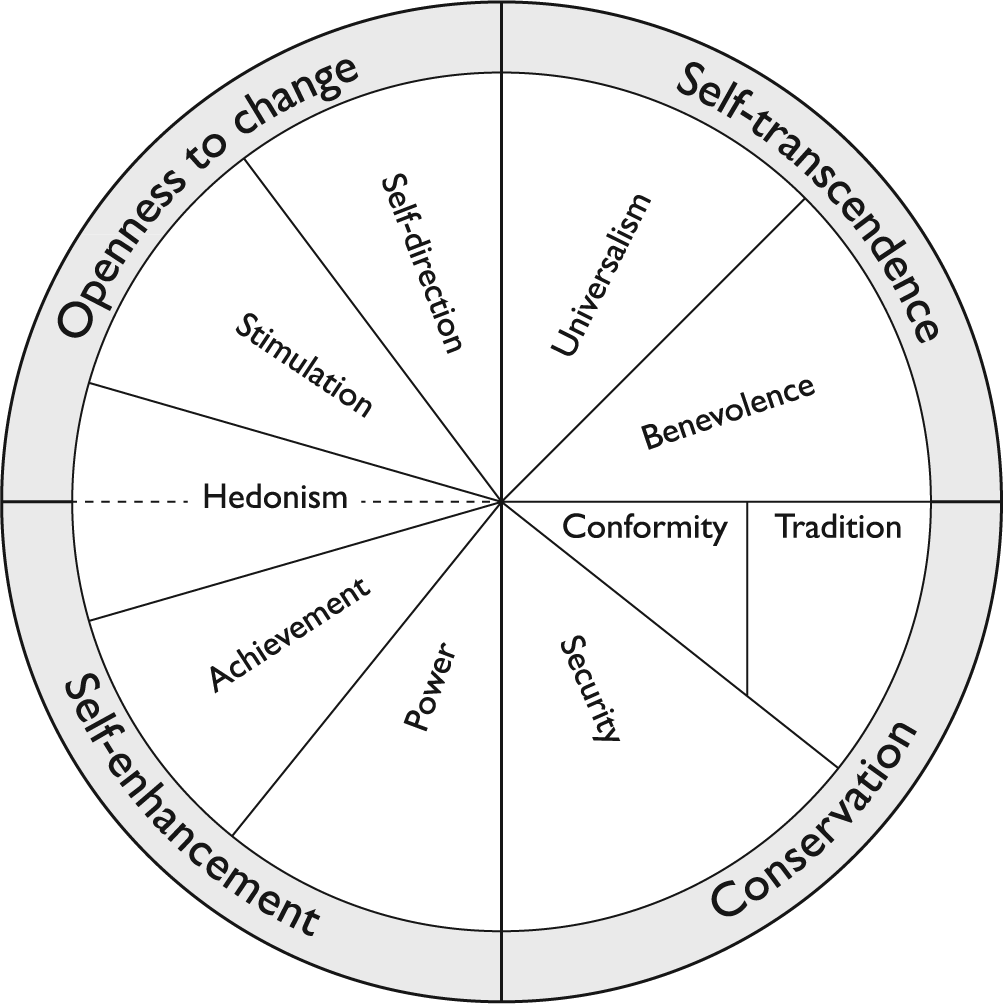
Theoretical structure of values, Schwartz (1992).
Due to the interrelatedness of values, the associations between values and other variables will likely follow a specific pattern (Schwartz, 1992, 1994). Namely, if an external variable is positively related to a particular value, it should, in turn, be positively associated with adjacent values and negatively associated with values on the opposite side of the value circle. The remaining relationships should decrease as one moves along the circle from the highest (i.e. most positive) association towards the lowest (i.e. most negative) association.
In his theory, Schwartz (1992) posited that there is a comprehensive set of values with universal content and structure; that is, these values form a cross-culturally stable motivational continuum built on compatibilities and conflicts among values. Both the content and the structure of the theory have been empirically supported (Schwartz, 2012; Schwartz et al., 2001). However, in some samples, Steinmetz et al. (2012) found deviations from the theorised value structure.
This study uses Schwartz’s (1992) theory of values and incorporates two truth-related values proposed by Wach and Hammer (2003a, 2003b: 123–146), who suggest that these two values represent two sides of the truth and are in opposition to each other, namely, rational truth (theoretical, logical and predictable truth) and non-rational truth (belief in magic, intuitiveness, fatalism and the denial of rationality). Wach and Hammer (2003b: 137–138) equate rational truth with Weber’s (1919/1970) ideas about intellectualist rationalisation created by science and non-rational truth with that which gives meaning to the world.
Wach and Hammer (2003b) hypothesised that rational truth would be located between self-direction and universalism and that non-rational truth would be situated between power and security. In their studies in six European countries (using different versions of the measurement instrument), Wach and Hammer (2003b) found that rational truth always emerged near self-direction (either as a distinct region or as a subregion of self-direction or intermixed with self-direction) with self-transcendence values also adjacent to it (universalism and benevolence items were often intermixed). Based on this, they suggest that rational truth could be a subtype of self-direction. They studied non-rational truth only in one country (France) and observed that it was located closest to security, in a region between security and power. Thus, it was hypothesised in this study that rational truth will emerge closest to self-direction with self-transcendence values adjacent to it and that non-rational truth will emerge closest to security with power adjacent to it.
5. Values and RQEV
In the case of RQEV, rational truth appears to be especially relevant because it may motivate people to question experts’ views in their search for the truth. Furthermore, openness-to-change values – that is, self-direction and stimulation – are congruent with questioning experts’ views because they involve the pursuit of one’s own independence and readiness for change. In contrast, conservation values – that is, security, conformity and tradition – motivate the preservation of the status quo and are, thus, less compatible with questioning experts’ views. Relatedly, a previous study found that valuing openness to change over conservation was positively associated with non-adherence to doctors’ instructions (Ahola, 2015). Also, openness-to-change values were negatively and conservation values were positively associated with authoritarian submission (i.e. passive obedience to authority; Passini, 2015) and trust in institutions (Morselli et al., 2012). Therefore, it was hypothesised that self-direction, stimulation and rational truth will be positively associated with, and security, conformity and tradition negatively associated with, RQEV. This study also explores people’s reasons for not disagreeing or not expressing disagreement with experts and the topics on which they have questioned experts’ views.
6. Materials and methods
Participants
The data were collected in 2010 using a postal survey questionnaire sent to 1000 randomly selected Finnish-speaking Finns, ranging in age from 15 to 65 years (at the time of sampling) and living in mainland Finland. The first mailing yielded 210 returns, and a reminder letter yielded an additional 116 returns, making a total of 326 returns. Six were unusable because the respondents had not answered any questions or answered too few. The final sample size was 320 respondents, of which 60.9% were women and 38.4% men (two responses were missing). Respondents were born between 1944 and 1994, with a mean age of 45.8 years (standard deviation (SD) = 14.9) (three responses were missing); 16.9% had completed basic-level education, 34.1% had finished upper secondary level and 46.3% had obtained a tertiary-level polytechnic or university degree (nine responses were missing).
Regarding sample representativeness, older people were overrepresented when compared to the Finnish population aged 15–64 years (Official Statistics of Finland (OSF), 2010b). The proportion of more educated people and females was also larger than in the general population aged 15 years or over (OSF, 2010a). However, the official statistics are not completely comparable with the present sample due to different age ranges and inclusion criteria. Nevertheless, a comparison of the rank order of values of the present sample to that obtained from a representative sample of Finns collected by the European Social Survey (ESS Round 5: European Social Survey Round 5 Data, 2010) indicates that as regards values, the present sample should not remarkably differ from the broader Finnish population.
Questionnaire
The questionnaire consisted of parts measuring values, epistemic understanding, disagreement with an expert (or reasons for not disagreeing), questions about the reported disagreement and demographic questions.
Measures
Values
The 40-item Portrait Values Questionnaire (PVQ; Schwartz, 2001; Schwartz et al., 2001) was used to measure 10 basic values. For each item, the respondent evaluated the similarity of the person described in the item to themselves on a Likert-type 6-point scale (1 = not like me at all; 6 = very much like me). An exemplary item of PVQ (measuring conformity) is, ‘It is important to him/her always to behave properly. He/she wants to avoid doing anything people would say is wrong’. This study used the Finnish translation of the PVQ (Koivula and Verkasalo, 2006) and an additional six items developed by Wach and Hammer (2003b), which measured rational truth and non-rational truth values (translated from French to Finnish using a back-translation procedure). Wach and Hammer’s (2003b: 141–142) items are presented below to further clarify the concepts of rational and non-rational truth (translations from French are my own): Rational truth: He/she thinks that it is always necessary to progress and to deepen one’s knowledge. What is true is important to him/her. It is important to him/her to understand the root causes of things. He/she likes to think logically and to appeal to his/her reason. It is important to him/her to develop his/her critical thinking. He/she wants to take into account the complexity of things. Non-rational truth: He/she believes that most of the things that happen to us in life have a hidden meaning. He/she thinks that nothing happens by chance. This person thinks that the reason does not lead to true knowledge. It is important to him/her to rely on nothing but his/her instinct when making important decisions. He/she thinks that one must search for authentic reality beyond appearances and the measurable. Practices like magic, clairvoyance or astrology are important for him/her.
A value score was computed for each of the 12 values. As three respondents had skipped more than 30% of the value items, their responses were excluded from the calculations of value scores and Cronbach’s alphas (cf. Schwartz and Rubel, 2005). Cronbach’s alphas (α) were .76 for benevolence, .82 for universalism, .61 for self-direction, .76 for stimulation, .82 for hedonism, .88 for achievement, .76 for power, .65 for security, .68 for conformity, .47 for tradition, .71 for rational truth and .53 for non-rational truth. The relatively low internal consistencies for some values may be attributed to that they were measured with only three to six items and that the items cover diverse components (Caprara et al., 2006).
RQEV
For the RQEV, respondents were instructed as follows: Recall a situation in which you disagreed with an expert (such as doctor, teacher, manager, subordinate) about some specific piece of information or knowledge-related matter. In case more than one situation comes to your mind, choose the one that has been the most important to you personally. Write briefly what it was about into the box below: From which field was the expert? What was the topic of your disagreement? How did the episode proceed? After that, respond to the questions below. If you have never disagreed with an expert or never expressed a differing opinion, explain why in the box below.
This procedure was adapted from Pirttilä-Backman and Keso (1998) and Keso (2002). RQEV was inferred from the written responses, as the following section will explain in greater detail. Overall, 251 respondents provided a written response, while 69 did not. One-third of a page was provided, and the length of accounts in handwritten Finnish ranged from one word to slightly exceeding the space provided.
Analyses
Values
The value structure and, in particular, the location of rational truth and non-rational truth values were analysed with ordinal multidimensional scaling (MDS; PROXSCAL) using IBM SPSS Statistics 22.
RQEV
An initial categorisation and a coding manual of the relevant categories for the RQEV were based on a careful reading of accounts and were piloted by the author and another researcher. All the disagreements in coding were discussed, which led to some modifications in the coding manual and categorisation. The final categorisation of the RQEV consisted of seven categories with an intercoder reliability of .89 (Cohen’s kappa based on an independent coding by the author and another researcher of 17.5% of the 251 accounts).
The categories were further combined into three categories. First category, clear RQEV (n = 162, coded as 1), was mostly made up of accounts in which the respondent reported a particular disagreement incident with one or more experts (n = 145). It also included accounts in which the respondent expressed a critical stance towards experts or wrote that he or she has disagreed with them (n = 17). Second category, emerging or no RQEV (n = 61, coded as 0), involved accounts in which the respondent showed only some emerging criticism towards experts or expressed (sometimes indirectly) having had opinions of their own (n = 25). Furthermore, it included accounts in which the respondent indicated not having disagreed or not having expressed disagreement with experts (it was sometimes impossible to clearly differentiate between these) or showed no critical stance towards them (n = 36). Third category, responses that cannot be interpreted (n = 28, coded as missing) involved reported disagreements in which the opposing side was not mentioned or in which it was unclear what roles were taken by the respondent and the opposing side (n = 15). It also included accounts in which the respondent wrote that he or she remembers no particular incident, cannot say or stated that he or she would skip the question or has no time to respond (n = 12). Finally, it included one reported disagreement in which the respondent played the role of an expert.
Relationship between values and RQEV
Point-biserial Pearson’s correlations with listwise deletion of missing values and logistic regression analyses were used to analyse the relationship between values and RQEV using IBM SPSS Statistics 22. Before conducting these analyses, respondents’ different uses of the PVQ response scale were addressed by centring the value scores, as Schwartz (2007) instructed. This procedure turns value scores into value priorities that reflect the relative importance of each value to the individual. Previous studies have shown that age, sex and education are associated with value priorities (Schwartz, 2007), age and educational level are associated with argumentativeness, and further, sex is relevant to both of these associations (Schullery and Schullery, 2003). Therefore, the effects of age (years), sex (0 = man; 1 = woman) and education (0 = lower level: basic or upper secondary; 1 = higher level: tertiary education) are adjusted for in the logistic regression analyses.
A separate logistic regression analysis with RQEV as the dependent variable was conducted for each of the 12 values for two reasons. First, since values are interrelated both theoretically and empirically, entering all values simultaneously into the regression model would have created multicollinearity problems (Sagiv et al., 2011) as evidenced also in the present sample by large Variance Inflation Factor (VIF) values that exceeded the general threshold of 10 (Hair et al., 2006: 230). Second, there were not enough events (i.e. the smaller number of the two possible outcomes, in this case emerging or no RQEV) to fulfil the recommendation of at least 10 events for each predictor in logistic regression analysis (Peduzzi et al., 1996) in case all 12 values were entered simultaneously.
Preliminary checks of the assumptions of logistic regression analysis indicated that the assumption of linearity in the logit of age was not supported for analyses including stimulation, achievement, security, conformity and tradition. However, age was retained as a continuous variable in these analyses following Chen et al.’s (2007) recommendation.
Reasons for not disagreeing
The author perused all 251 accounts to locate reasons for not disagreeing with experts or for not expressing disagreement with them and identified altogether 63 accounts with such reasons. Of these, 58 accounts included general comments and 5 accounts included specific comments (relating to a particular disagreement with a particular expert). These accounts were further analysed and similar reasons were grouped together. Different parts of one respondent’s account could be placed into different categories. The final categorisation system was created after several iterative rounds of categorisation. In translating the excerpts from Finnish to English, efforts were made to maintain the original meaning of the text.
Topics of disagreement
Respondents’ disagreement incidents with a particular expert or with several experts (n = 145) were analysed to identify the topics in which people have questioned experts’ views. Each account was coded to only one main topic.
7. Results
Value structure
Figure 2 presents the ordering of the 46 PVQ value items in a two-dimensional space. The lines in the figure are used to partition the space into separate value regions. The obtained stress-1 value of 0.13 indicates that the two-dimensional solution is adequate for portraying the relationships among the 46 value items (Sturrock and Rocha, 2000). Figure 2 shows that rational truth emerged as a distinct subregion within the region of self-direction with benevolence also adjacent to it. Non-rational truth did not form a distinct region, but was mixed with tradition, in a wide region between other conservation values and self-enhancement values. These two types of truth values were located opposite to each other.
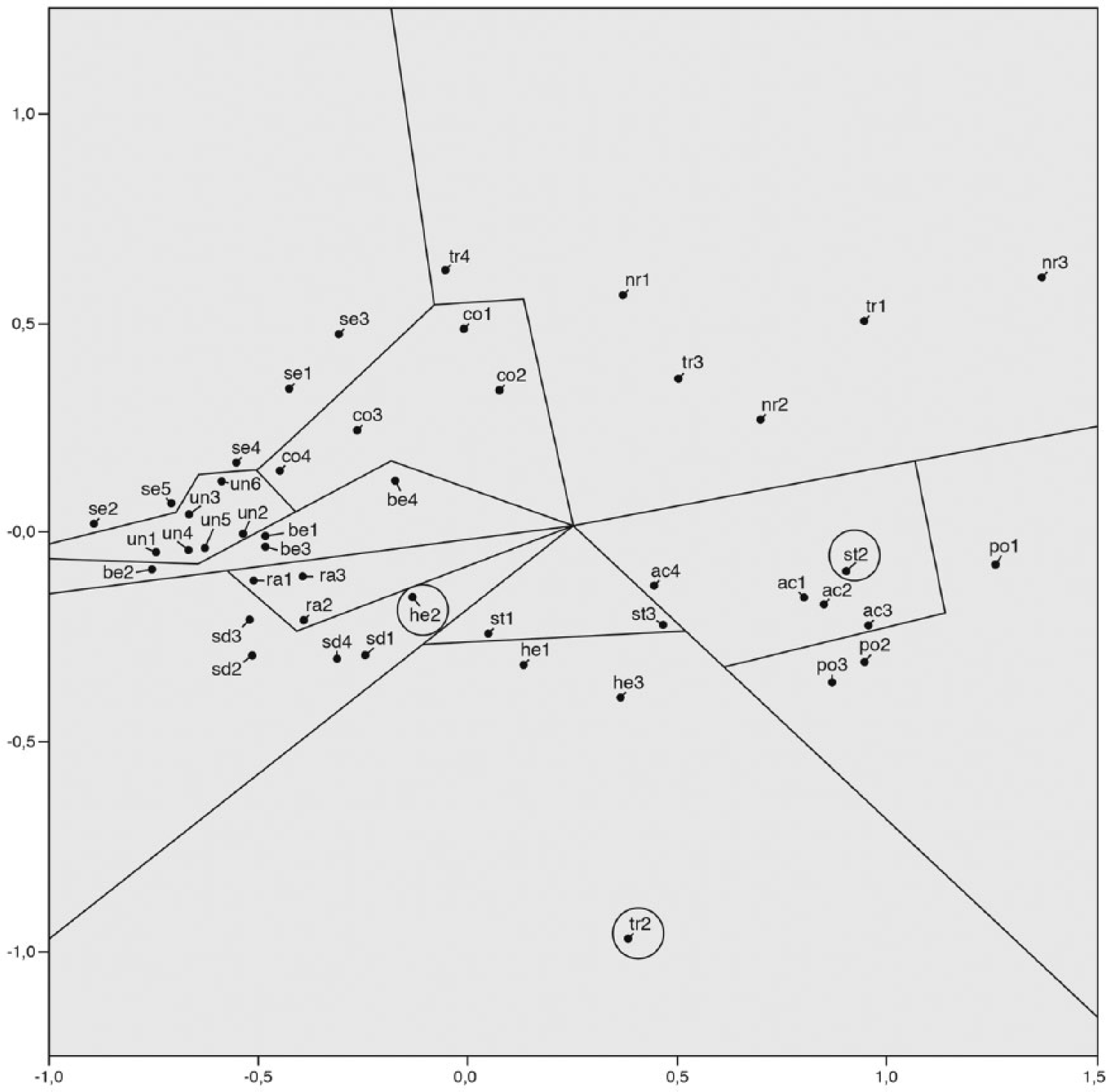
Ordinal multidimensional scaling (MDS, PROXSCAL) of 46 PVQ items (n = 296).
Figure 2 further shows that the obtained solution is largely, but not completely, in line with Schwartz’s (1992) theoretical value structure. A distinct region was found for all values except tradition. Deviating slightly from the theoretical model, some values emerged behind another value rather than side by side and some values emerged in reverse order. According to Bilsky et al. (2011), such splits and reversals of the order of two values are likely of minor importance when they involve adjacent values, which was the case for all but one of these deviations. Regarding single items, only three items were mislocated, shifting to a region of another value.
Values and RQEV
Table 1 shows the descriptive statistics and Pearson’s correlations of the study variables. Regarding statistically significant (p < .05) zero-order correlations, power (p = .043) and rational truth (p = .003) were positively associated and tradition (p = .009) was negatively associated with RQEV. Furthermore, security (p = .078) and conformity (p = .067) were marginally negatively associated. Educational level was also positively associated with RQEV (p = .031) at a statistically significant level and the association of age (p = .074) was marginally positive.
Descriptive statistics and Pearson’s correlation coefficients for values and demographic variables with RQEV.

SD: standard deviation; RQEV: the readiness to question experts’ views.
N = 213 (valid cases under listwise deletion of missing values).
0 = man, 1 = woman.
% women.
0 = lower level: basic or upper secondary, 1 = higher level: tertiary education.
% higher level education.
0 = emerging or no RQEV, 1 = clear RQEV.
% clear RQEV.
p < .001; **p < .01; *p < .05.
Table 2 shows the results of logistic regression analyses after adjusting for the effects of demographic variables. As regards statistically significant (p < .05) associations of values with RQEV, power and rational truth were positively associated with RQEV, whereas security, conformity and tradition were negatively associated. Moreover, stimulation was marginally positively associated.

RQEV: readiness to question experts’ views; OR: odds ratio; CI: confidence interval; SE: standard error.
Separate analysis for each value, n = 213–214. Analyses are adjusted for age, sex and education.
RQEV is the dependent variable.
A pseudo-measure of R2 including control variables and one value variable (Nagelkerke R2 for control variables only ranged from .046 to .047).
Reasons for not disagreeing with experts
Analysis of the respondents’ reasons for not disagreeing with experts or not expressing disagreement revealed four main categories. All but 10 (out of 63) accounts had components falling into these categories.
The individual factors category, which was the largest, involved different types of descriptions of the self. Many of these reasons were related to personal characteristics, traits or typical actions (e.g. ‘I have not disagreed with an expert because I am an agreeable and trusting person’) or lack thereof (such as a lack of knowledge, inability to justify one’s own views or not caring about others’ views). Other reasons concerned unwillingness to disagree (considering it futile, or seeking to avoid conflict, for example, ‘I am uninterested in orally debating matters because I don’t believe that expressing a difference in opinion like this leads to a better solution’) or trust in experts or professionals (e.g. ‘I have trusted experts’ professional skills and have not questioned them’).
The situational factors category had two subcategories. First subcategory, importance of the issue, consisted of accounts in which the respondents explained that they express dissenting views only if the issue is important enough or that they do not express their views if the issue or the difference of opinion is small or unimportant (e.g. ‘I have had a different opinion, but in those situations I haven’t felt the matter was important enough to mention. They have not been very significant topics or matters’.). The second subcategory referred to practical realities, for example, that the respondent seldom met experts: ‘I live in a very small rural village, so I have little to do with experts’.
Finally, the analysis revealed two small categories. First, the social risks category involved reasons such as an unwillingness to hurt the expert’s feelings or stand out. The first part of the second sentence in the following example reflects this category: I have often disagreed with experts, but have just not expressed my opinion on the matter. I always think I want to avoid hurting the opponent or don’t want my opinion to lead to a heated discussion. That is why I have seen it better to keep quiet.
Second, some respondents argued that experts stubbornly stick to their own views or would reject a differing view (e.g. ‘They will not change their view, even though they are experts; their view is the only correct one’). This category was labelled as experts will not change their view.
Topics of disagreement
The topics on which respondents questioned experts’ views varied. Some incidents were about personal issues (concerning the respondent, another person, a group or a community), whereas others were related to more general facts or knowledge claims.
Disagreements with doctors and other social or health-care professionals (n = 53) were most frequently reported. They concerned mostly personal health issues related to diagnosis (is there something wrong; what is wrong, n = 17), treatment of a condition (is a treatment needed; what kind of treatment is needed, n = 23) or inadequate examination (n = 4). Sometimes these aspects were intertwined, for instance, a disagreement about a treatment could be based on differing views about the diagnosis. Some incidents were related to general medical questions (n = 5) and the rest (n = 4) did not fit into these categories. Many disagreements with a manager or another superior in a workplace (n = 38) related to employment issues (salary, hiring, firing or vacations, n = 14) or changes at the workplace (n = 6), while other topics (e.g. bad treatment, practices, n = 18) were varied and received fewer mentions each. Disagreements with teachers, principals, lecturers, researchers or professors (n = 33) concerned knowledge claims or their justification (n = 8), the correct answer or solution to an assignment or a problem (n = 5), grading (n = 4) and other various topics (e.g. rules, requirements, teaching materials, n = 16). Disagreements with other experts (n = 21) were less frequently mentioned.
8. Discussion
This study addressed people’s RQEV. The findings support the idea that personal values are important to RQEV. As hypothesised, individuals valuing rational truth were more prepared to question experts’ views and those valuing conservation (i.e. security, conformity and tradition) were less prepared to do so. Although the associations of stimulation and self-direction with RQEV were statistically non-significant, they were positive, as expected. These results suggest, in combination with those of previous studies (Ahola, 2015; Morselli et al., 2012; Passini, 2015), that people endorsing openness to change tend to be more critical towards those in power, whereas people valuing conservation tend to be more adherent, trusting and submissive. The observed positive association of power with RQEV was not expected, but could be understood by considering that those who value power might try to gain control or dominance over experts by questioning their views. This finding is also in line with a relationship between assertiveness and argumentativeness (Nussbaum and Bendixen, 2003). Different motivations seem to underlie RQEV: truth and dominance. However, due to the cross-sectional nature of this study, it was not possible to offer causal conclusions regarding these relationships.
The order of correlations (Table 1) between values and RQEV around the value circle corresponded quite well to Schwartz’s (1992, 1994) integrated hypothesis, with only achievement and power clearly deviating from the pattern. Of the rest of Schwartz’s 10 values, self-direction and stimulation had the strongest positive associations, with the coefficients progressively decreasing as one moves along the circle in both directions towards tradition, which had the strongest negative association. Wach and Hammer’s (2003b) truth-related values also fit the pattern. Notably, this is the first time these two truth-related values have been studied in Finland among randomly sampled Finns.
Regarding the location of truth values in the value structure, results of the MDS analysis largely supported the hypothesis for rational truth. It formed a distinct region within the region of self-direction, which supports Wach and Hammer’s (2003b) notion that it would be a subtype of self-direction. However, the hypothesis for non-rational truth gained only partial support: non-rational truth emerged closest to tradition instead of security; however, as expected, self-enhancement values (including power) were also adjacent to it. More studies involving rational and non-rational truth would be needed before making further conclusions, but they seem worth considering, especially when focusing on knowledge-related topics.
One potential limitation of this study is that the associations of values with RQEV were overall relatively small. One reason for this may be that many other factors (e.g. social norms) compete with values (Bardi and Schwartz, 2003). Furthermore, it might be that different values motivate people to question experts’ views on different topics depending on how well an expert’s view aligns with the values people hold. If, for example, conservation values are very important for a person, he or she may generally not question experts’ views, but may be more likely to do so if an expert’s view advocates challenging the status quo. Unfortunately, the present data did not allow testing for this idea because many of the accounts did not provide enough information of the content of the opposing views. Nevertheless, it would be an interesting topic to study further. Some respondents reported that they express their disagreement only if the issue is important enough, which suggests that the characteristics of the issue itself, such as its moral intensity (Jones, 1991), may be among the factors determining RQEV. Future studies could investigate the relative contribution of different factors to RQEV and include also issue-related and situational factors.
The dichotomous measure of RQEV used in this study may be seen as another potential limitation. Thus, another method of measurement may produce stronger associations, for example, one that takes into account the frequency of questioning experts’ views. It would also be useful to be able to clearly differentiate between never disagreeing with experts, disagreeing quietly and explicitly questioning experts’ views and whether different values motivate each of these. Furthermore, since there is no validated scale to measure deference to scientific authority (Binder et al., 2015), these two measures could be developed simultaneously. It would be interesting, for example, to test empirically whether RQEV and deference are polar opposites of one dimension or form two distinct dimensions.
An advantage of this study is that it used a population-based sample with respondents of varied ages and educational backgrounds and covered a wide range of experts. However, due to the low response rate and lack of complete representativeness of the sample, it may not be possible to generalise the results to the Finnish population, which may be seen as a limitation.
As regards not disagreeing with experts, the reasons identified in this study were similar to those identified previously in literature on upward dissent (Bolkan and Goodboy, 2013; Kassing, 2008; Milliken et al., 2003). Two types of reasons that emerged in this study – that is, trust in experts and practical realities (seldom meeting experts) – have previously been found only in one study which used data from Finland (reported in Keso, 2002; Pirttilä-Backman and Keso, 1998). Such reasons may, thus, be specific to the Finnish context or to cases in which experts’ views have not yet been questioned, and more studies looking at such cases would be welcome. The particularities of the Finnish context may both hinder and enhance RQEV since Finland is characterised by both a relatively widespread trust in institutions and public authorities (European Commission, 2015) and a low power distance (Hofstede, 2001).
Since many people are affected by experts’ views and decisions at various points in their life, it is important that future research investigates the factors and conditions that contribute to people’s preparedness to think about and challenge experts’ knowledge claims. The existing models within organisational and educational contexts and within PUS could be complemented with a more social psychological approach that would aim to understand people’s own experiences and stances concerning expert knowledge. It would also be useful to include issues beyond science that are important for people in their everyday life, for example, some of those various topics (e.g. health or employment issues) which the respondents of this study reported in their accounts of disagreement with an expert.
Footnotes
Acknowledgements
The author would like to thank Anna-Maija Pirttilä-Backman for her valuable comments and suggestions.
Funding
The author(s) disclosed receipt of the following financial support for the research, authorship, and/or publication of this article: This work was supported by the Finnish Doctoral Program of Social Sciences (SOVAKO), the Kone Foundation, the Oskar Öflunds Foundation and the Ella and Georg Ehrnrooth Foundation. Support was also received from the Department of Social Research, University of Helsinki, for language revision services.