



Abstract
Given the ethical questions that surround emerging science, this study is interested in studying public trust in scientific and religious authorities for information about the risks and benefits of science. Using data from a nationally representative survey of American adults, we employ regression analysis to better understand the relationships between several variables—including values, knowledge, and media attention—and trust in religious organizations and scientific institutions. We found that Evangelical Christians are generally more trusting of religious authority figures to tell the truth about the risks and benefits of science and technology, and only slightly less likely than non-Evangelicals to trust scientific authorities for the same information. We also found that many Evangelicals use mediated information and science knowledge differently than non-Evangelicals, with both increased knowledge and attention to scientific media having positive impacts on trust in scientific authorities among the latter, but not the former group.
Scholars are generally in agreement that trust plays an important role in influencing how lay publics—those lacking thorough scientific training—arrive at decisions about scientific topics (for a discussion of the limited importance of trust, see Sjöberg, 2001). With few exceptions, trust in institutional actors (i.e. scientists, regulatory agencies, etc.) has been found to correlate negatively with perceptions of risk and positively with levels of support for emerging technologies (e.g. Olofsson et al., 2006; Priest et al., 2003). Thus, cultivating trust has emerged as a popular method for building support for scientific endeavors (Brossard and Nisbet, 2007; Priest et al., 2003).
Of course, there are institutional actors outside of scientists and regulatory agencies that weigh in on science topics and higher levels of public trust in some of these groups may correlate negatively with scientific support. Chief among these groups are religious organizations. 1 The Catholic Church, for example, has expressed its objections to embryonic stem cell research (Vestal, 2008). These objections have typically revolved around the ethical questions that surround the science and the very nature of life itself. Similar stances have been taken by the National Association of Evangelicals and sects of the Lutheran church (Pew Research Center, 2008). Such ethical questions are not unique to embryonic stem cell research as moral objections have been voiced for issues like nanotechnology, biotechnology, and synthetic biology (The Scotsman, 2005; Stein, 2010). Importantly, tensions between the views of traditional scientific authorities and religious organizations are only likely to increase as emerging science increasingly trends into “gray areas” of morality.
Given the thorny ethical questions that surround many emerging technologies, this study is interested in expanding our understanding of whom publics trust for science information. As previous research has examined the predictors of a variety of communication media, this analysis is concerned with exploring public trust in two potentially opposing institutions for information about the risks and benefits of science: scientific authorities and religious organizations. To date, there is no empirical research exploring trust in religious authority figures as a source of scientific information as a dependent variable. In pursuing this approach, we pay particular attention to the relationship between value predispositions—specifically religiosity and Evangelical Christian status—and trust evaluations. Moreover, our study examines the degree to which Evangelical Christian status interacts with knowledge and several distinct media sources to better understand how Evangelicals process mediated content about science, and in turn, what this means for whom they trust for information about the risks and benefits of science. Before elaborating on this approach, we outline the tension between religion and science.
1. Literature review
Tensions between religion and science
In the broadest sense, the interplay between religion and various forms of scientific research has always been complicated and tension-filled (Brossard et al., 2009). While Merton (1938) has argued that Puritanism—with its emphasis on finding order in the universe, promoting societal well-being, and differentiating humans from animals—helped drive the scientific revolution of the seventeenth and eighteenth centuries, there has also been the perception that there are “normative inconsistencies” between religious beliefs and science in general (e.g. Miller et al., 1997). Such inconsistencies are illustrated in the belief that science interferes with nature (Scheufele et al., 2009) or is akin to “playing God” (Sjöberg, 2004). This can be seen in the on-going debate around evolution and intelligent design and/or creationism, where religious activists have worked hard to galvanize public opinion toward altering the curriculum standards of public schools (Nisbet and Nisbet, 2005). Similar tensions exist for nanotechnology, which, as the science evolves, might be capable of creating life at the nanoscale (Roco and Bainbridge, 2003). Not surprisingly, some religious authority figures have expressed objections toward nanoscience. The head of the Church of Scotland’s “Society, Religion and Technology Project,” for instance, has issued warnings that nanotechnology research might result in the creation of “a superhuman soldier” or “enhanced humans” (The Scotsman, 2005).
Similarly, advances in synthetic biology have opened the door for ethics-based criticisms of the science (Stein, 2010). Although religious groups have largely neglected to take a stance on the science at this time, scholars and ethicists have voiced concerns that synthetic biology will forever change the relationship between man and nature (Sethi, 2012). Given the rapid development of these and other emerging sciences that tread into ethical gray areas, it would not be surprising for a major religious figure or organization to publicly decry the current state of scientific research or to voice disapproval of a specific scientific research agenda. Such a stance, in turn, could shape the opinions of large numbers of trusting followers.
Many scientists have met the animosity of religious leaders with stoicism, preferring to avoid escalating tensions and instead claiming that science and religion operate in separate spheres of inquiry. Scientists operating this way have argued that evidentiary science governs the natural world, while religion focuses on metaphysical questions pertaining to the meaning of life and humanity’s relationship with the divine (e.g. Dobzhansky, 1973; Gould, 1997).
There are, however, an increasing number of scientific authorities who reject this duality, arguing instead that religion and science present incompatible worldviews. Some have even managed to successfully cross over to the popular press, arguing en masse against the religious fervor they see as stunting scientific progress. Arguably the two most notable such figures are biologist Richard Dawkins and cosmologist Lawrence Krauss.
While both men take aim at religion on many fronts, they seem particularly bothered by the Evangelical Christian belief in biblical creationism. Dawkins (2008) takes special offense to “the creationist [who] chooses to masquerade in the politically expedient fancy dress of ‘intelligent design’” (p. 138) to undermine the teaching of evolution. Krauss (2012) expresses similar frustration, arguing that biblical creationism obstructs not just our understanding of the origins of life but the universe as a whole. Both men believe that advancements in science will someday—if they have not already—lead to an understanding of the world in which religion and the very concept of a deity are no longer plausible.
While the strains between science and religion are undeniable, they are by no means universal, and different degrees of tension exist across issues. Certainly in the United States, the debates over evolution and stem cell research are more influenced by religion than many other areas of science (Cash, 2010; Feng, 2010; Myskja, 2009). Numbers (2011) provides compelling evidence that religious people rarely exhibit a blanket rejection of science but instead treat issues on a case-by-case basis. He demonstrates that creationists are not “anti-science” across the board; they simply oppose what they see as an anti-Christian philosophy of science as embodied by evolution.
The nature of religious influence on scientific inquiry also differs across nations. Clément (2015) surveyed teachers’ conceptions of evolution and creationism across 30 countries, finding that teachers in less economically developed countries more strongly favor creationism. However, in Clément’s (2015) study, the United States was noticeably absent, where residents tend to display higher support for biblical creationism than much of the Western world (Scott, 2006). There’s also evidence that religious influence varies regionally within countries, as is the case with stem cell research in the United States (Green, 2008).
Opposition to science also varies across religious affiliation. Though Clément (2015) generally found little effect of religious denomination on views regarding creationism, fundamentalist Protestants were typically more likely to favor that stance. In regards to stem cell research, the strong opposition of the Catholic Church likely influences its adherents’ views on the science (Green, 2008). Again, while science and religion are not universally or diametrically opposed, a clash of values certainly exists at some level.
Understanding trust in religious organizations
Importantly, there is reason to believe the persuasive power of religious leaders and organizations may be particularly strong when it comes to influencing the attitudes of members. Scholars have argued that certain dimensions of trust are more important than others in determining trust evaluations. “Ability aspects” refer to a highly calculative form of trust that is dependent on both the past behavior of the trusted (or distrusted) party and the perceived constraints on their future behavior (Earle, 2010). This more calculative form of trust is based upon actual behaviors and can be quite fragile (Earle, 2010). On the other hand, the “social-relational” aspect of trust is based upon the relationship between the trusting person and the other (Earle, 2010). Generally speaking, this dimension of trust is thought to be concerned with the intentions of the other and is rather resilient to change (Earle, 2010). The social-relational dimension of trust is more heavily weighted in evaluations of trust, and therefore, to be more predictive of subsequent trust levels (Fiske et al., 2007; Wojciszke and Abele, 2008).
The type of relationship that an individual has with a pastor, rabbi, or priest, is typically quite different than the relationship one has with a larger institution or authority figure, with the latter being less personal in nature. Individuals learn about key scientific figures, for example, primarily through mediated content as opposed to direct person-to-person contact (National Science Board, 2010). The media content most likely to receive widespread public attention will tend to highlight the “ability aspects” of scientists, focusing specifically on major scientific breakthroughs (e.g. the synthesis of the first cell by J. Craig Venter) or extraordinary catastrophes (e.g. the Fukushima Daiichi meltdown). As noted, this form of trust is more fragile and likely to change. In short, the trust individuals place in scientific authority figures may be more fleeting and less likely to guide subsequent decision-making, which may help explain the weak to moderate correlations between trust and risk perception noted by Sjöberg (2001).
On the other hand, one’s relationship with a religious authority figure might best be described as social or interpersonal in nature given the direct, close, and regular contact between the two parties. In addition, the bond is necessarily spiritual, which might result in a more enduring and influential form of trust (Earle, 2010). In other words, people might be particularly likely to follow a trusted religious figure given the relational and intention-based manner by which the trust bond was formed. This makes understanding trust evaluations of such figures particularly important.
Values and science attitudes
Given the normative inconsistencies between science and religion noted above, religious beliefs have become a popular value predisposition that researchers have examined in relation to science attitudes. Previous research has found a direct and negative relationship between strength of religious beliefs and support for several scientific issues (e.g. Brossard et al., 2009; Scheufele et al., 2009).
While some religious leaders have been careful to stress that religion and science are indeed compatible (Burke and Marrapodi, 2010), others have been particularly vocal in sharing their opposition toward various scientific issues (e.g. Giberson and Stephens, 2011; The Scotsman, 2005). This has especially been the case among high-profile Evangelical Christian leaders—for instance, Ken Ham, David Barton, and James Dobson—who have encouraged their followers to defer to divine, biblical authority as opposed to widely accepted science (Giberson and Stephens, 2011). Of course, certain subgroups can be highly susceptible to persuasive appeals made by such elites, be they religious, political, or otherwise (Zaller, 1992). Moreover, Brewer and Ley (2013) have found evidence that attendance at religious services is negatively related to trust in scientists, further highlighting the potential impacts of religion on trust evaluations. Unfortunately, little work has empirically examined how Evangelical Christian status is related to general science attitudes, and where such people place their trust for science information. Therefore, we propose the following set of hypotheses:
Hypothesis 1. Religious guidance will be (a) negatively related to trust in scientific authorities and (b) positively related to trust in religious organizations for information about the risks and benefits of science and technology.
Hypothesis 2. Evangelical Christian status will be (a) negatively related to trust in scientific authorities and (b) positively related to trust in religious organizations for information about the risks and benefits of science and technology.
Aside from the direct effect of Evangelical Christian status on trust evaluations, we anticipate that such status may influence (a) where publics turn for information related to science and (b) how they interpret and process such information. Generally speaking, both scientific media attention and science knowledge levels have been found to correlate positively with science attitudes (Allum et al., 2008; Brossard et al., 2009) and trust in scientific authorities (Anderson et al., 2012). However, there is reason to believe that this may not be the case across all populations.
The motivated reasoning literature helps explain how individuals organize and process information when forming opinions. Kunda (1990) defines motivated reasoning as “reliance on a biased set of cognitive processes [or] strategies for accessing, constructing, and evaluating beliefs” (p. 480). The implications of motivated reasoning are a tendency for people to engage in the biased processing of information to arrive at conclusions that fit with their prior beliefs or experiences (Kunda, 1990; Taber and Lodge, 2006).
Overall, there is strong support for motivated reasoning (e.g. Cacciatore et al., 2011; Cacciatore et al., 2012; Taber et al., 2009; Taber and Lodge, 2006), including in studies examining scientific opinion formation (e.g. Kahan et al., 2009; Kahan et al., 2011). For instance, in their cultural cognition work, Kahan and colleagues have found evidence of selective exposure, such that people were more likely to search out information that was congruent with their predispositions and worldviews. They also found that respondents treated information that was disagreeable to their worldviews as less important than other information, giving less weight to it in subsequent evaluations (Kahan et al., 2009; Kahan et al., 2011). Similarly, Brossard et al. (2009) found that information about morally contentious science issues are often processed through the lens of religious beliefs. They concluded that the strong belief system of highly religious people acts as an interpretive lens through which they make sense of scientific information—one that suppresses the otherwise positive effects of knowledge on science attitudes.
Our understanding of motivated reasoning, coupled with the increasing polarization of attitudes toward science in the United States (e.g. Brewer and Ley, 2013; Gauchat, 2012), suggests a number of different ways in which different religious groups will consume mediated information. First, much like political partisans, Evangelicals can be expected to consume a different media diet than non-Evangelicals (Iyengar and Hahn, 2009), including having different definitions of what constitutes “science” media content. As a result, the two groups might be encountering decidedly different information related to science, which may impact where they place their trust for such matters. Second, given our understanding of how partisan groups process and scrutinize congenial and hostile information, Evangelicals and non-Evangelicals can be expected to interpret similar content in different ways depending on how it fits with their worldview. As a result, we can expect Evangelicals and non-Evangelicals to utilize the knowledge they gain from media differently and for this use to manifest itself in decidedly different trust evaluations. Therefore, we propose the following hypothesis:
Hypothesis 3. Evangelical Christian status will moderate the influence of media attention on trust evaluations.
Hypothesis 4. Evangelical Christian status will moderate the influence of scientific knowledge on trust evaluations.
2. Methods
To examine the hypotheses, we relied on data from a nationally representative online survey of US adults aged 18 years and older. The online survey was conducted by GfK Knowledge Networks and utilized their KnowledgePanel sample. KnowledgePanel members are randomly recruited through probability-based sampling that covers approximately 97% of all US households. To ensure representativeness, households are provided with access to the Internet and hardware where needed. The survey was fielded between December 2011 and January 2012. Some 13,131 panelists were randomly drawn from the GfK KnowledgePanel®; 6425 responded to the invitation, yielding a final stage completion rate of 48.9%. The recruitment rate for this study, reported by GfK, was 15.5% and the profile rate was 64.9%, for a cumulative response rate of 4.9% and a final sample size of 2806.
Independent variables
Gender, age, race, and socioeconomic status served as the primary control variables. Gender was a dichotomous variable with female coded as “1” and male coded as “0” (56.5% females). Age was measured as a continuous variable (M = 47.0, standard deviation (SD) = 15.7). Race was measured as a dichotomous variable where White respondents were coded as “1” and all other respondents were coded as “0” (73.2% White). Socioeconomic status was measured by combining standardized measures of education (Mdn = “some college, no degree”) and income (Mdn = US$40,000 to US$49,999; r = .40; e.g. Kahlor et al., 2004).
Ideology was assessed by asking respondents to report their political ideology on both social and economic issues. The two items were measured on 7-point scales, with “1” indicating “Very liberal” and “7” indicating “Very conservative” and were then averaged together into a single variable (M = 4.3, SD = 1.4, r = .77). Deference to scientific authority has been found to predict public response to science and risk issues (e.g. Brossard and Nisbet, 2007; Lee and Scheufele, 2006), including decisions specific to trust (e.g. Anderson et al., 2012). We assessed deference using a pair of items measured on 10-point scales (1 = “Do not agree at all,” 10 = “Agree very much”): (a) “Scientists should do what they think is best, even if they have to persuade people that it is right” and (b) “Scientists know best what is good for the public.” The items were averaged together into a single variable (M = 4.0, SD = 2.0, r = .64). Religiosity was measured by asking respondents, “How much guidance does religion play in your everyday life?” The scale was anchored at “No guidance at all” (coded as “1”) and “A great deal of guidance” (coded as “10”; M = 6.7, SD = 2.7). Evangelical Christian status was a dichotomous variable with Evangelicals coded as “1” and non-Evangelicals coded as “0” (36.9% Evangelicals).
Attention to science in traditional media was measured on a series of 5-point scales (1 = “None,” 5 = “A lot”) that asked respondents how much attention they pay to news stories about (a) science and technology, (b) specific scientific developments, such as nanotechnology, and (c) social or ethical implications of emerging technologies in (a) newspapers and (b) on television. Responses to the six items were then averaged together (M = 2.5, SD = 0.9, α = .92). Attention to science online was measured using the same scale by asking respondents how much attention they pay to news stories about (a) science and technology, (b) specific scientific developments, such as nanotechnology, and (c) social or ethical implications of emerging technologies when they go online. Responses to the three items were averaged together (M = 2.1, SD = 1.0, α = .94). Science talk was measured with a series of 5-point scales (1 = “Never,” 5 = “All the time”) asking respondents how often they have discussions about (a) science and technology, (b) specific scientific developments, such as nanotechnology, and (c) social or ethical implications of emerging technologies with family, friends, or co-workers. Again, a mean index was created by averaging together the three responses (M = 2.3, SD = 0.9, α = .90). Finally, Facebook use was measured by asking respondents how often they engage in the following set of behaviors on Facebook (1 = “Never,” 6 = “Several times a day”): (a) “Share photographs or videos,” “Comment on other people’s status or wall posts,” “Comment on other people’s photographs or videos,” “Post on someone’s wall (including your own),” “Read news stories or news headlines posted by other people,” “Read news stories or news headlines posted by media outlets such as the NY Times or Fox,” “Share a news story, headline or story link you have read or seen on other websites.” Responses were averaged together to form a single variable (M = 2.2, SD = 1.1, α = .90).
Dependent variables
There are four dependent variables of interest in this study, each dealing with trust in the information provided by different institutions concerning science issues. Trust in religious organizations, trust in university scientists, trust in industry scientists, and trust in science/technology museums were each assessed by asking respondents, on a scale ranging from “1” (“Do not trust their information at all”) to “10” (“Trust their information very much”), how much they trust each of religious organizations (M = 4.9, SD = 2.3), university scientists (M = 5.7, SD = 2.2), industry scientists (M = 5.0, SD = 2.1), and science and technology museums (M = 6.0, SD = 2.1), respectively, to tell the truth about the risks and benefits of technologies and their applications.
Data analysis
We analyzed the data using correlations, paired-samples t-tests, and hierarchical ordinary least squares (OLS) regression models. Four regressions were run, where variables were entered in blocks (demographics, value predispositions, media use, knowledge, and interactions) to determine their relative explanatory power. Interactions were created by multiplying standardized versions of the main effects variables to prevent multicollinearity between the interaction term and its component parts (Cohen et al., 2003).
3. Results
First, we explored the correlations between trust in religious organizations and trust in the three scientific institutions of interest. We found generally weak correlations between trust in religious organizations and trust in each of university scientists (r = .02, p = n.s.), industry scientists (r = .14, p < .001), and science and technology museums (r = .06, p < .01).
Second, we conducted a series of paired-samples t-tests. The first set explored whether the trust Evangelicals had for religious organizations differed significantly from their trust in the three scientific authorities. Overall, Evangelicals trusted religious organizations (M = 5.9) significantly more than university scientists (M = 5.4; mean difference = .54; t(833) = 5.05; p < .001), industry scientists (M = 4.8; mean difference = 1.11; t(828) = 10.88; p < .001), and science and technology museums (M = 5.6; mean difference = .32; t(835) = 3.28; p < .01) to tell the truth about the risks and benefits of technologies and their applications. The second set tested these same relationships among non-Evangelicals. This time non-Evangelicals reported significantly lower levels of trust in religious organizations (M = 4.4) as compared to university scientists (M = 5.8; mean difference = −1.35; t(1360) = −17.73; p < .001), industry scientists (M = 5.0; mean difference = −0.56; t(1358) = −7.78; p < .001), and science and technology museums (M = 6.0; mean difference = −1.61; t(1354) = −20.81; p < .001).
Next, we ran regression models with each of our four institutions as dependent variables (see Tables 1 and 2). Beginning with demographics, we found that—controlling for all variables in the model—non-White respondents were generally more trusting of religious organizations than were White respondents, older respondents were generally less trusting of all the groups examined, and those with higher socio-economic status (SES) were generally more trusting of the three scientific institutions.
Regression predicting trust in religious organizations and university scientists.

Cell entries are standardized regression coefficients, except for those in the first column and those in Block 5, which are before-entry standardized regression coefficients.
The incremental R2 values do not match the Total R2 value as the experimental manipulation block is excluded from this table.
p < .05; **p < .01; and ***p < .001.
Regression predicting trust in industry scientists and science & technology museums.

Cell entries are standardized regression coefficients, except for those in the first column and those in Block 5, which are before-entry standardized regression coefficients.
The incremental R2 values do not match the Total R2 value as the experimental manipulation block is excluded from this Table.
p < .05; **p < .01; and ***p < .001.
In terms of value predispositions, political conservatives were generally more trusting of religious organizations and less trusting of university scientists and science and technology museums for credible risk and benefit information. Deference was positively related to trust in each of the three scientific institutions, but not to trust in religious organizations. Religious guidance was positively correlated with trust in religious organizations but failed to predict trust in scientific authorities once other factors were controlled for. Thus, we found support for H1b, but not H1a. We also found Evangelical Christians, as compared to non-Evangelicals, to generally be more trusting of religious organizations. Evangelicals were generally less trusting of scientific authorities than non-Evangelicals, but this effect went away once the predisposition and media use variables were entered in the model. These findings support H2b but only partially support H2a.
At first glance, the results suggest only small impacts of media on trust evaluations. However, the before-entry betas suggest rather strong positive impacts of media and talk on evaluations of trust in the three scientific institutions. Attention to science in traditional and online media were positively correlated with trust in the three scientific authorities, while the science talk variable was positively correlated with trust in university scientists and trust in science and technology museums. The most likely reason for this discrepancy between the regression coefficients and the before-entry betas is collinearity between the different media measures given the relatively high correlations between the different items (Cohen et al., 2003).
Scientific knowledge levels were uncorrelated with each of trust in religious organizations, university scientists, and industry scientists. However, science knowledge was positively correlated with trust in science and technology museums.
Finally, we examined the interactions between Evangelical Christian status and both media attention and knowledge to garner a more nuanced understanding of how Evangelicals and non-Evangelicals might be arriving at trust evaluations. While there were no interaction effects for the regression predicting trust in religious organizations, two interactions emerged as significant when trust in university scientists was the dependent variable of interest. As Figure 1 reveals, online media appears to differentially impact Evangelicals and non-Evangelicals, with increased attention to science content online resulting in greater trust in university scientists among the non-Evangelicals, while having virtually no impact among the Evangelicals. Similarly, knowledge has different impacts on Evangelicals and non-Evangelicals, with Evangelicals showing a marked decrease in trust in university scientists as their science knowledge levels increase and non-Evangelicals showing a substantive increase in trust as their knowledge levels move from low to high (see Figure 2).
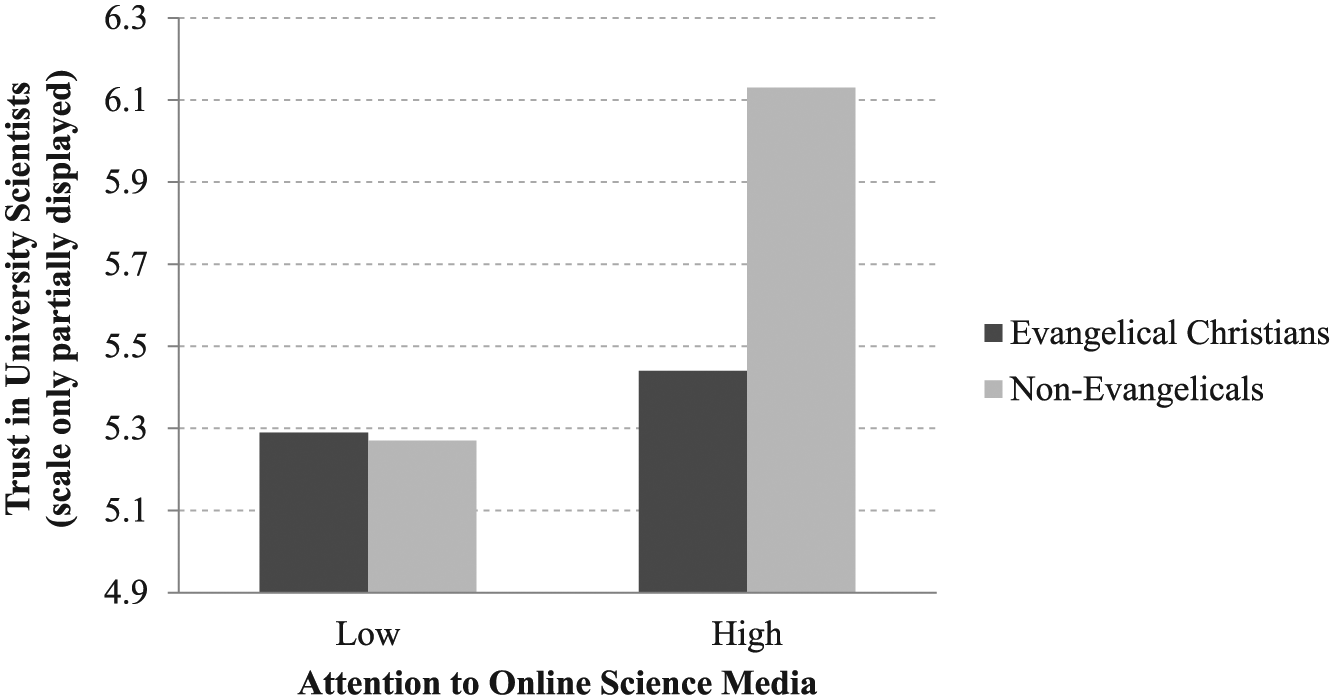
The interaction between Evangelical Christian status and attention to online science media on trust in university scientists.

The interaction between Evangelical Christian status and science knowledge on trust in university scientists.
Finally, when trust in science and technology museums was the dependent variable of interest, one interaction emerged as significant (see Figure 3). As non-Evangelicals increased in their scientific knowledge levels their trust in science museums showed a sharp increase. However, Evangelicals were largely stable in their museum trust evaluations, regardless of knowledge levels. Overall, these findings suggest that Evangelical status does indeed moderate the influence of both knowledge and media attention on trust evaluations; therefore, H3 and H4 are supported.

The interaction between Evangelical Christian status and science knowledge on trust in science and technology museums.
4. Discussion and conclusion
This study explored trust in institutions that publics may turn to when gathering information about the risks and benefits of science. The first of these groups was scientific authorities, including university scientists, industry scientists, and science museums, while the second was religious organizations. Scientific deference, political ideology, and Evangelical Christian status were all highly correlated with trust evaluations in the anticipated directions, while media attention emerged as having a much more consistent relationship with trust in scientific authorities than trust in religious organizations. Finally, our study revealed that Evangelical Christian status, above and beyond general religious beliefs, served to moderate the impacts of both media attention and knowledge on people’s trust evaluations. Before elaborating on these findings, we discuss some limitations of the work.
Limitations
The first limitation concerns the measurement of our dependent variables. Each was assessed with single-item survey measures, making it impossible to assess or control for random measurement error in the regression models. However, this decision was made on the advice of a reviewer, who suggested the increase in random measurement error would be offset by the information gain in looking at these dependent variables individually. Indeed, we did uncover patterns that would have been obscured with a combined dependent variable (e.g. the significant relationship between scientific knowledge and trust in science museums, but the absence of such a relationship for the other dependent variables), which gives us confidence in this decision. Moreover, had we been able to employ multi-item dependent variables, the relationships observed here would likely have been even stronger. Related to this issue, our dependent variables focus on general science attitudes. Items focusing on specific scientific topics might paint a different picture than the one reported here.
A second problem relates to the issue of causality. The analysis reported here has assumed that factors such as media attention influence how publics arrive at trust evaluations of various institutions. Unfortunately, because we are dealing with cross-sectional data, we cannot rule out alternative causal orders. For instance, it may be that publics arrive at their trust evaluations and then adapt their media diets accordingly. More than likely the process is reciprocal, with media attention influencing trust and trust determining attention paid to media. Unfortunately, we cannot disentangle this process with the data reported here.
A third issue concerns our measurement of the media use measures. First, given the degree to which Twitter has emerged as a prominent source of science information (Runge et al., 2013), our analysis had originally intended to test the impacts of both Facebook and Twitter use on scientific trust. However, the relatively small number of Twitter users in the dataset made this impractical. Second, while we measured both traditional and online media through a series of attention measures, the wording of our Facebook measures can best be described as frequency of use measures. Nevertheless, communication scholars have demonstrated high correlations between measures of media attention and use (Cacciatore et al., 2014; Eveland and Scheufele, 2000); thus, we have little reason to believe that our approach biased our findings.
Findings and implications
With these considerations in mind, this study provides important information concerning where people place their trust for science information, as well as what drives such evaluations. First, our results speak to a large subgroup of the population (Evangelicals) who, despite being among the largest religious groups in the United States (Pew Research Center, 2015), have been under-investigated in empirical scholarship concerning scientific attitudes. We found that Evangelicals were significantly more trusting of religious organizations than scientific authorities. The Evangelical preference for information from religious figures is not altogether surprising considering that distrust of authority serves as a foundational element of fundamentalist, Evangelical Protestantism. As Harrison (1998, 2006, 2009) has argued, the main point of differentiation between the Christianity of the Middle Ages and the Christianity that grew from the Protestant Reformation concerned the interpretation of biblical texts. Early Christian theologians read scripture to determine its allegorical meaning, oftentimes believing that sacred texts had no literal meaning, or that “when taken literally became nonsensical” (Harrison, 2006: 117). Less educated followers of the Christian faith often relied on the interpretation of religious authority to find meaning in biblical texts and teachings. Reformers such as Luther and Calvin disagreed with this approach. They argued for the philosophy of sola scritptura, meaning that the literal word of scripture was the definitive authority, and that an increasingly literate Europe need not rely on the supposed—and allegedly corrupt—allegorical readings established by Church leaders.
According to Harrison (1998, 2006, 2009), this interpretative shift resulted in several historically significant consequences, two of which are relevant to the current discussion. As noted above, the Protestant Reformation was premised on institutional distrust and the elevation of scripture to the ultimate authority, the literal meaning of which Christians could infer for themselves. Evangelical Protestants are today’s standard-bearers of this tradition, in which each believer is or can become a religious expert, so to speak. Additionally, by insisting on the literal truth of biblical texts, Protestant reformers moved scripture from the allegorical to the observable world and “inadvertently made possible a new approach … [that] was essentially a scientific one” (Harrison, 2006: 116) in that literal claims could be tested.
While this sixteenth century move toward biblical literalism may have contributed in some ways to the scientific revolution by promoting the empirical study of both scripture and the natural world (see Harrison, 1998; Merton, 1938), it arguably served as the springboard for the religion–science tension underlying many of this study’s findings. Indeed, the findings of modern-day science sometimes contradict biblical accounts, for instance the Genesis stories regarding the origin of the universe and life (Dawkins, 2008; Krauss, 2012). Evangelicals, for many of whom biblical literalism goes unquestioned, may thus find rejection of scientific authority—at least relative to religious authority—at times necessary to ensure the survival of a particular belief system. Moreover, given that biblical literalism is rooted in a more general distrust of authority, such a rejection might also come somewhat naturally.
Second, we found that demographics were largely consistent in their relationships with trust. White respondents reported lower levels of trust in religious organizations, which is unsurprising considering the rate of religious disaffiliation in the United States is greater among Caucasians than African Americans or Hispanics (Pew Research Center, 2012). Consistent with previous research, younger respondents were more likely to place high trust in scientific authorities (e.g. Anderson et al., 2012; Brewer and Ley, 2013). Scientists can take solace in this finding as it suggests younger generations are more trusting of their work.
In terms of value predispositions, liberals were more trusting of university scientists and science museums, but not industry scientists, and conservatives were more trusting of religious organizations. This finding also fits with recent trends suggesting that Democrats are considerably more likely than Republicans to report no religious affiliation (63% of those with no religious affiliation are Democrats, whereas only 26% are Republicans; Pew Research Center, 2012). Scientific deference was strongly and positively correlated with trust in scientific authorities. Overall, our findings echo previous scholarship which has identified the important role played by value predispositions in influencing scientific attitudes, opinions, and trust (e.g. Anderson et al., 2012; Brewer and Ley, 2013; Brossard et al., 2009; Brossard and Nisbet, 2007), while also identifying the unique role played by Evangelical Christian status in such evaluations.
The media use patterns suggest that media attention can cultivate trust in scientific authorities, but media attention was not correlated with trust in religious organizations. More importantly, we found some evidence that the relationships between media attention and trust are contingent on the religious outlook of respondents. In particular, increased attention to online science content was correlated with higher levels of trust in university scientists among non-Evangelicals. However, among Evangelicals, levels of attention to online science content had virtually no relationship with trust. This suggests that Evangelical status is a key variable for understanding science trust in relation to media usage. It also suggests two groups of people: non-Evangelicals who rely heavily on science information shared in the media when forming trust evaluations, and Evangelicals who do not translate information found in media into later evaluations of trust.
Related to this point, levels of scientific knowledge, once other factors were controlled for, were largely unrelated to trust evaluations, with the lone exception that greater science knowledge was related to greater levels of trust in science museums. However, the interaction effects revealed that knowledge levels are correlated with trust evaluations but that their impacts differ across subgroups in the population. Specifically, while increased knowledge was associated with greater trust in both university scientists and science museums among non-Evangelicals, increased knowledge had little (and even a negative) impact on trust in those same institutions among Evangelicals. Importantly, all of our interaction effects resulted even after controlling for the effects of religiosity, which suggests that self-identified Evangelicals are a unique group who evaluate and utilize both factual knowledge and media content differently than even other highly religious groups in the population.
Although the present research does not necessarily allow us to pinpoint how Evangelicals and non-Evangelicals interact with media and knowledge to arrive at different trust conclusions, we have outlined some potential reasons as part of our review of the literature. On the one hand, the two groups may be turning to different media channels when consuming science information. In this respect, our interaction between online science media attention and Evangelical Christian status may be partly explained by differences in media diet between the two groups. However, it may also be that Evangelicals and non-Evangelicals evaluate even the same factual information differently depending on how well that information fits with their original beliefs or opinions. By counter-arguing information that is hostile to their point of view and integrating information that they find congenial, Evangelicals and non-Evangelicals may be fixating on different aspects of a given news story. Over time, this may impact where they place their trust and to what degree they are willing to follow a trusted party.
Highly religious Evangelicals may also have some degree of immunity to the persuasive powers of science media and scientific understanding. There are a number of theories that might explain this effect, but the elaboration likelihood model (ELM; Petty and Cacioppo, 1981) and inoculation theory (McGuire, 1961) seem particularly applicable. Evangelicals who are regular churchgoers and highly involved in the messages disseminated by religious leaders—which perhaps run counter to some scientific claims—likely process those religious messages centrally and with greater elaboration. Messages processed in this manner tend to produce more stable attitudes that are resistant to change, even when presented with conflicting information (Petty and Cacioppo, 1984; Petty et al., 2009).
Inoculation theory extends this basic principal of ELM. Advocates for a particular point of view are more effective when they present potential counterarguments and then subsequently rebut them. Providing audiences with ready-made rebuttals to anticipated counterarguments lessens the effect of these counterarguments when encountered in real-life settings (Lessne and Didow, 1987). Some research suggests that inoculation practices increase the persuasiveness of messages, most notably in areas of public health (e.g. Goldberg et al., 2006; Niederdeppe et al., 2014). It is reasonable to assume that Evangelical Christian leaders could employ similar inoculation tactics to “protect” their flocks from what they view as dangerous scientific findings. While we are not aware of any studies that examine the current rhetoric of religious leaders concerning science issues, such tactics do have a historical precedent among religious authority figures (Compton and Kaylor, 2013).
We have offered some tentative explanations as to why we may have observed the effects found in this study; however, future research should empirically investigate these hypotheses. It may also prove helpful to expand this analysis to other religious groups to determine if there are similar differences in trust between different religions or different denominations of Christianity. Similarly, it makes sense to explore these patterns with measures about specific scientific topics that vary in terms of salient moral arguments.
Footnotes
Funding
The author(s) disclosed receipt of the following financial support for the research, authorship, and/or publication of this article: This material is based upon work supported by grants from the National Science Foundation to the Center for Nanotechnology in Society at Arizona State University (Grant No. SES-0937591) and the UW-Madison Nanoscale Science and Engineering Center in Templated Synthesis and Assembly at the Nanoscale (Grant No. SES-DMR-0832760). Any opinions, findings, and conclusions or recommendations expressed in this material are those of the authors and do not necessarily reflect the views of the National Science Foundation.