




Abstract
Using data from a national survey of South Koreans, this study explores the role of science communication in enhancing three different forms of scientific knowledge (factual, procedural, and subjective). We first assess learning effects, looking at the extent to which citizens learn science from different channels of communication (interpersonal discussions, traditional newspapers, television, online newspapers, and social media). We then look into the knowledge gap hypothesis, investigating how different communication channels can either widen or narrow the gap in knowledge between social classes. Television was found to function as a “knowledge leveler,” narrowing the gap between highly and less educated South Koreans. The role of online newspapers in science learning is pronounced in our research. Reading newspapers online indicated a positive relationship to all three measures of knowledge. Contrary to the knowledge-leveling effect of television viewing, reading online newspapers was found to increase, rather than decrease, the gap in knowledge. Implications of our findings are discussed in detail.
Communicating science can play an important role that goes beyond simply informing the public of new scientific discoveries. According to the scientific literacy model (Miller, 1998), further educating the public about science will eradicate misperceptions, which in turn can promote greater support for science. Science communication can also enhance democratic participation in science by allowing citizens to make informed judgment (Kim et al., 2013). Science learning is often related with greater self-efficacy, and knowledge can facilitate public participation by providing a useful platform, from which citizens can become more confidently involved in collective decision making (Brossard and Shanahan, 2003).
Research (e.g. National Academy of Sciences, 2010) shows that scientific knowledge is unequally distributed across the citizenry, with the lower social classes being less knowledgeable. An unintended outcome of communicating science with the public is a potential increase in the social class gap in knowledge. Supporting the knowledge gap hypothesis, recent research (e.g. Su et al., 2014) has indicated that segments of the population with higher socioeconomic status acquire mass-mediated science information at a faster rate than the lower status segments, further widening the gap between classes. The knowledge disparities can be problematic for several reasons. First, the uninformed lower classes may not understand how a certain scientific decision will affect their own interests; they thus can make decisions that do not represent their best interests (Kim et al., 2015). At the same time, lack of knowledge among the lower classes can function as a barrier to equal participation in decision making, resulting in their interests being largely underrepresented in science policies (Cacciatore et al., 2014).
Using data from a national survey of South Koreans, this study explores the role of science communication in enhancing knowledge. We first assess learning effects, looking at the extent to which citizens learn science from different communication channels. We then look closely into the knowledge gap in science, investigating how different forms of communication can widen or narrow the gap between social classes.
Our study can make several important contributions to the science communication literature. First, we conceptualize and operationalize scientific knowledge as a multidimensional construct. One form of knowledge is factual knowledge, referring to the understanding of scientific facts and concepts (Nisbet et al., 2002). Another form, procedural knowledge, can be conceptualized as knowledge of science as a mode of inquiry, and deals with one’s understanding of proper norms and procedures in scientific research (Miller et al., 1997). Finally, scientific knowledge can include subjective knowledge, which taps individuals’ subjective assessment of how well informed they are about science (Ladwig et al., 2012). In this study, we analyze these three forms of knowledge separately in investigating science learning and a knowledge gap.
Distinguishing between different forms of knowledge is important in the sense that they can play distinct functions. Factual knowledge helps citizens become scientifically literate, allowing them to read about issues involving science and technology (Miller et al., 1997). At the same time, factual knowledge allows citizens to make sense of the essence of competing arguments particularly during a scientific controversy (Miller, 1998). Procedural knowledge functions to enable the public to adequately evaluate scientific research and its findings (Miller, 2004). While factual knowledge can help individuals better comprehend the essential points of competing claims, procedural knowledge can help them critically assess the validity of such claims. Subjective knowledge is a type of knowledge that can be central to facilitating public engagement in science (Tytler et al., 2001). Those who consider themselves knowledgeable will feel more confident and comfortable when participating in collective decision making (Brossard and Shanahan, 2003). As each form of knowledge can play its own unique function, it is not our intention to argue that one form is more important than others. Rather, our intention is to demonstrate that all three measures should be included and analyzed separately in investigating scientific knowledge. These three forms of knowledge can be complementary in the sense that there are some overlaps in their functions. Nevertheless, we highlight in this study that different knowledge forms should not be combined or used interchangeably in investigating their predictors and impacts.
Second, we incorporate multiple channels of science communication into a single empirical test, and compare their discrete roles in enhancing public knowledge and in producing a knowledge gap. This was necessary because research has indicated that certain forms of communication can be more or less effective than others in terms of learning science (Nisbet et al., 2002). Research has also demonstrated that while certain forms of communication (e.g. newspapers) tend to increase a knowledge gap (Griffin, 1990), others (e.g. television) can function to reduce, rather than increase, the same gap (Eveland and Scheufele, 2000). In addition to testing the well-documented (e.g. Nisbet et al., 2002) learning effects from traditional media (i.e. newspapers and television), our study examines science learning from such newer media platforms as online newspapers and social media, and face-to-face communication, i.e. interpersonal discussions.
1. Scientific knowledge
Factual knowledge refers to understanding of scientific concepts and facts, including awareness of things, such as knowing that eating fruits and vegetables can prevent hypertension. Knowledge of this kind can predict certain behaviors in such a way that nutritional knowledge, for example, is positively correlated with healthy eating. Much of research on scientific knowledge has relied on using factual knowledge, typically measured with a series of true–false questions about scientific facts and concepts (Su et al., 2014). Researchers have questioned the validity of using this single-dimensional conceptualization of knowledge, arguing that factual knowledge alone may not fully capture the abstract and multifaceted nature of public knowledge (Eveland et al., 2004).
Procedural knowledge is knowledge about the procedures and methodologies in scientific inquiry, knowing, for example, that a scientific theory consists of propositions logically connected in a deductive reasoning, is subject to empirical scrutiny, and can be revised or falsified (Miller et al., 1997). Procedural knowledge is particularly necessary in critically evaluating scientific discoveries and claims as it allows a person to understand such concepts as principles of data collection, research design, and the validity of the evidence, which are often found at the center of a scientific controversy (Tytler et al., 2001).
Subjective knowledge refers to one’s perceived familiarity with science, also referred to as knowledgeability of science, which taps a person’s own assessment of how well he or she is informed of scientific issues and discoveries (Miller et al., 1997). The importance of such knowledge is founded in the meta-cognition literature, which suggests that a subjective assessment of own knowledge can play an important role in a number of ways, including facilitating participation in collective decision making and forming support for or opposition to science and technology (Ladwig et al., 2012).
2. Knowledge gap and scientific knowledge
According to the knowledge gap hypothesis (Tichenor et al., 1970), the amount of learning from mass media is determined, to some extent, by one’s socioeconomic status, typically measured with the level of his or her formal education. Persons with higher education gain knowledge more often and effectively from the media, so that the initial gap between classes increases even further. Testing the knowledge gap requires testing several interrelated sub-hypotheses, which together can explain how public communication can produce an increasing gap in knowledge (Kim, 2008). The first step in testing the knowledge gap would be to examine whether there is indeed a gap between high and low education groups. We test the following hypothesis:
H1: People with higher education will be more knowledgeable about science than the less educated.
Tichenor and colleagues’ original theorization offers two separate explanations of how the media can produce an increasing knowledge gap. The first is that the upper classes in general use the media more often for information because they have a greater stake in what happens in the economy and politics, and thus are highly motivated to become well informed in the first place (Tichenor et al., 1970). The upper classes, therefore, acquire more information about science because they tend to use the media more often for science information. That is, media use can mediate the link between one’s education level and his or her knowledge of science (education level → science media use → scientific knowledge).
Examining this mediating role requires testing two connected hypotheses. First, there should be a difference between social classes in their uses of science communication (education level → science media use/discussion participation). Most print media are tailored to the tastes of the upper and middle classes because they are the key customers of advertisers (Tichenor et al., 1970). It is, therefore, likely that people with higher education use traditional offline newspapers more often than the less educated for science information. Online newspapers are also likely to be preferred by the highly educated because they, like offline newspapers, are largely text-based, and thus cognitively demanding. In regard to interpersonal discussions, people with higher education are in general surrounded by others with a similarly high educational background and interest in science. This particular social setting can provide the highly educated with more opportunities to engage in conversations about science topics (Lee, 2009). However, researchers have pointed out that the content of television is in general geared more toward people with less education (Prior, 2005). It is, therefore, possible that television is consumed more often by less sophisticated and less educated viewers even for science information (Nisbet et al., 2002). It has been somewhat unclear who uses social media more often for science information although a recent study (Bode, 2016) suggests that information in social media has the potential to reach less educated and unsophisticated audiences, who are otherwise least likely or least motived to pay attention to scientific information. That is, social media users are exposed to scientific information incidentally while doing other things and are able to gain knowledge as a form of passive learning.
The class difference in the use of science communication seems to depend on the forms of communication. Some communication channels (e.g. traditional newspapers, online newspapers, or interpersonal discussions) seem to be used more often by the highly educated, while others (e.g. television) tend to be consumed more often by the less educated. Also, less is known about who uses more often such newer forms of communication as social media for science information. Therefore, we put forth a single research question, instead of testing separate hypotheses for different forms of communication:
RQ1: Is there a difference between highly and less educated citizens in the amount of using different channels of science communication?
In order to test the mediating role, it is also necessary to test the second part of the mediated causal links, the positive correlation between using science communication and learning science (science media use/discussion participation → scientific knowledge). Traditional newspapers have been found to significantly enhance public knowledge of science (Nisbet et al., 2002). Newspaper reading is in general a self-selected, highly involving, and cognitively demanding behavior, and can thus result in substantial learning (Eveland and Scheufele, 2000). Reading science news online is also a highly motivated and demanding behavior, having great potential to yield significant learning (Brossard, 2013). More importantly, online news readers can obtain essentially an unlimited amount of information about science with relatively little effort. With regard to television viewing, researchers argue that viewers are often passive and unmotivated, and thus may not learn as much as the self-selected and motivated newspaper readers (Prior, 2005). Challenging this “print superiority” perspective, nevertheless, studies have reported significant science learning from television viewing (e.g. Brossard and Nisbet, 2007). Evidence also suggests that frequent participation in interpersonal discussions can increase knowledge of a variety of scientific topics (Lee, 2009). As Ho (2012) points out, exposure to diverse others through formal and informal organizations can provide citizens with an opportunity to have a conversation with those who are willing to share information obtained from other mass-mediated sources. When it comes to social media use, however, its effects on science learning is somewhat questionable. As Bode (2016) argues, much of learning from social media tends to be incidental, passive, and short term; thus, knowledge gain may not be as substantive as self-selected and motived learning from newspaper reading. At the same time, many individuals who use social media for science information may not be focused much on learning scientific facts or discoveries but rather motivated to read more about scientific controversies (Su et al., 2014). We test the following hypothesis to examine learning effects from different forms of science communication:
H2: Heavy users of science communication will be more knowledgeable about science than light users.
Another explanation of how science communication can produce an increasing gap is rooted in the difference between social classes in their cognitive ability to process information. Formal education provides cognitive skills and background knowledge that allow highly educated citizens to easily make sense of often complicated information, thus obtaining greater knowledge from the media or interpersonal discussions (Eveland and Scheufele, 2000). Learning, therefore, is moderated by one’s education level. When exposed to the same information, individuals with higher education gain knowledge more effectively, so that the initial gap between classes increases over time.
It is well documented in the literature that the highly educated tend to gain greater knowledge from reading a newspaper, further widening the gap between classes (Kim, 2008). However, research also indicates that some forms of communication can function to narrow—rather than widen—the knowledge gap. Television, for example, often presents information in less cognitively demanding ways; even less educated viewers may gain significant knowledge (Neuman et al., 1992). Sophisticated and educated viewers, on the other hand, may find little to learn beyond what they already know because the content of television is somewhat superficial or less informational (Eveland and Scheufele, 2000).
With regard to online newspapers, it is still inconclusive whether they play a gap-increasing or a gap-reducing role. Some researchers (e.g. Su et al., 2014) point out that the format of information presented is largely text-based, and reading news online requires such skills as evaluation of source credibility and a certain level of literacy, which are prerequisites for reading a traditional newspaper. People with higher education, therefore, will gain greater knowledge from online newspapers, resulting in a larger knowledge gap. Others, however, argue that the less educated—not the highly educated—will benefit more from reading science news online. The additional information available in online newspapers, hyperlinked in the articles or provided by discussion groups and other experts online, can greatly help those who lack background knowledge (i.e. the less educated) make sense of often complicated science news (Brossard, 2013). Reading online newspapers, therefore, can allow the less educated to catch up with those with higher education (Ladwig et al., 2012).
The gap-increasing or gap-reducing role of interpersonal discussions is inconclusive as well. Some researchers (e.g. Su et al., 2014) contend that the highly educated are often surrounded by scientifically knowledgeable individuals, and thus can gain substantial knowledge from having a conversation. The less educated and less knowledgeable individuals, on the other hand, are likely to have a conversation with others who are also less knowledgeable, thus gaining little knowledge, so that the knowledge gap increases, rather than decreases. Others (e.g. Ho, 2012) disagree, arguing that it is somewhat unlikely that the nature of scientific information shared during a casual conversation would be highly substantive or sophisticated. Well-educated and already knowledgeable individuals, therefore, would gain only a small amount of new knowledge from the conversation. On the other hand, the less educated can gain a significant amount of new knowledge from a conversation by listening to opinion leaders who are in general more knowledgeable and informed of scientific issues.
When it comes to social media, using these newest forms of communication can reduce, rather than widen, the gap in scientific knowledge. As explained earlier, exposure to information in social media is often incidental, rather than self-selected, producing a passive rather than a motived form of learning. This passive learning is typically characterized by an absence of resistance to what is being learned, thus producing more effective learning among less educated and unmotivated individuals (Krugman and Hartley, 1970). Their highly educated counterparts, on the other hand, may experience a ceiling effect, unlikely to gain significant learning from using social media (Bode, 2016). Therefore, learning among the less educated would be relatively more substantial than it would be among the highly educated, reducing the knowledge gap.
Due to the inconsistent predictions across different forms of communication, we put forth the following research question, instead of testing multiple hypotheses:
RQ2: Are learning effects from different forms of science communication moderated by one’s educational level?
3. Methods
Sample
Data for this study were collected in August 2011, as part of the Korea Food and Drug Administration’s survey on the public’s perceptions of a variety of health and science issues. Respondents were recruited by a nationwide online survey firm from a panel of about 650,000 potential participants. Sampling was carried out, using a nonprobability quota sampling method, based on respondents’ age, gender, and geographic region: 20–29 (n = 240), 30–39 (n = 240), 40–49 (n = 240), 50–59 (n = 200), 60–69 (n = 120); males (n = 520), females (n = 520); Seoul (n = 460), Pusan (n = 160), Daegu (n = 110), Daejeon (n = 70); and Kwangju (n = 70), Inchon (n = 120), Ulsan (n = 50). Based on these quotas, e-mail solicitations were sent out to the potential participants who meet the criteria. Data were collected through an online survey, and individuals were not allowed to participate once their subgroup (age, gender, regions) reached its quota. Due to the use of quota sampling, we were not able to calculate a meaningful response rate. Nevertheless, the purpose of our sampling design was to ensure representative diversity in regard to gender, age groups, and geographic regions. 1 After sorting out incomplete and unreliable surveys (n = 39), the final size of the sample was 1001.
Measurement
Factual knowledge was measured based on responses to the following eight dichotomous (true/false) items, most of which were adopted, translated, and slightly revised from the National Science Board’s (2010) Science and Engineering Indicators: 2 (a) “The earth goes around the Sun” (true), (b) “If boiled, radiation-contaminated milk is safe to drink” (false), (c) “Mother’s genes determine baby gender” (false), (d) “Humans lived with dinosaurs” (false), (e) “Antibiotics cannot treat viruses” (true), (f) “Lasers work by focusing sound waves” (false), (g) “All radioactivity is man-made” (false), and (h) “Electrons are smaller than atoms” (true). The number of correct answers ranged between 0 and 8, and was summed up into a single index (KR-20 = .59), representing respondents’ understanding of a set of basic constructs sufficient enough to comprehend scientific news in a newspaper or magazine (Miller, 1998). Procedural knowledge was measured by asking respondents, on a 7-point scale (1 = strongly disagree; 4 = neutral; 7 = strongly agree), how strongly they agreed or disagreed with each of the following statements: (a) “Because different scientists use different knowledge and methods, they often offer different interpretations of the same scientific phenomenon” (true), (b) “Because scientists are objective, they always offer the same interpretations of the same phenomenon” (false, reverse-coded), (c) “A scientific theory is sometimes falsified as scientists discover new evidence” (true), (d) “A scientific theory is never falsified or replaced by another because it is based on a solid body of supporting evidence” (false, reverse-coded), (e) “Scientists often use multiple research methods to arrive at a compelling conclusion” (true), and (f) “Scientists always use one single research method” (false, reverse-coded). These six measures followed closely Miller’s (1998) conceptualization of procedural knowledge as an understanding of scientific norms and procedures, and were combined into a single index (α = .72), where higher scores indicated greater knowledge. Subjective knowledge was measured with five items, asking respondents how well informed (1 = not at all informed; 7 = very well informed) they felt they were about (a) genetic modification, (b) nanotechnology, (c) medical research, (d) climate change, and (e) radioactive contamination. Again, these five measures were combined into a single index (α = .80) representing one’s perceived level of own knowledge of different science subjects.
Respondents’ participation in interpersonal discussions was measured with a single item, asking how often (0 = never; 10 = very often) they discussed science with other people. Science media use was measured with the amounts of exposure and attention to science information on (a) traditional newspapers, (b) television, (c) online newspapers, and (d) social media (such as Facebook and Twitter). We used two questions tapping how often (0 = never; 10 = very often) respondents read or viewed, and how much attention (0 = none; 10 = very much) they paid to each medium. These two exposure and attention measures were combined into a single additive variable representing the amount of using each medium for science information: traditional newspaper reading (r = .721), television viewing (r = .731), online newspaper reading (r = .755), social media use (r = .824).
Demographic controls included gender (50.1% female), age, education (the highest degree completed, 64.0% with college diploma or more), and family income (median household monthly income = 3.00–3.99 million Korean Won (about USD 3000–3990)). Table 1 reports descriptive statistics of the demographics and other variables analyzed in this study.
Descriptive statistics (N = 1001).
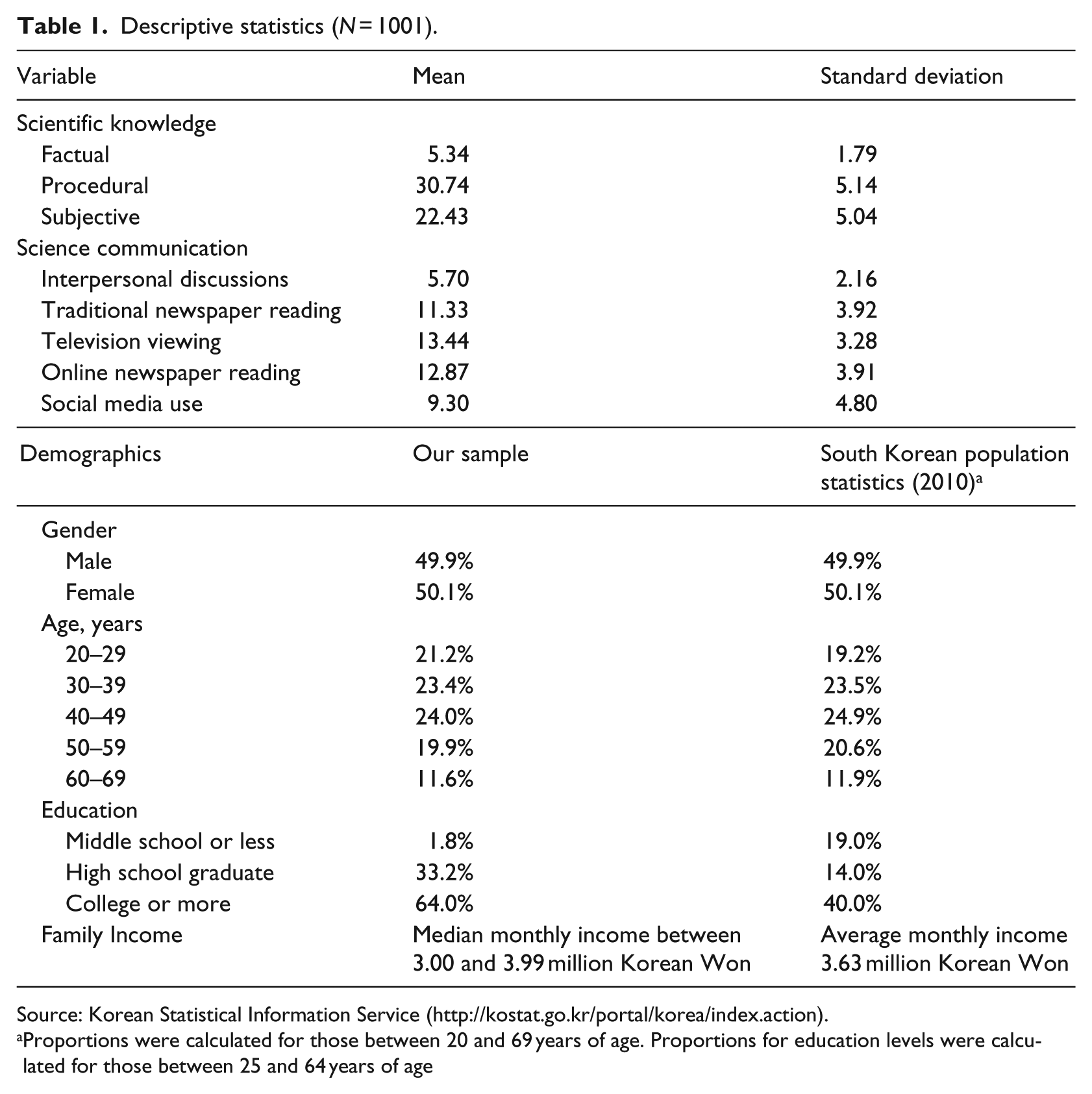
Source: Korean Statistical Information Service (http://kostat.go.kr/portal/korea/index.action).
Proportions were calculated for those between 20 and 69 years of age. Proportions for education levels were calculated for those between 25 and 64 years of age
Findings
Before examining our formal hypotheses and research questions, we first analyzed how closely the three measures of scientific knowledge were correlated with each other. Pearson correlations indicated that there was a moderate and statistically significant positive correlation between factual and procedural knowledge (r = .294, p < .001), a small but statistically significant negative correlation between factual and subjective knowledge (r = −.065, p < .05), and a nonsignificant correlation between procedural and subjective knowledge (r = −.003, p = ns). These moderate or small correlations indicate that the three knowledge measures may represent separate constructs.
Testing our first hypothesis (H1) examines whether there is a gap in scientific knowledge between highly and less educated South Koreans. Supporting H1, Table 2 shows that people with higher education (some college or more, M = 5.58) have greater factual knowledge than those with lower education (high school diploma or less, M = 4.75, t = −6.12, p < .001). The highly educated (M = 31.12) also indicated greater procedural knowledge than the less educated (M = 29.59, t = −4.09, p < .001). However, the highly educated (M = 22.30) were not much different from the less educated (M = 22.84, t = 1.46, p = ns.) in terms of subjective knowledge. 3 Given that those with lower education are in fact less knowledgeable in terms of both factual and procedural knowledge, this lack of difference in subjective knowledge may suggest that a significant number of the less educated tend to overestimate their knowledge in science, falsely perceiving that they are knowledgeable. Also, the negative correlation between factual and subjective knowledge may further support the idea that many people with lower education tend to perceive that they are more knowledgeable than they actually are.
Differences between high and low education groups in the amounts of scientific knowledge and communication (N = 1001).
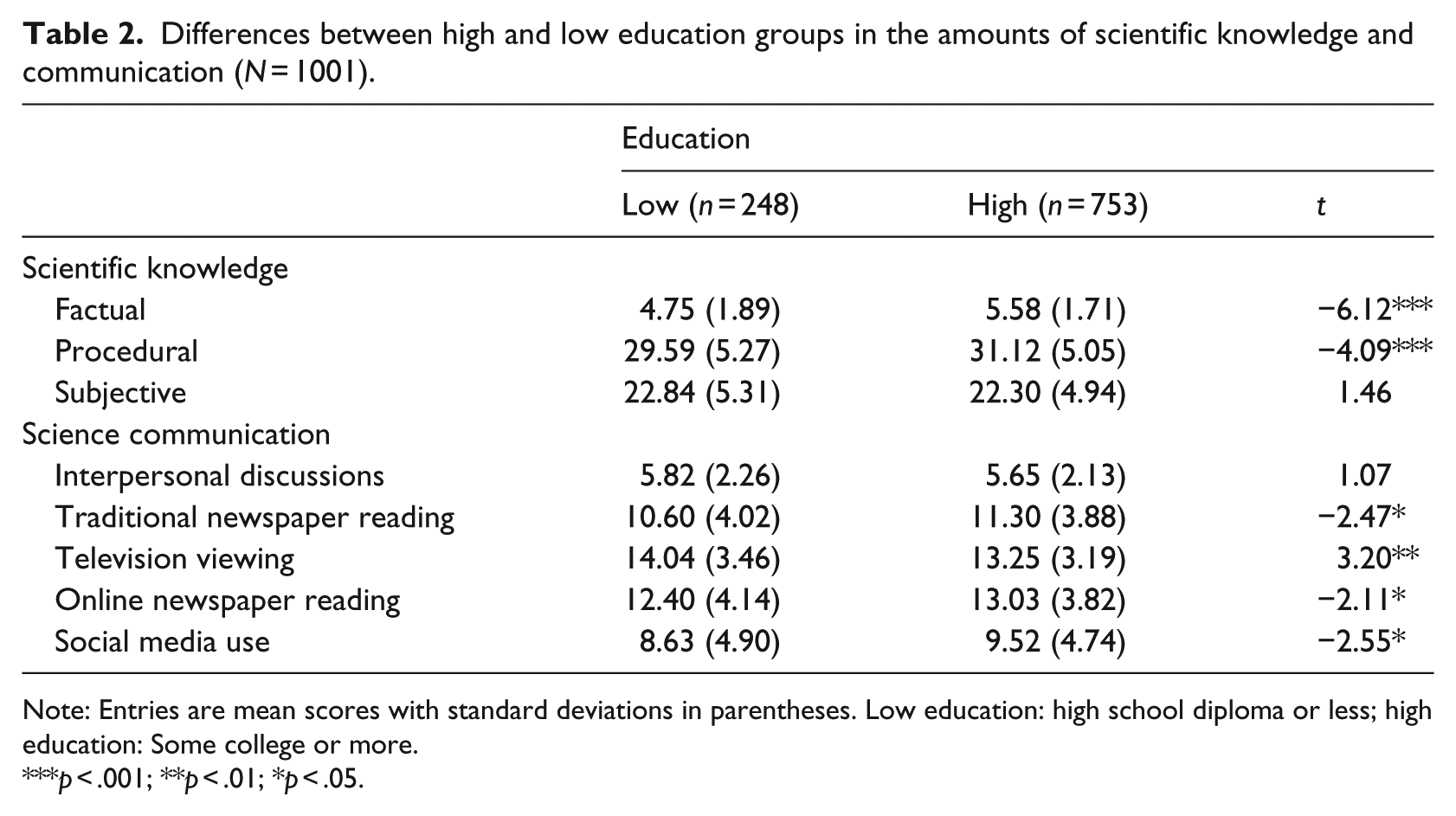
Note: Entries are mean scores with standard deviations in parentheses. Low education: high school diploma or less; high education: Some college or more.
p < .001; **p < .01; *p < .05.
Also examined is the question of whether there is a difference between highly and less educated citizens in the amount of using different channels of science communication (RQ1). We found no significant difference between the highly (M = 5.65) and less educated (M = 5.82, t = 1.07, p = ns) in interpersonal discussions (see Table 2). People with higher education (M = 11.30) read a traditional newspaper more often for science information than those with lower education (M = 10.60, t = −2.47, p < .05). Highly educated respondents (M = 13.03) read online newspapers more often as well, compared to less educated respondents (M = 12.40, t = −2.11, p < .05). There was also a significant difference between the highly (M = 9.52) and less (M = 8.63, t = −2.55, p < .05) educated, with the highly educated using social media more often. When it comes to television, however, the less educated (M = 14.04)—not the highly educated (M = 13.25, t = 3.20, p < .01)—indicated greater amount of television viewing for science information.
Learning from science communication (H2) and its interaction with education level (RQ2) were tested using hierarchical ordinary least squares (OLS) regressions, which predicted three measures of scientific knowledge as the dependent variables. Table 3 shows regression models with and without interaction terms (Model 1 and Model 2) for each knowledge measure. In producing the interaction terms, we used continuous—as opposed to dichotomous—measures of both education and communication use, and these two variables were z-standardized first in order to minimize multicollinearity between the components of an interaction term and the interaction term itself.
Regressions predicting scientific knowledge (N = 1001).
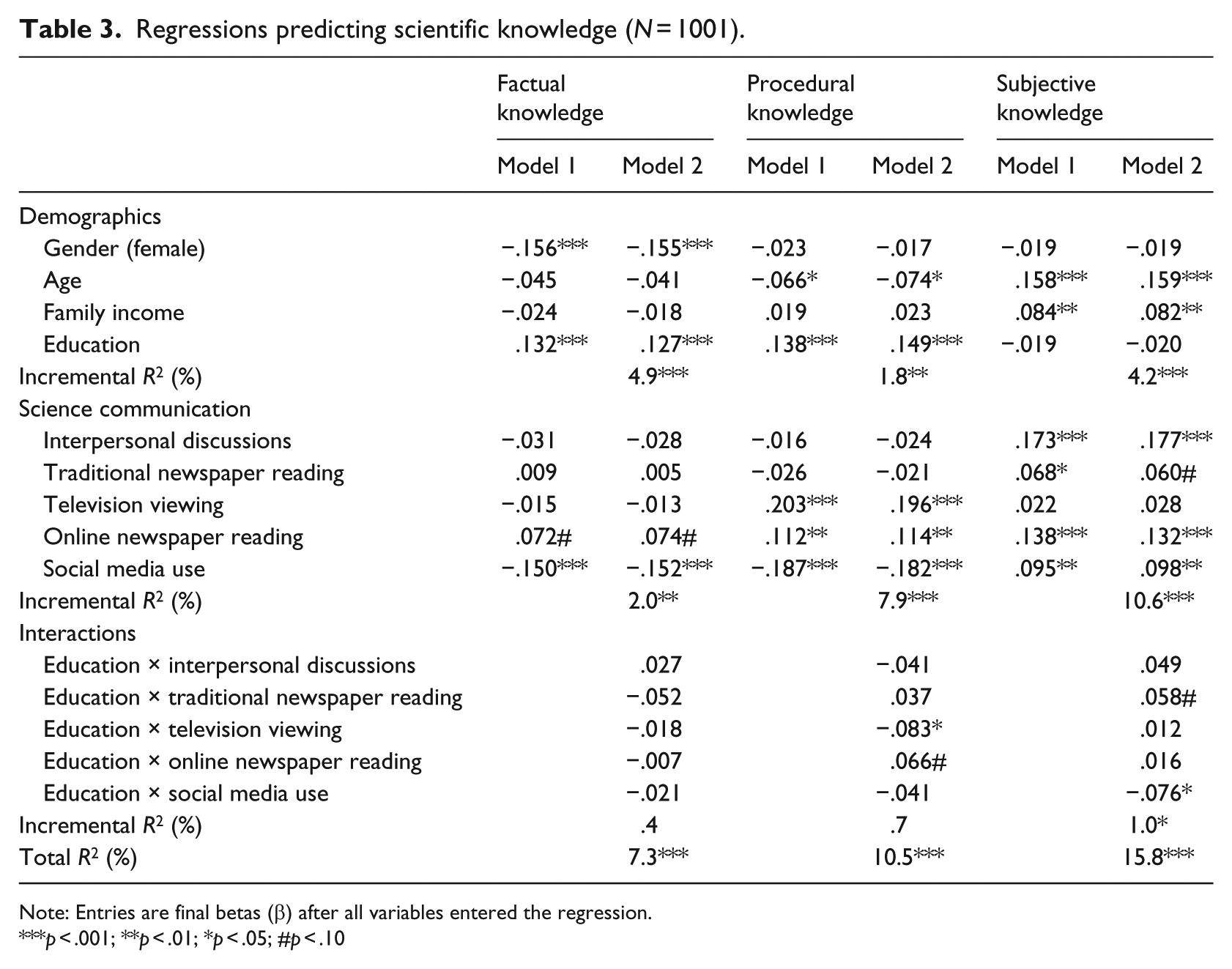
Note: Entries are final betas (β) after all variables entered the regression.
p < .001; **p < .01; *p < .05; #p < .10
Supporting H2, online newspaper reading indicated positive relationships to all three measures of scientific knowledge (see Model 1 columns in Table 3): factual (β = .072, p = .058), procedural (β = .112, p < .01), and subjective (β = .138, p < .001). Interpersonal discussions (β = .173, p < .001) and traditional newspaper reading (β = .068, p < .05) were positively associated only with subjective knowledge. Television viewing also showed a positive correlation with procedural knowledge (β = .203, p < .001). Interestingly, social media use had negative relationships with factual (β = −.150, p < .001) and procedural (β = −.187, p < .001) knowledge, while it showed a positive relationship with subjective knowledge (β = .095, p < .01).
RQ2 questions whether learning from science communication is moderated by one’s education level. Table 3 (see Model 2 columns) shows a significant interaction between education and television viewing in predicting procedural knowledge (β = −.083, p < .05). More specifically, a graphical presentation of the interaction between education and television (see Figure 1) reveals that while people with lower education learn significantly from television, learning is only marginal among the highly educated, suggesting that television can function as a knowledge leveler at least in terms of procedural knowledge. Table 3 also shows a marginally significant interaction between education and online newspaper reading in predicting procedural knowledge (β = .066, p = .077). The interaction graph in Figure 1 indicates that people with higher education tend to learn a lot more than those with lower education from reading newspapers online. 4 Contrary to the gap-narrowing effect of television viewing, reading online newspapers seems to increase, rather than decrease, the gap in procedural knowledge.
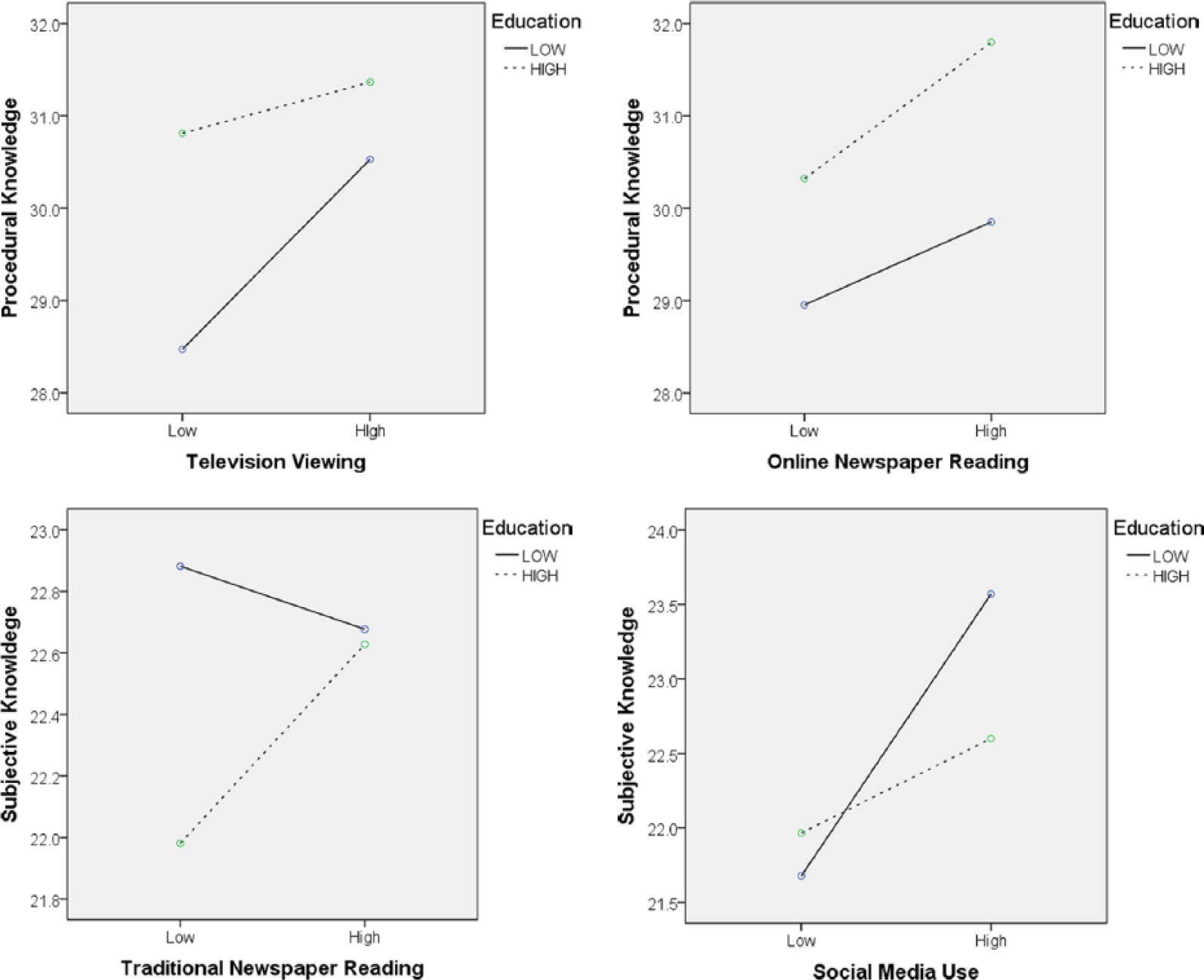
Interaction effects of education and science communication on scientific knowledge (N = 1001).
We found some significant interactions in predicting subjective knowledge as well. Findings in Table 3 show that there was a marginally significant interaction between education and traditional newspaper reading (β = .058, p = .090). The interaction graph in Figure 1 reveals that among light newspaper readers, the less educated are significantly more likely than the highly educated to perceive that they are knowledgeable. Among heavy readers, however, there is no such a gap between the two education groups. There was also a significant interaction between education and social media use (β = −.076, p < .05). The interaction graph shows that social media use significantly increases perceived (subjective) knowledge among the less educated, while the same effect is only marginal among the highly educated. 5 To some extent, social media use seems to foster misperceptions among the less educated, leading them to believe that they are more knowledgeable than they actually are.
4. Discussion
Among the mass media channels examined, television was not only the most heavily used source for science information (see Table 2) but also the most significantly and positively associated with gaining procedural knowledge. More importantly, television functioned as a knowledge leveler, narrowing the gap between social classes. First, those with lower—not higher—education were more likely to use television for science information, demonstrating that the content of television in general tends to better fit the tastes and cognitive skills of less educated South Koreans. Second, viewers with lower education tended to gain a significant amount of procedural knowledge from television, while the knowledge gain was only minimal among the highly educated. As researchers (e.g. Neuman et al., 1992) pointed out, television in general seems to provide science information in an easily understandable format, which requires less cognitive skills and background knowledge. Such television programming as science dramas, entertainment, and documentaries can present information in visual images and entertaining stories, which can make the information more understandable particularly among less educated viewers (Su et al., 2014).
Reading online newspapers indicated positive relationships with all three measures of scientific knowledge. Certainly, the use of nonlinear site designs in online newspapers—particularly the use of in-text hyperlinks—can allow the readers to obtain essentially unlimited information about science, helping them investigate important issues of interest in greater depth (Anderson et al., 2010). Contrary to the knowledge-leveling effect of television viewing, however, reading online newspapers was found to increase, rather than decrease, the knowledge gap. First, people with higher education read online newspapers more often, thus learning much more than the less educated. Second, the learning from online newspapers was moderated by one’s educational level, with the highly educated gaining significantly greater procedural knowledge. Although the Internet incorporates visual, audio, and text features in a mixed arrangement, the format of information presentation is in general closer to text-based traditional newspapers than to such visual media as television (Norris and Sanders, 2003). Reading online newspapers, therefore, requires substantial cognitive effort (Kim, 2008); only those with necessary skills and motivation—typically the highly educated—seem to learn significantly from online newspapers.
An interesting finding of our study is that social media use indicated a negative relationship with gaining factual and procedural knowledge. Social media tend to rely largely on user-generated content, and it is possible that much of the information is not only superficial but also inaccurate, unverified, or even biased, thus producing a negative learning effect (Brossard, 2013). When it comes to subjective knowledge, however, social media use indicated a positive relationship. More importantly, this positive relationship was moderated by one’s educational level. As shown in Figure 1, while social media use significantly enhanced less educated individuals’ perceptions that they were knowledgeable, using the same media did not have such a significant effect among the highly educated. Given that people do not actually gain much factual or procedural substantive knowledge from social media, those with lower education seem to falsely believe that they are learning a lot from social media, fostering their perceptions that they are more knowledgeable than they truly are.
Before further discussing our findings, it is necessary to mention some of the shortcomings of our study. First, the way we measured scientific knowledge has some limitations. In order to better demonstrate scientific learning from the media, as an anonymous reviewer points out, knowledge measures should have focused on topics that were actually covered by the media. Unfortunately, the nature of our data did not allow us to establish this link. Also, the items to measure factual knowledge (KR-20 = .59) approached but did not reach conventional levels of acceptable reliability, and this low reliability might be attributed to our use of a dichotomous (true/false) scale. Nevertheless, we need to mention that the “true/false” scale has been typically used in other scientific knowledge studies, and many of these published works (e.g. Ho, 2012) reported similarly low reliability coefficients.
Another shortcoming is that the cross-sectional nature of our data limits the ability to make a strong inference about causality. First, many potential third-variables were largely uncontrolled for in our study, and uncontrolled individual variations in communication use and scientific knowledge can produce spurious correlations. Individuals’ personal interest in science, for example, can affect both science communication use and scientific knowledge, producing a spurious correlation between the two outcome variables. Also, given that the direction of causality is often unclear in cross-sectional research, our findings do not establish that using science communication always precedes science learning. That is, we cannot rule out the possibility of a reverse-causation that the level of one’s knowledge affects the frequency of his or her use of science communication.
With these and other shortcomings in mind, our study can make several important contributions to the scientific knowledge literature. One of them is to enhance the intercultural validity of previous research. First, like the highly educated elsewhere, South Koreans with higher education demonstrated greater factual and procedural knowledge than those with lower education. However, there was no such a gap in their subjective knowledge, suggesting that many of the less educated were overestimating their knowledge. This finding is consistent with Kruger and Dunning’s (1999) observation that those without prior knowledge of a subject often fail to recognize their limitations, perceiving themselves to be more knowledgeable than they actually are. In terms of media use, South Koreans were found to use television and online newspapers most often for science information. These usage patterns are similar to those among Americans. In 2006, for example, television and the Internet were rated as the top two primary sources for science news in the United States (Anderson et al., 2010).
In terms of particularities, the lack of substantive learning from traditional newspapers is somewhat surprising, given the large body of literature demonstrating significant science leaning from newspaper reading (e.g. Nisbet et al., 2002). This may be attributed to the lack of expertise and superficial coverage in science reporting. Kim (2010) has revealed that science reporting in South Korean newspapers tends to be superficial in the sense that it often lacks the “science” component of the stories, focusing instead on newsworthy events and scandals. At the same time, it is worth noting that some of the most recent studies (e.g. Cacciatore et al., 2014) in the United States have reported a similar finding, suggesting that reading a traditional newspaper may have only a marginal effect on science learning. As Fraile (2011) pointed out, the “tabloidization” of the press, where newspapers increasingly focus on entertainment as opposed to information, might be responsible for these diminishing learning effects. Unlike previous studies in other countries (e.g. Nisbet et al., 2002), television viewing in South Korea was significantly associated with gaining scientific knowledge. Among many possibilities, it is important to note that most prime time news and documentary programs in the country are full 1-hour programs with no commercial break, which allow for delivering a large amount of information in great detail, potentially producing substantial learning (Kim et al., 2011). Finally, the role of online newspapers is pronounced in this research. Our findings suggest that online newspapers may have replaced traditional newspapers as a leading source of science information at least in South Korea. The respondents used online newspapers more often than traditional newspapers, which in turn led to considerable science learning.
Another important contribution is our finding that uses of different media and interpersonal discussions demonstrated differential effects in terms of both enhancing knowledge and producing a knowledge gap. For example, while reading a newspaper online had a positive relationship with all three forms of knowledge, social media use even had some negative relationships. In terms of knowledge gap, online newspapers were found to increase the gap in procedural knowledge, while television seemed to narrow the same gap. Social media tended to increase the gap in subjective knowledge, while traditional newspapers functioned to narrow the same gap. Given the substantial learning from online newspapers, there must be something science communicators can learn from the content and formats of the online media in terms of how to effectively enhance public knowledge of science. When it comes to the knowledge-leveling effect of television viewing, science communicators may also need to investigate what specific features in television can make the medium function to narrow, rather than widen, the gap between social classes.
Finally, our study demonstrates the need for conceptualizing and operationalizing scientific knowledge as a multidimensional construct. First, factual, procedural, and subjective knowledge were not closely correlated, indicating that they might represent separate dimensions. Second, science communication seems to play the most significant role in promoting one’s perception that he or she is knowledgeable, though its role is not as significant in enhancing such substantive knowledge as factual or procedural knowledge. The five measures of science communication together explained about 10.6% of the variance in subjective knowledge, 7.9% of procedural knowledge, and 2% of factual knowledge (see Table 3). When it comes specifically to the two measures of substantive knowledge, South Koreans seem to learn much more about scientific procedures, than scientific facts, from using mass media. This finding may not be very surprising given that most people learn scientific concepts—particularly the ones used for our measurement of factual knowledge—in a textbook, while information about scientific norms and procedures can often be found in mass media. For example, exposure to controversies and scandals in science reporting may help people learn more about scientific norms and procedures. It is also likely that people gain significant knowledge about scientific procedures by watching science dramas and documentaries on television. Taken together, these findings suggest that future research needs to analyze different dimensions of knowledge separately in order to provide a more complete picture of how science communication can enhance public knowledge and produce a knowledge gap.
Footnotes
Funding
The author(s) received no financial support for the research, authorship, and/or publication of this article.