



Abstract
This study examined to what extent Nobel Prize announcements and awards trigger global and local searches or “teachable moments” related to the laureates and their discoveries. We examined the longitudinal trends in Google searches for the names and discoveries of Nobel laureates from 2012 to 2017. The findings show that Nobel Prize events clearly trigger more searches for laureates, but also for their respective discoveries. We suggest that fascination with the Nobel prize creates a teachable moment not only for the underlying science, but also about the nature of science. Locality also emerged as playing a significant role in intensifying interest.
Keywords
1. Rationale
Nobel prizes, given their public and media prominence, institutional and social functions, and indisputable scientific status, are likely to create a teachable moment, that is, a time when learners are ready to accept new information (Leist and Kristofco, 1990), and are more attentive to specific content. Teachable moments are considered to support learning in both formal and informal settings, and can be tapped by both formal and informal educators and communicators to engage audiences. One such example is National Aeronautics and Space Administration’s (NASA) online “Teachable Moments” which aims at engaging students by providing science resources linked to recent astrophysical events.
Teachable moments may lead to enhanced learning of specific content even in the absence of an active facilitator, by increasing the public visibility of people and ideas that are largely unknown to the general public, and by enhancing opportunities for incidental science learning (Buchem, 2011; Marsick and Watkins, 2015) and serendipitous science learning (Foster and Ford, 2003). Teachable moments can be thought of as a special case of situational interest, which refers to interest arising from a reaction to a specific content or activity (Renninger and Hidi, 2016). In the longer term, teachable moments may help transform brief periods of situational interest into stable individual interests, and foster a tendency to reengage with specific content over time (Hidi and Renninger, 2006). This study explores different aspects of the online realization of the teachable moment—the short lived situational interest—prompted by Nobel prizes in the sciences.
Real or fictional science-related events may stimulate public interest, potentially making the underlying science temporarily more interesting. Angelina Jolie’s column about her decision to undergo a double mastectomy to reduce her chances of developing breast cancer, for example, was a teachable moment about genetic testing: daily BRCA test rates increased immediately after the 2013 editorial by 64% in the 15 business days after publication (Desai and Jena, 2016)—a strong behavioral measure of the importance of a teachable moment. Public health officials are constantly searching for such teachable moments (Leist and Kristofco, 1990) to motivate people to adopt risk-reducing health behaviors (Demark-Wahnefried et al., 2005; McBride et al., 2003, 2017; Phelan, 2010). Within science communication this concept was used by Hart and Leiserowitz (2009) to explain why the screening of the Hollywood film The Day After Tomorrow resulted in higher levels of web traffic on climate change websites. Similarly, the death of celebrity Harold Ramis of vasculitis resulted in an increase in vasculitis-related Google searches, Wikipedia page accesses, and tweets (Bragazzi et al., 2017).
Public interest in science is usually assessed using surveys (e.g. Eurobarometer, 2014; National Science Board, 2016). By contrast, this study analyzed active online searches for information as an authentic measure of people’s need for knowledge. While the media (including online media) are the public’s primary source of science-related information (National Science Board, 2016), when looking for specific information, individuals in Western countries often turn to the Internet to “know more” (almost 70% of all Americans in 2014 (National Science Board, 2016). Searching online was dominated in the last decade by the Google search engine with recent 2017 figures of a 79% market share of desktop searches (NetMarketShare, 2017) and 95% of all mobile searches (Statcounter, 2017). Google searches can be tabulated through publicly available data from Google Trends, and have been used in the last 10 years to assess trends in health, economics, and science information seeking (e.g. Anderson et al., 2010; Baram-Tsabari and Segev, 2011; Choi and Varian, 2009; Ginsberg et al., 2009; Segev and Baram-Tsabari, 2012).
Specifically, media attention as captured by the Google News reference volume (an estimation of the number of media items), and changes in information seeking behavior in online searches using Google Trends were used to estimate the lengths of teachable moments for the Nobel Prize announcements from 2004 to 2011. The findings indicate that Google searches on Nobel laureates were highly correlated with media coverage (Baram-Tsabari and Segev, 2011). However, the average teachable moment stemming from these Nobel Prize announcements lasted only about a week, based on the related Google searches. Online users searched Nobel laureates mainly on the day of the announcement, but the intensity of searches dropped by half with each additional day. News coverage declined more slowly and occasionally displayed seasonal trends when previous winners were followed up in subsequent years (Baram-Tsabari and Segev, 2015). This suggests that focused media coverage of current science events can create a teachable moment motivating people to independently seek related information (Baram-Tsabari and Segev, 2015).
What kind of information are people looking for? Are they only interested in the laureates themselves, driven by national pride and a sense of geographic proximity? The literature may hint in this direction since one study found that some newspapers choose not to explain the underlying science when they cover Nobel laureates (De Cheveigné and Véron, 1994). However, it remains unclear whether members of the public search for the underlying science. A preliminary exploration of both Google and Wikipedia found a significant increase in interest related to relevant scientific discoveries subsequent to the announcement of the Nobel Prize awards (Segev and Sharon, 2017). An exceptionally high peak was seen, for example, in October 2010, when Andre Geim and Konstantin Novoselov triggered an outstanding number of visits to the Wikipedia entry “grapheme.”
To better understand the nature of teachable moments, we examined whether Nobel Prize announcements motivate people to learn more about the underlying science, and the role of national pride in this process, that is, whether searches for Nobel laureates are higher in the laureates’ home countries.
2. Methods
Google searches for the names and discoveries of Nobel laureates from 2012 to 2016 during the 260 weeks between April 2012 and April 2017 were examined. This time frame was chosen to allow for the discovery of new trends and associations, while supporting reliability by replication of known trends using a new dataset differing from the one used in previous studies.
Searches for Nobel laureates have a number of specific characteristics. The Nobel Prize is widely covered in international news outlets for a short specific period at the beginning of October. Nobel laureates in the sciences are usually unknown to the public prior to the award. Searches for their names are therefore mostly related to the specific Nobel Prize event. 1 In the words of Crawford (1998), “He (rarely she) springs from anonymity into stardom” (p. 1256). Although the laureates’ names can be searched in different languages, English is the lingua-franca of science, and much of the scientific information available online is in English. The English spelling of laureate names is often identical to their vernacular spelling (e.g. Jean-Pierre Sauvage), so that national comparisons can be made to some level using the English name of the laureate. For all these reasons, Nobel laureates in the sciences make for a relatively clear but still authentic case study for exploring trends in public online interest in science.
The analysis took place in several steps. First, all names of Nobel laureates and their respective announcements between 2012 and 2016 were extracted from the official Nobel Prize committee website. We focused on Nobel laureates in three scientific categories: Chemistry, Physiology or Medicine, and Physics (Table 1). Many peace and literature laureates were public figures prior to the award, and therefore searches for their names could not be attributed to the Nobel Prize event. Our sample was made up of nine groups of laureates. From each group, one laureate was selected as representative, based on the high correlation between different laureates sharing the same prize (Baram-Tsabari and Segev, 2015; Segev and Sharon, 2017). This was necessary to control for different group sizes (a single laureate vs 2 or 3 sharing the prize). Full names with no initials or middle names were used, along with 10 keywords related to their discoveries. These scientific terms were taken from the titles of the announcements (Table 1). Reasons for exclusion from the quantitative analysis were (1) a lack of a suitable scientific term to use as a search query (e.g. Chemistry 2015: ‘DNA repair’ is a very general frequent term that is often searched for academic reasons) or (2) dis-similarities between laureates sharing the prize (e.g. Physics 2013: ‘Higgs’ used as both a scientific term and as a name; Physiology or Medicine 2015: the laureates sharing the prize were awarded it for different contributions related to different search terms—‘roundworm parasites’ and ‘Artemisinin’). These cases were included, however, in the qualitative description of the findings.
Nobel Laureates in Physics, Chemistry and Physiology or Medicine for 2012 to 2016, their affiliated countries and reason for the award as stated in the announcement. The search term used in the analysis is listed. Gray shading indicates exclusion from the quantitative analysis.
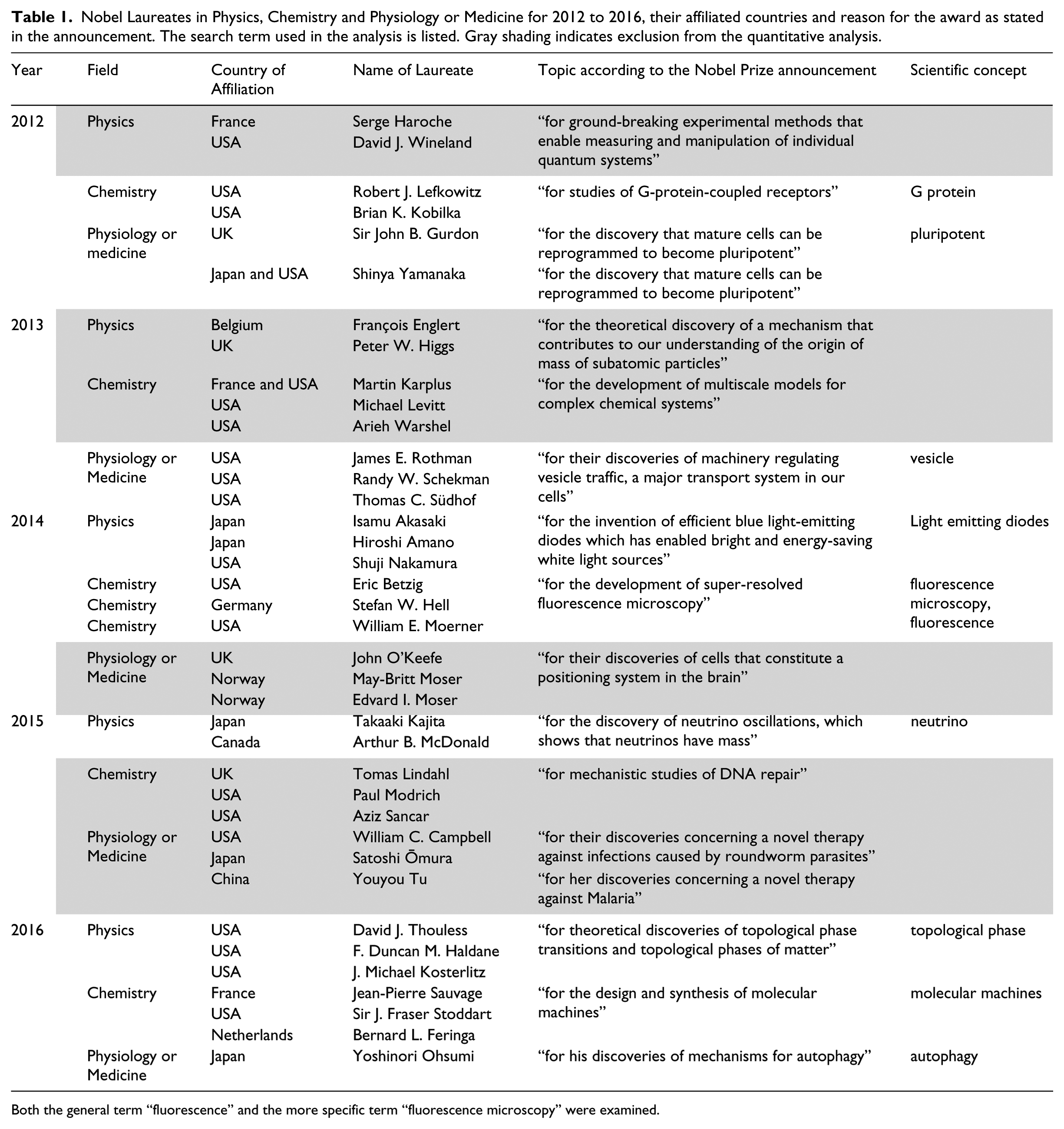
Both the general term “fluorescence” and the more specific term “fluorescence microscopy” were examined.
Publicly and freely available data in Google Trends (trends.google.com/trends/) reporting weekly changes in the volume of searches for specific terms were recorded. In total, the analysis covered 260 weeks between April 2012 and April 2017 for the Nobel laureates and their discoveries during that period. For each search query, we measured the half-life (Baram-Tsabari and Segev, 2015); namely, the time it takes for the most intensive searches to decline by half. The half-life was used to determine the number of weeks in which the value of the searches was higher than half of the maximum value during the 5-year period. Other studies have used this measurement to quantify the teachable moment for alcohol misusing patients in the emergency room (Williams et al., 2005). Hence, half-life can measure changes in search activity, and by extension, the teachable moment in which online users displayed the greatest interest in learning about certain scientific topics and events.
3. Results
Searches for the string “Nobel Prize” in English since 2004 present a number of regularities: there are high peaks in October when the winners are announced, and lower peaks in December when the Nobel prizes are awarded (a notable exception is Sweden, where the award ceremony attracts many more searches than the announcement). An overall downtrend since 2004 does not mean less interest or fewer searches in absolute terms, but rather fewer searches for this specific query out of the overall searches on Google.
Several winners sharing the same award usually elicited similar interest for a similar period of time on a global scale (Figure 1). The relationship between the laureates’ names and related science concepts tended to vary. Sometimes, there was more interest in the scientific concept, as in the case of Physiology or Medicine in 2016 (Autophagy > Yshinori Ohsumi), whereas at other times, there was more interest in the winners as in Physiology or Medicine in 2015 (Youyou Tu > Artemisinin).
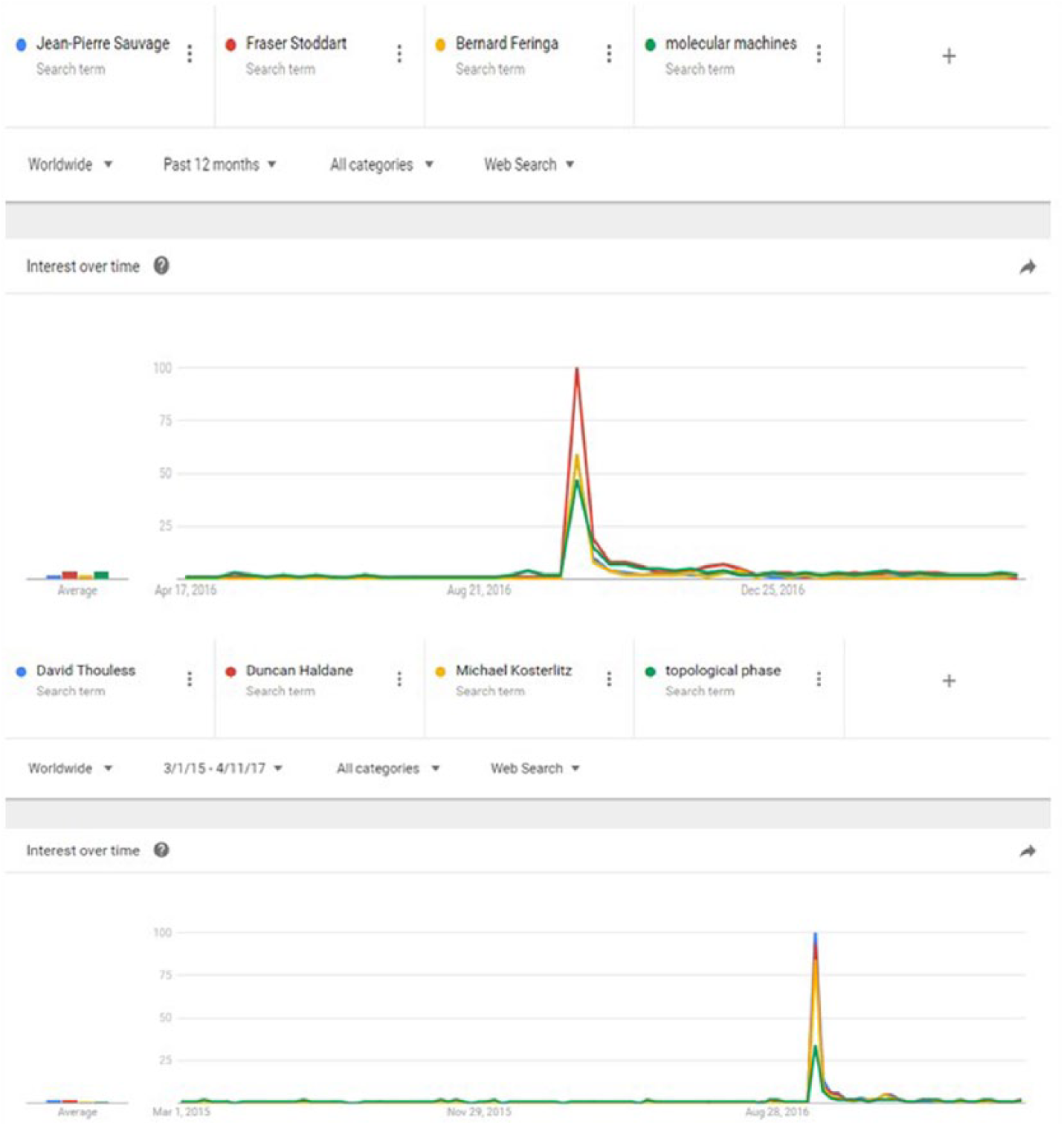
Google Searches for Nobel Prize Laureates in Chemistry (top) and Physics (bottom) and their related scientific discoveries, 2016.
Figure 2 indicates that the average half-life of searches for Nobel laureates (M = 1.136, standard deviation (SD) = 3.061) differed significantly from the half-life of their discoveries (M = 36.8, SD = 5.418), t(518) = 65.685, p < .0001. Whereas Nobel laureates attracted intensive online searches for about 1 week, their related discoveries were searched for about 36 weeks (about 14% of the entire sampling period) at over half of the maximum intensity. A similar finding was reported for searches on Wikipedia (Segev and Sharon, 2017).
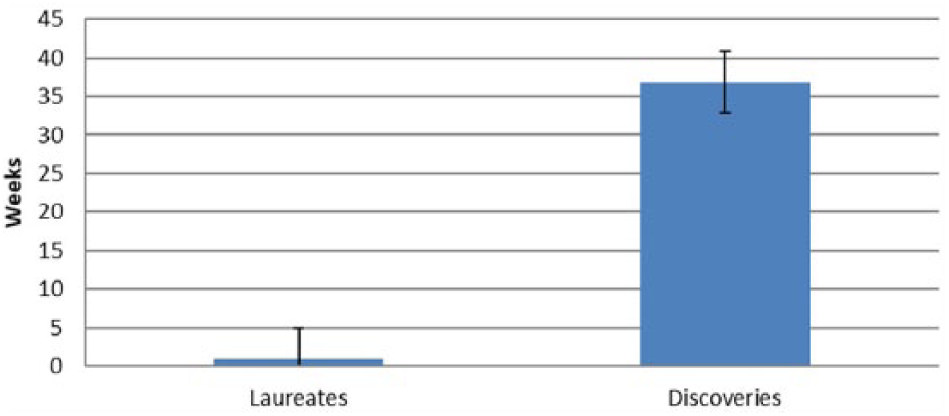
Average half-life in weeks of searches for Nobel laureates and their discoveries over 260 weeks between April 2012 and April 2017.
One reason for the relatively long half-life of searches for the Nobel discoveries compared to the Nobel laureate names emerged in the average weekly trends for both groups. The laureates’ names peaked as a function of current events and media attention. Figure 3 shows that the share of searches for laureates was close to zero during most of the year, but with very distinctive peaks in the first week of October when the announcement of the winners was made (sometimes accompanied by interest during the week of the ceremony itself). The average trend of searches for Nobel-related discoveries, on the other hand, corresponded to the academic year (Segev and Baram-Tsabari, 2012). These searches rise in September at the beginning of the academic year, and remain relatively high with characteristic drops during the winter and summer vacations. In general, the search patterns for concepts that follow the academic year are thus more likely to represent the demands and curricula of formal education. However, even in such cases (e.g. Chemistry 2012: “G protein”), additional searches for the scientific term tended to occur at the same time as the peak interest in the laureates’ names.
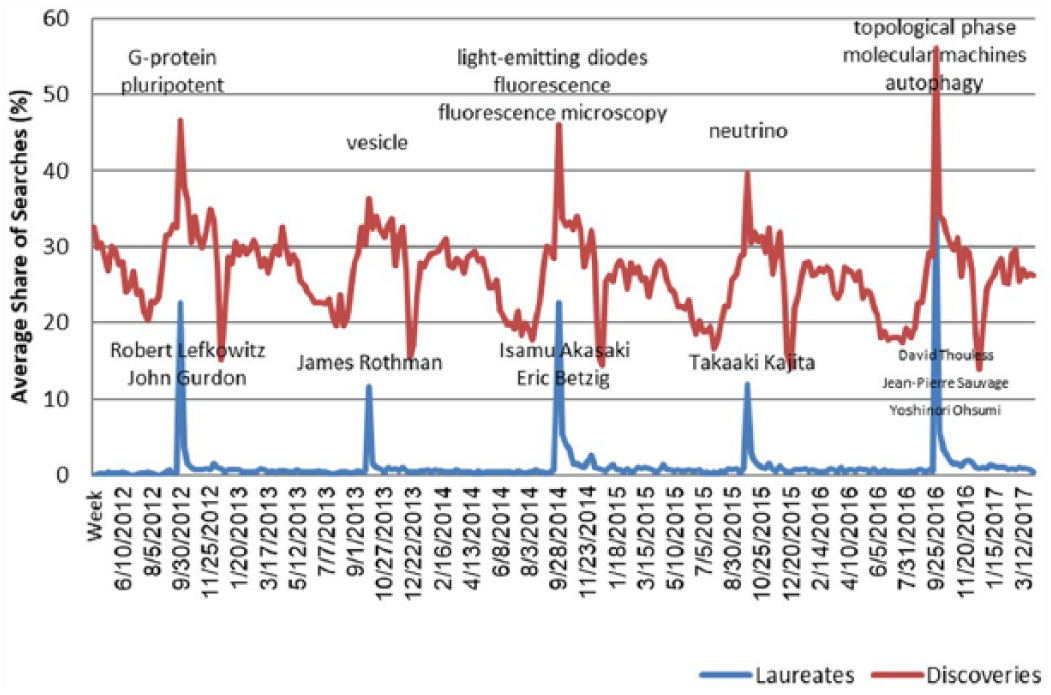
Average trends in Google searches for Nobel laureates and their discoveries over 260 weeks between April 2012 and April 2017.
The dramatic rise in searches of Nobel-related discoveries took place during the first week of October. It was accurately aligned with the rise in searches for the Nobel laureates, thus providing an indication that the announcement of Nobel laureates constitutes a short teachable moment, probably of no longer than a week, in which some online users actively search for scientific information related to the laureates’ discoveries (Figure 3). It may, of course, present a longer teachable moment for science educators and communicators who actively and purposefully use it to engage their audiences, as demonstrated by the much longer media attention to Nobel-related topics.
In addition, national pride plays a considerable role in searches for laureates who live or were born in countries that do not regularly receive Nobel Prizes. The Turkish-American biochemist and molecular biologist Aziz Sancar, for example (Chemistry 2015), was the focus of many searches from Turkey, where he was born, dwarfing searches for his two US and Swedish-born British fellow laureates. Searches for Nobel Prize laureates in Physiology or Medicine 2012 showed that the share of searches for “Shinya Yamanaka” in Japanese (山中 伸弥) that was the highest in Japan far exceeded the share of searches for “Shinya Yamanaka” in English, which was used by almost the rest of the world and was highest in the United States. Similarly, the share of searches for the British biologist John Gurdon was the highest in the United Kingdom (Figure 4). Another telling example is that of the Nobel Prize in Physics 2013. In Belgium, searches for the scientific term “boson” and the Belgian theoretical physicist “Englert” were almost identical in intensity. However, in neighboring France, searches for the scientific term “boson” were frequent, whereas searches for “Englert” were not.
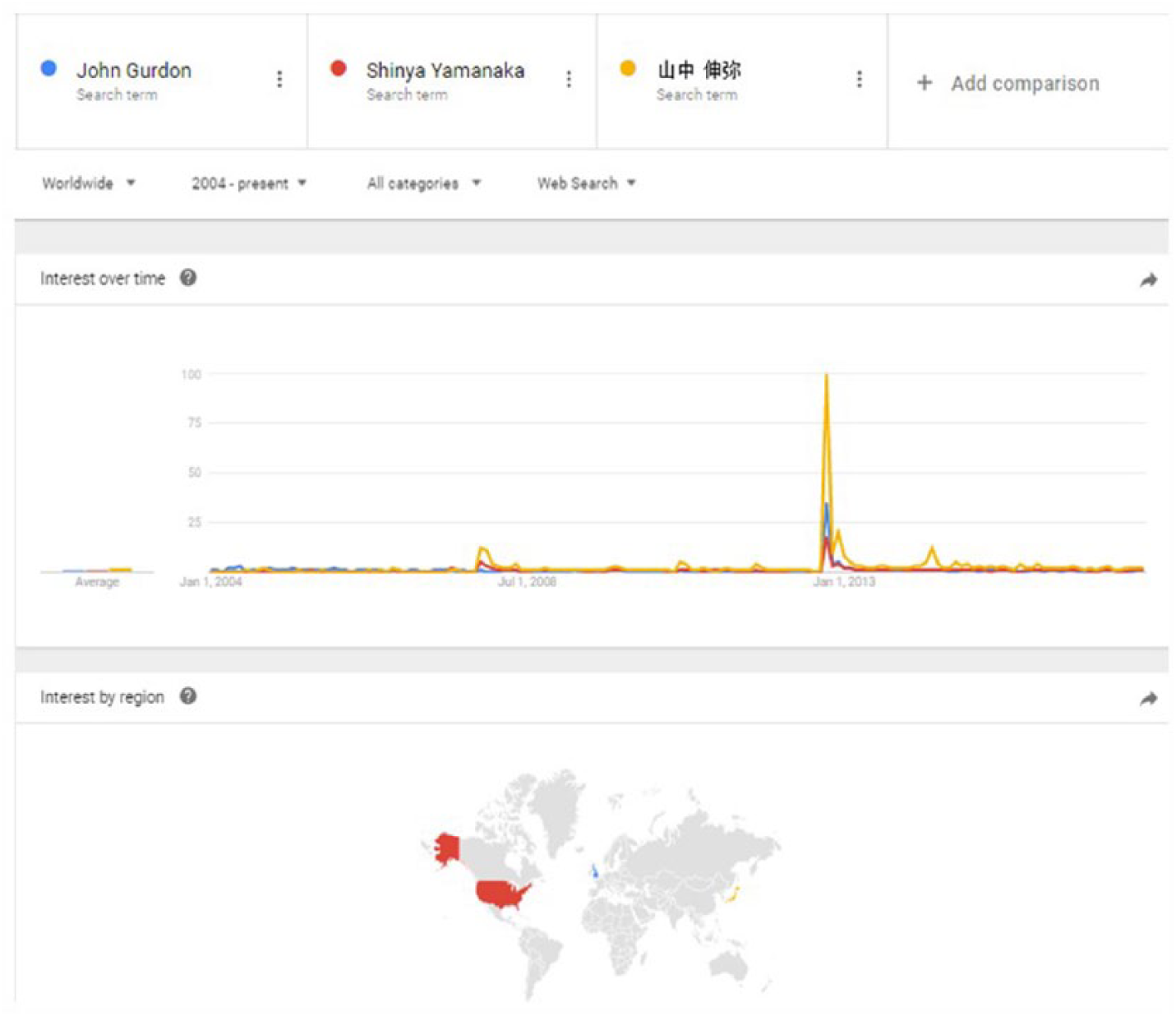
Searches for Nobel Prize laureates in physiology or medicine 2012.
Another localized phenomenon is Swedish-based users’ interest in the Nobel prize, who search much more often than users from other countries. They also find the ceremony to be more interesting than the announcement, and the search term “Nobel” emerges almost as interesting as the term ’science.’
4. Discussion
This study examined whether Nobel Prize events trigger teachable moments related to the laureates and their scientific work. We found (1) a clear association between the announcement of Nobel laureates and their Google searches for all the names in our sample, (2) that the announcement also triggered a distinctive rise in searches for related discoveries, and (3) that the share of searches was particularly high in countries that do not regularly receive Nobel Prizes.
Although the relationship between the Nobel Prize and the search of the specific Nobel laureates has been previously reported (Baram-Tsabari and Segev, 2015), the current study provides an indication that this relationship is not only consistent over time, but is also a national issue.
The news media in general are highly focused on national issues, to the extent that even international news are very often related to the country of the media outlet reporting the news (Segev, 2016). International news communication includes processes leading to both globalization (homogenization) and “domestication” (diversification) of news content, while national producers work to assign meaning to international events (Lisbeth, 2004). The media both develop and sustain national identity (Anderson, 2006). From an audience perspective, the proportion of local favorite television characters (as opposed to imported foreign programs) were found to predict national pride (Cohen, 2008). National pride is a fairly stable characteristic of countries, except in specific situations (such as athletic achievement) that may lead to minor temporary fluctuations (Ivo van et al., 2010). This is characteristic of science events as well. For example, a “national identity and pride” frame often emerged in media stories about Nobel laureates in the early twentieth century Italian press (Bucchi, 2012).
National pride not only plays out at the public and media level, but also at the nomination and selection level. The choices are conditioned by ties to international networks that tend to center almost exclusively on Europe and North America, allowing for few prize winners from other places (Crawford, 1998). Crawford (1987) devised a ’chauvinism index’ to determine the degree of nationalism of the nominators in each country (Smart et al., 2017). During the first 65 years of the physics prize, Americans were by far the most likely to nominate one of their own (78%) than Germans (54%). Chauvinism increased in World War I, with Germans nominating Germans and scientists from the Allied forces nominating scientists from the Central powers only twice. Crawford found that this nationalistic behavior continued after the war (Smart et al., 2017). Similarly today, for China, the pursuit of the Nobel Prize has been considered a pragmatic means of achieving political aims more than intrinsic respect for the values of modern science (Cao, 2014).
In line with Jank et al. (2005) and De Cheveigné and Véron (1994), our findings indicate that despite the internationality of the Nobel Prize, it has strong local and national importance, which is likely mediated by national media attention.
Given the existence of a relationship between a scientific event and its global and local searches, how is the teachable moment used by the media to communicate science? The media are highly skilled at using interest in current events to communicate related content. Are Nobel prizes used by the media as a teachable moment to further communicate the underlying science? The quantitative results suggest this is the case, but averages of aggregated results tell only part of the story. Here, this question will be discussed in the context of the Israeli media and Nobel Laureates.
In the Israeli cultural context, Nobel Prizes appear frequently in science-education related initiatives (e.g. a battle rap between laureates to convince students to take advanced science), 2 when narrating “important moments” in national history (e.g. the humorous song “remember”), 3 or when debating nature vs nurture issues (e.g. the lengthy debate on Prof. Kleinberg’s Facebook page in response to his post that counting the number of Jewish Nobel prize winners is redolent of racism). 4 Notwithstanding this salience, the actual ideas and concepts of science acknowledged by the Nobel Prize are not as well-known or integrated into popular discourse. One good example was the sub-head in Israel’s leading news site Ynet, when Prof. Arieh Warshel won the Nobel Prize for Chemistry (2013): “My brother won, I have no clue what for.” Analysis of mass media coverage after Prof. Dan Shechtman was awarded the Nobel Prize in Chemistry in 2011 indicated that much of the popular coverage did very little to explain the scientific concepts of fivefold symmetry and quasicrystals. Similarly, a critical article following the press conference after the announcement of Prof. Ada Yonath’s Chemistry Nobel Prize (2009) noted, “nobody felt like talking about ribosomes.” 5 Thus, the scientific specifics were not as important as the nationality of the laureate, supporting the quantitative findings discussed above.
This, however, does not mean that the teachable moment was not used to communicate science. Scientific content such as concepts and principles is only one aspect of science communication. The media coverage after Prof. Shechtman’s award was a prime opportunity for communicating the scientific method, and the nature of science knowledge, such as its tentativeness and subjectivity (Lederman, 2007). This communication of ideas about science, rather than scientific knowledge, was illustrated in the exchange between a foreign affairs reporter and an anchor discussing Shechtman’s discovery on national commercial TV:
6
Now, how did he win? It’s very interesting. He won (a) because he was right … in science this has an advantage … But, he won by presenting the results of his experiment fully and immediately sharing them … He gave them [other scientists] his data, so they could replicate the experiment. (Reporter)
Clearly, the fascination with the Nobel prize can create a teachable moment for the underlying science, but also about the drama and process of science.
Limitations and concluding remarks: Several limitations of this method and analysis must be mentioned. Using Google searches for a specific query is blind to searches for last name only or other search words aimed at the same person. Google Trends uses an arbitrary scale system. Its data indicate the query share based on a sample of all actual searches, and it only returns data when the volume of searches for a specific query is high enough. We are also in the dark as to the absolute number of users involved (one person can perform many searches), and the motivation for the query (information, criticism, and so on).
Furthermore, this research tool does not allow for further analysis based on users’ demographics (gender, education, social group), and is limited to the country of origin of the search. Naturally, this method does not provide a representative picture of interest in a topic, but only presents data about individuals who were interested enough to seek information. In the absence of demographic data, we can only fall back on surveys which suggest that lifelong learners of science and technology are not representative of the general population (Horrigan, 2017a, 2017b). Last but not least, the use of search query data for flu epidemic detection (Ginsberg et al., 2009) was found to complement but not replace traditional epidemiological surveillance networks (Butler, 2013; Lazer et al., 2014), suggesting this is also the case for detecting interest in other topics. For a fuller discussion of the method’s affordances and limitations for the social sciences, see Baram-Tsabari et al. (2017)
In addition, this analysis used a rather small sample, which precluded sophisticated statistical analysis, and excluded less clear cases (e.g. when a scientific term could not be matched to all winners). The alignment with previous preliminary findings (Baram-Tsabari and Segev, 2015; Segev and Sharon, 2017), however, strengthens its reliability.
Notwithstanding these limitations, as Google Trends data are interpreted as a relative scale, the current study provides a clear indication for the considerably higher engagement in online searches related to the announcement of Nobel Prize laureates and their discoveries. This is even more so in countries that do not regularly receive Nobel prizes. The Nobel prize event offers a clear study case to understand public interest and engagement in science online, and an empirical demonstration for the teachable moment that global events covered by media around the world can facilitate. Finally, it shows how national pride plays a significant role in intensifying this process.
Footnotes
Acknowledgements
This work benefited greatly from the helpful feedback of the participants of the Symposium on The Nobel Prizes and the Public Image of Science at the Royal Swedish Academy of Sciences, 11–12 May 2017 and the two anonymous reviewers.
Funding
The author(s) disclosed receipt of the following financial support for the research, authorship, and/or publication of this article: This work was supported by the I-CORE Program of the Planning and Budgeting Committee and The Israel Science Foundation (1716/12).