




Abstract
Predictive genetic testing often entails challenging decisions about preventive measures and uncertain health-related risk predictions. Because of its increasing availability, it is important to assess how to debate it publicly. Newspaper content analysis represents a common and reliable way to investigate public discourse retrospectively. We thus quantitatively compare broadsheet newspaper coverage about predictive genetic testing in the United Kingdom and Switzerland during the period of 2011–2016 regarding content, evaluations, stakeholder influence, and trigger events. British coverage was more extensive and positive and included more personal stories. Swiss coverage had more focus on political issues. Angelina Jolie’s announcement about her double mastectomy was the most important coverage trigger. Researchers were the most frequently cited stakeholder group, but stakeholders from government and civil society were also represented. Our results thus reflect a movement toward a more active public engagement with predictive genetic testing. The findings help to improve and enrich public engagement regarding predictive genetic testing.
1. Introduction
Predictive genetic testing
On 14 May 2013, the American actress Angelina Jolie announced that she had had a preventive double mastectomy due to an increased genetic risk of developing breast cancer (Jolie, 2013). Her decision, which attracted international media attention (Kamenova et al., 2014) and enhanced the public’s interest in genetic testing and preventive mastectomies (Borzekowski et al., 2014; Lebo et al., 2015), was based on predictive genetic testing. It involves the analysis of the genetic code prior to the development of a certain trait. Here, we focus on predictive genetic testing of born humans, excluding any genetic testing prior to birth, that is, prenatal screenings or preimplantation genetic testing. The traits investigated are usually mutations linked to hereditary diseases like certain cancer types (e.g. hereditary breast and ovarian cancer), metabolic disorders (e.g. familial hypercholesterinaemia), or neurological disorders (e.g. familial Alzheimer’s disease). Predictive genetic testing is becoming more common in clinical practice all over the world, but its meaning, impact, and consequences are complex. The decision regarding whether or not to do such testing is a personal one and depends, inter alia, on the nature of the investigated disease, disease history in the family, environmental risk factors, the state of scientific knowledge, and personal factors (i.e. age, gender, family relationships, psychological coping mechanisms, etc.). Predictive genetic testing usually gives a percentage of risk that a disease might be expressed throughout a person’s life because most mutations are associated with less than 100% disease prevalence. This means that even upon diagnosis of the presence of a mutation, it is generally impossible to foresee with certainty if and when a patient will develop the corresponding disease. That is why high-quality and professional genetic counseling is crucial and forms a common part of the clinical process for predictive genetic testing. In contrast, direct-to-consumer genetic testing kits are freely available on the market, often without any offer of counseling prior to or after testing. Still, many of the results of direct-to-consumer genetic testing are of a predictive nature. Because of this commercialization as well as the increase in scientific knowledge and growing public interest, predictive genetic testing is becoming an important issue for societies worldwide.
For a growing number of well-investigated mutations, there are substantial medical benefits related to predictive genetic testing. The possibility of early identification of at-risk people often improves early detection or disease prevention, leading to a better clinical outcome and even the possibility of reducing long-term healthcare costs. Risks regarding predictive genetic testing often relate to a lack of or bad genetic counseling, for example, in direct-to-consumer genetic testing. Professional, non-directive genetic counseling is irreplaceable for predictive genetic testing with a health impact (Evers-Kiebooms et al., 2001), but it is important that non-specialists have access to reliable information and become aware of the most important (personal) risks and benefits around predictive genetic testing. This will give non-specialists the chance to engage actively with these issues and to become less prone to commercially or politically driven, one-sided information.
Predictive genetic testing is both a scientific and a medical topic. The scientific field of genetics is fast-growing and has many practical applications, both medical and non-medical. Predictive genetic testing is a medical application of that scientific field. Such health-related issues are of particular public interest. Science communication research about health-related scientific topics like predictive genetic testing is therefore particularly important. Investigating mass media coverage is a common, reliable, and stable way to retrospectively analyze public debates about medico-scientific topics.
Science communication, mass media, and the public
According to Haran and Kitzinger (2013), research on media coverage regarding human genetics followed four strands. (1) The Public Understanding of Science approach investigates whether media accurately represent science in order to give readers a good understanding of genetics. Evidently, the mass media play an important role in communicating science to the public, particularly regarding genetics and diseases (Garrett and Bird, 2000; Schwitzer et al., 2005). Broadsheet newspapers, in particular, aim to uncover complex issues and make them available to the public in an understandable way. They are one of the main public sources of scientific knowledge (Metag and Schäfer, 2016), and still have an agenda-setting role for online news platforms (Maier, 2010).
Taking the readers in focus, (2) Health Education assesses whether they have accurate and full information about genetics. (3) Public Relations of Science focuses more on political and industrial campaigns and their influence on readers. The effects of communication on recipients are complex and multi-layered (Condit, 2001). According to the dynamic transactional model (Früh and Schönbach, 1982, 2005), media effects on readers are individual and highly dynamic, depending, for example, on the recipient’s personal situation, cognitive state, and emotions at the moment of consuming media content. Readers in turn also influence media content through their interests, opinions, and feedback. Supporting this model, empirical studies show that media coverage does have an important impact on health-related attitudes and behavior (Bonfadelli, 2002; Fishman and Casarett, 2006), but the concrete effects remain unclear (Catalan-Matamoros and Peñafiel-Saiz, 2017). However, it is important to distinguish between media effects on an individual level, and the effects of media coverage for a society, as it is described in science communication models. Even though they do not cover the whole public discourse, and do not directly reflect public opinion, an exploration of mass media coverage is an important part of grasping public opinion on a topic of public relevance (Condit, 2001).
(4) Public Engagement with Science investigates active, controversial discussions between different stakeholder groups (Bubela, 2006; Bucchi, 2008; Gerhards and Schäfer, 2009; Jones, 2011; Lock, 2011; Schäfer, 2009; Stilgoe et al., 2014). The engagement of public stakeholders takes place on many levels and has different definitions when translated into practice (Davies, 2013). Mass media reporting, which is the basis for this study, is one type of engagement mechanism of public stakeholders, in distinction to publicity and public hearings or meetings (Rowe and Frewer, 2005). Gerhards and Schäfer (2009) attempted to make the extent of public engagement within mass media reporting empirically measurable. According to their framework, the “science-dominated scientific public sphere” applies a passive role to media recipients. Media, therefore, should transport scientific content as communicated by scientists, but also in a way that is understandable for non-specialists. The “contextualized scientific public sphere” stands for an active and controversial public discourse, where science is one stakeholder among many and needs public legitimation. A contextualized scientific public sphere is thus characterized by a high variety of stakeholders in media coverage (as opposed to a dominance of scientific stakeholders), the presence of positive, negative, and ambivalent assessments (instead of predominantly positive reporting), and a high variety of topics (instead of scientific topics dominating). Applying these public sphere models in a media content analysis about human genetic research in 1999–2001, Gerhards and Schäfer (2009) found what they called a “hegemony of supporters” in both the United States and Germany. Following the “science-dominated scientific public sphere” model, scientific stakeholders dominated media coverage of human genetic research with their positive assessments in both investigated countries.
Another approach to empirically measure public engagement in mass media reporting is medialization (Weingart, 2005), which was measured by the extensiveness of coverage about a certain topic, the diversity of stakeholders and content, and the level of controversial evaluations of the scientific topic (Schäfer, 2009). The more extensive, pluralized, and controversial a topic is treated, the more it is medialized. Schäfer (2009) showed that the level of medialization is topic-dependent. In media coverage reflecting active public engagement with science, we expect highly pluralized and controversial media coverage. We also expect that a higher extent of coverage is an indicator of higher engagement with the topic. Thus, high medialization reflects higher public engagement, but given the dynamic nature of media effects on an individual level, this effect can only be true on a societal level.
Generally, empirical analyses focused on media coverage of genetic research (Henderson and Kitzinger, 2007; O’Mahony and Schäfer, 2005), or on more specific applications like pharmacogenetics (Almomani et al., 2015), genetic screening programs (Holton et al., 2017), prenatal genetic testing (Kamenova et al., 2016; Lewis et al., 2015), and direct-to-consumer genetic testing (Lynch et al., 2011). To our knowledge, this is the first media content analysis about the particularities of predictive genetic testing.
Comparing Switzerland and the United Kingdom
Comparative research faces at least two major problems: the comparability of data and the choice of countries under scrutiny (Wirth and Kolb, 2013). To assure comparability, the functional equivalence approach is commonly used in the social sciences as well as in psychology (Wirth and Kolb, 2004). The first part of Wirth’s and Kolb’s guideline to comparability proposes the examination of the functions of the topic and objects of research within the specific society (e.g. Esser, 2000; Patzelt, 1997; Wirth and Kolb, 2004): While the United Kingdom and Switzerland can be considered rather similar in terms of welfare and quality of healthcare, there are some important differences. First, the United Kingdom has a parliamentary democracy under a constitutional monarchy (GOV.UK, 2018) as a political system, whereas Switzerland has a direct democracy, meaning that the people have a direct say in all policy issues (The Federal Council, 2017). For example, in case of changes to legislation, it is the parliament that has the final decision in the United Kingdom, while in Switzerland there is generally the possibility of a public vote. Second, the British media system is more liberal and adopted a commercial model earlier than in Switzerland, where the political party–related press dominated the media system until the mid-20th century (Hallin and Mancini, 2011). Taking these differences into account, we consider the role of the mass media in any public discourse as functionally equivalent in both countries, because none of the differences affect the information function of mass media and especially of leading quality newspapers. Kolb (2005) presents an in-depth analysis of the comparability of Western countries’ press and has come to the same conclusion for Germany, France, and the United Kingdom in a study of health risks potentially caused by car traffic.
An optimal rational choice of countries for comparison can be taken either based on the quasi-experimental most similar systems design (with a different outcome) or the most different systems design (with the same outcome) (Berg-Schlosser, 2003; Teune and Przeworski, 1970). We follow the first approach: the two countries should be similar with regard to the research object of media and society. Searching for specific differences is economical due to the limited number of differences that may occur in rather similar countries or cultures, and it is fruitful because of the possible integration in a quasi-experimental design that after finding some dissimilarity looks back at possible causes (Kolb, 2004). Even after gathering the data and when interpreting it, a self-critical search for sources of bias and causal testing remains recommendable as will be seen in the discussion.
There are differences between Switzerland and the United Kingdom that could possibly cause differences in the results. First, their legislation is different regarding predictive genetic testing: in Switzerland, the Human Genetic Testing Act (The Federal Council, 2004) regulates very specifically who can prescribe predictive genetic testing and how it should be performed, but there is no specific legislation in the United Kingdom regarding predictive genetic testing. Second, there are important differences in the health insurance system: Switzerland has mandatory public health insurance with tax-independent financial contributions from individuals (Federal Office of Public Health (FOPH), 2017), complemented by a quite well-established private health insurance sector. In contrast, the National Health Service (NHS) organizes the health care system in the United Kingdom; it is directly funded by national insurance, and the private health insurance sector is rather small (NHS, 2016).
We compare public debates about predictive genetic testing from 2011 to 2016 in broadsheet newspaper coverage in the United Kingdom and the German-speaking part of Switzerland, which is the largest language region of the country, covering 65% of the Swiss population. We aim to assess the content and evaluation of media coverage of predictive genetic testing and determine which stakeholders and which events influenced the media reporting to what extent. We furthermore investigate the extent to which newspaper coverage of predictive genetic testing reflects public engagement with the topic by comparing it to the aforementioned science communication models (Gerhards and Schäfer, 2009; Weingart, 2005).
2. Methodology
Study design
We compared broadsheet newspaper coverage of predictive genetic testing from the German-speaking part of Switzerland and the United Kingdom. Broadsheet newspapers aim to provide in-depth information of high journalistic quality, and they are considered to serve as both an information source and agenda setter for other media such as television and online media (Jarren and Vogel, 2011). A population-wide Swiss survey revealed that the Swiss population mainly receives scientific news through newspapers (Metag and Schäfer, 2016). Thus, to assess media coverage of a complex medico-scientific topic such as predictive genetic testing, broadsheet newspapers are a good indicator.
For quantitative comparison, we chose a total of four broadsheet newspapers based on their functional equivalence in the country (Wirth and Kolb, 2004). Each newspaper had high circulation and traditions on different political spectra to minimize newspaper-specific bias. For Switzerland, we chose Tages-Anzeiger from the left-liberal spectrum and the right-liberal Neue Zürcher Zeitung. Equivalently, we chose the left-liberal The Guardian and the right-conservative Daily Telegraph from the United Kingdom. 1 All chosen broadsheet newspapers target a national and, in the case of The Guardian and Neue Zürcher Zeitung, an international audience.
We used the online database Factiva (Dow Jones, New York, United States) for the sampling of relevant articles, generating separate search algorithms for English- and German-speaking media based on a previous (unpublished) analysis from our group. The precise search algorithms are available as supplementary material. For the analysis, we only included articles where predictive genetic testing on born humans, its consequences or its social, economic, and political implications were the focus in at least 1/5th of the article body in order to avoid the inclusion of unspecific articles. We excluded articles about epigenetics, prenatal or preimplantation predictive genetic testing as well as post-symptomatic genetic testing, where a genetic test is done because of already existing symptoms or disease for diagnostic or therapeutic purposes (i.e. pharmacogenetics, or cancer diagnosis-related testing). Furthermore, we excluded articles about genetic testing on animals or plants and non-medical applications of genetic testing, such as forensics, evolutionary genetics, or ancestry search as well as articles shorter than 100 words, because that content was not rich enough to be useful for our variables of interest. All articles collected from Factiva were screened for inclusion or exclusion by two researchers (B.Z. and N.A.) separately. In cases of disagreement, researchers discussed articles and reached consensus about whether to include the article based using the aforementioned criteria. The unit of analysis was each article, but interviews, info-boxes, and first-page short announcements were merged into one unit of analysis with the main article (defined as the longest piece of text) if they were published on the same day, in the same medium, and on the same topic. Editorials and opinion pieces always remained as a separate unit of analysis, even if the above criteria applied.
Codebook development
We used a mixed-method approach, starting with a summarizing qualitative content analysis. Following the approach of Mayring (2015), topic-specific text passages from all German-speaking articles were first paraphrased, then rewritten in a more abstract form. We then reduced the number of statements by summarizing similar passages. This was done by two researchers separately and then compared. We repeated this reduction step two times, aiming for agreement after each step. Having a list of 70 abstract content categories, we translated them into English and compared them with 20 randomly chosen articles from British coverage. If we found text passages in the UK coverage that were not reflected in our content category list yet, we extended the list until no more categories were found. We then further reduced these categories based on topicality, which resulted in 13 distinct topics. Again, this stepwise reduction was performed by two researchers separately and an agreement was reached upon discussion.
The codebook for quantitative analysis and the stakeholder list were inspired by quantitative content analyses by Gerhards and Schäfer (2007) and Schäfer (2009) to allow for comparability of results. The complete codebook is available as supplementary material. We tested and adapted the codebook in several steps, aiming to capture a high amount of content but allowed high inter-coder reliability. Scott’s Pi was used to calculate the reliability score (Scott, 2009). The mean reliability score was 0.72, ranging from 0.48 to 0.84. A reliability score higher than 0.7 is considered a good, higher than 0.4 a medium reliability. Variables with medium reliability were improved with additional inter-coder agreements in case of uncertainties. Furthermore, since the complexity of articles differed importantly (depending mainly on the numbers of stakeholders and topics that were covered), and reliability decreased with article complexity, we decided to increase the appropriateness of our data by double-coding articles that had more than seven stakeholders and more than one topic, or that were subjectively considered unclear by the coding researcher. A total of 43 articles (in addition to the 20 articles from reliability testing) were analyzed by two researchers separately and compared. In case of non-agreement, we reached agreement upon discussion.
3. Results
Content comparison
The Factiva keyword search resulted in 1154 hits. A total of 137 articles met the inclusion criteria. We found 2.5 times more articles about predictive genetic testing in the United Kingdom than in Switzerland throughout the investigation period. We assigned each article one or several topics, which were identified by qualitative content analysis and reflect the content of media coverage. In total, we assigned 195 topics to 137 articles (Table 1). The most common topic in both countries was Public Debates, which included celebrities going public with a genetic disease risk or a preventive treatment, such as Angelina Jolie, as well as political discussions. Research, accounting for research studies as well as clinical trials, was more common in the United Kingdom than in Switzerland. The same is true for Preventive Treatment in relation to predictive genetic testing and for Genetics in Society. The latter topic included articles about the implementation of predictive genetic testing into healthcare, general guidelines, the notion of the genetic revolution or personalized medicine. A common topic in Switzerland was Direct-to-Consumer Genetic Testing, which contained articles about genetic testing in a do-it-yourself manner by sending DNA samples and receiving test results directly from a genetic testing company without passing through any health care provider. Legal and Economic Aspects of predictive genetic testing and Ethical Issues such as discrimination, stigmatization, privacy, data protection, data sharing, and confidentiality issues, were not frequently addressed in either country. Some articles focused on clinical aspects, such as the Medical Use of Predictive Genetic Testing, including new tests, healthcare procedures, clinical eligibility criteria for predictive genetic testing, and the Disclosure of Disease Risk, including doctor–patient relationships related to counseling and information giving, the right not to know, the disclosure of incidental findings, and expression of uncertainty in the clinical context. Genetic Data focused on predictive genetic testing related to Big Data, data sharing platforms, whole genome sequencing (WGS), and other uses of genetic data in various contexts. This topic was more important in the German-speaking part of Switzerland than in the United Kingdom. Finally, Personal Stories did not occur at all in Switzerland but was frequently present in British articles. This topic included examples, cases, and statements of people living with a genetic risk and their families, but excluded celebrity stories, which were included in the topic Public Debates.
Frequency and percentage of topics regarding predictive genetic testing and stakeholders represented in media coverage.

CH: German-speaking part of Switzerland.
Evaluations
We also assessed how the different topics were evaluated. British coverage had significantly more positive evaluations (p = .002), whereas in Swiss-German articles the topics were significantly more often negatively evaluated (p = .016, Figure 1a). Switzerland also had a higher ratio of ambivalent articles that covered both positive and negative aspects, but this difference was not statistically significant when applying the Benjamini–Hochberg (BH) correction for multiple testing (p = .046). Evaluations differed considerably between topics, but the trend of the United Kingdom having a higher ratio of positive and a lower ratio of negative articles ranged through nearly all topics (Figure 1b). The topic Research was significantly more neutral, and the topic Direct-to-Consumer Genetic Testing was significantly more negative than the other topics. Regarding stakeholder-specific evaluations (Figure 1c), stakeholders from research and medicine were more ambivalent and negative in Swiss-German reporting and more neutral in the United Kingdom. Economic stakeholders generally were more positive than the other stakeholders.

Evaluation of topics. (a) Overall evaluation of topics per country, (b) topic-specific evaluation, and (c) stakeholder-specific evaluation. White = positive evaluation, gray = ambivalent (both positive and negative) evaluation, black = negative evaluation, dashed = neutral (no evaluation).
Stakeholders and events influencing media coverage
We collected all stakeholders that gave direct or indirect statements on a topic in each article as an indicator of the influence on media coverage. We coded a total of 623 stakeholders for 195 topics in 137 articles (Table 1). Stakeholders cited in coverage were distributed similarly in both countries, except research studies and patients and their families, which were significantly more often cited in the United Kingdom than in the German-speaking part of Switzerland. Instead, Swiss-German coverage had a higher ratio of political stakeholders. In both countries, stakeholders from the economic sectors, namely companies from the pharmaceutical industry, biotech industry, direct-to-consumer genetic testing companies, and health insurers occurred seldomly, and so did experts from research fields of social sciences, humanities, or law.
As another measure, we assessed which stakeholder initiated each article (Figure 2c). For example, stakeholders organizing press releases or conferences or writing a commentary were considered initiators of the corresponding article. In the United Kingdom, a higher proportion of research studies, as well as affected people and their families, initiated articles in the broadsheet newspapers. In Switzerland, politicians were more often initiators of articles, but not affected people.
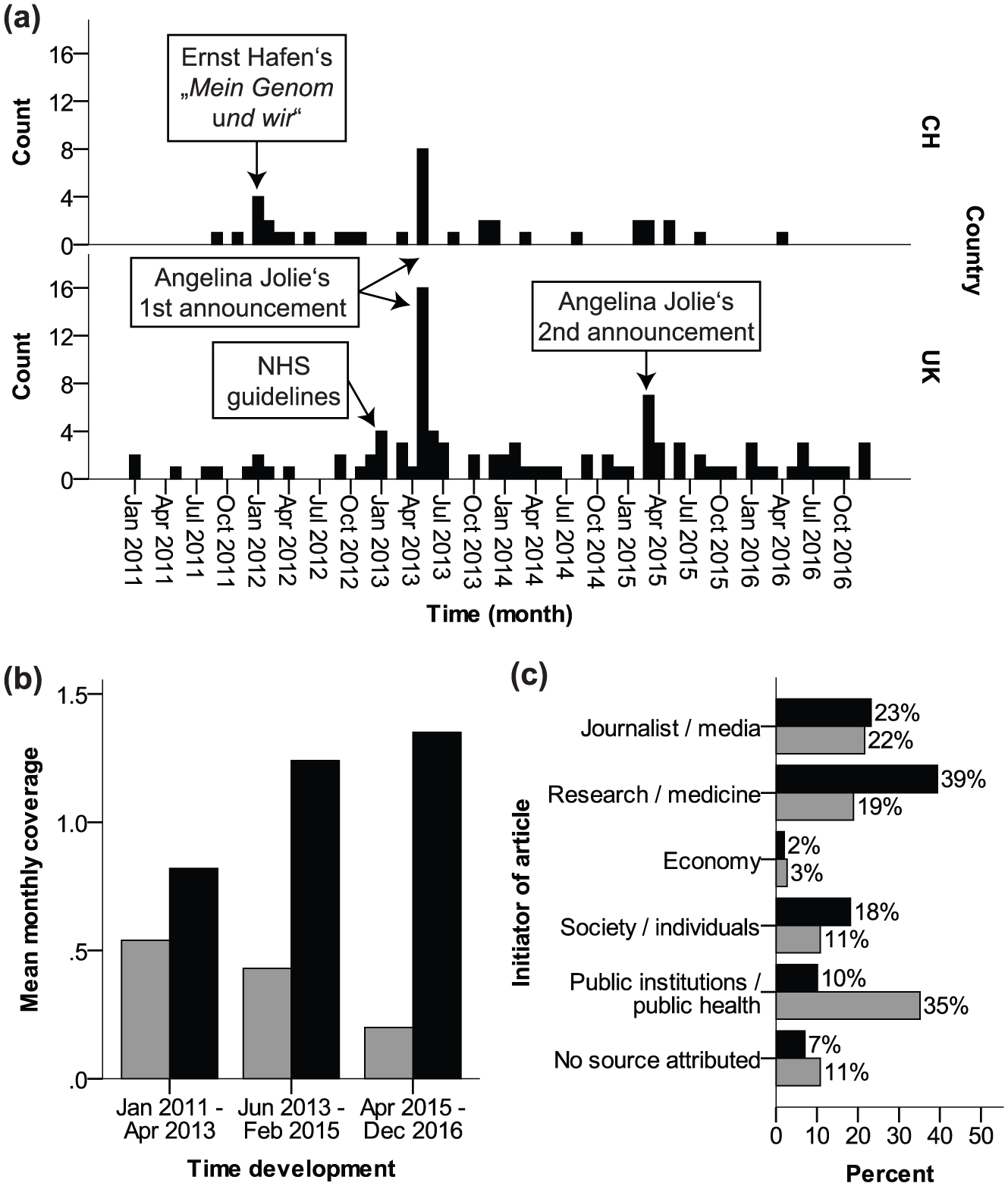
Triggers of media coverage. (a) Development of coverage over time (always three months added together for each quarter of the year). (b) Mean number of articles per month before, between and after Angelina Jolie’s statements in May 2013 and March 2015. (c) Stakeholders initiating articles, e.g. by press conference, press release or interview (only coded if made explicit in the respective article). The percentage was calculated for each country separately. Black lines/bars = UK, grey lines/bars = German-speaking part of Switzerland.
We also assessed which events triggered media coverage by analyzing the development of media coverage over time (Figure 2a). Angelina Jolie’s two announcements about her double mastectomy and ovariectomy in May 2013 and March 2015 led to the most important peaks in media coverage of predictive genetic testing. In the United Kingdom, more articles appeared after Angelina Jolie’s first announcement than before, and coverage increased even more after the second announcement, indicating that the effect was long-lasting (Figure 2b). Angelina Jolie’s first announcement also caused coverage in the German-speaking part of Switzerland to peak, but not as much as in the United Kingdom, and there was no long-term increase in coverage after the announcements. Another peak in UK coverage was in the first quarter of 2013. This was mainly coverage of new guidelines and preventive treatment options. In Switzerland, the affair of Professor Ernst Hafen attracted the broadsheet newspaper’s attention in the first quarter of 2012. Hafen wanted to launch a public campaign about genetic testing but was criticized in the media. 2
Connection with theory and empirical evidence
We compared our data with previous empirical studies to address the level of public engagement provided by mass media reporting. Compared to the data from Gerhards and Schäfer (2009), our data revealed a higher ratio of non-scientific stakeholders and they took more ambiguous positions, particularly in Swiss-German coverage (Table 2). Even though UK stakeholders gave more positive assessments than Switzerland, their positioning was not as hegemonial as in Gerhards and Schäfer’s study. Research was not the only dominant topic in our data. Even though it was an important topic in British coverage, our topic analysis showed that other topics had similar importance, also in the United Kingdom.
Comparison of our data to Gerhards and Schäfer (2009). Bold typed categories are the sum of the following indented sub-categories.
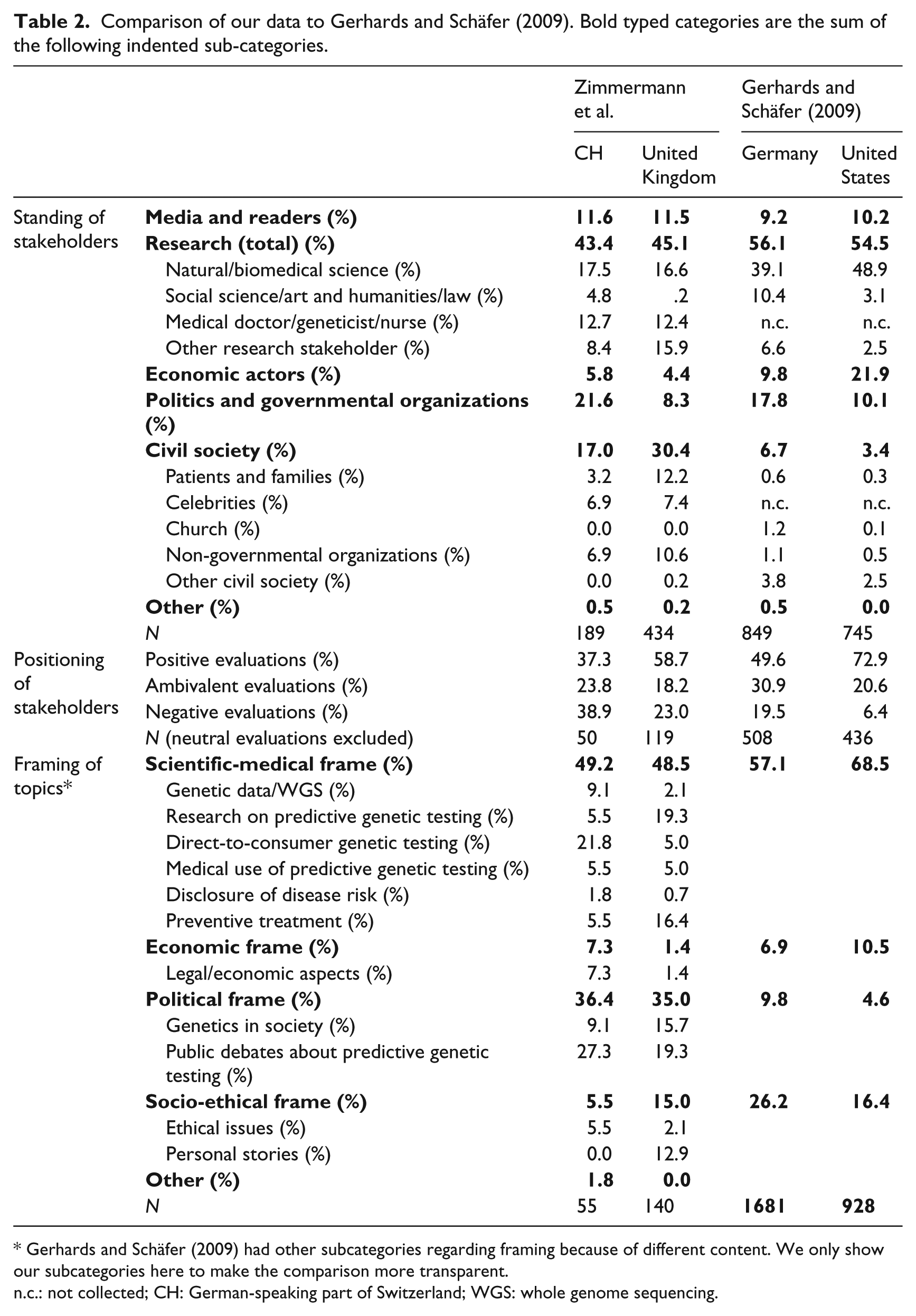
Gerhards and Schäfer (2009) had other subcategories regarding framing because of different content. We only show our subcategories here to make the comparison more transparent.
n.c.: not collected; CH: German-speaking part of Switzerland; WGS: whole genome sequencing.
We extended the comparison with the medialization model first applied by Schäfer (2009) (Table 3). By comparing our data with the three differently medialized topics in Schäfer’s investigation, we are able to rank our data and make estimations about the level of medialization. The extensiveness of coverage, measured by the number of articles appearing each year, was low in both countries, especially in the German part of Switzerland, where on average one article appeared every 2 months. The level of pluralization, measured by the ratio of scientific stakeholders and the share of articles appearing in the science section of the newspaper, corresponded to medium or high medialization. Our data showed a high level of controversy in both countries because a high ratio of statements were evaluative, and there were many ambivalent or negative statements. Swiss reporting was even more ambiguous than in the United Kingdom.
Comparison of the level of medialization with a study by Schäfer (2009).
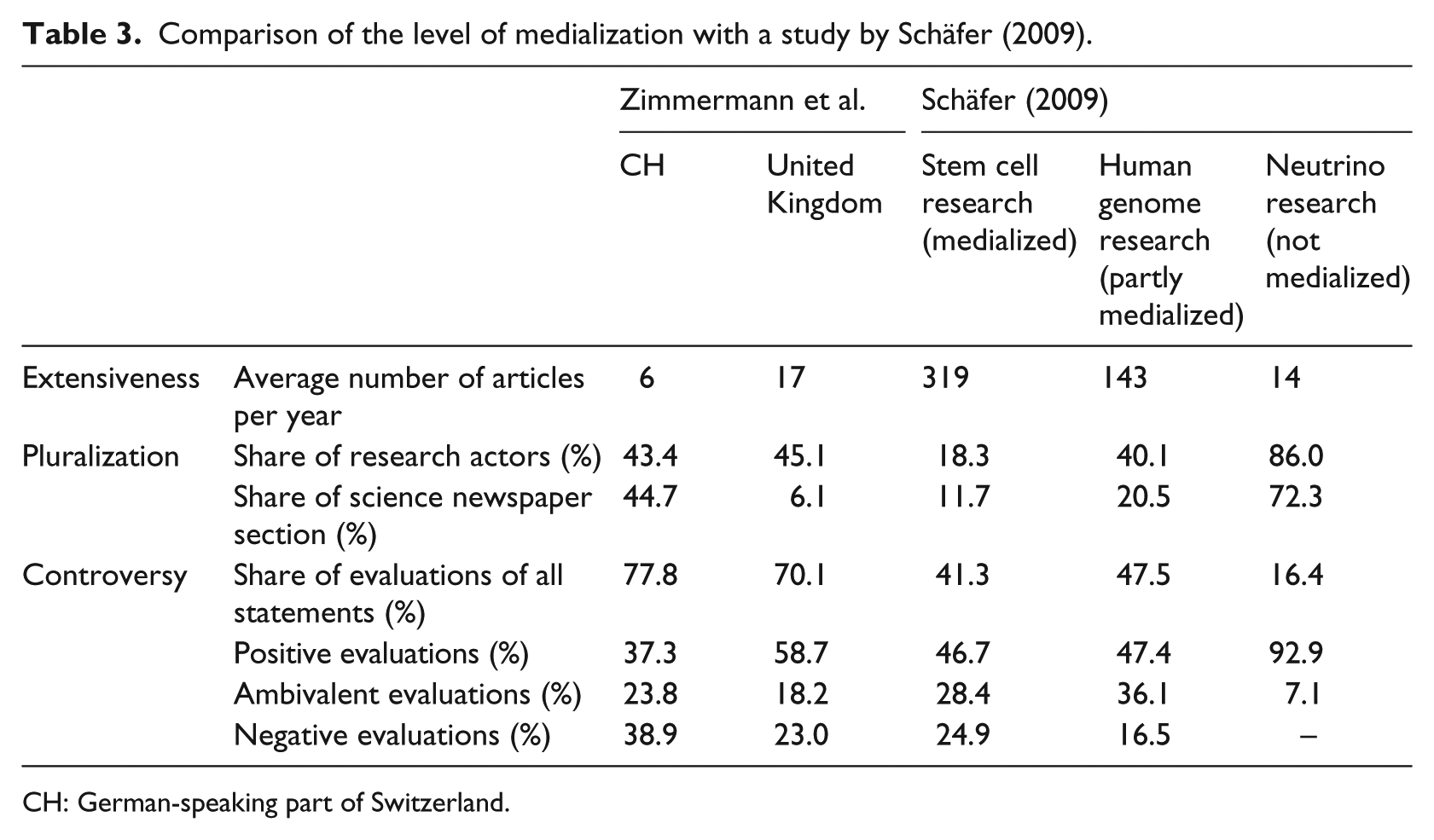
CH: German-speaking part of Switzerland.
4. Discussion
A large body of literature postulates a transition from passive public understanding to active public engagement with science (e.g. Bucchi, 2008; Gerhards and Schäfer, 2009; Jones, 2011; Schäfer, 2009), and we share the opinion that this is a desirable development. Media coverage of predictive genetic testing in both Switzerland and the United Kingdom reflected a more active public engagement than in previous studies (Gerhards and Schäfer, 2009; Schäfer, 2009). Despite a lack of extensiveness, we conclude that the content of broadsheet newspaper reporting about predictive genetic testing supports active public engagement with the topic. It needs further research doing similar analyses on other scientific topics to examine whether this is a general trend or topic-related. Predictive genetic testing is of high interest to the general public because of its health-relevance, and it is well possible that this feature facilitates public engagement.
Especially for topics with high social and ethical relevance like predictive genetic testing, where the solutions to specific problems (e.g. the availability of testing, disclosure of information, or cost coverage) are not black or white, journalists need to include all stakeholder groups in order to give a solid picture that provides readers with enough information to make opinions that go beyond a simplistic “right-or-wrong” scenario (Hivon et al., 2010). Besides scientific and medical stakeholders, governmental and non-governmental organizations were well represented in both countries’ newspaper reporting, and Swiss-German coverage also often represented political stakeholders. The healthcare system in Switzerland is highly political, so it is more prone to discussing medico-scientific topics such as predictive genetic testing in a political manner. The UK NHS is publicly funded and also accountable to the political system, but most NHS-related issues were framed in a societal context rather than as political issues, with political stakeholders only rarely cited. It might be due to the lack of direct democracy in the United Kingdom that politicians are less salient in newspaper coverage.
Research on ethical, legal, and social issues has accompanied genetic research and its translation into practice since the 1980s (Caulfield et al., 2013). A media content analysis reported an intensive discussion on ethical issues in the United Kingdom on coverage about the Human Genome Project in the early 2000s (Smart, 2003), and not only journalists but also quoted scientists initiated discussion of these issues (Henderson and Kitzinger, 2007). Our results contradict these assessments, showing a lack of ethical topics and researchers cited from social science, humanities, and law in both countries. The public is exposed to the medical and scientific point of views regarding predictive genetic testing, but much less about ethical issues. Since broadsheet newspapers are known to address complex issues and have a higher capacity for well-investigated journalism than other media, we suggest that ethical issues are generally not addressed enough in the media, even though ethical considerations are of crucial relevance for public engagement with science (Miah, 2005).
Based on earlier studies (Gerhards and Schäfer, 2009; Hjörleifsson et al., 2008) and the fact that large, international companies from pharmaceutical and biotech industry are headquartered in both countries, we would have expected a higher and more active influence of economic stakeholders in media coverage. Direct-to-consumer genetic testing companies are widespread in the United Kingdom, but not in Switzerland due to legal restrictions, but in both countries they are underrepresented. However, economic stakeholders might choose other media types such as online media, television, or other public relations measures to place their messages into the public discourse. In addition, industry influence media coverage more indirectly, through lobbying, research collaborations, or targeted advertising in print media (Rinallo and Basuroy, 2009; Weishaar et al., 2016). It is thus conceivable that the higher and less controversial coverage of predictive genetic testing in the United Kingdom might be partly due to the presence of direct-to-consumer genetic testing companies. Additional research is needed to reveal the extent of industrial influence on media coverage of genetic testing.
Previous studies suggested that patients are an underrepresented stakeholder group in the public debate (Weigold, 2001). Others found that patients and patient organizations were represented in health-related media debates (Hivon et al., 2010). In our data, affected people had a major say in media coverage in the United Kingdom; however, in Switzerland, they were marginalized. This country-specific difference could be due to a possible cultural dependency, it might well be that British newspapers more often use personal stories in order to interest readers. Since personalization is a typical feature of tabloid media, and tabloids are much more established in the media landscape of the United Kingdom than in Switzerland, we suggest that this finding could be due to converging tendencies of broadsheets toward tabloids (Kolb, 2015). Personalization in broadsheet newspapers is also higher in the United Kingdom than in Denmark and Spain (Jebril et al., 2013).
Because previous studies suggested that the Angelina Jolie effect, meaning higher testing rates, more preventive mastectomies, and more public interest in predictive genetic testing, lasted at least several years (Evans et al., 2015; Freedman et al., 2016), we tested whether the same applied to media coverage. We found a long-term increase in media coverage in the United Kingdom but not in the German-speaking part of Switzerland. Because of the heterogeneity of topics published in the United Kingdom even after Angelina Jolie’s announcements, we suspect that the observed increase in coverage is not exclusively due to the Angelina Jolie effect, but is affected by other factors, such as the increase in the number of scientific studies and the increasing implementation of predictive genetic testing applications within the NHS. Despite that, Angelina Jolie’s first statement in May 2013 was the most important trigger for media coverage of predictive genetic testing in both countries. The lack of any long-lasting effect in Swiss-German broadsheet coverage, however, explains only part of the very low coverage about predictive genetic testing.
Swiss-German reporting was strongly characterized by controversial political discussions about direct-to-consumer genetic testing. In contrast, British coverage had a stronger focus on positively evaluated research aspects of predictive genetic testing, a finding in line with previous research claiming that media hype genetic research (Bubela and Caulfield, 2004; Caulfield, 2004). Our findings suggest that Swiss-German coverage has a more critical view and is less prone to over-hyping the future potential of research for predictive genetic testing. Overall, Swiss coverage reflects a more skeptical attitude toward predictive genetic testing compared to the United Kingdom, a deduction that is supported by the more restrictive policy strategy in Switzerland regarding the implementation of predictive genetic testing both in clinical practice and for direct-to-consumer testing (The Federal Council, 2004). To our knowledge, the only comparable survey data about public attitudes toward genetics is from 1997, when Swiss citizens had a more critical view toward gene technologies than other European countries, including the United Kingdom (Gaskell et al., 2000). However, until 2000, public attitudes in Switzerland became considerably more positive, indicating that fast changes in attitudes can occur (Bonfadelli et al., 2002). A more recent representative survey in Switzerland shows that attitudes in favor of or against genetic testing are in balance (Comparis, 2012).
5. Conclusion
Our results show that newspaper coverage about predictive genetic testing reflects a trend toward more public engagement compared to previous studies on similar topics. However, the extent and nature of coverage varied considerably between the German-speaking part of Switzerland and the United Kingdom. UK coverage was more extensive and more positive. Personal stories and Research were predominant foci in UK coverage; in Switzerland, political topics like Direct-to-Consumer Genetic Testing had a stronger focus. Research stakeholders were the most prominent stakeholder group, influencing media coverage with statements and coverage-initiating initiatives. Governmental and non-governmental organizations were frequently cited in both countries. In addition, political stakeholders in Switzerland and affected people in the United Kingdom had input into coverage. The Angelina Jolie case was the most important trigger for coverage but was followed by a long-term coverage increase only in the United Kingdom, not in the German-speaking part of Switzerland.
Our study gives important insights into how the public has been informed about predictive genetic testing in recent years. Media coverage reflects an important part of a public discourse and is the only aspect that can be measured retrospectively in a consistent, comparable, and reliable manner. Cited stakeholders are a good and indeed the only analyzable indicator to address who is influencing this public discourse through media coverage. Extensive, controversial, and diverse media coverage in terms of aspects covered and stakeholders cited might even reinforce the public’s engagement with predictive genetic testing. Because media coverage is the most important source of information for non-specialists, we would also assume that it also increases the public’s general knowledge about this topic. However, our analysis cannot directly reflect the public’s knowledge of or attitudes toward predictive genetic testing. These factors need to be assessed through representative population surveys, and our data can inform the content of such research. An analysis of Swiss public discourse and attitudes toward biotechnology some 20 years ago revealed that media coverage reflected the public attitudes well at that time (Bonfadelli et al., 2002).
To avoid in-country language bias, our analysis was limited to the leading German-speaking newspapers in Switzerland, not addressing their French- and Italian-speaking counterparts. Because of different cultural and political attitudes in the different Swiss language regions, it is important to state that our results are valid for the German-speaking Swiss newspapers, which cover the majority (65%) of the Swiss population, but cannot necessarily be expanded to the whole country. Because we compared German with English-speaking newspaper coverage, there is possible bias due to differences in language. However, comparing countries with such differences can also reveal interesting differences for broader applications allowing our results to be to some extent transferable to and comparable with other Western countries. Certain findings might also be biased due to the rather small sample size of our study. We only covered broadsheets in our analysis, despite the fact that online media and television are other important information sources for non-specialists. The high-quality broadsheet newspapers used in this study are known to have a focus on science communication more than other news media and serve as an information source for journalists as well. Thus, they are influencing the media content across the media system. We also aimed to include broadsheet newspapers that are representative of the newspaper landscape of the respective country, but it is possible that results would look different if we had selected other newspapers for our analysis.
Our study adds up to the empirical evidence of public engagement with science. We show that it is worthwhile making data collection comparable to previous studies because it provided context and knowledge by comparison with other scientific topics as well as between different countries. Public engagement with science seems to have increased in the media in the last decade, according to our data. Furthermore, our results are useful for science communication scholars, who can learn which aspects are lacking in terms of successful public engagement with the issues raised by predictive genetic testing. Researchers, clinical geneticists, and other stakeholders can also obtain insights into where and how to enhance their communication activities with the mass media. In particular, we recommend that researchers from the fields of ethics, law, and social sciences intensify their communication activities in the mass media. Because their work has a high societal impact, their representation in media would help to produce richer, more holistic coverage about predictive genetic testing in both countries (Miah, 2005). Acknowledging that this call is not easily accomplished and requires a lot of effort, time, manpower, special training, and collaborations with journalists, we also call on the responsible authorities to provide these researchers with the necessary financial, educational, and technological tools.
Supplemental Material
Supplementary_Codebook – Supplemental material for Content, evaluations and influences in newspaper coverage of predictive genetic testing: A comparative media content analysis from the United Kingdom and Switzerland
Supplemental material, Supplementary_Codebook for Content, evaluations and influences in newspaper coverage of predictive genetic testing: A comparative media content analysis from the United Kingdom and Switzerland by Bettina M. Zimmermann, Noah Aebi, Steffen Kolb, David Shaw and Bernice S. Elger in Public Understanding of Science
Footnotes
Acknowledgements
We thank Fabian Zimmermann for his help with parts of the qualitative content analysis for topic identification.
Funding
The author(s) disclosed receipt of the following financial support for the research, authorship, and/or publication of this article: This research was internally funded by the University of Basel.
Supplemental material
Supplemental material for this article is available online.
Notes

Author biographies
References
Supplementary Material
Please find the following supplemental material available below.
For Open Access articles published under a Creative Commons License, all supplemental material carries the same license as the article it is associated with.
For non-Open Access articles published, all supplemental material carries a non-exclusive license, and permission requests for re-use of supplemental material or any part of supplemental material shall be sent directly to the copyright owner as specified in the copyright notice associated with the article.
