



Abstract
The impact of knowledge on public attitudes toward scientific issues remains unclear, due in part to ill-defined differences in how research designs conceptualize knowledge. Using genetically modified foods as a framework, we explore the impacts of perceived familiarity and factual knowledge, and the moderating roles of media attention and a food-specific attitudinal variable (food consciousness), in shaping these relationships. Based on the differential effects on “negative attitudes” toward genetically modified foods, we provide further evidence that the measures of knowledge are separate concepts and argue against a one-dimensional view of scientific knowledge. We discuss implications for understanding the relationship between knowledge and science attitudes.
1. Introduction
Social science has long recognized the complex nature of knowledge and the existence of different types of knowledge (e.g. Johnson, 1993; Turnbull, 1997). Despite this awareness, research examining the impact of knowledge on attitudes and perceptions of scientific topics often conflates, or fails to distinguish, various types of knowledge (for a review, see Ladwig et al., 2012). Partially due to these complexities and conflations, the impact of “knowledge” on public attitudes toward science remains unclear. More recent scholarship has paid closer attention to distinguishing specific types of knowledge, especially regarding how knowledge influences attitudes toward controversial scientific issues (e.g. House et al., 2005; Su et al., 2014). Researchers have sought to understand the persistence, limitations, and applicability of the long-standing knowledge deficit model (Brossard and Lewenstein, 2010; Meyer, 2016; Simis et al., 2016; Sturgis and Allum, 2004), which outlines a direct relationship between the public’s scientific knowledge and support for science. Critics highlight the model often does not predict public opinion or account for other influential factors, including value predispositions, risk and benefit perceptions, and media coverage (Eveland and Cooper, 2013). Although factual scientific knowledge can impact public attitudes toward emerging technologies (Allum et al., 2008; Scheufele and Lewenstein, 2005; Stoutenborough and Vedlitz, 2016), treating knowledge as a single, broad concept contributes to conflicting findings and undermines the potential importance of certain conceptualizations of knowledge for science attitudes.
Given remaining questions surrounding knowledge’s role regarding attitudes toward scientific issues, this article distinguishes two specific and commonly used ways of conceptualizing knowledge—factual knowledge and perceived familiarity—and explores their relationships with scientific attitudes. We examine predictors of negative attitudes toward genetically modified (GM) foods and test the moderating roles of attention to news about GM foods and a food-specific attitudinal variable, food consciousness, in shaping the relationships between GM knowledge and attitudes. Our findings demonstrate the relationship between attitudes and knowledge depends on its operationalization and re-emphasizes the importance of clarifying knowledge types to understand the connection between science knowledge and attitudes.
2. What type of knowledge?
In the context of attitudes toward science or scientific issues, prior research explored multiple types and operationalizations of knowledge. At a broad level is a distinction based on the “domain” of knowledge, ranging from general science knowledge to knowledge applied to a specific science, technology, or issue (Allum et al., 2008). In this study, we focus on another distinction by examining two common conceptualizations: factual knowledge and perceived familiarity. Factual (or objective) knowledge is a measure of the amount of “textbook” information individuals have about a concept. This measure is based on a battery of questions relating to factual aspects of science (either general or specific to a topic), usually developed with expert input, and covering key aspects of a technology or issue (Brossard and Shanahan, 2006; Johnson, 1993; Stoutenborough and Vedlitz, 2016). Although factual knowledge indices can have high reliability, scholars have expressed concerns regarding whether these indices capture too narrow a view of knowledge (Bauer et al., 2000; Brossard and Shanahan, 2006; Johnson, 1993). That is, the measure is less susceptible to multiple interpretations by study participants, but it may not accurately represent what is important to know about a given issue.
An alternative operationalization employs self-reported measures of how informed or knowledgeable respondents believe themselves to be about a topic or self-ratings of the extent of their familiarity (Malka et al., 2009; Stoutenborough and Vedlitz, 2016; Su et al., 2014; Zhu and Xie, 2015). Researchers often label this measure perceived or subjective knowledge, but a more accurate term is perceived familiarity (Ladwig et al., 2012). While a self-reported measure avoids the potential narrowness associated with researcher-created questions, it might be a distorted reflection of knowledge on a topic. For instance, when comparing factual knowledge and perceived familiarity, Stoutenborough and Vedlitz (2016) found people typically underestimated what they know about different energy sources. More often, researchers are concerned with the potential biasing effect of overconfidence where individuals overestimate their self-reported knowledge compared to what it may more accurately be in practice (Banwart, 2007; Kruger and Dunning, 1999; Mabe and West, 1982; Malka et al., 2009). Especially in cases where systematic differences in how people self-assess knowledge exist, such as across genders or socioeconomic classes, measures of perceived familiarity could be confounded by other factors or inaccurately represent the knowledge of various groups. For example, there is mixed evidence of gender bias for self-assessed knowledge (Banwart, 2007). Overall, while self-reported knowledge assessments enable a more holistic interpretation of knowledge, this measure introduces self-reporting bias and difficultly in discerning exactly what knowledge individuals have of the topic.
In addition to conceptual differences, prior research examining measures of scientific knowledge demonstrated that factual knowledge and perceived familiarity are distinct. Often, the measures are not highly correlated (Ladwig et al., 2012) and some research has found those with the lowest levels of factual knowledge might be most likely to self-report high knowledgeability (Kruger and Dunning, 1999; Rock et al., 2005). Importantly, the two measures have different impacts on other variables such as risk perceptions (e.g. Stoutenborough and Vedlitz, 2016). With these distinctions in mind, the following section takes a closer look at the relationship between knowledge and attitudes toward science, particularly in the context of genetically modified organisms (GMOs).
3. Public attitudes toward GM foods
In a climate of mixed public support, GM foods provide a relevant context to study conceptualizations of knowledge and attitude formation concerning scientific issues. Agricultural biotechnology practices, and the creation of GMOs, involve modifying the DNA from a plant to improve or introduce a desired trait (National Academies of Sciences, Engineering, and Medicine (NASEM), 2015). Concerns about the safety of GM foods emerged in the public sphere partly because of the nature of this technology (Brossard, 2012), including its close association with certain moral characteristics such as human-controlled modification of nature and unnaturalness (Brossard and Shanahan, 2007; Scott et al., 2018). Over the last few decades, public support for biotechnology in food systems remained evenly split in polls (Runge et al., 2017) and a meta-analysis demonstrated the stability of attitudes toward GM applications in North America (Frewer et al., 2013). Both sources also identified lasting concerns among the public, with views of food biotechnology as a “serious health hazard” steadily increasing in US poll data (Runge et al., 2017) and ethical concerns persisting in North America (Frewer et al., 2013).
Knowledge, attitudes, and GMOs
As introduced above, the knowledge deficit model has historically been the dominant explanation for the relationship between science knowledge and attitudes, with higher (factual) knowledge of a scientific issue directly leading to greater support for that science (Brossard and Lewenstein, 2010). More often in practice, the relationship between science knowledge and attitudes varies in direction, across issues, and in response to other values and predispositions (e.g. Allum et al., 2008; Brossard et al., 2009; Brossard and Lewenstein, 2010; Ho et al., 2008; Scheufele and Lewenstein, 2005). This is not to say knowledge is unimportant for science attitudes; providing information can have important impacts for certain segments of the public (Einsiedel, 2000). Attitudes toward science, however, are based less on analytical assessments of the science or technology and more on affective perceptions (Slovic et al., 2004), with factors such as personal identities filtering scientific information (Irwin and Wynne, 1996). In all, evidence suggests the relationship between knowledge and attitudes is not as simple or direct as the knowledge deficit model proposes.
Focusing on knowledge types, previous studies found the measure of knowledge can greatly impact the nature of the relationship between knowledge and attitudes for GM foods (Costa-Font et al., 2008; Frewer et al., 2003) and toward science and technology more broadly (Johnson, 1993; Knight, 2005; Ladwig et al., 2012; Su et al., 2014). In a meta-analysis exploring consumer attitudes and acceptance of GM foods, Costa-Font et al. (2008) called attention to the diverse types of GM knowledge considered by prior research, highlighting the complicated nature of knowledge and education. In addition, research has explicitly explored the differential impacts of knowledge types on support for GM crops (Gaskell et al., 1999), risk perceptions (McComas et al., 2014), and willingness to accept GM products (House et al., 2005), generally finding a positive relationship between perceived familiarity and attitudes but mixed results for factual knowledge (see Costa-Font et al., 2008).
Considerably more research on opinions toward GM foods has studied factual knowledge, often operationalized as 4 to 10 true-or-false questions related specifically to GM technologies or foods. Researchers in Germany showed those with either strongly negative or strongly positive attitudes had higher levels of factual knowledge compared to those who were more neutral or uncertain (Christoph et al., 2008). In Taiwan, researchers found perceived risks of GM foods were negatively related to factual knowledge (Chen and Li, 2007). In contrast, attempting to explain the more positive public opinion toward GM foods in the United States compared to Europe, Gaskell et al. (1999) found no effect of factual knowledge. Others found factual knowledge is not a strong predictor of risk perceptions of GM foods after accounting for various heuristics such as value predispositions (Brossard and Nisbet, 2007; Zhu and Xie, 2015). This trend of conflicting findings replicates across studies exploring the impact of information provision on the relationship between factual knowledge and attitudes. While new information is more likely to have a positive impact on attitudes for those with already high levels of factual knowledge of GM foods (Zhu and Xie, 2015), information on GMOs does not always improve knowledge levels and acceptance (Hansen et al., 2003) or attitudes (Frewer et al., 2003) and may even decrease acceptance (Verbeke, 2005).
Researchers have less often studied perceived familiarity and measured it with less consistency. In one of the few studies addressing differences in knowledge related to GM foods, House et al. (2005) found perceived familiarity (measured as self-reported knowledgeability of GM food production) positively related to consumer willingness to eat GM foods, but did not find a relationship for factual knowledge. McComas et al. (2014) explored these relationships through a less direct route, examining how knowledge types influenced perceptions of the GM food decision-making process which then impacted benefit and risk perceptions. Factual knowledge related to lower perceived legitimacy in the decision-making process, while perceived familiarity with the food system and biotechnology (measured as four “I understand …” questions) related to higher perceived legitimacy. Legitimacy then predicted lower risk perceptions and higher benefit perceptions (McComas et al., 2014). This research acts as a starting point for examining the processes shaping knowledge’s impact on perceptions and how this differs depending on the type of knowledge and, overall, demonstrates the complexities in the relationship between knowledge and perceptions of GM foods and operationalization of knowledge.
Food attitudes
Values and other attitudes can play significant roles in predicting public opinion and the effect of knowledge on opinions. When making sense of GM foods, people employ general attitudes toward food as a perceptual filter (Costa-Font et al., 2008). For instance, for Taiwanese consumers, fear of unfamiliar foods predicted benefit perceptions of GM foods (Chen and Li, 2007). In addition, worldviews play a role in consumers’ views of organic and GM foods. Those who value control over resources are more likely to buy GM foods and less likely to purchase organic foods, while those who value universalism (protection of people and nature) are more likely to purchase organic foods (Dreezens et al., 2005). Attitudes toward GM foods, however, are less likely to be based on personal attributes than are attitudes toward organic foods (Saher et al., 2006). For food-related lifestyles, organic shoppers are categorized as either “rational consumers” (valuing taste and healthiness) or “adventurous consumers” (valuing healthiness, food safety, and freshness; frequenting farmers’ markets) (Nie and Zepeda, 2011). Values such as altruism, ecological values, universalism, and benevolence have been attributed to organic food shoppers (Hughner et al., 2007). Support for GM foods, on the other hand, is not as clear-cut but is less likely among those who avoid meat and have ecological and humanistic values, which align with support for organic foods (Saher et al., 2006).
Media attention
Finally, media is an important source for information on GM foods and agricultural biotechnology (Brossard and Nisbet, 2007; Scheufele, 2007) and often has a strong connection to attitudes toward GM foods over time (Gaskell et al., 1999; Marques et al., 2015). Media coverage is, therefore, vital for understanding the relationship between knowledge and attitudes. Agricultural biotechnology coverage typically centers on specific issues or events, quickly reacting with “expressive and emotive” headlines (Flipse and Osseweijer, 2013). Concerning GM foods, the media often acts as a watchdog for the interests of the public rather than for large institutions (Lang and Hallman, 2005) and can frame conversation about agricultural biotechnology through its coverage. Coverage of new GM food technology risks is generally negative (Vilella-Vila and Costa-Font, 2008), with one study of GMO-related images in Italy finding a predominance of negative, or “scary,” images accompanying information on GMOs (Ventura et al., 2017).
Research agenda for attitudes toward GM foods
Based on the prior research outlined above, we propose the following research question and associated hypotheses addressing the predictors of attitudes toward GM foods.
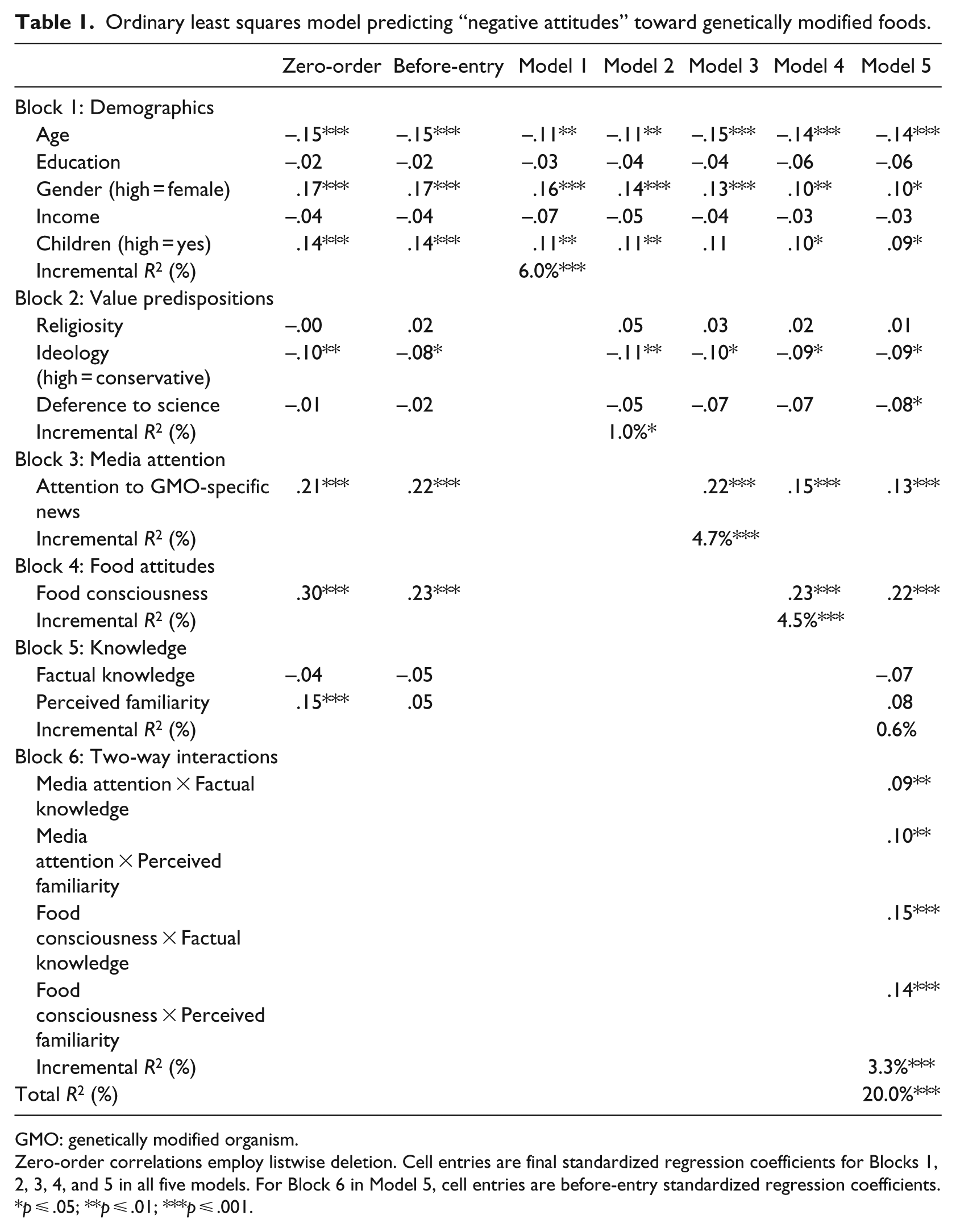
RQ1: What are the predictors of negative attitudes toward GM foods? (See Table 1.)
RQ1a: Given mixed past findings, how will factual knowledge impact attitudes toward GM foods?
H1a: Higher levels of perceived familiarity will be related to less “negative attitudes” toward GM foods (negative relationship).
H1b: Higher levels of food consciousness (an attitude conceptualized as a preference for organically and locally grown food) will be related to more “negative attitudes” toward GM foods (positive relationship).
H1c: Greater media attention will be related to more “negative attitudes” toward GM foods (positive relationship).
Ordinary least squares model predicting “negative attitudes” toward genetically modified foods.
GMO: genetically modified organism.
Zero-order correlations employ listwise deletion. Cell entries are final standardized regression coefficients for Blocks 1, 2, 3, 4, and 5 in all five models. For Block 6 in Model 5, cell entries are before-entry standardized regression coefficients.
p ⩽ .05; **p ⩽ .01; ***p ⩽ .001.
The intersection of knowledge with values and the media
Attitudes, such as food consciousness, might further impact the relationship between knowledge and perceptions of GM foods. For instance, Costa-Font et al. (2008) summarize GM food attitudes are driven by three main dimensions: risk and benefit perceptions, individual values and attributes, and knowledge and its relation with values. Therefore, the relationship between knowledge and attitudes toward GM foods might differ with varying levels of food consciousness. Given the absence of a larger systematic body of work documenting this potential interactive relationship, we did not put forth a formal hypothesis.
RQ2: How does food consciousness influence the relationships between the different conceptualizations of knowledge—perceived familiarity and factual knowledge—and attitudes toward GM foods? (See Figures 1 and 2.)
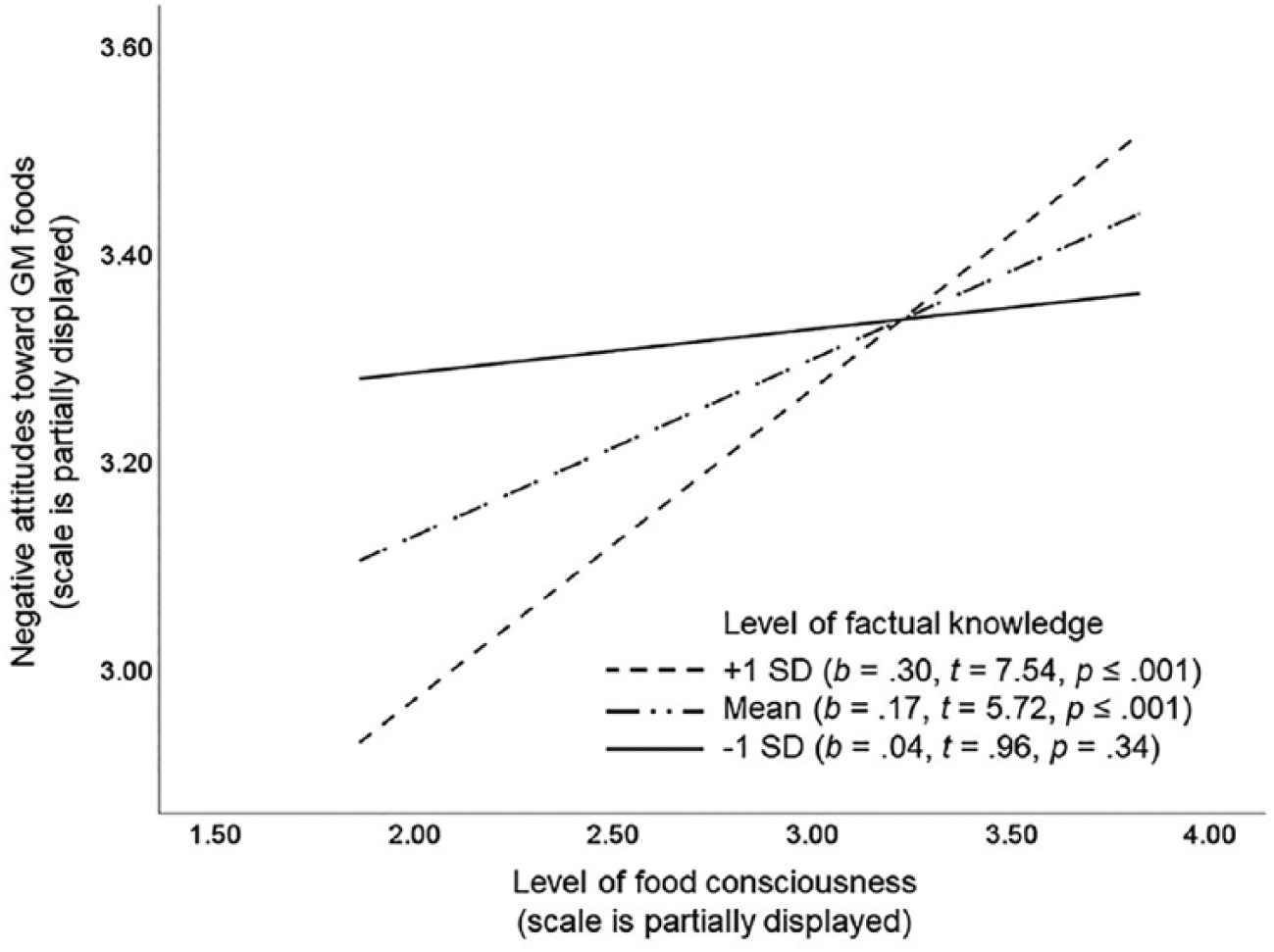
Interaction between food consciousness and factual knowledge on “negative attitudes” toward genetically modified foods. All other variables were controlled.
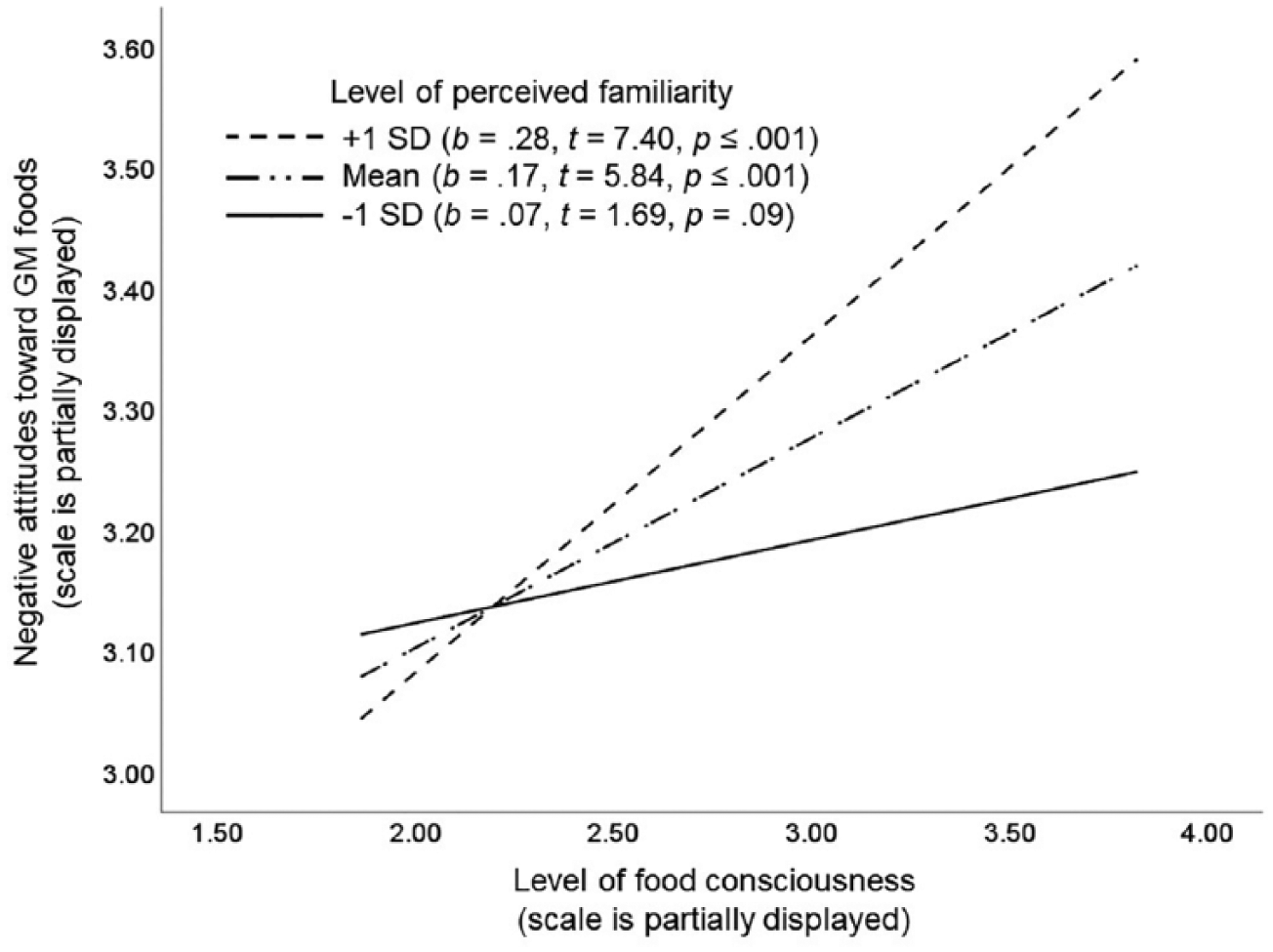
Interaction between food consciousness and perceived familiarity on “negative attitudes” toward genetically modified foods. All other variables were controlled.
In addition, media can play a moderating role for knowledge’s impact on risk perceptions for scientific issues (e.g. Brossard and Nisbet, 2007; Malka et al., 2009; Zhu and Xie, 2015). Attention to news coverage combined with the media portrayal of issues can influence perceptions and the relationship between knowledge and attitudes as the news media provides heuristic cues that direct attitudes toward scientific issues (Ho et al., 2008). The strength of this effect varies by information affect, as information about risks can have stronger and longer lasting impacts on attitudes compared to information about benefits (Lu et al., 2017). These long-lasting impacts could be strengthened by the consistency of negative media coverage of GMOs, which researchers have found amplifies risks (Frewer et al., 2002; Scholderer and Frewer, 2003; Vilella-Vila and Costa-Font, 2008). Based on this research and given differences in the main effects of factual knowledge and perceived familiarity, the relationship between knowledge and GM food attitudes might differ with varying levels of media attention, although we do not propose a formal hypothesis based on the absence of a larger body of systematic work.
RQ3: How does attention to GMO news influence the relationships between the different conceptualizations of knowledge—perceived familiarity and factual knowledge—and attitudes toward GM foods? (See Figures 3 and 4.)
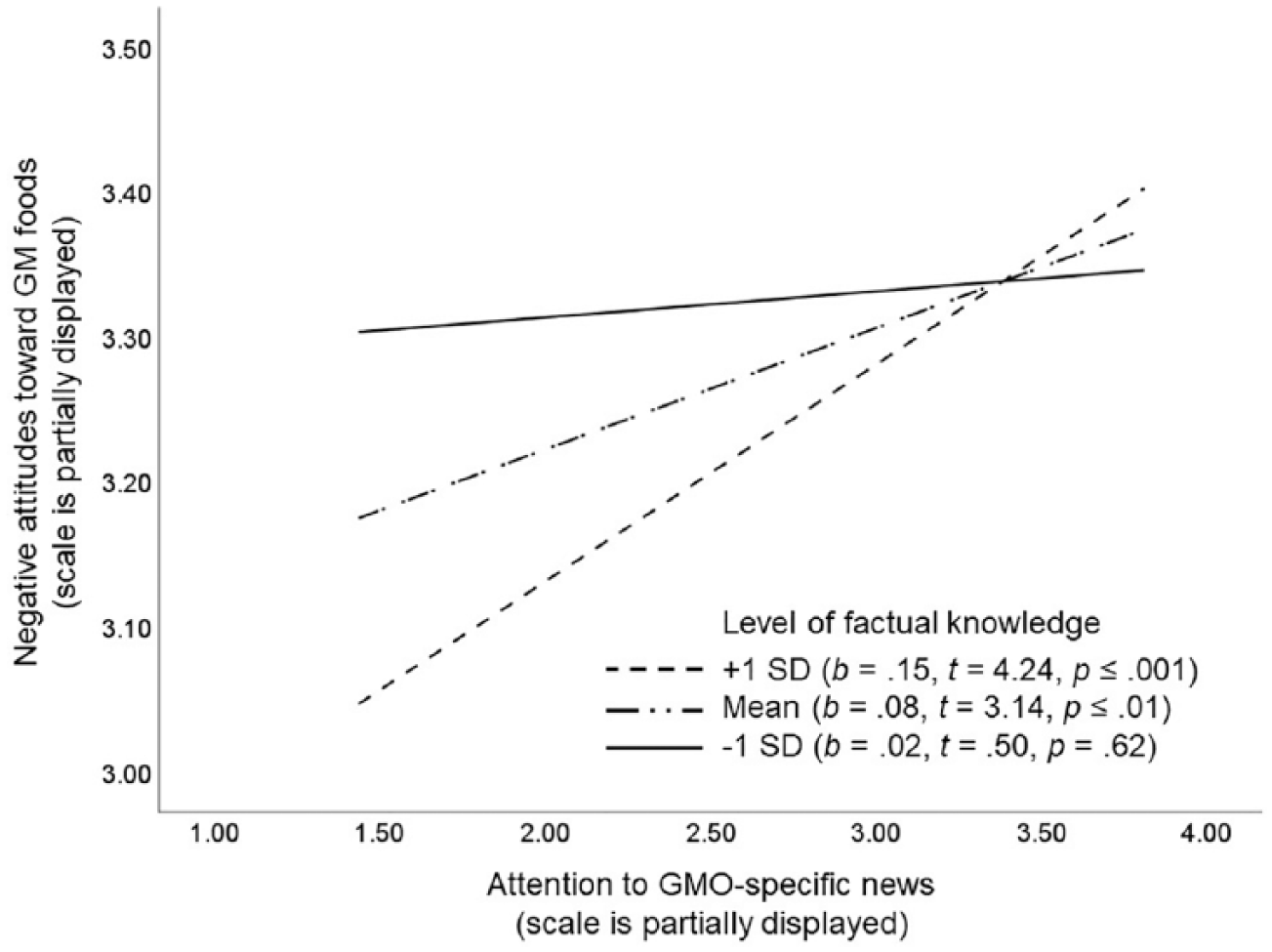
Interaction between attention to GMO-specific news and factual knowledge on “negative attitudes” toward genetically modified foods. All other variables were controlled.

Interaction between attention to GMO-specific news and perceived familiarity on “negative attitudes” toward genetically modified foods. All other variables were controlled.
Demographics and value predispositions
In the analyses, we control for demographic characteristics and value predispositions that shape individuals’ perceptions of GM foods and biotechnology. Briefly, agricultural biotechnology risk perceptions vary by individuals’ ages, gender, education, income, and having children in the household. Females and older individuals are more likely to oppose GM foods (Costa-Font et al., 2008; Legge and Durant, 2010; Lu et al., 2017; Magnusson and Koivisto Hursti, 2002; Moerbeek and Casimir, 2005). Education levels (Costa-Font et al., 2008; Lusk et al., 2004; Magnusson and Koivisto Hursti, 2002; Saher et al., 2006; Traill et al., 2004) and income (Costa-Font et al., 2008; Hu et al., 2005) relate to perceptions of GM foods and agricultural biotechnology, with some studies linking higher levels of education to more positive views (Magnusson and Koivisto Hursti, 2002; Saher et al., 2006), more perceived benefits from the technology (Traill et al., 2004), and less concern with moral objections (Traill et al., 2004). Individuals with children are more likely to perceive higher levels of food-related risk in general (Bruhn, 2005; Bruhn et al., 1992; Macfarlane, 2002).
In addition, because value predispositions are often used as perceptual filters to help make sense of complex technological issues (Brossard et al., 2009), we control for three value-related predispositions related to perceptions of GM foods: religiosity, political ideology, and deference to science. Few studies have examined religiosity as a predictor of GM food perceptions (Costa-Font et al., 2008): one study did not find a relationship between religion and overall GM acceptance (Hossain et al., 2003), but another found regular churchgoers were less willing to consume GM meat (Hossain and Onyango, 2004). Political ideology has been linked to support the technology, with conservatives slightly more likely to support agricultural biotechnology (Brossard and Nisbet, 2007). Finally, deference to scientific authority captures long-term values that include believing the scientific process produces reliable outcomes superior to those produced by other systems of inquiry (Scheufele, 2013). Deference often relates to support science and technology (Brossard and Nisbet, 2007; Ho et al., 2008) and can supersede political ideology when determining attitudes toward science issues and risk perceptions of controversial technologies (Blank and Shaw, 2015).
4. Methods
To test the impacts of factual knowledge and perceived familiarity and the moderating roles of attention to GM news and food consciousness in explaining “negative attitudes” toward GM foods, we use data from a representative survey of residents from a US Midwestern state. A university-associated survey center conducted the survey from April to July 2015. The mailed survey went to 2000 state residents based on random address selection, with four waves of contact and a US$2 incentive (Dillman et al., 2014). The final sample size was 931, with a 50.3% response rate (after adjusting for undelivered survey packets).
Measures
Demographics
The study measured age as a continuous variable (M = 56.4, standard deviation (SD) = 16.5) and gender as a dichotomous variable (63.8% female). Education was measured by asking respondents the highest degree completed (39.9% completed 4 years of college with a bachelor’s degree). Income measured respondents’ estimated total household income before taxes (49.9% with US$40,001 or more). Children was measured by asking how many children under the age of 18 live in their household. The response was recoded into a dichotomous variable (27.5% with one child or more).
Value predispositions
Religiosity was measured on a 5-point scale (1 = “none” to 5 = “a great deal”) asking respondents how much guidance religion provides in their everyday life (M = 3.1, SD = 1.3). Political ideology was measured with the following items on a 5-point scale (1 = “very liberal” to 5 = “very conservative”): (a) “In terms of economic issues, would you say you are …?” and (b) “In terms of social issues, would you say you are …?” The two items were averaged to create an index (M = 3.1, SD = 1.0, Pearson’s r = .7, p < .001). Deference to scientific authority was measured by asking agreement with the following two items on a 5-point scale (1 = “disagree strongly” to 5 = “agree strongly”): (a) “Scientists know what is best for the public” and (b) “Scientists should do what they think is best, even if they have to persuade the public.” The two items were averaged to form a single index (M = 3.0, SD = 0.9, Pearson’s r = .5, p < .001).
Media attention
Attention to GMO-specific news was measured on a 5-point scale (1 = “not at all” to 5 = “a great deal”) by asking respondents how much attention they paid to news stories about (a) “the possible Food and Drug Administration (FDA) approval of genetically modified salmon for human consumption” and (b) “the FDA approval of a genetically modified potato.” The two items were averaged to create a new index (M = 2.7, SD = 1.2, Pearson’s r = .7, p < .001).
Food attitudes
Food consciousness was measured on a 5-point scale (1 = “not at all” to 5 = “extremely”) by asking respondents how important the following attributes are when shopping for food: (a) “organically grown” and (b) “locally grown.” The two items were averaged to create a new index (M = 2.9, SD = 0.98, Pearson’s r = .5, p < .001).
Knowledge
Consistent with previous literature, factual knowledge was measured by recoding correct answers to two true-or-false questions commonly included in past studies: (a) “Ordinary tomatoes do not carry genes, but genetically modified tomatoes do” (false) and (b) “Genetically modified foods are currently sold in supermarkets” (true). “Don’t know” responses were included as incorrect (M = 1.2 correct, SD = 0.76). To measure perceived familiarity, we asked the respondents: “Prior to taking this survey, how much had you heard about genetically modified foods?” The question used a 5-point scale anchored at 1 = “nothing at all” and 5 = “a lot” (M = 3.1, SD = 1.1). Factual knowledge and perceived familiarity were significantly correlated (Pearson’s r = .4, p < .001). 1
Interaction terms
We included four interaction terms testing the relationships between (a) news attention and factual knowledge/perceived familiarity and (b) food consciousness and factual knowledge/perceived familiarity for negative GM food attitudes. Before creating each interaction term, we standardized the variables to avoid multicollinearity between the interaction terms and their components (Cohen et al., 2003).
Dependent variable
“Negative attitudes” toward GM foods is an index of four items. Respondents were asked to indicate how much they agreed with the following statements (5-point scale; 1 = “disagree strongly” to 5 = “agree strongly”): GM foods (a) “are a threat to the environment” (M = 3.1, SD = 1.1), (b) “only benefit food manufacturers” (M = 3.3, SD = 1.0), (c) “are unnatural” (M = 3.5, SD = 1.1), and (d) “cause allergies and illness in humans” (M = 3.2, SD = 1.0). The items were averaged to create a new index indicating “negative attitudes” toward GM foods (M = 3.3, SD = 0.8, Cronbach’s α = .80), with those higher on the scale expressing more concern about GM foods.
Analysis
We used a hierarchical ordinary least squares (OLS) regression model to test the research questions and hypotheses. All independent variables were grouped in blocks, each introduced into the regression models based on the assumed order of their causality (Cohen et al., 2003). For example, demographics enter the model before value predispositions because age and gender are more likely to influence political ideology than vice versa. The OLS regression blocks were ordered as follows:
Demographics (age, education, gender, income, and children)
Value predispositions (religiosity, ideology, and deference to scientific authority)
Media attention (attention to GMO-specific news)
Food attitudes (food consciousness)
Knowledge (factual knowledge and perceived familiarity)
Two-way interactions between media attention and factual knowledge/perceived familiarity; food consciousness and factual knowledge/perceived familiarity.
Significant two-way interactions were plotted using a conditional process modeling program, PROCESS, run through the SPSS software (Hayes, 2013).
5. Results
Predicting attitudes toward GM foods
The OLS regression model explained 20.0% of the variance in negative attitudes toward GM foods. Demographics (6.0%), media attention (4.7%), and food consciousness (4.5%) explained the largest portions of the variance. Addressing the first research question (RQ1), in the final model found in Table 1, the main effects of age, conservative political ideology, and greater deference to scientific authority predicted less concern with GM foods (less “negative attitudes”). In contrast, women, respondents with children in their household, those who paid attention to media, and the food conscious were significantly more likely to hold more negative views of GM foods (Table 1, Model 5). The significant effects of higher levels of food consciousness (β = .22, p ⩽ .001) and greater attention to GMO-related news (β = .13, p ⩽ .001) predicted higher levels of concern toward GM foods, providing support for H1b and H1c, respectively.
The impact of knowledge on GM food perceptions varied. Factual knowledge was not a significant predictor of attitudes before or after controlling for other variables, providing an answer to the sub-research question related to the mixed prior findings (RQ1a). Perceived familiarity was significantly correlated with “negative attitudes” at the zero order, opposite the predicted direction (H1a): higher perceived familiarity correlated with more concern for GM foods (r = .15, p ⩽ .001). However, within the final regression model, we failed to find a significant main effect of perceived familiarity when controlling for demographics, value predispositions, media attention, and food consciousness. Although both measures of knowledge were non-significant in the final model, the differential impacts of knowledge emerge in the interactions.
Food consciousness moderates knowledge and GM food attitudes
Addressing the second research question (RQ2), the first set of interactions focused on how the relationship between the knowledge measures and GM food attitudes varied as a function of food consciousness. The interactions can be seen in Figures 1 and 2. The interactions for both factual knowledge (β = .15, p ⩽ .001) and perceived familiarity (β = .14, p ⩽ .001) were significant. Food consciousness did not relate to significantly different GM food attitudes among those of low factual knowledge (Figure 1); those with low factual knowledge were more likely to be concerned, regardless of their level of food consciousness. Food consciousness did relate to significantly different perceptions among those with high factual knowledge: of the knowledgeable respondents, the food conscious were more likely to hold negative views of GM foods compared to the non-food conscious. As such, those who were food conscious and factually knowledgeable held similar levels of “negative attitudes” as those of low factual knowledge. Similar to factual knowledge, the interaction with perceived familiarity revealed food consciousness related to significantly different views among those who reported high levels of perceived familiarity (Figure 2). In this interaction, those of low perceived familiarity were less concerned, regardless of food consciousness. Rather, food consciousness was more influential for those with high perceived familiarity, with food consciousness corresponding to more concern toward GM foods.
Media attention moderates knowledge and GM food attitudes
Finally, the third research question (RQ3) addressed the influence of media attention on the relationships between knowledge and GM food attitudes, which are displayed in Figures 3 and 4. The interactions of media attention with both factual knowledge (β = .09, p ⩽ .01) and perceived familiarity (β = .10, p ⩽ .01) were significant. For factual knowledge (Figure 3), the attitudes of those with low knowledge were different depending on attention to GMO-specific news, and they viewed GM foods more negatively regardless of news attention. In contrast, news attention significantly related to greater “negative attitudes” among those with higher levels of factual knowledge. That is, the factually knowledgeable who paid attention to news coverage were more concerned with GM foods compared to those who did not pay attention. For perceived familiarity (Figure 4), news coverage was again more impactful for those with higher levels of perceived familiarity, while those with low perceived familiarity had comparable attitudes across differences in news attention. The attitudes associated with low perceived familiarity were overall less negative than those associated with high levels of perceived familiarity, in contrast to the higher concerns held by those with low levels of factual knowledge.
Overall, there are discernable patterns based on the impact of knowledge across both sets of interactions. Factual knowledge relates to “negative attitudes” toward GM foods in similar ways across both interactions (food consciousness and media attention). Interacting with food consciousness or media attention, those with high factual knowledge are more likely to be concerned with GM foods. Likewise, both moderating variables interacted similarly with perceived familiarity on predicting “negative attitudes” toward GM foods. Food consciousness or media attention had a stronger relationship to attitudes for those of higher perceived familiarity, predicting more negative attitudes. Altogether, food consciousness and media attention appeared to predict more even levels of negative attitudes across individuals with different factual knowledge scores while predicting increased differences in the level of negative attitudes across those with different perceived familiarity scores.
6. Discussion
This study explores two different conceptualizations of knowledge—factual and familiarity. We study the knowledge measures by testing their role in explaining “negative attitudes” toward GM foods, and by examining their influence on the relationship between attitudes and two predictor variables, food consciousness and attention to media coverage. Prior research has failed to distinguish various types of knowledge and found knowledge to have either a highly limited or conflicting influence on attitudes toward science (e.g. see Allum et al., 2008).
Our study provides insights into the different roles of knowledge types for attitudes toward scientific issues through the case of GM foods. Based on zero-order correlations for the knowledge measures and their interactions with food consciousness and media attention, our findings demonstrate perceived familiarity and factual knowledge are different concepts, and not interchangeable representations of a one-dimensional scientific knowledge. This is consistent with previous findings applied to other scientific issues (Ladwig et al., 2012; Stoutenborough and Vedlitz, 2016; Su et al., 2014) and across different aspects of GM food opinions (House et al., 2005; McComas et al., 2014). Focusing first on the main effects of the two concepts, neither knowledge measure significantly predicts (negative) GM food perceptions after accounting for other explanatory variables. Without controlling for other variables, however, perceived familiarity is significantly and positively correlated with negative GM food attitudes, meaning those with higher levels of perceived familiarity are also more concerned with GM foods. The failure to find a significant influence from factual knowledge is potentially in line with recent studies examining the limited impact of knowledge on support for and perceptions of scientific issues (e.g. Allum et al., 2008; House et al., 2005). The positive correlation of perceived familiarity with “negative attitudes” before controlling other variables is contrary to previous findings of the opposite effect (House et al., 2005; McComas et al., 2014) and to assumptions about the impact of knowledge based in the deficit model.
Joining other calls for separating these specific measures of knowledge (Ladwig et al., 2012) and for more careful distinctions related to knowledge (Allum et al., 2008), our results provide additional evidence for perceived familiarity as a measure of a distinct concept. Based on the results of the interactions, perceived familiarity might also be capturing effects of selective exposure. Measured by asking respondents how much they have heard about GM foods (familiarity), this conceptualization indicates those who are more familiar hold more negative attitudes toward GM foods. Thus, reporting greater familiarity may be due to seeking information which confirms preconceived attitudes about the risks of GM foods. Although our analyses did not set out to test a connection between perceived familiarity and evidence of selective exposure, our findings might provide a basis for future work probing this relationship more carefully.
Therefore, the second main finding of our study addresses the importance of knowledge for the relationship between GM food attitudes and prior attitudes (food consciousness) or heuristics (media attention). In the factual knowledge interactions, those who paid attention to the media or were food consciousness perceived GM foods more negatively, regardless of knowledge level. Higher factual knowledge was associated with less concern for GM foods only for those who did not pay attention to the media or were not food conscious. Food consciousness appears to have acted as a previously established value that trumped the impact of knowledge. Similarly, those who reported paying attention to GMO-specific news may have had greater exposure to risk-focused media coverage of GM foods (e.g. Frewer et al., 2002; Scholderer and Frewer, 2003; Vilella-Vila and Costa-Font, 2008) and may have employed this as a heuristic for perceiving more risks, and thus developing more negative attitudes, associated with GMOs.
Turning to the perceived familiarity interactions, the effect of perceived familiarity on attitudes toward GM foods differed from that of factual knowledge. Those who did not pay attention to the media or were not food conscious were less likely to express concern with GM foods, regardless of perceived familiarity. Instead, the differential effects of perceived familiarity come into play for those who are also employing prior attitudes or heuristics: higher perceived familiarity is related to more concern with GM foods for those who pay attention to the media or are food conscious. Here, perceived familiarity could be an indicator of greater exposure to more negative information, which compounds with the effects of media attention and food consciousness to produce negative perceptions of GM foods.
With these main findings in mind, we discuss some limitations. First, the questions included in the dependent variable index (negative attitudes toward GM foods) did not vary in direction. As a result, this index lacks a strong check on response set behavior. Although we find no direct evidence of this influencing our results, concerned readers should consider this in interpreting our findings. Second, our factual knowledge measure was based on two true-or-false questions. While the two question topics (genes and supermarket availability) are commonly included in other studies as factual measures of GM food knowledge, they might not reflect a wide-enough image of public knowledge about GMOs. The inclusion of additional questions would create a more comprehensive measure of factual knowledge but unfortunately were not in the survey. Likewise, the perceived familiarity measure was based on a single question asking respondents to report their familiarity with GM foods (how much they had heard). Again, this may not be reflective of other measures of respondents’ self-assessed knowledge and is only one possible conceptualization. Capturing perceived familiarity with a wider battery of items could increase our ability to capture a complete picture of familiarity and any significant relationships between familiarity and attitudes. Both measures of knowledge are in line with previously employed operationalization of GM food knowledge (e.g. Chen and Li, 2007; Gaskell et al., 1999; House et al., 2005; McComas et al., 2014). Future research should employ additional knowledge questions to test the varying impacts on GM food attitudes and should focus on distinguishing various measures of perceived familiarity.
7. Conclusion
Considerable debate remains about the nature of the relationship between knowledge and public attitudes toward science, especially across scientific topics and emerging technologies. Although scholars increasingly acknowledge and stress the relationship between support and scientific knowledge is often not as simple as the knowledge deficit model proposes (Eveland and Cooper, 2013), viewing scientific knowledge as unimportant does not capture the full picture either. The conflation of various knowledge types further confuses findings concerning the nature of the impact of knowledge on science support, attitudes, and understanding (Allum et al., 2008; Ladwig et al., 2012). In this study, we contribute to research that acknowledges the complexities and existence of different types of knowledge (e.g. Johnson, 1993; Ladwig et al., 2012; Turnbull, 1997). In focusing on two specific measures of knowledge—factual and perceived familiarity—we demonstrate they build on distinct underlying concepts, rather than represent one-dimensional scientific knowledge.
In sum, food consciousness and media attention shape the relationship between knowledge and negative attitudes toward GM foods. Perceived familiarity could be capturing effects of selective exposure, in which people who are food conscious and feel more familiar with the topic of GM foods are in fact more familiar with information that matches their prior held beliefs about the topic, and we encourage future research to test this assertion. We find additional evidence that the impact of factual knowledge on attitudes toward scientific issues is dependent on values, where factual knowledge is less important for those who have already formed opinions. Finally, to clear remaining confusion regarding the relationship between knowledge and attitudes, future studies should carefully consider, and distinguish, the measures of knowledge employed.
Footnotes
Funding
The author(s) disclosed receipt of the following financial support for the research, authorship, and/or publication of this article: This material is based upon work supported by grants from the United States Department of Agriculture (Hatch Grant, DUNS # 069225519). Any opinions, findings, and conclusions or recommendations expressed in this material are those of the authors and do not necessarily reflect the views of the United States Department of Agriculture.
