



Abstract
Despite the fact that citizen engagement in research is widely practised and regarded as one of the keys to maximizing the impact of research and innovation, empirical evidence on the value, potential and possibilities of engaging a broad diversity of citizens in practice is scant. The purpose of our article is twofold: (1) to provide more insight into the value and opportunities of engaging audiences that typically are not engaged with science and (2) to explore the effect of a targeted recruitment strategy versus a generic recruitment strategy on the profile, motivation and retainment of citizen science volunteers. Our empirical research is based on five citizen science projects in the domain of surface and drinking water research in the Netherlands. This article finds that using a targeted recruitment strategy, it is possible and worth to recruit a diverse sample of citizen science volunteers.
Keywords
1. Introduction
In the European Union (EU)-wide efforts to create more societal value from scientific knowledge, also known as valorisation, the participation of a diverse range of actors in the production of knowledge is considered crucial. Besides the collaboration with businesses, public authorities and other stakeholders, increasing attention is being paid to the interaction with the broader public in the form of citizen science (CS). Following a steep growth of CS projects in number, scale and scope (Bonney et al., 2016; McKinley et al., 2017), influential international institutions have started advocating the idea of public participation in research as a source of inspiration for engaging and empowering citizens and a mechanism to improve science-society-policy interactions (European-Commission, 2016).
The promising discourse surrounding CS, and the generally recognized importance of public participation in research, are of considerable importance. The idea of responsible research and innovation (RRI), including public engagement, is defined as a `cross-cutting issue’ in the EU Research and Innovation funding programme Horizon 2020 (European-Commission, 2016). An independent High Level Group on maximizing the impact of EU Research & Innovation programmes recently identified CS as one of the key actions to strengthen the impact of European research and innovation (Lamy Committee, 2017). The current proposal for the next European Framework Programme suggests that the attention to citizen engagement in research is going to increase. 1
The number of studies on the value, potential and possibilities of CS is rapidly expanding. However, to date, empirical studies on engaging a broad diversity of citizens in practice are scant. As we will show in section 3, a representative sample of volunteers is key for CS to fulfil its promises in terms of valorisation. The aim of this article is to twofold: (1) to provide more insight into the value, opportunities and means of engaging audiences that typically are not engaged with science; and (2) to explore the effect of inviting specific households to participate in CS projects, instead of using a generic invitation to the general public. Based on a rich dataset of five CS projects, our article analyses the influence of a targeted recruitment strategy versus a generic recruitment strategy on the sample of participants in CS projects, explores how the activity of participants relates to personal characteristics and looks at the question of how personal characteristics relate to impacts on confidence and awareness.
2. Rationales for CS
Science policies across the world have shown a growing interest in increasing the societal value from science over the past few decades. In relation to changing public and political expectations of science, policies of governments and research organizations have shifted their attention from concerns about quality and relevance to a focus on valorisation (Hessels et al., 2009), that is, to ‘the process of creating value from knowledge by making knowledge suitable and/or available for economic and/or societal use and translating that knowledge into products, services, processes and entrepreneurial activity’ (De Jong et al., 2015). One driver for this focus is a pressure for accountability, which implies the need to show that public investments in science lead to economic competitiveness, improved public policies or other forms of ‘social impacts’. Valorisation policy interventions include challenge-driven research programmes (Bos et al., 2014), the inclusion of impact assessment in university performance evaluations (Smith et al., 2011) and the stimulation of public engagement with science (Stilgoe et al., 2014). This article deals with the promotion of public engagement, particularly CS, as a strategy to stimulate valorisation, and accordingly does not focus on grassroots CS.
Even if CS projects generally have overlapping goals, on a higher level of abstraction the rationales for CS cited in the literature can roughly be classified as either substantive, instrumental or normative. The substantive rationale relates to the idea that CS might improve the quality of research or the final product. Public participation in research might not only raise new research questions that the scientific community had not yet considered, and generate more information on the research topic itself, but it might also suggest additional alternative or more specific solutions (Reed, 2008). The instrumental rationale for CS is rooted in the idea that the process of participation will increase the legitimacy and/or quality of the final product. Cooperation between scientists and the public is believed to reinforce mutual trust (Bäckstrand, 2003; Chandler et al., 2012). Another part of the instrumental rationale rests on the potential of citizen scientists to make large contributions to the quantity of data available to research professionals (Bonney et al., 2016; Cohn, 2008; Lidskog, 2008). The normative rationale for CS postulates that there is intrinsic value to and strong moral ‘ought’ for participation (Stilgoe et al., 2014). Indeed, scholars such as Buytaert et al. (2014) and Haywood (2016) argue that the engagement of the public in research processes makes science more democratic and ‘legitimate’, regardless of its effects on trust or the implementation of research results discussed in relation to the instrumental rationale.
We would argue that both the substantive and normative rationale for CS are almost by definition associated with knowledge valorisation. Projects initiated because of these rationales aim to contribute to the social impacts of science. As for the instrumental rationale, there can be various manifestations which are not necessarily linked with valorisation. Whereas projects that engage with citizens to increase the legitimacy of results typically aim for valorisation, research projects that invite citizens to participate in the collection of data from an efficiency perspective, will not always be oriented at generating social impacts or improving science literacy. In light of the work of Bonney et al. (2009), who made a classification of different CS projects, these will be primarily ‘contributory’ projects in which citizens merely collect data for scientists to use in their research.
3. Causal patterns between CS and the social impacts of science
Many CS projects are driven by a combination of substantive, instrumental and normative rationales. We would argue that, in principle, a project driven by any of the rationales can contribute to valorisation. When looking in more detail at the valorisation promises in relation to CS in the literature, one can distinguish at least seven different causal patterns assumed between CS and the social impacts of science:
Citizens can help to gather or analyse more data, which increases the quality of science (Bonney et al., 2016; Cohn, 2008; Lidskog, 2008), which can, in turn, enhance the social impact of a given scientific project.
It is suggested that the engagement of citizens increases the significance of research agendas for the broader society, and therefore enhances the societal relevance of science, which, in turn, increases the possible impact of its outcomes (Lamy Committee, 2017). This idea has also been framed in terms of a stronger contextualization of science, which helps to connect knowledge production with people’s local understandings, and to take the public understanding of a certain problem as the starting point for scientific enquiries (Lidskog, 2008).
The participation of citizens can help to reverse skewed representation in the production of knowledge (through the inclusion, for instance, of women, indigenous people and other underrepresented groups). This is suggested to increase both the quality and legitimacy of knowledge (Bäckstrand, 2003).
Citizens may bring in more diverse perspectives (Bäckstrand, 2003). These ‘new’ perspectives may be of great value (Lidskog, 2008). This claim is also apparent in the notion of public engagement in RRI, defined as ‘co-creating the future with citizens and civil society organisations, and also bringing on board the widest possible diversity of actors that would not normally interact with each other, on matters of science and technology’ (European-Commission, 2016).
CS can enrich the practices of quality control by extended peer review, which is considered necessary in the age of ‘post-normal’ science (Bäckstrand, 2003). The argument here is that wicked problems require a range of difficult perspectives, which should not only be included in the agenda setting of science but also in the assessment of scientific products (Funtowicz and Ravetz, 1993).
CS is assumed to raise scientific literacy, meaning that the experience of collecting data for use by professional scientists fosters scientific knowledge and provides learning opportunities (Ballard et al., 2017; Bonney et al., 2009; Strasser and Haklay, 2018). CS is expected to enhance the public understanding of science, in the sense that it helps promote understanding of the potential and limitations of science, and enhances the public trust in science (Bäckstrand, 2003).
Citizen participation can enhance the public acceptance of scientific outcomes (McKinley et al., 2017). In this regard, Chandler et al. (2012) maintain that ‘The inclusion of local community members in the research teams […] helps to build trust and leads to cultural sharing and acceptance of scientific outcomes and recommendations’ (p. 331).
A critical look at these claims reveals that they rest on a couple of crucial assumptions, which often remain rather implicit, both in policy documents and in scientific papers. In particular, the causal patterns 2, 3, 4, 6 and 7 all depend on the condition that a diverse (representative) sample of citizens participate in the research. If the (active) contributions of volunteers come mainly from a highly skewed sample of citizens, these promises will not be fulfilled. A second crucial condition to be noted is that the citizen scientists are affected by their participation in the project, in the sense that it changes or enriches their relationship with the object of study or with science in general. Only if this is the case, can CS enhance the public acceptance of scientific outcomes or increase the scientific literacy of participants.
We would argue that many CS projects do not fulfil these conditions. When looking at the educational background of CS participants, we find again and again that people with higher education are overrepresented in CS (Strasser and Haklay, 2018). Indeed, CS projects with over two-thirds of the participants holding a university degree are by no means exceptional (Brossard et al., 2005; Overdevest et al., 2004; Raddick et al., 2013). Furthermore, the empirical evidence with regard to improved understanding of the scientific process remains inconclusive at best, nor does participation necessarily result in, for instance, the adoption of pro-environmental attitudes. Improvements in content knowledge, however, seem to be better supported (Bonney et al., 2016; Brossard et al., 2005; Crall et al., 2013; Cronje et al., 2011; Jollymore et al., 2017; Strasser and Haklay, 2018).
The fact that many CS projects do not to fulfil these conditions may relate to the fact that not all projects are intended to improve the social impacts of science. Many projects, for instance, are intentionally designed to primarily increase the quantity of data or to answer specific scientific questions. We concur with Bonney et al. (2009) that such projects should not be held to standards for broadening the impact of science that they never intended to achieve. However, an alternative plausible explanation may relate to a lack of expertise or knowledge on how these conditions translate in design principles. Although recruiting participants is integral to the success of each individual CS project, very little has been published about different CS recruitment strategies. An exception is the paper by West and Pateman (2016), who, to this end, draw on the volunteering literature. They distinguish between three recruitment strategies: (1) word-of-mouth; (2) the use of third party organizations, such as volunteering agencies; and (3) the ‘scattergun approach’, that is, advertising to large numbers of people using, for instance, mass and social media. Whereas the first approach is likely to attract people who are already engaged in volunteering, the use of third party organizations may well function to reach specific groups (Ockenden, 2007; Unell and Castle, 2012). The ‘scattergun approach’ can be expected to create a bias towards people that are receptive to the particular media employed.
From a diversity perspective, a tension exists between the need to establish a legitimate cross-section of the population and the need to acknowledge and account for salient differences between groups (Blue et al., 2012). In this article, we focus on diversity in the sense of a representative sample of the population. In this light, this article presents a fourth strategy to recruit participants, which concerns sending out personal invitations to a random sample of the population. We refer to this strategy as a targeted strategy, as opposed to a non-targeted or generic invitation strategy, aligning well with the scattergun approach (West and Pateman, 2016) directed at all citizens of a specific area, but no one in particular. In section 5, we elaborate on the influence of recruitment strategy on the sample of participants and their motivation, followed by section 6 which evaluates the value of diversity from a research impact perspective. In the next section, we first explain how we conducted our research.
4. Research design
Our empirical research is based on five unique CS projects in the domain of water research in the Netherlands conducted in the period between 2016 and 2017, in cooperation with four different (drinking) water companies and over 1000 volunteers: the ‘Freshness of Water’ (2016), the ‘Clean Water Experiment’ (2017), ‘Citizen Science and Lime’ (2017), ‘Citizen Science and Lead’ (2017) and ‘Citizen Science and Hardness’ (2017–2018); see Table 1. The selection of these projects was guided by two considerations: (1) project relevance and (2) the availability of data. First, the selection of projects covers all CS projects in the drinking water sector in the Netherlands, as well as the country’s most comprehensive CS project related to surface water quality. Second, for all projects we have detailed empirical knowledge and data concerning the actual process. 2 All five projects can be characterized as primarily contributory CS projects, in which members of the public merely collect data for scientists to use in their research (Bonney et al., 2009). Two of the projects used a generic recruitment strategy, while the other three followed a targeted recruitment strategy by personally contacting a random sample of specific households, using the client database of the cooperating water company.
Overview of the recruitment strategies, number of invitations, participants and response rate.

CS: citizen science.
The Freshness of Water
This CS project on the microbiological stability of drinking water was the first CS project in the domain of drinking water in the Netherlands (Brouwer et al., 2018). Research was conducted with citizen scientists in Amsterdam into the ‘freshness’ of their own drinking water, particularly its bacterial composition. To this end, participants took water samples at their home and performed analyses themselves. Samples were also transported to the KWR laboratory, where the latest DNA techniques in the field of ‘Next Generation Sequencing’ were performed, making it possible to classify millions of bacteria at the DNA level. The project resulted in a better understanding of how the bacterial species community composition in drinking water changes during transportation in the distribution system, after stagnation in the premises plumbing system and after water is stored for several days in, for instance, a bottle. Participants were recruited by means of a generic invitation via a Facebook campaign, providing a link to the project registration page and online registration survey. The project received 85 complete registrations, 50 citizens were selected and 43 participants confirmed their participation.
The Clean Water Experiment
A year after the Freshness of Water project, a new CS project was conducted in Amsterdam, now focussing on the quality of the city’s surface water. Hundreds of participants received a special toolbox, containing various instruments to carry out water quality measurements, including an Escherichia coli (E. coli), colour, temperature and odour experiment. Citizens were invited to research the quality of the water in the city over a period of 3 months, and asked to upload their results to a dedicated website. Through the Clean Water Experiment, citizens learned more about the quality of water in their surroundings, making it easier for them to make well-informed decisions about how to use it. In addition, the project resulted in a larger spatial and temporal coverage of water quality data. Participants were recruited by means of generic invitation to the general public, both online and offline. A special feature of the recruitment process in this project was an artistic installation, allowing the people passing by to see, taste, smell and feel water. Flyers were distributed to all observers, inviting them to register online for the project. The installation was set up at various locations in the city. The project received 667 complete registrations.
CS and lime
In this 2017 CS project, over 100 citizens participated in a scientific study of drinking water hardness and lime-scaling. The research was conducted around the pumping station in Pey-Echt, in the south of the Netherlands. The reason for looking at this area relates to the fact that the responsible drinking water company had major issues with discoloured water in 2015, accompanied by regular complaints about the water’s hardness and quality. To improve the water quality of this pumping station, measures were taken in 2016. The CS project helped to get a better idea of the impact in the clients’ home of the measures taken, while the participants gained more insight into the composition of their drinking water. Using a simplified boiled water test and a ‘drop test’, the participants determined the hardness and lime-scaling of their water. The drop tests were carried out twice; once on water directly from the tap and once on water that had been boiled for 5 minutes. Invitations from the drinking water company to participate in the project were sent by e-mail to 1500 randomly selected addresses, and 134 citizens replied with a positive response.
CS and lead
Guided by the goal to locate and remove the last residues of lead from the (in-house) drinking water pipe network in the city of The Hague, this CS project involved citizens in research into lead water pipes. In two measurement rounds, citizens were invited to participate in the research, which included three variants with different research steps, ranging from taking pictures, taking samples and measuring pipes to testing for the presence of lead using indicator strips. This project has resulted in more insight about the presence of lead water pipes, and the effectiveness and significance of the three variants of locating these pipes. In addition, it presented an opportunity to raise the home owners’ awareness about lead, so they could take the appropriate measures. Invitations from the drinking water company to participate in the project were sent by e-mail to more than randomly 1255 selected addresses with houses built before 1960, that is, to houses that may still have in-house lead water pipes. In total, 107 citizens replied with a positive response.
CS and hardness
The CS project on the hardness of drinking water is in many respects the same as the above-mentioned project on lime, yet differs from it in two ways. First, participants were invited to take measurements on three different occasions over a period of 7 months: before, during and after the work on a particular transport pipeline. Second, participants were exclusively asked to carry out the ‘hardness drop test’ with water directly from the tap. This project was carried out in the region of the city of Oss, where during the project a transport pipeline was replaced and customers were temporarily supplied with harder water from another production site. Over the course of the research, participants could experience the variations in the drinking water’s hardness. Invitations from the drinking water company to participate in the project were sent by e-mail to 2384 randomly selected addresses, and 163 citizens replied with a positive response.
Data collection
All five projects had a similar set-up, and all included an extensive online registration survey, one or more data sharing surveys and an evaluation survey. 3 In our analysis we focused on the following: (1) the registration data, including age, educational background and motivation; (2) data on active contribution versus dropout; (3) experiences with measurement; and (4) evaluation data. Evaluation surveys also included questions about the degree to which participants were affected by their participation in CS projects, in terms of water awareness, confidence in their water and confidence in their water company. To maximize the validity of the survey questions, we shared the questions with experts on communication and conducted a qualitative focus group discussion prior to its administration. Both the comments of the experts and the focus group participants helped to improve the design of the survey questions.
Statistical analysis
The relations among the outcomes of surveys and the characteristics of participants were statistically tested. First, the relation between motivation and age class was examined using the chi-square test, with the null hypothesis that motivation is independent of age class. As a measure of the strength of the difference between observed and expected values, standardized residuals were computed for each frequency. When necessary, some of the categories were grouped, and the Fisher’s exact test was used when more than 25% of the expected frequencies were less than five, even after the grouping procedure. Fisher’s exact test is a statistical significance test used in the analysis of contingency tables. The same analysis was conducted for the following combinations of variables: motivation versus education level, project versus education level and age class, project invitation type versus education level and age class, participation activity versus education level and age class and evaluation versus education level and age class. For nominal variables with more than two categories (e.g. motivation), the chi-square test was also conducted for each of the categories separately. This was done by converting the nominal variable into several binary variables (e.g. yes/no for motivation ‘A’, yes/no for motivation ‘B’ etc.). This extra analysis made it possible to identify which specific category contributes to the dependency between the variables (on the entire table level, as tested in the preceding chi-square test). When two ordinal variables were compared, we tested the direction of the relation with Spearman’s rank correlation test, a non-parametric measure of rank correlation. This was applied for the following combinations of variables: evaluation versus education level and evaluation versus age class. Finally, the relation between dropout and age class (or education level) was further tested using the non-parametric Mann-Whitney’s U test to examine if there is difference in central values of age (or education level) between active and dropout participants. The statistical summary is shown in Supplementary Appendix 1.
5. The impact of two different recruitment strategies
The impact on the sample of participants
Analysis of the registration data of the five CS projects indicates a clear relationship between the recruitment strategy and the sample composition.
Diversity in age
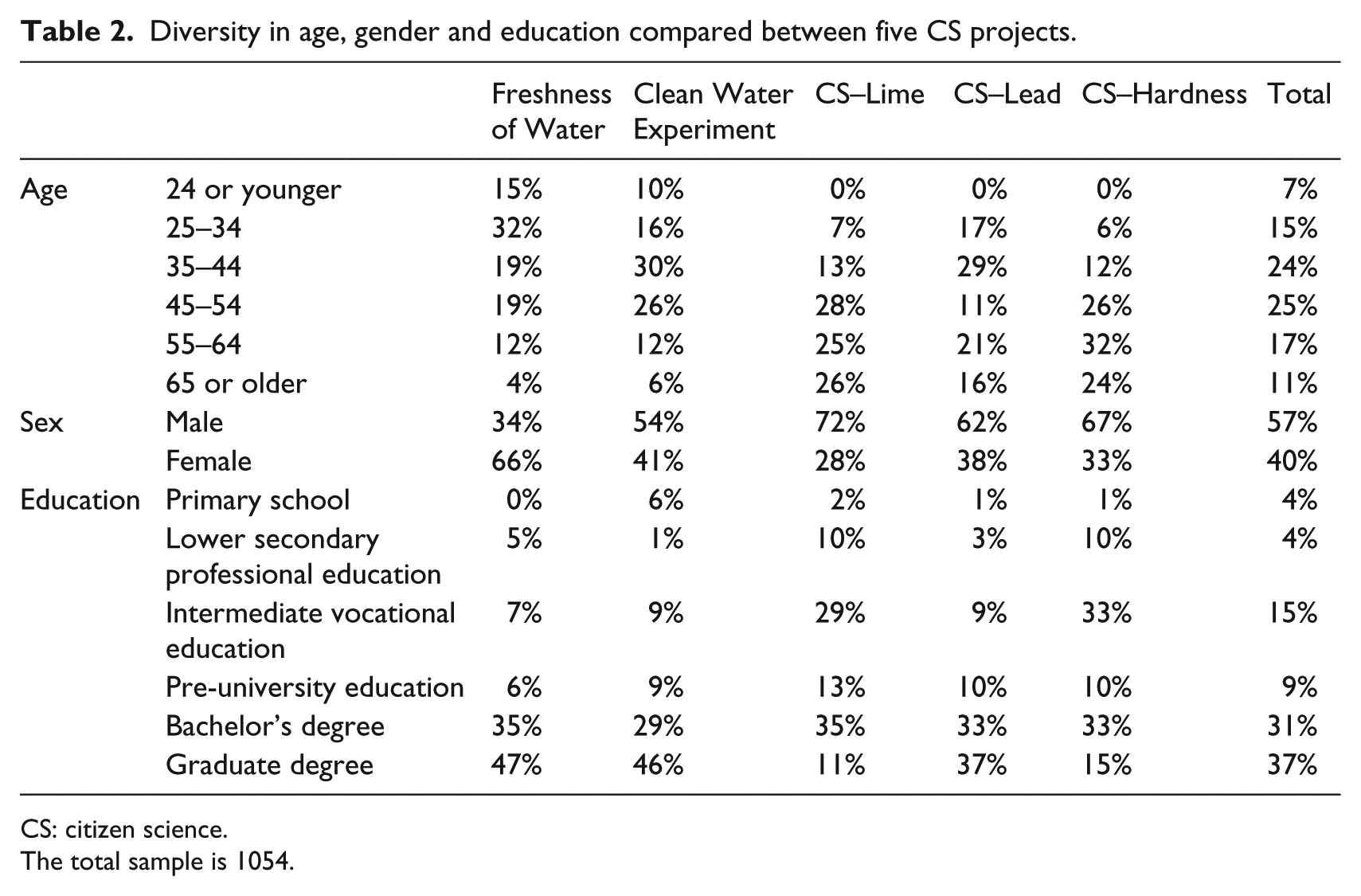
As depicted in Table 2, in both projects with a generic invitation strategy, that is, the Freshness of Water and the Clean Water Experiment, relatively few seniors registered, and the share of the people who registered over age 65 was, respectively, 4% and 6%. At the same time, we find that the same projects resulted in, respectively, 15% and 10% registrations from citizens aged 24 or younger. Also, the chi-square analysis showed that the age distribution of the registered people was significantly dependent on the invitation strategy (p < 0.001). A plausible explanation for the relatively many young volunteers is that both projects recruited volunteers by means of social media. Instead, the three CS projects using the targeted invitation strategy, in which specific households were asked to participate, recruited no volunteers of 24 years old or younger, and relatively many seniors; the percentage of the people who registered over age 65 ranges between 16% and 26%.
Diversity in age, gender and education compared between five CS projects.
CS: citizen science.
The total sample is 1054.
Diversity in education
Similar to most CS projects (Brossard et al., 2005; Overdevest et al., 2004; Raddick et al., 2013), the two CS projects in this study that used a generic recruitment strategy are characterized by a relatively high percentage of citizens with high education. Respectively, 47% and 46% of the volunteers even had a graduate degree as their highest level of education; see Table 2. 4 The share of people with a lower education is proportionately low, and for, respectively, 7% and 9% of the respondents, intermediate vocational education was the highest completed education. The projects that used the targeted recruitment strategy show that the overrepresentation of highly educated citizens in research projects can be overcome. In fact, we find that the distribution of education levels of the participants was significantly related to the type of invitation strategy of the project (p < 0.001 with chi-square test). Both the CS and Lime and the CS and Hardness projects managed to recruit relatively many volunteers with an intermediate vocational education as their highest level of education, 29% and 33%, respectively. In the same projects, the percentage of respondents holding a graduate degree is merely 11% and 15%. As depicted in Figure 1, this analysis shows that a targeted invitation strategy other than a generic invitation to the general public has the potential to result in a higher sample diversity.

Diversity in education compared between the two different invitation strategies. The relative share of each educational level is depicted on the y axis, the relative share of each invitation strategy is depicted on the x axis.
Next to diversity in age and education, also achieving gender diversity has long been a guiding principle in EC policy (European-Commission, 2018). Table 2 depicts the diversity in gender, demonstrating that the majority of respondents is male (57% versus 40% female, and 3% unknown). The reason why projects with the targeted recruitment strategy attracted relatively more male participants may relate to the fact that the invitations were sent to the drinking water companies contact persons, which are the persons in charge of paying the bill. It is not unlikely that these are relatively often men. However, as we have no reason to suppose that male volunteers respond differently than female ones to the participation in CS projects, this study does not consider gender as a variable in establishing meaningful connections. An analysis of ethnicity would also be interesting, but could not be included in this study because the respective data are unavailable. In order to avoid putting off potential participants, more sensitive questions, such as those regarding race/ethnicity and income level, were not included in the registration survey.
Motivation
The motivation of participants to engage in the five water CS projects shows a clear pattern across age groups (p < 0.001 with chi-square test; Figure 2). All motivation categories, except acquiring new knowledge, were related to age class (p < 0.05 with chi-square test on each motivation category). The interest in the particular topic of the project is more important for the older participants. Younger participants are more strongly motivated by the fun element or the opportunity to carry out measurements by themselves, and less often motivated by the special interest in the subject (p < 0.01 with chi-square test on this motivation).
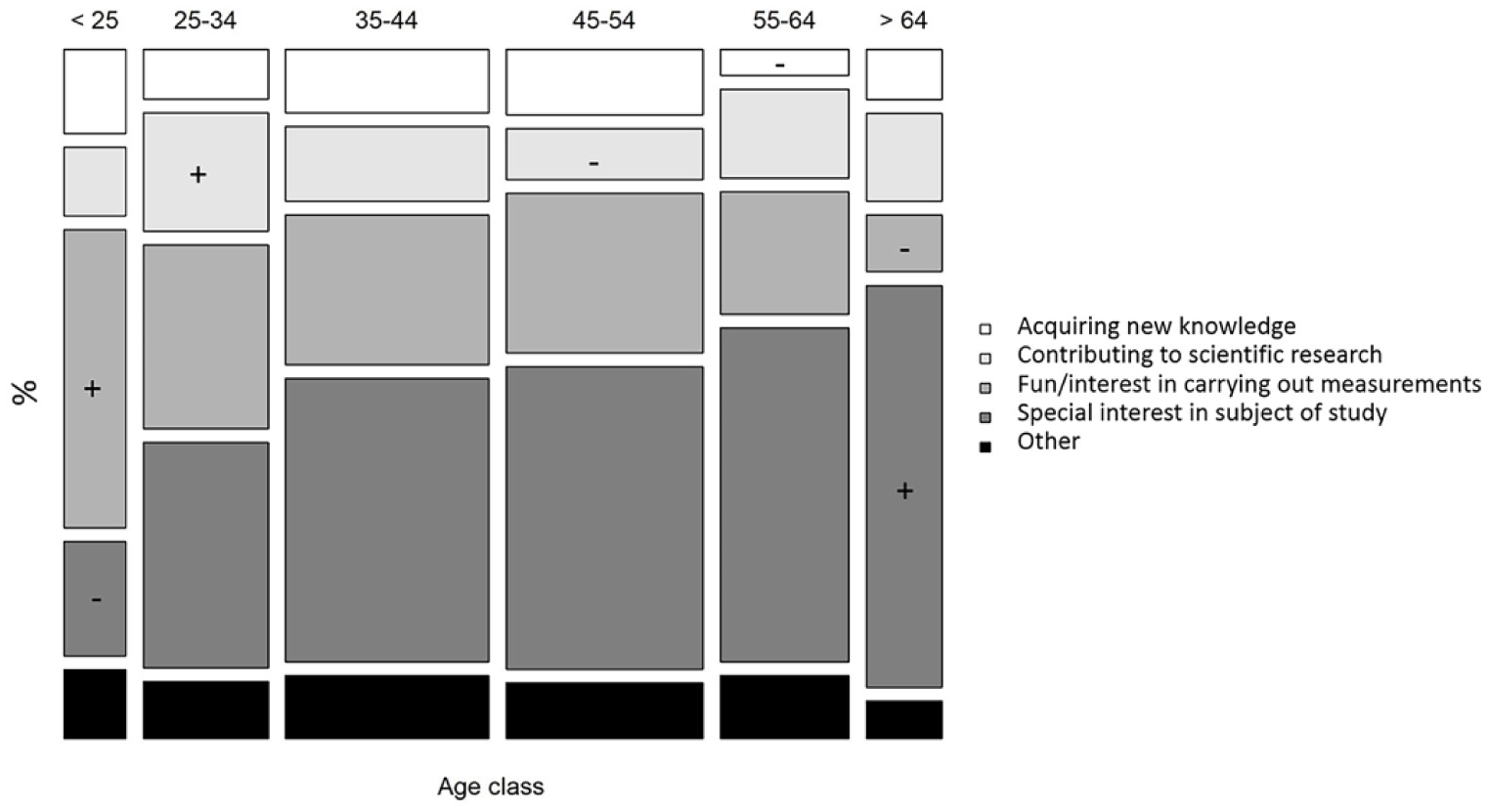
The motivation of participants compared across age groups. The relative share of each motivation is depicted on the y axis, the relative share of each age class is depicted on the x axis. The total sample is 1054. A box is marked with a plus (+) when standardized residuals are greater than 2, and marked with a minus (-) when standardized residuals are smaller than 2.
The motivation of participants also showed significant patterns across education levels (p < 0.01 with chi-square test). People with the lowest and highest education levels tend to be motivated by the fun element (p < 0.001 with chi-square test on this motivation). One remarkable observation is that participants with a low level of education (primary school only) perceive CS more often than others as a learning opportunity.
6. The value of diversity
Participant activity
It is one thing to recruit a diverse group of volunteers, but it is quite another to retain them over the course of the project. Therefore, we will now compare the active participation versus dropout of citizen scientists, across age groups and education level, to determine to what extent the diversity resulting from the recruitment strategy will maintain during the course of CS projects. We observe a clear trend in the active participation in relation to age (p < 0.001 with chi-square test). Older participants tend to remain involved throughout the various CS projects, and younger participants show a greater probability to drop out (p < 0.001 with Mann-Whitney’s U test). The correlation between the frequency of dropout and education level was marginally significant (p < 0.01 with chi-square test), with people with intermediate vocational education having a lower dropout probability. However, education level was not significantly different between dropouts and active participants, with Mann-Whitney’s U test (p = 0.248) indicating that there is no monotonous pattern of dropout along the gradient from low to high education level.
Effects of participation
In this section, we will investigate the effects of participation on confidence in institutions, confidence in water quality, water awareness, CS motivation and learning. In the evaluation surveys of the various projects, a vast majority of all respondents indicated that their confidence in the (drinking) water company that organized the CS project had increased (52%) or remained stable (43%). In this matter, we did not find a clear difference across age groups or education levels (p > 0.05 with chi-square test). The few participants (2%) whose confidence decreased all relate to occasions where lead was found in the drinking water system in the CS and lead project. The confidence in the quality of (drinking) water had increased for about half of the participants (51%), and for another 44% their level of confidence in the quality of (drinking) water remained equal. The increase in the confidence level was significantly correlated with age class (rho = 0.13, p < 0.05 with rank correlation test). We found marginal age dependency on confidence in water quality (p = 0.061 with Fisher’s exact test). Young people (<35) tended to have decreased confidence, whereas the strongest increase in confidence was found in the oldest participant group. There was no clear relationship between the confidence in water and educational background (p = 0.512 with chi-square test). When asked about a change in water awareness, a majority of participants (70%) indicated that this had increased; see Table 3. We did not find a clear pattern in relation to educational background (p = 0.563 with Fisher’s exact test) or age class (p = 0.255 with chi-square test).
The effect of participation on water awareness compared across education levels and age groups.

Depicted are the answers to the statement ‘As a result of participation, my awareness has increased’. The total sample size is 250.
Most participants (87%) responded positively to the statement ‘I have experienced participation in this project as a learning experience’. Again, the differences across age groups and educational backgrounds are very small (p = 0.257 and 0.156 with the chi-square and Fisher’s exact test, respectively). This indicates that from an educational perspective, it is meaningful to attract a diverse sample of participants. When asked whether they would consider participating again in a study in the water domain, a vast majority (90%) of participants responded positively. Although not significantly related to age class (p = 0.428 with chi-square test), we observed a pattern in which younger participants are relatively less eager to participate again (79% of the participants aged 24 or younger stated a willingness to participate in a new CS study in the future). This observation is in line with the larger share of dropouts in younger age groups. The willingness to participate again was higher in individuals with intermediate education and up; compared with the other participants, we found that participants with a lower secondary professional education less often say they would consider future participation (p = 0.034 with Fisher’s exact test).
7. Conclusions and implications
From a science policy standpoint, a powerful reason for investing in CS is the potential contribution of CS to the valorisation of knowledge, that is, to create more societal value from science. A crucial condition for CS projects to deliver on this promise is the participation and active contribution of a diverse sample of citizens. Based on a meta-analysis of five recent CS projects in the water domain, this article explores the possibilities of working with such a diverse sample, by investigating the recruitment of citizens, their active participation and the effects of participation.
We conclude that, from a valorisation perspective, it is worth the effort to attract a diverse sample of participants in CS. The meta-analysis of five CS projects presented in this article suggests that people across all age groups and education levels can participate meaningfully in CS projects, in the sense that they are moved or affected by their participation. The current literature is ambivalent about the possibilities of citizens acquiring knowledge about the research topic or about science in general (Bonney et al., 2016; Jollymore et al., 2017). In this article, we did not analyse scientific literacy as such, but we did find effects of participation on confidence and awareness in participants of all ages and education levels. The majority of participants expressed increased confidence in the water company and in water quality, as well as greater water awareness. This indicates that their CS participation has changed the relationship with the object of study. Apart from a relationship between age and the change in confidence in the quality of water, we did not find significant variations between education levels or age groups. Our finding that lower educated people can also participate meaningfully in CS resonates with Den Broeder et al.’s (2017) findings that citizen scientists with lower education levels can benefit from their participation in terms of self-confidence, social skills and cross-cultural network.
The second conclusion of this article is that it is possible to recruit a diverse sample of citizen scientists, and that a homogeneous group, consisting primarily of highly educated CS volunteers, should no longer be seen as inevitable. The three projects we have analysed, which used a targeted recruitment strategy, managed to attract a significantly higher diversity in participation. Citizens of older age and citizens with lower level education were much better represented than in the projects with a generic recruitment strategy. This shows that sending out personal invitations to a random sample of the population can help to attain a diverse sample of participants, as opposed to the scattergun approach of advertising on mass media or social media (West and Pateman, 2016). This is notable because CS projects are known to attract mainly highly educated participants (Brossard et al., 2005; Crall et al., 2013; Overdevest et al., 2004). It cannot be excluded that the specific focus of the projects and the contribution required from the citizens have influenced the composition of the sample of participants, which could be considered as a limitation in this study. We would argue, however, that this influence is limited, as all five CS projects were conducted in the Netherlands, around the same time, and all dealt with (drinking) water topics.
Although the recruitment of a diverse sample of volunteers indeed seems very possible, the active participation of all participants remains a concern. In the younger participants, we found a higher dropout during the projects, and also a lower willingness for a repeat participation. This suggests that additional efforts are required during the project to prevent the loss of interest (Conrad and Hilchey, 2011) and to keep these more volatile groups motivated.
Not all CS projects are aimed at valorisation. Particularly, instrumental CS projects of the ‘contributory’ type may well be oriented at generating large datasets or increasing fundamental understanding, without generating social impacts. However, it seems more than reasonable to assume that a large share of all CS efforts will be oriented at valorisation. For these projects, we derive some practical recommendations from our analysis. First, we would encourage project designers to consider a targeted recruitment strategy rather than an open call if they intend to attract a diverse sample of participants. Second, in order to sustain the activity of younger participants, project designers may explore possibilities to ask more commitment at the start and to invest more in face-to-face contact with their (younger) participants. Third, given our finding that younger participants tend to be motivated less by the specific topic of study and more by the possibility of contributing to science in general or by the fun aspect of CS, project designers interested in valorisation may consider strengthening these aspects (e.g. by site visits or social media activities), or stressing them more in the communication with participants.
Furthermore, we would argue that the discourse about CS deserves to be refined, as many contributions to the CS literature are insufficiently precise about the rationales for CS. We recommend to policy-makers and subsidy-granting agencies working with CS to make the valorisation goals of CS explicit, including the underlying goals and assumptions. In this manner, scholars and institutions designing CS projects can purposefully choose whether to take measures to enhance diversity of participation, and to make a contribution to the valorisation of knowledge.
As a final remark, it should be noted that in addition to diversity, certainly also a critical mass is necessary to fully extend the social impacts of science. Although the number of CS participants is not explicitly covered in this article, it is interesting to note that from the targeted invitation response rate data depicted in Table 1, it can be inferred that the potential of CS volunteers nationwide may be in the millions. In sum, we believe that if some of the necessary steps outlined in this article are taken, the valorisation potential by involving citizens certainly shows substantial promise.
Supplemental Material
Appendix_I – Supplemental material for Increasing research impact with citizen science: The influence of recruitment strategies on sample diversity
Supplemental material, Appendix_I for Increasing research impact with citizen science: The influence of recruitment strategies on sample diversity by Stijn Brouwer and Laurens K. Hessels in Public Understanding of Science
Footnotes
Acknowledgements
The authors would like to thank Yuki Fujita for the statistical analysis of the data, and Timo Maas, Janneke Elberse and Mariëlle van der Zouwen for reviewing the manuscript. We would also like to thank all team members, including all participating citizen scientists, of the five water CS projects.
Funding
The author(s) disclosed receipt of the following financial support for the research, authorship, and/or publication of this article: This paper was based on research financed by the joint research programme that KWR carries out for the Dutch drinking water companies and De Watergroep, Flanders.
Notes
Supplemental material
Supplemental material for this article is available online.

Author biographies
References
Supplementary Material
Please find the following supplemental material available below.
For Open Access articles published under a Creative Commons License, all supplemental material carries the same license as the article it is associated with.
For non-Open Access articles published, all supplemental material carries a non-exclusive license, and permission requests for re-use of supplemental material or any part of supplemental material shall be sent directly to the copyright owner as specified in the copyright notice associated with the article.
