




Abstract
This article investigates how activists use science communication to protest the regulation and use of Traditional Chinese Medicine in China. The article reports on a participant observation study of the motivations of the activists as well as the form and content of their activities. The article hereby questions the apparently close links between the systems of state and science in China. It also points to different configurations of the relationship between scientists, activists, science communication and publics than what has been common in analyses of science communication and activism in Western countries.
1. Introduction
The improvement of public understanding of science in China is an important issue for the Chinese government. According to the overall strategic plan for development in China the government describes ‘a scientifically literate population and labour force’ as a foundation for the development of China into ‘an innovative country’ (Gao et al., 2016). The investments in science popularization in China have risen from approximately 2 billion CNY in 2004 to more than 15 billion CNY in 2014 (Gao et al., 2016; Jia and Liu, 2014). The official figures suggest the investment is having effects: according to the Chinese Association of Science and Technology (CAST), scientific literacy in China has increased from 1.6% in 2005 to 6.2% in 2015 (Wei et al., 2016). The national science communication efforts have, however, also been met with critical voices. In a comment on the website SciDev.net, Professor Li Daguang criticized the official strategies of science communication in China for being too top-down and not enough focused on inclusion of public voices: ‘The public has a right to be involved in the science-policymaking process, to share their concerns and to expect them to be addressed’ (Li, 2008).
In this article we present another example, which demonstrates that the situation regarding science communication in China is more complex than it might appear at first sight. We are focusing on Traditional Chinese Medicine (TCM) in China and how it is an object of what we term science communication activism. By this term, we mean that activists use science communication as a way of protesting the current political, medical and cultural structures around the use and funding of TCM in China. Rather than simply being a governmental tool for development in line with the overall strategic plan, science communication in this case serves as a tool of protest against official structures. The case, therefore, questions an assumption of straightforward and close links between the systems of state and science in China. Hereby, it also points to slightly different configurations of the relationship between scientists, activists, science communication and publics than what has been common in analyses of science communication and activism in Western countries. In the case of TCM, activism is not based in criticism of science and technology (Breyman et al., 2017), but rather in support of scientific method and argumentation against what is seen as a non-scientific state-sanctioned use of TCM.
We start the article by describing the role and status of TCM in China and then explore the notion of science communication activism drawing on existing scholarship on social movements and science communication. We then present our empirical study, which is organized into three parts. First, we describe a pilot study of the characteristics of the activists. We subsequently look at the activists’ motivations for protest and finally we describe the types and content of protests undertaken by activists.
2. TCM in China
TCM is widely practised in China. 1 Many people perform self-diagnosis and self-treatment with TCM. There are also private clinics dedicated to TCM, but more importantly, there are Chinese medicine departments in every public hospital. The Chinese medical education system, and the governance of healthcare encourage the integration of Chinese and modern medicine. 2 As the current Constitution states, the government ‘develops both medicine and traditional medicine of China’ (Constitution of the People’s Republic of China, Article 21).
In line with this policy of integration, at least one course on TCM is compulsory for all medical students, and curricula on modern medicine are often supplemented with theories and treatments of TCM. For instance, Internal Medicine (one of the best-selling medical textbooks in China) recommends the use of TCM to shorten the disease period, when explaining treatment for acute upper respiratory tract infections (Ge and Xu, 2013: 13–15). In this way, medical doctors are trained to consider TCM alongside modern medicine and there is a high probability of being treated with TCM when seeking medical treatment in China.
In addition, TCM is a rapidly expanding business area in China. Since 2005, the annual growth rate of China’s TCM industry has been more than 20%, thereby exceeding the average growth rate of the pharmaceutical industry. According to the Qianzhan Industrial Research Institute (2017), the annual output value of the TCM industry was more than 800 billion CNY in 2016, accounting for about 25% of the domestic pharmaceutical market, and this share is increasing.
Compared with many other countries, where traditional medicine like TCM exists as an alternative form to modern medicine, TCM has the status of mainstream medical treatment in China (i.e. an integrated part of the healthcare system). This status is reinforced by the positive coverage of TCM in the public media, where it is often portrayed as something that should be appreciated and used by Chinese citizens – both as a patriotic gesture and as the right health choice. A similar message is found in the general education system. For example, Zhejiang province decided to make TCM a compulsory course in primary school in 2017, stating that TCM is China’s ‘original medical science’ and a ‘representative of traditional excellent culture’ (Fang, 2017). Knowledge about TCM is also included in the officially sanctioned understanding of scientific literacy in China: The Benchmark of Scientific Literacy of Chinese Citizens published by the state council in 2016 includes ‘Understanding that traditional Chinese medicine is the traditional Chinese medical treatment and that compared with Western medicine, Chinese medicine has its own advantages’.
The use of TCM, however, has also been the object of prolonged controversy. Since the late nineteenth century, public intellectuals have criticized the efficiency and legitimacy of TCM. Although such criticism faded from public discourse after 1949, it grew in strength at the end of the century, particular through the use of new digital communication channels. So while the use of TCM is mainstream, it does not enjoy universal social acceptance. In this article, we will investigate the current opposition to TCM by focusing on a group of people who not only reject using TCM themselves, but also try to persuade others to refuse TCM by arguing that it is not scientifically based, often ineffective and sometimes harmful. We analyse such arguments as a form of ‘science communication activism’.
3. Science communication and activism
We understand activism as non-institutional practices that emphasize action in support of or in opposition to one side of a controversial issue (Woodhouse et al., 2002). The objective is to (1) bring about or impede certain changes in a targeted field, (2) change policy or regulation and (3) alter cultural norms or behaviours within a particular society (Smith and Ferguson, 2010). Activists are usually volunteers, working to change a situation which they consider to be unjust (Castree et al., 2013). Activism can be a part of established social movements, but it can also be performed on a more ad hoc basis. In the case of TCM, there is no official social movement protesting its use, rather activism is more dispersed and ad hoc. We have chosen to understand the concept of activism rather broadly in this article to include communication efforts to strategically spread information. The reason for this is both theoretical and empirical. Theoretically, we understand communication to be a form of action and empirically, we have to take the specific Chinese context into account. In China, ‘direct action’ understood as ‘offline’ public protests are highly regulated (and subject to repercussions) and activists therefore often have to settle for online protests in the form of spread of information (King et al., 2013).
A substantial amount of the literature on science communication and social activism operates with a distinction between scientists and activists. Often, studies of scientific controversies have found the relationship between these two groups to be antagonistic (Nelkin, 1979). Civil society protests against GMO (genetically modified organism) have been global and spectacular (Bauer and Gaskell, 2002; Bloomfield and Doolin, 2012; Motion et al., 2015), but activists have also fought local waste facilities or contamination (Fan, 2012; McNew-Birren, 2014), nuclear weapons (Feigenbaum, 2015; Meyer, 1993) and vaccines (Dube et al., 2015; Reiss, 2017). Often, lay activists have been focused on mobilizing dissent and challenging the authority of science and scientific knowledge claims.
Other analyses, however, have found alignment and cooperation between scientists and social movement groups, particularly regarding environmental issues (Frickel, 2004; Jahng and Lee, 2018; Lubitow, 2013). In a study of industrial transitions, Hess (2016) argues that we need to broaden the focus of social movements to ‘mobilized publics’ which include, for example, scientist activism and advocacy of public interest science organizations as well as citizen science organizations. And in his seminal analysis of AIDS activism, Epstein (1995) described how activists succeeded not only in being seen to have credible expertise, but also in changing the rules for what counts as credible, so that they became genuine participants in the construction of scientific knowledge. Activists can therefore also be pro-science in the Western world, although they are often advocating supplementary expertise and ‘undone science’ (Hess, 2016).
Communication and use of particular scientific knowledge is often crucial to social movements (McCormick, 2009). Motion et al. (2015) have argued that we should pay separate attention to popularization strategies by civil society groups. In contrast to a derogatory understanding of ‘popularization’ as a form of deficit-model (Hilgartner, 1990; Irwin and Wynne, 1996), Motion et al. (2015) use the term ‘civic popularization’ to denote the ‘politicized, publicity-oriented strategies that civil society groups adopt to influence and mobilize public opinion as a legitimating or de-legitimating voice for a wider set of socio-cultural, technical and political factors in governance processes’ (p. 497). Such popularization strategies should be analysed both with regard to form and content. Jahng and Lee (2018), for instance, point to social media as channels that enable activists to engage with publics in a more interactive and direct manner than traditional news media. Such a strategy would be important in China where online criticism has been allowed more freedom than direct physical collective mobilization (King et al., 2013).
In terms of content, it has been argued that modern environmental protests tend to prefer ‘semiotic excessive symbolism’ and ‘visual rhetorics’ rather than narrow denotation, facts and discursive analysis (Szerszinsky, 2002: 54–55). The use of images as a rhetorical tool, however, can be very powerful and also have unintended consequences if activists have no control over the powers that the imagery provokes. In an analysis of New Zealand GMO protests, Bloomfield and Doolin (2012) demonstrate how such powerful imagery ended up hindering dialogue and prevented activists from reaching wider audiences. They emphasize how activists have to be careful not to do ‘cultural transgression’ and thereby losing goodwill in popular opinion. In this respect the TCM case is particularly interesting, given the interconnectedness of TCM and Chinese national identity formation.
In addition, popularization strategies should also be seen in connection to wider social and economic issues and dynamics (McNew-Birren, 2014). It is obvious that TCM activism has to be understood in connection with the wider social and economic climate in China. The use of TCM is not simply a question of health effects, but also of socio-economic questions in the form of access to and funding of the healthcare system as well as the importance of a growing TCM market.
Against this background and with inspiration from Bauer (2015), our research has been focused on answering the following questions: Who are the activists and what are their motivations? What do the activists do and what are they protesting against? Exploring these questions, we will also investigate more closely the nature of the relationship between science and activism in this case, as well as the form and content of popularization strategies.
4. Methodology
The overall methodology of this article is one of participant observation by Q.Z. In 2011, she came into contact with activists who were recruiting members for online groups on Sina and Sohu Weibo (two microblogging services in China at the time). Q.Z. applied to become a member and was admitted early in 2012 into a Tencent QQ group chat with more than 100 members nationwide. The membership followed a careful check that Q.Z. was (1) not a fan of TCM according to her previous posts on Weibo and (2) the owner of the checked Weibo account. It was obvious that many groups had the same form of background check to try to avoid personal information about activists being leaked or made public on the Internet. During the field research, the identity of Q.Z., research purpose and research questions were open to the activists. Non-public materials used in this article have been obtained with informed consent.
In the period 2012–2017, Q.Z. joined more than 20 Internet groups of activists. The total number of people in these groups were more than 3000. Q.Z. participated in the online debates where activists continuously shared their experience, opinions and knowledge. She also participated in physical meetings of the activists more than 10 times in five cities (Beijing, Shanghai, Tianjin, Ningbo and Wenzhou). In addition, Q.Z. followed many public social media accounts of activists. This allowed a collection of public posts, where the activists were not necessarily contacted in person.
Throughout the period, semi-structured, informal interviews were conducted with more than 200 activists during the physical meetings or over the Internet. Interviewees were selected based on activity: Q.Z. followed interaction patterns in the groups and contacted activists who posted messages which were relevant to the research questions. All material has been analysed using a qualitative, interpretative method focused on identifying central themes and patterns of similarity. Throughout the data collection, Q.Z. collected several hundred specific examples of protest actions. In the following analysis we have selected a few cases, which are typical of such activities. By typical we mean that they share a number of characteristics with many other examples and serve to illustrate the general forms and content of such protests. Throughout the empirical analysis we use quotations from the data material. We have translated the quotations in order to keep as much of the original meaning – although the cultural and linguistic differences between English and Chinese has not always made this easy.
Finally, an online questionnaire was administered to participants in an activist meeting in Wuhan in October 2013. The participants in the meeting were from all over the country. In total, 212 completed questionnaires were collected, which amounts to approximately 80% of the registered participants.
In general, it should be taken into account that the entire data collection has been done on a sensitive issue with a population that cares for its own protection, as they fear that public disclosure of their personal information could lead to unwanted attention or repercussions for their activism. The questionnaire and the interviews should therefore be considered as an indicative pilot study rather than as a conclusive and final comprehensive description.
In what follows we present the results. We start by describing the TCM activists using results from our survey and the interviews. In particular, we investigate their motivations to become involved in this form of activism. Subsequently, we give examples of the activism and describe its form and content.
5. Characteristics of the TCM activists
The survey conducted at the meeting in Wuhan provides information about the general demographic characteristics of this group of activists as well as their specific behaviour pattern in relation to science communication. The group consisted predominantly of males (83%). It included a few minors and some seniors, but most activists (97%) were between 18 and 60 years old (i.e. in the ‘working population’). While seniors above 60 years only made up 3% of the the activists, they account for more than 13% of the general population in China (National Bureau of Statistics, 2011). More than 75% of the activists had a bachelor’s (or higher) degree. They mainly worked in companies (46%) or government and public institutions (25%). 3 In all, 15% of them were students. While the average income per capita in China is just over 18,000 CNY (National Bureau of Statistics, 2014), 78% of the activists had an annual income of more than 30,000 CNY. Those with an annual income below 30,000 CNY were mainly students and minors.
With regard to science communication, the activists obtained scientific information through the Internet, popular science publications and television. As much as 69% regularly browsed scientific and technological information on the Internet, 36% frequently read popular science publications and 23% often watched science shows on television. One of the questions in the questionnaire was designed to probe their understanding of scientific methods and 91% responded correctly. A total of 66% of the respondents also agreed that when discussing science issues with others, they could cite relevant scientific information.
Furthermore, they were also active in communicating scientific information to friends and relatives in daily life and 76% said they were likely to argue their own point of view openly and refute non-scientific views when discussing scientific issues with others. Similarly, 79% said that they were more likely to be giving than receiving scientific information in such discussions, and 81% said they were more likely to persuade others of their own opinion rather than being persuaded by others. Based on the survey we must therefore conclude that this group of activists was keen to obtain science information from various media, and actively seek to disseminate such information to friends and colleagues. They were highly educated and relatively affluent, identifying with scientific values and harbouring a desire to spread these values to others.
6. Activists’ motivations
A central focus in the interviews was the reasons why respondents had become involved in TCM activism. The answers revealed four different overall motivations: (1) a desire to increase the public awareness of harm by TCM, (2) a desire to improve patients’ rights in China, (3) a concern for the protection of biodiversity and (4) a wish to improve public understanding of scientific thinking and method.
First of all, activists were concerned about the potential harmful consequences of TCM and wanted to alert the public to these effects. Several of the activists directly refer to scientific evidence of TCM’s harmful medical consequences. Examples are papers showing that TCM can cause nephrotoxicity (Yang et al., 2000), hepatotoxicity (Teschke et al., 2014) and carcinogenicity (Ng et al., 2017) or demonstrations that TCM contain excessive levels of heavy metals (Ernst and Coon, 2001). On this basis, activists feel an obligation to draw attention to the harmful effects in an otherwise non-critical public communication climate: Under the long-term systematic propaganda, TCM is a default setting for most Chinese. Many people think that TCM has less side effects than western medicine and that it is good for the physical condition, being not fully aware of its harm. My family and I had been the victims of TCM before pondering it over. I hope more people, at least the people I love, can know the truth. (Activist L)
It is not uncommon for activists to have experienced such negative effects of TCM in their own families and sometimes this has been an important point of reference for activists: My father died of uremia. In the last few years before his death, he was suffering. He took a lot of TCM, which aggravated his illness. Finally, he passed away in pain. Taking my father’s death as a lesson, I have been disseminating the idea that TCM is toxic and may lead to kidney disease to my family members. (Internet observation, WeChat group D)
Throughout the interviews and observations, it is a constant recurring theme that activists want to protect people from using medicine which is not scientifically proven and may be unsafe. The activists describe how a lot of health tips in the media and treatments offered by the healthcare system are not based on scientific evidence. They therefore try to persuade people around them to adopt a critical attitude and improve their ability to distinguish between medicine that has been scientifically tested and that which has not: Although it is unlikely to change something at once, people will reflect so long as there is a visible controversy. We hope to remind the public to think about the essence of TCM through our actions: Pay attention to the efficacy and safety of TCM! Medicine is related to everyone’s health and happiness. Believe in science, and stay away from superstition! (Activist F)
It is worth noticing that activists’ criticism is not reserved for TCM, but generally covers use of medical treatment which is not based on scientific studies proving safety and efficacy.
The second, but related, type of motivation that activists mention is a concern for patient rights. Again, activists are concerned with the legal status around TCM and what they see as a preferential treatment for TCM compared with modern medicine. For example, they protest the type of regulation found in the Chinese State Food and Drug Administration’s (SFDA) guidelines from 2006. The guidelines state that if it is not clear whether there are adverse reactions or contraindications, it can be stated as ‘not yet clear’ in the instructions. Similarly, if TCM products have not been subjected to clinical trials or toxicological studies, there is no need to list the results of trials in the instructions (SFDA, 2006). After 2008, the regulations furthermore included that for traditional TCM compounds with ‘long-term clinical application, definite curative effect and obvious features and advantages’, there is no requirement for animal experiments to prove the efficacy or other forms of clinical trials (SFDA, 2008). Activists react to these rules and find it wrong that the drug approval system does not demand the same standards of clinically proven efficacy and non-toxicity for TCM as for modern medicine. To them, this is disregarding the fundamental human right to safe medical treatment: For the drug that ‘it is not clear whether there is any adverse drug reaction’, shouldn’t you make it clear first before approval? How dare you approve it for clinical use with ‘not yet clear’? It utterly disregards human life . . . (Yu, 2013)
Activists argue that the ancient classic TCM treatments cannot be regarded as effective without scientific proof and they protest against an argumentation whereby they are allowed simply because they are part of a tradition. They see the system as concerned more with the promotion of TCM than the protection of life and health of Chinese citizens and argue that the current system violates the notion of informed consent. In their eyes, patients have the basic right to know about the potential benefits and risks of the treatment they get. The ‘not yet clear’ about adverse drug reaction, contraindications and toxicological effects in the drug instructions above, is seen to ignore the right to know. According to them, many Chinese people will perceive ‘not yet clear’ as ‘no risk’. On this basis, it is paramount to activists that there should be the same standards for TCM as for modern medicine and that both should be fully examined in terms of efficacy and safety.
In addition, activists also describe how victims of harmful TCM have very little access to legal remedies or other forms of help. Due to the ambiguity of the TCM theory, they argue that it is difficult to recognize or prove misdiagnosis and medical errors. On this basis, the activists sometimes use the satirical expression of ‘legal poison’ about TCM and make reference to the economic incentive in the Chinese healthcare sector: What motivates my action? The answer is the current situation of Chinese people in the medical system. I am forced. With the policy of ‘drug-maintaining-medicine’
4
, a kind doctor will ask you if you have medical insurance before prescribing. However, if the doctors just want to get more kickbacks, he will prescribe a lot of Chinese traditional patent drug without asking for your consent. (Zhou, 2015)
A third motivation is related to the protection of biodiversity. The activists explain how there is a theory of sympathetic magic in TCM, which means that resemblance can bring about connections between two entities. For instance, TCM theories state that a bird’s nest can nourish women’s bodies because of its resemblance to the female organ, that the bones of tigers can improve men’s sexual performance due to the strength of tigers and that gall bladders from bears are good for human gall bladder problems. On this basis, the pursuit of wildlife as medicine is threatening the survival of many wild animals all over the world due to illegal trade.
The activists argue that sympathetic magic is nothing more than witchcraft and that it is necessary to stop using wild and endangered animals for medical purposes, as it threatens the biodiversity. During their field observations in 2013, a pharmaceutical company advertised in the local newspapers and claimed that its drug contained high-quality rhinoceros horns. Several activists noticed the advertisement and pointed out that the company was either illegally selling rare animals or illegally making false advertisements: I don’t believe that they dare use the real rhinoceros horn. The so-called expensive TCM material is just a selling tool. The company encourage superstitious behaviour to earn money and neglect social responsibility. (Internet observation, local forum)
A final motivation for activists is a wish to disseminate scientific thinking in line with what they see as a more general story of development in China. They are building on the understanding that efforts to rejuvenate the nation since the late Qing Dynasty has been based on the idea of ‘saving the nation by science’, and find that this promise is being sold short: We find all kinds of superstitions and rumors prevailing in China. Superstitions are everywhere. There are always people who recommend a variety of absurd, boring health tips to you with good intentions. This is the reason why I am against TCM. I hope my sons will live in a more rational county in the future. (Activist F)
Activists argue that ‘the scientific foundation of Chinese culture’ is not as strong as they would like it to be, as many of them experience a scarcity of scientific understanding and thinking in daily life. They want to contribute to the dissemination of a scientific culture as they believe this to be important for the development of a democratic and prosperous nation much in line with the official government strategies.
7. Content of activism
As mentioned previously, there are several hundred examples of science communication activities in our material. They can be loosely divided into two groups: individual actions and collective, quasi-organized actions. Individual actions here mean actions taken by single activists. They include Internet communication, for instance, in posts on social media, interpersonal communication and specific events in which actions are designed to protest the use and regulation of TCM in China. The collective actions are typically carried out by self-organized groups with changing identities and organizational patterns – hence the characterization of ‘quasi-organized’. Such actions can be ad hoc or more planned and they also vary between offline and online actions.
Individual actions
The individual actions are very often linked with personal experiences and are often aimed at people directly affected by the use of TCM. A typical form is to communicate scientifically informed messages to family, relatives and friends as part of daily life, especially when there is a direct reason to be concerned about the use of TCM: My mom ate a kind of wild herbs last month. It happened that the herbs can cause photosensitivity. She had a strong allergic reaction. I took the opportunity to tell her that ‘pure natural’ doesn’t mean non-toxic. (Internet observation, WeChat group D)
Many of the activists consider it a long-term task to inform about TCM and adopt a pragmatic stance, where they take advantage of suitable opportunities to communicate their messages. Besides interpersonal communication, it is very common to use the Internet as a dissemination tool. Just as they themselves were most often exposed to TCM criticism online, they now create science communication with text, images, video, animation and so on and post it on social media, forums or blogs.
However, activists also describe how they find it difficult to persuade people about their views. Some activists have, therefore, been exploring more innovative methods of communication by strategically distributing science information to specific audiences. One activist came up with the idea of designing a reading competition during a family gathering. He chose reading materials with science information and then made a set of questions that could only be answered correctly if his family members had read the text carefully (Miao, 2014).
During a hospitalization, another activist was discussing the use of TCM with doctors and patients, but did not feel he had received enough response and attention. Then he placed two posters on the wall on top of two existing notices – thereby changing their meaning (see Figure 1, offered by activist L). The two background notices had the following titles: ‘What the Inpatients Need to Know’ and ‘Watch Your Steps’. Below he put his own messages: Modern medicine has demonstrated that there is no disease that only TCM can
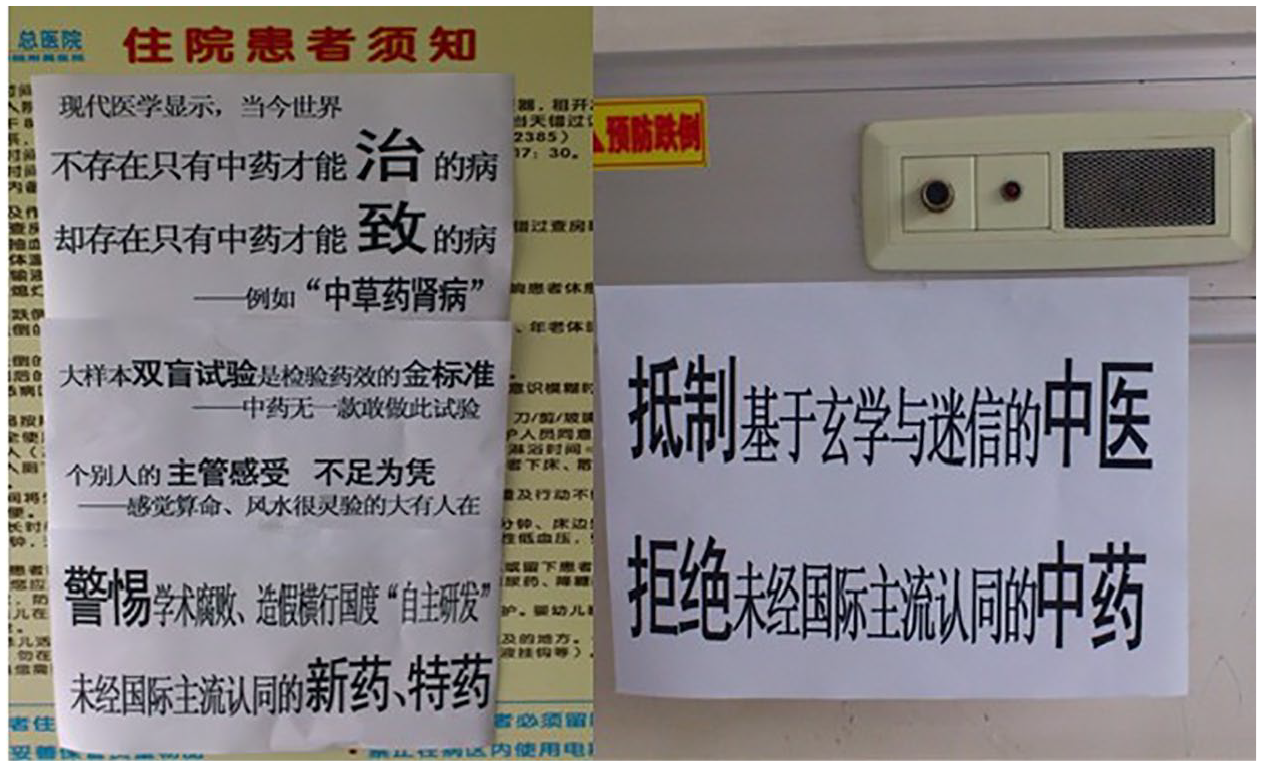
Two posters on the wall of the ward.
The hospital was run by a state-owned enterprise in which the activist worked as a senior technical expert. Because this position gave him a lot of prestige, the staff at the hospital did not want to take the posters down. Many of the patients saw the posters and some of them started talking to the activist. Other activists have described putting up posters in places such as bulletin boards, school gates, offices and private cars.
Collective actions
In addition to individual actions, activists regularly converge around some form of collective protest. Usually, such collective groups are formed by one or more activist recruiting others through the Internet and thereby forming a voluntary, semi-organized team. The joint actions can mobilize more resources and potentially gain a higher amount of visibility.
One example of such collective action was a group that decided to print health information on poker cards (poker being a popular game with middle-aged and older people, especially in the countryside). They selected 52 pieces of information from the only recent book in mainland China which criticizes TCM, Criticizing Traditonal Chinese Medicine (Fang, 2007) and designed a deck of cards, so that every card had one of these pieces of information (see Figure 2). The activists managed to raise funding enough to print 37,000 copies that they could acquire for 1 CNY per copy. They subsequently gave copies to their friends and relatives, distributed them in the street and donated them to local poker clubs. Similar collective actions include the donation of science books to primary and junior high schools and the distribution of leaflets with scientific information about medication, for instance, in streets and at the entrance to a kindergarden.
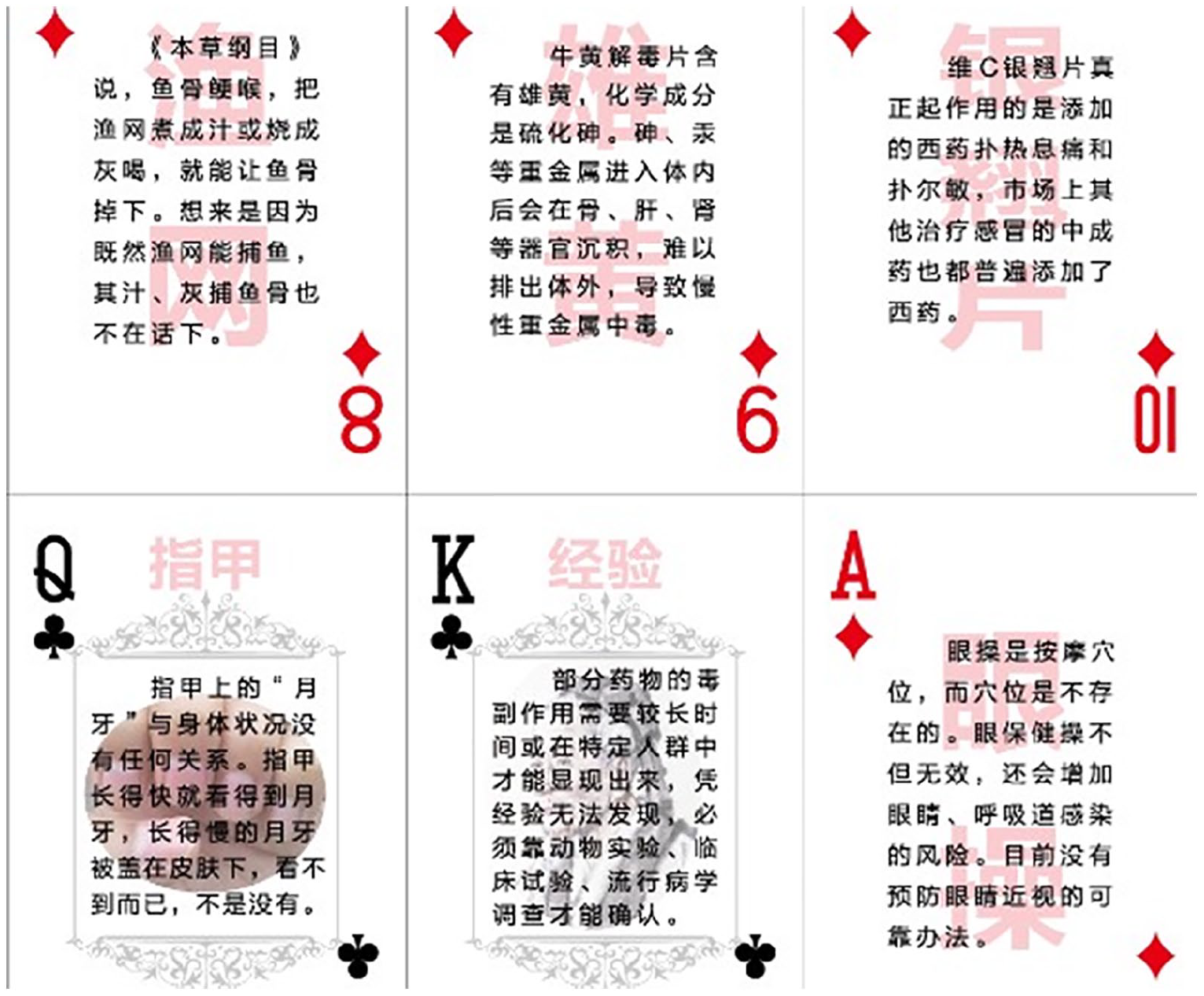
Anti-TCM poker cards (retrieved from QQ group K).
Besides communicating to the public, the activists also make protests which more explicitly challenge the government, experts, special interest groups and other forms of power. For instance, some parents in Zhejiang province wrote an open letter to the education department protesting the inclusion of TCM in the primary school curriculum.
Another effort was aimed at helping patients refuse TCM when coming into contact with the healthcare system. Activists describe how it can be difficult for individual patients to refuse treatment with TCM, because it would offend the doctors if a patient refused, or because doctors might forcibly give TCM in spite of the patient’s refusal. A group of activists therefore made an anti-TCM stamp that could be put on medical records. Another group used this as inspiration to make printed stickers, which they could conveniently hand out to friends and relatives (see Figure 3, offered by activist D). The stickers contained one of two very simple messages: Dear doctors, I am allergic to any kind of traditional Chinese medicine, Chinese traditional patent medicine and Chinese medicine injections. Dear doctors, I refuse any kind of traditional Chinese medicine, Chinese traditional patent medicine and Chinese medicine injections. I will assume all the consequences.
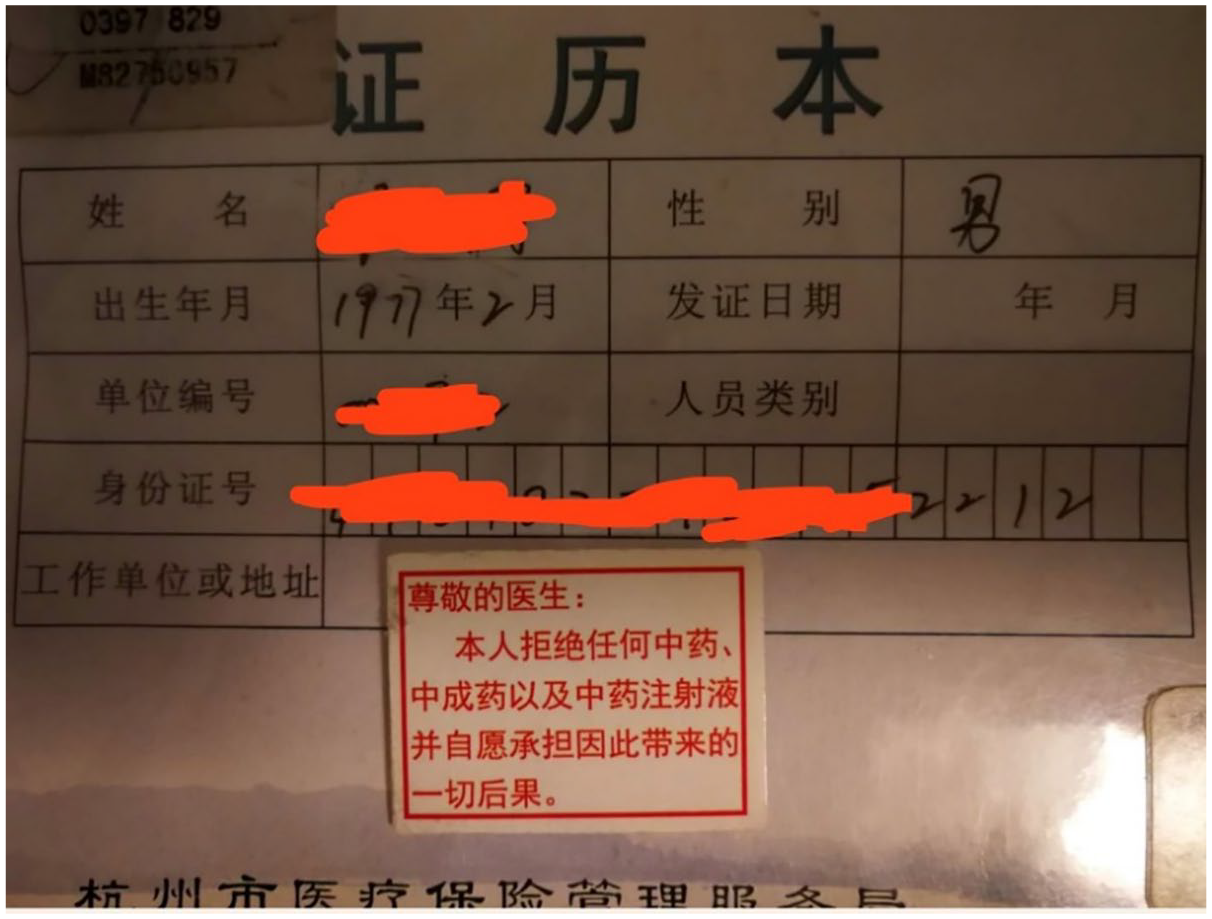
Anti-TCM stamps or stickers.
Another example was inspired by a group of female students, who sparked a heated public debate by posting photos online of themselves holding placards advocating their play, The Vagina Monologues. An anti-TCM activist got inspired to use a similar method drawing on the fact that one of China’s most celebrated writers, Lu Xun, was also a critic of TCM. Lu Xun is highly acclaimed by the Chinese government for his left-wing viewpoints, but he also repeatedly satirized TCM in his books, saying that TCM was nothing more than a deliberate or unintentional lie. The activists thought it was creative and meaningful to commemorate Lu Xun and promote his standpoint on TCM in his hometown. A total of 10 local activists went to attractions in Shaoxing holding placards with TCM-critical messages in December 2013 and simultaneously posted photos of this protest online. Their slogans included the following messages: Experience ≠ experiment The standard of drugs can’t be ‘one county, two systems’ Toxicity of TCM, who is in charge? Drugs should not be sold without toxicology test. You have the right to believe, and I have the freedom to oppose. Regulate modern medicine
‘One county, two systems’ refers to a principle that is supposed to solve territorial issues with Hong Kong and Macau. The principle implies that there is only one country – China – but while Hong Kong and Macau have their own capitalist political system, the rest of China uses the system of ‘socialism with Chinese characteristics’. By using the reference to this principle, the activists are pointing to the way the Chinese government has adopted different regulatory policies on TCM and modern medicine.
8. Concluding discussion
Contrary to what is found in some Western studies of science communication and activism, the activists in this study are not protesting against an alliance between science and state, but rather the state-authorized use of what they see as non-science. The activists in the anti-TCM case are well educated and affluent compared to the background population, and they identify strongly with a scientific culture. Central to their discontent is a complaint that their state is not fulfilling the promise to ‘save the nation through science’, but instead putting citizens at risk of harm through TCM and disregarding their rights as well as allowing a risk to biodiversity. Their argument is that all of this would not happen if the people and the government were guided by science, rather than other considerations. Importantly, therefore, they do not just aim their science communication efforts at family, friends and wider publics, but also at the experts and doctors as well as the government and state more widely.
Contrary to the preference for ‘semiotic excessive symbolism’ (Szerszinsky, 2002) found in Western modern environmentalist activism described earlier, the TCM activists in China generally use more narrow denotation, facts and discursive argumentation. Even the more visual protests and event-oriented forms are centred on linguistic statements and scientific information and content. Such a ‘popularization strategy’ (Motion et al., 2015) is less likely to ‘culturally transgress’ (Bloomfield and Doolin, 2012) in a country where public protests are highly regulated. It can, however, also be seen to have many similarities with what has been criticized as a ‘deficit model’ (Irwin and Wynne 1996) form of science communication. Such communication departs from the idea that if anyone disagrees with what is claimed to be scientific, it is because they lack the proper knowledge to see what is right. Such a strategy, therefore, aims at putting forward facts and rational arguments and assuming that such information has convincing power in itself.
While the strength of the activists’ deficit-model science communication strategy stems from the fact that the Chinese government is committed to a nation-building strategy based on the increase of scientific literacy, it might prove weaker in dealing with the wider cultural and social contexts (McNew-Birren, 2014), in this case a nation-building strategy that is simultaneously celebrating ‘traditional excellent Chinese culture’. The official sanction of TCM treatment is not simply a question of scientific evidence, but also of praising a cultural trajectory. However, as we have seen, the activists commonly reject such cultural considerations as pure ‘superstition’. 5 Whether this is a viable solution is not certain, when we consider how the use of a deficit-model in Western countries has been seen to be a form of arrogance on behalf of scientific institutions and expertise (Wynne, 2003) – most notably in the GMO-controversy (Bauer and Gaskell, 2002). The misalignment between culture and science in this case, however, is not just a problem for the TCM activists. Rather, their opposition to TCM is drawing attention to – and highlighting – a general tension in the Chinese science-society governance by illustrating how the efforts to increase scientific literacy and ‘save the nation by science’ is not always taking precedence.
Another important aspect of the activists’ motivations relate to the relationship between TCM and business. In a situation in which the TCM market share of pharmaceuticals is 25% and rising, many activists are particularly critical of the economic aspects of TCM. They argue that medical doctors can have an economic incentive to prescribe TCM (as well as overprescribing modern pharmaceutical drugs) due to the ‘drug-maintaining medicine’ system (see endnote 4). They are also highly critical of the marketing practices of the TCM companies and sceptical of a political system that is not seen to regulate business properly and transparently. This makes for an interesting comparison with the controversy around GMO, where opponents were also very critical of the economic interests of companies (and the political regulation of this industry) and what they saw as sacrificing consumer and safety concerns in the interest of profit. While GMO opponents did not use deficit-model science communication in the same way as the anti-TCM activists, both movements protest the influence of business in healthcare decisions.
Compared with the GMO controversy, debate about TCM has a much longer history and is arguably also more widespread in current China. It is possible that the use of deficit-model science communication as a form of activism will diminish in the future. This would be the lesson to be learned from parts of the literature on controversies, activism and science in the West, where the deficit model has been considered ‘outdated’ (Wagner, 2007) or ‘dead’ (Jones, 2014; Trench, 2006). However, the case of anti-TCM can also be seen as an illustration of what happens in a situation in which the state-science nexus is less strong than what was perceived to be the case with GMO. Perhaps current experiences of climate denial, vaccine resistance and fake news will lead to more (not less) deficit-style science communication activism in the future – also among social movements in the West.
Footnotes
Acknowledgements
The authors would like to thank the two anonymous reviewers for constructive input as well as Bu Wei and Liu Xiaohong at the Chinese Academy of Social Sciences for their very valuable advice.
Funding
The author(s) disclosed receipt of the following financial support for the research, authorship and/or publication of this article: Q.Z. received funding from the Chinese government in 2017 when she studied abroad for a year (the period in which this paper was written). Philosophy and Social Science Project of Zhejiang Province, No. 18NDJC131YB.
