




Abstract
Research shows that people in predominantly Christian cultures tend to perceive a basic tension between science and religion, which is not reflected in predominantly Muslim cultures. In this cross-cultural study comparing Christian university students in the United States and Muslim university students in the United Arab Emirates, we examined time spent in Western countries (for UAE students) or overseas (for American students) as predictors of perceived religion-science compatibility. Drawing upon the notion that science is viewed as more secular in Christianity than in Islam, we hypothesized and found that among UAE students, number of weeks per year spent in the West correlated negatively with religion-science compatibility beliefs. This relationship held even when controlling for science knowledge, suggesting that it results not from epistemological opposition to science but from an increasing exposure to the idea that science should be seen as a secular institution. Among American students, number of weeks per year spent overseas and religion-science compatibility beliefs were not associated. Implications for perceptions of science among different religious groups and in different cultural contexts are discussed.
Keywords
1. Introduction
The notion that science and religion are incompatible has circulated widely in the West for centuries. This “conflict thesis” was formally introduced into public discourse in the mid-nineteenth century and gained traction with John William Draper’s book History of the Conflict Between Religion and Science (Draper, 1875). Debates about whether science and religion can be reconciled have persisted into the twenty-first century (Dixon, 2008). Research suggests that religiosity can predict greater distrust of science (Evans, 2013; Gauchat, 2012) and lower scientific literacy (Sherkat, 2011), and that perceptions of the science-religion conflict can even occur on an automatic level (Preston and Epley, 2009).
The vast majority of studies on religiosity and attitudes toward science have been conducted in North America, though, where Christianity predominates and negative stereotypes about Christians in science are widely endorsed (Rios et al., 2015). Much less is known about the nature of conflict-compatibility beliefs in non-Western societies, and whether exposure to Western culture weakens such beliefs. Understanding how religiosity relates to science attitudes across sociocultural contexts is critical given the disproportionate focus of social science research on Western, Educated, Industrialized, Rich, Democratic (WEIRD) populations (Henrich et al., 2010), as well as the need to maximize public understanding of science globally.
In the present research, we focus on attitudes toward science among young adult Muslims, as Islam is the second largest world religion following Christianity (Worley, 2016). Prior findings demonstrate that science and religion are perceived as more compatible among Muslims than Christians. In a recent survey, a majority of Muslims in 17 out of 23 countries reported believing that no conflict between religion and science exists (Pew Research Center, 2013). By contrast, 50% of religiously observant American adults reported believing that science and religion are often in conflict (Pew Research Center, 2015). Likewise, interview data indicate that Muslim individuals in the United States often view science as informing their religious beliefs and vice versa, while distancing themselves from what they consider to be the anti-science stance of evangelical Christians (Vaidyanathan et al., 2016). Also, a survey of biologists and physicists across eight countries revealed that, whereas only 12% of scientists in the United States claim religion and science are compatible, 33% of scientists in Turkey make the same claim (Ecklund et al., 2016).
The above studies examine the relationship between nationality and beliefs about science, without directly testing how these beliefs might depend on cross-cultural experiences. Demonstrating that beliefs about religion and science can shift as a function of such experiences would undermine the idea that being religious is universally associated with harboring more anti-science sentiments, a stereotype with the potential to detract religious believers from pursuing scientific careers (Rios et al., 2015). In particular, we investigate whether religion-science compatibility beliefs are attenuated among Muslim students the more time they spend in the West. Although no extant research has examined the role of cross-cultural exposure in beliefs about religion-science compatibility, one recent study suggests that popular figures in the news are capable of altering people’s views on this topic. Specifically, reading a passage about Francis Collins (an evangelical Christian appointed as Director of the National Institutes of Health in 2009) relative to a passage about Richard Dawkins (an atheist and evolutionary biologist) heightened Americans’ perceptions that religion and science can be reconciled (Scheitle and Ecklund, 2017). Furthermore, research in cross-cultural psychology more generally has demonstrated that exposure to concepts and ideas from other cultures can shift participants’ beliefs and behaviors to be more in line with said cultures. For example, Hong Kong students who are randomly assigned to view American (versus Chinese) cultural symbols subsequently exhibit more “Westernized” patterns of thinking (Hong et al., 2000), and Japanese students have higher self-esteem (a quintessentially Western concept) the more time they have spent in North America (Heine et al., 1999).
Why might exposure to Western cultures be related to weaker religion-science compatibility beliefs among Muslims? Drawing from prior research on the role of religion in attitudes toward science, we highlight two possibilities. First, religious believers in the West may view science as clashing with their epistemological beliefs about the world, and hence may be reluctant to seek knowledge of scientific facts (Evans and Evans, 2008). If this is the case, then controlling for participants’ science knowledge should eliminate the relationship between time spent in the West and Muslims’ compatibility beliefs. Importantly, however, Evans (2011) has found that religious groups in the United States largely do not differ in their science knowledge after controlling for demographic variables, which refutes the notion that religious believers object to science on epistemological grounds.
Second, because science is seen as very secular in the West (Rutjens and Heine, 2016) and because scientists are objectively more secular in Western countries than in predominantly Muslim countries (Everhart and Hameed, 2013), religious believers may be opposed to science’s assuming a prominent position in society and having a greater influence on social issues (Evans, 2013). In support of this possibility, certain scientific issues such as human evolution are perceived as more morally charged among Christians than among Muslims (Guhin, 2016; see also Unsworth and Voas, 2018). In addition, it has been theorized that Muslims in the West (e.g. Europe) who reject evolution do so not because scientific facts are inconsistent with their religious beliefs, but rather because of a growing association between acceptance of evolution and secularism (Hameed, 2015). Thus, Muslims who spend more time in the West may perceive a greater religion-science conflict because they come to associate science with secularism and as morally antithetical to religion.
In our study, we compare Muslim students from American University of Sharjah (AUS) in the United Arab Emirates (UAE) to Christian students from Ohio University in the United States. We argue that students at these two universities are ideal populations to compare, although as we acknowledge in the Discussion, they also differ in important ways. The AUS is accredited in the United States and uses an English-language curriculum. Courses and programs are very similar across the two institutions: both include a General Education Program with similar components such as natural sciences and social sciences. Thus, we were able to avoid complications related to differences between languages and educational systems.
2. Methods and procedures
Participants: UAE sample
In all, 294 undergraduate students at AUS in the UAE participated (after informed consent) in exchange for partial course credit. Twenty-eight participants who failed a basic attention check (i.e. “For this question please choose the number 4 and ignore the labels”), 38 non-Muslim participants, one exchange student, and 18 participants who did not report the number of weeks they spent in the West were omitted from analyses. Although data on gender and age were not collected, this population is typically about 65% female and ranges in age from 18 to 24 years. The nationalities in this sample represent an array of Middle Eastern and North African backgrounds, including Emirati, Egyptian, Syrian, Jordanian, Palestinian, Lebanese, Saudi, and others.
Participants: US sample
In all, 205 undergraduate students at Ohio University in the United States participated (after informed consent) in exchange for partial course credit, with 18 participants who failed the attention check and 68 non-Christian participants removed from the analysis. (Notably, the results did not change when the non-Christian participants were retained.) Thus, the final sample consisted of 119 individuals. Although data on gender and age were not collected, this population is typically about 80% female and ranges in age from 18 to 24 years.
Materials and procedure
All study materials were administered online and were identical across both samples. See Table 1 for the descriptive statistics (means, standard deviations, and reliabilities) for each sample.
Descriptive statistics by sample.
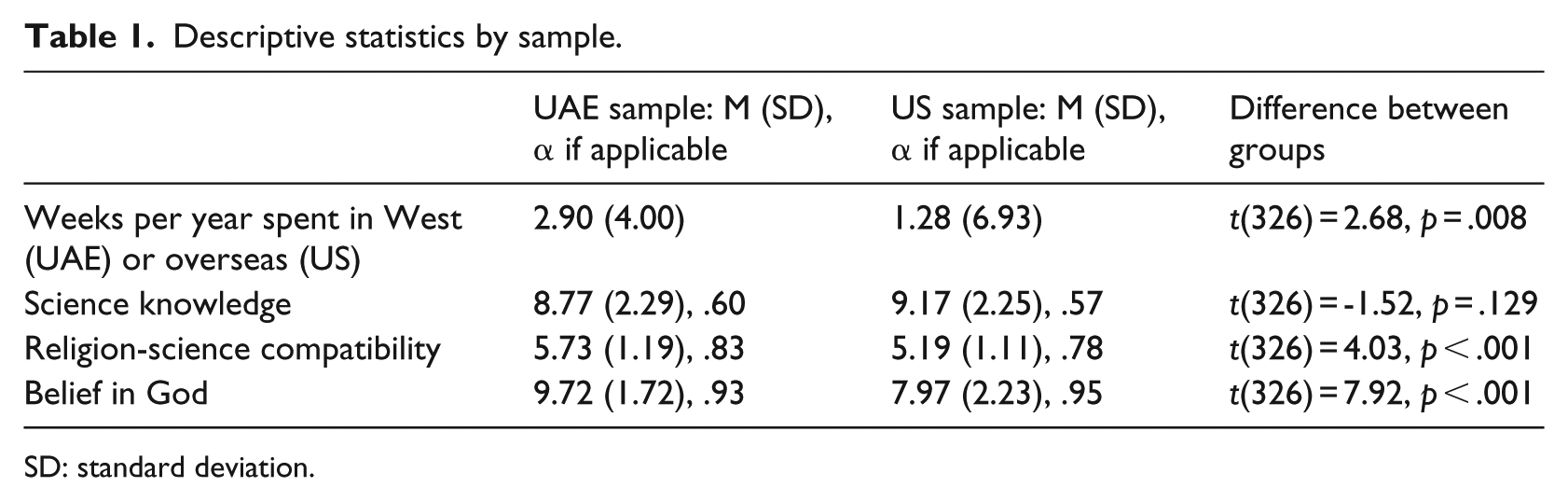
SD: standard deviation.
Religion-science compatibility beliefs
Participants answered the following four questions about science and religion compatibility on a 7-point scale, with higher scores reflecting greater perceived compatibility: (1) “To what extent do you personally believe that science and religion are incompatible versus compatible?” (2) “To what extent do you personally believe that it is impossible versus possible to be both religious and a scientist?” (3) “To what extent do you personally believe that it is impossible versus possible to value both religion and science?” (4) “To what extent do you personally believe that it is impossible versus possible to trust both religion and science as sources of information about the world?”
Belief in God
Participants completed the 5-item measure of Belief in God used by Preston and Epley: (1) “What is the general importance of God in your life?” (2) “How important is God to you on a daily basis?” (3) “How confident are you that God exists?” (4) “To what extent do you feel you have a personal connection to God?” (5) “Please rate your faith in God compared to the average person.” All items were administered on 11-point scales (e.g. 1 = not at all/much weaker, 11 = extremely/much stronger); higher scores indicated stronger belief in God.
Exposure to other cultures
Participants in the UAE sample indicated the average number of weeks per year they spent in the United States, Canada, or Europe, whereas participants in the US sample indicated the average number of weeks per year they spent outside of the United States. (In the latter sample, we did not ask about the Middle East specifically to avoid floor effects.) This measure served as the primary predictor.
Science knowledge
A 13-item measure of science knowledge (National Science Foundation, 2018) was administered. This measure included questions about scientific methodology (e.g. basic probability) as well as scientific facts (e.g. the hot temperature at the center of the Earth, whether humans evolved from earlier species).
Additional measures
Participants indicated the first TV channel they watch for international news and the average days per week they watch that channel, but because this measure was an imprecise proxy of exposure to Western cultures (for UAE students), we used time actually spent abroad as our predictor instead. Participants also completed two measures of confidence in science: a 5-item scale assessing trust in the scientific community (Nisbet et al., 2015) and a 2-item scale assessing support for scientific research (Gauchat, 2012). However, because these measures did not cleanly load onto a single factor (or two factors) in the UAE sample, we did not include them in our analyses.
3. Results
Although the measures were identical across populations, we analyzed the data separately for the UAE and US samples, rather than testing two-way interactions with country/sample as a factor. Belief in God and exposure to other cultures were significantly higher in the UAE sample than in the US sample (see Table 1), so collapsing these scores across samples in moderation analyses would have compromised interpretability of our findings.
UAE sample
We predicted that time spent in the West would be associated with weaker religion-science compatibility beliefs for UAE students. To test this prediction, we performed a linear regression analysis with exposure to the West as the predictor variable, and religion-science compatibility beliefs as the outcome variable. We included belief in God (given its significant correlation with compatibility beliefs, r = .18, p = .006) and science knowledge (to determine whether the predicted relationship could be attributed to opposition to science on epistemological grounds; see Evans and Evans, 2008) as covariates.
The overall model was significant, F(3, 205) = 18.95, p < .001, total R2 = .217 (see Table 2 for full regression statistics). As predicted, weeks spent in the West was negatively correlated with perceived religion-science compatibility (p = .044). Both belief in God and science knowledge correlated positively with compatibility beliefs (ps < .001).
Regression statistics, UAE sample.
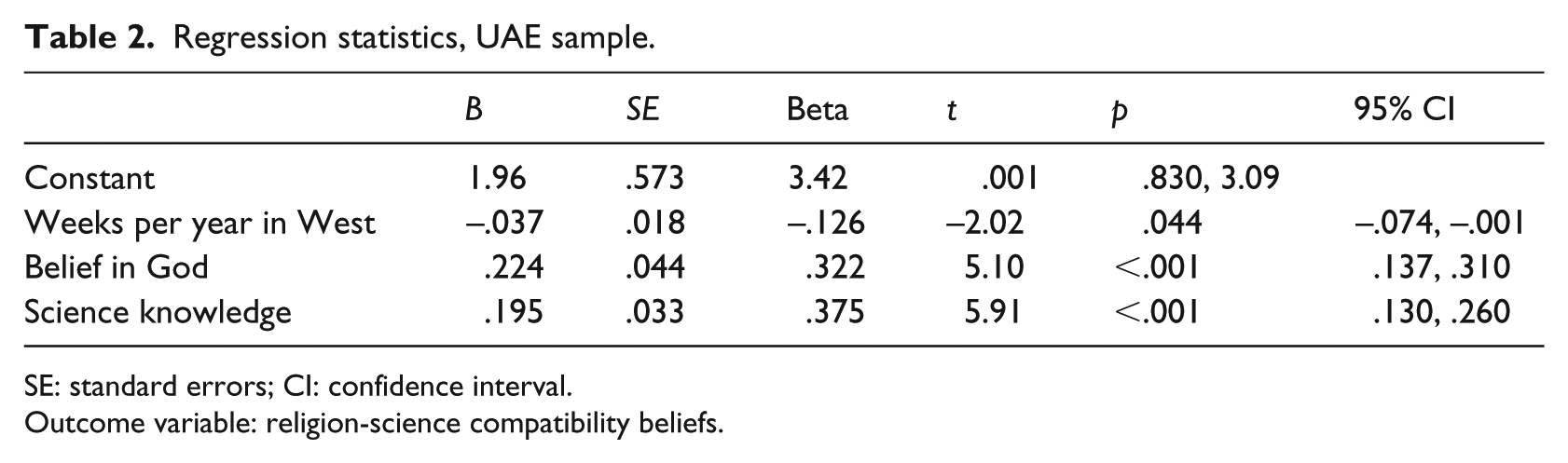
SE: standard errors; CI: confidence interval.
Outcome variable: religion-science compatibility beliefs.
US sample
We did not have any a priori hypotheses about whether time spent outside the United States would be related to religion-science compatibility, as less than 3% of American students who study abroad do so in the Middle East or North Africa, and the majority (over 50%) do so in other Western societies (e.g. European countries) (NAFSA, 2017). An analysis identical to that performed above revealed a significant overall effect, F(3, 115) = 8.38, p < .001, total R2 = .179 (see Table 3 for full regression statistics). There was a positive relationship between belief in God and perceived religion-science compatibility (p = .001), as well as a positive relationship between science knowledge and perceived religion-science compatibility (p < .001), but no relationship between time spent outside the United States and compatibility beliefs (p = .821).
Regression statistics, US sample.

SE: standard errors; CI: confidence interval.
Outcome variable: religion-science compatibility beliefs.
4. Discussion
The results of this study show that among Muslim students in the UAE, exposure to Western cultures predicted weaker religion-science compatibility beliefs. Thus, Muslim UAE students who spend more time in the West tend to harbor beliefs about the science-religion relationship that more closely resemble those of Christian US students (e.g. Ecklund et al., 2016; Pew Research Center, 2013, 2015). Although American students who had spent more time overseas did not exhibit the opposite patterns (i.e. they were not more “non-Western-like” in their beliefs about science and religion), this is perhaps because most of these students who had spent time outside of the United States had traveled to other Western societies (e.g. European countries), rather than to the Middle East or North Africa where beliefs about religion and science are markedly different (e.g. Vaidyanathan et al., 2016). Another potential explanation is that when American students travel abroad, they interpret their experiences differently (e.g. in a way that justifies the status of the United States as a dominant power) than do students from non-Western societies (Falk and Kanach, 2000).
The present findings shed light on attitudes toward religion and science in different sociocultural contexts. Prior work has suggested that beliefs in religion-science compatibility can shift according to aspects of one’s experiences (e.g. exposure to scientists of different religious backgrounds; Scheitle and Ecklund, 2017). However, no studies to our knowledge have assessed whether exposure to other cultures is another such factor. In demonstrating that time spent in Western countries can predict Arab Muslim students’ beliefs about whether religion and science can and should coexist, our results suggest that frequent exposure to the West has the potential to foster increased polarization of religion and science (i.e. perceptions of conflict between the two) in Middle Eastern contexts.
This study also enhances understanding of how and why attitudes toward religion and science differ across cultures. Notably, Evans’ two hypotheses about potential sources of the perceived religion-science conflict—that religious believers are opposed to scientific facts on epistemological grounds (Evans and Evans, 2008), and that religious believers are opposed to the increased prominence of a (secularized) science in society (Evans, 2011, 2013)—have not been examined cross-culturally until now. The finding that exposure to Western culture is still related to weaker religion-science compatibility beliefs among Muslims even after taking science knowledge into account suggests that the relationship cannot be attributed to a reluctance to accept scientific facts. Instead, Muslim students who spend more time in the West likely grow to perceive science as more secular and hence as more distant from their conception of morality. However, this explanation should be directly tested in future research—for instance, by seeing whether perceptions of science as secular or less moral than religion mediate the relationship between exposure to the West and compatibility beliefs. An alternative possibility is that dialectical thinking (holding two conflicting views simultaneously) is more prevalent in non-Western than Western cultures (Spencer-Rodgers et al., 2010), so Muslims exposed to the West come to adopt a less dialectical mind-set and thus view religion and science as less reconcilable.
One limitation of this study is that it is cross-sectional and correlational. To determine whether cross-cultural exposure directly influences science-religion attitudes, future experimental research could manipulate the salience of Western (versus non-Western) concepts (see Hong et al., 2000) or perceptions of science-religion compatibility (e.g. by having participants read a passage indicating that science and religion either coexist or are in conflict). In the present dataset, time spent in Western countries may be correlated with other variables that also (or instead) predict UAE students’ compatibility perceptions, such as growing up in a family that is more immersed in Western cultures or in which more Western media is consumed. (Of note, however, the frequency of UAE participants’ exposure to international news did not correlate with compatibility perceptions when controlling for time spent in Western countries and belief in God.) Although our use of student samples limits generalizability, we argue that college students are an ideal population for examining attitudes toward religion and science, as in many cases they are newly being introduced to these topics.
Another contextual limitation is that AUS may not be representative of many or most Arab universities. Although it is an independent, locally incorporated institution with no legal ties to other American institutions, it is situated in a more cosmopolitan context than many universities in the Middle East. Indeed, Ohio University—where most students study at least 2 years of a foreign language but are not taking other coursework in a language besides their own—is arguably more representative of US universities than AUS is of Arab universities. One implication is that at more traditional Arab universities, religion-science compatibility beliefs may be stronger at baseline because these students have had less exposure to Western ideas. However, what this means for the relationship between exposure to the West and compatibility beliefs at such universities is an empirical question. In fact, it is possible that time spent in the West is an even stronger predictor of compatibility beliefs for students at more traditional universities because these students have more room for their beliefs to change.
In sum, the present study underscores the need to further examine why, and under what conditions, the widely held perception of a religion-science conflict is not universal. It also indicates, however, that as societies become more globalized (with more people traveling overseas), attitudes toward religion and science may increasingly converge across populations. In fact, in societies such as the UAE, where individuals vary widely in their exposure to other cultures, languages, and belief systems, the within-society differences in these attitudes may be even more pronounced than the differences between societies.
Footnotes
Acknowledgements
The authors would like to thank Laila Al-Bakshy, Yasmeen Alwani, and Aisha Munshi in the UAE for their help with data collection.
Funding
The author(s) disclosed receipt of the following financial support for the research, authorship, and/or publication of this article: This research was supported with a grant from the Global Religion Research Initiative (University of Notre Dame).
