



Abstract
Applications in artificial intelligence such as self-driving cars may profoundly transform our society, yet emerging technologies are frequently faced with suspicion or even hostility. Meanwhile, public opinions about scientific issues are increasingly polarized along the ideological line. By analyzing a nationally representative panel in the United States, we reveal an emerging ideological divide in public reactions to self-driving cars. Compared with liberals and Democrats, conservatives and Republicans express more concern about autonomous vehicles and more support for restrictively regulating autonomous vehicles. This ideological gap is largely driven by social conservatism. Moreover, both familiarity with driverless vehicles and scientific literacy reduce respondents’ concerns over driverless vehicles and support for regulation policies. Still, the effects of familiarity and scientific literacy are weaker among social conservatives, indicating that people may assimilate new information in a biased manner that promotes their worldviews.
Keywords
Artificial intelligence applications such as self-driving cars may profoundly transform our society and lifestyles. Experts claim that self-driving vehicles will bring about various benefits such as reducing traffic accidents, providing mobility for non-drivers, and improving energy efficiency (U.S. Department of Transportation (DoT, 2018). It is estimated that autonomous vehicles will comprise one quarter of the global market by 2035–2040 (West, 2016). Yet, as we have seen in the cases of other technologies such as nuclear power and nanotechnology, emerging technologies are frequently faced with suspicion and hostility (Kahan et al., 2009; Peters and Slovic, 1996). In a recent survey, 71% of US adults reported they would be afraid to ride in fully self-driving vehicles, showing a negative sentiment toward autonomous vehicle technology (American Automobile Association, 2019).
Meanwhile, political liberals and conservatives are increasingly divided on a wide range of scientific issues, such as climate change, vaccination, and stem cell research (Choma et al., 2013; Drummond and Fischhoff, 2017; Guber, 2013). There is also a growing interest in the scholarly community that examines the social aspects of autonomous vehicles, especially demographic characteristics and psychological mechanisms that contribute to the acceptance of autonomous vehicles (Brell et al., 2019; Schoettle and Sivak, 2014). Yet, few studies have looked at whether political ideology also shapes perceptions of self-driving cars (Becker and Axhausen, 2017; Gkartzonikas and Gkritza, 2019). Although driverless vehicles are not in the spotlight of political elites’ discourse, this does not mean that they are immune to the influence of ideology. The expansion of self-driving cars is expected to have various socioeconomic consequences that resonate with worldviews inextricably linked to ideology. Political ideology might also reflect deep-seated psychological traits and tendencies that shape public perceptions of risks and hazards (Choma et al., 2013).
To address this issue, this study analyzes a nationally representative panel in the United States. We investigate what factors affect individuals’ perceptions of autonomous vehicles as well as their support for regulation policies, paying special attention to the effects of political ideology and ideology-related worldviews. Our results thus provide timely insights into the additional determinants of public acceptance of driverless cars beyond existing research. By examining a technology that is in its initial stage of development, this study also contributes to our theoretical understanding of the emergence of the political divide in public reactions to scientific and technological issues.
1. Public perceptions of driverless vehicles
There is a growing interest in studying public perceptions of autonomous vehicles (for reviews, see Becker and Axhausen, 2017; Gkartzonikas and Gkritza, 2019). One line of scholarship focuses on the role of individual characteristics. Regarding demographic variables, men and younger adults often report more positive attitudes toward autonomous vehicles (Becker and Axhausen, 2017; Schoettle and Sivak, 2014). People with higher education and income tend to show more acceptance, although the effects were not consistent (Becker and Axhausen, 2017; Schoettle and Sivak, 2014). Regarding psychological traits, Kyriakidis et al. (2015) revealed a few correlations among personality variables and attitudes toward autonomous vehicles, although these associations were not substantial. Payre et al. (2014) showed that people scoring high on the driving-related sensation seeking scale expressed higher intention to adopt autonomous cars. In addition, tech-savvy individuals, for example, people who have more awareness of driverless cars and who score higher on consumer innovativeness in the technological domain, tend to view autonomous vehicles positively (Gkartzonikas and Gkritza, 2019; Haboucha et al., 2014). Other factors have also been identified, such as trust, environmental concerns, and prior experiences with driver assistance systems (Gkartzonikas and Gkritza, 2019).
Another line of research has looked at the kinds of benefits and concerns people associate with self-driving vehicles. For instance, Howard and Dai (2014) showed that people were most attracted to the increased safety, convenience, and amenities (e.g. multitasking while en route) provided by autonomous driving technology while being most concerned with its liability, costs, and lack of control. Schoettle and Sivak (2014) revealed that people expected that self-driving vehicles would most likely bring about benefits such as a reduction in travel accidents and more efficient energy use while being most worried about issues such as safety consequences of equipment/system failure and self-driving cars getting confused by unexpected situations. Kaur and Rampersad (2018) showed that participants’ perceived usefulness of driverless vehicles (e.g. increasing living and working productivity) and perceived reliability of self-driving technology were important predictors of adoption intention, whereas concerns were raised about data security and privacy.
2. The ideological divide on scientific issues
As summarized above, a line of scholarship has developed that examines public attitudes toward self-driving vehicles, although the effects of political ideology and related worldviews are rarely studied. Yet, public opinions about science and technology in the United States are increasingly polarized along ideological lines (Gauchat, 2012). Compared with liberals and Democrats, conservatives and Republicans are often less confident in science and are more skeptical of scientific issues such as anthropogenic climate change and vaccination (Choma et al., 2013; Gauchat, 2012; Guber, 2013; Hamilton et al., 2015). Nevertheless, liberals and conservatives are not divided regarding all scientific issues: studies have rarely found a link between political ideology and beliefs about genetically modified food (Drummond and Fischhoff, 2017; Fernbach et al., 2019).
What contributes to the widening gap between liberals and conservatives regarding their positions on scientific issues? One possibility is that political ideology is increasingly linked to party identity due to polarization and party sorting (people choose parties in line with their political ideology) in the United States (Hamilton et al., 2015). Political ideology, along with party identity, can function as cognitive shortcuts that help citizens quickly formulate attitudes (Krosnick et al., 2000). As Democrat and Republican elites take clearly opposite sides, party identity could effectively trigger partisans to formulate polarized attitudes regarding politicized issues such as climate change. Nevertheless, the development of driverless vehicles has rarely been a focus of the US political discourse and there seems no clear divide between the two parties. For example, we analyzed 6484 tweets from the two major candidates in the 2016 presidential election, Donald Trump and Hillary Clinton. Terms such as “self-driving,” “autonomous,” “driverless,” and “artificial intelligence” were not mentioned; in comparison, politicized issues such as “climate change” and “abortion” were mentioned 16 and 11 times, respectively. 1
Nevertheless, ideology might still influence public perceptions of autonomous cars for several reasons. First, political ideology is not only an external cue for partisans to formulate attitudes; it also reflects deep-seated psychological traits and tendencies (Hibbing et al., 2014; Jost et al., 2003). A meta-analysis concludes that political conservatism is negatively associated with openness to experience and positively associated with the fear of threat and loss (Jost et al., 2003). Hibbing et al. (2014) argued that political conservatives exhibit higher levels of negativity bias than liberals, being more attentive to and responsive to negative and threatening stimuli in the environment. Yet, the authors also acknowledged while this tendency can explain why conservatives are more concerned with threats such as criminals and pathogens, it fails to address that it is liberals who are more worried about risks such as gun shootings and environmental degradation (Hibbing et al., 2014). Others have proposed that conservatives are not always more responsive to threats than liberals when it comes to specific domains of hazards (Choma et al., 2013). Compared with liberals, conservatives were found to perceive personal, voluntary, recreational activities as riskier, such as skydiving and skiing, and to discount issues that could pose collective risks to society, such as climate change, handguns, and pesticides (Choma et al., 2013). Furthermore, autonomous driving technology would bring about socioeconomic consequences that potentially resonate with ideology-related worldviews, which we will discuss later. As one of the few studies that include political ideology when predicting public attitudes toward self-driving cars, Dixon et al. (2020) showed that liberals were more supportive of self-driving cars, but this link disappeared when other worldviews were considered. Therefore, we first propose a research question (RQ1): How does political ideology affect public reactions to self-driving cars?
3. The contributions of economic and social conservatism
This study aims to examine the unique contributions of different components of political ideology. Decades of scholarship have converged on a bi-dimensional structure of ideology that goes beyond the liberal–conservative continuum, with various schools of scholarship assigning it different labels (Duckitt, 2006; Jost et al., 2003). We adopt a common set of labels: economic conservatism, characterized by an opposition to government regulation of private enterprise and redistribution of social goods; and social conservatism, which reflects an adherence to authority, social order, and moral traditions (Crowson, 2009; Malka et al., 2019; Van Hiel and Mervielde, 2004).
Other theories suggest other and more detailed distinctions between dimensions of ideology, which could be explored in further research. The cultural cognition of risk, for example, proposes two worldview dimensions: individualism–communitarianism and hierarchy–egalitarianism. Individualists tend to believe that individuals in society should take responsibility for themselves, whereas communitarians favor collective assistance. Hierarchists endorse a rank-based social system, whereas egalitarians strive for equality among different social groups (Kahan, 2012; Kahan et al., 2009). People who hold individualistic and hierarchical worldviews tend to discount environmental, industrial, and technological risks, such as climate change and nuclear power (Kahan et al., 2012; Peters and Slovic, 1996). Another framework, the dual process model of ideology, incorporates two ideological components: social dominance orientation (SDO), which reflects a desire to maintain group hierarchy and superiority, and right-wing authoritarianism (RWA), a tendency that reflects adherence to authority, societal control, and conventions. SDO either lowers risk perceptions or poses no influence (Choma et al., 2013; Choma and Hodson, 2017), whereas RWA heightens fear of a wide range of personal and societal risks (Choma et al., 2013).
Yet, as said above and motivated by the availability of data in the surveys we use for secondary analysis (see below), we focus on economic and social conservativism in this study. This goes beyond previous research as it looks beyond the single liberal–conservative spectrum. Regarding economic conservatism, the development of autonomous vehicles has been viewed as a symbol of business innovation and creativity (U.S. DoT, 2018). Previous research has shown that individuals who favor limited government tend to dismiss technological risks since crediting these risks would bring about more governmental regulation of business and commerce (Kahan, 2012). Economic conservatives, being advocates of limited government and free market principles, might be less concerned with autonomous vehicles. Furthermore, being linked to anti-egalitarianism, economic conservativism is typically associated with apathy toward economic inequality and risks posed to disadvantaged populations. On one hand, the growth of autonomous vehicles could potentially result in substantial job losses of drivers (U.S. DoT, 2018). In Dixon et al. (2020), individuals holding egalitarian worldviews indeed tended to oppose policies that helped the expansion of self-driving cars. On the other hand, driverless cars can provide mobility to those who cannot drive, such as children, the elderly, and people with disabilities, thus resonating with egalitarian values (Dixon et al., 2020). In combination, economic conservatism should influence public reactions to driverless vehicles. Yet, given that few studies have revealed which beliefs about self-driving cars are salient in the public mind, we propose a research question (RQ2): How does economic conservatism influence people’s reactions to driverless vehicles?
Social conservatism is often associated with need for security, order, and certainty (Malka et al., 2019). Research has shown that individuals high in RWA—a tendency that associates with social conservatism—tend to see the world as dangerous and threatening, showing higher concern about threats that disrupt social traditions as well as risks that jeopardize their health and safety (Choma et al., 2013; Choma and Hodson, 2017). Furthermore, social conservatism is also characterized by resistance to change and adherence to social order and traditions, yet people who show resistance to change are often less innovative in adopting new technology (Nov and Ye, 2008). As an application that would significantly transform routines of transportation, autonomous driving technology might be more welcome by social liberals. We again propose a research question (RQ3): How does social conservatism influence public reactions to self-driving cars?
4. The moderation effects of political ideologies
Moreover, not only do political ideologies directly predict individuals’ concerns about different types of dangers and hazards; they also shape how people process and interpret new information about risks (Drummond and Fischhoff, 2017; Kahan et al., 2009; Nan and Madden, 2014). One seemingly intuitive assumption, the familiarity hypothesis, proposes that when people learn new information and become more familiar with a certain technology, they become more accepting of that technology (Kahan et al., 2009). Yet, due to the mechanism of biased assimilation, people process new information about technology in a way that defends their ideological orientations, thus not necessarily forming more favorable attitudes. In one study that uses the cultural cognition framework, after being exposed to identical information about nanotechnology, participants who identified with hierarchical and individualistic worldviews perceived more benefits of nanotechnology, while participants holding egalitarian and communitarian worldviews perceived more risks (Kahan et al., 2009).
Another common assumption in science communication, namely the scientific literacy model or the science comprehensive thesis, claims that people reject scientific claims due to their lack of scientific literacy to process complicated scientific evidence. More scientifically knowledgeable individuals should thus be more likely to accept scientific claims and emerging technology (Hart et al., 2015; Kahan et al., 2012). Yet, the effect of scientific literacy on public acceptance of new technology is often mixed. In a meta-analysis, no or even negative relationships were found between knowledge and attitudes toward specific technologies such as nuclear power, genetic medicine, and genetically modified food (Allum et al., 2008). Furthermore, increased scientific literacy often polarizes individuals’ beliefs on scientific issues, indicating that people are motivated to generate interpretations of scientific evidence that affirm their existing worldviews (Drummond and Fischhoff, 2017; Kahan et al., 2012).
Recent works have demonstrated that scientific knowledge is still sometimes associated with more acceptance of a mainstream scientific position, such as less opposition to genetically modifying food (Fernbach et al., 2019) or higher concern about climate change (Shi et al., 2016). Attempting to reconcile empirical evidence from both sides, scholars have proposed that the scientific literacy model can happen simultaneously with biased processing (Hart et al., 2015). These two mechanisms are likely to coexist in the case of self-driving cars. This technology has not become a highly politicized issue, so people are unlikely to be completely clouded by party affiliations and identity commitments. Furthermore, prior research has documented that people who are more familiar with autonomous vehicles often show more positive attitudes and so do people who claim to have more knowledge of this technology (Dixon et al., 2020; Schoettle and Sivak, 2014; Ward et al., 2017). Therefore, we should expect that familiarity should be linked to more positive reactions to self-driving cars (H1). Nevertheless, the effect of scientific literacy has been rarely examined in the context of autonomous vehicles. We thus propose a research question (RQ4): how does scientific literacy influence individuals’ reactions to self-driving cars? Last, if familiarity and scientific literacy indeed pose an influence on attitudes toward autonomous vehicles, we should further expect that their effects are moderated by political ideologies (H2).
5. Method
Data
This study applied secondary data analysis to the American Trends Panel, a nationally representative panel of US adults created by the Pew Research Center. The first cohort of panelists was recruited from a national, landline and cell phone random digit dial survey in 2014. With the same method, two additional cohorts were recruited in 2015 and 2017, respectively. Periodically, panelists were invited to participate in self-administered web surveys. 2 By December 2019, a total of 37 waves of surveys had been made publicly available.
This study selected items from three waves of surveys: wave 17 (N = 4563; field dates: 10 May–6 June 2016; items about scientific literacy), wave 24.5 (N = 3844; field dates: 28 February–12 March 2017; social and economic conservatism), and wave 27 (N = 4135; field dates: 1 May–15 May 2017; demographic variables and perceptions of driverless vehicles). We merged responses from three waves using a variable QKEY provided in the dataset, which is a unique identifier assigned to each respondent. A total of 4135 respondents participated in wave 27, in which they were asked about driverless vehicles. After we merged participants’ responses with the other two waves (Wave 17 and 24.5), a subsample of 3341 respondents who participated in all three waves of surveys remained in the analysis. Since we combined responses across multiple waves, we chose not to use respondents’ weights provided in the original datasets. Readers should note that the items were chosen from different time periods: items on economic/social conservatism were asked almost 2 months earlier than the questions about driverless vehicles, and the measures of scientific literacy were asked almost 1 year ago.
Measures
Political conservatism
Respondents indicated how they would describe their political views on a 5-point scale (1 = very conservative, 5 = very liberal; reversed; M = 3.00, SD = 1.12).
Party affiliation
Respondents indicated whether they considered themselves as a Democrat, Republican, Independent, or something else. If they did not choose Democrat or Republican, they were asked which party they leaned more to. We constructed a 5-point scale (1 = Democrat, 2 = leaning to Democrat, 3 = Independent/moderate, 4 = leaning to Republican, 5 = Republican; M = 2.82, SD = 1.68).
Concern about driverless vehicles
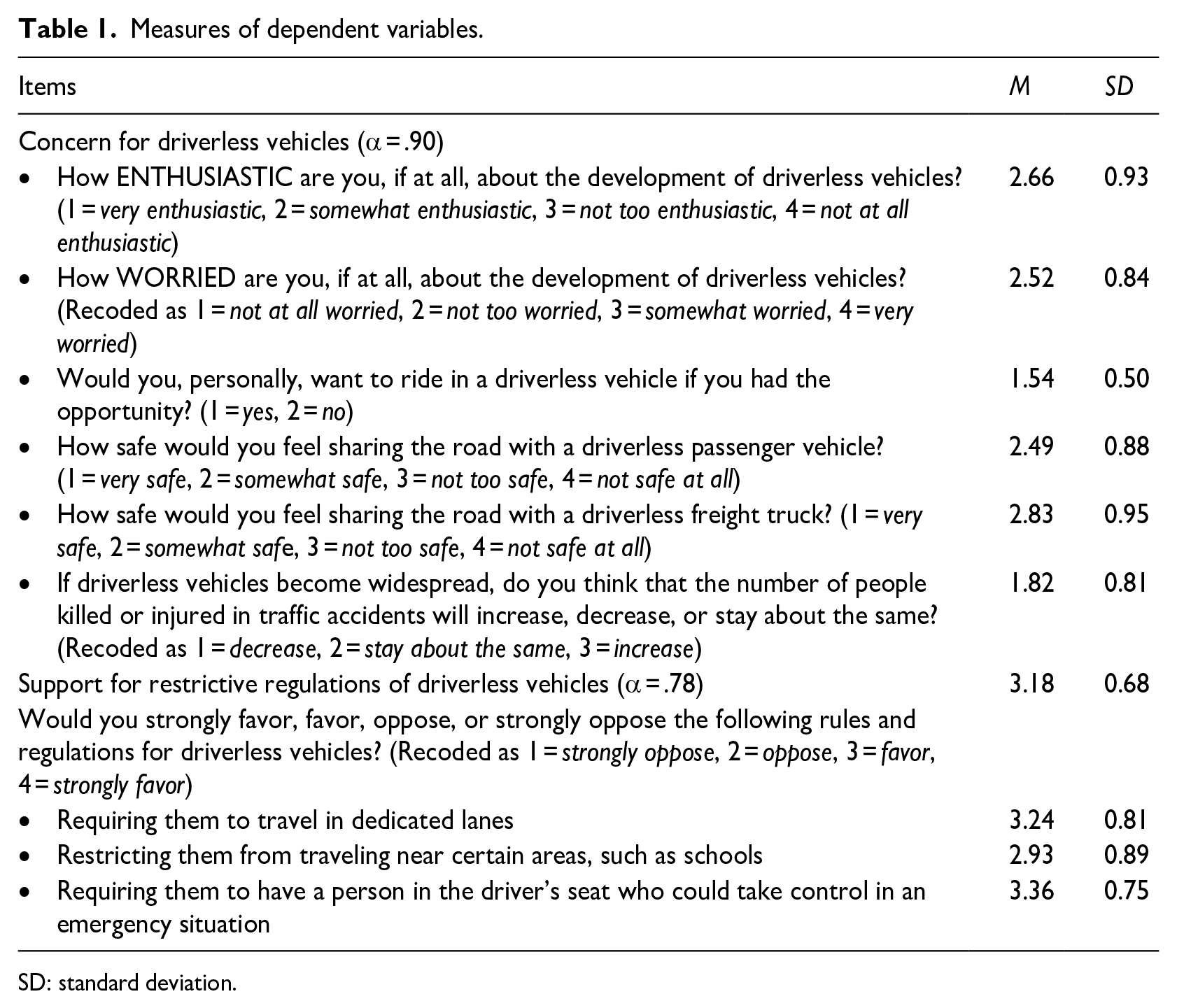
We constructed two dependent variables to capture reactions to self-driving cars. First, a total of six items (α = .90) were chosen to measure concern about driverless vehicles, which included respondents’ emotional responses to the development of driverless vehicles, perceived safety of driverless vehicles, and willingness to ride in a driverless vehicle (Table 1). Since these items were measured on different scales, we first standardized them and then combined the z-scores into one scale. When calculating the mean of a scale, person-mean imputation was applied to missing values in this study.
Measures of dependent variables.
SD: standard deviation.
Support for restrictive regulations of driverless vehicles
In addition, on three 4-point items (α = .78, M = 3.18, SD = 0.68), respondents indicated to what extent they favored or opposed rules or regulations that restricted the use of driverless vehicles, for example, requiring them to travel in dedicated lanes (Table 1).
Economic conservatism
Economic conservatism reflects opposition to equality, support for free markets, and rejection of collective assistance and governmental regulation (Crowson, 2009; Feldman and Johnston, 2014; Malka et al., 2019; Van Hiel and Mervielde, 2004). This study picked up four items (α = .76) that measured people’s beliefs about governmental regulation, collective assistance in social life, and free markets (e.g. “The government should do more to help needy Americans, even if it means going deeper into debt vs. The government today can’t afford to do much more to help the needy”) (see Supplemental Material). For these four items, respondents were presented with two competing statements and instructed to indicate which statement came closer to their own views (recoded as 3-point scales with 2 representing neither/both equally; M = 1.96, SD = 0.75).
Social conservatism
Social conservatism captures endorsement of moral and cultural traditions. Measures often use people’s attitudes toward abortion, gay marriage, and women’s role, among others (Crowson, 2009; Feldman and Johnston, 2014; Malka et al., 2019; Van Hiel and Mervielde, 2004). Similarly, we chose four items (α = .70) that captured respondents’ attitudes about cultural issues such as homosexuality, women’s role, and interracial marriage. These four items were recoded as 3-point scales (M = 1.81, SD = 0.55).
Familiarity with driverless vehicles
Respondents indicated their answers on one 3-point scale (1 = a lot, 2 = a little, 3 = nothing at all; reversed): “how much have you seen or heard about the effort to develop driverless vehicles—that is, cars and trucks that can operate on their own without a human driver?” (M = 2.38, SD = 0.55). The vast majority of respondents had some exposure to driverless vehicles (a lot = 41.1%, a little = 55.6%).
Scientific literacy
This concept was measured as the number of correct answers given by respondents to a total of nine scientific knowledge questions (α = .72, M = 5.25, SD = 2.32). These questions covered scientific issues from a wide range of scientific fields, such as antibiotic medications, placebo effect, and the makeup of the Earth’s atmosphere (see Supplemental Material).
We also controlled for various socio-demographic variables, including gender, age, education, income, race, marital status, and census region.
6. Results
Table 1 presents descriptive analyses of the items used to construct the two dependent variables. The majority of items had means above the midpoints of the scales, echoing other public opinion surveys that revealed an overall negative attitude toward self-driving cars (American Automobile Association, 2019).
The ideological divide in public perceptions of self-driving cars
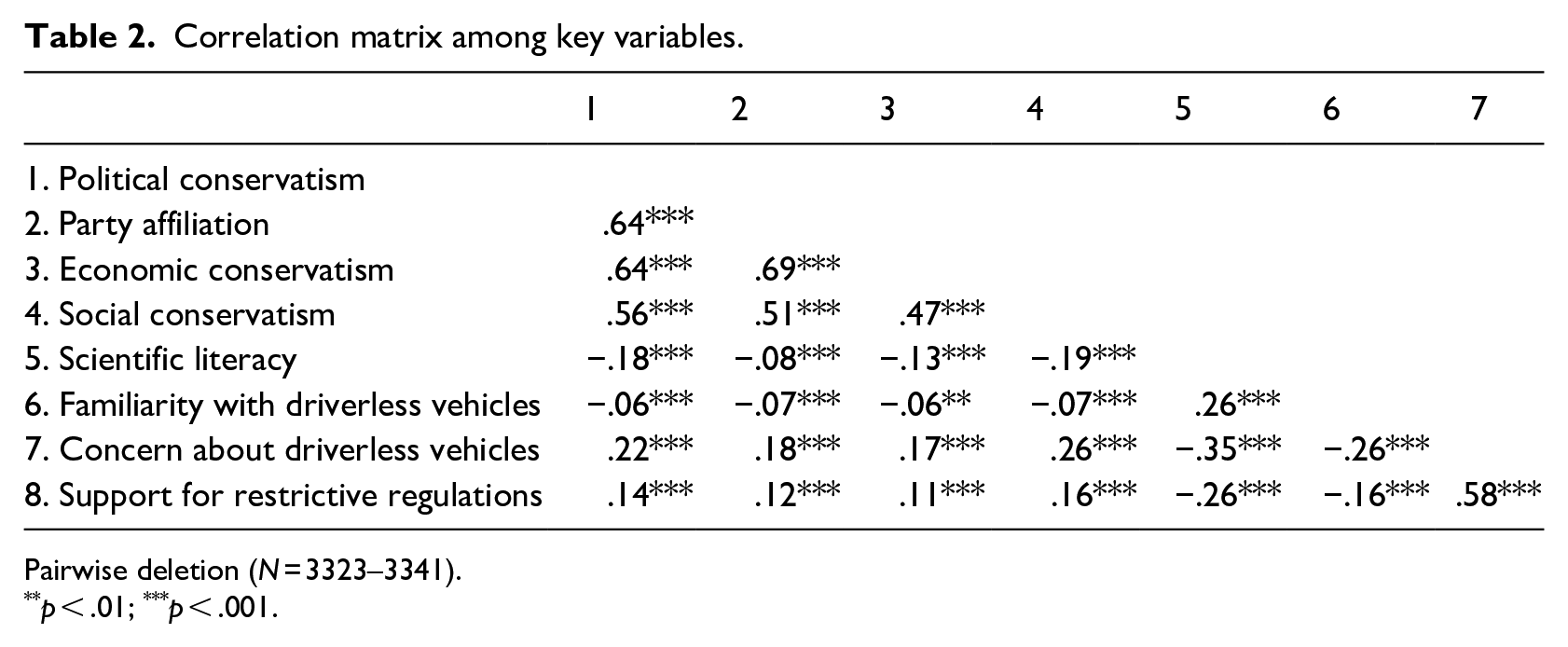
Our suspicion about the impact of political ideology (RQ1) was confirmed by the results. Individuals’ concern about driverless vehicles positively correlated with both political ideology (r = .22, p < .001) and party affiliation (r = .18, p < .001), and so did support for restrictive regulations of driverless vehicles (political ideology, r = .14; party affiliation, r = .12, both ps < .001) (Table 2). We further conducted regression analyses that controlled for various socio-demographic variables (Figure 1, Model 1). Political ideology and party affiliation were highly correlated (r = .64, p < .001) and we ran regression models separately for each variable. All variance inflation factors (VIF) in ordinary least squares (OLS) regressions were less than 3. Again, political ideology heightened respondents’ concern for driverless vehicles (β = .19) and support for restrictive regulations (β = .12), and so did party affiliation (β = .18; β = .13; all ps < .001) (see Supplemental Material for regression models with party affiliation).
Correlation matrix among key variables.
Pairwise deletion (N = 3323–3341).
**p < .01; ***p < .001.
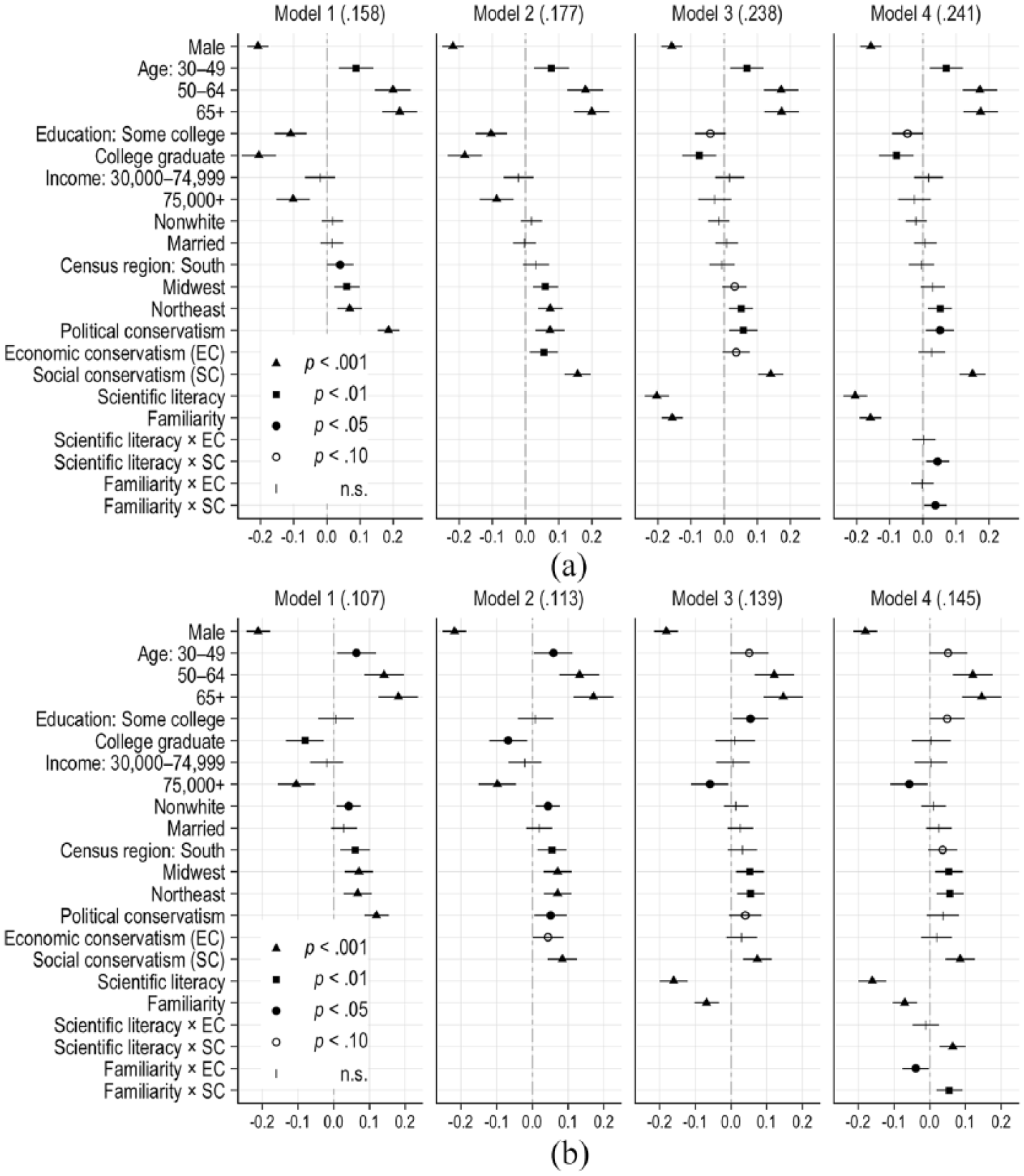
(a) Concern about driverless vehicles (N = 3221). (b) Support for restrictive regulations (N = 3214).
The contributions of economic and social conservatism
We then moved to test the influence of different components of political ideology (Figure 1, Model 2). Regarding RQ2, in regressions, economic conservatism had a small positive effect on concern (β = .06, p = .009; Model 2), although its effect was insignificant with familiarity and scientific literacy included (β = .04, p = .080; Model 3). The effect of economic conservatism on support for restrictive policies was only approaching significance (β = .04, p = .051; Model 2) and became insignificant as well when familiarity and scientific literacy were included (Model 3). Regarding RQ3, social conservatism increased both respondents’ concern about driverless vehicles (β = .16, p < .001) and support for restrictive regulations (β = .08, p < .001, Model 2), and its effects persisted when familiarity and scientific literacy were included. In addition, when social and economic conservatism were considered (Model 2), the effects of political ideology on concern (β = .07, p = .001) and policy support (β = .05, p = .027), while remaining statistically significant, dropped substantially. This suggested that the role of political ideology is largely driven by deep-seated social attitudes and social conservatism in particular.
Effects of familiarity and scientific literacy
We then investigated the main effects of scientific literacy and familiarity (Figure 1, Model 3). Confirming H1, familiarity lowered respondents’ concern about self-driving cars (β = −.16, p < .001) and support for restrictive regulations of driverless vehicles (β = −.07, p < .001). Regarding RQ4, scientific literacy was similarly associated with lower concern (β = −.20, p < .001) and lower support for restrictive regulations (β = −.16, p < .001).
The moderating effects of political ideologies
To test the interaction effects, we added the products of familiarity/scientific literacy and economic/social conservatism (mean-centered) to the regression model (Figure 1, Model 4). Consistent with H2, social conservatism moderated the negative effects of scientific literacy (β = .05, p = .012) and familiarity (β = .04, p = .033) on concern about driverless vehicles. This moderation effect was also found in predicting policy support (scientific literacy, β = .06, p = .001; familiarity, β = .06, p = .004). In comparison, as we discovered previously, economic conservatism did not influence perceptions of driverless vehicles. Its interaction terms with familiarity and scientific literacy did not reach statistical significance when predicting concern. The interaction between economic conservatism and familiarity did significantly predict policy support (β = −.04, p = .035). However, a close examination revealed that this interaction became not significant if we excluded the other three interaction terms from the same regression model. Therefore, this interaction might be spurious due to the inclusion of other interaction terms. H2 was partially supported only regarding the moderating role of social conservatism, but not economic conservatism.
Figure 2 visualizes the interaction effects. First, scientific literacy reduced individuals’ concern with self-driving cars and support for restrictive regulations. The negative impact of scientific literacy was observable across different levels of social conservatism, although this effect was weaker among social conservatives. Similarly, as respondents became more familiar with self-driving technology, their concern about driverless vehicles and support for restrictions also decreased. Again, the effect of familiarity was less salient among social conservatives, replicating the pattern we found regarding scientific literacy.
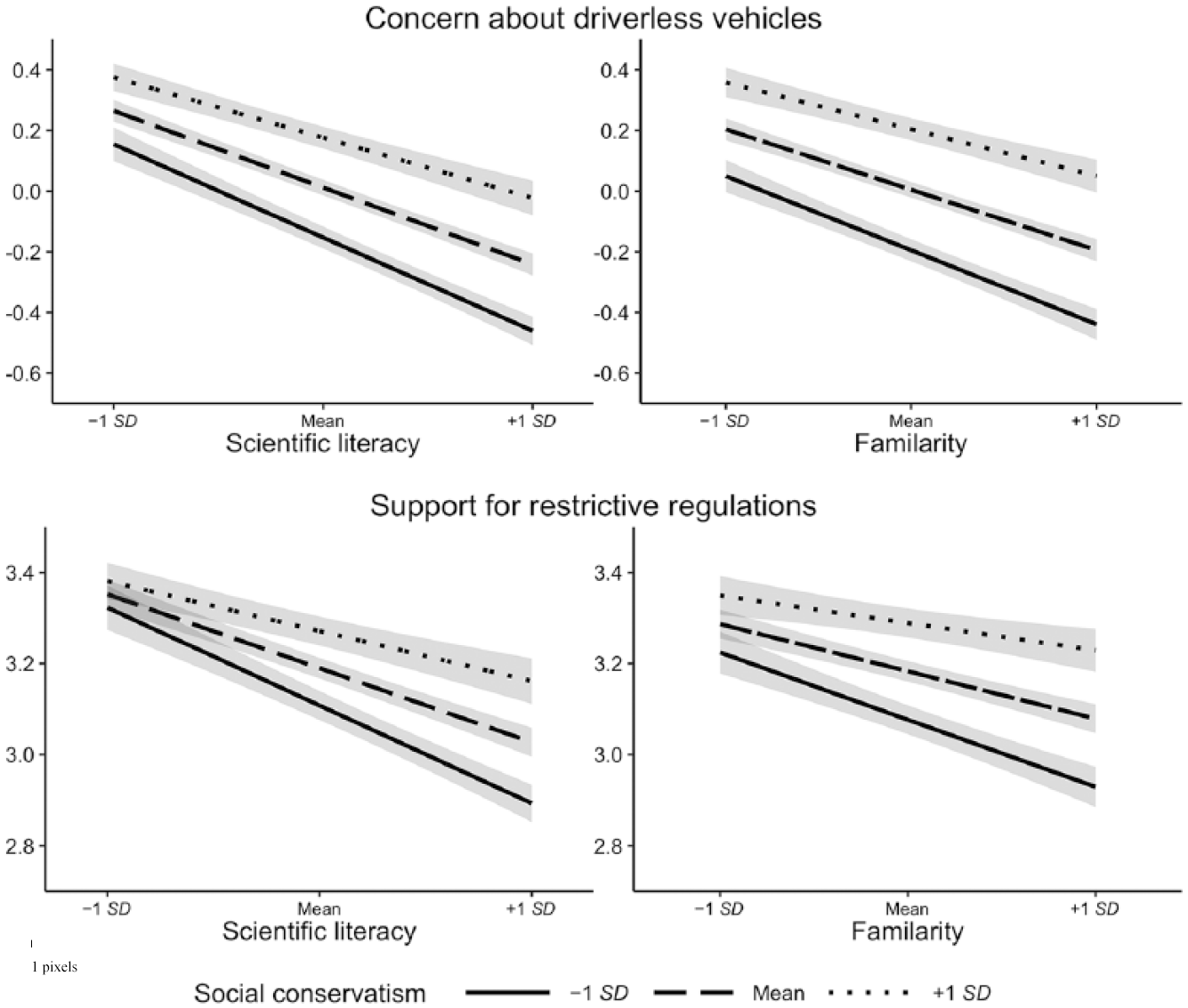
Moderating effect of social conservatism on the influence of scientific literacy and familiarity on public concern about driverless vehicles and support for restrictive regulations. Shading represents 95% confidence intervals.
Robustness tests
We additionally tested if the findings remained robust when other potential predictors were considered. We conducted a series of regression models controlling for variables that might also influence public attitudes toward self-driving cars, including personal innovativeness in technology, attention to science and political news, attitudes toward science and technology, and transportation habits (Agarwal and Prasad, 1998; Allum et al., 2008; Brell et al., 2019; Hart et al., 2015). The analyses revealed that individuals who were less innovative in technological use, less attentive to science news but more attentive to political news and less positive about science/technology expressed higher concern for driverless vehicles and support for restrictive regulations. Frequent drivers also showed higher concern. When these factors were accounted for, the results from our analysis largely remained robust (see Supplemental Material). The effects of social conservatism, scientific literacy, and familiarity, as well as the interaction between scientific literacy and social conservatism, were consistently found in a total of eight regression models. Nevertheless, the interaction between social conservatism and familiarity remained statistically significant in five out of the eight models while approaching significance (p < .10) in another two models and being nonsignificant in one model.
7. Discussion
In summary, our results revealed an emerging ideological divide in public reactions to self-driving cars: conservatives and Republicans were more concerned about the development and safety of self-driving cars and more supportive of restrictive policies than liberals and Democrats. Nevertheless, in the current study, the effect of political ideology was largely explained away when the economic and social aspects of ideology were considered. In particular, social conservatism heightened respondents’ concern for driverless vehicles, whereas economic conservativism posed limited effects. Thus, the ideological divide we observed, at least, at this stage, is likely to be primarily driven by deep-seated worldviews instead of partisan cues from political elites. Furthermore, both familiarity with driverless vehicles and scientific literacy reduced respondents’ concerns over driverless vehicles and support for regulation policies, although their effects were weaker among social conservatives.
This study demonstrates the relevance of political ideology in the context of technology acceptance. Echoing previous literature, this study supports the thesis that different components of ideology guide individuals’ perceptions of technologies beyond the liberal–conservative continuum (Choma et al., 2013; Kahan et al., 2012). First, we observe a small effect of economic conservatism, showing that economic conservatives were slightly more concerned with driverless vehicles than economic liberals. Nevertheless, its effects diminished when scientific literacy and familiarity were included in the model. We previously proposed that self-driving cars might bring out socioeconomic consequences that speak to the economic dimension of ideology, for example, job losses of drivers and mobilities provided to disadvantaged populations. However, these issues might not have become salient in the public discourse. Kohl et al. (2018) showed that on Twitter, the discussion around driverless vehicles typically centers around accidents involving self-driving cars, concerns for safety and privacy, and personal benefits such as saving time, with relatively little reference to this technology’s larger socioeconomic implications. Nevertheless, as self-driving cars enter the political discourse, future research should still track the influence of economic conservatism. For example, one question asked during the Democratic primary debate was about job loss due to “self-driving cars, robots, drones, artificial intelligence.” 3 This aspect is particularly relevant to the economic aspect of ideology that deals with the welfare of vulnerable populations and government regulation of business.
Our results show that social conservatism heightens public concern about self-driving cars and support for restrictive regulations. It also moderates the effects of familiarity and scientific literacy. As noted earlier, social conservativism is typically associated with need for security and order (Malka et al., 2014). Previous research shows that people who are socially conservative (scoring high on RWA) tend to see the world as dangerous and threatening, being more responsive to various personal risks that could jeopardize their safety, such as dangerous animals (e.g. snake), carjacking, commercial aviation, and railroads (Butler, 2013; Choma et al., 2013; Choma and Hodson, 2017). Another explanation could be that self-driving technology is still a novel application and has not been integrated into the existing social system. Driverless vehicles might bring significant changes to our society, transforming our ways of traveling and working as well as the symbolic value of driving, which might face opposition from social conservatives who place importance on societal traditions.
In addition, this study demonstrates that the positive effects of scientific literacy and familiarity can coexist with biased processing and motivated reasoning (Hart et al., 2015). Both scientific literacy and familiarity led to more positive views about driverless vehicles, supporting the idea that when people become more scientific knowledgeable and familiar with a certain technology, they are more likely to endorse that technology. These results additionally corroborate previous studies showing that familiarity with and self-assessed knowledge of autonomous vehicles contribute to positive attitudes toward this technology (Dixon et al., 2020; Schoettle and Sivak, 2014; Ward et al., 2017). Nevertheless, the influence of familiarity and scientific literacy was moderated by social conservatism, which suggests that individuals still assimilate new information in a biased fashion that is consistent with their ideological orientation. If more information about self-driving cars becomes available in the media environment, it is possible that people with different worldviews might formulate more polarized views about driverless vehicles.
It is worth noting that economic and social conservatism are only one way to characterize the dimensional structure of political ideology. Other constructs, including communitarianism–individualism and egalitarianism–hierarchy in the cultural cognition framework, SDO and RWA in the dual process model—which we mentioned previously—might also contribute to public perceptions of driverless vehicles. In particular, previous research has noted a conceptual similarity between political ideology and cultural worldviews in the cultural cognition framework (Michaud et al., 2009; Swedlow, 2008). The communitarianism–individualism dimension reflects opposition to collective assistance and governmental intervention (Kahan, 2012; Kahan et al., 2007), which should resonate with economic conservatism. The egalitarianism–hierarchy dimension might reflect both economic and social conservatism. It has an anti-egalitarianism component, which resonates with economic conservatism that justifies income inequality and opposes wealth redistribution. This dimension also has a pro-hierarchy element that captures a defense of existing social hierarchy and traditions (Kahan et al., 2007), which is more related to social conservatism. Similarly, researchers have proposed that RWA and SDO overlap social and economic conservatism, respectively (Duckitt and Fisher, 2003; Feldman and Johnston, 2014; Jost et al., 2003). However, given the limitation of secondary data analysis, we were unable to test the influence of these concepts. One promising direction is to apply other theoretical concepts to identify the exact components of ideology that contribute to the associations we have observed in this study.
While this study focuses on one application of artificial intelligence, self-driving cars, future studies should also examine other emerging applications that could deeply transform our society, such as the automation of jobs, facial recognition, and algorithmic decision-making. Many of these technologies will have impacts that resonate with a variety of values and worldviews that are associated with political ideology. For instance, the automation of jobs and the application of algorithms in decision-making might further disadvantage underprivileged groups and aggravate inequality, which goes against economic liberalism. The use of facial recognition in surveillance facilitates the maintenance of social order, which resonates with social conservatism and authoritarianism, while its intrusion to personal space and the empowerment of governmental control should go against individualistic values. One promising direction for future research is to understand the role of different aspects of political ideology in shaping public perceptions of various artificial intelligence applications.
Given that this study is a secondary data analysis of existing surveys, certain limitations should be identified. We remind our readers that this analysis had to use variables from different time periods. Furthermore, this study only offers a snapshot of public opinions about driverless vehicles. The survey about people’s attitudes about self-driving cars was conducted in May 2017, before some major accidents of self-driving cars broke out, for example, the first recorded fatal crash involving an autonomous car hitting a pedestrian, which happened in Arizona in March 2018. 4 Future research should continue tracking the role of political ideologies in shaping public perceptions of autonomous vehicles. Finally, this study only examines one socio-political context: the United States. Prior research has revealed substantial variation in the ideological landscape across different cultures (Malka et al., 2019). A comparative perspective should provide more insights into the relationship between ideology and public acceptance of self-driving cars.
Supplemental Material
Supplemental_material_submit – Supplemental material for The ideological divide in public perceptions of self-driving cars
Supplemental material, Supplemental_material_submit for The ideological divide in public perceptions of self-driving cars by Yilang Peng in Public Understanding of Science
Footnotes
Funding
The author(s) received no financial support for the research, authorship, and/or publication of this article.
Supplemental material
Data can be downloaded from https://www.pewresearch.org/american-trends-panel-datasets/. We used SPSS (version 20) and R (version 3.4.0) to conduct statistical analyses and data visualization. Supplemental material and replication codes can be found at 
Notes
Author biography
References
Supplementary Material
Please find the following supplemental material available below.
For Open Access articles published under a Creative Commons License, all supplemental material carries the same license as the article it is associated with.
For non-Open Access articles published, all supplemental material carries a non-exclusive license, and permission requests for re-use of supplemental material or any part of supplemental material shall be sent directly to the copyright owner as specified in the copyright notice associated with the article.
