



Abstract
This study analyzes the predictors of media use for information about science and research by drawing on the theory of planned behavior and audience orientations. It uses data from a representative survey in Switzerland. We find that both audience orientations and motivations explained the use of media to access science information. People with positive attitudes toward science were more likely to use all kinds of media to access information about science. Positive evaluations of mass media coverage predicted print media and website, television and radio use positively but social media use negatively. Thus, social media could be a way to reach people who do not appreciate the coverage of the traditional mass media as much as others but who are still positive toward science. However, people who use social media may possess lesser knowledge to assess to what extent such science information is trustworthy and correct.
Science produces the best available knowledge for many collective and individual decisions (Fischhoff and Scheufele, 2013), such as whether to vaccinate children, what kind of diet is healthy, or what kind of childcare is best for a child’s development. Online and offline media are important sources of individuals’ information about science. While there are studies on citizens’ media repertoires with regard to science (Guenther and Weingart, 2017; Kawamoto et al., 2011 Metag et al., 2018), the drivers behind the various kinds of media use are also relevant. Because scientific information is vital in many everyday situations, it is important to understand what drives people’s use of media to access information about science. Knowledge of the predictors of media use for information about science will help in identifying the individual psychological and sociological drivers that prevent or encourage media use for information about science.
Several studies have analyzed the drivers of information seeking for specific scientific issues such as global warming (Kahlor, 2007; Yang et al., 2014; Yang and Kahlor, 2013) and environmental or health risks (Ho et al., 2014; Hwang and Jeong, 2016; Kahlor, 2010; Kahlor et al., 2006). In this realm of research, some models are frequently drawn upon to explain information seeking. Two of the commonly used models are the risk information seeking and processing model (RISP) (Griffin et al., 1999; Kahlor, 2007) and the planned risk information seeking model (PRISM) (Kahlor, 2010). These models perform well in explaining information seeking about specific scientific issues that pose a risk to individuals.
However, RISP and PRISM are not perfectly suitable for explaining media use for general science information because many scientific issues or disciplines do not pose any risks to individuals. This particularly applies to the social sciences and humanities. For example, political science usually does not involve a risk or a hazard. When one seeks information about electoral behavior, this seeking is most likely not driven by risk perceptions. Thus, the question arises as to what explains the use of media to access general science information. A model that explains media use for general science information is more generalizable than issue-specific models and can be used as a heuristic to develop issue-specific models. Therefore, we aim to test for the predictors of using media to access general science information. We do so by drawing on the theory of planned behavior (Ajzen, 1991; Fishbein and Ajzen, 2010) and on audience orientations (Cho et al., 2009; Rosenthal, 2018; Rubin, 1983).
In developing this model, we account for traditional media use and online media use. While online science communication is becoming increasingly relevant—in the United States, it is the most important source of information about science and research (National Science Board, 2014, 2018)—research on this remains scarce (Brossard, 2013). People can come into contact with science information online in various ways. News websites and platforms such as Wikipedia, blogs, social networks, and video platforms provide new multimodal, interactive, and distributive opportunities for science communication (Fischhoff and Scheufele, 2013; Schäfer, 2017b). Thus, we include social media use and the use of Web 1.0 applications to access science information as well as traditional media use. We take into account that people’s media use cannot be clearly differentiated along the lines of offline and online since these boundaries are blurring (Kim, 2016) and, first, take on an exploratory approach to analyze what forms of media use for information about science exist and, second, examine what predictors are related to the different types of media use.
1. Theoretical background
Communication research has many approaches and models that aim to establish the predictors and consequences of media use and information seeking processes (Case, 2012; Rubin, 1983). While communication research has traditionally focused on people’s motives for media use in the context of the uses and gratifications approach (Palmgreen and Rayburn, 1982; Rubin, 1983), other models incorporate the socio-psychological factors that lead people to look for information about an issue. These models follow the notion of information use and seeking as a kind of reasoned or planned behavior. The most prominent model of this kind, the theory of planned behavior, seeks to explain which factors influence a behavioral intention (Ajzen, 1985, 1991). A combination of both approaches thus appears to be suitable for a comprehensive analysis of the factors explaining the use of media and information about science and research (Rosenthal, 2018).
Theory of planned behavior
The theory of planned behavior argues that behavioral intention is the antecedent of actual behavior (Ajzen, 1985; Ajzen and Fishbein, 1980). This behavioral intention is driven by personal, social, and situational determinants (Ajzen, 1991). The theory has been used in communication science in relation to theories of media usage and diffusion (Rossmann, 2011). It has also been used to explain the adoption and usage of social media and the Internet in general (Hoffmann et al., 2016; Liu, 2010; Marcinkowski and Metag, 2014). Overall, the theory of planned behavior appears to be helpful in explaining the adoption and usage of information and communication technologies.
An individual’s attitude toward a behavior is understood as a personal driver (Ajzen, 1989). Individuals can have favorable or unfavorable attitudes toward a behavior. The more favorable their attitude is, the more likely they are to turn a behavioral intention into actual behavior (Ajzen and Fishbein, 1980). Applying this to the use of media to access information about science in general, we hypothesize the following:
H1. The more positive individuals’ attitudes toward media coverage of science and research are, the more frequently they use media for information about science and research.
The social determinants of one’s behavior are captured by the concept of subjective norms, which refer to the perceived social pressure to perform or not to perform a behavior (Ajzen, 1991; Ajzen and Fishbein, 1980). People inform themselves about an issue if they believe that others expect it from them. Subjective norms are categorized into descriptive and injunctive norms: Injunctive norms are “perceptions concerning what should or ought to be done with respect to performing a given behavior,” while descriptive norms are “perceptions that others are or are not performing the behavior in question” (Fishbein and Ajzen, 2010: 131). Thus, the social environment is an important driver of an individual’s behavior. If the behavior has a positive connotation in the social environment, then this will positively affect one’s behavioral intention. In the context of media use for information about science, we therefore assume the following:
H2. The stronger media use-related subjective norms are, the more frequently individuals use media for information about science and research.
With regard to the situational determinants, people need to recognize that they have the capacity to seek information and that they are able to comprehend the information they find; this construct is referred to as perceived behavioral control (Ajzen, 2002; Ho et al., 2014; Yang and Kahlor, 2013). Perceived behavioral control encompasses internal and external factors. Internal factors entail individual skills to perform a certain behavior, while external factors include resources such as time and money (Ajzen, 1985: 25; Fishbein and Ajzen, 2010: 58). We thus hypothesize that if people think they possess the ability to inform themselves about science and research, then this should enhance their use of media for information about science:
H3. The greater the individuals’ perceived behavioral control over their media use, the more frequently they use media for information about science and research.
Audience orientations
The theory of planned behavior accounts for the conceptualization of media use as planned behavior. However, not all kinds of media use are planned. Certain models in communication science take another audience-focused perspective of individual media use. The most prominent approach of this kind is the uses and gratifications approach (Palmgreen and Rayburn, 1982). This approach argues that people use media to satisfy certain social and psychological needs. The types of needs that are satisfied through media use (e.g. to feel entertained, to learn something, and to relax) vary depending on the media content, individual characteristics, and the communicative setting (Rosenthal, 2018).
The uses and gratifications approach has also fueled other models explaining individual media use. In media and communication research, the OSOR model (meaning Orientation, Stimulus, Orientation, Response) (Markus and Zajonc, 1985) has become prominent. In our context, the first letter is of particular relevance since it describes a set of orientations that influence the entire communication process and that are antecedents of mass media use and interpersonal discussions (Cho et al., 2009; McLeod et al., 1999). McLeod et al. (1994: 146f.) described this set of orientations as “the set of structural, cultural, cognitive, and motivational characteristics the audience brings to the reception situation that affect the impact of messages.”
Against the background of the OSOR model and the uses and gratifications approach, individual motives can be identified as important predictors of media and information use. These motives or needs can be further differentiated based on the self-determination theory (Deci and Ryan, 1985) and expectancy-value theory (Wigfield, 1994). These theories differentiate between intrinsic and extrinsic motivations. Intrinsic motivations originate within the individual (e.g. enjoyment and interest), whereas extrinsic motivations originate externally (e.g. social expectations and rewards) (AbiGhannam et al., 2016: 217). Intrinsic motivations thus refer to one’s interest in a certain behavior, while extrinsic motivations refer to the external utility of a certain behavior (Deci and Ryan, 1985). Intrinsic motivations are mostly activated when an individual feels competent. With regard to science, this means “individuals are motivated to engage with science when they find it interesting or enjoyable” (Rosenthal, 2018: 26). Extrinsic motivations are more dependent on the environment; examples are learning something for school and being motivated by peers who are interested in something or who would like to talk about a certain topic (AbiGhannam et al., 2016; Kahlor and Rosenthal, 2009). Although motivations can also depend on a topic (e.g. they may differ for consumption of medical information or of literary studies) they have already been proven as useful predictors for information about science in general (Rosenthal, 2018). Of course, it could still be the case that the strength of the influence of motivations differs depending on specific scientific topics. We still argue though that the general correlations hypothesized should hold and that the models can serve as heuristics to identify motivations as possible predictors.
We therefore hypothesize the following:
H4. The stronger the individuals’ intrinsic motivations are, the more frequently they use media and information about science and research.
H5. The stronger the individuals’ extrinsic motivations are, the more frequently they use media and information about science and research.
Although intrinsic motivations can be understood as a dimension of attitudes toward science (Rosenthal, 2018), these motivations do not capture these attitudes fully. Gogolin and Swartz (1992) also identified—among other attitudes such as anxiety toward science and one’s self-concept in science—the value of science in society as a dimension of attitudes toward science (see Rosenthal, 2018: 26). In science communication research, this dimension refers to people’s reservations and beliefs about the “promise of science” (Bauer, 2016). It captures these hopes and concerns about science and its potential to solve societal problems (European Commission, 2014; National Science Board, 2014; Prpic, 2011). Studies have shown that these attitudes toward science are related to media use for science information (Metag et al., 2018; Nisbet et al., 2002; Schäfer et al., 2018). Although positive attitudes toward science are most likely to be correlated with attitudes toward media coverage about science (see Hypothesis 1), these are still two different constructs since the object of an attitude differs. Attitudes toward the media coverage about an issue are dependent on characteristics of the media coverage, for example, credibility (Newhagen and Nass, 1989). Therefore, we assume that attitudes toward science influence media use in addition to attitudes toward the media coverage about science:
H6. Positive attitudes toward science are positively related to the use of media and information about science and research.
Finally, the abovementioned orientations include demographics, which play an important role in predicting all the other variables in the proposed model (McLeod et al., 1999: 317). We therefore assume that sociodemographics influence the use of media for information about science and research in general.
Active information seeking
The information channels examined in this study also differ in terms of how they are used to access information about science. People can either actively and purposefully search for science information or passively and inadvertently receive it through media (Atkin, 1972; Gantz et al., 1991). Atkin (1972) differentiated between information search, which refers to seeking information actively and intentionally, and information receptivity, which refers to “receptive encounters with topic-related cues during routine scanning of the message environment” (p. 191). Individuals can watch a science TV show purposefully because they are actively looking for information about science and research, and they can come into contact with science information inadvertently when they are watching the news on TV. On the Internet, individuals can seek science information by going to the website of a scientific institution. They can come into contact with science more passively online when a science story suddenly pops up in their social media news feed even though they had originally gone online for other purposes (Utz, 2009). Therefore, we analyze whether active information seeking serves as a predictor of the use of different kinds of media for information about science. We pose the question:
RQ1. How does active information seeking differ as a predictor for different kinds of media for information about science?
Media use for science information
The dependent variable of this study is individuals’ use of media and information about science and research. People come into contact with science not only through traditional mass media but also through online media (Brossard, 2013; National Science Board, 2018; Schäfer, 2017a). Thus, it makes sense to analyze the effects of attitudes toward the behavior, subjective norms, perceived behavioral control, and audience orientations (motives and attitudes toward science) on traditional mass media use and Internet use. In today’s information environment, people are exposed to messages from a variety of sources (De Vreese and Neijens, 2016)—they may watch a science show on traditional TV or later on demand online. Also, media exposure should not only be measured as exposure to media type but also as exposure to media content (Slater, 2004). However, since media type and content are hard to differentiate for respondents, as explicated in the TV example above—it is not feasible any more to differentiate media use along the lines of offline and online media but rather take on an exploratory approach to understand what types of media use for information about science emerge. This is even more reasonable since studies have shown that different motivations and needs are related to different online applications. For example, instrumental needs such as learning can be related to news seeking online, while the use of social media is often related to entertainment motives (Zhou et al., 2014). But the findings are not consistent; other research has shown that social media use is also driven by informational motivations (Go et al., 2016). In sum, research has demonstrated that media use for information about science cannot be taken as a uniform entity but different types of media use need to be accounted for.
2. Method
We will answer the research questions using data from the representative Science Barometer survey that was conducted in Switzerland in June 2016. The field work was done by the market research institute Demoscope. The survey aimed to capture people’s attitudes toward science and their science information use. 1 The sample was obtained through random quota sampling. First, telephone numbers were randomly drawn from all the listed numbers of private households (including mobile phone numbers, which accounted for 5%). Second, quotas for age and gender combined were used to select participants. A total of 1051 respondents participated in the survey (651 from the German-speaking parts of the country, 200 from the French-speaking parts, and 200 from the Italian-speaking parts). The final sample was weighted by cantons, 2 the size of the living area, education, occupation, and household size. There were slightly more women than men (51% vs 49%, respectively), the mean age was 46 years (standard deviation (SD) = 17.9), and, with regards to education, 46% (n = 477) had an obligatory school degree, completed apprenticeship, or no education, 26% (n = 275) had some form of secondary school education, and 28% (n = 295) had a degree in higher education.
Throughout the entire questionnaire, respondents were surveyed on their perceptions and information behavior of “science and research” in general. We did not provide a definition of “science and research” since we aimed at capturing the individual associations of each participant with science and research.
Exogenous variables
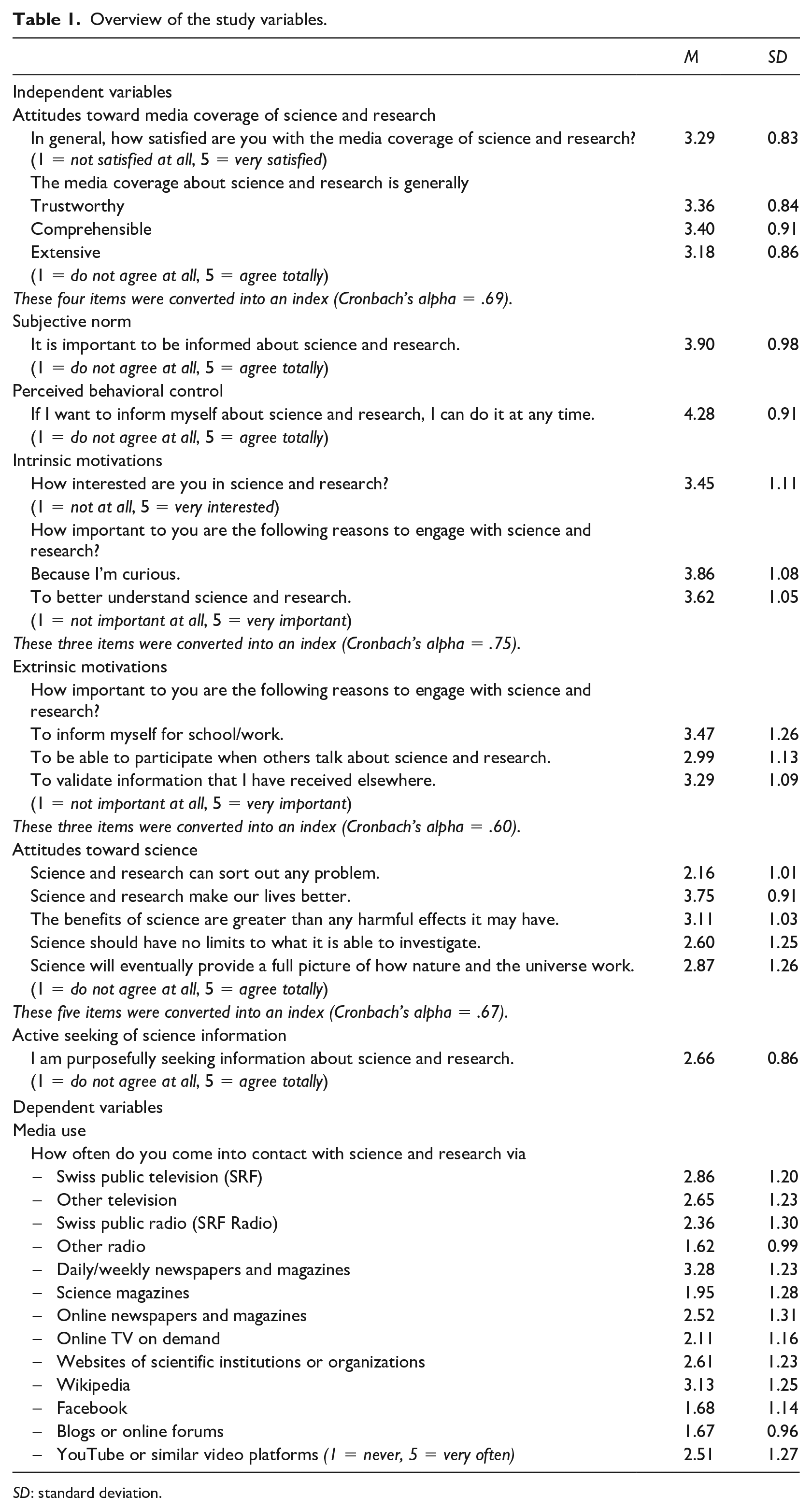
Table 1 shows the descriptive statistics for all measures.
Overview of the study variables.
SD: standard deviation.
Attitudes toward media coverage of science and research
Two variables were used to capture respondents’ evaluations of the media coverage of science and research. First, one item assessed people’s overall satisfaction with the media coverage of science. Second, several items were used to capture respondents’ evaluation of the extent, comprehensibility, and trustworthiness of media reporting on science (Macedo-Rouet et al., 2003; Tsfati et al., 2010). Together with the general satisfaction score, these items were converted into an index capturing assessments of the media coverage of science.
Subjective norms and perceived behavioral control
Since the survey was a broad survey on attitudes toward science in general and served different purposes, it did not include several items for all constructs. We could use only one item each to measure subjective norms and perceived behavioral control. These items have been established in previous research based on the theory of planned behavior (Ajzen, 2002). For subjective norms, respondents were asked whether they think it is important to be informed about science and research. Thus, we measured the injunctive norm here. The item does not fully capture Ajzen’s (2002) subjective norm in the sense that it mentions directly how people who are important to an individual, view an issue. However, it still expresses perceptions of which behaviors are typically approved or disapproved. Perceived behavioral control was measured by asking whether the respondents think they are capable of informing themselves about science and research.
Motives for media use for science information
Items measuring motives for media use for science information were adapted from established items in uses and gratifications studies (Palmgreen and Rayburn, 1982; Rössler, 2011). Items were also adapted from one of the few studies in science communication that used items measuring motives for science media use (Treise et al., 2003). To measure intrinsic motivations, one item measuring general interest in science and research (AbiGhannam et al., 2016; BBVA Foundation, 2011; OST & The Wellcome Trust, 2001) was combined with two items covering intrinsic gratifications sought by the individual (“because I’m curious” and “to better understand science and research”). To measure extrinsic motivations, three items were used capturing external expectations and rewards such as school performance or a friend’s interest in the topic (“to inform myself for school/work,” “to be able to participate when others talk about science and research,” and “to validate information that I have received elsewhere”).
Attitudes toward science
Several items were used to measure respondents’ attitudes toward science. These items stem from established surveys on attitudes toward science (BBVA Foundation, 2011; European Commission, 2014) and assess respondents’ reservations and beliefs about science (Prpic, 2011). Five of these items were combined into an index.
Information seeking
Due to time constraints in the survey, only one item for the active seeking of science information could be measured. Respondents were asked about the extent to which they agree that they purposefully search for information about science and research.
Dependent variables
Respondents were asked about the media channels through which they come into contact with science (BBVA Foundation, 2011) (“How often do you come into contact with science and research via . . .”; (1 = never, 5 = very often)). The frequency of using legacy media— Swiss public television (SRF), other television, Swiss public radio (SRF Radio), other radio, daily/weekly newspapers and magazines, and science magazines—was measured.
Internet use for information about science and research was covered in detail by the survey. Seven items captured online media use: (1) the use of online newspapers and magazines, (2) the use of online TV, (3) the use of websites of scientific institutions and organizations, (4) the use of Wikipedia, (5) the use of Facebook, (6) the use of blogs or online forums, and (7) the use of YouTube or similar video platforms (see Table 1 for descriptives).
3. Results
Table 1 presents an overview of the descriptive statistics of the study variables. It also provides information on the general patterns of media use for information about science and research in Switzerland. Among the traditional mass media, television and print media were the most frequently used to access information about science. Daily and weekly newspapers and magazines were the most frequently used media overall. The Internet also played an important role in citizens’ science information use. Wikipedia was the most frequently used online platform; it was used almost as much as print media. Social media was not as important as Web 1.0 as a source of information about science and research. Citizens rarely came into contact with science information on Facebook or blogs. Among the social media applications, YouTube was the most frequently used social media platform for information about science and research.
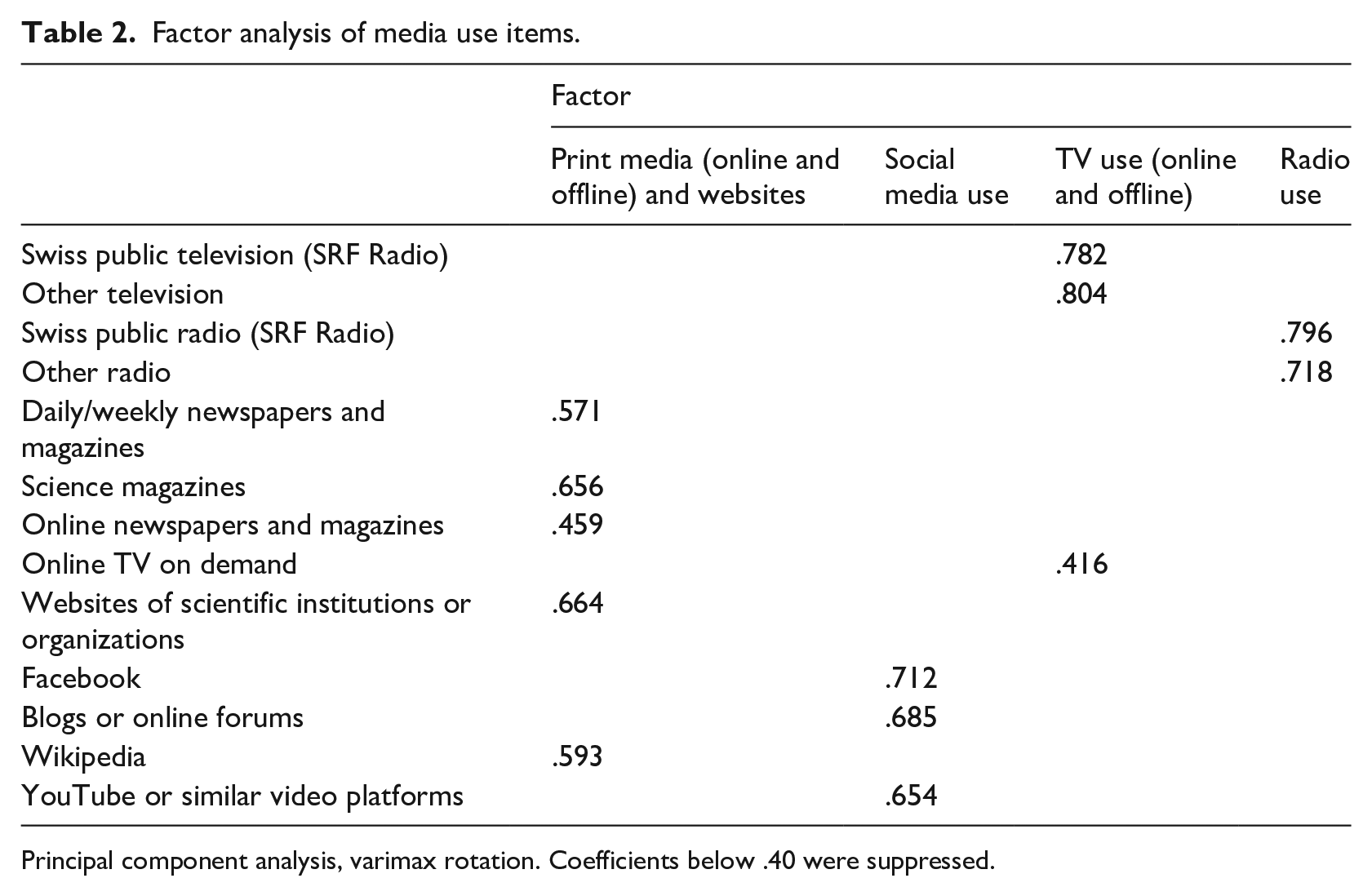
In order to identify more comprehensive dimensions of media use in today’s information environment, we used exploratory factor analysis to account for this. The 12 items measuring media use were subjected to principal component analysis (PCA) with varimax rotation. The PCA resulted in four factors (see Table 2) which we termed “Print media (online and offline) and websites,” “Social media use,” “TV use (online and offline),” and “Radio use.” The Kaiser-Meyer-Olkin criterion (.703) and the Bartlett’s test (p < .001) proved acceptable. We named the first factor “Print media (online and offline) and websites” since it comprises the use of print media (newspapers, magazines, science magazines), their online outlets, the use of websites and Wikipedia. The factor “Social media use” entails the use of Facebook, YouTube, and blogs/forums, while the third and fourth factor subsumes TV use offline and on demand and radio use.
Factor analysis of media use items.
Principal component analysis, varimax rotation. Coefficients below .40 were suppressed.
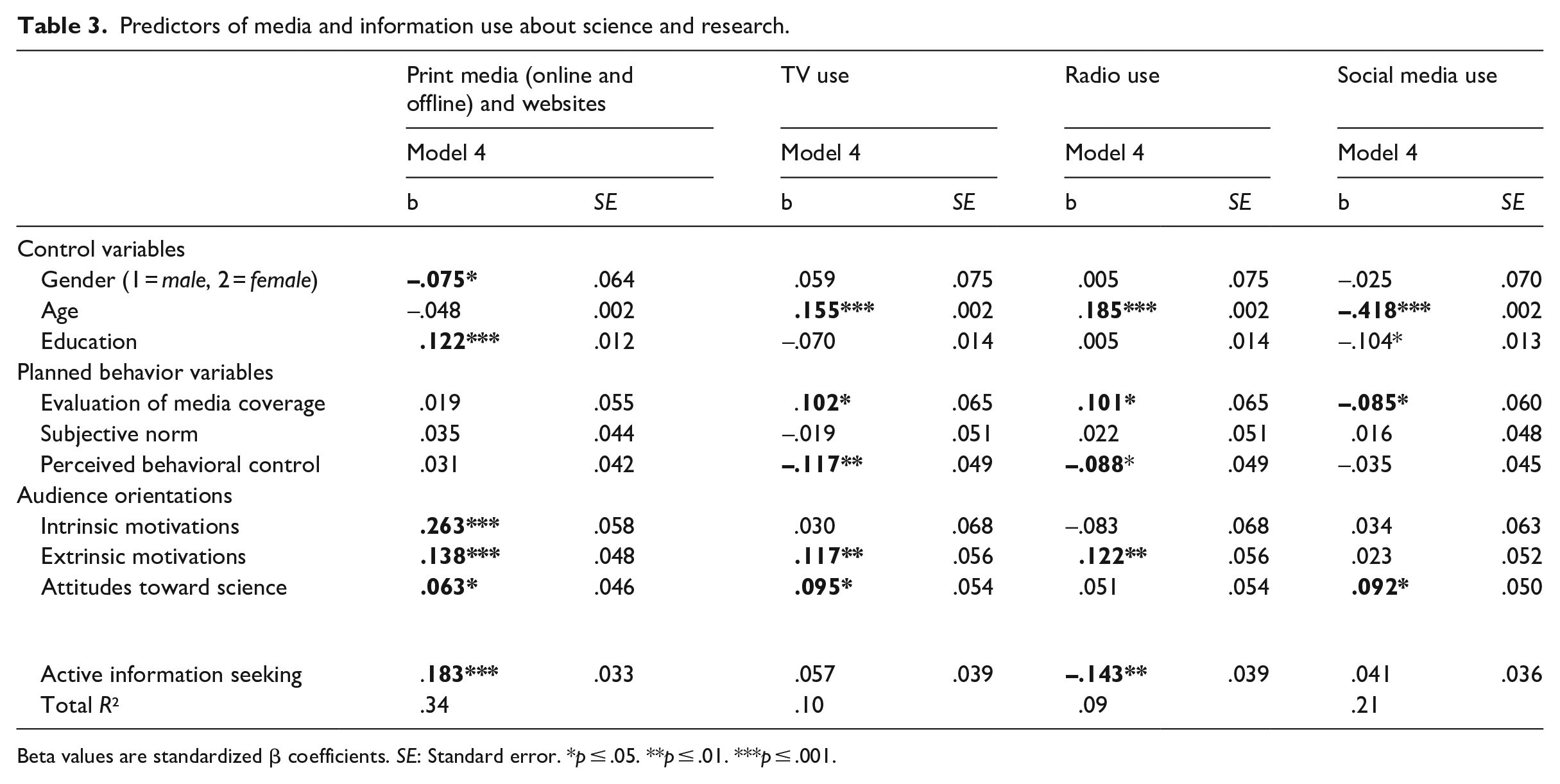
We tested Hypotheses 1–6 and RQ1 by running linear regression models. We ran four different regressions with print media and website use, TV use, radio use, and social media use as the dependent variables. We conducted stepwise regressions with listwise deletion of missing data. This reduced the sample to n = 693 cases that were used for the regressions. After modeling the control variables (sex, age, and education) in the zero-order model, we included the variables relating to the theory of planned behavior in the first step: assessments of the media coverage of science, subjective norm, and perceived behavioral control. In the next step, we included audience orientations, namely intrinsic and extrinsic motivations as well as attitudes toward science. In the final step, we inserted the variable measuring purposeful information seeking. We checked for multicollinearity in all models and the variance inflation factor (VIF) was in most cases around 1 and never higher than 2.2, thus indicating low multicollinearity (Alin, 2010). Table 3 shows the final model 4. The other models 1–3 can be found in the Supplemental materials (Table 1A–Table 4A).
Predictors of media and information use about science and research.
Beta values are standardized β coefficients. SE: Standard error. *p ≤ .05. **p ≤ .01. ***p ≤ .001.
Predictors of print media (online and offline) and websites/Wikipedia
The results show that males and highly educated people were more likely to use newspapers/magazines, no matter if online or offline, or websites and Wikipedia to inform themselves about science and research. People who positively evaluated the media coverage of science and research, who felt social pressure to be informed about science and perceived the ability to do so also used these kinds of media more frequently (Model 2, Table 1A Supplemental Materials). However, these effects vanished when audience orientations were introduced in the regression (Model 3, Table 1A Supplemental Material). Intrinsic and extrinsic motivations and attitudes toward science were important predictors of using print media and websites/Wikipedia to access information about science and research. Model 4 shows that these media were primarily used for purposeful information seeking.
Predictors of TV and radio use for science information
A slightly different picture emerged for accessing information on science and research through television (offline or on demand online) and radio. Age was a significant predictor for both television and radio use. Older people were more likely to encounter science information through these media. Positive evaluations of the media coverage of science and research increase the use of television and radio for information about science. However, in both regression models, perceived behavioral control had a negative effect. People get across science information on TV or on the radio if they do not have a pronounced feeling of behavioral control. These media do not seem to be information sources on science for people who look for this information intentionally and feel empowered to do so. These effects remained significant in all steps of the regression model. Audience orientations also exerted effects: The stronger the extrinsic motivations and—at least for television use—the positive attitudes toward science were, the more likely individuals were to use TV or radio for information about science and research. These predictors remained stable when purposeful information seeking was introduced in Model 4. Here, we find differences between TV and radio use. For television use, there is no effect of active information seeking. For radio use, we find a negative effect of active information seeking. The less people are purposefully looking for information about science and research, the more likely it is that they come across it on the radio.
Predictors of social media use for science information
Our last analysis investigates the predictors of social media use (i.e. Facebook, blogs, and YouTube) for information about science and research. Age and education were significant predictors. The results show that younger citizens were more likely to encounter information about science and research on social media than older citizens were. In contrast to the use of print media and websites/Wikipedia, less educated people more frequently accessed science information on social media platforms. Positive evaluations of the media coverage of science had a negative effect. At the same time, positive attitudes toward science increased the likelihood of using social media for science information. This means individuals—who are generally supportive of science—used social media more frequently for information about science when they were dissatisfied with the media coverage about science and research. These effects also remained when purposeful seeking of information about science and research was included. This variable was not a significant predictor.
4. Discussion
In this study, we aimed to analyze the predictors of media use for information about science in general. We tried to fill a research gap by differentiating between the kinds of media used to access science information. We referred to the theory of planned behavior (Ajzen, 1991) as well as audience orientations—based on the uses and gratifications approach (Palmgreen and Rayburn, 1982) and the OSOR model (Cho et al., 2009)—to analyze the predictors of using media for general information about science.
A factor analysis showed four different kinds of media use—print media (offline and online) and websites/Wikipedia, television use, radio use, and social media use. Our study revealed that predictors related to planned information seeking and predictors related to audience orientations explained the use of these information sources differently. The theory of planned behavior assumes that attitudes toward the behavior—in this case, attitudes toward the media coverage about science—influence the behavior (i.e. using media to access science information). Our findings partly support this assumption (Hypothesis 1; see Table 4 for an overview). Positive evaluations of the media coverage of science and research positively affected TV and radio use for information about science, but they negatively affected social media use. This is quite plausible since the operationalization of our attitudinal variable provided a general assessment of the (journalistic) mass media coverage of science. Social media seem to be an alternative to legacy media for science information. Social media were used more frequently when people evaluated legacy media’s science reporting negatively. However, social media were generally seldom used for information about science and research.
Overview of hypotheses and results.
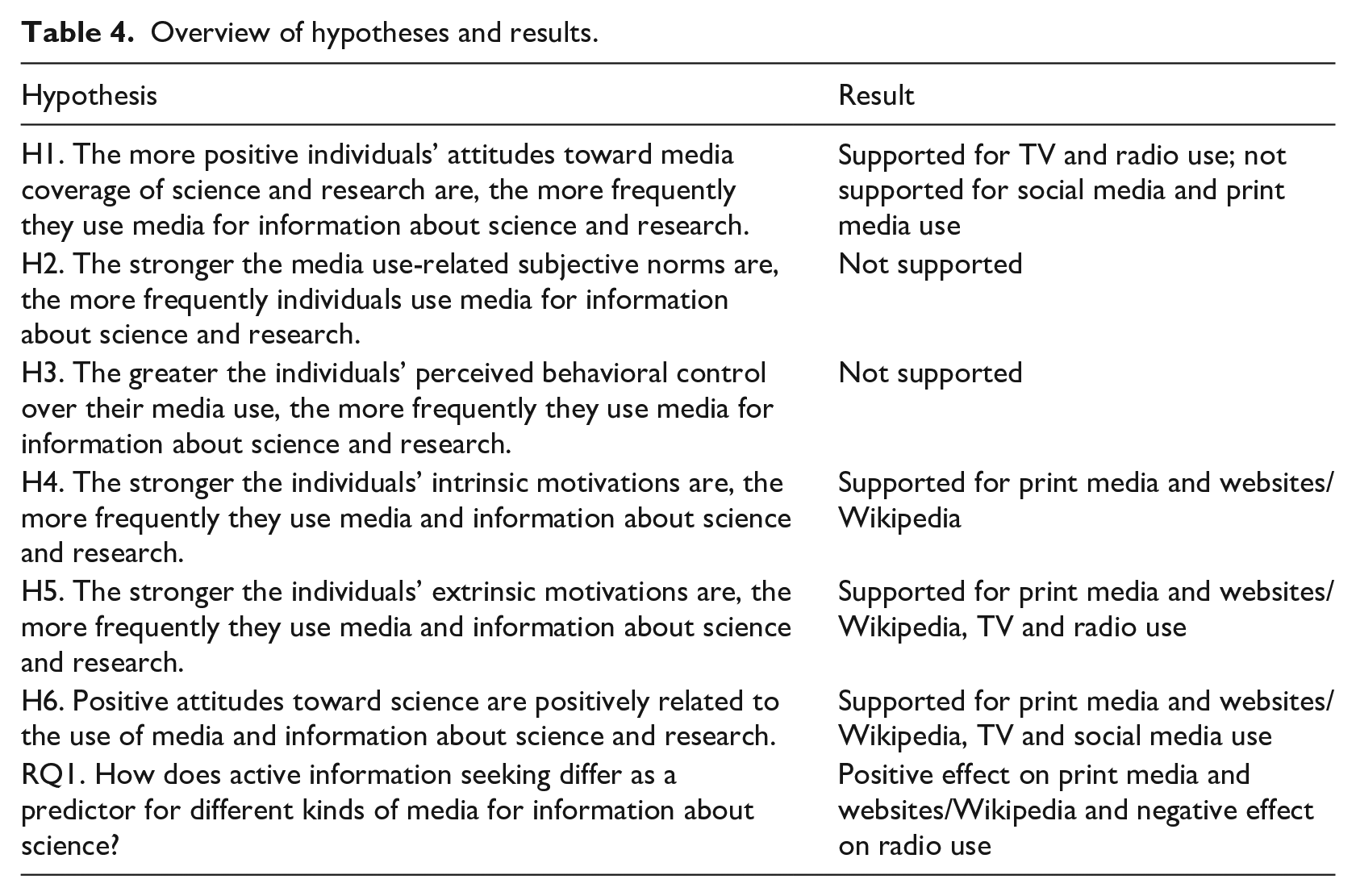
In three of the four regression models, the norm that people think it is important to be informed about science and research did not appear as a significant predictor. Thus, these results do not support Hypothesis 2. Only for information in print media and on websites/Wikipedia, this injunctive norm had a positive effect. However, once the variables capturing audience orientations were introduced in the regression models, the significant effect of norms and perceived behavioral control disappeared. Individual motivations and positive attitudes toward science were more important predictors of using print media and websites/Wikipedia to access information on science.
Perceived behavioral control was a significant predictor of the use of television and radio, but not in the expected direction. The more people thought they were able to inform themselves about science, the less they used television and radio. Therefore, Hypothesis 3 was not supported.
Our analyses revealed that motivations positively affected print media and websites/Wikipedia use, television use and radio use. However, the effects were somewhat differentiated. Both intrinsic and extrinsic motivations were significant predictors of using print media and websites/Wikipedia to access science information, with intrinsic motivations having a larger effect size. Extrinsic, but not intrinsic, motivations enhanced the use of radio and television for information about science. There was no effect of motivations on social media use. Thus, Hypotheses 4 and 5 were supported but need to be refined with regard to the kind of information channels under consideration. The difference between extrinsic and intrinsic motivations could be explained by the different functions performed by the information channels. For example, people turn to traditional mass media such as television and radio when they would like to be able to participate in conversations about science and research. Traditional mass media are viewed as sources that can fulfill these functions. People who use print media, science magazines, and websites for information about science and research seem to be more intrinsically motivated. If they are curious or have a general interest in science, then they will actively look for information on these channels.
Hypothesis 6 assumed that not only positive assessments of the media coverage about science but also positive attitudes toward science itself enhance the use of media to access science information. This hypothesis was supported for all dependent variables, except for radio use. People with positive attitudes toward science and research more frequently used print media and websites/Wikipedia, television and social media to access information on science and research.
Finally, we investigated whether active information seeking differed as a predictor for the kind of channels people used for science information. In the regression models, active information seeking was a positive significant predictor only of print media online and offline and websites/Wikipedia for information about science. This underscores that the textual media (newspapers, magazines) and web 1.0 online information are particularly relevant for the active seeking of science information. Individuals who are actively looking for information do so in print media and online on websites and Wikipedia. The effect on radio use, on the contrary, was significant and negative. This underscores the function of radio as being used alongside while doing other things and people coming across science on the radio inadvertently. A reason for the result that active information seeking was not a significant predictor for TV use and social media use—neither a positive nor a negative one—could be that both kinds of media can be used actively or passively. As mentioned above, individuals can watch a science TV show purposefully and receive science information inadvertently while watching the news. On social media, individuals actively search for the facebook page of a scientific institution while inadvertent exposure can happen while browsing the social media feed. Radio and print media more clearly imply passive or, respectively, active use than TV and social media.
5. Conclusion
Our results on motivations and attitudes toward science as predictors are consistent with those of other studies. People who are highly educated, who are highly interested in science, and who already show positive attitudes toward science use a variety of information channels, use them more frequently, and search for more information on science (Lee et al., 2005; Nisbet et al., 2002; Nisbet and Markowitz, 2014; Schäfer et al., 2018).
This result has implications for science policy making. If people who already have positive attitudes toward science and research use more information about science, and if people who have negative attitudes toward science hardly look for further information on science, then it would be difficult to reach those with negative attitudes toward science. Another possibility is that these people are using alternative media, which are not covered by the survey. Nevertheless, it seems that those who are already interested in and have positive attitudes toward science will be more informed than those who are not. Our study shows that it is important to motivate those who are not that interested in science and those who do not have positive attitudes toward science to search for scientific information.
Our study thus provides insights for journalists and science communicators about who uses what kinds of information channels and what the drivers of media use are. It demonstrates that predictors of different information sources vary—which can be a chance for journalists and science communicators. For example, the radio is still a medium to reach people who have not actively searched for information about science and having a positive attitude toward science is not a precondition. People get in contact with science and research inadvertently when listening to the radio. On social media, people do not need to be particularly motivated to get across information about science and research. This could be a way to reach people who do not appreciate the coverage of the traditional mass media as much as others but who are still positive toward science—if they receive information about science and research on social media they may have an interest in it. In some ways to be expected, the study shows that the information channels differ in their suitability for different age groups. While radio and television are more frequently used by older cohorts, younger people are more likely to get access to information about science on social media. This needs to be considered when thinking about whom to reach on different channels. Also, the role of education shows a nuanced picture for the different media types. Those who are more highly educated are more likely to use print legacy media and websites, while those with lower education are more inclined to use social media. Since research has shown that education can be regarded as a proxy for exposure to science (Noy and O’Brien, 2019), this underscores the finding that those with greater affinity to science use legacy media more. However, in light of the discussion about the spread of mis- and disinformation online, and particularly on social media (Scheufele and Krause, 2019), this result also implies that people who get in contact with information about science or with information that seems scientific on social media may be less educated and thus may possess less knowledge to assess to what extent such information is trustworthy and correct.
In addition to being cross-sectional and thus not being able to disentangle causes and effects entirely, this study has some limitations arising from the operationalization of variables. Since the survey was a general and broad survey on attitudes toward science and information use, it entailed questions and items on many different constructs, but that means that only a few items were available for each construct (e.g. subjective norms and perceived behavioral control). Wherever possible, we used indices of several variables in the regression models, but there were still constructs that were assessed with only one item.
One could question whether investigating the predictors of media use for information about science in general is useful, as nobody ever searches for general information about science and people usually search for information about a specific scientific topic. However, the aim of this study was to understand the drivers of media use for information about science regardless of the topic. Thus, the predictors that we singled out in our models should hold for different scientific topics. Our results should therefore be more generalizable than results for a specific scientific topic. At the same time, the respondents probably thought about a specific scientific topic when answering the survey questions about science and research in general. We tried to assess what they thought about by asking them at the beginning of the survey what they associated with science and research. Not surprisingly, most respondents associated medicine and natural sciences with science and research (Schäfer et al., 2018). We thus have an idea of what they thought about when answering questions on science information use.
If members of a society should be informed about science to a certain degree, then knowledge of what leads to media use for science information is needed. The results of this study can be used as heuristics to understand which psychological and sociological drivers make people look for scientific information in what kind of channels. The results can also be used to reflect on the way scientific information is presented and how it can appeal more to those drivers. If one knows which conditions favor media use for science information, then these conditions could be used to make even more people aware of the information available. Combined with studies on people’s media repertoires (Guenther and Weingart, 2017; Metag et al., 2018), the results on predictors of media use provide a more complete picture of people’s media use for information about science.
Supplemental Material
Fragebogen_WiB_FR – Supplemental material for What drives science media use? Predictors of media use for information about science and research in digital information environments
Supplemental material, Fragebogen_WiB_FR for What drives science media use? Predictors of media use for information about science and research in digital information environments by Julia Metag in Public Understanding of Science
Supplemental Material
Questionnaire_German_Supplementary_Materials_ – Supplemental material for What drives science media use? Predictors of media use for information about science and research in digital information environments
Supplemental material, Questionnaire_German_Supplementary_Materials_ for What drives science media use? Predictors of media use for information about science and research in digital information environments by Julia Metag in Public Understanding of Science
Supplemental Material
Supplemental_Materials – Supplemental material for What drives science media use? Predictors of media use for information about science and research in digital information environments
Supplemental material, Supplemental_Materials for What drives science media use? Predictors of media use for information about science and research in digital information environments by Julia Metag in Public Understanding of Science
Supplemental Material
Supplementary_Files_Title_page_(002)_ – Supplemental material for What drives science media use? Predictors of media use for information about science and research in digital information environments
Supplemental material, Supplementary_Files_Title_page_(002)_ for What drives science media use? Predictors of media use for information about science and research in digital information environments by Julia Metag in Public Understanding of Science
Supplemental Material
Tables_Supplementary_Materials – Supplemental material for What drives science media use? Predictors of media use for information about science and research in digital information environments
Supplemental material, Tables_Supplementary_Materials for What drives science media use? Predictors of media use for information about science and research in digital information environments by Julia Metag in Public Understanding of Science
Footnotes
Funding
The author(s) disclosed receipt of the following financial support for the research, authorship, and/or publication of this article: This work was supported by the Gebert Rüf Stiftung under Grant GRS-025/15; and Stiftung Mercator Schweiz under Grant 2014-0607.

Supplemental material
Supplemental material for this article is available online.
Notes
Author biography
References
Supplementary Material
Please find the following supplemental material available below.
For Open Access articles published under a Creative Commons License, all supplemental material carries the same license as the article it is associated with.
For non-Open Access articles published, all supplemental material carries a non-exclusive license, and permission requests for re-use of supplemental material or any part of supplemental material shall be sent directly to the copyright owner as specified in the copyright notice associated with the article.
