



Abstract
Religiously conservative Americans consistently demonstrate lower scientific literacy than other Americans. Some argue, however, that Americans’ scientific literacy is contingent on subcultural conflict, showing differences in scientific literacy that emerge only on religiously contested scientific claims. Building on these insights, we find that the most salient factor explaining Americans’ divergence on contested (though not on uncontested) scientific claims is not religious commitment or conservatism per se, but an ideology that seeks political—and consequently epistemic—dominance: Christian nationalism. National data show that Christian nationalism is unassociated with Americans’ answers on questions about uncontested scientific knowledge. However, Christian nationalism is the strongest predictor of incorrect answers on questions about religiously contested scientific claims. Contemporary “culture war” debates over science have little to do with outright ignorance of science, nor are they strictly about religiosity or theological conservatism. Rather, disputes over science and religion reflect politically motivated denials of scientific facts that threaten Christian nationalism’s claims to epistemic and cultural authority.
Keywords
1. Introduction
The contentious relationship between religion and science is a perennial concern for scholars (Barbour, 1966), and has recently resulted in a considerable body of research that documents how religious characteristics among the public (or even among scientists themselves) correspond with beliefs about science (e.g. Ecklund, 2010; Ecklund and Scheitle, 2017). Within research looking at scientific literacy and religion among the American public, studies consistently show that Americans who are more religious (measured in various ways) (McPhetres and Zuckerman, 2018), or who are more theologically conservative demonstrate lower scientific literacy compared with other Americans (Miller, 2012; Miller et al., 2006; Sherkat, 2011).
A variety of theories have been proposed to account for this disparity, ranging from less access to education that is secular or at least of sufficient quality (Bak, 2001), to a subculture of distrust for science and scientists (Alumkal, 2017; Mann and Schleifer, 2020). An important critique of research on this topic using at the 2006–2014 General Social Survey’s true/false questions of scientific knowledge is that some studies ignored the fact that certain measures made explicit claims that contradicted conservative religious beliefs (e.g. referencing evolution or The Big Bang), while others made claims that were not religiously contested (e.g. about lasers, antibiotics, or atoms) (Roos, 2014, 2016, 2017; also see Pasek, 2018). Scholars have pointed out that once these questions were separated, religious conservatives scored no lower on the uncontested scientific knowledge claims, but did worse only on the religiously contested claims, suggesting that the lower overall scores were less attributable to ignorance of science and more a reflection of a subcultural willingness to deny scientific claims that contradicted valued religious myths (Drummond and Fischhoff, 2017; Evans, 2011, 2013; Perry, 2020, 2021).
We propose that the mechanism driving this tendency is not religiosity or general theological conservatism. Rather, we posit that the most salient factor explaining Americans’ divergent views on contested scientific claims is a pervasive and influential ideology that seeks political and cultural dominance―which scholars have termed as “Christian nationalism” (Gorski, 2017; Whitehead and Perry, 2020a, 2020b). Analyzing recent, nationally representative data that contain batteries of both religiously contested and uncontested scientific knowledge, as well as a well-tested measure of Christian nationalism, we demonstrate that Christian nationalism is the leading predictor of incorrect answers on true/false questions that contain religiously contested statements, but is not significantly related to Americans’ answers regarding uncontested scientific claims. These findings make a key contribution to our understanding of how American conservative religion intersects with science. To the extent that Americans embrace Christian nationalism as an ideology, they will be more likely to challenge scientific claims that threaten cherished ideological narratives and myths, particularly issues perceived as undermining the ultimate authority of a particularistic and exclusivist biblical worldview. We discuss the relevance of this research for understanding the current situation with Christian nationalism and the ongoing response to the COVID-19 research and guidelines in the United States.
Before proceeding with the analyses, we outline the relevant theory and empirical findings about religion and scientific literacy, focusing on the role of subcultural conflict and knowledge systems in shaping Americans’ views about contested versus uncontested scientific knowledge. We then discuss the research on contemporary Christian nationalism and theorize about its underlying influence on Americans’ acceptance or denial of scientific claims that are perceived as threats to a social order in which White, politically conservative Christians hold epistemological―and therefore cultural and political―authority.
2. Theoretical framework
Over the past decade, sociological studies of the connections between religion and science have rightly moved away from the “inherent epistemological conflict” model (Evans and Evans, 2008), and moved toward theories of subcultural boundaries (Evans, 2018) and empirical examinations of the complexities of public opinion (Ecklund and Scheitle, 2017). This paradigm shift has opened up numerous areas for theoretical and empirical inquiry, catalyzing a previously moribund subfield on “science and religion” (see Jones et al., 2019).
These new theoretical approaches to studies of science and religion put the focus on cultural conflicts and boundaries, particularly in relation to status politics. In science and technology studies (STS), the cultural boundaries framework has a longer history of application (e.g. Gieryn et al., 1985). The cultural constructivist lens often used in STS (e.g. Gieryn, 1999; Latour, 1987) provides a way to understand different types of intersections between science and religion among the general public, that is, to look at science and religion beyond the walls and boundaries of institutional science. Moving to studying the connections between religion and science among the public or within religious subcultures requires a theoretical reorientation away from the notion of inherent epistemological conflict and toward a vantage offered by the sociology of knowledge. Namely, that communities collectively define what constitutes knowledge within their own group (Berger and Luckmann, 1966; McCarthy, 1996; Stark ([1958] 1991)), which may notably be at odds with other groups or mainstream institutions, such as science (see, for example, Trollinger and Trollinger, 2016 on “scientific” creationist subcultures).
A “folk epistemologies” orientation that views knowledge systems as socially constructed, localized understandings of agreed upon points of belief provides for greater flexibility in application, and necessarily shifts theoretical focus to questions of power and politics. Not only does power shape accompanying knowledge systems, knowledge then shapes future experiences, inter-subjective relations, and ongoing power relations. As Foucault (1980) emphasized, Knowledge and power are integrated with one another, and there is no point in dreaming of a time when knowledge will cease to depend on power…. It is not possible for power to be exercised without knowledge, it is impossible for knowledge not to engender power. (p. 52)
Similarly, more than three decades earlier, C. Wright Mills (1940) noted that Closely linked with such a view of categories is the social theory of perception. In acquiring a technical vocabulary with its terms and classifications, the thinker is acquiring, as it were, a set of colored spectacles. He sees a world of objects that are technically tinted and patternized. A specialized language constitutes a veritable a priori form of perception and cognition, which are certainly relevant to the results of inquiry. (p. 322)
Reorienting the study of religion and science with an emphasis on power directly implies considerations of cultural conflict and politics.
Accordingly, Evans (2011, 2013, 2018) has recently advanced the sociological study of science and religion by applying a theoretical framework analyzing conflicts over religion and science as reflections of cultural conflicts about morality, and hence often politics. This more refined sociology of knowledge perspective helps explain many contemporary issues involving religion and science: A particular type of belief system relevant to the religion and science debate is what I will call a knowledge system, where beliefs are structured in a hierarchical fashion, with higher-level and more abstract beliefs justifying lower-level and less abstract beliefs. The lower beliefs, since they are now justified, become knowledge. (Evans, 2018; p. 7)
A sociology of knowledge systems approach with an emphasis on power allows for diverse and flexible applications to disparate historical and contemporary issues involving science and religion, and helps make sense of the recent empirical findings about how views of science and religion intersect among the public.
Below we consider this empirical research on how religious factors relate to scientific knowledge. We also theorize that Christian nationalism is an ideology uniquely oriented toward preserving hegemonic dominance in cultural fields and vigilance toward perceived status threats, and thus, is particularly likely to predict responses to propositional aspects of scientific knowledge.
3. Empirical research
Empirical research on religion and public views of science has focused primarily on views of the Bible or fundamentalist religious identifications in relation to views of science (Zigerell, 2012), particularly acceptance or rejection of evolution (Guhin, 2016; Tom, 2018). Importantly here, views of the Bible should be taken as expressions of collective identity (Boone, 1989) and political positioning (Franzen and Griebel, 2013), rather than as expressions of particular theological or exegetical positions. Notably, participating in such religiously conservative interpretive communities is associated with closed social networks, which effectively alter engagement with other institutions that can influence views of science, such as education (Baker, 2013; Hill, 2014; Perry, 2020, 2021)
Evans (2018) refers to the conflicts between fundamentalist religion and science as “propositional,” meaning selective rather than totalizing. That is, particular scientific tenets that are seen as morally threatening, such as evolution and the origins of the universe, are actively opposed, while other issues related to science and technology are unrelated to religious views (O’Brien and Noy, 2015, 2018). In effect, these religiously controversial aspects of science end up gauging particular religious worldviews as much as scientific literacy (Roos, 2014). Ultimately, it is perceived that cultural and status threat from mainstream science shapes distrust of science among both conservative religious communities (Simpson and Rios, 2019) and political conservatives (Cofnas et al., 2018; Mann and Schleifer, 2020).
Christian nationalism, as an ideology that idealizes and advocates a fusion of American civic life with an exclusivist, authoritarian interpretation of Christianity (see Whitehead and Perry, 2020a), has been shown to promote ultra-conservative cultural positions on a variety of political issues, ostensibly in the service of preserving cultural and political power for religiously conservative (most often also White and native born) Americans (Baker et al., 2020a; Braunstein and Taylor, 2017; Davis, 2018; Davis and Perry, 2020; McDaniel et al., 2011). Recent work has also shown that Christian nationalism is a critical piece of understanding intersections of religion and science among the American public. Baker et al. (2020b) document that Christian nationalist ideology is strongly related to perceiving a moral threat from science and scientists, as well as rejection of evolution and support for teaching creationism in public schools. This reflects the desire among Christian nationalists to establish the cultural dominance of a particularistic vision of public Christianity that supports the differential distribution of power along gendered and racialized boundaries (Whitehead and Perry, 2020a).
In related work, studies show that, even after accounting for traditional measures of religious and political conservatism, Christian nationalism powerfully predicts Americans’ unwillingness to follow recommendations promoted by scientists regarding vaccinations (Whitehead and Perry, 2020b) or proper behavioral precautions during the COVID-19 pandemic (Perry et al.,2020a, 2020b). These findings offer evidence that Christian nationalist ideology orients Americans in opposition to “science” as a perceived threat to their values that can guide and frame oppositional behaviors.
Importantly, the strong connections between Christian nationalism and views of science are part of a broader trend toward the political polarization of orientations toward science among the American public that has been occurring since the 1970s (Gauchat, 2012, 2015; Noy and O’Brien, 2016; O’Brien and Noy, 2020). Taken together, the recent empirical research on the connections between religion and views of science among the public strongly support a sociology of knowledge systems approach that emphasizes power, cultural conflict, and politics, with Christian nationalism—because it is singularly oriented toward cultural dominance and perceived threats—a potentially influential factor above and beyond traditional measures of religiosity, religious orthodoxy, or political conservatism.
4. Hypotheses
Based on a sociology of knowledge systems framework, as well as previous empirical research on public views of science, we test two relate hypothesis. First, H1: Christian nationalism will be strongly related to scientific literacy outcomes on religiously contentious issues in science.
Second, we test whether H2: Christian nationalism will be more strongly related to scientific literacy outcomes on religiously contentious issues in science compared to issues that are not religiously contentious.
Support for these hypotheses would provide evidence for Christian nationalism as a key ideological mechanism structuring many disputes over science and religion in the contemporary United States, and also provide further support for the utility of applying a sociology of knowledge systems and power theoretical approach to empirical questions in studies of science and religion.
5. Method
Data
Data for this study come from the Public Discourse Ethics Survey (PDES), which is a nationally representative panel survey of American adults (Perry et al., 2020a, 2020b). Wave 1 was collected in August of 2019; Wave 2 in February of 2020; Wave 3 in May 2020; and Wave 4 in August 2020. For the present analysis, we use Waves 1 and 4, which contain our necessary measures. Survey waves were designed by the authors and fielded by YouGov, an international research data and analytics company. For more about the YouGov recruitment and sampling strategy, see Perry et al. (2020a, 2020b). YouGov develops sampling weights in order to ensure that the survey sample is in line with nationally representative norms for age, gender, race, education, and census region. The resulting original survey sample included 2519 Americans that were matched and weighted at Wave 1. Weighted results from the PDES compare favorably with the 2018 General Social Survey across key demographic factors (see Appendix Table 1A). With sample attrition between waves and a modest amount of missing data, the final analytic samples are between 1379 and 1380 cases in full models.
Measures
Scientific knowledge questions
The outcome variables for this study consist of two indices made from 10 true/false statements about scientific facts. These questions were largely taken from those asked in the General Social Surveys from 2006 to 2014 (e.g. Evans, 2011, 2013; Perry, 2020; Sherkat, 2011) with two added by researchers and another slightly adjusted. Following Evans (2011, 2013), we divided up the statements into those for which there was no obvious religious contestation (six total) and those for which there was religious contestation, particularly within conservative Christianity (four total). Table 1 lists each question and whether the statement is true or false.
Statements about scientific facts.

Source: PDES Wave 4.
Respondents were given the option of indicating that the statement was “True,” “False,” or they “Don’t know.” Following previous research (Evans, 2011, 2013; Johnson et al., 2015), we recoded the responses such that correct answers were coded as 1 and incorrect answers or “don’t know” answers were coded as 0. We then added up the responses into an “Uncontested Science Questions” index ranging from 0 to 6 and a “Contested Science Questions” index ranging from 0 to 4. Because each scale had 5 or more values, we used ordinary least squares (OLS) regression as our modeling strategy.
Christian nationalism
While there have been several measures of Christian nationalism (e.g. McDaniel et al., 2011; Perry et al.,(2020a, 2020b)) all with similar results, our measure is an index constructed from measures repeatedly asked in surveys like the Baylor Religion Surveys (Whitehead and Perry, 2020a) and the Chapman University Survey of American Fears (Baker et al., 2020a). This index typically includes six level-of-agreement questions using the same statements: “The federal government should declare the United States a Christian nation,” “The federal government should advocate Christian values,” “The federal government should enforce strict separation of church and state” (reverse coded), “The federal government should allow prayer in public schools,” “The federal government should allow religious symbols in public spaces,” and “The success of the United States is part of God’s plan.” Following previous research, we combine these measures into an additive index ranging from 0 to 24, with higher scores indicating greater adherence to Christian nationalism (Cronbach’s α = .902). Our Christian nationalism measures were taken from Wave 4 of the PDES. 1
Controls
Analyses also included controls theorized to be related to both scientific knowledge (Evans, 2011, 2013; Johnson et al. 2015; Perry, 2020; Sherkat, 2011) and Christian nationalist ideology (Baker et al.,2020a, 2020b; Whitehead and Perry, 2020a). All controls are from Wave 1 of the PDES. Sociodemographic controls are included for educational attainment (1 = less than high school, to 6 = postgraduate degree), age (in years), gender (male = 1, female = 0), race (dummy variables: 0 = White, 1 = Black, 1 = Hispanic, 1 = Asian, 1 = other races/ethnicities), family income (dummy variables: 0 = US$0–US$29,000 per year, 1 = US$30,000–US$99,000 per year, 1 = US$100,000 or more, 1 = did not report), and region (Southern residence = 1, other = 0).
Political and religious characteristics are also important to include since Christian nationalism may simply be a proxy for political and/or religious conservatism (Baker et al., 2020a; McDaniel et al., 2011). Political controls include party identification (Republican = 1, other = 0) and political conservatism (1 = very liberal, 5 = very conservative). Religion controls include religious tradition and religiosity. Religious tradition is measured with six categories: born-again Protestant (reference), liberal (i.e. non-born-again) Protestant, Catholic, other Christian, other religions, and seculars (including atheists, agnostics, and the unaffiliated). 2 Religiosity is an additive index from three standardized measures: religious service attendance, prayer frequency, and religious importance (Cronbach’s α = .85). 3
Plan of analysis
The analysis proceeds as follows. Table 2 presents descriptive statistics for all variables in the main analyses as well as zero-order correlations between all predictor variables and correct answers for a composite scale of science questions, uncontested science questions, and contested science questions. 4 Figure 1 focuses more directly on comparing the strength of correlation between correct answers on each individual science statement and Christian nationalism.
Descriptive statistics.

Source: PDES Waves 1 and 4 (N = 1379).
p < .05; **p < 01; ***p < .001 (two-tailed tests).
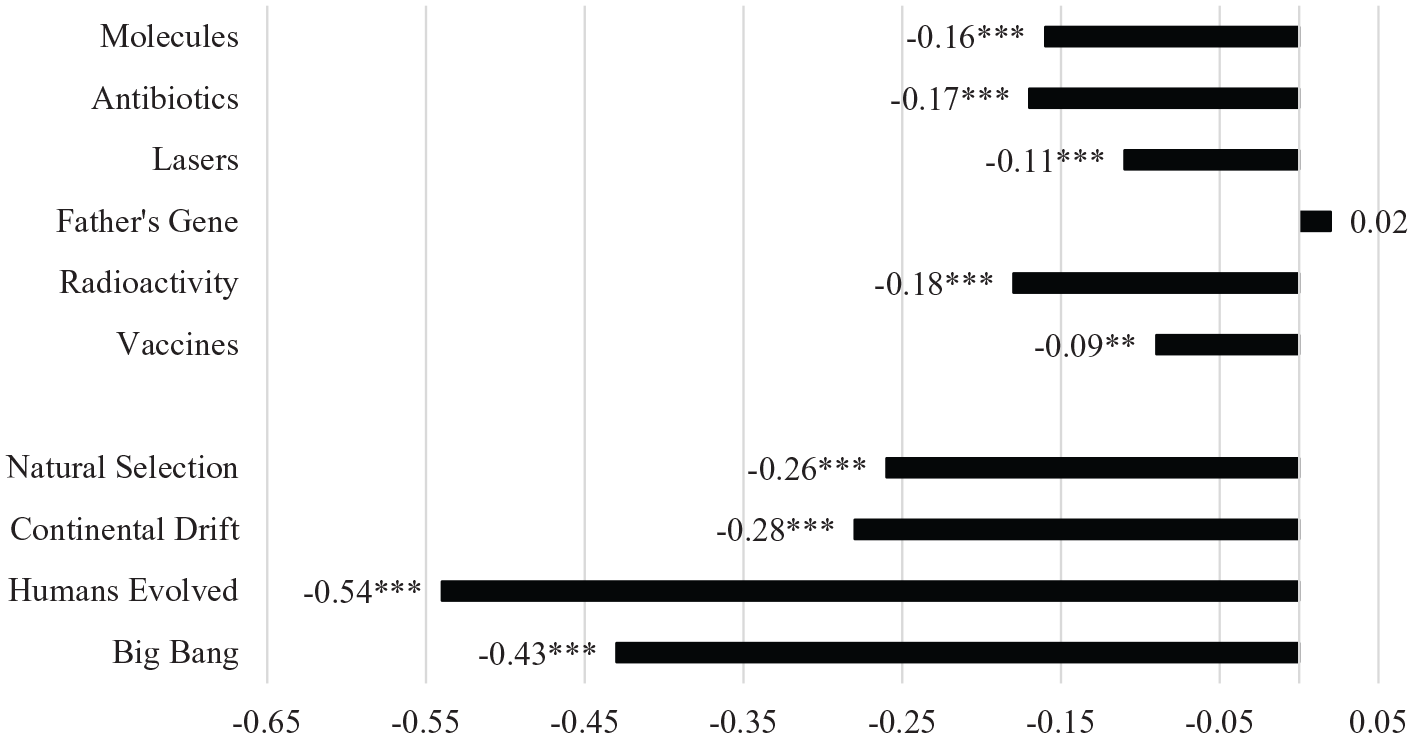
Correlation coefficients between correct answers on contested and uncontested scientific knowledge with Christian nationalism.
Table 3 presents multivariate models predicting correct answers on three configurations of the science statements. Each model includes the full battery of controls and presents both standardized betas and unstandardized coefficients in order to assess both statistical significance and magnitude of effects. Model 1 predicts correct answers for the aggregated list of science statements in order to observe how Christian nationalism might predict correct answers if all questions are considered together, without taking into account uncontested versus contested statements (following other studies that have included all such measures together, for example, Perry, 2020; Sherkat, 2011).
Ordinary least squares regression models predicting correct answers on scientific knowledge questions.

Source: PDES Waves 1 and 4.
Note: Excluded categories are aWhite; bincome below US$30K; cborn-again Protestant.
p < .05; **p < 01; ***p < .001 (two-tailed tests).
Difference of coefficients for Christian nationalism between Models 2 and 3 significant at p < .0001 (two-tailed test).
Model 2 predicts correct answers for the uncontested science questions. Model 3 predicts correct answers for the contested science questions with an identical set of controls as Model 2 in order to compare significance and substantive strength across the models. To formally test H2, we also ran supplemental versions of Models 2 and 3 with mean-standardized measures for the religiously contested and uncontested science measures as the outcomes. We then calculated a Z-test for the difference of the unstandardized coefficients for Christian nationalism across the models (see Paternoster et al., 1998).
Finally, Model 4 in Table 3 adds correct answers for the uncontested science questions as a predictor of the religiously contested science index in order to provide a robustness test of Christian nationalism’s influence, having taken into account not only sociodemographic, political, and religious characteristics, but also someone’s basic awareness of explicit and uncontested scientific facts.
6. Results
Correlations presented in Table 2 indicate that Christian nationalism is negatively, moderately associated (r = −.39, p < .001) with correct answers on the aggregate list of science questions. However, when we disaggregate those questions by uncontested versus contested science questions, Christian nationalism is much more strongly, negatively associated with correct answers for contested science questions (r = −.52, p < .001) compared with correct answers on uncontested questions (r = −.18, p < .001).
Figure 1 helps us better compare these patterns by showing the relative sizes of zero-order correlation coefficients for Christian nationalism and each of the specific statements about scientific facts. While Christian nationalism is indeed significantly associated with incorrect answers on each science statement except for “Father’s Gene,” the size of the associations are visibly larger for those statements that are religiously contested (about evolution, the Big Bang, continental drift over millions of years, or natural selection) compared with those for which there is no religious objection. Yet because Christian nationalism is still significantly associated with correct answers on uncontested science questions, our larger theory that Christian nationalism is related less to scientific ignorance than with politically motivated denial of claims that contradict cherished cultural myths is only moderately supported; however, this may reflect unaccounted for confounds known to be related to both views of science and Christian nationalism, such as education, political identity, and other religious characteristics. Consequently, the full model accounting for other potentially relevant factors offer a more accurate and rigorous assessment of our hypotheses.
Turning to the multivariate analyses in Table 3, we first see that Christian nationalism is a significant, negative predictor (b = −.063; p < .001; β = −.171) of correct answers on the aggregated list of science questions. In terms of substantive strength, it ranks third behind educational attainment (β = .229; p < .001) and being a Black American (vs being White) (β = −.228; p < .001). 5 The relative strength of these two predictors suggest that exposure to science education might shape scientific knowledge more so than Christian nationalism’s influence on awareness or agreement with scientific claims. However, dividing the science statements into uncontested versus contested science questions explains the underlying dynamics that are masked by combining all the science literacy questions together.
Model 2 predicts correct responses on uncontested science questions. In this model, Christian nationalism is no longer a statistically significant predictor (b = −.012, p = .169), nor is religious commitment or any other religious variables, except for being Catholic compared with being a born-again Protestant (b = −.344; p < .05; β = −.076). Factors that remain strong in their substantive significance are educational attainment (β = .234; p < .001), being a Black versus White American (β = −.222; p < .001), and being male (β = .152; p < .001). This model affirms that Christian nationalism (and religious commitment generally) is unrelated to Americans’ awareness of basic scientific knowledge, all else being equal. Rather, factors that increase the likelihood of exposure to scientific knowledge are far more salient predictors.
Model 3 predicts correct responses to questions on the religiously contested science questions. Here the story changes completely. Christian nationalism is now clearly the strongest predictor of Americans’ (in)correct answers to questions about evolution, continent drift, natural selection, or the Big Bang (b = −.051; p < .001; β = −.260). It is followed in magnitude by religious commitment (β = −.166; p < .001), being a Black American versus being White (β = −.161; p < .001), being Catholic versus a born-again Protestant (β = .159; p < .001), and educational attainment (β = .152; p < .001). Providing support for H2 that the relationship between Christian nationalism and religious-contested issues in science would be stronger than for other issues of scientific knowledge, the Z test for a significant difference between the coefficients for Christian nationalism across Models 2 and 3 was unambiguously significant (Z = 4.08; p < .0001).
Interestingly, being a liberal Protestant (vs being a born-again Protestant) was not significantly associated with correct answers on the aggregated list of uncontested science questions, and being Catholic was negatively associated with correct answers; however, on the list of contested science questions both being a liberal Protestant (β = .116; p < .001) and a Catholic (β = .159; p < .001) are strong, significant, and positive predictors of correct answers compared with being a born-again Protestant. This suggests that both liberal Protestants and Catholics are less likely to deny scientific claims that biblicist, conservative Protestants find threatening to myths about creationism.
For a more robust test of Christian nationalism’s influence on how Americans respond to statements of religiously contested scientific fact, Model 4 includes correct scores on uncontested scientific facts as a predictor, which allows us to hold constant someone’s general awareness of basic science knowledge in addition to their educational attainment, religious characteristics, and other sociodemographic considerations. Unsurprisingly, scores on uncontested scientific knowledge are the strongest predictor of correct answers on contested scientific knowledge (b = .252; p < .001; β = .307); however, Christian nationalism remains the second strongest predictor (b = −.048; p < .001; β = −.246). This increases our confidence that Americans’ evaluations of scientific claims diverge considerably depending on whether those claims threaten cherished and politically strategic cultural myths.
Figure 2 illustrates these divergent trends by plotting the predicted percentage of correct answers on uncontested scientific questions and contested scientific questions across values of Christian nationalism. Because the measurement scales are different for the outcomes, we use the mean of correct answers on each scale to standardize. Clearly, as scores on the Christian nationalism index increase, Americans tend to decline in the percentage of contested scientific statements they answer correctly, and this decline is highly linear. In contrast, the slope for correct answers on uncontested science questions is relatively shallow, reflecting the nonsignificant association between Christian nationalism and knowledge of uncontested science statements in Model 3.
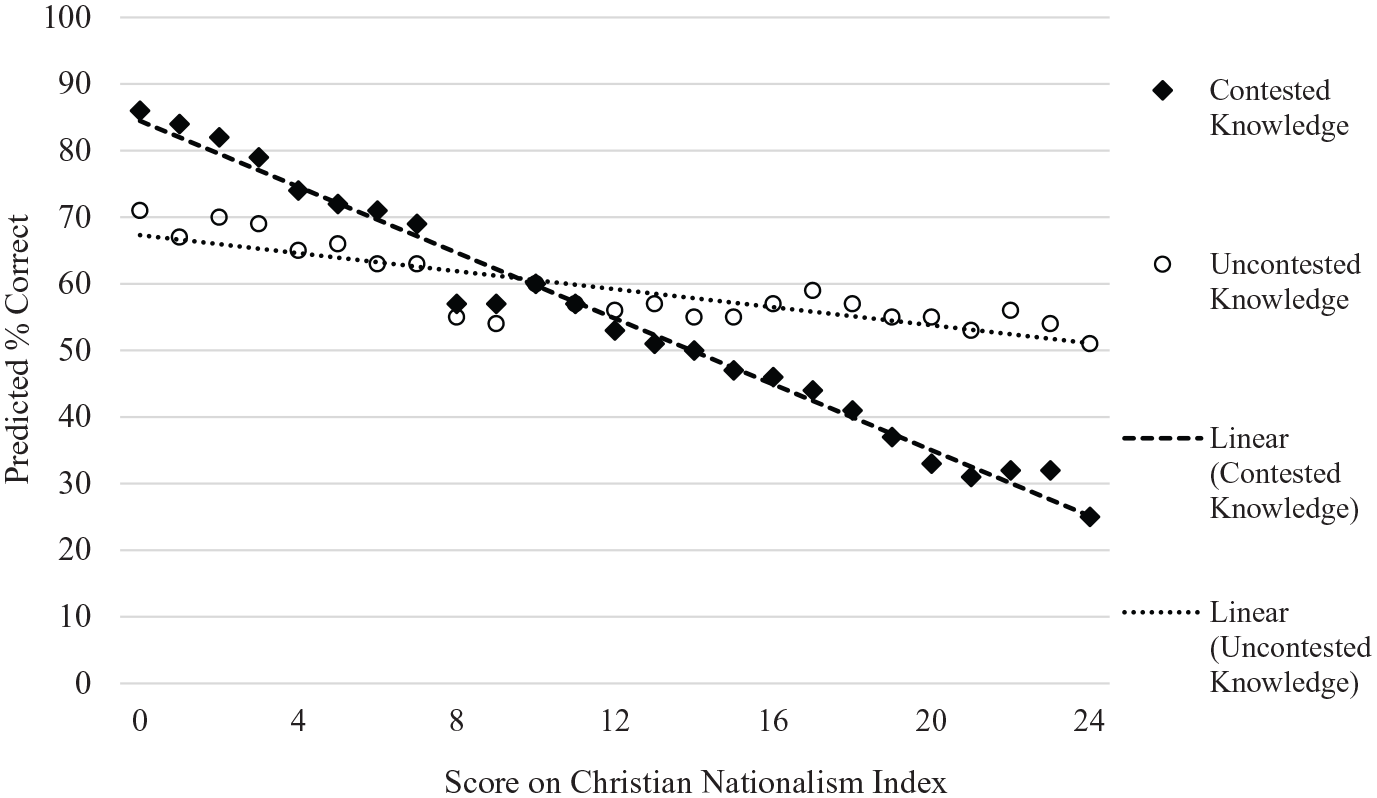
Predicted correct percentage on contested and uncontested scientific knowledge across values of Christian nationalism.
Robustness checks
We ran series of robustness checks in order to affirm that our findings were not subject to variations in measurement, model specification, or omitted variable bias. For example, reasoning that “don’t know” answers might also tell us something about culture war reasoning and scientific truth claims (see Guhin, 2016), we ran ancillary analyses predicting “don’t know” response patterns to our science questions and found that Christian nationalism was only modestly associated with selecting “don’t know” at the bivariate level. When we predict selecting “don’t know” on contested or uncontested science questions, Christian nationalism is unassociated with selecting “don’t know” on uncontested science questions and positively associated with selecting “don’t know” on contested science questions, but only at the .05 level. We also tested associations presented in Table 3 when we removed respondents who selected “don’t know” and this did not change the overall patterns or strength of our findings. Ultimately, these analyses suggest that Christian nationalism was not particularly related to whether respondents admitted they didn’t know the correct answer.
Second, because education was theorized to be such an important predictor of correct answers on scientific knowledge, we recoded educational attainment as a series of dummy variables. The results in our final models were virtually identical in both strength and statistical significance (see Appendix Table 2A). Although we follow precedent in using OLS regression as a modeling estimation strategy here (see Sherkat, 2011), we recognize that these could also be understood as proper count variables, and thus we estimated models using Poisson and negative binomial regression models. Again, in the final models, Christian nationalism remains a strong and significant negative predictor of correct answers on contested scientific knowledge (see Appendix Table 3A).
Finally, we also included a measure of views about the Bible from wave 1 of the PDES. Because of missing data on this measure (it was only asked of a subsample in the survey) the sample size was reduced, and thus, we opted to use the larger sample with more cases in the main analysis. However, when we include this measure in our final models (Model 4 of Table 3) we find the results are substantively the same on our key measures (see Appendix Table 4A). Christian nationalism is still a strong, negatively significant predictor of Americans’ correct answers on contested scientific knowledge, and in fact, ranks higher in magnitude than Bible views. The only difference is that being a Catholic versus being a born-again Protestant has a slightly stronger (positive) association with answering correctly on questions of contested scientific knowledge. This may suggest that the intellectual subculture of Catholicism (compared with born-again Protestants) places far less emphasis on preserving biblicist myths about creation, and this difference comes into greater relief when other factors like Bible beliefs, religiosity, and Christian nationalism are held constant.
7. Discussion and conclusion
Epistemic conflict matters, but in a different way than classical theorizing about conflicts between science and religion in the social sciences presumed. Rather than an inherent epistemic conflict with science, disputes over science and religion are cultural disputes that involve subcultural, propositional epistemic conflicts. Approaching the topic from the vantage of the sociology of knowledge systems—and hence an eye toward “folk epistemologies”—we can reconcile how conflicts between science and religion are culturally specific rather than universal, as well as how localized disputes over apparent issues of epistemology are reflections of disputes over cultural power. Focusing on Americans’ answers to questions regarding propositional science claims that are both religiously contested and uncontested, we find that Christian nationalism (as an ideology singularly oriented around contention for cultural dominance) is unrelated to Americans’ answers on uncontested science questions, but is the strongest predictor that Americans fail to select correct answers on contested science questions.
Our findings make an important contribution to our understanding of the link between religion and science in the United States. It is clear that rather than thinking of religion and science writ large, specific points of intersection between these social institutions should be examined in relation to subcultural understanding of knowledge systems. Furthermore, a focus on localized knowledge systems necessarily implies looking for and making connections to power, politics, and social status. Empirically, Christian nationalism is the key to understanding conflicts over science and religion in the contemporary United States. Accordingly, research on populations both inside and outside the United States should examine and account for this publicly oriented dimension of religion and politics.
Several data limitations should be acknowledged in order to chart a path for future studies. Although we tested our Christian nationalism index from earlier waves of the PDES (Waves 1–3 predicting the Wave 4 outcome) and the results were substantively identical, it is possible that the association between Christian nationalism and Americans’ beliefs about contested propositional science claims are bidirectional, with earlier inculcated beliefs about Creationism (perhaps from being raised in a fundamentalist home) strengthening a belief that one needs to fight for Christianity’s epistemic dominance in society. More likely, however, is that these views are inculcated as part of the same subcultural ideology, and this is consistent with our argument: conflicts between “religion” and “science” have more to do with subcultural responses to threat, thus provoking opposition when propositional science claims are perceived to threaten one’s claim to cultural supremacy (reflected in Christian nationalist ideology).
Even so, the possibility of bidirectionality suggests that future studies should consider the role of socialization and experience for disentangling the complex relationship between what is inculcated as scientific reality and Americans’ beliefs about the supremacy of their own religio-cultural views. Another potential limitation worth addressing in future studies would be that we are unable to examine views toward “science” or “scientists” generally as a potential mediator. Following our theoretical argument, it is possible that Christian nationalism influences Americans’ responses on contested scientific claims through distrust in scientists, whom many may perceive to have a liberal/secular mindset (Mann and Schleifer, 2020; Simpson and Rios, 2019). Future studies would ideally include measures for Americans’ confidence in scientists to consider this possibility.
Although we are unaware of available data on this topic, it is worth considering what the future of these associations might look like over time. O’Brien and Noy (2020) have recently demonstrated that political partisanship has polarized Americans’ confidence in science and religion. Specifically, compared with Democrats, Republicans have grown more confident in religious leaders, while Democrats have grown relatively more confident in scientists. Given that our findings map onto a view that “scientific knowledge” is defined within contested cultural and political space, we would anticipate that while the most religiously and politically conservative Americans (of whom Christian nationalists are the chief representatives) would not differ from others in their understanding of uncontested scientific claims, there would be growing differences in Americans’ responses to contested scientific claims. That is, compared with other Americans, those higher on Christian nationalism would be increasingly likely to reject statements about the Big Bang, evolution, natural selection, and continental drift, seeing these as salient markers of their own tribal identity. This possibility would suggest an increasingly intractable rift between Americans, not only in their views about policy and economics, but who presents reliable information about the nature of reality.
While issues involving scientific literacy among mass publics are important in their own right, they become even more clearly consequential in particular circumstances, such as the ongoing COVID-19 pandemic. As political leaders and medical experts attempt to mobilize the public to engage in transmission mitigation behaviors, Christian nationalist ideology has become an impediment to compliance (Perry et al., 2020a) and an ideological framework for resisting mitigation politically (Perry et al., 2020b). Moving forward, the connection between Christian nationalism and anti-vaccination attitudes (Whitehead and Perry, 2020b) will also become more consequential. In this sense the culture war conflicts over religion and science in the United States have moved out of the museum into the morgue.
Supplemental Material
sj-pdf-1-pus-10.1177_09636625211006271 – Supplemental material for Ignorance or culture war? Christian nationalism and scientific illiteracy
Supplemental material, sj-pdf-1-pus-10.1177_09636625211006271 for Ignorance or culture war? Christian nationalism and scientific illiteracy by Samuel L. Perry, Joseph O. Baker and Joshua B. Grubbs in Public Understanding of Science
Footnotes
Funding
The authors disclosed receipt of the following financial support for the research, authorship, and/or publication of this article: Funding for data collection was provided by the Charles Koch Foundation. The funder played no role in survey design or data interpretation.

Supplemental material
Supplemental material for this article is available online.
Notes
Author biographies
References
Supplementary Material
Please find the following supplemental material available below.
For Open Access articles published under a Creative Commons License, all supplemental material carries the same license as the article it is associated with.
For non-Open Access articles published, all supplemental material carries a non-exclusive license, and permission requests for re-use of supplemental material or any part of supplemental material shall be sent directly to the copyright owner as specified in the copyright notice associated with the article.
