



Abstract
The current study investigated how individuals process aggressive and humorous video messages communicating childhood vaccination and climate change. Employing psychological reactance, message discounting and expectancy violation, we built a theoretical model that explains the effects of communication styles on individuals’ activism intentions. Two online experiments in the United States (N = 441 and N = 533) using self-created videos on the topics of childhood vaccination and climate change were conducted to examine this model. The results showed that both perceived aggressiveness and humorousness of the videos led to higher message discounting, which then resulted in stronger activism intentions. Perceived aggressiveness led to higher expectancy violation, while perceived humorousness led to lower expectancy violation, which negatively affected activism intentions. The role played by psychological reactance was inconsistent across the two contexts. The findings provide theoretical implications for understanding how individuals process aggressive and humorous communication styles, especially in relation to discussions on science issues.
Keywords
In the current digital era, science communication is not limited to traditional media channels. The Internet has become a leading source of information on societal issues such as climate change and public health (Brossard, 2013). In particular YouTube videos function as an important source of information that is accessible and popular (Smith and Joffe, 2013). Researchers have acknowledged that YouTube videos not only fulfill entertainment purposes but also engage the public with science issues such as climate change (Shapiro and Park, 2015). A growing amount of content on social media using different communication styles, such as humor, attracts attention, and drives more traffic to these sites (Anderson and Becker, 2018). As individuals seek and receive science information via YouTube videos, they encounter different communication styles used by YouTubers, which may differ from the science information they receive from news media or classrooms. It is unclear how these different styles affect viewers’ opinions about the issue being communicated.
Humor, aggression, and the combination of both are communication styles commonly observed in discussions over controversial science issues. For controversial science topics like genetically modified organisms, climate change, and childhood vaccination, we can find magazine columns, science blogs, or YouTube videos that debunk misinformation or advocate for science aggressively (e.g. Kaulbars, 2008; ZDoggMD, 2018). We can also find messages that deliver similar content in a humorous way (e.g. Veritasium, 2014). Although they seem to be two different styles of communication, many messages use some level of aggression in delivering humor, such as satire or teasing. In the meantime, some humorous messages can be seen as offensive or inappropriate, such as disparaging jokes (Graefer et al., 2019). A paucity of research has looked at aggressive and humorous communication styles conveyed through videos in science communication, and how these styles may influence the audience’s reactions. Such research is needed because persuasive messages, if not well crafted, can easily lead to unintended effects that may work against the communicators’ intent (Cho and Salmon, 2007).
In the current study, we present a theoretical framework with an attempt to explain the process of how communication styles are perceived. The framework we develop employs three plausible information-processing mechanisms that encompass affective, cognitive, and relational aspects—psychological reactance, message discounting, and expectancy violation—to explain the effects of different communication styles.
1. Communication styles
Communication styles are described as the characteristic ways people send “verbal, paraverbal and nonverbal signals in social interaction” (De Vries et al., 2009: 2). Communication styles are an important element of communication strategies (Sparks et al., 1998), but research has not yet fully explored their effects on video communication about controversial science topics. In the current study, we investigate aggressive and humorous communication styles in a YouTube video setting. In the following sections, we review the literature on these two types of communication styles and the mechanisms we propose to explain the effects of these styles.
Aggressive style
Opposite to polite or warm communication, aggressive communication styles use utterances in language to deviate from a neutral position and demean anyone who disagrees with the communicator’s opinion (Infante, 1987). We adopt the definition that regards aggressive communication styles as a style of language that combines intense language with content not only arguing the subject but also attacking a target or targets (Yuan et al., 2018). In general, researchers have found that aggressive communication styles are associated with mixed effects on reactions to the message and the messenger. Because the aggressive approach aims to defame competitors by demeaning them and highlighting their weaknesses, such messages are found to be more intensive than the nonaggressive approach (McNair, 2011). In addition, aggressive messages are found to be more entertaining (Mutz and Reeves, 2005), more engaging (Brooks and Geer, 2007), and of higher quality as long as it does not violate the audience’s expectations (Yuan et al., 2018). In contrast, the negative effects of aggressive communication are also well-documented. Aggressive messages can jeopardize the communicator’s credibility (Thorson et al., 2010) and trustworthiness (Lau et al., 2007), and therefore influence the relationship between communicator and audience (Ferreira et al., 2021; König and Jucks, 2019). Individuals are less likely to have the desired behavioral intentions after exposure to an aggressive message that is meant to be persuasive (Yuan and Lu, 2020).
Affiliative and aggressive humorous style
Humor plays an important role in many aspects of our lives, such as advertising, politics, and health communication (Walter et al., 2018). Although humorous styles are often excluded from systematic reviews of the inventory of communication styles (De Vries et al., 2011; Edwards and Noller, 1998), they can be recognized as a communication style (Bippus et al., 2012). The broader concept—humor—contains many aspects including individuals’ propensity (i.e. sense of humor). A meta-analysis of humor effects on persuasion showed that humor has a limited effect on attitude and behavioral intention (Walter et al., 2018). In addition, Skurka et al. (2018) found that while perceived humor can help increase proenvironmental behavioral intentions, humor resulted in decreased perceived message informativeness.
The concept of humor can be further understood through the affiliative-aggressive dimension. Affiliative humor is defined as a humorous approach to eliciting laughter and other forms of amusement by reducing tension and conflicts during interactions (Ziv, 1984). Aggressive humor is described as “any humor that derogates or provides negative information about someone or something” (Janes and Olson, 2000: 474), examples of which include satire, teasing or sarcasm, or good-humored mockery. Several studies have investigated the effects of two types of humor. One study showed that humor and aggression independently affected individuals’ risk perception and behavioral intentions toward climate change, but there was little or no effect from a satirical style, defined as a mix of humor and indignation (Skurka et al., 2019). Some studies which investigated political satire also suggested the effects of such a style on persuasion or other communication outcomes (Boukes et al., 2015; Holbert et al., 2011; Nissenbaum and Shifman, 2020), which we review in depth below.
2. Processing of aggressive and humorous messages
Researchers who study aggressive communication and humor have adopted different concepts of message processing in attempts to explain the effects of these communication styles. However, to our knowledge, these two bodies of literature rarely overlap in terms of their assessments of message effects. As we have reviewed in previous sections, these two styles may merge and be presented in an integrated way (aggressive humor or humorous aggression). Here, we integrate prior literature on psychological reactance, discounting, and expectancy violation that has been separately applied to the understanding of humorous and aggressive styles. The rationale is that these processing factors cover the affective, cognitive, and relational reactions of individuals when they view these messages, and integrating these factors provides a comprehensive understanding of the processing mechanisms.
Psychological reactance
The first factor—from an affective perspective—is psychological reactance, which describes how individuals react to a persuasive message when it attempts to affect their decisions. Psychological reactance is defined as “the motivational state that is hypothesized to occur when a freedom is eliminated or threatened with elimination” (Brehm and Brehm, 1981: 37). Psychological reactance includes two dimensions: the affective response such as anger, and the cognitive response, which covers thoughts from negative to positive (Dillard and Shen, 2005). Psychological reactance theory explicitly presents the role of reactance as a mechanism that explains the effects of a threat to freedom on different outcomes such as attitude and behavior (Dillard and Shen, 2005). In the theory, freedom refers to individuals’ knowledge or ability to exercise behavior freely, which includes any feeling, emotion, attitude, and action (Shen, 2015). More specifically, the argument is that any force on an individual (such as messages aimed at changing people’s minds or calling for actions) that makes it difficult for that individual to exercise freedom would be a threat (Brehm and Brehm, 1981), and this threat would be the antecedent of psychological reactance. Researchers found that the rise of psychological reactance contributes to the rejection of messages, and is negatively associated with individuals’ corresponding attitudes and behaviors (Dillard and Shen, 2005; Leventhal, 1970).
The concept of psychological reactance or part of it has been applied to both aggressive and humorous styles. For instance, in health communication contexts, Miller et al. (2007) found that controlling messages, which are similar to aggression, lead to more anger and more negative assessments of message fairness. Similar findings were also observed in the context of climate change messaging (Yuan and Lu, 2020). When it comes to humorous messages, a study on persuasive health messages found that humor decreases reactance through eliciting positive emotions (Skalski et al., 2009). In addition, Nabi et al. (2007) found that humor in social issue messages can lead to less counterarguing, which is often conceptualized as cognitive reactance. However, no studies have assessed aggressive and humorous styles in one study and directly compared their effects on psychological reactance. The rationale is that aggressive styles which deviate from neutral styles could be perceived as offensive, which is likely to trigger a perceived threat to one’s freedom. Meanwhile, affiliative humor may ease the tension (Lynch, 2002) and result in less psychological reactance. In the current study, we propose that individuals may have different levels of psychological reactance in response to aggressive and humorous messages. In addition, as is demonstrated by models built in previous studies (Nabi et al., 2007; Skurka et al., 2018), we predict that individuals’ perceptions of the message will drive potential changes in psychological reactance. Specifically, aggressive and humorous messages will influence psychological reactance by affecting individuals’ perceived aggressiveness and humorousness of the message. Therefore, we predict that:
However, there is a lack of research on the relationship between aggressive humor and psychological reactance. Therefore, we propose a research question instead:
Message discounting
The second factor of message processing—from a cognitive perspective—is message discounting, which explores how individuals perceive the intended information contained in the video. Message discounting is often discussed with the use of humorous or satirical messages (LaMarre et al., 2014; Nabi et al., 2007). Message discounting is a cognitive process in which individuals cued by the message style (humor in most discussions) discount the argument as just a “joke” and take the message less seriously (Nabi et al., 2007). Different from psychological reactance, message discounting solely focuses on the cognitive aspect of information processing. Nabi et al. (2007) found that humorous messages may not help form judgments of important issues because the message may seem to serve the purpose of entertaining instead of informing.
Upon reviewing the literature, we argue that message discounting is an important factor that should be considered while assessing the effects of these styles. This is because the elements of aggressive communication including emotional and intensive language and attacks on others may make the message on serious issues—such as childhood vaccination and climate change—appear less serious. Thus, we propose hypotheses to examine the effects of aggressive, affiliative humor, and aggressive humor styles on message discounting.
Expectancy violation
The third factor in information processing—from a relational perspective—is expectancy violation, which explores how individuals compare the message with what they expect. Expectancy violation is found to be an important mechanism explaining the effects of aggressive styles (Yuan et al., 2019) from a communicator–audience relationship perspective. The expectancy violation theory (EVT; Burgoon and Hale, 1988) provides the theoretical foundation. EVT states individuals’ expectations toward the behaviors of others, which is considered a type of belief, can be violated if the behaviors deviate from their expectation range, and the violation can cause arousal and thus accelerate attitudinal and behavioral change (Burgoon and Miller, 1985). Several studies have provided empirical evidence for this argument (Bain et al., 2012; Johnson, 2012; Yuan et al., 2018). Expectancy violation has been applied to understand political humor (Walther-Martin, 2015) as well as in the teacher–student communication (Sidelinger, 2014). In the current study, we expect that individuals’ perceptions of aggressive and humorous messages determine the extent to which they think the messages violate their expectations via perceived humorousness or aggressiveness.
3. Effects on activism intentions
In the contexts of the current study—childhood vaccination and climate change—a major outcome of interest is individuals’ activism intentions. Tremendous efforts have been devoted to persuading people to accept childhood vaccination and climate change and the efforts have largely come from individual members of the community (Schoeppe et al., 2017). Importantly, instead of focusing on individuals’ private-sphere decisions, such as vaccinating their children or recycling, the current study focuses on the public sphere, which we describe as activism behaviors, such as signing petitions to support mandatory vaccination or writing to local newspapers or other media outlets in support of climate change mitigation (Lu and Yuan, 2021).
Studies on psychological reactance (Dillard and Shen, 2005), message discounting (Nabi et al., 2007), and expectancy violation (Yuan and Lu, 2020) have all provided evidence that these aspects of message processing can influence behavioral intentions. In brief, these studies suggested that psychological reactance and expectancy violation, as processing factors, are negatively associated with behavioral intentions promoted in messages, while message discounting is positively associated with behavioral intentions. Therefore, we predict that how individuals process aggressive and humorous messages, including their psychological reactance, message discounting, and expectancy violation, will affect their willingness to engage in activism behaviors in support of childhood vaccination and climate change mitigation:
The conceptual framework proposed in this study is presented in Figure 1.

Conceptual framework.
4. Method
Overall design
Data from two studies were analyzed to investigate the effects of three styles of video messages: aggressive, affiliative humor, and aggressive humor, in comparison to a neutral message style. A between-subjects experiment (with four conditions) was designed for each study. The two studies applied the same model but were in two different contexts: childhood vaccination and climate change. Messages in both studies were designed as videos simulating a YouTuber talking about either vaccines or climate change with different styles.
Participants
Study 1
An online experiment (N = 450) was conducted via MTurk using four styles (affiliative humor, aggressive humor, aggression, and neutral) of video messages communicating about childhood vaccination. Each participant was compensated with $0.8. A total of 441 participants in the United States completed the survey and answered the attention check questions correctly (e.g. “Which of the following is a type of fruit” and “Please select strongly disagree”). Two hundred twenty-eight participants were male, 206 were female, 4 were transgender, and 3 identified their gender as other. The average age was 38 years old (SD = 11.11). About 71% of the participants identified as White, 8.6% African American, 11.8% Asian, and 6.8% Hispanic or Latino. In terms of education, the median highest education level was a bachelor’s degree.
Study 2
An online experiment (N = 550) was conducted via Prolific using the same four communication styles in the context of climate change. Each participant was compensated with $1.5 via the platform. A total of 533 participants in the United States completed the survey and answered the attention check questions correctly. Of these participants, 240 were male, 281 were female, 3 were transgender, and 3 identified their gender as other. The average age was 35 years old (SD = 13.27). About 69% of the participants identified as White, 5.8% African American, 11.8% Asian, and 7.3% Hispanic or Latino. In terms of education, the median highest education level was a bachelor’s degree.
Stimuli
The research team wrote four scripts that were appropriate for a YouTube talk show (a single host talking about one topic) on the topics of childhood vaccination and climate change. The messages of Study 1 included information such as the danger of not vaccinating one’s children and the debunking of misinformation on this topic. The central content of these four scripts was the same, but the communication styles were manipulated to reflect the four styles examined in the study. Based on the definitions we have discussed above, the aggressive condition included intensive languages and uncivil utterances that attacked antivaxxers, the affiliative humor condition included jokes or funny languages that did not attack others, and the aggressive humor condition mainly included satire to expose or criticize antivaxxers’ stupidity. A portion of the script was revised based on some parts of late-night talk shows such as Jimmy Kimmel Live (2015, February 27) and Last Week Tonight with John Oliver (2017, June 26). Similarly, in Study 2, the target of the attack is climate change deniers. The neutral condition presented the central content more objectively and less emotionally that did not resemble any of the other three communication styles. Aggressive and humorous languages were removed in the neutral condition. Messages in Study 2 were manipulated similarly with the central content focusing on climate change mitigation. Students at the first author’s university acted in, filmed, and edited the video as a fictitious YouTube channel — Science with Amy (see supplemental material).
Procedure
Study 1 and Study 2 followed a similar procedure. Participants were asked to watch a YouTube video and provide some feedback on this video. To ensure that participants could hear the audio from the video, we included a screening question at the beginning of the survey that asked participants to write down a number they heard from playing a brief audio record. Participants who wrote the number correctly were then randomly assigned to watch one of the four YouTube videos, after which they proceeded to complete a survey including key measures detailed in the next section.
Key measures
Perceived humorousness
Participants responded to the question, “Considering the style of the video, how humorous would you say this video was?” with the response options ranging from 1 = Not at all to 7 = Extremely (Study 1: M = 2.74, SD = 1.57; Study 2: M = 2.36, SD = 1.51). 1
Perceived aggressiveness
Participants responded to the question, “Considering the style of the video, how aggressive would you say this video was?” with the response options ranging from 1 = Not at all to 7 = Extremely (Study 1: M = 3.13, SD = 1.72; Study 2: M = 3.00, SD = 1.91).
Psychological reactance
This item included two subscales. Anger at the YouTuber. Participants indicated how much they felt irritated/angry/outraged at the YouTuber on a 7-point scale (1 = Not at all to 7 = Extremely; Shen, 2011). We created a composite scale by averaging the three items (Study 1: α = .91; M = 1.93, SD = 1.44; Study 2: α = .81; M = 1.64, SD = 1.12). Counterarguing: Participants indicated how much they agreed or disagreed with four statements on a 7-point scale, which was used for all agreement questions in this study. Sample items included “I found myself actively agreeing with the speaker’s points” (reverse-coded) and “I was looking for flaws in the speaker’s arguments.” (Nabi et al., 2007). We created a composite scale by averaging the four items (Study 1: α = .80; M = 2.70, SD = 1.32; Study 2: α = .80; M = 2.56, SD = 1.24). Following previous research (Dillard and Shen, 2005; Shen, 2011), we created a psychological reactance scale by averaging the scores of the anger-at-the-YouTuber scale and the counterarguing scale (Study 1: rSB = .95; M = 2.32, SD = 1.23; Study 2: rSB = .75; M = 2.10, SD = 1.05).
Discounting
Participants indicated how much they agreed or disagreed with four statements, including “The speaker of the video was just joking,” and “The message was intended more to entertain than to persuade” (Nabi et al., 2007). We created a composite scale by averaging the four items (Study 1: α = .81; M = 2.37, SD = 1.17; Study 2: α = .68; M = 2.42, SD = 1.10).
Expectancy violation
Participants indicated how much they agreed or disagreed with the following statements: “The speaker’s message was appropriate as a way we talk about science issues like childhood vaccination/climate change,” “The speaker’s message was spoken in a way I would expect when we talk about science issues like childhood vaccination/climate change,” and “The speaker used a normal style to talk about science issues like childhood vaccination/climate change.” (J. Burgoon and Walther, 1990). We reverse coded all three items and averaged them into a composite scale (Study 1: α = .89; M = 2.94, SD = 1.51; Study 2: α = .88; M = 3.12, SD = 1.61).
Activism intentions
Participants indicated how likely they were to perform four behaviors in the future on a 7-point scale from 1 = Extremely unlikely to 7 = Extremely likely. In Study 1, sample items included “sign petitions supporting mandatory vaccination in my state,” “write to local newspapers or other media outlets in support of childhood vaccination,” and “donate to provaccination organizations” (Bain et al., 2012). We created a composite scale by averaging these items (α = .90; M = 3.42, SD = 1.74). Activism intentions in Study 2 were similarly worded but toward proenvironmental behaviors (e.g. “Sign petitions supporting pro-environmental bills or regulations”). We also created a composite scale by averaging these items in Study 2 (α = .88; M = 3.66, SD = 1.71).
Analyses
First, we ran an ordinary least squares regression model to examine the total effects of the three style conditions (compared to the neutral condition) on activism intentions. We created three dummy variables for the experimental conditions (i.e. aggressive, affiliative humor, aggressive humor) using the neutral condition as the reference group and used them as the independent variables predicting activism intentions in the model. Then, we conducted sequential mediation analyses using the PROCESS macro for SPSS with 10,000 bootstraps resamples and a 95% confidence interval (CI; Hayes, 2017). Because the numbered models provided by PROCESS do not match exactly the conceptual model in Figure 1, we created a customized model (Hayes, 2017). Specifically, based on the conceptual model in Figure 1, we used the three dummy variables for the experimental conditions as the independent variables predicting all other variables in the model. Four models were run. Three models used perceived humorousness and aggressiveness as mediators and psychological reactance, message discounting, and expectancy violation as the outcome, respectively. A fourth model used activism intentions as the outcome with perceived humorousness and aggressiveness, psychological reactance, discounting, and expectancy violation serving as the mediators with their sequence matching what is shown in Figure 1. Direct paths between perceived humorousness and aggressiveness and activism intentions were also created in this fourth model.
5. Results
Manipulation checks
In both Study 1 and Study 2, we found that compared to the neutral condition, the aggressive condition (Study 1: B = 1.23, SE = .20, p < .001; Study 2: B = 1.00, SE = .17, p < .001), the affiliative humor condition (Study 1: B = .93, SE = .20, p < .001; Study 2: B = 1.36, SE = .17, p < .001), and the aggressive humor condition (Study 1: B = 1.56, SE = .20, p < .001; Study 2: B = 1.72, SE = .17, p < .001) all increased perceived humorousness. 2 When it comes to the effects on perceived aggressiveness, in both studies the aggressive condition (Study 1: B = 2.21, SE = .21, p < .001; Study 2: B = .26, SE = .19, p < .001), and the aggressive humor condition (Study 1: B = .88, SE = .20, p < .001; Study 2: B = 1.79, SE = .19, p < .001) increased perceived aggressiveness. In addition, the affiliative humor condition in Study 1 (B = .42, SE = .20, p = .038) also increased perceived aggressiveness, but the same condition in Study 2 (B = .26, SE = .19, p = .171) did not significantly influence perceived aggressiveness. Therefore, the manipulation of each condition was successful.
Effects of experimental conditions on activism intentions
In Study 1, both the affiliative humor condition (B = −.47, SE = .23, p = .043) and the aggressive humor condition (B = −.53, SE = .23, p = .023) led to weaker activism intentions than the neutral condition. In comparison, the aggressive condition (B = −.39, SE = .24, p = .099) did not differ from the neutral condition. In Study 2, the aggressive condition (B = −.03, SE = .21, p = .875), the affiliative humor condition (B = −.27, SE = .21, p = .205), or the aggressive humor condition (B = .12, SE = .21, p = .573) did not differ from the neutral condition in influencing activism intentions.
Hypotheses testing
When it comes to psychological reactance (H1a, H1b, and RQ1), we found that in Study 1, perceived humorousness did not mediate the effects of any experimental conditions on psychological reactance (aggressive condition: B = −.04, SE = .05, 95% CIs = −.14 to .07; affiliative humor condition: B = −.03, SE = .04, 95% CIs = −.11 to .05; aggressive humor condition: B = −.05, SE = .07, 95% CIs = −.19 to .08). However, in Study 2, perceived humorousness mediated the effects of all experimental conditions on psychological reactance (aggressive condition: B = −.14, SE = .04, 95% CIs = −.23 to −.06; affiliative humor condition: B = −.19, SE = .06, 95% CIs = −.30 to −.08; aggressive humor condition: B = −.24, SE = .07, 95% CIs = −.38 to −.11). In addition, in Study 1, perceived aggressiveness mediated the effects of all experimental conditions on psychological reactance (aggressive condition: B = .78, SE = .12, 95% CIs = .56 to 1.02; affiliative humor condition: B = .15, SE = .08, 95% CIs = .01 to .30; aggressive humor condition: B = .31, SE = .08, 95% CIs = .16 to .48). In Study 2, perceived aggressiveness mediated the effects of the aggressive condition (B = .76, SE = .10, 95% CIs = .58 to .95) and the aggressive humor condition (B = .51, SE = .07, 95% CIs = .37 to .66) on psychological reactance, but not the affiliative humor condition (B = .07, SE = .05, 95% CIs = −.02 to .17). Therefore, H1a was supported in both studies. H1b was supported in Study 2, but not Study 1.
As for message discounting (H2a–H2c), we found that in both studies, perceived humorousness mediated the effects of all experimental conditions on discounting (Study 1: aggressive condition: B = .25, SE = .07, 95% CIs = .13 to .40; affiliative humor condition: B = .19, SE = .05, 95% CIs = .09 to .31; aggressive humor condition: B = .32, SE = .08, 95% CIs = .18 to .48; Study 2: aggressive condition: B = .10, SE = .04, 95% CIs = .03 to .18; affiliative humor condition: B = .14, SE = .05, 95% CIs = .04 to .24; aggressive humor condition: B = .17, SE = .06, 95% CIs = .05 to .30). In addition, in Study 1, perceived aggressiveness mediated the effects of all experimental conditions on discounting (aggressive condition: B = .31, SE = .10, 95% CIs = .13 to .52; affiliative humor condition: B = .06, SE = .04, 95% CIs = .00 to .14; aggressive humor condition: B = .12, SE = .05, 95% CIs = .04 to .23). In Study 2, perceived aggressiveness mediated the effects of the aggressive condition (B = .36, SE = .09, 95% CIs = .20 to .54) and the aggressive humor condition (B = .24, SE = .06, 95% CIs = .13 to .36) on discounting, but not the affiliative humor condition (B = .04, SE = .02, 95% CIs = −.01 to .09). Therefore, H2a–H2c were supported in both studies.
In terms of expectancy violation (H3a–H3c), we found that in both studies, perceived humorousness mediated the effects of all experimental conditions on expectancy violation (Study 1: aggressive condition: B = -.24, SE = .07, 95% CIs = −.39 to −.12; affiliative humor condition: B = −.18, SE = .06, 95% CIs = −.30 to −.09; aggressive humor condition: B = −.31, SE = .08, 95% CIs = −.48 to −.16; Study 2: aggressive condition: B = −.24, SE = .06, 95% CIs = −.37 to −.13; affiliative humor condition: B = −.33, SE = .07, 95% CIs = −.48 to −.19; aggressive humor condition: B = −.41, SE = .09, 95% CIs = −.59 to −.25). In addition, in Study 1, perceived aggressiveness mediated the effects of all experimental conditions on expectancy violation (aggressive condition: B = .80, SE = .13, 95% CIs = .56 to 1.06; affiliative humor condition: B = .15, SE = .08, 95% CIs = .01 to .31; aggressive humor condition: B = .32, SE = .08, 95% CIs = .17 to .50). In Study 2, perceived aggressiveness mediated the effects of the aggressive condition (B = 1.27, SE = .13, 95% CIs = 1.02 to 1.53) and the aggressive humor condition (B = .84, SE = .11, 95% CIs = .65 to 1.06) on expectancy violation, but not the affiliative humor condition (B = .12, SE = .08, 95% CIs = −.03 to .28). Thus, H3a was supported in both studies, but H3b was rejected in both studies. In addition, H3c was partially supported in both studies.
Regarding activism intentions (H4a–H4c), we found that in both studies, psychological reactance (Study 1: B = −.22, SE = .09, p = .012; Study 2: B = −.38, SE = .08, p < .001) and expectancy violation (Study 1: B = −.39, SE = .07, p < .001; Study 2: B = −.37, SE = .06, p < .001) were negatively associated with activism intentions, whereas discounting was positively associated with intentions (Study 1: B = .22, SE = .08, p = .006; Study 2: B = .31, SE = .07, p < .001). Therefore, H4a–c are all supported. Figures 2 and 3 present the model results of Study 1 and Study 2, respectively (see Tables 1 and 2 for path analysis details).
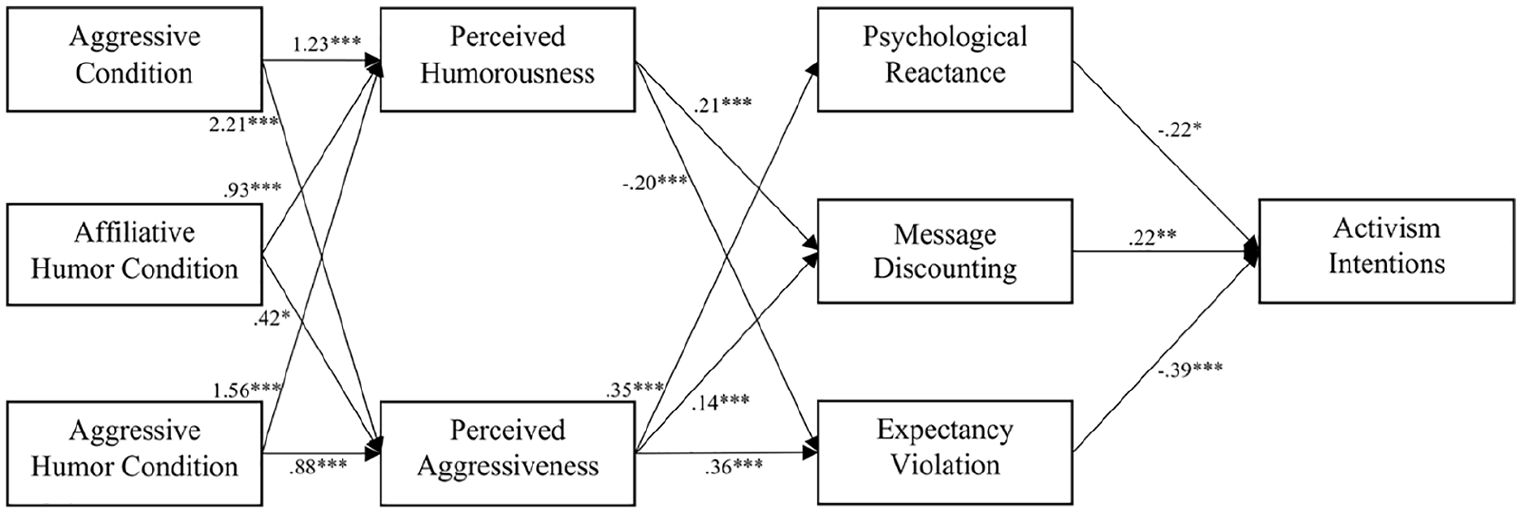
Path model from Study 1.
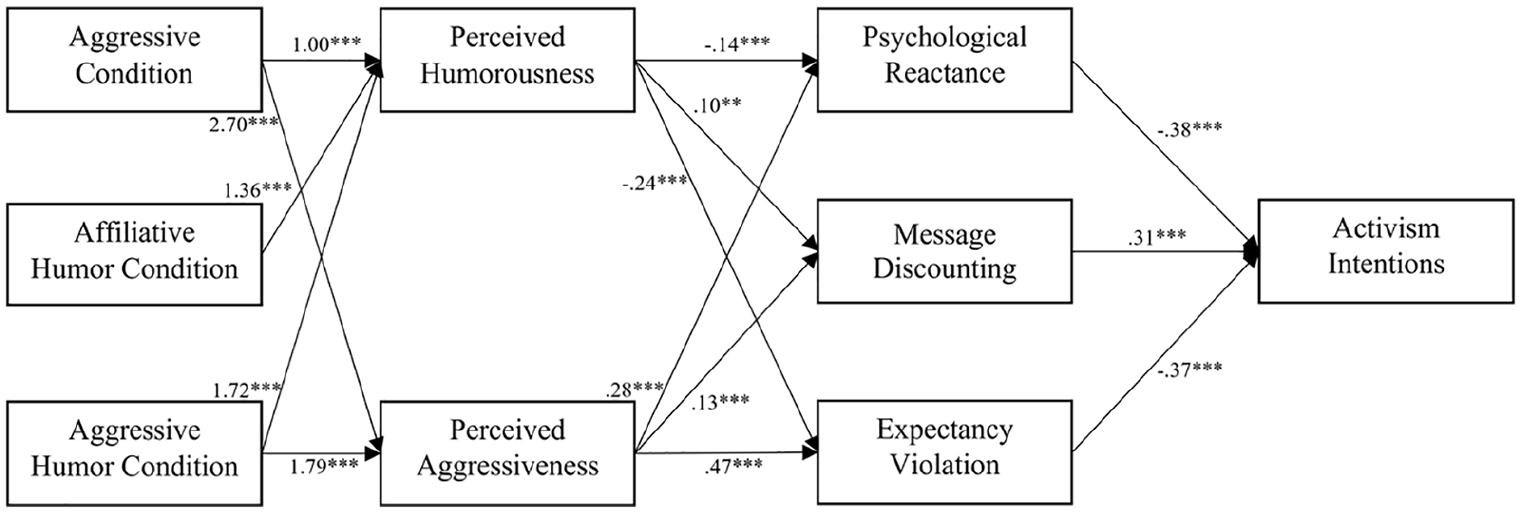
Path model from Study 2.
Indirect effect results for activism intentions in study 1.
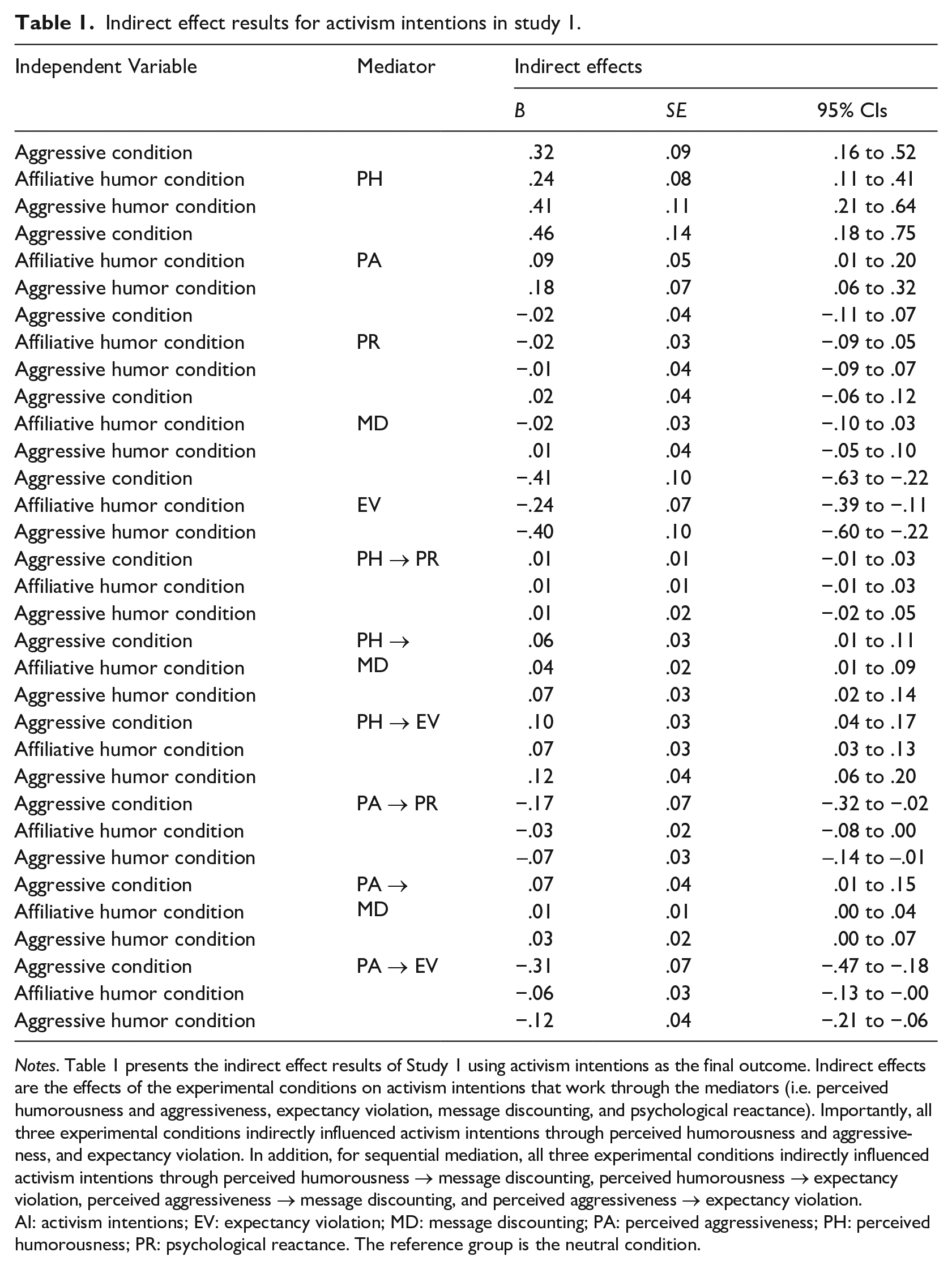
Notes. Table 1 presents the indirect effect results of Study 1 using activism intentions as the final outcome. Indirect effects are the effects of the experimental conditions on activism intentions that work through the mediators (i.e. perceived humorousness and aggressiveness, expectancy violation, message discounting, and psychological reactance). Importantly, all three experimental conditions indirectly influenced activism intentions through perceived humorousness and aggressiveness, and expectancy violation. In addition, for sequential mediation, all three experimental conditions indirectly influenced activism intentions through perceived humorousness → message discounting, perceived humorousness → expectancy violation, perceived aggressiveness → message discounting, and perceived aggressiveness → expectancy violation.
AI: activism intentions; EV: expectancy violation; MD: message discounting; PA: perceived aggressiveness; PH: perceived humorousness; PR: psychological reactance. The reference group is the neutral condition.
Indirect effect results for activism intentions in study 2.
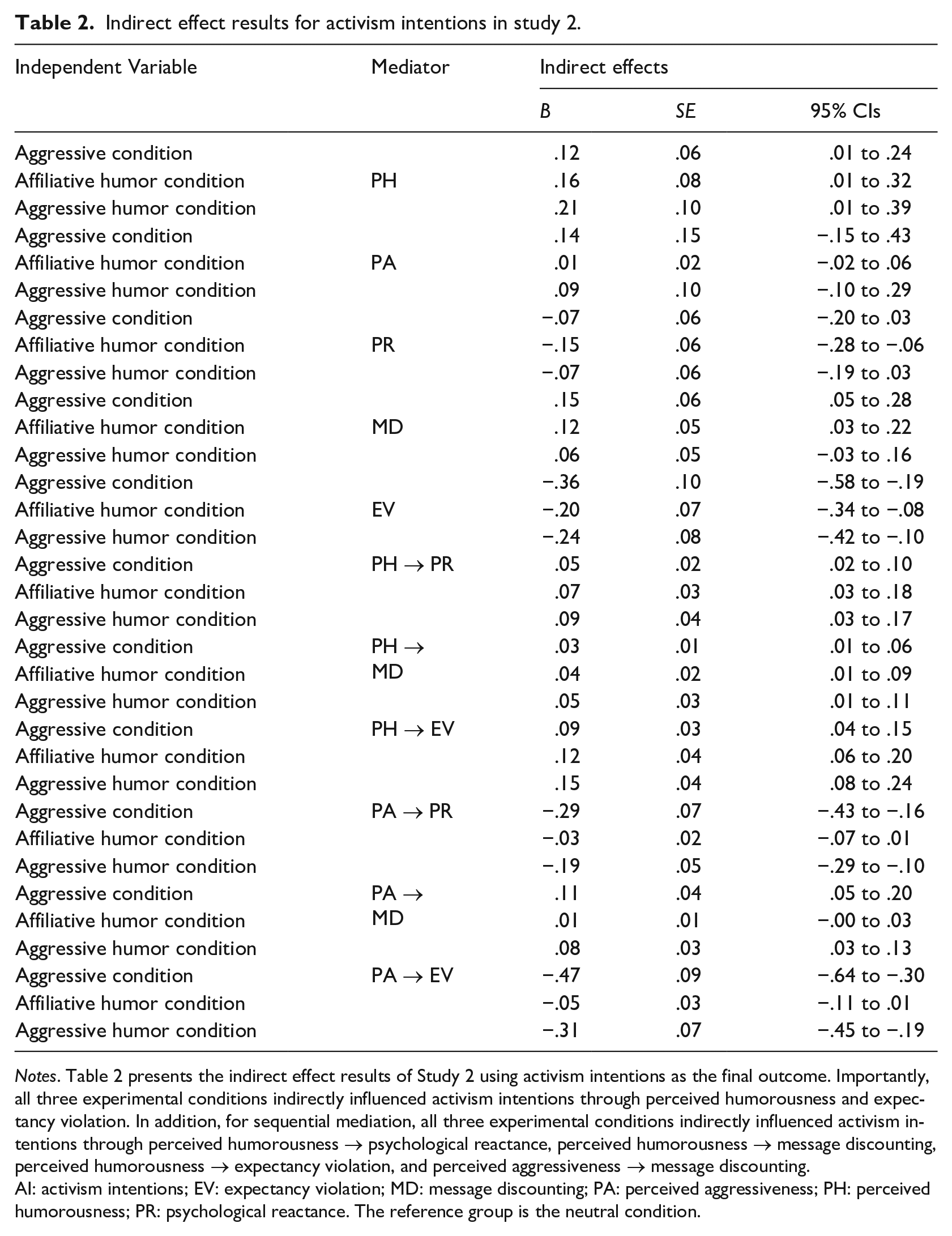
Notes. Table 2 presents the indirect effect results of Study 2 using activism intentions as the final outcome. Importantly, all three experimental conditions indirectly influenced activism intentions through perceived humorousness and expectancy violation. In addition, for sequential mediation, all three experimental conditions indirectly influenced activism intentions through perceived humorousness → psychological reactance, perceived humorousness → message discounting, perceived humorousness → expectancy violation, and perceived aggressiveness → message discounting.
AI: activism intentions; EV: expectancy violation; MD: message discounting; PA: perceived aggressiveness; PH: perceived humorousness; PR: psychological reactance. The reference group is the neutral condition.
6. Discussion
The controversy of some scientific topics, the freedom of the social media environment, and the need for viewership all contribute to the use of nonneutral communication styles. When more messages, especially visual messages like YouTube videos become available, the question for communication scholars becomes: how do communication styles affect audiences’ reactions to messages that communicate science issues? Does the use of aggression or humor affect individuals’ willingness to adopt provaccine or climate change mitigation behaviors? We developed a conceptual model which captures the affective, cognitive, and relational dimensions of information processing and set forth this study with three communication styles (aggressive, aggressive humor, and affiliative humor) in comparison to the neutral style to address these questions.
In general, the results of the total effects showed that adopting different communication styles could influence activism intentions to some degree, but the effects were limited and depended on the contexts as well. Affiliative humor and aggressive humor led to weaker activism intentions when communicating about the childhood vaccine but such differences were not observed in conversations about climate change. The limited and inconsistent total effects observed in our studies were not unexpected, considering recent meta-analyses demonstrating that in general message design choices did not make much difference to persuasiveness (O’Keefe and Hoeken, 2021) and that, in particular, humor only had a weak effect on persuasion (Walter et al., 2018). The different total effects across the two contexts could be due to the different information, including the use of different humors to discuss the two issues, which were provided in the videos. Importantly, a central tenet of our conceptual model is that different humor styles should work through a series of mediating factors to indirectly influence persuasion. As is discussed further below, our examination of these indirect pathways enriches our understanding of the underlying mechanisms accounting for the potential effects of different humor and aggressive styles on persuasion.
In support of our conceptual model, we found that these styles indirectly influenced activism intentions by influencing how individuals perceived and processed the message. Viewers had a stronger perception of humor and aggression with all three tested styles (aggressive, affiliative humor, and aggressive humor) compared with the neutral condition. Message discounting and expectancy violation were seen as two pathways that led to activism intentions in both contexts. In Study 2, psychological reactance played a more prominent mediating role than in Study 1. While our test of this conceptual model compared all three styles separately with a neutral style, the major differences were the amount of perceived aggressiveness and humorousness. Perceived humorousness seems to have effects that are more positive while perceived aggressiveness is associated with more negative impacts on persuasion.
Our findings showed that compared with the neutral style, all three tested styles increased the viewers’ perceived humorousness and perceived aggressiveness. Interestingly, when it comes to the conversation advocating for childhood vaccination, even affiliative humor was perceived as more aggressive than the neutral style. This might be because in defending childhood vaccination, any utterance used in the message is going to increase the forcefulness of the message. As reviewed in the literature section, the perception of aggressive or humorous messages is dependent on the context, with aggression seen as entertaining sometimes (Mutz and Reeves, 2005) and humor messages regarded as demeaning (DiCioccio, 2012). In addition, the perception of humorous style may not be as straightforward as the perception of an aggressive style. There are clear signals of aggressive messages including cursing, swearing, or attack on others. However, finding something humorous is largely dependent on the interpretation of the topic (Booth-Butterfield and Booth-Butterfield, 1991).
What we observed in these two studies is the mediating role of psychological reactance. In both studies, perceived aggressiveness led to greater psychological reactance. However, perceived humorousness was unrelated to psychological reactance in Study 1. In contrast, in Study 2, perceived humorousness reduced psychological reactance. This finding provides unique insights into the positive effect of humorousness on behavioral intention outcomes indirectly, which was rarely examined in previous studies. This relationship can be explained by the reduced tension resulting from perceived humorousness, as suggested in other studies (Nabi et al., 2007; Skurka et al., 2018).
Message discounting served as a significant mediator between both perceived humorousness and aggressiveness, and activism intentions. As expected, perceived humorousness led to more message discounting. Consistent with a previous study (Nabi et al., 2007), when individuals perceived the message as funny, they took it less seriously and discounted the message to some extent. We suspect that individuals who find the message aggressive may decode the message as less rational and more emotional and therefore discount the message. However, the finding here is the positive association between message discounting and activism intentions. Our explanation is that, although discounting may seem to be a negative outcome of information processing, in the analyses we conducted, the relationship between message discounting and activism intentions was assessed with psychological reactance and expectancy violation being controlled. Psychological reactance and expectancy violation are negative outcomes of information processing and may co-vary with message discounting to some extent. When these negative aspects of information processing were controlled, the effect of message discounting might show a more positive influence on behavioral intentions. Instead of perceiving the message as a persuasive piece, Nabi et al. (2007) argued that if respondents viewed a humorous message but dismissed it as a joke at the moment, it is likely they would remember the information of the message and allow it to increase its influence on attitudes sometime later.
Similarly, perceived humorousness and aggressiveness had effects on activism intentions through expectancy violation. Our results showed that perceived humorousness decreased the level of expectancy violation, but perceived aggressiveness increased the level of expectancy violation, which further negatively affected activism intentions. Previous studies have shown consistent findings on expectancy violation being the underlying mechanism of aggressive communication styles (Yuan and Besley, 2017; Yuan et al., 2018). The findings here expanded our understanding by confirming the power of expectancy violation in explaining the effects of humorous styles as well. It is worth investigating more generally in future research the conditions under which a humorous style versus an aggressive style is to be expected. In addition, since humor can lead to positive feelings, it is also important to examine whether perceived humorousness itself has its unique contribution beyond its positive valence. Specifically, individuals may have the general tendency to expect YouTube videos to be pleasant so any violation of this expectancy may lead to poorer persuasion outcomes. Other research has also shown how pre-existing moods may influence individuals’ expectancy of the valence of incoming information, which could be explored as an important moderator for the effects of expectancy violation (Ziegler, 2013). These are intriguing questions for future research to explore when it comes to more nuanced effects of expectancy violation.
Overall, this model provides a logical breakdown for the processing of information varying in different communication styles, and our empirical evidence suggests that these three processing mechanisms co-exist to further influence individuals’ behavioral intentions. Treating these three processing dimensions as parallel mediators may be one of many ways of modeling their relationships (Nabi et al., 2007); the model itself may be further improved in future studies by testing the relationships among these three dimensions.
Limitation and future studies
While we believe this study adds valuable theoretical and empirical contributions to the literature as well as to the practice of strategic communication, it is not without limitations. First, while we recruited our participants via two different participant pools (MTurk and Prolific), they were not representative of the American public. We recognize that there are limitations with these recruitment panels, such as false data on their demographic information and bot accounts (Dennis et al., 2020). Future research may wish to examine the generalizability of the findings with a representative sample. Given that the vaccine and climate change situations differ in different countries, it is worth exploring our proposed model in other cultural backgrounds as they have developed different civic epistemologies and ways to discuss science issues (Jasanoff, 2011). Second, although we believe that video messages are commonly observed and deliver the styles of messages more vividly, the choice of YouTube videos may create a unique setting that potentially affects individuals’ reactions to the messages. Third, while we examined three different styles across two contexts, we did not examine the subcategories within each style. For instance, different aggressive styles may convey aggression with various intensities, with some being highly aggressive and others only moderately. Therefore, our conclusions may apply only to the subcategories of styles we examined. Future research may try to examine if there is an ideal sub-category within each style for achieving communicators’ goals. In addition, with the topics of childhood vaccination and climate change, we expect certain audience characteristics (such as personal experiences or knowledge level) may also affect how they perceive these messages. With all the limitations considered, we hope the findings of the current study provide empirical evidence for us to further understand the importance of communication styles.
Supplemental Material
sj-docx-1-pus-10.1177_09636625221091490 – Supplemental material for Examining a conceptual framework of aggressive and humorous styles in science YouTube videos about climate change and vaccination
Supplemental material, sj-docx-1-pus-10.1177_09636625221091490 for Examining a conceptual framework of aggressive and humorous styles in science YouTube videos about climate change and vaccination by Shupei Yuan and Hang Lu in Public Understanding of Science
Footnotes
Funding
The author(s) received no financial support for the research, authorship, and/or publication of this article.

Supplemental material
Supplemental material for this article is available online.
Notes
Author biographies
References
Supplementary Material
Please find the following supplemental material available below.
For Open Access articles published under a Creative Commons License, all supplemental material carries the same license as the article it is associated with.
For non-Open Access articles published, all supplemental material carries a non-exclusive license, and permission requests for re-use of supplemental material or any part of supplemental material shall be sent directly to the copyright owner as specified in the copyright notice associated with the article.
