



Abstract
Art is increasingly used to engage publics on emerging and controversial technologies, but we still know little about what works in art-based engagement and why. To investigate what art can do for public engagement, we systematically reviewed academic work published from 2000 to 2018 about the effect of art on organized public engagement. We used the dimensions of Responsible Research and Innovation as an analytical framework to identify what outcomes are achieved and what processes contribute to those outcomes. The 30 included studies showed that art mainly supported engagement by (1) reaching wider audiences, (2) fueling individual reflection, and (3) making visible how technologies come into being and interact with the world. With due consideration of the risks of instrumentalization, future research should empirically and reflexively investigate the outcomes and methodologies of art-based engagement, especially concerning collective reflection and change.
Keywords
1. Introduction
Emerging technologies are novel technologies such as nanotechnology, biotechnology, and digital technology that interact with society in uncertain but profound ways (Rotolo et al., 2015). Although emerging technologies typically offer various societal benefits, they can also create significant risk and controversy. In an attempt to manage these implications, the last two decades have seen increasing efforts to allow laypeople to participate in, or at least think and talk about, the direction of emerging technologies. The call for such public engagement has been reinforced under the heading of Responsible Research and Innovation, which primarily imagines societal engagement as a two-directional process that seeks balanced representation and is embedded in ongoing technological trajectories (Bauer et al., 2021). In this way, public engagement is thought to pave the way for more responsible science and technology as well as a better science–society relationship.
Public engagement on emerging technologies has turned out to be challenging, however. First of all, public engagement matters most when technologies are still in an early phase of development, but in those early days, the technologies are still far removed from people’s daily lives. The result is that anyone who does find their way to an engagement event is typically higher educated and more interested in the topic than the wider society (Powell et al., 2011; Sturgis, 2014). Furthermore, it can be difficult (for laypeople and professionals alike) to find the words to discuss important but less tangible implications of technology, such as changing norms and values (Brey, 2012; Swierstra and te Molder, 2012). In addition, public engagement traditionally focuses on the reasoned argument, while we know that people also use other factors to make sense of emerging technologies such as materiality and affect (Davies, 2014; Roeser and Pesch, 2016). Finally, public engagement is often criticized for its lack of impact on ongoing technological developments (Braun and Könninger, 2018).
In light of these challenges, public engagement may have something to learn from art-based engagement. By “art-based public engagement,” we refer to a wide range of initiatives of artists, scientists, policy-makers, educators and science communicators to engage publics on emerging and controversial technologies through and with art. These initiatives paint a wide and diverse landscape, including, for example, the use of participatory theater to engage publics and scientists on synthetic biology (Reinsborough, 2020), installations and literary works on geoengineering (Roeser et al., 2020), and exhibitions on nanotechnology (de Ridder-Vignone, 2012). Research suggests that such art-based engagement can help people to make sense of the intangible and complex implications of technology (Pérez et al., 2019; Roeser et al., 2020) and contribute to the democratization of technology by reaching a wider audience than academic work alone (Salter et al., 2017). At the same time, there are remaining questions, most notably about the instrumentalization of art for public engagement—the unreflective use of art without acknowledging its artistic qualities and ambitions (Reinsborough, 2020).
At the moment, we still know very little about what works in art-based engagement and why. Two literature reviews aimed to bring together various art-based engagement experiments, but those reviews studied science education and promotion rather than two-directional engagement (wherein publics are invited to co-define the direction of future technologies) (Ball et al., 2021; Lesen et al., 2016). Furthermore, the scholars who study art-based public engagement come from various backgrounds (arts, humanities, social sciences, sciences) and use a wide range of reasonings, research methods, and publication platforms. In effect, much art-based engagement work lacks a shared theoretical basis that could explain and advance the role of art in public engagement (Roeser et al., 2018).
Therefore, we aimed to investigate what art can do for public engagement by systematically reviewing academic work published from 2000 to 2018 about art-based public engagement on technologies. We used the dimensions of Responsible Research and Innovation as an analytical framework to identify what outcomes are achieved through art-based engagement and what processes are thought to contribute to those outcomes.
2. Methodology
Search
We searched for English peer-reviewed articles, books, and book chapters published between 2000 and 2018 in online databases Scopus and Web of Knowledge that had terms on public engagement AND art AND technology in their titles, abstracts or key words (see Supplemental Material A for a complete list of search terms). The search terms were developed iteratively and based on the following definitions:
We defined public engagement as any practice that seeks to stimulate active meaning-making on the part of the public, in essence allowing publics to exchange perspectives with each other or with technology professionals and possibly influence technological trajectories (Davies and Horst, 2016). With this definition of public engagement, we included studies that aimed to for example foster participation, opinion-forming, awareness, critical thinking, debate, or imagination among people who were not professionally involved in the topic. We excluded studies that only sought to inform, educate, or persuade the public. Furthermore, we focused on forms of organized public engagement and therefore excluded studies on how publics use art to engage with technology themselves (e.g. biotechnology hobbyists).
We were looking for studies that used art as a means of engagement. We imagined art in its broadest sense, including forms of visual art, performing art, conceptual art, applied art, literature, poetry, music, and new media. Rather than trying to pin down what art is, we followed the studies’ own interpretation. We considered studies to be about art if the authors called them art, if they were published in an academic art journal, or if they were enacted at an artistic setting such as an art festival or gallery. In this way, we included studies that engaged publics using, for example, performances, installations, three-dimensional art pieces, images, or works of fiction, but excluded studies on design, games, role-play, or scenarios unless explicitly referred to as artistic by the authors. As long as the artworks were meant to support public meaning-making, the artworks could be standalone pieces, part of an activity, or the participants could be invited to create their own artworks.
We aimed to include studies that saw technology as an object of engagement. It was not simple to identify studies on technology specifically, because the studies often presented the technologies as intertwined with various knowledge-intensive practices (namely, science, urban planning, sustainability practices, and health care). Therefore, we only included studies that explicitly mentioned technology as an object of concern. In effect, the included studies typically characterized the technologies either as new and emerging, as controversial, or as technologies that are not typically considered to be controversial but should be considered as such according to the authors. We did not include studies that used technology only as means of engagement (for example, using digital technologies to facilitate participation on another topic). Nevertheless, the technologies in the included studies did sometimes feature both as an object as well as a means of engagement. In one case, for example, the authors aimed to engage reflection on brain scan technologies, and to that end repurposed existing brain scan technology as an art installation to facilitate interaction with the public (Puig et al., 2018).
The systematic search was complemented with a manual search, because we expected the academic field of art-based public engagement to be diverse. The manual search consisted of checking the references of found literature, asking public engagement scholars for recommendations, and hand-searching relevant journals such as Leonardo (a peer-reviewed journal on the relation between art and technology). Together, these searches resulted in 998 unique studies (see Figure 1 for a flowchart of the systematic search and selection process).

Flowchart of literature search and selection process.
Selection
From those studies, we selected 78 studies for full-text review by checking the titles and abstracts for the definitions of public engagement, art, and technology as outlined above. For a study to be included, it had to comply with all three definitions. Furthermore, the studies had to give detailed insights into the workings of art-based engagement in practice, so evaluate specific cases of art-based engagement rather than present a general theory on art-based engagement. After full-text review, 48 studies were excluded because the title and abstract had not accurately reflected the content of the full text in terms of how they approached public engagement, art, or technology. In this way, 30 studies were included in this review (of which 8 had been found systematically and 22 manually).
Analysis
We performed a thematic analysis (Braun and Clarke, 2006) on the full text of the studies, using the dimensions of Responsible Research and Innovation (RRI) (Owen et al., 2013) as the main themes. The RRI framework is an adequate framework for this analysis because its dimensions describe the wide range of impacts asked from public engagement (see Table 1). This is illustrated by previous studies that explicitly linked art-based public engagement to RRI (Pérez et al., 2019; Reinsborough, 2020; Robinson et al., 2014).
Definitions of RRI dimensions.
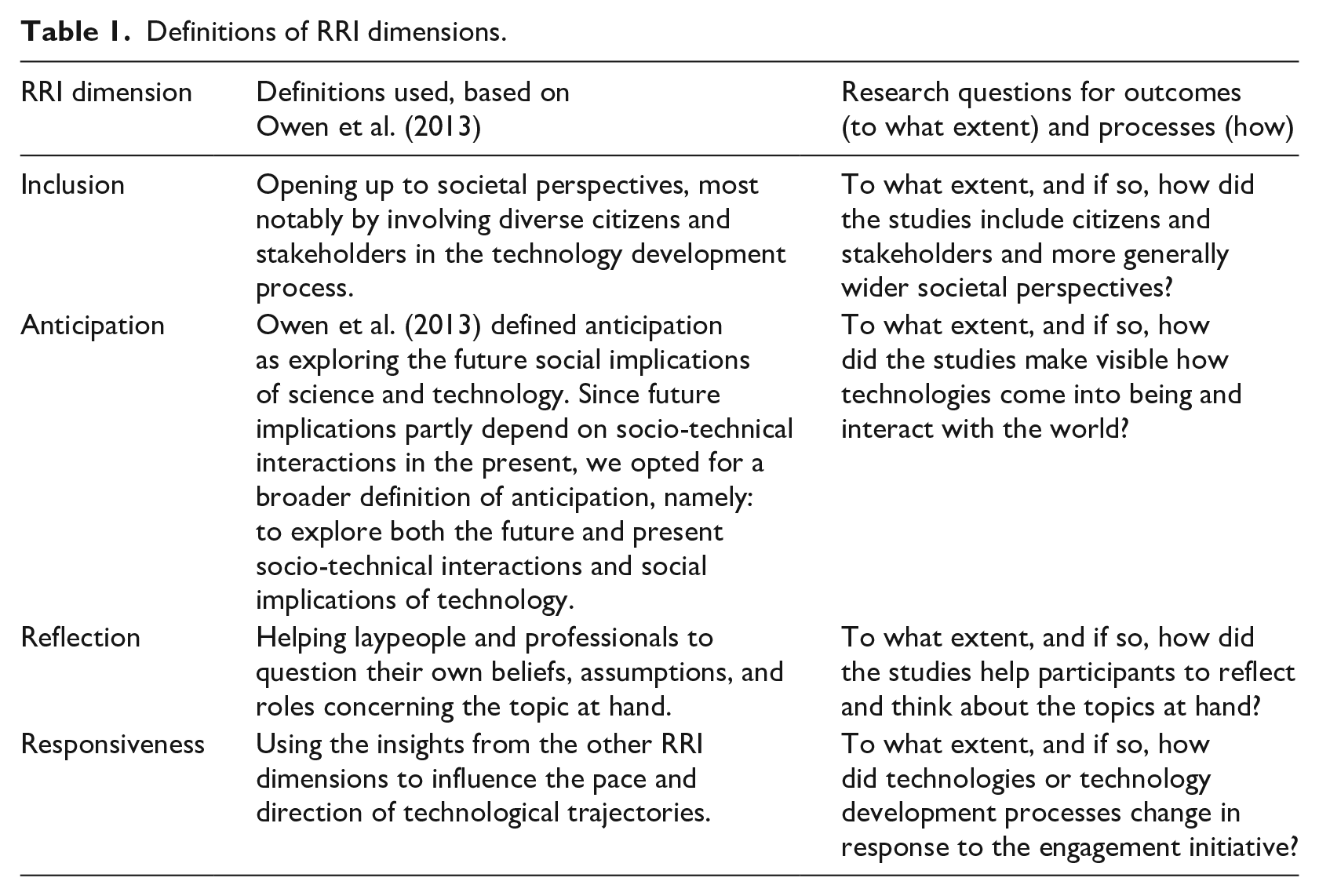
Within each RRI dimension, we then distinguished between what effects were achieved (realized outcomes) and what mechanisms, approaches and methods were thought to contribute to those outcomes (processes). When a study did not report any realized outcomes, we also identified what goals and ambitions the makers aimed to achieve (intended outcomes). Furthermore, it should be noted that even though we distinguished between processes and outcomes, the studies themselves did not necessarily link the two: studies that mentioned certain outcomes, did not necessarily also describe the processes toward those outcomes and vice versa.
3. Results
Sample description
We included 30 peer-reviewed articles and book chapters on the effects of art on public engagement regarding technologies published from 2000 to 2018. Before we move on to the results, we will first describe the included studies in terms of their research methods and how they engaged their publics (see Supplemental Material B for an overview of all included studies).
The studies were published in a wide range of fields and applied a wide range of research methods. Most studies (22) were on the author’s own engagement initiative. In these cases, the studies were published in fields of science communication, science education, policy, environmental studies, ethics, legislation, or human–robot interaction. These scholars either used social research methods to systematically collect empirical data on how participants had experienced engagement (11) or only presented anecdotal evidence to this end (based on, for example, a coincidental conversation with a visitor) (11). The rest of the studies investigated other people’s art-based engagements (8) using personal interpretation and document analysis (4) or observation and interviews with participants (4). These studies were published in fields of STS, sociology, ethics, art, and public engagement.
The studies engaged publics through (a combination of) different art forms; most notably through performances and installations, but also through books, films, photos, drawings and three-dimensional art pieces. Regardless of the exact art forms used, the studies varied in how they used these art forms to foster conversation. In most studies (19), conversation was an integral part of the artistic experience. For some studies, this meant that participants took part in creating the artwork themselves. In Carvalho and Nunes (2013), for example, citizens collaboratively created and performed a theatrical performance about nanotechnology. Conversation could also be incorporated in the artistic experience by creating an artwork that invited interaction: McMullen and Winkler (2018), for example, created an interactive installation that allowed groups of visitors to manipulate and explore the algorithms of an intelligent video camera together. Other studies (6) did not embed conversation in the artistic experience, but they did organize a separate discussion. Knippels et al. (2007), for example, let students first watch a movie and then discuss what they had seen. In other studies still (5), the artistic experience was thought to foster discussion in the public space, but this discussion remained unreported aside from how the artwork was received in the media. Auger (2013), for example, placed speculative design objects in an art gallery to fuel public debate on the future of biotechnology, but did not organize any additional activity to trigger conversation.
The studies were on technologies in different phases of development, including emerging (e.g. nanotechnology) and established technologies (e.g. satellites). More specifically, the technologies included various types of biotechnology (9), information technology (6), nanotechnology (5), biomedical technologies (5), urban technologies (1), space technologies (1), and technologies for sustainability (3). The authors argued that the technologies were in need of public meaning-making because they were still emerging and therefore shaped uncertain futures, and/or because they were controversial in the sense that they created moral or social dilemmas.
Inclusion
Outcomes
To what extent did the studies include wider perspectives and more generally broadened technological trajectories through art? A few studies explicitly aimed to broaden the range of perspectives and consequently widen the scope of issues concerned (Bhowmik et al., 2013; Cox et al., 2009; Puig et al., 2018; Roeser et al., 2018). Puig et al. (2018), for example, wanted to involve a “broad range of perspectives” in the development of brain scan technologies, because these technologies were considered to play an important role in “ideas about self and about human capacities and behavior” (2018: 111). As these aims remained fairly abstract, however, it remained unclear to what extent they were also achieved. It was more common for studies to report more measurable inclusion outcomes, specifically about the size of their audience, the diversity of their audience, and the quality of their contributions.
In terms of audience size, studies only reported successes. Four studies reported that many people had participated (Bhowmik et al., 2013; Cox et al., 2009; Nisker et al., 2006; Smith and Zeller, 2017). Of these studies, Cox et al. (2009) reported the largest number of participants (n = 741). They used this number to emphasize the legitimacy of their theatrical performance on preimplantation genetic diagnosis for further policy development. Four other studies reported large audience sizes in the sense that their artwork had been covered by the popular press, which was seen both as a measure of a broad possible uptake as well as of the artists’ personal success (Auger, 2013, 2014; Holmer et al., 2015; Smith and Zeller, 2017). One study, however, warned against trying to reach large audiences: Anderson (2015) stated that when artworks on climate change try to reach a mass audience, they usually oversimplify the issues.
The reports on diversity of the audience were more mixed: Two studies mentioned that they were positively surprised by the diversity of people that had joined (Bhowmik et al., 2013; Kupper, 2017), but five studies reported that they had failed to reach the audience of their preference (Holmer et al., 2015), excluded certain publics (Bhowmik et al., 2013), or primarily engaged those who were higher educated, living in urban areas and already interested in the topic (Bendor et al., 2017; Cox et al., 2009; Nisker et al., 2006). A lack of diversity was considered problematic, especially for studies that sought to inform policy, because diversity was seen as a means to achieve demographic representation.
Finally, the studies reported whether participants were able to make valuable contributions to the debate. Last (2012), for example, wanted to show that citizens could join the conversation on nanotechnologies so that governments would take their concerns more seriously. The outcomes were mixed, however: in some studies, participants were found to make valuable contributions (Carvalho and Nunes, 2013; Last, 2012; Nisker et al., 2006), but in other cases, participants were unable or unwilling to participate as envisioned (Carvalho and Nunes, 2013; Holmer et al., 2015; Wieringa et al., 2011; Yaneva et al., 2009). Holmer et al. (2015), for example, found that a major arts festival in San Jose, California, did not offer the right setting to engage visitors in in-depth conversations about agriculture robots.
Processes
The studies aimed to achieve inclusion in two different ways. First, many studies aimed to create attractive experiences that people wanted to participate in (Auger, 2013; Bhowmik et al., 2013; de Ridder-Vignone, 2012; Harmon, 2015; Last, 2012; Marmor, 2008; Nisker et al., 2006; Smith and Zeller, 2017). Although some authors simply wanted participants to enjoy themselves (e.g. Anderson, 2015; Holmer et al., 2015; Puig et al., 2018), other authors saw enjoyment as a vehicle for more in-depth participation (Harmon, 2015; Holmer et al., 2015; Wieringa et al., 2011). Art was considered a good vehicle for participation because it could use humor and empathy to draw in the crowds and because it was considered easier to understand than science and technology (Auger, 2013; Harmon, 2015; Nisker et al., 2006; Roeser et al., 2018; Wieringa et al., 2011). Five studies reported that their participants had enjoyed themselves (Anderson, 2015; Bendor et al., 2017; Holmer et al., 2015; Puig et al., 2018; Toonders et al., 2016), but two studies also found that enjoyment did not lead to more in-depth participation (Holmer et al., 2015; Wieringa et al., 2011).
Second, the studies aimed to make people feel like they had a say (Carvalho and Nunes, 2013; Cox et al., 2009; de Ridder-Vignone, 2012; Holmer et al., 2015; Last, 2012). This was typically done by asking for input from the audience in one way or another (Bendor et al., 2017; Bhowmik et al., 2013; Carvalho and Nunes, 2013; Cox et al., 2009; Davies et al., 2013; Last, 2012; Marmor, 2008; Smith and Zeller, 2017). For a play on nanotechnology, for example, Carvalho and Nunes (2013) asked the spectators to become the main creators and actors of the play, suggesting that these spectators would gain agency in technology discussions in general if they gained agency on stage. The efforts to give people a say were somewhat successful: two studies reported that participants had indeed gained confidence about participating in discussions about technology as a result of their engagement (Cox et al., 2009; Last, 2012).
Anticipation
Outcomes
To what extent did the studies make visible how technologies come into being and interact with the world? Generally, the studies seemed very focused on this; in fact, the studies appeared to consider it a core feature of art to bring out in the open what went unnoticed before. The purpose of engagement was therefore usually to make people realize how they relate to and interact with technology (Amoore and Hall, 2010; Davies et al., 2013; Nieman, 2005; Smith and Zeller, 2017) so that the technology in question would become more open for debate (Altamirano-Allende and Selin, 2016; Bhowmik et al., 2013; Harmon, 2015; Kupper, 2017; Wieringa et al., 2011) and so that appropriate measures could be taken (Anderson, 2015; Last, 2012). The studies focused on three types of technology in particular: (1) technologies that were inaccessible for people without specific knowledge and tools, such as nano- and biotechnologies (de Ridder-Vignone, 2012; Last, 2012; McMullen and Winkler, 2018; Marmor, 2008), (2) ubiquitous technologies that were “hiding in plain sight,” such as digital urban infrastructures (Altamirano-Allende and Selin, 2016; Davies et al., 2013), and (3) technologies that were literally hidden from view, such as smart energy meters in a basement (Bhowmik et al., 2013). Five studies found that participants were better able to recognize, articulate and discuss technology as a result of their engagement (Davies et al., 2013; Kupper, 2017; Sleenhoff, 2016; Toonders et al., 2016; Wieringa et al., 2011), but three studies also mentioned that it was not clear what the artwork aimed to reveal, because the artwork was too subtle (Betten et al., 2017; Davies et al., 2013; Kilker, 2017).
Processes
The studies tried to achieve anticipation in four ways. First, seemingly intangible socio-technical interactions and social implications were made more understandable by turning them into a personal experience. This personal experience could take several forms: In four studies, the socio-technical interactions in question were mirrored in the interaction with the artwork (Altamirano-Allende and Selin, 2016; Bendor et al., 2017; Last, 2012; Marmor, 2008; Nieman, 2005); Bendor et al. (2017), for example, let participants walk a labyrinth to symbolize the difficulties of navigating climate change debates. In five studies, seemingly intangible phenomena were translated to sensory experiences (Bhowmik et al., 2013; de Ridder-Vignone, 2012; Last, 2012; McMullen and Winkler, 2018; Marmor, 2008); Bhowmik et al. (2013), for example, adjusted the brightness of a streetlamp according to how much energy was saved by the neighborhood. And, finally, in three studies, the artist acted as a mediator between public and expert (Elam, 2005; Koski and Holst, 2017; Marmor, 2008); in Marmor (2008), for example, the artist tried to build a satellite and engaged the audience in her learning process.
Second, studies used various methods to draw attention to whatever they wanted to bring to the fore. Some studies mentioned exaggeration as a tool to highlight specific elements (Auger, 2013; Roeser et al., 2018; Toonders et al., 2016; Wieringa et al., 2011)—even though caricatures and stereotypes were also found to oversimplify and polarize the conversation (Toonders et al., 2016; Wieringa et al., 2011). Other studies focused the attention of the viewer by combining familiarity with strangeness (Amoore and Hall, 2010; Auger, 2013, 2014; Koski and Holst, 2017; Puig et al., 2018; Smith and Zeller, 2017). Puig et al. (2018) for example created an installation that looked like a medical brain scan (familiar), but actually asked users to store their personal memories at a specific location within the brain (strange). In this way, the installation brought the participant’s attention to the widespread but debated efforts of neuroscientists to localize brain functions. Interestingly, two studies did not bring out whatever they wanted to show but trained participants to see what they wanted them to see: they taught citizens to recognize the technologies in their city with photography workshops (Altamirano-Allende and Selin, 2016; Davies et al., 2013).
Third, nine studies tried to explore possible future socio-technical interactions and social implications of technology through experimentation (Anderson, 2015; Auger, 2013, 2014; Harmon, 2015; Kupper, 2017; Last, 2012; Roeser et al., 2018; Sleenhoff, 2016; Toonders et al., 2016). In this context, art-based engagement was often described as a thought experiment or test-bed (Anderson, 2015; Harmon, 2015; Kupper, 2017; Last, 2012; Roeser et al., 2018; Toonders et al., 2016); a space to explore possible implications of new technologies before they are introduced in society, free from scientific and commercial constraints (Anderson, 2015; Auger, 2013, 2014; Roeser et al., 2018). Kupper (2017), for example, organized a forum theater where actors could play out suggestions from the audience to explore alternative futures.
Whatever other anticipatory processes the studies relied on, the studies were usually also concerned with achieving some form of plausibility. This is not without reason: three studies reported that perceived plausibility indeed enhanced general interest and emotional involvement (Auger, 2013; Nisker et al., 2006; Smith and Zeller, 2017). Plausibility was achieved in different ways, however: for most studies, achieving plausibility meant doing research to get the facts right (Auger, 2013; Harmon, 2015; Knippels et al., 2007; Last, 2012; Nisker et al., 2006; Toonders et al., 2016), but for three studies plausibility (also) meant making sure that the result seemed possible (Auger, 2013, 2014; Roeser et al., 2018). Auger (2014), for example, described how a photo series about a futuristic house robot came alive thanks to references to small, everyday experiences such as setting the table and cutting the meat.
Reflection
Outcomes
To what extent did the studies help participants to reflect and think about the topics at hand? Seven studies reported that they had successfully caused participants to think about their topic or more specifically, form an opinion on the matter (Auger, 2013; Carvalho and Nunes, 2013; Holmer et al., 2015; Knippels et al., 2007; Kupper, 2017; Toonders et al., 2016; Wieringa et al., 2011). In all of these studies, it was not considered important what opinion the participants adopted exactly, but it was considered important that their opinion was authentic; Nieman (2005), for example, created space art to make sure citizens could form their own relation to space (emphasizing that citizens usually rely on astronomers to do that for them). Interestingly, in one study, it was also considered important that the opinions were well-founded (Knippels et al., 2007). To estimate the argumentative quality of student opinions on genetically modified crops, Knippels et al. (2007) counted the number of reasoning steps students used to come to an opinion (whereby more steps indicated better arguments).
In addition to an authentic opinion-forming process, studies reported having fostered some form of critique in the sense that participants started to analyze and question the technologies and their social implications. Some studies reported that they had managed to make participants more critical of a certain issue (Bendor et al., 2017; Bhowmik et al., 2013; Toonders et al., 2016); Bendor et al. (2017), for example, reported that participants had become more skeptical of simplistic conceptions of sustainability after engaging with their art installation. Others reported that participants had been involved in a critical reflection process, meaning that participants were torn between viewpoints (Altamirano-Allende and Selin, 2016; Betten et al., 2017; Cox et al., 2009; Kupper, 2017; Wieringa et al., 2011) and questioned each other without necessarily adopting a new or changed viewpoint (Carvalho and Nunes, 2013; Toonders et al., 2016). According to Cox et al. (2009), such an ongoing reflection process was important for policy development on preimplantation genetic diagnostics because it appreciated the complexity of the issues and prevented the discussion from closing too early.
Next to forms of individual reflection, 14 studies aimed to instigate dialogue, deliberation, or public debate (Altamirano-Allende and Selin, 2016; Amoore and Hall, 2010; Bhowmik et al., 2013; Carvalho and Nunes, 2013; Cox et al., 2009; Elam, 2005; Harmon, 2015; Holmer et al., 2015; Kilker, 2017; Koski and Holst, 2017; Kupper, 2017; McMullen and Winkler, 2018; Puig et al., 2018; Roeser et al., 2018; Yaneva et al., 2009). Kupper (2017) considered dialogue important in addition to individual reflection, because he thought individual viewpoints were always constructed in relation to a wider community. Dialogue was reported to enhance individual reflection (Bendor et al., 2017; Toonders et al., 2016), mutual understanding (Koski and Holst, 2017; Kupper, 2017), and construction of a shared vision (Altamirano-Allende and Selin, 2016).
Processes
To stimulate reflection, the studies applied two processes. The first process was to trigger emotions and intuitions (Betten et al., 2017; Cox et al., 2009; Elam, 2005; Koski and Holst, 2017; Kupper, 2017; Roeser et al., 2018; Sleenhoff, 2016). This process was considered important because decision-making on controversial and emerging technologies was thought to rely too much on ratio, professional knowledge, and verbal communication (Betten et al., 2017; Carvalho and Nunes, 2013; Cox et al., 2009; Elam, 2005; Koski and Holst, 2017; Kupper, 2017; Roeser et al., 2018; Sleenhoff, 2016). Instead, so it was argued, the complexity of decision-making on controversial and emerging technologies required the additional voice of emotions and intuitions. Art was thought to trigger emotions for decision-making in several steps: According to Sleenhoff (2016), art first triggers aesthetic emotions (like surprise, goosebumps, or wet eyes), then basic emotions (such as anger or happiness) and finally moral emotions (like pride, shame, or indignation). These moral emotions were then thought to point the way to what values were important to consider in the decision-making process, “such as autonomy, fairness, and justice” (Roeser et al., 2018: 2).
The studies used various methods to trigger emotions and intuitions. They depicted characters and situations that the audience could identify with (Cox et al., 2009; Elam, 2005), involved audience members in story development (Carvalho and Nunes, 2013; Elam, 2005; Koski and Holst, 2017; Kupper, 2017) or let participants create art themselves so that they could express themselves (Carvalho and Nunes, 2013; Kupper, 2017; Toonders et al., 2016). Indeed, three studies reported that seeing characters’ emotional responses on stage helped participants decide how they were feeling about the issues (Cox et al., 2009; Nisker et al., 2006; Toonders et al., 2016). However, various studies also warned that emotions and intuitions can be biased and should therefore be handled with care (Elam, 2005; Koski and Holst, 2017; Roeser et al., 2018; Sleenhoff, 2016). Elam (2005), for example, criticized how the makers of a documentary on biotechnology purposefully evoked strong emotions by narrowly framing biotechnology as an instrument to fight hunger and disease, and thereby ruling out alternative perspectives.
Fittingly, the second reflection process that we identified was to leave things open to interpretation—either literally or conceptually. Things were literally open to interpretation when participants were free to explore the artworks in their own preferred order and at their own pace (Bendor et al., 2017; de Ridder-Vignone, 2012; Holmer et al., 2015; Last, 2012; Nieman, 2005; Wieringa et al., 2011; Yaneva et al., 2009). De Ridder-Vignone (2012), for example, described how a nanotechnology exhibition was purposefully placed in the children’s section of an art museum to emphasize that participants were free to explore the exhibits in their own way. By contrast, 12 studies left things open for interpretation in a more conceptual way: they created indeterminate situations that required participants to make sense of themselves, for example, by presenting multiple perspectives on the same issue (Altamirano-Allende and Selin, 2016; Cox et al., 2009; Davies et al., 2013; Koski and Holst, 2017; Kupper, 2017; McMullen and Winkler, 2018; Toonders et al., 2016; Wieringa et al., 2011; Yaneva et al., 2009) or by triggering conflicting emotions (Amoore and Hall, 2010; Anderson, 2015; Auger, 2013; Bendor et al., 2017; Betten et al., 2017; Roeser et al., 2018). Betten et al. (2017), for example, described how a performance on biotechnology was both beautiful and gruesome, thereby inviting the audience members to develop their own opinion. Three studies confirmed that conflicting emotions fueled the reflection process (Auger, 2013; Bendor et al., 2017; Betten et al., 2017). However, indeterminacy and uncertainty did not always fare well with the participants: citizens sometimes kept looking for the single correct answer (Bendor et al., 2017; Kupper, 2017), and when scientists were involved, they tended to omit uncertainties when they spoke about their work (Toonders et al., 2016; Yaneva et al., 2009).
Responsiveness
Outcomes
To what extent did the studies influence technological trajectories? No studies reported that technologies or technology development processes changed in response to the engagement initiative, but two studies did report that opportunities were created to this end: Koski and Holst (2017) reported that the scientist involved better understood the citizen perspective thanks to his collaboration with the artist and Toonders et al. (2016) found that the science students involved in their theatrical approach were now better prepared to converse with the public.
In lack of realized outcomes to report, we also investigated the intended outcomes regarding responsiveness. Fourteen studies aimed to inspire participants to take action after participation (Carvalho and Nunes, 2013; Cox et al., 2009; de Ridder-Vignone, 2012; Harmon, 2015; Holmer et al., 2015; Last, 2012) or to influence technology development (Auger, 2014; Bhowmik et al., 2013; de Ridder-Vignone, 2012; McMullen and Winkler, 2018; Roeser et al., 2018), technology governance (Cox et al., 2009; Davies et al., 2013; Harmon, 2015; Last, 2012; Nisker et al., 2006), or social implications of technology (Altamirano-Allende and Selin, 2016; Anderson, 2015; McMullen and Winkler, 2018). Furthermore, these aims were directed at the technology development system at large (Altamirano-Allende and Selin, 2016; Auger, 2014; de Ridder-Vignone, 2012) or at actor groups including the public (Roeser et al., 2018), policy-makers (Harmon, 2015; Last, 2012; Roeser et al., 2018), technology developers (Roeser et al., 2018), and future scientists (Koski and Holst, 2017; Toonders et al., 2016).
Not all studies aimed to influence technological trajectories, however. In fact, some were explicitly against it: four studies warned that art made with a specific purpose in mind risks instrumentalization and therefore threatens artist autonomy (Betten et al., 2017; Holmer et al., 2015; Roeser et al., 2018; Sleenhoff, 2016). One of the curators in Betten et al. (2017), for example, thought that when art is made to serve a purpose, it is made to be interpreted in a single way and thereby defies the very definition of art. Others were less strict: they objected against art that was made for science communication and promotion but did encourage art that aimed to problematize an issue (Amoore and Hall, 2010; Anderson, 2015; Betten et al., 2017).
Processes
The studies aimed to redirect technology trajectories by stimulating critical and imaginative reflection among publics and professionals (Altamirano-Allende and Selin, 2016; Auger, 2013, 2014; de Ridder-Vignone, 2012; Harmon, 2015; McMullen and Winkler, 2018; Roeser et al., 2018). The studies hoped that technological trajectories would be redirected “by enriching the thinking of all parties involved” (Harmon, 2015: 78). The studies provided three suggestions for how those critical, imaginative reflections might translate into concrete changes to technological trajectories approaches. First, they created opportunities for change by involving professionals (Altamirano-Allende and Selin, 2016; Bhowmik et al., 2013; Cox et al., 2009; Koski and Holst, 2017; Nisker et al., 2006; Toonders et al., 2016). Second, they taught technological professionals of the future to engage in ethical reflection and conversation (Koski and Holst, 2017; Toonders et al., 2016). Third, they thought of the long-term consequences of the artwork as a memory, reminding participants of that “which had previously slipped away from view” (Amoore and Hall, 2010: 307) whenever they would encounter the technology in the future.
4. Discussion
This literature review aimed to shed light on what works in art-based public engagement and why. To this end, we reviewed the academic literature published from 2000 to 2018 on the effects of art on public engagement regarding emerging and controversial technologies. The included studies were published in a wide range of academic fields (including art, policy, ethics, science education, and science communication) and showed significant differences in how they engaged their audiences and investigated audience responses. Amid this diversity, we used the dimensions of Responsible Research and Innovation (inclusion, anticipation, reflection, and responsiveness) to identify the outcomes and processes of art-based engagement, which were mainly to (1) involve wider audiences by offering attractive and participatory experiences, (2) show how technologies come into being and interact with the world, and (3) trigger individual sensemaking and critical reflection. One-third of the included studies intended to exert influence on technological trajectories in the long run, but only two studies created opportunities to these ends.
In line with how RRI was initially envisioned (Owen et al., 2013), our findings indicate that art-based engagements often performed the RRI dimensions simultaneously. Open, multi-interpretable experiences played a role in reflection as well as in activating publics to get involved (inclusion). In addition, making the socio-technical interactions and social implications of technology more tangible (anticipation) also made engagement more accessible (inclusion). Furthermore, both reflection and anticipation relied on some form of conflict: conflicting emotions and narratives created room for interpretation (reflection), and scenarios that distort our relation to technology made that relation more visible (anticipation). And finally, the studies that aimed to change technological trajectories (responsiveness) primarily did so by stimulating reflection.
Opening up and closing down
Arguably, one of the purposes of public engagement as we defined it here, was to “open up” technological trajectories: to render the technological development process more sensitive to broader societal perspectives and concerns (cf. Stirling, 2008). As expected, our review showed that art-based engagement can help open up technological trajectories by involving new publics, stimulating reflection, and envisioning new futures. Our review also showed, however, that art-based engagement can close down technology trajectories: First of all, even though the studies were typically keen to articulate the meaning of an artwork, they were not always concerned with whether their audiences also picked up on that message (e.g. Kilker, 2017; Marmor, 2008; Nieman, 2005). Furthermore, some artworks accidentally oversimplified rather than problematized the issues at hand (e.g. Toonders et al., 2016; Wieringa et al., 2011). And finally, the artworks regularly combined aims of public engagement with ambitions that are typically more about closing down than opening up, such as informing the public (de Ridder-Vignone, 2012; Harmon, 2015; Nisker et al., 2006; Yaneva et al., 2009) and promoting science (Elam, 2005; Harmon, 2015; Smith and Zeller, 2017). The use of art, therefore, does not automatically open up technological trajectories. This review thereby shows that opening up requires work and attention, whether art is used or not.
The question of impact
Another key concern was whether art-public engagement could influence technological trajectories. Our findings indicate that with a few exceptions, most art-based engagement studies did not do that directly—only indirectly through inclusion, reflection, and anticipation at most. Perhaps art projects could have a more direct influence on technological trajectories, but this would have to involve at least long-term, in-depth interactions with those who drive technological development (as is possible with, for example, artist-in-residency programs). Yet, only six of the included studies involved technology professionals in the public engagement activities, let alone over longer periods of time.
Regardless of their influence on technological trajectories, the studies generally showed little interest in capturing the outcomes of their interventions: 5 studies did not organize conversation around the artwork, 11 studies gauged audience responses only based on anecdotal conversations, and many studies did not explicitly link outcomes to processes. We believe this primarily indicates that the studies did not want to portray art-based engagement as a predictable, step-by-step process. Instead, they described art-based engagement as an emerging process whereby the artwork’s meaning is discovered along the way and distributed between maker, setting, and spectator. In part, this may be specific to the art-based engagement literature, which warns against the instrumentalization of art for public engagement—the use of art without acknowledgment of its artistic qualities or ambitions (cf. Reinsborough, 2020). Yet, it also chimes in with recent calls for more reflective and emerging approaches to public engagement in general. For example, Chilvers and Kearnes (2020) argued that to prevent the instrumentalization of public engagement, public engagement should be seen as an emerging process that is co-constructed by organizers, publics, formats and settings.
However, the emergent character of art-based engagement does not mean that we should not further investigate the relationship between art and technological trajectories. We should for the simple reason that art is one of the ways in which publics and artists make sense of emerging technologies. In particular, we should study how art feeds into processes of collective socio-technical change. The studies that did report audience responses, usually reported what art did in terms of individual reflection (e.g. Betten et al., 2017; Roeser et al., 2018; Sleenhoff, 2016). This focus on the individual audience response is typical for studies investigating audience responses to art (see, for example, studies in the academic journal The Empirical Studies of Art). Yet RRI conceptualizes responsibility for change as a shared responsibility (Owen et al., 2013). It is currently not clear how art-based engagement feeds into such broader, collective processes of change. A similar observation was made by Davies et al. (2009), who noted that the value of public engagement that does not aim to inform policy (but simply to stimulate dialogue, for instance) is poorly understood. Therefore, the remaining question is, what role does art play in the way participants deliberate with each other, form groups, become problem owners, and contribute to social change?
Limitations
The results need to be considered with several limitations in mind. First, we reviewed studies on organized public engagement; in so doing, we did not include studies on how publics use art to engage with technology themselves (e.g. Novak, 2017; Wilbanks, 2017). Those studies could shed more light on how art can contribute to the democratization of technology. Furthermore, this review only included scholarly work, while much has been written about art-based engagement outside of academia, particularly in the art and museum world. Such publications could add a practice-based perspective. Moreover, we only reviewed studies published from 2000 to 2018, even though art-based engagement is by no means a recent phenomenon. Still, we felt that focusing on this period was acceptable since these two decades have seen an increased call for engagement with science and technology.
In terms of the analysis, we described the results per RRI dimension, which inevitably reduced the specificity of technologies and art forms. We have tried to alleviate this shortcoming by giving examples of technologies and art forms in each results section, but more research is needed to identify the relationship between specific technological characteristics, or art forms, and art-based engagement. Perhaps more importantly, however, we reviewed art-based engagements in the light of RRI, whereas the reviewed studies did not usually refer to RRI themselves. Therefore, one could argue that we contributed to the instrumentalization of art-based engagement in the sense that we contributed to its use in a new context. We hope to have at least prevented the unreflective and uncontextualized use of art for public engagement (cf. Reinsborough, 2020) by emphasizing the diversity and contexts of art-based engagement as well as by depicting art-based engagement as a process rather than as a tool or method. In this way, we hope to have contributed to an understanding of art-based engagement that acknowledges its artistic qualities and ambitions.
Conclusion
Our findings indicate that art is not a one-size-fits-all solution to public engagement but takes its place within an ecology of engagement practices. While art-based engagement may not be particularly suitable to influence technological trajectories directly, it may do so through other RRI dimensions, particularly by engaging broader audiences, fueling individual reflection, and by making social implications and socio-technical interactions more tangible. If public engagement in general should be seen as a co-constructed practice, then this is especially true for art-based engagement, whereby the meaning of the artwork is discovered along the way and distributed between maker, setting, and spectator. Still, we require a better understanding of how art-based public engagement fuels the formation of issues and publics and, with that, a shared responsibility for emerging and controversial technologies.
Supplemental Material
sj-docx-1-pus-10.1177_09636625221093213 – Supplemental material for Art for public engagement on emerging and controversial technologies: A literature review
Supplemental material, sj-docx-1-pus-10.1177_09636625221093213 for Art for public engagement on emerging and controversial technologies: A literature review by Aafke Fraaije, Marjoleine G. van der Meij, Frank Kupper and Jacqueline E. W. Broerse in Public Understanding of Science
Footnotes
Funding
The author(s) received no financial support for the research, authorship, and/or publication of this article.

Supplemental material
Supplemental material for this article is available online.
Author biographies
References
Supplementary Material
Please find the following supplemental material available below.
For Open Access articles published under a Creative Commons License, all supplemental material carries the same license as the article it is associated with.
For non-Open Access articles published, all supplemental material carries a non-exclusive license, and permission requests for re-use of supplemental material or any part of supplemental material shall be sent directly to the copyright owner as specified in the copyright notice associated with the article.
