



Abstract
Long-standing discussions of the so-called urban–rural divide in the United States have uncovered meaningful differences between urbanites and rural residents, but much of this work has focused on political attitudes. However, there is reason to believe that geographic divides also influence Americans’ science attitudes, including, for example, positive affect toward scientists and levels of trust in them. Unfortunately, existing work has not clearly ruled out confounding factors such as religiosity, political views, media habits, and conspiracism. This brief article addresses this problem by drawing on survey data from 2016 to test the hypothesis that rural residency will be associated with colder feelings toward the scientific community, even with controls in place. The results offer support for this expectation. These findings lend support to recent arguments that rural Americans’ science attitudes are influenced by factors that go beyond demographics, conspiracism, political polarization, differences of religiosity, and (partisan) media consumption.
The 2016 US Presidential election seems to have prompted increased attention to possible “urban–rural divides” in American life. By some accounts, rural Americans are “more religiously and morally conservative than those living elsewhere,” as well as more “traditional” (Gimpel and Karnes, 2006: 471). Rural areas also “lag behind . . . when it comes to some measures [of] economic well-being,” such that rural-dwellers tend to be less optimistic about the financial future, and in recent years, they tend to identify as Republican (Pew Research Center, 2018).
Existing work of this kind has often focused on urban–rural divides in politics and culture. Yet, there is reason to believe that urban–rural divides might also play a role in public opinion of science and scientists, including willingness to trust them. For example, rural residents have shown low confidence in scientists through decades of opinion polls (Krause et al., 2019). Furthermore, ethnographic work has shown that some rural residents believe scientists exhibit a “lack of respect” and disregard for “local knowledge” (Cramer, 2016: 126–127). These signals suggest that rural Americans may harbor negativity toward scientists. This is important because, among other things, negative affect about people is linked to lower trust in them (Iyengar et al., 2019).
Can signals of negativity toward scientists on the part of rural Americans be explained by, for example, a tendency to be more religious, conservative, or morally traditional? Might rural Americans have more limited or right-leaning news diets? Below, I offer empirical evidence to address these kinds of questions. Specifically, I pose and test the hypothesis that as the ruralness of a person’s county of residence increases, they will feel colder toward scientists (on average), even with various controls in place. Ultimately, I provide evidence supporting this expectation.
1. Warmth toward scientists and trust in science
The outcome variable I examine is feelings of warmth toward the scientific community, which I construe as theoretically likely to be related to rural residents’ willingness to “trust” scientists, and which I see as an important part of the empirical story about possible urban–rural divides in “trust in science.” I take this position because there is accumulating evidence that public opinion is often influenced by social identity (Achen and Bartels, 2017) and that people are less likely to trust information from “outgroups” about whom they feel more “coldly” (Iyengar et al., 2019).
That said, I also acknowledge that because trust is a complex, context-dependent, and multi-dimensional construct, it is not strictly necessary to feel warmly toward someone in order to trust them (Siegrist, 2021). Therefore, correlates of positive affect or warmth will not overlap fully with correlates of trust. Still, there should be some similarities (e.g. perceived value congruence can predict both trust and warm feelings). Furthermore, recent work suggests that studies predicting broadly construed “trust in science” are often too broad, and that it might be more productive to pointedly examine perceptions of scientists that, taken together, will be expected to influence a person’s willingness to trust the scientific community (Besley et al., 2021). To this end, I am examining warmth toward scientists in conjunction with literature on predictors of trust, from the standpoint that positive affect can be an important component of trust, even if it is not always so.
Conservativism, religiosity, moral traditionalism, and openness
Perhaps the most obvious way to account for rural residents’ negativity toward scientists in some polls is with the argument that rural people tend to be more conservative and religious, and these groups tend to exhibit lower trust in science (Gauchat, 2012). Yet, there is nuance. For example, while conservatives trust scientists less than liberals when asked about science in general, they exhibit higher trust when asked about “production” versus “impact” science (McCright et al., 2013). Generally, conservatives’ and liberals’ trust in scientists can depend on whether they think scientists’ values and beliefs align with their own (Nisbet et al., 2015). Meanwhile, while some research has shown a negative link between attendance at religious services and trust in scientists (Brewer and Ley, 2012), other research has found no link with religiosity (Cacciatore et al., 2018). Still, this latter study did find that Evangelicals were slightly less likely to trust scientists. Despite some ambiguity in these works (and others they cite), there is nonetheless a fairly clear signal that as political conservativism increases, generalized trust in scientists will decrease.
Arguably related to religious and political views is the concept of “moral traditionalism,” which is more common in rural areas (Gimpel and Karnes, 2006). By one account, moral traditionalism is a set of non-religious moral beliefs that reflect “a backlash against post-materialistic values, such as secularism, moral relativism, and alternative lifestyle choices” (Knuckey, 2016: 651). As some scientists have been described as engaging in “stealth advocacy” on behalf of political progressives or in alignment with Democrats (Pielke, 2007), and as scientists like Richard Dawkins or Lawrence Krauss conflate science with atheism in public discourse (Simpson and Rios, 2019; Unsworth and Voas, 2021), scientists may be seen as (a) active agents of secularism and (b) as endorsing what some people might see as “alternative lifestyles,” such as feminism or civil rights for LGBTQ+ (lesbian, gay, bisexual, transgender, queer, and others) communities. For example, the “Marches for Science” have conflated support for “science” with feminist opposition to former President Trump, and recent work suggests the Marches had a polarizing effect on liberals’ and conservatives’ feelings toward scientists (Motta, 2018). Similarly, election yard signs popular with Democrats during the 2020 Presidential race proudly declared that “science is real” alongside a list of progressive policy positions, such as “Love is Love” (i.e. support for LGBTQ+ rights) (Krause et al., 2021).
Finally, some might argue that, amid broader “social sorting” trends (Bishop, 2008), people who are more “open to experience”—a trait which captures a propensity for creativity, curiosity, and intellectualism (Fatke, 2019)—might be leaving rural areas. This could yield relevant place-based divides, as “openness” has also been linked to positive science attitudes (e.g. Feist, 2012).
Media habits, conspiracism, and generalized trust
Work on belief in anthropogenic climate change has found a negative link with conservative media consumption, mediated by lower trust in scientists (Hmielowski et al., 2014). Another study examining trust in scientists’ statements about the environment also found that viewing Fox News was negatively linked to trust, while viewing other TV news was positively associated (MacInnis and Krosnick, 2017). Therefore, general news attention might be linked to higher trust, while viewing right-leaning television (especially Fox News) may be linked to lower trust. Given that conservatives tend to view Fox News (Pew Research Center, 2014) and that rural residents are more likely to be conservative and to have limited media options (Pew Research Center, 2019), Fox News might usefully explain rural residents’ negativity toward scientists.
Relatedly, by viewing more Fox News, it is possible that rural Americans are consuming more conspiratorial information. For example, in the context of the COVID-19 pandemic, some have argued that Fox News has promoted conspiracy theories that undermine scientists’ credibility (Jamieson, 2021). Conspiracism fosters “doubt [in] scientific advice” by suggesting that science is “not motivated solely by truth” and is thus untrustworthy (Druckman and McGrath, 2019). To this point, there is recent evidence that, in the United States, endorsement of conspiracy theories is linked to a rejection of scientific consensus on various topics, while conservativism and a “free-market worldview” were linked only to greater rejection of climate change (Lewandowsky et al., 2013).
Finally, some might argue that a tendency to believe conspiracy theories is highly correlated with low institutional or social trust in general, which is itself plausibly linked to reclusiveness (including living in remote, rural areas). Given that evidence from multiple countries shows that “confidence in key national institutions” is one of the most important correlates of trust in scientists (Gallup, 2019), the possibility that rural Americans might have systematically lower institutional or social trust is therefore a potential confound.
Overall, the above review suggests many reasons why Americans who live in more rural areas will have negative views of scientists. To help the research community better understand the relative explanatory power of these competing explanations, including whether there is a clear need to pursue alternative explanations, I pose the following hypothesis:
2. Methods
To address my hypothesis, I draw on data from a representative survey of US adults conducted in 2016 and 2017 by the American National Election Studies (ANES). Sampling details can be found in the Supplemental Material and in the ANES methodology report. The ANES dataset does not include a ruralness item, but it does capture respondents’ counties. Consequently, I merged the ANES dataset with data from the United States Department of Agriculture (USDA), which freely offers a “ruralness” score for each US county. As with any survey, there were missing values due to nonresponse. To address this issue, missing data were imputed prior to analysis. After imputation, and after accounting for the complex sampling design by following ANES recommendations for alternatives to Taylor Series estimation of sampling errors, I performed multivariate regression analysis. To visualize how my results may have differed without multiple imputation and with the use of the Taylor Series approach, I ran a set of comparison analyses, which appear in Table 1 of the Supplemental Material. Differences in the results were negligible, with one exception, which is acknowledged in the “Results” section below.
Pooled, standardized betas from multivariate regression predicting feelings of warmth toward scientists (weighted N = 2498).
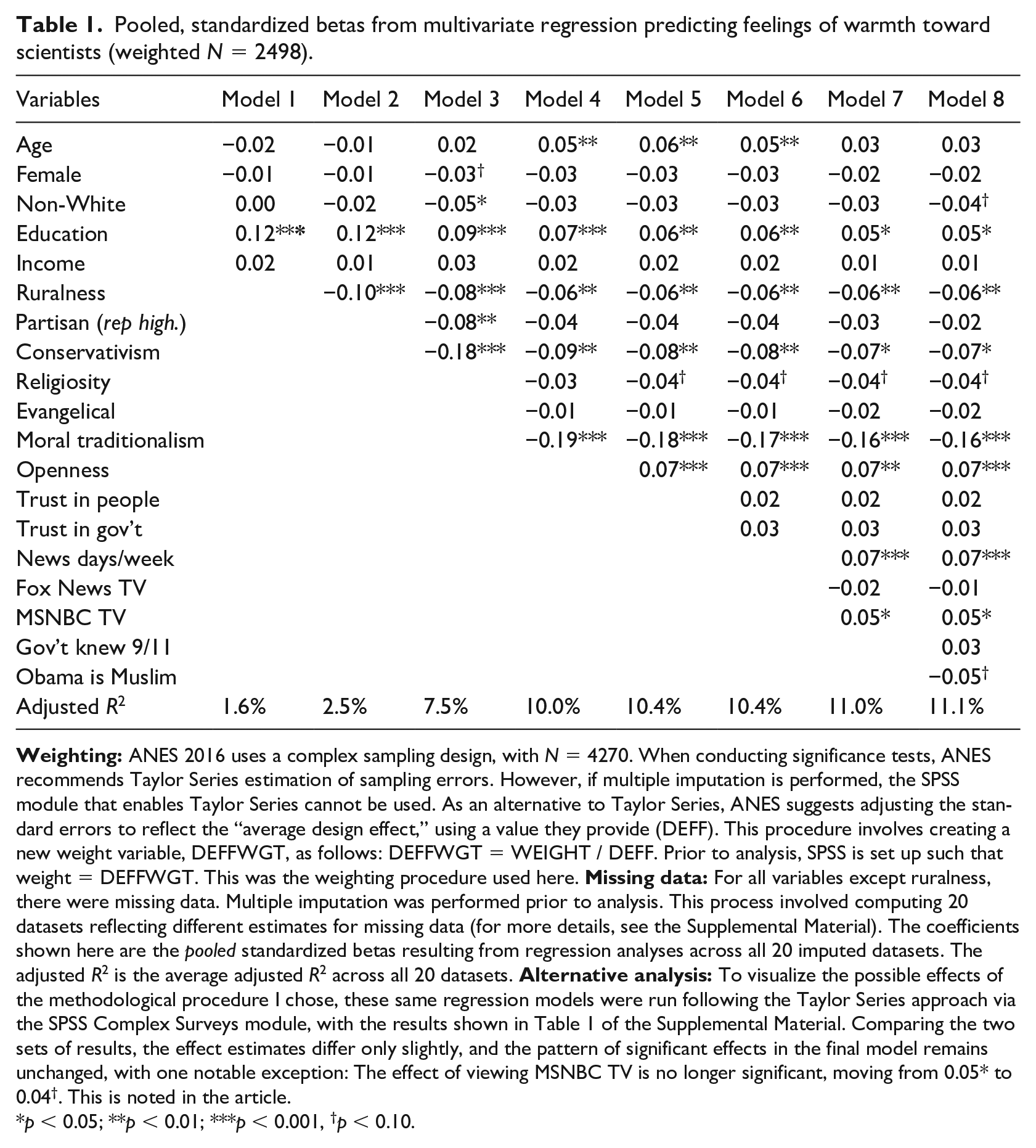
p < 0.05; **p < 0.01; ***p < 0.001, †p < 0.10.
Characteristics of the sample were as follows: weighted N = 2498; mean age = 47.4 years; 52% female; 30.2% non-White and non-Hispanic; mean education level = 10.7 (“some college but no degree”); mean income range = 15.6 (roughly “US$50,000–US$59,999”); mean partisan identification = 3.8 out of 7 (between “Independent-Democrat” and “Independent”); mean conservativism = 4.1 out of 7 (“Moderate/middle of the road”); mean religiosity = 1.5 out of 3 (between answers of religion plays “some” guidance in daily life to “quite a bit” of guidance); mean ruralness = 2.1 out of 9 (i.e. “Metro, counties in metro areas of 250,000 to 1 million population”).
Measures
Below, I offer details on key measures or measures that required analytical choices on my part and which might be construed as limitations. Details on other measures are in the Supplemental Material.
Warmth toward scientists
This construct is operationalized with a feeling thermometer question, asking respondents how “warmly” they feel toward scientists, from 0 to 100.
Conspiracism
Two items were used: (1) The government knew in advance about the September 11 attacks, and (2) Former President Barack Obama is a Muslim. The first belief tends to be endorsed by liberals and the latter by conservatives (Miller et al., 2016). The “Obama is a Muslim” variable was coded from 1 (“extremely sure Obama is not a Muslim”) to 10 (“extremely sure Obama is a Muslim”). This scale is more granular than the “government knew about 9/11” scale, which ranged from 1 (“definitely did not know)” to 4 (“definitely knew”). Crucially, neither of these items is a direct measure of conspiracist ideation, and, given that people do not endorse all conspiracy theories, they are imperfect measures of conspiracism.
Partisan TV attention
ANES asks how, if at all, people heard about the presidential campaign. Individuals who say they have heard about the campaign on TV are asked to indicate the programs they “watch regularly” (defined as “at least once a month”). Among the programs mentioned were Fox News shows hosted by Sean Hannity, Bill O’Reilly, and Megyn Kelly, as well as MSNBC shows hosted by Rachel Maddow, Chris Hayes, and Chris Matthews. Arguably, these shows represent the 2016 primetime partisan match-ups between partisan news networks, given that Fox News tends to attract a more right-leaning audience, while MSNBC tends to attract a more left-leaning audience (Pew Research Center, 2014). For this analysis, if a respondent watched any of the Fox News shows, they were coded “1” for Fox News, while all others were coded “0.” A similar dummy variable was created for viewing MSNBC.
Ruralness
This item represents the ruralness of a respondent’s county using rural–urban continuum (RUC) codes from the USDA. The codes range from: 1 (“Metro, counties in metro areas of 1 million population or more”) to 9 (“Nonmetro, completely rural or less than 2500 urban population, not adjacent to a metro area”). This operationalization of “ruralness” is just one of many possible measures. In fact, there are several definitions of ruralness in use by the US government, including within the USDA itself, which also offers Frontier and Remote (FAR) codes to “identify areas where residents may be cut off from key services such as broadband internet access and emergency medical care” (Jones and Ewald, 2017). Therefore, it is important to note that a different operationalization of ruralness might yield different results.
3. Results
The results appear in Table 1. Consistent with H1, the final model indicates that rural residency has a statistically significant and negative relationship with feelings of warmth toward scientists (β = −0.06, p = .002) even while controlling for many factors that are plausibly or known to be correlated with both trust in scientists and rural residency. The magnitude of the ruralness association is comparable to the link with conservativism (β = −0.07, p = .023). By far, the strongest (and negative) association, however, is with moral traditionalism (β = −0.16, p < .001).
There is only weak evidence that general religiosity might be linked to colder feelings toward scientists (β = −0.04, p = .066). Furthermore, the Evangelical link is null, as are links with trust in government, social trust, and right-leaning media consumption of Fox News. Meanwhile, there is a positive association for consumption of left-leaning MSNBC shows (β = 0.05, p = .019), as well as general news consumption (β = 0.07, p < .001), openness to experience (β = 0.07, p < .001), and education (β = 0.05, p = .026). Notably, in a comparative analysis that used different procedures to handle the ANES complex sampling design (see Table 1 of the Supplemental Material), the estimated association with MSNBC was weaker and not statistically significant (β = 0.037, p = .098). Therefore, this specific finding should be interpreted with caution.
There are no observed associations of age, sex, or income with feelings of warmth toward scientists, and there is only a weak link with identification as non-White and/or Hispanic (β = −0.04, p = .081). However, this dummy-coded variable is an oversimplified measure of race and ethnicity that does not differentiate well across non-White respondents, which means there is likely noise in this estimate. Finally, belief in the two conspiracy theories functions differently: Belief that the government knew about 9/11 in advance has no association, while there is weak evidence of a negative link for belief that Barack Obama is a Muslim (β = −0.05, p = .056).
4. Discussion
Put simply, in this study, Americans living in more rural counties tended to report colder feelings toward scientists, on average, than people living in more urban areas, even while controlling for possible confounds. Before discussing this finding in more detail, I want to clearly state that it should not be interpreted as evidence that rural people are “anti-science.” Although some recent and high-profile discussions of public opinion about science have described different publics as “anti-science” by various measures (see, for example, Phillipp-Muller et al., 2022), I take the position that “anti-science” is an empirically and ethically dubious label (see, for example, Hilgartner et al., 2021 and Krause et al., 2021).
The negative association I observed for ruralness was similar in size to that of conservativism. Arguably, political divides have received far more attention than geographic divides in research on cleavages in science attitudes, and my results suggest more balance is warranted. Relatedly, my data suggest that value systems that are known to be correlated with political views but are nonetheless distinct (e.g. moral traditionalism) should be modeled separately and may have more explanatory power than political views. This may be especially true for science attitudes pertaining to less “politicized” issues—see, for example, opinions on genetically modified foods (Scott et al., 2018). Furthermore, there is accumulating evidence that some subgroups’ alienation from science may be rooted in their concerns about scientists’ “moral agendas” (Evans, 2018), underscoring the importance of examining more nuanced moral constructs (beyond proxies like “religiosity”).
Given the persistence of the “ruralness link,” what else might be unique about rural areas, in terms of science attitudes? The answer will likely depend on the kinds of science or scientists under consideration. One fruitful avenue for future research may be to recognize that people’s lived experiences of risk-related phenomena can be shaped by geography and by population. For example, there is evidence that local weather patterns can influence non-partisans’ beliefs about climate change (Hamilton and Stampone, 2013). The COVID-19 pandemic has also demonstrated that experts’ risk assessments and risk mitigation plans can logically be influenced by population density. Given that weather and population can systematically differ across urban and rural areas, these kinds of factors might account for geographic divides in public opinion on some topics.
Beyond this, economic differences across geographic areas—such as variation in key industries or the socioeconomic class of the populace—might be another way to examine place-based divides in science attitudes. For example, technologies such as artificial intelligence (AI) might be expected to pose economic risks and benefits that will vary geographically. Relatedly, advances in science and technology can have sociocultural impacts that may be processed through the lens of local life, social norms, and place-based identity. For example, if AI or other developments are perceived to alter cultural valuation of certain types of “work,” then it is possible that urban–rural divides may emerge in this area if strong or starkly divergent views on “work” exist among people identifying as rural versus urban, as some work suggests may be the case (Cramer, 2016).
Supplemental Material
sj-docx-1-pus-10.1177_09636625221147232 – Supplemental material for Placing “trust” in science: The urban–rural divide and Americans’ feelings of warmth toward scientists
Supplemental material, sj-docx-1-pus-10.1177_09636625221147232 for Placing “trust” in science: The urban–rural divide and Americans’ feelings of warmth toward scientists by Nicole M. Krause in Public Understanding of Science
Footnotes
Funding
The author(s) disclosed receipt of the following financial support for the research, authorship, and/or publication of this article: This work was supported by the National Science Foundation [award number 1827864] and the John Templeton Foundation [award number 62194]. Any opinions, findings, and conclusions or recommendations expressed in this material are those of the author and do not necessarily reflect the views of the National Science Foundation or the John Templeton Foundation.

Supplemental material
Supplemental material for this article is available online.
Author biography
References
Supplementary Material
Please find the following supplemental material available below.
For Open Access articles published under a Creative Commons License, all supplemental material carries the same license as the article it is associated with.
For non-Open Access articles published, all supplemental material carries a non-exclusive license, and permission requests for re-use of supplemental material or any part of supplemental material shall be sent directly to the copyright owner as specified in the copyright notice associated with the article.
