



Abstract
Individuals in high-income countries increasingly express less scientific optimism than in lower-income societies. In this article, we utilize risk society theory to understand the complicated relationship between individual- and country-level factors, and optimism toward the role of science in society in “reflexively modern” societies. We use multilevel modeling with 16 high-income countries to determine the individual-level and country-level factors that shape scientific optimism. Next, we look at the individual characteristics that affect scientific optimism in each country individually. At the individual level, we find that older people, the more highly educated and higher earning, those farther to the Right on the political spectrum, and those with more materialist (rather than postmaterialist) attitudes have higher scientific optimism, while more religious people have lower optimism regarding science. At the country level, we make a corollary argument about materialism: societies that have higher measles immunization rates, generate more electricity from fossil fuels, and have a greater percentage of mobile phone subscriptions, have populaces that are more optimistic toward science.
1. Introduction
Previous research has presented us with a paradox: those living in wealthy societies with all the markers of national success—high college enrollment rates, widespread Internet access, and low infant mortality rates—express doubts that science is improving society and human well-being, while those living in less well-off societies (where the benefits of science are still out of reach for substantial proportions of the population) are significantly more likely to believe in the positive potential of science and technology (Bauer et al., 1994; Sjøberg and Schreiner, 2012). In a previous article, we drew on risk society theory and the related concept of reflexive modernization to explain the global divide in optimism toward science. We concluded that in wealthy countries many individuals are no longer looking to science with urgency to improve their standard of living, but are instead increasingly focused on the risks to themselves, society, the environment, and future generations that may be unintended consequences of scientific and technological development.
To better understand scientific optimism in arguably modern societies, we turn our attention to a selection of World Bank-classified high-income countries, using country income as a proxy measure for “reflexively modernized.” We know that on average, individuals in these countries are less trusting and invested in science compared to those in countries who are “reflexively modernizing.” In fact, research has teased out a compelling curvilinear relationship between national development and scientific optimism: while higher national development is associated with a greater understanding of and support for science in modernizing societies, there is a decline in interest in and support for science in the wealthiest postindustrial societies (Bauer et al., 1994; Sjøberg and Schreiner, 2012). Individuals in the wealthiest societies are also less likely to believe that the benefits of science outweigh the potential harms (Sjøberg and Schreiner, 2012). Nowotny et al. (2001) theorize that in wealthy democracies where access to education has become more equally distributed and widespread, “science now finds itself interrogated by the spirit of criticism” (p. 34) and expertise is no longer considered the domain of elites. Similarly, Noy and O’Brien (2019) write that “skepticism of science in the most industrialized European societies is thought to reflect a critical stance toward science that stems from a higher degree of familiarity with science and active engagement with its impact” (p. 900).
However, while the populace of wealthy countries may hold less optimistic views toward science overall, there is significant variation both across and within these countries (Sjøberg and Schreiner, 2012). We examine how individual characteristics, including sociodemographics, education, religiosity, political affiliation, value orientations, and use of different sources of media for information influence scientific optimism within countries. At the country level, we include indicators of public health, as measured by measles vaccination rates, technology penetration, as measured by mobile phone subscription rates, and environmental attitudes measured by reliance on fossil fuels. Finally, we compare the effect of individual predictors across countries, looking at how well predictors of scientific optimism established in the United States and western Europe operate across a sample of 16 high-income countries.
2. Reflexive modernity and risk in the world polity
World society theory, developed by John Meyer in the 1970s and further refined in the 1980s and 1990s, theorizes that nation-states have declined in importance, replaced by a world culture composed of global norms and international organizations that have increased isomorphism (Meyer, 1999; Meyer and Bromley, 2013; Meyer et al., 1997). According to this theory, in the contemporary time period, national histories and local customs are not as important in shaping individual experience and the organization of nations (such as educational curriculums, constitutions, and the structure of government) as are global forces acting outside the state (Meyer et al., 1992, 1997; Schafer, 1999). World society integration means adhering to ideological, as well as institutional, norms, and the world society emphasizes a rational, science-based understanding of progress, and a future-oriented outlook. Because of this isomorphism of structure and procedure across disparate settings, nation-states are “marked by considerable and sometimes extraordinary, decoupling between purposes and structure, intentions and results” (Meyer et al., 1997: 152). Cynicism emerges when it becomes clear that “idealized rational models,” such as for economic growth, are much harder to effectively implement than they are to simply model (Meyer et al., 1997: 155).
The Paris Agreement provides an example of the disconnect between global models and national priorities. Leaders of the American government are selected by the American people, not by the United Nations, or other signatories to multilateral treaties, such as the Paris Agreement. Barack Obama signed the Paris Agreement, but the reversal by Donald Trump 1 year later was a response to Trump’s electoral base, including the coal industry (Grunwald, 2017). When Joseph Biden took office, he rejoined the pact on his first day in office, reflecting the principles of his campaign (McGrath, 2021).
Based on his research into when and why countries sign environmental treaties, Frank (1999) concluded that while we collectively tend to perceive nation-states as individual actors pursuing their own calculated interests, “at least in the realm of international environmental treaty ratifications, nation-states appear to be exogenously constructed” (p. 538). Now, over 20 years later, is this view of “exogenously constructed” nation-states maintained? Or is the world society contracting? “Brexit”—the withdrawal of the United Kingdom from the European Union in 2020—suggested a shift in the balance of power between nations and the world society, as does varied vaccine mandate policies across European Union member states, with many not adhering to global standards outlined by the World Health Organization (Vaz et al., 2020). These countries are powerful actors in the World Polity (Beckfield, 2003; Hughes et al., 2009), with highly educated publics (on average) and representative democratic norms. How can we make sense of the connection between national policies in the international arena, and within-country electorates?
At least a partial explanation can be found by utilizing the risk society theory. Risk society theory argues that the risks that people face are increasingly “manufactured,” meaning that they arise as consequences of progress; they are unintended and inescapable effects of technological and scientific development (Beck, 1992, 2011, 2014). These risks can be seen as arising at least partially from decoupling; global models cannot be implemented without risks that may be heightened in particular societies. Cynicism is heightened because individuals lack control not just of the risks they are exposed to, but of the information they need to make risk assessments. Actors distant from the individual make decisions that change individual levels of risk, such as when pollution generated in one part of the world changes the risks of birth defects and asthma for the present generation as well as their descendants, and for people both local to and distant from the source. On the other hand, when international actors mandate new climate change goals and pollution reduction standards, job losses in polluting industries are felt most keenly by individuals, families, and communities. When people choose to forgo vaccinations for themselves or their children, they are making guesses about the likelihood of contracting a serious illness and may even be balancing perceived risks to themselves with perceived risks to their communities (Makarovs and Achterberg, 2017). The COVID-19 pandemic demonstrated the power of individual nation-states and even individuals themselves to make decisions that alter the risks for others within world society.
We conceive of Risk Perception as a Pendulum Swing:
Science and technology create new goods that people enjoy.
Additional science (and pseudoscience) points out the problems/downsides/flaws in the original science.
More studies (and pseudostudies) produce more results, all of which are published with near equal weight in the general press.
Debate ensues, sides are taken.
People become entrenched in their positions.
Overall trust in science takes a hit: how can we ever know the truth?
Some seek to minimize their reliance on modern science and technology.
In our previous work, we examined optimism regarding the positive potential of science and technology using all available countries in Wave 6 of the World Values Survey. We developed an index measure of scientific optimism based on three items: (1) Comfort: “Science and technology are making our lives healthier, easier, and more comfortable”; (2) Opportunity: “Because of science and technology, there will be more opportunities for the next generation”; (3) Better Off: “The world is better off, or worse off, because of science and technology.”
Looking across World Bank income classification groups, we found support for risk society theory. Optimism about science and technology is highest in the lower- and middle-income countries. When it comes to beliefs about whether science increases our comfort and improves the world, optimism is lowest in the high-income group. Furthermore, multilevel models demonstrated that at the country level, higher tertiary enrollment is significantly associated with lower confidence in science, having more Internet servers per million people has a significant negative effect on confidence in science, and having a higher infant mortality rate is associated with more confidence in science. It appeared that in lower- and middle-income countries, individuals were looking to science to improve their health and standard of living, while individuals in the wealthiest countries were more concerned about the health and environmental risks of new scientific and technological developments.
With these analyses, we turn specifically to these high-income countries to understand the factors that shape scientific optimism, and how optimism toward science varies across these countries. We first examine the contextual and individual-level factors that shape scientific optimism in the 16 high-income countries available in Wave 6 of the World Values Survey. While economically relatively homogeneous, the sample includes good geographic diversity, with countries of Eastern, Western, Central, and Northern Europe, North and South America, Eastern Asia, Australasia (Australia and New Zealand), and the island nations of Cyprus and Trinidad and Tobago. Using Freedom House’s political rights and civil liberties rankings, all of the countries in our sample rank as having very high rates of freedom of expression and equality before the law, with the exception of Russia, which is classified as “Not Free.” Second, we examine how the individual predictors of scientific optimism operate differently across these same countries. To start, Figure 1 demonstrates the variation in attitudes toward science measured as a principal components factor of the three variables presented earlier: Comfort, Opportunity, and Better Off.
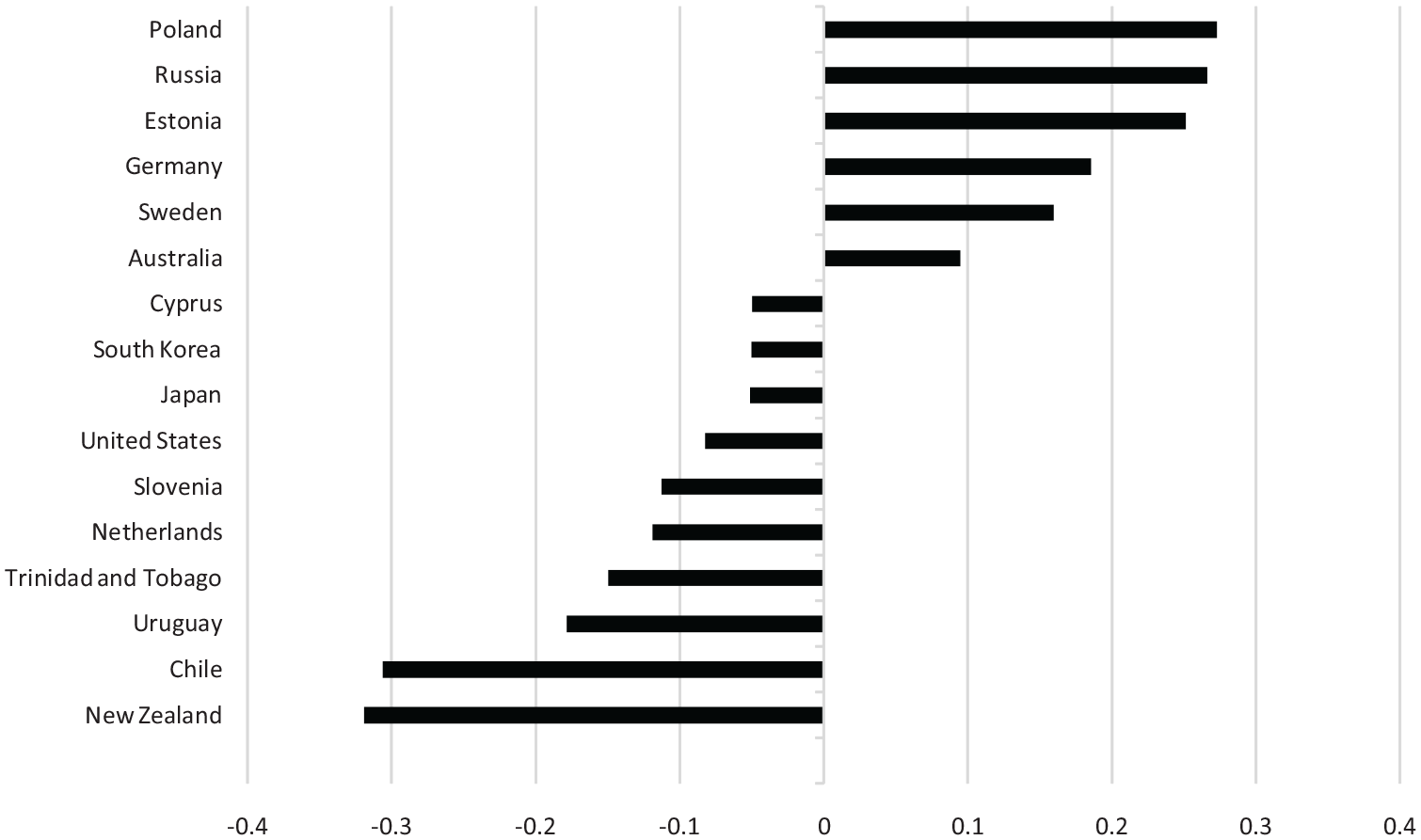
Scientific optimism factor scores.
Overall, Figure 1 shows substantial differences across high-income countries in terms of citizen optimism regarding science. Eastern Europeans on average have more optimism regarding science than the rest of the high-income countries. Second, Spanish-speaking and heavily Catholic countries are clustered near the bottom.
What explains variation in attitudes toward science across this relatively economically homogeneous set of countries? The large literature on the public understanding of, and engagement with, science holds some clues, although most cross-national research on the subject simply clusters individuals within their countries, and does not measure other factors about the country itself. In a meta-analysis, Allum et al. (2008) find a positive correlation between scientific knowledge and improved attitudes toward science, and that this relationship does not vary much cross-culturally, although it does vary depending on which kind of science one is studying. Using a sample of 34 primarily European countries and multilevel modeling, Kim et al. (2014) find that countries with more “postmaterialist” ideologies have lower acceptance of new technologies, as do countries where people are more religious. However, these two level 2 measures were in fact created by taking averages of individual survey responses from the same individuals studied at level 1. The fact that the level 2 measures are not exogenous from the level 1 measures provides a need for more analysis. They do find that wealthier countries have lower acceptance of new science and technology, which is in line with our past research. In their recent paper on 32 European countries, Makarovs and Achterberg (2018) find that more democratic countries contain citizens who are more engaged with science, and have higher support for the democratic control of science.
An examination of the risk society scholarship reveals two main arenas that separate countries according to their orientation toward science: health and the environment. While these arenas are significantly overlapped, they are distinct enough to generate unique research questions and hypotheses. We want to be clear: we are not arguing a one-way causal relationship between country-level factors and individual attitudes. Instead, we are working more within the frame that Anthony Giddens (1984) called “structuration”: societies shape individuals, and individuals shape societies. Therefore, a society with a particularly high vaccination rate, for example, both encourages people to get vaccinated, and reflects a higher level of acceptance for vaccines.
Health
Around the world, people are living longer lives (Zimmer and McDaniel, 2013), and more children are surviving past their first birthdays. In high-income countries specifically, the average life expectancy at birth has increased by 12 years since 1960, to an average 80.5 years.
At the opposite end of the life course, the declines in infant mortality are even more striking than the increases in life expectancy. In high-income countries, infant mortality declined from 10.3 deaths to 4.5 per 1000 live births between 1990 and 2016, a decline of over 50% (World Bank, 2018).
Perhaps, the most studied aspect of the relationship between health and risk in the world polity is vaccines (Makarovs and Achterberg, 2017). International organizations, such as the World Health Organization, are increasingly responsible for disseminating information about communicable diseases, including those for which there are vaccinations. Nations, in turn, have their own public health organizations to communicate the risks of vaccine-preventable diseases, and the ability to mandate vaccinations to access public institutions and services. Ultimately, however, individual people and families must make their own decisions about vaccinations, at least insofar as they are in compliance with the law.
As with any medical intervention, there are rare risks associated with vaccines. In line with risk society theory, wealthier countries have populaces that are more vaccine skeptical than lower-income countries (Trujillo and Motta, 2021). The COVID-19 pandemic and vaccine roll out present us with an opportunity to look at characteristics of individuals that predicted vaccine hesitancy. First, individuals' intention to vaccinate increased and undecidedness declined as vaccinations become more widespread (Kothari et al., 2021). In Japan, men and older individuals expressed less hesitancy toward COVID-19 vaccination (Yoda and Katsuyama, 2021), but in Poland, women, older individuals, and those with underlying conditions were more willing to accept a booster (Rzymski et al., 2021). In a global meta-analysis of COVID-19 vaccine hesitancy, in line with previous research on vaccine uptake, the authors found determinants of vaccine hesitancy were highly context-specific (Nehal et al., 2021).
We use a country’s measles immunization rate to assess the relationship between the uptake of vaccine technology and individual attitudes. Measles is a contagious viral disease, with a widely available vaccine that is known to be safe and effective (World Health Organization (WHO), 2018). Unlike the flu vaccination, people do not have to get vaccinated annually, and countries are more likely to have policies about measles vaccinations, for instance, that children cannot go to public schools unless they are vaccinated against measles. Several high-profile measles outbreaks in recent years have been characterized as evidence of increasing public distrust in science (Sugerman et al., 2010).
Environment
The second large body of work on risk society theory in the world polity is on the natural environment (Allan et al., 2000; Beck, 1992; Giddens, 2002; Mol and Spaargaren, 1993; Strydom, 2002). The relationship between science, technology, and risk in the environmental arena is complicated. Industrialization and the accompanying fossil fuel extraction and consumption are themselves scientific and technological advances and have greatly contributed to the standard of living experienced in upper- and middle-income countries. However, they have caused extensive damage to the natural environment. Nuclear technology for energy production is contested, particularly after nuclear disasters (Hasegawa, 2014). Nuclear energy may be an ideal example of the complexity of living in a risk society: the energy is cleaner and safer than that produced by fossil fuels—with a risk of catastrophic events. When systems are functioning at optimal levels, people and their natural environments are safe and healthy. But, when systems fail, the events are devastating for people and the natural world.
Environmental risks cannot be contained within country borders. All individuals live with some degree of risk from both anthropogenic and natural environmental events, despite county-level differences in resources to mitigate the effects. The environmental arena is also a lens for viewing the limits of global governance of the world polity. Although groups of nations may agree on climate standards, what of those countries that do not agree, or do not comply?
We measure a country’s environmental profile with the percent of electricity derived from fossil fuels, namely, coal, oil, and gas. The relationship between consumption of these fossil fuels and the warming environment is clearly demonstrated. Alternative energies are available for people and societies to convert to, at least partially. We argue that people living in societies with higher rates of fossil fuel use will have more optimism that science and technology can improve lives in the future. Particularly, in highly educated, high-income countries, this represents governments who are aware of the risks of fossil fuels but have not changed course. Curran (2021) identified key narratives the Australian government used from 2013 to 2020 to maintain support for reliance on the coal sector. These narratives included economic justifications (focusing on stability, prosperity, and employment), cultural justifications (referencing Australia’s character and regional culture), and contrasting the coal sector with environmental elitism. We believe that in societies with greater fossil fuel reliance, scientific optimism leads decision-making: if fossil fuels are contributing to global warming, and if global warming is detrimental, then science and scientists will develop new ways to handle these problems. This is in line with the theory of techno-optimism, or the belief that science and technology can solve societal and environmental problems even in the face of increasing demand, without restrictions on economic growth or a heightened focus on environmentalism (Krier and Gillette, 1985). Danaher (2022) defines techno-optimism as “the view that technology, when combined with human passion and ingenuity, is the key to unlocking a better world” (p. 1).
Mobile phone subscriptions
We use mobile phone subscriptions as an indicator of materialist (versus postmaterialist) orientation at the country level. Country-level income has low variability across this selection of high-income countries, but mobile phone usage has been used as a measure of economic development in previous research (see Das et al., 2016; Pappalardo et al., 2016). In examining how increased Internet and mobile cellular phone subscriptions can positively affect economic growth, Das et al. (2016) note that this diffusion of information and communication technology can “improve the quality of decision making by economic agents” (p. 141). Here, we extend that premise beyond improved decision-making by economic agents to argue that the widespread availability of communication and information technology is also beneficial for improved decision-making among individuals regarding scientific issues and thus linked to greater scientific optimism.
Individual-level factors
We expect that in high-income countries, individuals’ religious and political orientations, as well as the information sources they rely on, shape their scientific optimism.
Materialist/nonmaterialist orientation
Risk society is characterized by a populace that has achieved a great enough level of economic and material security that they can focus on more nonmaterial concerns. We expect that at the individual level, those with more nonmaterialist attitudes will be more risk-averse and express less scientific optimism. We use Inglehart’s Materialist/Nonmaterialist scale to measure this concept (Inglehart, 2006; Inglehart and Flanagan, 1987). The scale takes into consideration a person’s attitudes toward 12 goals and priorities for themselves and their country. Valuing less impersonal societies, having ideas count more than money, having more say in government, freedom of speech, more say on the job, and more beautiful cities are considered to be postmaterialist ideals while maintaining a stable economy, fighting rising prices, having strong defense forces, fighting crime, emphasizing economic growth, and maintaining order are considered to be more materialist values. Higher values on this scale correspond to a more nonmaterialist orientation.
Political ideology
Previous research presents mixed findings on the effect of political ideology on trust in science. In the United States, being farther to the Right is associated with less trust in science (Gauchat, 2012). However, across 46 economically and culturally diverse countries, being farther to the Right politically was associated with greater confidence in science (Price and Peterson, 2016). We include a measure of political ideology that ranges from 1 (Left) to 10 (Right), but we do not hypothesize a direction of effect.
Sources of media for information
We also examine how the type of media individuals use for information affects scientific optimism. Previous research has demonstrated that where individuals receive their news affects their attitudes toward particular scientific policy areas, with country context moderating the effect. Some research in sociology and communication studies argues that television news, in particular, is harming public understanding of science by treating all information as up for debate (Nisbet and Goidel, 2007). The “two-sides of the story” framework of many television news programs does not help viewers determine which side carries the most credibility among the scientific community. The Internet, too, has come under scrutiny for its effects on attitudes toward science (Black and Rappuoli, 2010; Diehl et al., 2021; Makarovs and Achterberg, 2017; Puri et al., 2020). Information is treated equivalently in the digital commons, without editorial or academic review, and misinformation and pseudoscience can easily take on the look and tone of academic literature.
Researchers have raised concern about how social media affects vaccine hesitancy, both in terms of recommended childhood vaccinations and COVID-19. Content across YouTube, Instagram, and Twitter demonstrated that there is much more antivaccine content available than content supporting or advocating for vaccines, there was more user engagement with antivaccine posts, and that bots and trolls were generating such content, not just human users (Puri et al., 2020). On the other hand, one recent study of 20 countries demonstrated that using social media for news was linked with decreased climate change skepticism; however, this effect was reduced in high-income countries (Diehl et al., 2021). We include a series of dichotomous variables for where a person gets their daily information, including, newspaper, radio, mobile phones, the Internet, and friends, with television as the reference group.
We also include sociodemographic controls at the individual level. We expect that women, older individuals, those who are married, employed, and have a higher education and income to express greater scientific optimism in line with previous research. We expect higher religiosity to be associated with lower scientific optimism.
3. Data and methods
Data come from Wave 6 of the World Values Survey (Inglehart et al., 2018), which were collected between 2010 and 2014 in 60 countries or territories. We first limit our sample to the 17 high-income countries, as classified by the World Bank, then we eliminate Spain because individuals there were not asked the series of questions on the sources of media they use for information. We use a Likelihood ratio (LR) test to justify the use of multilevel models. The LR test has a null hypothesis that the two models provide the same goodness of fit. The LR test versus the linear model is highly significant (p < .001), providing statistical justification for hierarchical modeling. The maximum number of individuals in any model is just under 19,000. The minimum sample size is just over 15,000 after missing data are taken into account. We employ the Stata MIXED command to construct the multilevel models and include a random slope to account for unmeasured variation across countries. The operationalizations and descriptive statistics for all of the variables are in Table 1.
Operationalizations and descriptive statistics.
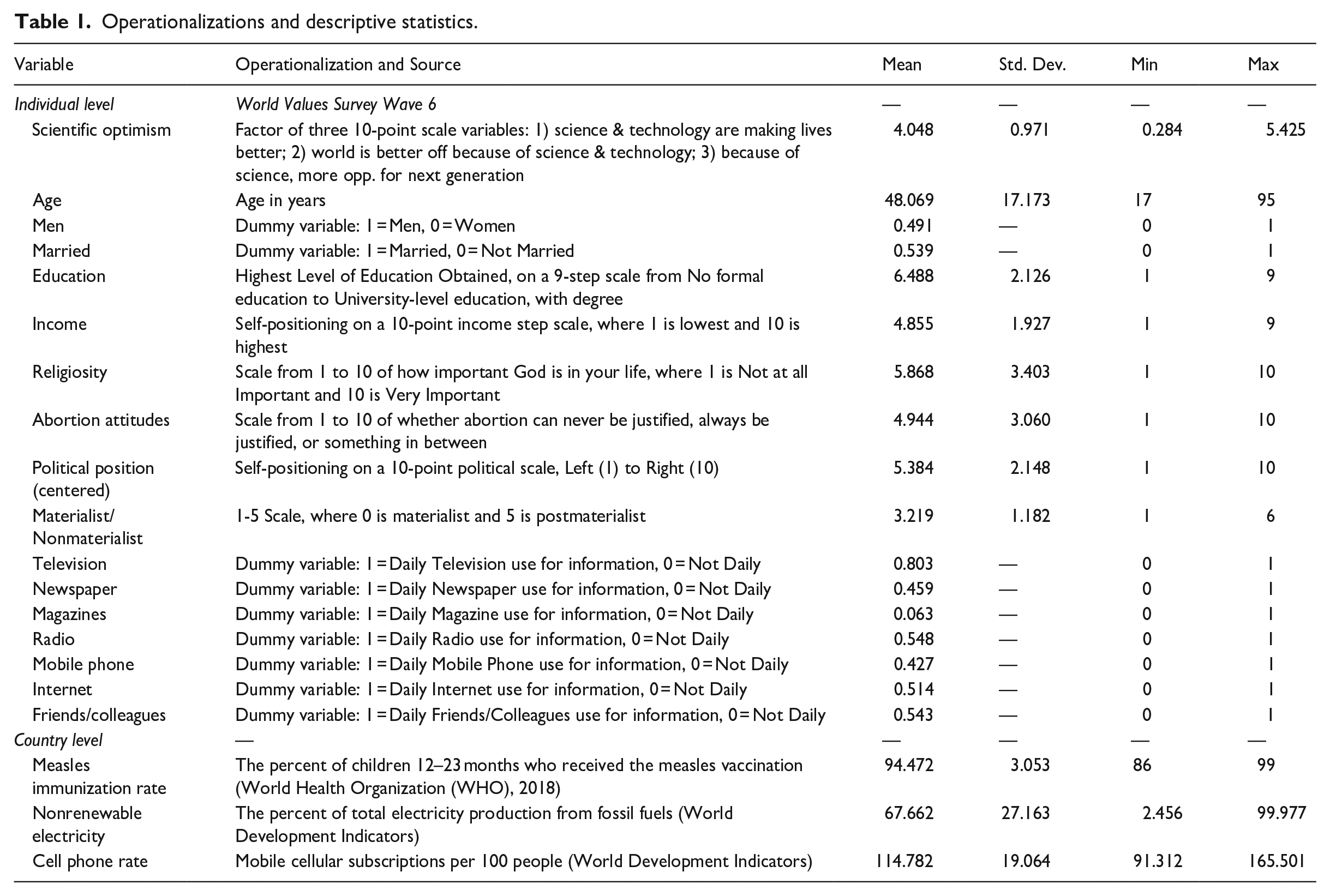
Average levels of optimism regarding science is relatively high in these 16 high-income countries. The average age of the sample is 48, about half are men and half are women, and slightly over half are married. On average, people have completed at least some secondary school, and are about in the middle of the income scale. There is high variability in how religious people are, as evidenced by the high standard deviation. Similarly, people are in the middle of the abortion justification scale, with high variability. The average political position is almost exactly between right and left. On average, the sample reports slightly more nonmaterialist orientations than materialist. The vast majority of the sample use television for information daily (80%), just under half use the newspaper daily (45.9%), just over half use the radio (54.8%), the Internet (51.4%), and friends/colleagues (54.3%). Under 10% of respondents use magazines daily for information. On average, these 17 countries have a 94.472% measles immunization rate, with 86% on the low end, and 99% on the high end. On average, 67.662% of electricity is derived from nonrenewable fossil fuel sources. Finally, the average mobile cellular subscription is 114.782 for every 100 people. Because average country income does not vary much across these places, we are using mobile phone subscriptions as an indicator of material consumption.
There are no correlations between variables at or above r = .4. The highest correlation (r = .358) is between those who use their mobile phone as an information source and their friends as an information source. The correlation matrix is available from the authors upon request.
4. Results
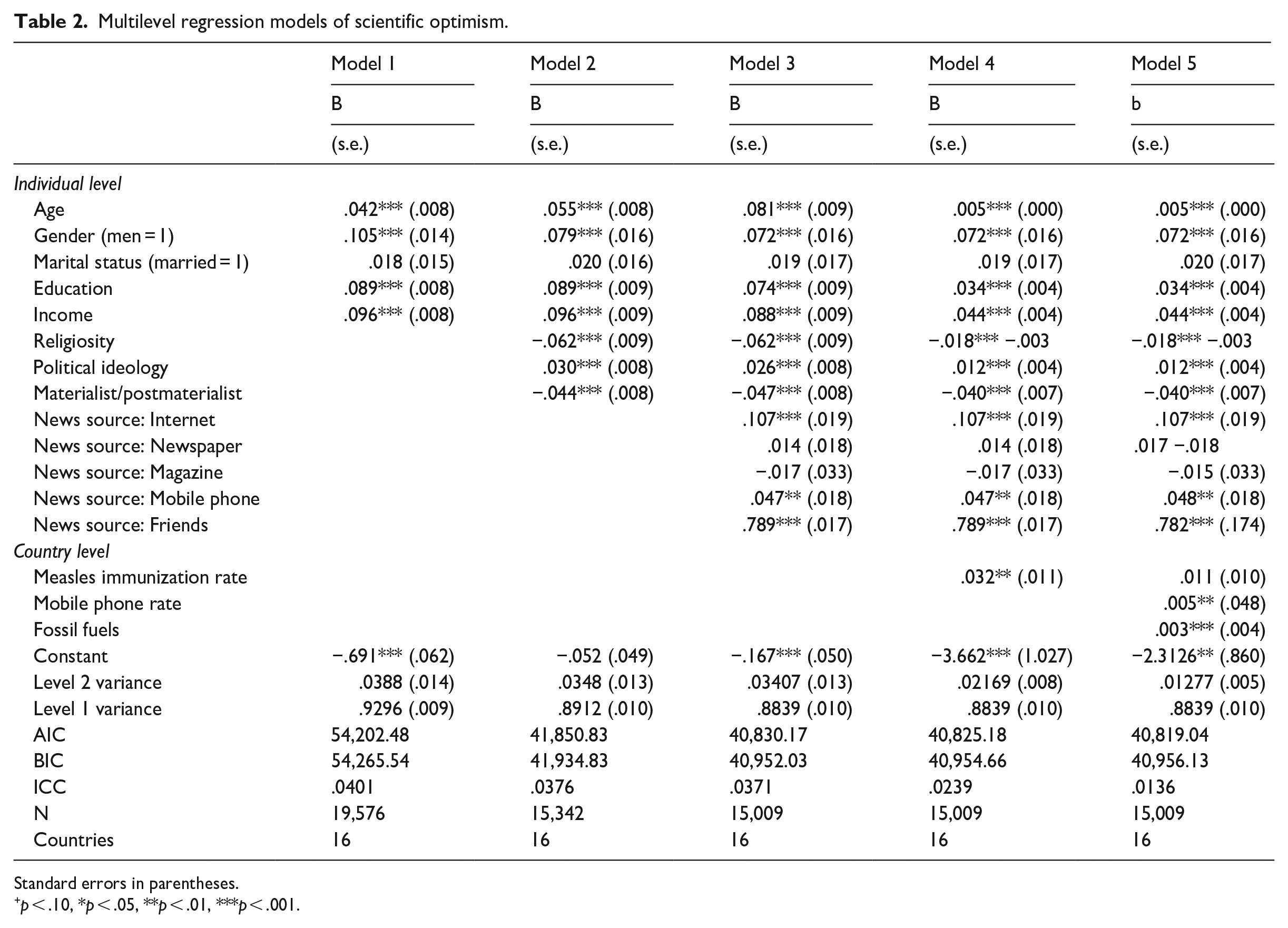
Table 2 displays the multilevel results for five regression models. Model 1 contains only the individual-level demographic factors. Increasing age, education, and income are associated with increasing scientific optimism. Men express more scientific optimism than women.
Multilevel regression models of scientific optimism.
Standard errors in parentheses.
p < .10, *p < .05, **p < .01, ***p < .001.
Model 2 adds in the individual-level value indicators. The direction and effects of the demographic variables stay the same. Religiosity is associated with a strong, significant decline in scientific optimism. Those further to the Right on the political positioning scale have more optimism regarding the role of science, and those who express more nonmaterialist values have significantly less optimism toward science.
Model 3 builds on Model 2 with the addition of information source questions that ask respondents where they get their daily information. In comparison to those who use the television for daily information, those who use the Internet, mobile phone, or friends and colleagues report greater scientific optimism.
Model 4 adds in measles immunization rate as a country-level factor. We find that countries with a higher measles immunization rate have citizenry that express greater scientific optimism. Model 5 adds the mobile phone rates as well as fossil fuel consumption. The effect of measles immunization is no longer significant, but greater fossil fuel reliance and mobile phone penetration are both associated with higher scientific optimism. The intraclass correlation coefficient (ICC), presented below the models, suggests that we have done a fairly thorough job accounting for the variation at the country level in this select group of high-income countries. In Model 1, 4% of the variance in attitudes toward science were due to factors at the country level. In Model 5, after the inclusion of mobile phone rate, the measles immunization rate, and fossil fuels, 1.3% of variance left to be explained is at the country level.
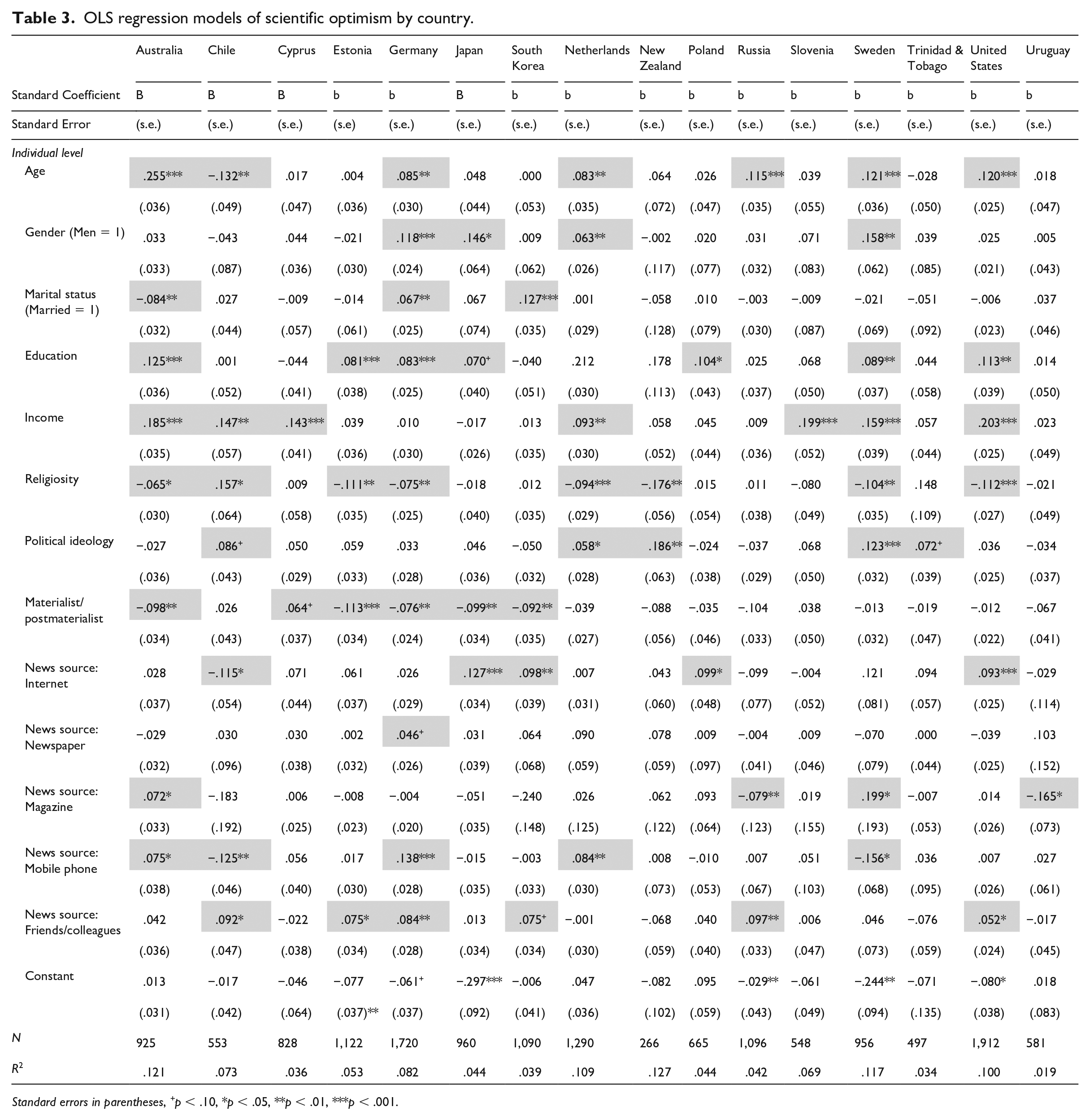
Table 3 presents the individual regression analyses predicting scientific optimism in each of the 16 countries separately. All coefficients are standardized, allowing for a comparison of the strength of predictors and the significant predictors across countries. Looking first at the predictors that operate most consistently across countries, religiosity was a significant predictor in eight of the 16 countries, with a negative effect on scientific optimism in Australia, Estonia, Germany, the Netherlands, New Zealand, Sweden, and the United States, and a slightly significant positive effect in Chile. Age was a significant predictor across seven countries, predicting greater scientific optimism with rising age in Australia, Germany, the Netherlands, Russia, Sweden, and the United States. Again, Chile was unusual in that older individuals were found to express less scientific optimism. Education and income also operated well as predictors. Higher education predicts greater scientific optimism in Australia, Estonia, Germany, Japan, Poland, Sweden, and the United States, while higher income is associated with more optimism toward science in Australia, Chile, Cyprus, the Netherlands, Slovenia, Sweden, and the United States. Postmaterialist attitudes are associated with less scientific optimism in Australia, Estonia, Germany, Japan, and South Korea, but have a positive effect in Cyprus. Those farther to the Right politically express greater scientific optimism in Cyprus, the Netherlands, New Zealand, Sweden, and Trinidad and Tobago. Using the Internet for information (as compared to TV news) has a positive effect on scientific optimism in Japan, South Korea, Poland, and the US. Referring to friends and colleagues (in comparison to TV news) has a positive effect on scientific optimism in Chile, Estonia, Germany, South Korea, Poland, and the United States. Finally, using a mobile phone for information is a significant predictor of scientific optimism across five countries with inconsistent results, referring to magazines significantly predicts attitudes across four countries, men express more scientific optimism than women in four countries, and marital status is predictive in three countries.
OLS regression models of scientific optimism by country.
Standard errors in parentheses, +p < .10, *p < .05, **p < .01, ***p < .001.
Looking to how many of the individual variables significantly predict scientific optimism in each country reveals that the model specified works best in Australia, Germany, the Netherlands, Sweden, and the United States (it also operates well in Chile, but variables do not always operate in the direction hypothesized).
5. Discussion and conclusion
In this article, we consider the variation in scientific optimism in 16 high-income, reflexively modern countries. Although they have important differences, these countries have many similarities, and are highly embedded in the world polity. All of these countries represent risk society; nation-states where individuals are no longer seeking to meet their material needs, and are increasingly focused on unlikely but high-consequence risks to themselves, the environment, and future generations. We use a risk society framework to examine the individual-level factors that account for differing attitudes toward science, but we also consider how the country context of technological consumption, public health, and orientation to the natural environment impact these attitudes.
We find significant support for the risk society thesis at the individual level, with some important caveats. First, in support of the thesis, we find that younger people have significantly less optimism in science than older people. This suggests that younger people are more aware of the risks associated with scientific achievement, and warier of them, approaching scientific advancements with more caution and less optimism. Second, we find that people who express more nonmaterialist attitudes have significantly less confidence in science and technology than those who express more materialist attitudes, which holds true in our multilevel models and in five of the individual country models (Australia, Estonia, Germany, Japan, and South Korea). People with nonmaterialist orientations have moved past looking to science to address material concerns of safety and security, and are more focused on risks associated with scientific and technological advances, such as environmental consequences.
Third, we find that people who are more to the Right of the political spectrum have significantly more scientific optimism than those to the Left. Being politically Right predicts greater scientific optimism consistently in our multilevel models including 16 countries and in five of the individual country regressions (Chile, the Netherlands, New Zealand, Slovenia, and Sweden). Those on the Right tend to prioritize economic growth and free market economy, and favor politicians who will remove restrictions from the market, even if the removal is detrimental to the natural environment or population health, as was seen in the differential approaches politicians took in balancing COVID-19 mitigation strategies with economics. Therefore, it makes sense that, controlling for other factors, those on the Right would be more accepting of scientific risk than those on the Left.
We also find several things that are consistent with previous literature, namely, that more religious individuals have less optimistic attitudes toward science than less religious individuals, men are more optimistic regarding science and risk than women, and those with higher education and incomes are more optimistic than those with lower incomes.
We also add to the literature by considering how a person’s sources of information affect their attitudes toward science and risk. In comparison to the daily use of television for information, individuals who use the Internet, mobile phone, or friends and colleagues as news sources express more scientific optimism.
Perhaps our largest contribution is the consideration of how even within this set of reflexively modern countries, context matters. We do not propose a top-down causal argument in which a state exists outside of the individuals within it, and socializes them according to state directive. That may be more plausible in nondemocratic countries, but here we have 16 democracies, where the state is more likely to reflect the people it governs, albeit imperfectly. Thus, we are arguing more within the structuration framework developed by Giddens (1984). Structuration theory allows for “knowledgeable agents” who live in societies in which “the degree of closure of societal totalities. . .is widely variable” (Giddens, 1984: 281, 283). In other words, people are reflections of the state they live in, and the state reflects the people it governs. Particularly with the advent of technologies that allow information to flow near-freely across borders, populaces are not tied to the state for information about the risks and rewards of modernity.
When we consider country-level factors in this article, we are thinking of them as parts of a national identity that will socialize current and future residents, and as reflections of individual-level attitudes aggregated to the society. We argue that countries with higher technological consumption, higher immunization rates, and more electricity derived from fossil fuels will contain people with more optimism regarding the role of science and technology to improve lives today and in the future. We believe that all three of these measures indicate a focus society-wide on material needs, rather than a heightened concern about risks of scientific and technological advancement. However, we recognize that a limitation of this study is that we cannot completely rule out the possibility of reverse causality. For example, while we theorize that countries with higher measles immunization rates foster a society that is more optimistic about the positive role science can play in shaping the future, we recognize that populaces with greater scientific optimism may lead to higher measles immunization rates overall. In conclusion, we argue that a greater public understanding of science, and especially recent developments, is necessary so that people can make informed choices about the risks and rewards of scientific advances to themselves, and to the societies they live in.
Supplemental Material
sj-docx-1-pus-10.1177_09636625231165150 – Supplemental material for The health and environmental risks and rewards of modernity that shape scientific optimism
Supplemental material, sj-docx-1-pus-10.1177_09636625231165150 for The health and environmental risks and rewards of modernity that shape scientific optimism by Anne M. Price and Lindsey Peterson in Public Understanding of Science
Footnotes
Funding
The author(s) received no financial support for the research, authorship, and/or publication of this article.

Supplemental material
Supplemental material for this article is available online.
Author biographies
References
Supplementary Material
Please find the following supplemental material available below.
For Open Access articles published under a Creative Commons License, all supplemental material carries the same license as the article it is associated with.
For non-Open Access articles published, all supplemental material carries a non-exclusive license, and permission requests for re-use of supplemental material or any part of supplemental material shall be sent directly to the copyright owner as specified in the copyright notice associated with the article.
