




Abstract
The saccadic eye movements that people make when thinking have been largely ignored in the eye-movement literature. Nevertheless, there is evidence that such eye movements are systematically related to internal thought processes. On average, people move their eyes about twice as often when searching through long-term memory as they do when engaged in tasks that do not require such search. This pattern occurs when people are in face-to-face situations, when they are in the dark, and when they have their eyes closed. Because these eye movements do not appear to serve visual processing, we refer to them as “nonvisual” eye movements and discuss why the eyes move during thinking that does not involve vision.
If you observe people answering questions or engaged in conversation, you will notice that their eyes are often in motion. Why do these eye movements occur? Why don’t people simply look at each other continuously in these situations? When we have asked people this question, they often say that they look away because looking at the other person is distracting and makes it harder to think. Empirical support for this view has come from studies of gaze aversion, which have demonstrated that shifts of gaze may occur to free up cognitive resources, especially when people need to think more deeply about what they are saying (i.e., are experiencing high cognitive load, Beattie, 1981; Doherty-Sneddon & Phelps, 2005; Glenberg, Schroeder, & Robertson, 1998). Nevertheless, there are a number of reasons why this account is, at best, incomplete. If people shift their gaze to avoid distraction, why do they often continue to move their eyes after they have looked away from the distracting stimulus (Argyle & Cook, 1976)? Moreover, eye movements occur not only in face-to-face situations but also when people are alone in a physically barren environment (Hiscock & Bergstrom, 1981; Micic, Ehrlichman, & Chen, 2010), when they are in complete darkness (Ehrlichman & Barrett, 1983), and even when their eyes are closed (Ehrlichman, Micic, Sousa, & Zhu, 2007). Indeed, there is evidence that seeing another person’s face may actually suppress eye movements that would otherwise occur were the face not present (Ehrlichman, 1981).
The eye movements we are discussing are called saccades. Their role in vision is to bring salient information onto the fovea. Because the saccades that accompany thinking do not seem to occur for the purpose of visual processing, we refer to them as “nonvisual” eye movements. Although the shifts of gaze produced by eye movements that occur during thinking are visible to the naked eye and easily observed in everyday life, they have been largely ignored in the eye-movement literature (Godijn & Theeuwes, 2002; Leigh & Kennard, 2004). Nevertheless, we believe there is now sufficient evidence not only that nonvisual eye movements exist but that they are systematically related to cognitive processes that occur when people think.
Lateral Eye Movements
The first sustained interest in eye movements during thinking emerged in the 1960s and 1970s under the rubric of the “lateral eye movement” phenomenon. It was observed that while people answered questions, they typically shifted their gaze away from the questioner. However, rather than interpreting this behavior as gaze aversion, researchers proposed that these shifts of gaze were secondary motor responses triggered by asymmetries in the activation of the cerebral hemispheres (Kinsbourne, 1972). Rightward shifts (contralateral to the verbal left hemisphere) were said to occur when a question elicited verbal thinking (e.g., interpreting proverbs, providing word definitions) and leftward shifts (contralateral to the ostensibly more visual right hemisphere) were said to occur when a question elicited visual imagery (e.g., reporting how many edges a cube has, describing what one’s living room looks like). However, reviews of studies following this model revealed that the verbal and visuospatial questions did not consistently show the predicted directional patterns. Interestingly, questions did differ in the frequency with which any lateral eye movements occurred: People were more likely to make no eye movement (that is, to stare) when answering visuospatial questions than when answering verbal questions (Ehrlichman & Weinberger, 1978).
Further research demonstrated that this effect was not limited to the initial saccade but extended to subsequent eye movements. Using a measure of eye-movement rate (EMR, in saccades per second), Weiner and Ehrlichman (1976) found a mean EMR of 0.84 for verbal questions and of 0.67 for spatial questions. This verbal–visuospatial difference in EMR was found whether eye movements were directly observed or were assessed by electro-oculography (Hiscock & Bergstrom, 1981), when subjects viewed a face or a gray oval, were in a visually complex environment, or were in total darkness (Ehrlichman & Barrett, 1983).
Despite these robust findings, it remained unclear why verbal and visuospatial questions should produce different rates of eye movements. Ehrlichman and Barrett (1983) noted that these questions differed not only in terms of verbal versus visuospatial processing but also in their memory demands; whereas verbal questions typically required extensive memory search, visuospatial questions typically provided all of the information required within the image itself. Bergstrom and Hiscock (1988) tested this idea by comparing questions that differed in what they called “constraint.” They found that constraint was far more important than either the verbal/visuospatial distinction or question difficulty in eliciting eye movements. Unconstrained verbal questions (those requiring extensive memory search—e.g., “Name a five-letter word with three consonants and two vowels”) produced EMRs about twice as large as did constrained verbal questions (those requiring little memory search—e.g., “How many vowels are in the word ‘intransigent’?”).
Nonvisual Eye Movements and Memory
Bergstrom and Hiscock’s (1988) study was designed to clarify why verbal and visuospatial questions differed in EMR. We have recently carried out a series of studies to directly examine the role of memory in nonvisual eye movements (Ehrlichman et al., 2007; Micic et al., 2010). Our working hypothesis was that searching for information in long-term memory generates saccadic activity, whereas maintenance of, or attention to, information in working memory inhibits saccadic activity. In our studies, participants were seated in a room with minimal visual stimuli. We communicated with them via audiovisual link and videorecorded their eye movements as they carried out the tasks (which were presented auditorily). Participants were told that we were studying facial expressions; no mention was made of the eyes. Eye movements were then counted off-line. This procedure produced highly reliable EMRs.
Cognitive tasks that differed in their requirement for long-term-memory search and/or maintenance of information in working memory were chosen. Six of the tasks are shown in Table 1. As can be seen, tasks that involved minimal long-term-memory search and required focus on material in working memory produced the lowest EMRs, whereas tasks with high requirements for long-term-memory search produced the highest EMRs. Participants’ ratings of visual imagery and difficulty were unrelated to task differences in EMR.
Mean Eye-Movement Rate (EMR), Difficulty, and Imagery for Tasks Varying in Requirements for Search Through Long-Term Memory

Note: Instructions for the six tasks were as follows. Continuous performance: Press a clicker whenever a specified sequence is detected in an auditorily presented sequence of letters. Mental alphabet sound: Mentally go through the alphabet and report the number of letters with a specified auditory property (e.g., long e sound). Mental alphabet shape: Mentally go through the alphabet and report the number of letters with a specified visual property (e.g., a curve). Auditory word retrieval: Name words that rhyme with a specified word. Visual object retrieval: Name objects with a specified visual feature (e.g., triangular). Semantic word retrieval: Name words that have a similar meaning to a specified word.
An EMR of 0.50 indicates that one saccade occurred for every 2 seconds in the task; an EMR of 1.00 indicates that one saccade occurred for every second in the task. Difficulty and imagery ratings were made using 6-point scales, from 1 (very easy/no imagery) to 6 (very difficult/extensive imagery).
Source: Adapted from “Looking for Answers: Eye Movements in Non-Visual Cognitive Tasks,” by H. Ehrlichman, D. Micic, A. Sousa, and J. Zhu, 2007, Brain and Cognition, 64, p. 11. Copyright 2007, Elsevier. Adapted with permission.
We have found that virtually any task that requires search through long-term memory produces high EMRs (Micic et al., 2010). Semantic and phonemic verbal fluency tasks, semantic and episodic recall tasks, and recall of words encoded at a deep or shallow level of processing all produce comparably high EMRs as compared with tasks requiring little or no long-term-memory search. These effects are not subtle; they are easily reproduced and typically involve extremely large effect sizes (d is often in the 1.0 to 2.0 range). Furthermore, they are not affected by the amount of verbal output required by a task and are highly robust with regard to the visual environment, having been observed in situations with very high and very low visual stimulation and while subjects’ eyes are closed. We have also seen that task difficulty does not account for differences in EMR. Neither does cognitive load: Blink rate, which can serve as an index of cognitive load (Siegle, Ichikawa, & Steinhauer, 2008), was found not to differ between high- and low-retrieval tasks (Ehrlichman et al., 2007).
Tasks that utilize material from long-term memory but do not require search, such as our mental alphabet task (and tasks such as saying the days of the week or simple counting), typically produce low EMRs. In such tasks, once the first element (e.g., the letter a, Sunday) is “located,” the remaining task requires no additional search for completion because the initial element provides a strong cue for the next element in the series.
Are Nonvisual Eye Movements Functional?
Why do these patterns occur? One possibility is that nonvisual saccades somehow facilitate cognitive processes. Averting gaze is said to have this function because it reduces cognitive load, but it is hard to see how this reasoning could apply to the saccades that occur after gaze has shifted or to those that accompany thinking in barren or dark environments or when eyes are closed. However, there is recent research that does demonstrate a functional role explicitly relating saccades to memory retrieval. Christman, Garvey, Propper, and Phaneuf (2003) instructed participants to make large eye movements to the right and left for 30 seconds prior to recalling word lists or recent autobiographical events. Eye movements were found to facilitate recall compared to a no-eye-movement control condition. Christman et al. (2003) proposed that these saccades sequentially activate the left and right cerebral hemispheres and thus facilitate recall via increased hemispheric interaction. Although the linkage between saccades and episodic memory retrieval is certainly consistent with our findings, it remains unclear how it applies to the patterns of EMR in our studies, in which eye movements are much smaller and rarely cross the visual midline.
If eye movements that spontaneously occur in high-retrieval tasks facilitate memory, then suppressing them should impair performance. We tested this idea by comparing performance when participants were instructed not to move their eyes or were allowed to move their eyes naturally (Micic et al., 2010). Half of the subjects recalled lists of words with no instructions regarding their eyes (free gaze); the other half recalled lists while instructed to suppress all eye movements and look steadily at a dot in front of them (fixed gaze).
Figure 1 shows that whereas the EMR in the free-gaze condition was typical for high-retrieval tasks, EMR in the fixed-gaze condition was greatly reduced. However, performance in the two conditions was identical. These results suggest that the saccades people make in high-retrieval tasks have little functional value. Therefore, it may seem surprising that some people find it difficult to avoid making eye movements while thinking. Despite repeated admonitions to maintain fixation, 18 out of 75 participants in this study were not able to suppress their eye movements during retrieval but were able to do so easily during an auditory continuous performance task.
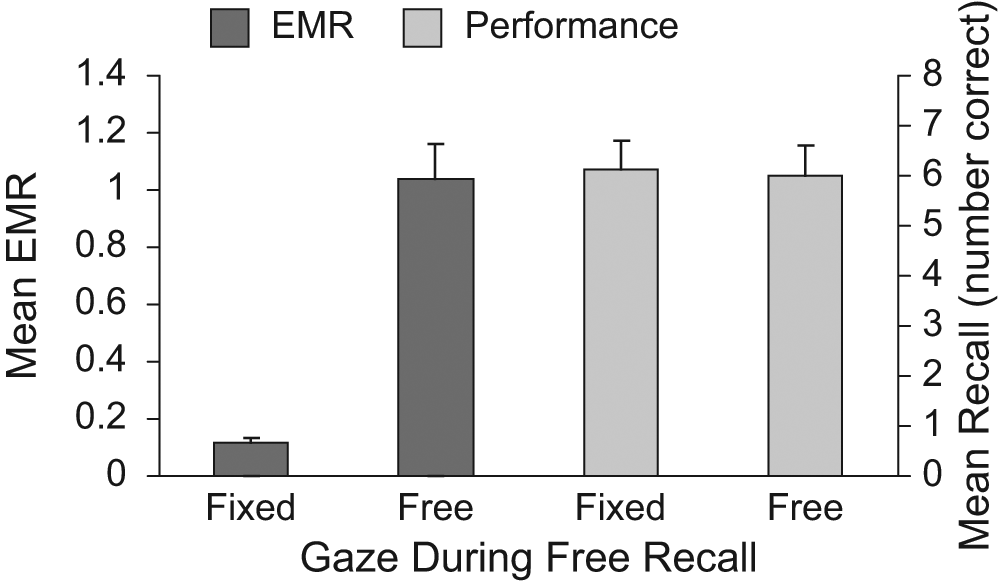
Mean eye movement rate (EMR) and mean recall (number of words correct) under two gaze conditions (fixed gaze, free gaze). Error bars represent standard errors.
So Why Do Eye Movements Accompany Long-Term Memory Search?
We suggest that this close (yet possibly epiphenomenal) relationship between saccadic activation and long-term-memory search may reflect the evolutionary history of the brain. It is a tenet of evolutionary thinking that new structures and systems do not simply replace older ones but rather build on them (cf. Jonides, Lacey, & Nee, 2005). In this spirit, we speculate that the ability to search for information stored in long-term memory may have developed from already-existing neural systems that enable the search for information in the visual environment. People use saccades to scan the visual environment. When they locate a stimulus of interest, scanning ceases and they focus on that stimulus. By analogy, people make multiple eye movements when they “scan” for information in long-term memory and very few eye movements when they “focus” on information in the working-memory “buffer.” (Participants have reported experiences during high-retrieval tasks that are consistent with this analogy—e.g., “My eyes were darting around trying to pull the answer out of my head”; “I felt like I was looking around the room for the words, even though I knew they weren’t there.”) Such an analogy of functions warrants identification of the neural circuits that could be involved in both long-term-memory retrieval and saccadic activation. Indeed, there are many areas of potential overlap and interaction between the circuits involved in these processes. Candidate structures include the basal ganglia, cerebellum, frontal eye fields, and dorsolateral prefrontal cortex, as well as others (Anderson, Mannan, Rees, Sumner, & Kennard, 2010; Micic et al., 2010; Tanaka & Kunimatsu, 2011).
If saccades can be triggered by both visual and memory systems, then perhaps these systems may compete for control of eye movements. If such competition exists, then one could imagine situations in which the need to maintain visual scanning is compromised by a shift of control from visual- to memory-based saccadic triggers. For example, it is known that conversation during driving is detrimental to efficient scanning of the road (Strayer & Drews, 2007). Perhaps that is in part because saccades are being triggered by memory-retrieval processes that are intrinsic to conversation.
Future Directions
Eye movements that people make while thinking are ubiquitous, easy to observe, and closely related to aspects of cognitive processes in which people are engaged. We believe that the evidence that these eye movements are independent of visual processing is compelling, and hence we have referred to them as nonvisual eye movements. Current research supports the idea that a main trigger of these eye movements is search through long-term memory. We have also hypothesized that maintenance of information in working memory inhibits eye movements. Because tasks that maximize maintenance also minimize search, current research cannot clearly distinguish between effects of search and those of maintenance. Our finding that a no-task “baseline” EMR fell midway between EMRs for high-retrieval/low-maintenance and high-maintenance/low-retrieval tasks (Ehrlichman et al., 2007) is consistent with the notion of inhibition. However, the concept of a baseline is problematic because we do not know the extent to which eye movements may be triggered by visual or cognitive processes occurring during the no-task condition. Clearly, further research will be needed to tease out the facilitating and inhibiting influences on EMR.
Many other questions also remain. Some of these involve a much more fine-tuned analysis of the properties of these eye movements. For example, do the task differences we have documented occur with saccades smaller than the 2 degrees that are reliably assessed visually or with electro-oculography? Do these saccades differ in their physical or temporal properties from those that serve vision? What is the developmental course of eye movements that accompany long-term-memory search? At what age do they first appear? Might nonvisual eye movements have clinical significance—for example, in assessing memory deficits associated with aging? What accounts for the large individual differences in overall EMR (ranging from near 0 to more than 2.0 in our participants) on which task effects are superimposed? Finally, we can ask whether these eye movements are unique to humans. It has been argued that humans may be the only animals capable of “mental time travel” (Tulving, 2005). If mental time travel requires a sense of a self that exists through time, then perhaps the same is true of intentional search for information in long-term memory (Conway, 2005). If so, humans may also be only animals that make eye movements that are not in the service of vision.
Recommended Reading
Glenberg, A. M., Schroeder, J. L., & Robertson, D. A. (1998). (See References). A good discussion of the concept of gaze aversion.
Micic, D., & Ehrlichman, H. (2011). Eye movements in non-visual cognition. In D. P. Anderson (Ed.), Eye movement: Theory, interpretation, and disorders (pp. 1–55). New York, NY: Nova Science Publishers. A comprehensive review of the literature on nonvisual eye movements.
Roediger, H. L., & Guynn, M. J. (1996). Retrieval processes. In E. L. Bjork & R. A. Bjork (Eds.) Memory (pp. 197–236). San Diego, CA: Academic Press. An excellent discussion of the role of retrieval in memory.
Footnotes
The authors declared that they had no conflicts of interest with respect to the research, authorship, and/or publication of this article.