



Abstract
Cognitive control enables humans to flexibly switch between different thoughts and actions. An important prerequisite for this cognitive flexibility is the human ability to form and apply general task rules. In this article, I review research investigating the functional role of task rules, with an emphasis on two main findings. First, the shielding function of task rules helps guide attention toward task-related information, thereby reducing possible distraction by irrelevant information. Second, this task shielding has to be relaxed when a task rule changes, thereby making the cognitive system more vulnerable to the intrusion of distracting information. Implications for developmental psychology and higher-level cognition are discussed.
In daily life, we constantly have to switch between different thoughts and actions in response to changing task demands and internal needs. For example, while writing a paper with its deadline approaching, you might get distracted by incoming e-mails or feelings of hunger. You can either switch actions (answer the e-mails or grab some food) and then turn back to your writing task, or you can try to ignore the distraction and continue with the ongoing task. Whether you switch or stay on task, cognitive control can support either decision by shielding against the distraction or by helping to switch back and forth between tasks.
In this context, the task-switching paradigm has become a popular tool to study such processes of cognitive control (see Kiesel et al., 2010; Vandierendonck, Liefooghe, & Verbruggen, 2010, for recent reviews). In this paradigm, participants have to switch between two or more simple cognitive tasks (e.g., a letter- and a digit-categorization task). One robust finding is that performance, in terms of reaction times and error rates, is better on task repetitions (e.g., two letter tasks in a row) than on task switches (e.g., a letter-categorization task after a digit-categorization task). These switch costs (i.e., decreased performance resulting from switching between tasks) have long been taken as a direct measure for the amount of cognitive control needed to flexibly switch between cognitive operations. 1 In this article, I review recent research from our lab showing that when it comes to task switching, the application of a task rule is just as indicative of the involvement of cognitive control as is the process of switching per se.
Why Task Rules Instead of Stimulus-Response Rules?
When I first learned about the task-switching paradigm 15 years ago, I already wondered why participants actually switched between tasks instead of simply learning the individual stimulus-response (SR) rules by heart. This is surprising, especially given that most studies use only a small set of four to eight stimuli. Figure 1 illustrates this idea by showing two alternative task representations for eight different stimuli, either in the form of individual SR rules (left) or in the form of two task rules (right). From this, it should also be apparent that task rules differ from SR rules, in that task rules define a common response-discriminating stimulus feature whereas SR rules define the mapping between an entire stimulus and a response.
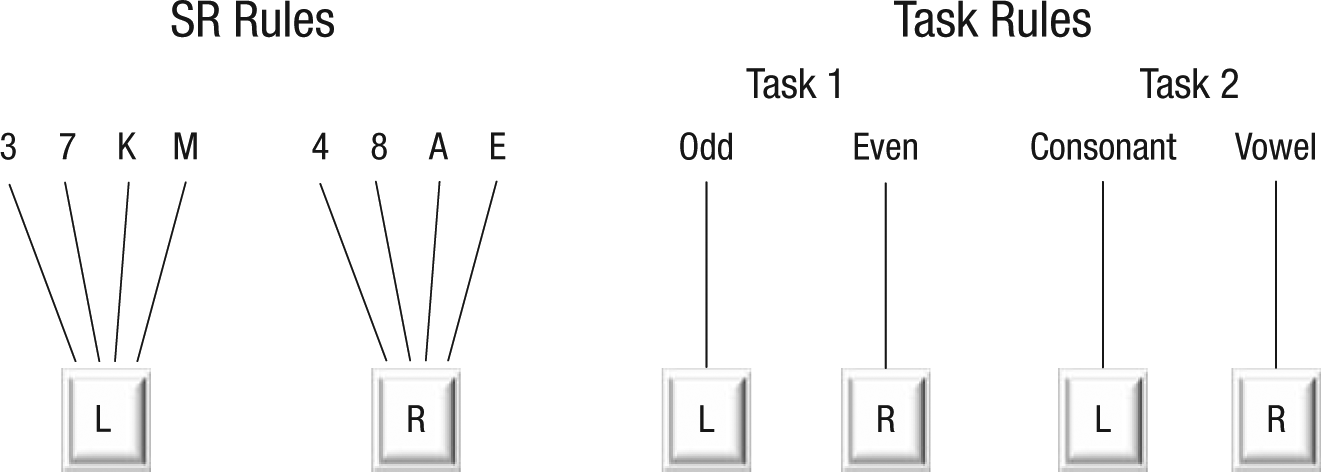
Alternative task representations in form of stimulus-response (SR) rules or two task rules. L = left response; R = right response.
If participants used SR rules instead of task rules, no switch costs should occur because there are no task rules that could be switched in the first place. But apparently—and as indicated by robust finding of switch costs even with only four different stimuli—participants do switch. One straightforward reason for this could be that participants simply do what they are asked to do by the instructions, which typically tell participants to respond to the stimuli according to a given categorization rule. An alternative and less obvious answer to the question of why participants use these rules is that they cannot refrain from doing so once they become aware of the rules, either through instruction or because stimuli are mapped to responses according to a natural category (as in the example in Fig. 1).
To test this latter assumption, we created a paradigm in which the instructions suggested that participants use a task representation based on single SR-rules (Dreisbach, Goschke, & Haider, 2006, 2007): Eight different word stimuli were introduced in pairs (the two stimuli in each pair were mapped to the left or the right response, respectively) so that participants could practice applying the SR rules before the next pair was introduced. Critically, four words were always printed in red and the other four were always printed in green. One group of participants simply learned the SR rules through practice, whereas another group of participants was additionally informed about two underlying task rules but was not explicitly asked to use them: For red-colored words, the underlying rule was “animal vs. not an animal”; for green-colored words, the underlying rule was “first letter a consonant vs. first letter a vowel.” It follows that color was a completely irrelevant stimulus feature in the SR group but informative in the task-rule group. It turned out that the participants in the former group (without information about the underlying task rules) outperformed participants who had been given the task-rule information in every respect: They were generally faster and did not show any switch costs (between-color switches). In contrast, participants who were aware of the task rules showed switch costs from the very beginning, even at a stage where only four or six different words occurred. Moreover, when another group of participants was casually informed about the task rules after they had already learned and applied the eight SR rules without exhibiting switch costs, switch costs occurred immediately after this information was given! These data strongly suggest that task rules are extremely persistent in nature: Once task rules are known, participants cannot help but apply them (see also Mayr & Bryck, 2005). This finding is even more surprising because we consistently used univalent stimuli that were unequivocally mapped to one response, making the actual application of a given task rule even less necessary.
Gilbert and Shallice (2002), who developed a neural-network model of task switching, also emphasized the importance of differentiating between stimulus-specific vs. task-specific processes: “The distinction between individual S-R mappings and task sets, composed of all of the individual S-R mappings which are required to carry out an experimental task, is crucial” (p. 298). In their model, however, Gilbert and Shallice used Stroop color words as stimuli and implemented switching between color-naming and word-reading tasks. Because with such bivalent stimuli, each stimulus can be used for both of the tasks, stimulus-specific and task-specific processes are necessarily confounded. It might be interesting to determine how the model behaves using representations based on SR rules versus representations based on task rules with univalent stimuli. The data and paradigm presented so far might thus provide a sound empirical basis for further model testing.
The Functional Role of Task Rules
Participants’ unexpectedly good performance under SR conditions raises the question of what functional role task rules might play. Of course, one obvious advantage of task rules over SR rules is that they can be applied to a theoretically infinite number of stimuli, whereas SR rules have to be learned individually. 2 This still does not explain why task rules are so persistent in nature. However, it is possible that comparing performance using SR rules with performance using two task rules makes it hard to detect their functional value. After all, the task-switching paradigm might overemphasize the costs of task rules and obscure their benefits when the task rule does not change constantly.
Therefore, in a series of additional experiments, we compared performance using SR rules with performance using just one task-rule (Dreisbach & Haider, 2008, 2009). These studies consistently yielded evidence that task rules facilitate shielding against irrelevant information. The first study (Dreisbach & Haider, 2008) showed that an irrelevant stimulus feature (color) interacted with participants’ responses in the SR group, but not in the group that used a task rule. The second study (Dreisbach & Haider, 2009) showed that the task rule prevented response interference from spatial distracters (the target words were presented on spatially oriented pictures of animals) that were unrelated to the task rules. The same distracters, however, led to significant response interference in the SR condition. Interestingly, the participants in the SR group, who reported in a postexperimental interview that they had formed their own task rule (e.g., “things I like” vs. “things I don’t like”), showed the same shielding effects as the instructed task-rule group did. Taken together, the data from these latter studies suggest that task rules guide attention toward the response-discriminative stimulus features that are part of the task representation, thereby helping participants to ignore any information that is not part of the task representation. Individual SR rules, in contrast, do not indicate which feature of a given stimulus is important, making the system more susceptible to distraction by extraneous stimulus features.
With this newly gained insight about the shielding function of task rules, we went back to the investigation of task switching (Dreisbach & Wenke, 2011). We reasoned that during task switching, task shielding should temporarily be relaxed because otherwise, the system would perseverate in using the currently active task rule. As predicted, task shielding occurred on task repetitions (as indicated by a lack of interference by an irrelevant stimulus feature) but not on task switches (Dreisbach & Wenke, 2011). From this perspective, the switch costs in the task-switching paradigm can be explained at least in part by the temporary relaxation of task shielding. That is, although this relaxation enables task switching (which might otherwise not be possible), it concurrently makes the cognitive system more vulnerable to the intrusion of any information that is not part of the currently activated task rule, thereby incurring switch costs.
Processes Underlying Task Shielding
But what is the cognitive process underlying the specific shielding mechanism? Is it the inhibition of irrelevant information, the activation of relevant information, or a mixture of both? So far, most evidence indicates that shielding enhances the processing of the response-discriminative stimulus features defined by the task rule, thereby reducing the influence of information that is unrelated to the task rule but increasing the influence of related (but possibly irrelevant) information (Dreisbach & Haider, 2009; Reisenauer & Dreisbach, 2012). Note that such a mechanism is not possible when task performance is based on SR rules, because the SR-rule instructions do not indicate which feature of a given stimulus is response discriminative.
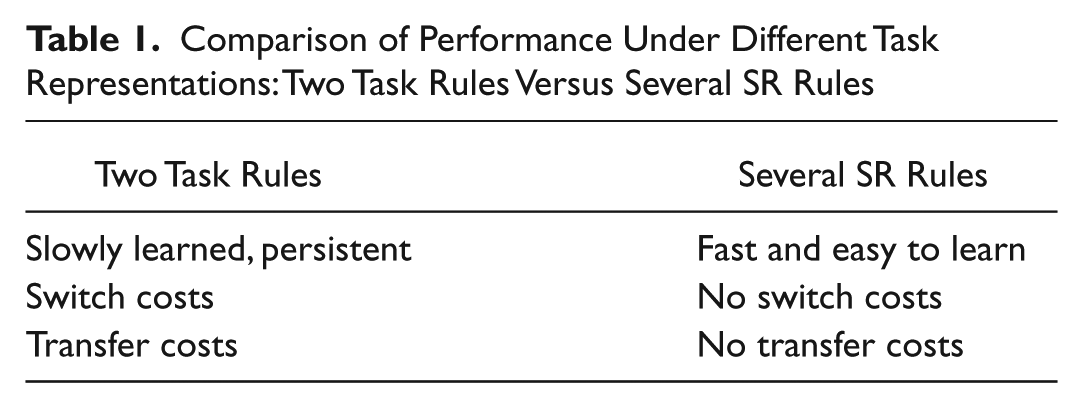
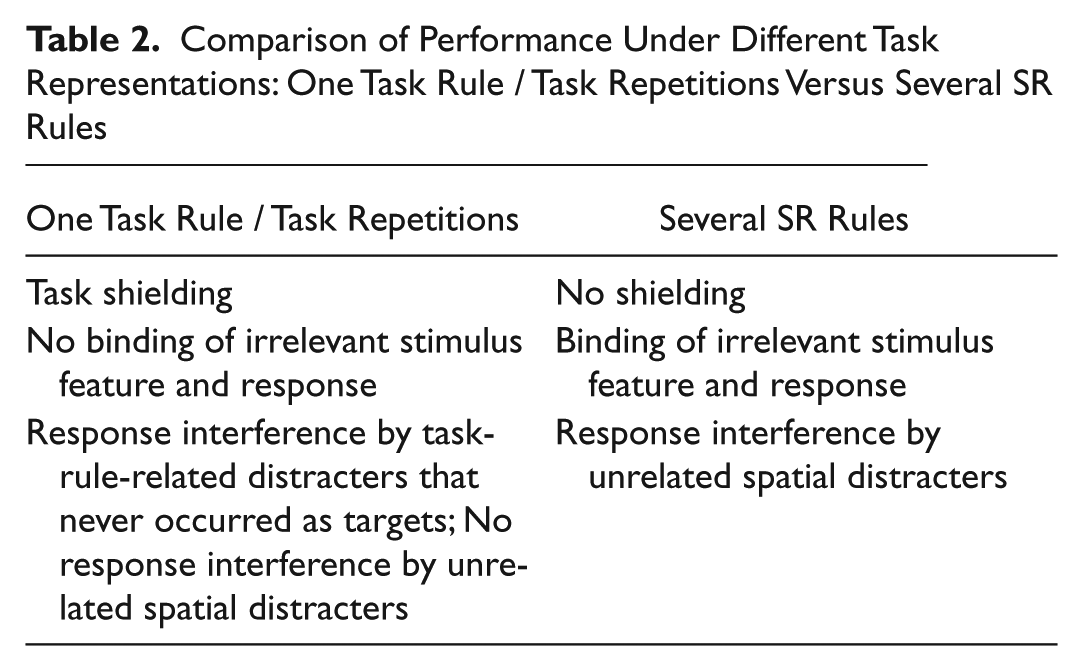
In principle, a shielding mechanism based on enhanced processing of task-related information would seem to be highly adaptive because—at least outside the lab—task-related information more often than not is also task-relevant information. Moreover, such a shielding mechanism might also circumvent the not-so-trivial problem of selecting between relevant and irrelevant information by directing attention to any response-discriminative stimulus feature that matches the currently active task rule (Reisenauer & Dreisbach, 2012). The elegance of this assumption lies in its independency of an omniscient homunculus that miraculously knows what is relevant and what is not relevant. This idea also fits nicely with the well-established contingent-capture hypothesis from the literature on attention (e.g., Folk, Remington, & Johnston, 1992), according to which attentional selection is driven by perceptual goals (equivalent to the response-discriminative features of task rules), maybe even suggesting a general selection mechanism of the attentional and cognitive-control system. Tables 1 and 2 contrast the main findings concerning SR rules and task rules that I have reviewed so far.
Comparison of Performance Under Different Task Representations: Two Task Rules Versus Several SR Rules
Comparison of Performance Under Different Task Representations: One Task Rule / Task Repetitions Versus Several SR Rules
Implications for Developmental Psychology and Higher-Level Cognition
Research on the functional role of task rules presented here is closely related to that of other psychological disciplines. In developmental psychology, for example, it is well documented that until the age of 3, children have problems switching between tasks, a deficit that might be due to the specific task representations that children adopt. Recently, it was shown that 3-year-old children who used abstract task rules were actually better able to switch than were those who used stimulus-specific SR rules, who showed deficits. The children’s use of either abstract or stimulus-specific task representations was inferred from their ability or inability, respectively, to apply a given task rule to new stimuli (Kharitonova, Chien, Colunga, & Munakata, 2009). On a neuronal basis, this development of rule use from specific SR rules to more abstract task rules is reflected in the structural and functional specialization of the prefrontal cortex (PFC) during early life: Although univalent SR rules seem to rely on the earlier- maturing ventrolateral PFC, higher-order task rules rely primarily on the later-maturing dorsolateral and rostrolateral PFC (cf. Bunge & Zelazo, 2006; see also Badre, 2008).
But even though the formation and use of task rules as such can be seen as indicative of higher-level cognition, 3 it is striking how easily adults form their own task rules. In fact, it was always a challenge to create task rules that would not be detected by the participants in the SR condition, even though these participants were never informed that there was an underlying task rule—resulting in rules like “things that move” (e.g., swing, tractor, arm, koala) versus “things that do not move” (e.g., desk, cheese, cactus, phone). Overall, an estimated 10% of the participants still reported that they had formed their own individual task rule that allowed them to categorize stimuli mapped to the left and the right response, respectively. Presenting all stimuli at once (e.g., Dreisbach & Haider, 2009, Experiment 2) actually increased this percentage to over 50% (18 out of 34 participants). On the other hand, even though the task rules in our experiments were unusual and arbitrary, they obviously still were considered helpful. This is in line with the ideas of Barsalou (1983), who was one of the first to point out the importance of such ad hoc categories (e.g., “things you need for a day on the beach”) for goal achievement. Further support for this claim has come from a recent study by Chrysikou (2006), which provided the first empirical evidence that training participants to form such ad hoc categories significantly improves their performance in an unrelated insight-problem-solving task.
Conclusion
In sum, task rules are easily formed and hard to get rid of. The shielding function of task rules helps to guide attention and action by enhancing the processing of any information that fits into the currently active task rule. Even though switching between task rules comes at a cost, because it requires that task shielding be relaxed, the consequential susceptibility to new information unrelated to the abandoned task may eventually open the mind and promote flexible thinking.
Recommended Reading
Dreisbach, G., Goschke, T., & Haider, H. (2007). (See References). Provides the first demonstration of a direct comparison between performance based on SR rules vs. task rules.
Dreisbach, G., & Wenke, D. (2011). (See References). Presents two experiments showing that the shielding mechanism is present on task repetitions but relaxed on task switches.
Kiesel, A., Steinhauser, M., Wendt, M., Falkenstein, M., Jost, K., Philipp, A. M., & Koch, I. (2010). (See References). A timely review of the existing task-switching literature.
Vandierendonck, A., Liefooghe, B., & Verbruggen, F. (2010). (See References). Another timely review that—together with the article by Kiesel et al.—provides a comprehensive and elaborate overview of the existing task-switching literature.
Footnotes
Acknowledgements
I would like to thank my collaborators Thomas Goschke, Hilde Haider, Renate Reisenauer, and Dorit Wenke.
Declaration of Conflicting Interests
The author declared no conflict of interest with respect to the authorship or the publication of this article.
Funding
The research presented here was supported Deutsche Forschungs- gemeinschaft Grants DR 392/5-1 and DR 392/5-2 to the author.