




Abstract
Traditionally, self-control research has put a strong focus on the mechanisms that support the control of behavior in the face of temptation. This emphasis in the field has led to some neglect of desire as an impelling force that needs to be controlled. However, the focus appears to be shifting, as recent research has led to novel insights into the nature of desire. In this review, we integrate these insights into how desire emerges, how it operates, and how it may best be controlled. Drawing on competitive-access models of working memory and dynamical reprocessing models, we highlight, among other factors, the role of top-down attentional resources in preventing the early conscious processing and subsequent escalation of desire.
Self-control can be understood as a struggle between impelling forces, such as prepotent impulses and desires, and restraining forces, such as self-regulatory goals (Carver, 2005; Hofmann, Friese, & Strack, 2009; James, 1950/1890). In this sense, self-control is like the struggle of a rider trying to tame a wild horse (see Fig. 1), with the stronger party gaining control.

A metaphor for self-control: rider taming a wild horse (c. 440 BC) in a detail of the frieze adorning the upper part of the Parthenon in Athens, Greece.
Traditionally, self-control research has mostly focused on the part of the rider: Studies on the depletion of self-regulatory resources (Baumeister, Bratslavsky, Muraven, & Tice, 1998), inhibition (Carver, 2005), and related concepts have all stressed people’s ability and/or motivation to control themselves. Only recently have researchers begun to scrutinize the very forces that need to be controlled in the first place (i.e., the “pull” of the horse). The science of self-control currently appears to be shifting toward the more balanced view that the role of desire in self-control is just as important and vital as the well-understood role of restraint. The purpose of this review is to sketch this new hot spot in the field and to integrate recent research on the psychological underpinnings of desires and cravings. To this end, this review highlights three basic questions that have drawn considerable research interest: What is desire? How does desire emerge and operate? And how can desire be successfully regulated?
What Is Desire? What Turns Desire Into Temptation?
Desire can be defined as an affectively charged motivation toward a certain object, person, or activity that is associated with pleasure or relief from displeasure (see Kavanagh, Andrade, & May, 2005). Desire is the feeling of wanting to have or do something, and thus motivates behavior. In contrast to general motives, desires are “about” certain objects or people. Desires vary in strength and therefore in their potential to motivate behavior. Whether a given desire turns into a temptation, and thus enters the sphere of self-control, depends on whether the behavior implied by the desire conflicts with a person’s values or self-regulatory goals (Hofmann, Baumeister, Förster, & Vohs, 2012). For instance, there is nothing wrong with savoring a delicious cake unless you are on a diet. Temptation necessitates a structural conflict or incompatibility between the behavioral implication of a given desire and a person’s underlying goals or values. Note that this aspect of temptation often appears to be overlooked in laboratory experiments in which people are confronted with what the researchers believe is tempting for everyone. Possible remedies for this limitation include preselecting participants on the basis of their long-term goals, providing them with personal temptations, or controlling for the degree to which participants indicate they are actually tempted by a certain stimulus.
How Does Desire Emerge and How Does It Operate?
For a better understanding of how desire emerges and drives behavior, we integrated the research on iterative processing of evaluation (Cunningham & Zelazo, 2007), theories of competitive access to working memory (Baars & Franklin, 2003; Kavanagh et al., 2005), and research on automatic and reflective behavior determination in self-regulation (Hofmann et al., 2009) into a Dynamical Model of Desire (see Fig. 2). The model is dynamical in the sense that a person’s current level of desire and the desire’s potential to influence behavior are assumed to fluctuate systematically, depending on (a) the interaction of external and internal factors that determine the strength of the affective reward signal assigned to desirable stimuli, (b) the extent to which desire gains access to working memory (and thus becomes a conscious experience), (c) the extent to which iterative reprocessing causes desire to gain further clout in working memory, and (d) the extent to which each of these three mechanisms is offset by powerful attentional distractors or inhibiting mechanisms involved in down-regulating desire or preventing it from emerging into consciousness in the first place.
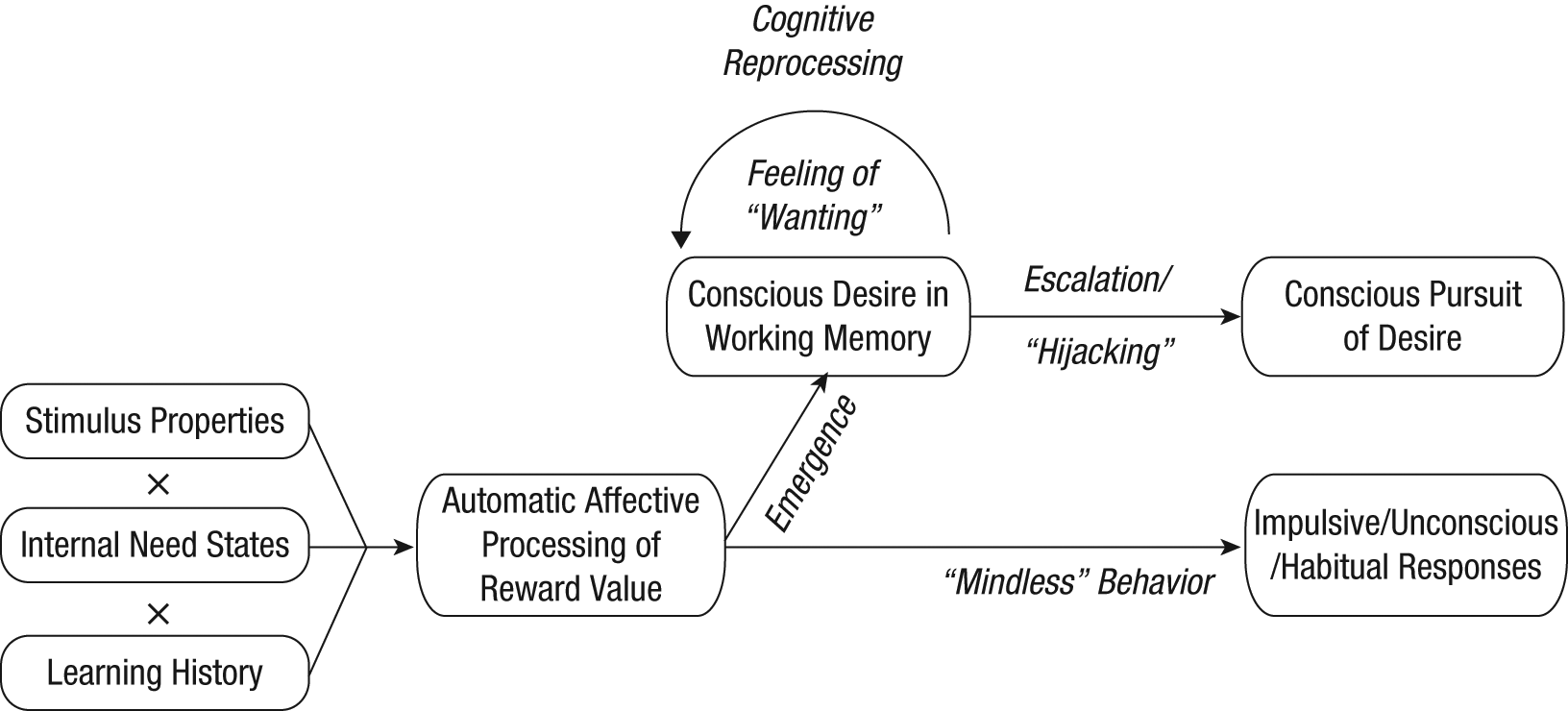
A Dynamical Model of Desire. Desire originates from the interplay of stimulus properties, internal need states, and learning history. Affective processing of the reward value assigned to desirable stimuli generates an automatic affective response that can, under certain conditions, result in relatively “mindless” behavior. However, given attentional amplification, desire may also emerge into consciousness, thus occupying limited working-memory resources. The more a desire attracts further cognitive elaboration and thus generates motivated cognitions in support of it, the more likely it is to eventually gain control over behavior by “hijacking” the executive mechanisms that support the conscious pursuit of desire.
In a nutshell, desire originates in a relatively automatic manner as reward-processing centers in the brain evaluate external stimuli (or mental images) against the background of internal need states (e.g., hunger, thirst, substance deprivation) and an individual’s learning history (i.e., the feelings that an individual has come to associate with certain consummatory behaviors, such as a feeling of relaxation after a drink; Hofmann et al., 2009). The automatic affective responses thus generated have the potential to trigger impulsive, habitual behavioral responses (Heatherton & Wagner, 2011; Hofmann et al., 2009), even in the absence of conscious awareness (Winkielman, Berridge, & Wilbarger, 2005). These automatic responses can be measured, for instance, using paradigms from research on implicit social cognition and neuroscience (e.g., measuring reward-center activity in the brain). Such automatic responses may be more likely to translate into mindless behavior when the desired object is immediately available and when processing resources are low (whether because of the situation or because of the desirer’s disposition) and therefore less likely to be inhibited (for a review, see Hofmann et al., 2009).
However, this is only one possible route by which desire can influence behavior. A second route arises once desire gains access to working memory, thus becoming a conscious experience. Access to the global workspace of the mind makes a big difference, because any mental content that achieves privileged access to working memory has the potential to broadcast its message to a wide range of participating systems, including those that generate thoughts, full-blown emotions, and intentional behaviors (Baars & Franklin, 2003; Baumeister, Masicampo, & Vohs, 2011; Hofmann & Wilson, 2010; Van Dillen & Koole, 2007). To use a metaphor, mental contents that participate in the global workspace of working memory are much like political candidates in an election campaign who are trying to garner further support and resources. With regard to desire, there are two important questions to be asked. First, which conditions facilitate or hinder the likelihood that a desire will emerge in consciousness in the first place? Second, which conditions allow a conscious desire to mount and ultimately become so preoccupying that it may cause people to go a long, effortful way toward satisfying it, even against their best interests?
Regarding the first question, the more attention a person allocates to a rewarding stimulus, the more likely he or she will be to experience a subjective feeling of “wanting” or “craving.” A simple access-to-consciousness account of desire would posit that this is solely a matter of bottom-up attention. Bottom-up attention involves information selection on the basis of salient stimulus properties (i.e., novelty, predictability, reward, and threat) likely to be important for adaptive behavior (Knudsen, 2007). The rewarding properties of tempting stimuli, such as a high-caloric food, may thus bias perceivers to process these stimuli preferentially over other stimuli in the environment (Field, Munafo, & Franken, 2009).
Increasing evidence has suggested, however, that top-down attention can modulate more automatic bottom-up attention (Van Dillen & Koole, 2009), even at the early stages of visual processing (for a review, see Rauss, Schwartz, & Pourtois, 2011). Top-down attention has been shown to subserve current (task) goals represented in working memory (Kane, Bleckley, Conway, & Engle, 2001) and to enable the selective processing of information relevant to the goal at hand (Knudsen, 2007). Hence, when a goal directs attention in such a way that tempting information need not be processed, attentional capture of tempting stimuli should be substantially reduced or not occur at all. Conversely, people should process tempting cues more strongly in the absence of a specific goal (i.e., when their top-down attention is free to wander), or when their focus on a goal prompts attentional processing of such cues. Indeed, recent research has shown that administering cognitively demanding tasks during the processing of unrelated tempting stimuli can actually prevent the emergence of desire experiences in response to these targets (Kemps, Tiggemann, & Christianson, 2008; Van Dillen, Papies, & Hofmann, 2012). Thus, early powerful distraction can actually facilitate resistance to temptation, insofar as it may prevent the emergence of desire and, by implication, the conscious goal-directed pursuit of desire. 1
Once a desire becomes conscious, though, it gains the potential to trigger further cognitive elaborations (Kavanagh et al., 2005). This is a story of increasing returns: The more supporting working memory resources and cognitive elaboration a desire has already acquired, the more it will get. There is a large but currently unused potential for nonlinear, dynamic approaches, such as attractor models (Carver & Scheier, 2002), to explain how desires can exert more and more “gravitational pull” on conscious processing and goal pursuit through repeated cycles of temptation-directed processing and sustained attention. In a typical self-control situation, a desire (such as the desire for tempting food) will compete for limited resources with representations of goals (such as weight-control goals) in working memory (Baars & Franklin, 2003; Kemps, Tiggemann, & Grigg, 2008). Whichever mental representation manages to inhibit the competing representation should eventually win the mental struggle (Kruglanski et al., 2002; Miller & Cohen, 2001). Unless they are effectively down-regulated, desires can thus turn into hedonic short-term goals that people pursue at the expense of more effortful long-term goals (Hofmann, Koningsbruggen, Stroebe, Ramanathan, & Aarts, 2010; Stroebe, Mensink, Aarts, Schut, & Kruglanski, 2008).
Moreover, as people ruminate about their desires (Kavanagh et al., 2005), they may generate more supporting cognitions that license and justify indulgence. Recent research has indeed suggested that people are more likely to engage in this type of motivated reasoning when the decision’s context and social factors favor consumption (Haws & Poynor, 2008; Hofmann et al., 2012), and when they believe that sufficient progress toward their goal of self-control has been made (Fishbach & Dhar, 2005; Kivetz & Simonson, 2002; Mukhopadhyay & Johar, 2009). In extreme cases, a given desire may gather so much clout in working memory that it is even able to crowd out all other opposing goal representations. The important implication for self-control research is that, under certain conditions, desires can take full control of the very mechanisms that otherwise support (healthy) long-term goal pursuit, as illustrated in a moving passage on the power of cravings for alcohol taken from William James’s (1950/1890, p. 543) seminal chapter on will: A few years ago a tippler was put into an almshouse in this State. Within a few days he had devised various expedients to procure rum, but failed. At length, however, he hit upon one which was successful. He went into the wood-yard of the establishment, placed one hand upon the block, and with an axe in the other struck it off at a single blow. With the stump raised and streaming he ran into the house and cried, “Get some rum! get some rum! My hand is off!” In the confusion and bustle of the occasion a bowl of rum was brought, into which he plunged the bleeding member of his body, then raising the bowl to his mouth, drank freely, and exultingly exclaimed, “Now I am satisfied.”
How Can Unwanted Desire Be Successfully Regulated?
The new focus on desire raises the question of how problematic desires can best be regulated. Here, we review recent work that has specifically looked at how desires may be effectively prevented or down-regulated. Our main focus is on strategies for preventing the full-blown occurrence of desire by interfering with the early automatic processing of temptation and with the emergence of desire in working memory. Such proactive strategies may be particularly useful because regulating a desire becomes more difficult as the desire becomes more elaborated—just as it is easier to extinguish a little flame than a full-blown kitchen fire. Clearly, then, the most effective strategy to prevent desire is to avoid exposure to tempting situations and stimuli altogether. Because it is not always possible to implement such a strategy in temptation-rich environments, however, self-regulation research has an important agenda to empower people with the best mental strategies for dealing with problematic desire.
In this spirit, recent work has shown that construal can have a surprisingly profound impact on the early automatic affective processing of tempting stimuli (Fujita & Han, 2009; Hofmann, Deutsch, Lancaster, & Banaji, 2010). Having people adopt an abstract mind-set or imagine tempting stimuli in a nonconsummatory fashion, as was first proposed in Mischel’s work on the delay of gratification (Mischel, Ebbesen, & Raskoff Zeiss, 1972), can help to prevent or down-regulate desire. In a similar vein, implementation intentions to avoid temptation have been shown to interfere with the early affective processing of temptations, presumably because such implementation intentions condition the mind to respond to tempting stimuli with negative affect (Hofmann, Deutsch, et al., 2010). Some research has even gone one step further and attempted to modify the automatic processing of tempting stimuli in at-risk samples, such as heavy drinkers, via evaluative conditioning and avoidance training, and has demonstrated promising effects with regard to successful self-regulation (Houben, Havermans, & Wiers, 2010; Wiers, Rinck, Kordts, Houben, & Strack, 2010).
Our conclusion about the key role of top-down attention implies that strategies that harness the benefits of powerful distractors, such as mentally engaging activities, may prevent unwanted cravings in response to actual or imagined tempting cues (Florsheim, Heavin, Tiffany, Colvin, & Hiraoka, 2008). The powerful role of attention has also been exemplified by recent work showing how mindfulness- and acceptance-based interventions can reduce cravings in at-risk populations (Alberts, Mulkens, Smeets, & Thewissen, 2010; Forman et al., 2007) and thus help people to break an otherwise maladaptive cycle of desire elaboration. Specifically, these interventions may empower people to mentally disengage from ongoing cravings by accepting them as transient events that will eventually fade rather than by trying to suppress them. This interpretation is consistent with earlier work showing that willful suppression of desire bears the potential to backfire (Johnston, Bulik, & Anstiss, 1999; Mann & Ward, 2001), presumably because it constantly redirects attention toward the very mental content one is trying to avoid.
Conclusion
A full understanding of self-control phenomena requires a better understanding of desire as a motivating force. Recent research at the intersection of self-control and related topics has made substantial progress in illuminating how desire emerges, how it operates, and how it can be successfully regulated when it is problematic. Still, much more work needs to be done to develop an integrative science of why we want the things we want and how we can best resist the things we wish we would not want.
Recommended Reading
Heatherton, T. F., & Wagner, D. D. (2011). (See References). A recent, highly accessible review of recent cognitive-neuroscience research suggesting that self-control involves a conflict between subcortical regions involved in reward processing and top-down control regions in the prefrontal cortex.
Hofmann, W., Friese, M., & Strack, F. (2009). (See References). A review of self-control research and conceptual paper arguing that many instances of self-control can be understood as conflicts between impulsive and controlled processes.
Kavanagh, D. J., Andrade, J., & May, J. (2005). (See References). Presents an influential cognitive model of desire (the elaborated intrusion theory of desire) that explains the emergence of and obsession with desire and places a strong emphasis on the role of working-memory processes.
Kringelbach, M. L., & Berridge, K. C. (Eds.). (2010). Pleasures of the brain. New York, NY: Oxford University Press. A comprehensive edited volume presenting the state of the art in research on human and animal pleasure.
Footnotes
Declaration of Conflicting Interests
The authors declared that they had no conflicts of interest with respect to their authorship or the publication of this article.