




Abstract
Guilt proneness is a personality trait indicative of a predisposition to experience negative feelings about personal wrongdoing, even when the wrongdoing is private. It is characterized by the anticipation of feeling bad about committing transgressions rather than by guilty feelings in a particular moment or generalized guilty feelings that occur without an eliciting event. Our research has revealed that guilt proneness is an important character trait because knowing a person’s level of guilt proneness helps us to predict the likelihood that person will behave unethically. Web-based studies of adults across the United States have shown that people who score high on measures of guilt proneness (compared to low scorers) make fewer unethical business decisions, commit fewer delinquent behaviors, and behave more honestly when making economic decisions. In the workplace, guilt-prone employees are less likely to engage in counterproductive behaviors that harm their organization.
The majority of research on morality and ethics has focused on people’s judgments and reasoning in difficult hypothetical dilemmas (see Haidt & Kesebir, 2010, for a review). This research has revealed important insights into how people make attributions of right and wrong and into the factors on which they base their decisions when various moral considerations are at play (e.g., considerations about harm, fairness, loyalty, authority, and purity). These studies have helped us understand decision making in situations in which it is hard to decide what course of action is the most ethical, but they cannot fully address what prevents people from engaging in unethical behavior in their daily lives.
Rather than investigate moral judgments or people’s ability to reason about difficult choices, our research instead focuses on identifying predictors of unethical and counterproductive behaviors in situations in which people must choose between moral and selfish actions. Guiding our research is a central question about moral character: Are certain individuals predisposed to act more unethically than others? If so, which individual differences—or character traits—predict such behavior? Although there are a number of traits that predict moral behavior (e.g., Honesty-Humility, Ashton & Lee, 2008; empathy, Batson, 1998; future self-continuity, Hershfield, Cohen, & Thompson, 2012), one trait that is particularly important for understanding moral character is guilt proneness.
What Is Guilt Proneness?
Guilt proneness is a personality trait indicative of a predisposition to experience negative feelings about personal wrongdoing, even when the wrongdoing is private. It is characterized by anticipating a bad feeling about committing transgressions rather than by guilty feelings in a particular moment or generalized guilty feelings that occur without an eliciting event. Our research program has revealed that guilt proneness predisposes people to think, feel, and act ethically (see also the research program of June Tangney and her colleagues; e.g., Tangney & Dearing, 2002; Tangney, Stuewig, & Mashek, 2007; Tangney, Stuewig, Mashek, & Hastings, 2011; Tangney, Youman, & Stuewig, 2009). Knowing a person’s level of guilt proneness helps us predict the likelihood that person will behave unethically. Why should guilt proneness decrease unethical behavior? The anticipation of guilty feelings about private misdeeds indicates that one has internalized moral values. Thus, for guilt-prone individuals, public surveillance is not required to prevent moral transgressions; instead, their conscience guides them.
Measuring Guilt Proneness
Guilt proneness can be measured with the Guilt and Shame Proneness scale (GASP for short; Cohen, Wolf, Panter, & Insko, 2011). The GASP contains four items that measure guilt proneness. It also contains 12 other items that measure related constructs, including shame proneness. Participants imagine themselves in situations in which they have committed a transgression and indicate the likelihood that they would react in the way described. Responses are made using rating scales ranging from 1, very unlikely, to 7, very likely, with a score of 4 indicating about 50% likely. Here is a sample guilt- proneness item: “After realizing you have received too much change at a store, you decide to keep it because the salesclerk doesn’t notice. What is the likelihood that you would feel uncomfortable about keeping the money?”
This scale is scored by summing (or averaging) the four guilt-proneness items. Although guilt proneness is a continuum, and we treat it as a continuous measure in our statistical analyses, we consider people with scores of 20 points or below to have low levels of guilt proneness, those with scores of 21 points to 24 points to have medium levels of guilt proneness, and those with scores of 25 points to 28 points to have high levels of guilt proneness. Sample populations vary, but on the basis of these cutoffs, roughly 30% to 40% of the adults we have surveyed are considered low in guilt proneness and roughly 30% to 40% are considered high in guilt proneness.
The GASP scale was modeled after the Test of Self Conscious Affect (TOSCA)—a precursor to the GASP developed by Tangney and her colleagues (see Tangney & Dearing, 2002, for a description of the TOSCA and a review of key findings). Although there are some conceptual differences between the TOSCA and the GASP (Cohen et al., 2011), the two scales tend to yield similar results and are highly correlated (e.g., r = .66 in Schaumberg & Flynn, 2012). In addition to measuring guilt proneness, both the TOSCA and the GASP measure shame proneness. The primary difference between guilt proneness and shame proneness has to do with whether people make negative evaluations of specific bad behaviors (guilt proneness) or negative evaluations of their entire selves (shame proneness). When studying moral character, we focus on guilt proneness rather than shame proneness because guilt is a more moral emotion than shame, in that it is associated more strongly with ethical behavior (see Tangney et al., 2007; Tangney et al., 2009, for reviews).
Guilt Proneness and Personality
We have administered the GASP, along with other personality scales, to thousands of people across the United States (Cohen, Panter, & Turan, 2012; Cohen, Panter, Turan, & Morse, 2012; Cohen et al., 2011). In our research, we typically ask adults to answer questions about their personality and behavior in confidential Web-based questionnaires. What have we found?
First, guilt proneness is positively correlated with Honesty-Humility—one of the six major dimensions of personality. Honesty-Humility—or “the H-Factor”—is a broad disposition comprising the more narrow traits of sincerity, fairness, greed avoidance, and modesty (Ashton & Lee, 2007, 2008, 2009). People with lower levels of Honesty-Humility are more likely to behave unethically—for example, by committing delinquent and criminal behaviors, such as theft and vandalism. Correlations between guilt proneness and the H-Factor are typically around .50, indicating that people who are low in guilt proneness are generally dishonest and arrogant as well.
Guilt proneness also correlates with Conscientiousness and Agreeableness, albeit to a lesser degree. Conscientiousness is a broad disposition comprising organization, diligence, perfectionism, and prudence; Agreeableness is a broad disposition comprising forgiveness, gentleness, flexibility, and patience (Ashton & Lee, 2007, 2009). Correlations between guilt proneness and these personality dimensions tend to be between .30 and .40, indicating that people who are low in guilt proneness tend to be more unreliable and intolerant than those who are high in guilt proneness. Scores on integrity tests have consistently been found to correlate with Honesty-Humility, Conscientiousness, and Agreeableness (e.g., Marcus, Lee, & Ashton, 2007). The fact that these three personality dimensions show moderate correlations with guilt proneness lends credence to the assertion that guilt proneness is a character trait. The relationships between guilt proneness and the remaining three major personality dimensions (i.e., Emotionality, Extraversion, and Openness to Experience) are weaker, with correlations typically below .20.
Honesty-Humility, Conscientiousness, and Agreeableness are all broad personality dimensions. What about more specific aspects of people’s personalities? Guilt proneness has moderately strong relationships with empathy, perspective taking, consideration of future consequences, and moral identity, with correlations generally between .30 and .40 (e.g., Cohen, Panter, Turan, & Morse, 2012; Cohen et al., 2011; Tangney & Dearing, 2002; Tangney et al., 2011). Compared to individuals with low guilt-proneness scores, those with high scores are more likely to be sympathetic, take the perspective of others, consider the future consequences of their behavior, and value having moral traits.
It is also informative to consider personality traits that are uncorrelated with guilt proneness, in order to establish discriminant validity. Self-esteem, neuroticism, and rumination are all unrelated to guilt proneness (Cohen et al., 2011; Tangney & Dearing, 2002). People with low self-esteem are no more likely to be guilt prone than are those with high self-esteem, and the same goes for neuroticism and rumination. We have found a small negative relationship between guilt proneness and depression (r = −.17; Cohen et al., 2011, Study 2), with people high in guilt proneness slightly less likely to report depressive symptoms than those low in guilt proneness (see also Tangney et al., 2011).
What about demographic characteristics? Women are more guilt prone than men, and older adults are more guilt prone than younger adults (Cohen et al., 2011; Tangney et al., 2009). How large are these differences? In a sample of more than 3,000 American adults (N = 3,644) who have completed the GASP in various studies we have run (e.g., Cohen, Panter, & Turan, 2012; Cohen, Panter, Turan, & Morse, 2012; Cohen et al., 2011), we have found that women’s guilt-proneness scores are approximately 1 standard deviation higher than men’s scores (d = 0.94), and the correlation between guilt proneness and age is moderate (r = .28).
Although we have not found reliable differences in levels of guilt proneness across members of different religious groups, our results show that guilt-prone people tend to be somewhat higher in intrinsic religiosity, but not extrinsic religiosity (Cohen et al., 2011). In other words, people whose religious beliefs shape their approach to life tend to feel guilty for wrongdoing.
Overall, these findings suggest that guilt proneness is a key aspect of moral disposition. It has moderately strong relationships with a variety of individual differences that have been linked to ethical behavior. Moreover, it is uncorrelated, or negatively correlated, with indicators of poor mental health, such as rumination and depression.
Guilt Proneness and Unethical Choices
Unethical business decisions
One way we have investigated the relationship between guilt proneness and unethical choices is by looking at people’s willingness to engage in unethical business practices, such as corporate crime (cf. Ashton & Lee, 2008). We asked 153 adults about their willingness to make unscrupulous business decisions in hypothetical situations in which they could benefit themselves and their company by engaging in business practices that harm society and/or the environment (Cohen et al., 2011, Study 2). Participants were presented with six such dilemmas. For example, in one dilemma, respondents were asked whether they would advise their company to exploit a legal loophole that would allow their company to drill for oil and gas in a country in which it is illegal to do so because of human rights violations committed by that country’s government. Exploiting the loophole would result in a large promotion and raise, as well as large profits for the company. In this dilemma, 41% of participants low in guilt proneness said they would probably or definitely exploit the loophole, whereas only 25% of those high in guilt proneness said they would probably or definitely exploit the loophole. When we averaged people’s responses across all six dilemmas, we found that the correlation between guilt proneness and willingness to make unethical business decisions was −.44. This relationship is similar in magnitude to that between unethical business decisions and the H-Factor of personality (Ashton & Lee, 2008).
One reason why the unethical-business-decisions measure is informative for the study of unethical choices is that in this task, decisions are private and confidential, so there is no pressure to conform to social norms or risk of punishment. However, a limitation of this method is that the dilemmas are hypothetical and describe rare events. To provide converging evidence of the relationship between guilt proneness and unethical choices, we examined people’s actual behavior in a situation in which they could lie for monetary gain.
Lying for monetary gain
To investigate lying, we adapted a paradigm from behavioral economics (cf. Gneezy, 2005). In this study, 72 adults completed a Web-based decision-making task in which they could lie to potentially earn $50 rather than $25 in a raffle (Cohen et al., 2011, Study 2). Participants were led to believe that they were interacting with another participant. They were informed that they had been randomly assigned to the role of a “message sender” and that their counterpart had been assigned to the role of a “message receiver.” The senders were shown a payment table and asked to send a message to a receiver whose payment table was blank. The senders had to choose between two messages: One message was an honest statement about the values in the payment table; the other message was a lie. Senders learned that the receivers would choose one of two payment allocations, and that their choice would be based on the message they had been sent. Participants who sent the honest message would earn $25 if they won the raffle (and their counterpart would earn $50), but participants who sent the deceptive message would earn $50 if they won the raffle (and their counterpart would earn $25).
People’s guilt proneness predicted the frequency with which they lied. Whereas 45% of the participants with low guilt-proneness scores lied, 36% of those with medium guilt-proneness scores lied, and 20% of participants with high guilt-proneness scores lied.
Dishonesty in negotiation
We examined whether negotiators low in guilt proneness were more unethical than negotiators high in guilt proneness in a study with 56 MBA students (Cohen et al., 2011, Study 3). Participants were randomly assigned to the role of either a buyer’s agent or a seller’s agent in a role-playing exercise about a real-estate negotiation. The two parties had incompatible interests, and there was strong pressure on participants in the buyer’s role to lie. Following the negotiation, sellers reported whether the buyers had engaged in dubious negotiation practices (e.g., misrepresentation). Guilt proneness was assessed 1 to 4 weeks prior to the exercise.
Buyers who were high in guilt proneness were judged by sellers to have committed fewer unethical negotiation behaviors (r = −.53) and to have been more honest (r = .43) than negotiators low in guilt proneness. Specifically, 75% of negotiators with low guilt-proneness scores were suspected of unethical behavior, whereas 55% of those with medium guilt-proneness scores, and 46% of those with high guilt-proneness scores were suspected of unethical behavior.
Counterproductive work behaviors
In the workplace, guilt-prone employees engage in less counterproductive work behavior (CWB; r = −.33 in Cohen, Panter, & Turan, 2012), or volitional behavior that harms or is intended to harm organizations or people in organizations, such as showing up at work late without permission, stealing office supplies, and being rude to clients (Spector et al., 2006). Very few employees who are high in guilt proneness commit CWB, but many employees who are low in guilt proneness commit CWB. And, of the employees who commit at least some counterproductive acts at work, those who are higher in guilt proneness commit fewer of these acts. Moreover, guilt proneness significantly predicts CWB even after statistically controlling for other variables known to predict these behaviors, including gender, age, intention to leave one’s job, interpersonal conflict at work, and negative affect at work (Cohen, Panter, & Turan, 2012). As an illustration of the relationship between guilt proneness and CWB, Figure 1 displays the frequency of counterproductive acts (standardized factor scores) committed over the course of seven days among a large and diverse sample of employed adults across the United States.

Employees’ frequency of counterproductive work behavior (CWB) over the course of seven days as a function of guilt proneness. Standardized CWB scores are presented, with 0.00 representing the average level of CWB in the sample, –0.50 representing half of 1 standard deviation below the sample mean, and 0.50 representing half of 1 standard deviation above the sample mean. In this sample of 416 American adults, 39% of the respondents had low guilt-proneness scores (4–20 points), 27% had medium guilt-proneness scores (21–24 points), and 34% had high guilt proneness scores (25–28 points; possible range = 4–28 points). Data are drawn from Cohen, Panter, and Turan (2012).
Delinquency
We found similar evidence using a survey (Cohen et al., 2011, Study 2) that asked respondents about both general delinquency and workplace delinquency (cf. Ashton & Lee, 2008). The general-delinquency scale, for example, asked participants to report the number of times they had entered a theater, concert, park, sports facility, or other public facility without paying the entrance fee and without being authorized to do so. The workplace-delinquency scale, for example, asked participants to estimate the percentage of work shifts for which they called in sick without actually being sick. Adults with higher guilt-proneness scores reported significantly less delinquency than those with low scores did, both at work (r = −.24) and in general (r = −.28). Figure 2 depicts this relationship for individuals with low, medium, and high levels of guilt proneness.
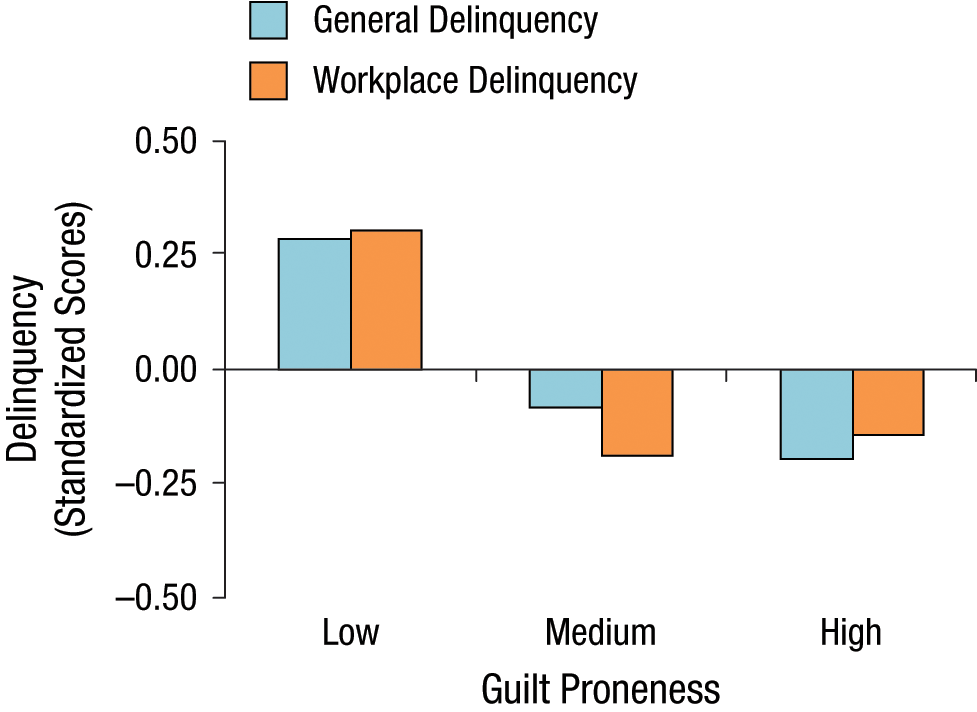
Adults’ frequency of delinquent behaviors committed inside and outside the workplace as a function of guilt proneness. Standardized delinquency scores are presented, with 0.00 representing the average level of delinquency in the sample, –0.50 representing half of 1 standard deviation below the sample mean, and 0.50 representing half of 1 standard deviation above the sample mean. In this sample of 148 American adults, 34% of the respondents had low guilt-proneness scores (4–20 points), 26% had medium guilt-proneness scores (21–24 points), and 39% had high guilt-proneness scores (25–28 points; possible range = 4–28 points). Data are drawn from Cohen, Wolf, Panter, and Insko (2011).
Criminal behaviors
An exciting development in the guilt-proneness literature is the study of this personality trait among jail inmates. Tangney and her colleagues (2011) have used an adapted version of the TOSCA to measure guilt proneness among hundreds of inmates in a suburban Washington, D.C., jail. They have found that there is considerable individual variation in guilt proneness among inmates and that this variation is associated with risk factors for criminal recidivism. For example, inmates who are higher in guilt proneness report lower levels of antisocial personality and are rated lower in psychopathy by trained clinicians using the Hare Psychopathy Checklist. Moreover, guilt proneness is negatively correlated with prior felony convictions and incarceration rates, as well as severity of criminal charges.
Using the GASP to Assess Moral Character
We believe the guilt-proneness scale of the GASP has the potential to be an important measurement tool for predicting which individuals are likely to behave unethically in their social interactions inside and outside the workplace. Given the relatively high frequency with which people low in guilt proneness lie and commit counterproductive acts, it may be wise for seekers of ethical friends and lovers to be mindful of guilt proneness when selecting new companions. In the workplace, it may be wise for employers to consider guilt proneness when making hiring decisions. Because the scale is short (only 4 items), human-resource professionals may be able to employ it to help prescreen applicants and assist with targeted interviewing. However, given that the GASP has yet to be used in high-stakes settings such as personnel selection, we recommend that future research first examine the scale’s predictive validity in contexts where respondents might be motivated to lie or engage in impression management.
Recommended Reading
Ashton, M. C., & Lee, K. (2008). (See References). A review article providing a brief description of the HEXACO model of personality, with a focus on the Honesty-Humility dimension.
Cohen, T. R., Wolf, S. T., Panter, A. T., & Insko, C. A. (2011). (See References). An empirical article describing the development of the GASP scale and documenting the negative relationship between guilt proneness and unethical behavior.
Tangney, J. P., & Dearing, R. L. (2002). (See References). A book discussing the similarities and differences between guilt and shame, and the relationships these emotions have with other psychological variables.
Tangney, J. P., Stuewig, J., & Mashek, D. J. (2007). (See References). A review article discussing how guilt, shame, and embarrassment relate to moral behavior.
Footnotes
Declaration of Conflicting Interests
The authors declared that they had no conflicts of interest with respect to their authorship or the publication of this article.
Funding
This publication was made possible through the support of the Center for Behavioral & Decision Research at Carnegie Mellon University, the Berkman Faculty Development Fund at Carnegie Mellon University, and Grant 15519 from The Character Project at Wake Forest University and the John Templeton Foundation to Taya R. Cohen and A. T. Panter. The opinions expressed in this publication are those of the authors and do not necessarily reflect the views of the sponsors.