




Abstract
People avoid collisions when they walk or drive, and they create collisions when they hit balls or tackle opponents. To do so, people rely on the perception of depth (perception of objects’ locations) and time-to-collision (perception of when a collision will occur), which are supported by different information sources. Depth cues, such as relative size, provide heuristics for relative depth, whereas optical invariants, such as tau, provide reliable time-to-collision information. One would expect people to rely on invariants rather than depth cues, but the size-arrival effect shows the contrary: People reported that a large far approaching object would hit them sooner than a small near object that would have hit first. This effect of size on collision perception violates theories of time-to-collision perception based solely on the invariant tau and suggests that perception is based on multiple information sources, including heuristics. The size-arrival effect potentially can lead drivers to misjudge when a vehicle would arrive at an intersection and is considered a contributing factor in motorcycle accidents. In this article, I review research on the size-arrival effect and its theoretical and practical implications.
People intentionally avoid and create collisions with objects in the environment. Drivers control the speed and position of their vehicles to avoid collisions with other cars. Batters control the path and timing of their swings to make collisions between bat and ball. How do drivers know when a response is needed to avoid a rear-end collision? How do batters know when it is time to swing the bat? To execute an evasive maneuver before a collision occurs, drivers presumably recognize that the lead car is getting too close and estimate how much time remains before collision would occur (time-to-collision). To select a pitch that can be hit and to swing at the right time, batters presumably recognize that the ball is within reach and estimate how much time remains before the ball would arrive at home plate. These tasks rely on perceptions of depth and time-to-collision, which are supported by different information sources.
Visual Information for the Perception of Depth and Time-to-Collision
Depth information includes the monocular depth cues, which are patterns in the retinal image associated with an object’s depth (Goldstein, 2010). Examples include relative size (near objects produce larger images than farther objects of the same three-dimensional [3D] size) and motion parallax (during observer motion, near objects move faster in the image than farther objects). The use of a depth cue can be considered a heuristic (Braunstein, 1976), and a depth cue can result from multiple 3D environments (Cutting, 1986). In contrast, an optical invariant—a higher order property of the optic array (pattern of light reaching the eye)—is more reliable and provides veridical information, that is, a one-to-one mapping with an environmental property (Cutting, 1986; Cutting & Wang, 2000; Gibson, 1979). Especially important for this article is the invariant tau, which provides veridical time-to-collision information when constraints are met.
In 3D space, time-to-collision is computed by dividing an object’s distance by its velocity. Thus, one might expect that perception of time-to-collision depends on estimates of velocity and distance. However, tau is available in the optic array; estimates of velocity and distance, depth cues, and cognitive processes are unnecessary (Lee, 1976). As shown in Figure 1, tau is calculated by dividing an object’s optical size (theta) at a given instant by the object’s instantaneous rate of optical expansion (increase in optical size per unit time), and it is independent of an object’s 3D size, distance, and velocity. Moreover, tau provides a scaled depth map (Lee, 1980). For example, as an observer moves through a cluttered environment, near objects provide smaller values of tau than farther objects. Evidence suggests that people can use or are sensitive to tau in a variety of tasks (Kaiser & Mowafy, 1993; Todd, 1981). Tau-theory is the most influential explanation of time-to-collision perception (Hecht & Savelsbergh, 2004).

Tau is computed by dividing theta at a given instant by its instantaneous rate of expansion. In this example, theta is the angle formed on the driver’s eye by the lead car. Theta-dot is the first derivative of theta.
In summary, there are different information sources to support the perception of depth and time-to-collision, including depth cues and optical invariants. When multiple sources are available, which one(s) will people use? It is reasonable to expect people to rely on the most reliable information. For example, when judging which of two approaching vehicles would arrive at an intersection first, one would expect drivers to rely on tau rather than depth cues. However, evidence shows that time-to- collision judgments are not based solely on tau and are influenced by depth cues. In particular, the depth cue of relative size can affect time-to-collision judgments even when tau is available. This finding is known as the size-arrival effect, which has important theoretical and practical implications.
Size-Arrival Effect
In the original demonstration of the size-arrival effect, two computer-generated objects approached the observation plane at the same speed while suspended above a ground plane and disappeared after about 333 milliseconds (DeLucia, 1991). Participants reported which object would hit or pass them first had the objects continued approaching. Stimuli are represented in Figure 2 and provided contradictory information. The displays depicted two objects that differed in size and distance. The larger object projected the larger image throughout the approach even though it was always farther from the eye. Consequently, relative size suggested that the larger object was closer and would arrive first. Tau provided accurate information that the smaller object would arrive first. Which object did participants report as the first to arrive? Unexpectedly, participants selected the large object. Judgments were consistent with the less reliable relative size cue rather than with tau.
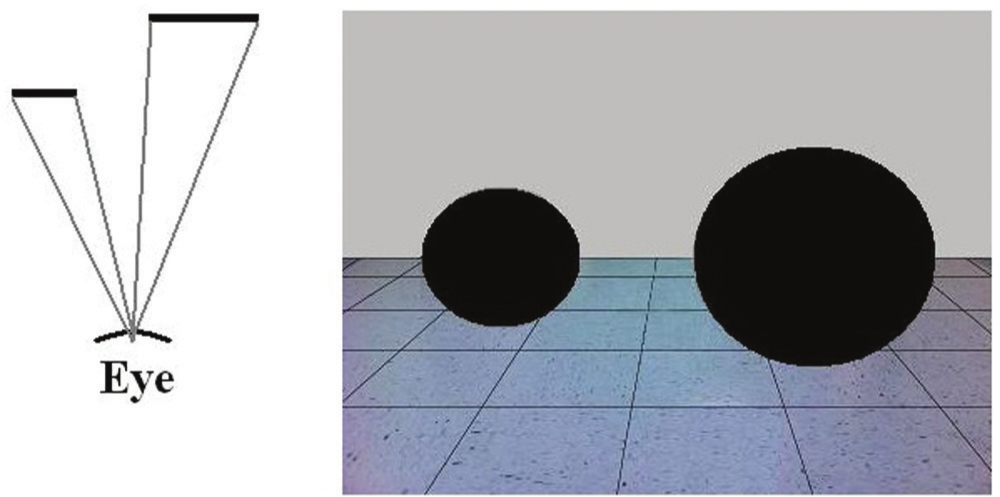
Schematic representation of scenes used to demonstrate the size-arrival effect. Two objects approached the eye while suspended above a ground plane. The smaller object arrived first but projected the smaller image throughout the approach. The depth cue of relative size contradicted tau. Left panel: Top view. Right panel: Front view.
The size-arrival effect is robust. It occurred with longer approach durations, higher resolution photographic animations of real approaching objects, and textured objects (DeLucia, 1991, 2005). The effect also occurred with an active collision-avoidance task: When participants viewed simulations of self-motion toward an object and used a joystick to “jump” over the object to avoid collision, they began jumping earlier when approaching a large object compared with a smaller object, even when the objects were approached from the same distances at the same speeds and had the same heights (DeLucia & Warren, 1994). The size-arrival effect has been replicated with a variety of displays and tasks in the context of both collision-avoidance and interception (Caird & Hancock, 1994; DeLucia & Warren, 1994; Hahnel & Hecht, 2012; Hosking & Crassini, 2011; Michaels, Zeinstra, & Oudejans, 2001; Smith, Flach, Dittman, & Stanard, 2001; van der Kamp, Savelsbergh, & Smeets, 1997). Although the effect was shown mostly with computer simulations, it also occurred with real objects (Michaels et al., 2001; van der Kamp et al., 1997), and an analogous effect even occurred in the haptic (touch) modality (Cabe, 2011). Factors that reduced the size-arrival effect included binocular disparity and familiar size information (DeLucia, 2005; but see Hosking & Crassini, 2011), markers that indicated where the objects would intercept the ground (DeLucia, 1991), and an increase in the ratio of the objects’ projected sizes (DeLucia, 1991). The effect of familiar size and reports that effective information sources change with practice (Smith et al., 2001) suggest that the size-arrival effect may be influenced by training.
Effects of size are not limited to relative time-to- collision judgments. Size also affected absolute judgments (DeLucia, Kaiser, Bush, Meyer, & Sweet, 2003) and affected judgments of collision between two objects (DeLucia, 1995). For example, when participants viewed perspective displays of two moving objects that disappeared before colliding with or passing each other, judgments of whether a collision would occur were less accurate when objects were unequal in size and on a collision course, compared with equal-sized objects (DeLucia, 1995).
Further, relative size is not the only depth cue that can affect time-to-collision judgments. Such judgments were influenced by height in field (near objects are located lower in the image compared with farther objects of the same 3D height), occlusion (far objects are partially hidden from view by near objects), and motion parallax (DeLucia et al., 2003). Other factors that affected collision judgments included the rate at which fine-grain texture detail appeared (Jacobs & Díaz, 2010), cognitive processes (Baurès, Oberfeld, & Hecht, 2011; DeLucia & Liddell, 1998; DeLucia & Novak, 1997), and affective content (Brendel, DeLucia, Hecht, Stacy, & Larsen, 2012). For example, time-to-collision judgments were smaller when an approaching object represented a threatening picture compared with a neutral picture that provided the same time-to-collision information (Brendel et al., 2012). The mechanism underlying the size-arrival effect has not been unequivocally determined; candidates include apparent size-distance relationships, optical size, and optical expansion rate (DeLucia, 1991; DeLucia & Warren, 1994; Hosking & Crassini, 2011).
Implications for Perceptual Theory
Why would people rely on heuristics when veridical time-to-collision information is available? Several reasons have been considered (DeLucia et al., 2003). First, tau provides veridical time-to-collision information under certain constraints. For example, velocity must be constant (Tresilian, 1995). In the context of driving, this constraint is violated when cars accelerate and decelerate. Second, the visual system is limited in temporal and spatial resolution. For example, an approaching object’s optical expansion must be above detection threshold before tau can be effective. Third, cognitive processes are limited, and observers may not extract tau effectively during high demands on memory and attention. For example, when participants reported which of multiple approaching objects would reach them first, mean response time was greater with eight objects compared with two objects, consistent with limited capacity processing (DeLucia & Novak, 1997). Even though tau can provide accurate information, it may not always be effective and is constrained by limits in sensory and cognitive processes. It is adaptive for the visual system to rely on other information.
Indeed, the size-arrival effect questions the autonomy of tau (Warren, 1995) and the single-optical-invariant assumption (Cabe, 2011; Fajen, 2005; López-Moliner & Keil, 2012). It has been assumed that an effective visually guided action is based on a single invariant relevant to the task (Fajen, 2005). The size-arrival effect shows instead that time-to-collision perception is based on multiple information sources, including heuristics and invariants (DeLucia, 2004). It is important to determine the conditions under which different information sources contribute to depth and collision perception and how those sources are integrated (DeLucia et al., 2003; Landy, Maloney, Johnston, & Young, 1995).
Another important implication of the size-arrival effect is that the information sources that influence time-to- collision judgments may vary with distance and, thus, during an approach event (DeLucia, 2004, 2008, in press; DeLucia & Warren, 1994). Studies of time-to-collision perception typically assume that the same information source is used throughout an approach event. Studies of the size-arrival effect contradict this assumption. The effect occurred when approaching objects were relatively far and provided relatively slow optical expansion rates, but this effect did not occur when objects were closer and provided faster optical expansion rates (DeLucia, 1991). Participants may have relied on heuristics, such as relative size, when objects were far and relied on tau when objects were closer (DeLucia, 2004; DeLucia & Warren, 1994).
Thus, it is important to consider distance in theories of depth and time-to-collision perception and to determine the conditions under which heuristics and invariants contribute to perception. This is reflected in a conceptual framework, shown in Figure 3. I proposed that there are three factors that determine whether the perception of depth and collision is based on heuristics and cognitive processes or optical invariants (DeLucia, 2008, in press): viewing distance (near or far), task (judgment or action), and the presence and nature of motion (fast or slow). These factors were motivated by increasing evidence for two functionally distinct pathways in the visual system (Milner & Goodale, 1995). The dorsal pathway processes motion and mediates visually guided actions and the perception of near space. The ventral pathway processes object characteristics and mediates perceptual judgments and the perception of far space. Tresilian (1995) suggested that fast interceptive actions are mediated by the dorsal pathway, whereas time-to-contact judgments are mediated by the ventral pathway.
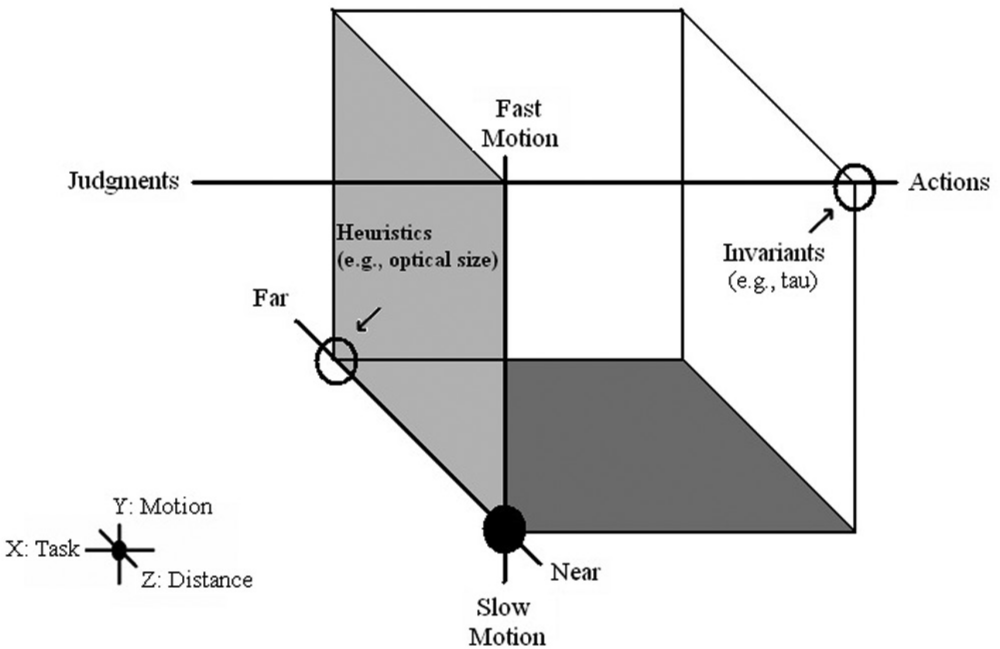
Conceptual framework of information used in collision perception during approach events. The three dimensions are the distance between the observer and the observer’s attentional location (near or far), presence and nature of motion (slow motion or fast motion and differential quality and effectiveness of optical flow information), and the nature of the task (perceptual judgments or visually guided actions). The cube is used as an aid to present the dimensions in the framework. Mathematical properties of a cube are not assumed. Reprinted with permission from “Perception of Collision,” by P. R. DeLucia (in press), Cambridge Handbook of Applied Perception Research (R. R. Hoffman, P. A. Hancock, M. W. Scerbo, J. L. Szalma, & R. Parasuraman, Eds.) Copyright 2013 by Cambridge University Press. (Adapted with permission from “Critical Roles for Distance, Task, and Motion in Space Perception: Initial Conceptual Framework and Practical Implications,” by P. R. DeLucia, 2008, Human Factors, 50, Figure 1, p. 813. Copyright 2008 by the Human Factors and Ergonomics Society.)
At one extreme of the framework, actions toward rapidly moving objects in near space are predominated by invariants. At the other extreme, judgments of slowly moving objects in far space are predominated by heuristics and cognitive processes. Between these extremes both invariants and heuristics are used and allow for flexibility. An important implication of the framework is that the information that affects perception changes as an object approaches the eye (DeLucia, 2004, 2008, in press; DeLucia & Warren, 1994). It is important to measure collision perception as a function of the three dimensions of the framework.
Implications for Transportation Safety
The size-arrival effect has important practical implications for transportation safety, which depends on effective perception of potential collision events. For example, drivers may risk collisions by turning late in front of small oncoming vehicles that appear farther than the actual distance.
Effects of vehicle size on time-to-collision judgments were demonstrated with computer simulations of a traffic scene that represented a left-turn situation (Caird & Hancock, 1994). Vehicles of different sizes approached an intersection, and participants were asked to press a button when they thought the vehicle would reach them. Participants responded sooner for large vehicles compared with smaller vehicles, consistent with the size-arrival effect. The implication is that drivers may perceive that they have more time to complete a left turn when the oncoming vehicle is small (such as a motorcycle), compared with a larger vehicle (such as a truck).
Indeed, crashes between motorcycles and cars typically occur when a car violates the motorcycle’s right-of-way with a path intrusion (Mundutéguy & Ragot-Court, 2011; Pai, 2011). It has been proposed that drivers misjudge the motorcycle’s distance and velocity because of its small size (Pai, 2011). Consequently, the size-arrival effect has been characterized as a contributing factor in motorcycle accidents (Horswill, Helman, Ardiles, & Wann, 2005; Mundutéguy & Ragot-Court, 2011; Pai, 2011; Shahar, van Loon, Clarke, & Crundall, 2012).
To examine this possibility, Horswill et al. (2005) showed drivers videos of vehicles that approached a traffic intersection, filmed from the view of a driver waiting on the nonpriority road. The vehicles varied in size (motorcycle, car, or van) and speed (30 or 40 miles per hour) and approached for either 2 or 5 seconds before disappearing. Participants pressed a button when they thought the approaching vehicle would arrive at a marked location on the road in front of them. Time-to-collision judgments were greater for motorcycles than larger vehicles, consistent with the size-arrival effect. In a subsequent experiment, the authors ruled out the possibility that the effect of vehicle size occurred because rate of optical expansion was below threshold for the motorcycles and above threshold for larger vehicles: The size-arrival effect occurred when optical expansion rate was above threshold for both vehicles.
In conclusion, effects of size on collision perception raise important questions for perceptual theory and suggest a need to consider multiple information sources, including heuristics and cognitive processes as well as optical invariants. Moreover, small near approaching vehicles that pose a risk of collision may appear farther and may result in delayed responses compared with large far vehicles that pose less immediate risk. Effects of size on the perception of collision must be considered in analyses of transportation accidents and in the design of countermeasures.
Recommended Reading
DeLucia, P. R. (2008). (See References). A more complete discussion of the conceptual framework for depth and collision perception.
DeLucia, P. R. (in press). (See References). An introductory chapter on the perception of collision.
Gordon, I. E. (2004). Theories of visual perception (3rd ed.). New York, NY: Psychology Press. A clear and comprehensive presentation of the major theories of perception.
Hecht, H., & Savelsbergh, G. J. P. (2004). (See References). A collection of chapters that review the status of research on time-to-collision perception.
Footnotes
Acknowledgements
I thank Ryan L. Stacy for creating Figures 1 and  . I also thank Michael J. Crites, Samuel J. Levulis, Doug A. Preddy, and Ryan L. Stacy for providing comments on drafts of this article.
Declaration of Conflicting Interests
The author declared no conflicts of interest with respect to the authorship or the publication of this article.