




Abstract
Considerable research supports a fixed link between affect and attentional scope, with positive affect producing a focus on the forest, so to speak, and negative affect producing a focus on the trees. New research, however, reveals greater flexibility in this link than is commonly assumed. Research consistent with the idea that affective feelings merely influence whether people act on briefly dominant tendencies to focus broadly or narrowly is presented. Implications of these new findings for research on affect and attention are discussed.
Our attention seems naturally drawn to emotionally significant objects in the environment. A hissing snake in the grass and the angry scowl of a colleague seem to instantly catch our attention (Öhman, Flykt, & Esteves, 2001). Not only do external emotional cues have the power to command our attention, internal affective cues, such as those from moods and emotions, also may direct our attention to particular kinds of objects. When anxious, we are quick to focus on negative or threatening stimuli (MacLeod & Mathews, 1988), and when happy, we are quick to seize on rewarding and positive stimuli (Tamir & Robinson, 2007).
Feeling a particular way influences not only what we attend to but also how we attend to the world. That is, emotion influences the style of attention; specifically, it shapes whether we focus on the forest or on the trees. Although past research seemed to indicate that positive feelings directly produce a global or broadened focus and negative feelings a local or narrowed focus, new research suggests that this connection may be quite flexible, rather than fixed. Indeed, this research finds that positive feelings facilitate and negative feelings inhibit whatever style of attention is most accessible in a given moment. Here I summarize this new research and discuss its implications for understanding how emotion influences the scope of attention.
Affect and Attentional Scope
The notion that emotion modifies the scope of attention can be traced to Easterbrook (1959), who proposed that negative emotion, in particular stress and anxiety, narrows the scope of attention. Over the years, Easterbrook’s original proposal was extended to include the idea that positive emotion expands and negative emotion constricts the scope of attention. Early evidence that emotion tunes the attentional system to focus either broadly or narrowly came from research examining emotionally relevant traits. This research showed, for example, that habitually anxious and depressed people focus narrowly, whereas manic people and merry optimists focus more broadly (Andreason & Powers, 1975; Basso, Schefft, Ris, & Dember, 1996). More momentary affective states, such as happy and sad moods, also seem capable of broadening or narrowing the attentional spotlight. When judging the similarity between a series of geometric figures (Fig. 1), happy people tend to base their similarity judgments on the global features of the stimuli, and sad people base their judgments on the local features (Gasper & Clore, 2002; see also Fredrickson & Branigan, 2005). The tendency of people in happy moods to focus broadly on their environment also leads them to display better memory for extraneous environmental information (Biss & Hasher, 2011) and increases the amount of information stored in sensory memory (Kuhbandner, Lichtenfeld, & Pekrun, 2011).

Example of a global-local perceptual task (Kimchi-Palmer figure). Respondents indicate which of two comparison figures (bottom) is most similar to the target figure (top). In this example, if respondents base their similarity judgment on global features, they would choose the comparison picture with the overall shape of a triangle. If they base their similarity judgments on local features, they would choose the comparison picture in which the component elements are squares.
Positive and negative affect seem to have these effects by fundamentally fine-tuning the scope of attention (Rowe, Hirsh, & Anderson, 2007). This research used a flanker task in which participants responded to the identity of a central letter while ignoring irrelevant flanking letters. In some trials, the flanking letters are compatible (SSSSS); in other trials, the flanking letters are incompatible (HHSHH) with the central letter. The widened focus generated by positive affect impaired performance on this task (i.e., slower reaction times on incompatible compared to compatible trials) by amplifying visual encoding of irrelevant flanking distractors, whereas the constricted focus generated by negative affect improved performance by diminishing such encoding.
The idea that positive and negative affective feelings broaden or narrow the scope of attention is now an important element of many affect-cognition theories (Derryberry & Tucker, 1994; Fredrickson, 2004; Friedman & Förster, 2010; Isen, 2008; Schwarz & Clore, 2007). Such affective broadening or narrowing of attention is generally assumed to occur because positive and negative affect provide information about the environment that adaptively tunes the cognitive and perceptual system to meet the demands of the situation. One popular explanation proposes that negative affect signals the presence of a problem, and thus triggers a narrow focus and more detailed, bottom-up processing in an attempt to resolve the perceived problem. In contrast, positive affect signals a safe and benign environment, and thus triggers a broad focus and more relational, top-down processing. Such accounts imply a dedicated influence of affective feelings on the scope of attention or, said another way, that particular affective feelings have particular attentional signatures.
A Flexible Impact of Affect on Attentional Scope
According to the theoretical perspective offered here, the influence of affective feelings on the focus of attention should be flexible rather than fixed. This perspective takes as a theoretical starting point the view that affect simply signals the value of whatever it takes as its object, including whatever perceptual inclinations happen to be most accessible at the moment (Clore et al., 2001; Clore & Huntsinger, 2007, 2009; Huntsinger & Clore, 2012; Huntsinger, Isbell, & Clore, 2012; Isbell, Lair, & Rovenpor, 2013; Martin, 2001). Thus, rather than providing information about the nature of the environment, this perspective assumes that the information provided by affect is considerably more general and less constrained than previously thought. Positive affect acts as a green light or a “go signal” that facilitates the use of accessible perceptual inclinations, whereas negative affect acts as a red light or a “stop signal” that inhibits their use. Thus, this account predicts that the impact of affect on attention should be flexibly responsive to whether a broad or narrow focus is briefly dominant.
From this perspective, then, the seemingly robust finding that people in happy moods focus broadly and those in sad moods focus narrowly can be explained by the fact that people generally show a tendency to focus broadly (Bruner, 1957; Eriksen & St. James, 1986; Fiske & Taylor, 2008; Kimchi, 1992; Köhler, 1929; Navon, 1977, 2003; Neisser, 1967). Not only is such a focus the default for most people, this general tendency is only strengthened in most experimental contexts (Clore & Huntsinger, 2007). Therefore, rather than directly triggering a broad focus or a narrow focus, in past research positive and negative affect may have had their effects by conferring positive or negative value on this highly accessible way of viewing the world.
Because prior research failed to manipulate the accessibility of a broad versus narrow focus, there was no opportunity to observe anything other than what appeared to be a dedicated link between affect and the scope of attention. To test this account, then, one must vary the accessibility of tendencies to focus broadly or narrowly and examine the impact of affective feelings on the use of such accessible orientations. If a broad focus is briefly dominant, happy people should focus broadly and sad people narrowly. If instead one makes a narrow focus dominant, happy people should focus narrowly and sad people broadly. But if a dedicated connection of some sort exists between affect and the scope of attention, then varying the relative dominance of a broad or narrow focus should do little to disturb the usual effect.
Evidence for Flexibility
Initial evidence for flexibility came from research examining performance on perceptual outcomes like that shown in Figure 1 (Huntsinger, Clore, & Bar-Anan, 2010). In this research, the momentary dominance of either a broad or a narrow attentional orientation was manipulated in several ways. In one study, for example, participants completed a variant of the Navon-letter task shown in past research (Förster, 2012) to prime a broad, global focus or a narrow, local focus (Fig. 2). After this task, to create happy and sad moods, participants in one study either wrote about a happy or sad event or, in the other, listened to a cheery or gloomy classical music selection. Attentional focus was indexed by performance on a standard Navon-letter task in which trials were split evenly between global-letter and local-letter targets or by performance on an abridged version of the Kimchi-Palmer figures.

Examples of global-letter targets (left) and local-letter targets (right) from the modified Navon-letter task. In each trial of this task, a large letter made up of smaller letters appeared on a computer screen. Participants were instructed to press the L key if the letter L appeared in the compound stimulus and press the H key if the letter H appeared. In the global-priming condition, a majority of trials had global-letter targets (e.g., a large H made of small Fs), whereas in the local-priming condition a majority had local-letter targets (e.g., a large F made of small Ls).
Consistent with flexibility, across both studies when a local focus was dominant, happy participants displayed a narrowed focus and sad participants displayed a broadened focus. By contrast, when a global focus was dominant, the characteristic impact of affect on perceptual focus was observed—happy participants showed a broadened focus and sad participants showed a narrowed focus (Fig. 3).
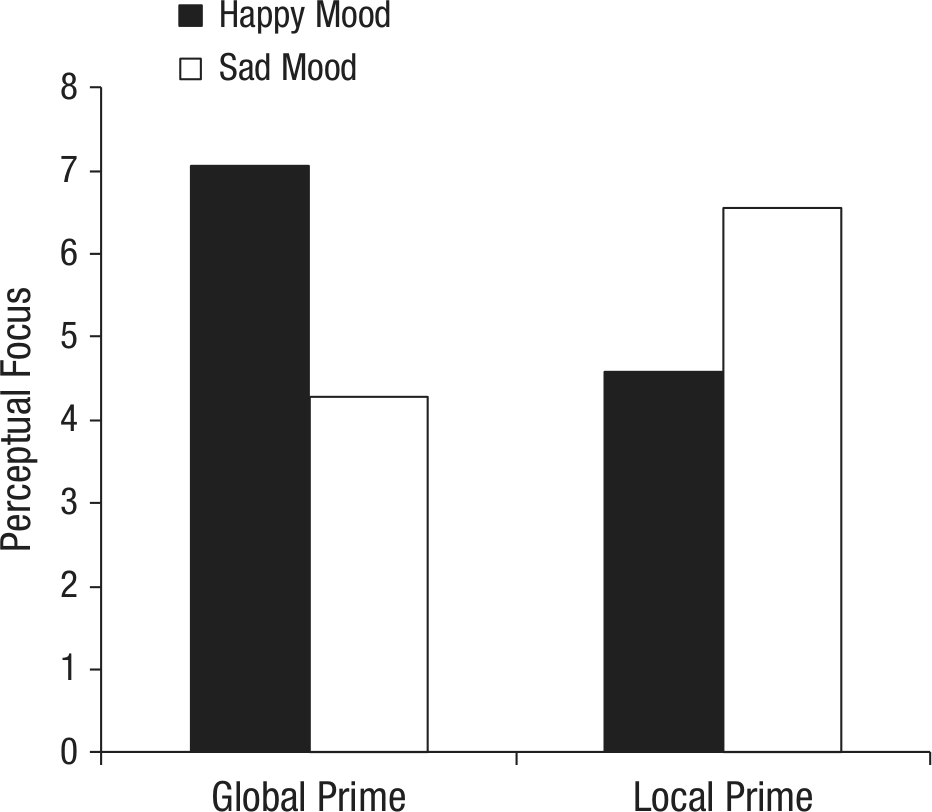
Perceptual focus (number of global matches made in the Kimchi- Palmer figures task) as a function of mood when a global focus or a local focus is primed (see Huntsinger, Clore, & Bar-Anan, 2010, Experiment 2). Higher values reflect a broader focus.
Despite the consistency of these results, because flexibility on such perceptual outcomes may reflect postperceptual processes, such as biases in response selection (Kimchi, 1992; Rowe et al., 2007), this initial research may have merely revealed superficial shifts in the scope of attention rather than an underlying change in attention. This alternative explanation was ruled out in recent research in which a flanker task was used as the index of attentional focus (Huntsinger, 2012). This task more directly captures attentional broadening or narrowing, and it provides evidence that these shifts reflect differences in attention at encoding.
This research also included a priming condition in which neither a broad nor a narrow focus was made dominant. Such a condition provides a strong test of the possibility that, rather than directly tuning the attentional system, positive and negative affect have the effects that they do merely by assigning positive and negative value to the dominant attentional orientation in a given situation. If affect directly alters attentional scope, then one should observe differences in attentional scope in this condition, as positive and negative affect should tip the temporarily balanced attentional scales toward either a broad or narrow focus. If affect operates on whichever focus is dominant, then no association between mood and attentional scope should be evident in this condition, because affect has nothing for which to serve as a go or stop signal.
Participants in this research first completed the modified Navon-letter task described earlier, with the addition of a condition in which both attentional orientations were primed equally. Next, participants experienced the mood induction in which they read either a happy or sad story, or listened to a cheerful or gloomy musical selection. Finally, to measure attentional scope, participants completed a traditional flanker task like that described earlier or a modified flanker task.
The results clearly support the idea that flexibility in the influence of affect reflects a fundamental alteration of attentional scope (Fig. 4). When a global focus was dominant, participants in happy moods exhibited a larger flanker compatibility effect than those in sad moods. When a local focus was dominant, participants in happy moods exhibited a smaller flanker compatibility effect than those in sad moods. Finally, when neither focus was dominant, affect failed to tune the scope of attention.
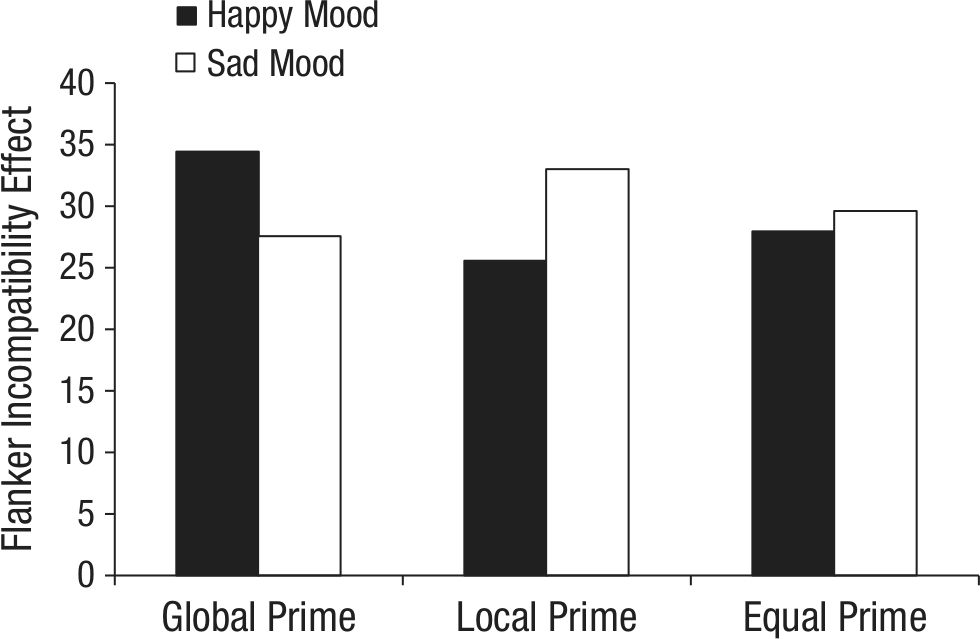
Attentional focus as a function of mood when a global focus is primed, a local focus is primed, and both equally primed (adapted from Huntsinger, 2012, Experiment 1). Higher values reflect a broader focus.
Summary and Implications
Consistent with much past research, the research reviewed here shows that whether one attends broadly or narrowly on the environment is indeed shaped by how one currently feels. This research also suggests, however, that rather than having fixed effects on the scope of attention, the impact of positive and negative affect is surprisingly flexible. Consistent with the idea that affective feelings signal the value of accessible styles of attention, this connection seems to depend on the accessibility of tendencies to focus broadly or narrowly. When a broad focus is accessible, as is customarily the case, happy people focus broadly and sad people focus narrowly. But when a narrow focus is accessible, happy people now focus narrowly and sad people broadly. Also consistent with the idea that affect does not directly tune the scope of attention is the finding that when neither focus is dominant, affect fails to influence the focus of attention.
This research suggests that understanding how affect influences the style of attention requires knowing the default or most accessible style of attention in a particular situation. Because a global or broadened focus of attention is often the default, the customary influence of affective feelings on attention should be observed in most experimental contexts. This research does not overturn past findings so much as it clarifies our understanding of the complex connection between emotion and attention.
Recent work by Harmon-Jones and his colleagues is consistent with the current view that affective valence is not tied to a particular focus of attention (Harmon-Jones, Price, & Gable, 2012). This work showed that the motivational intensity associated with positive and negative affective states is an important predictor of attentional scope. Affective states high in motivational intensity (e.g., disgust, enthusiasm) are associated with active goal pursuit and therefore were theorized to lead to a narrow scope of attention that should aid individuals in achieving their goals. In contrast, states low in motivational intensity (e.g., satisfaction, sadness) are associated with goal completion and therefore were theorized to lead to a broad scope of attention that should allow individuals to be receptive to new opportunities. Recent research is consistent with these predictions (Gable & Harmon-Jones, 2008, 2010)
Although both seek to explain variability in the link between emotion and attentional scope, the two accounts focus on largely independent contributors to such variability. Indeed, holding motivational intensity constant, the research reviewed here shows that whether a broad or narrow focus is the momentary default is crucial to predicting whether positive and negative affective feelings broaden or narrow attention. Moreover, as suggested elsewhere (Friedman & Förster, 2011; Isbell et al., 2013), some motivationally intense positive emotion manipulations may be confounded with a local attentional focus (e.g., videos of desserts may prime both local processing as well as positive feelings). Thus, certain motivational-intensity effects may instead result from processes outlined here. Future research is necessary to examine the possible joint impact of motivational intensity and the accessibility of global/local orientations on attentional focus.
Many other affective cues have been found to tune the attentional system to focus either broadly or narrowly (for a review, see Friedman & Förster, 2010). These include, for example, enactment of approach motor actions (e.g., arm flexion) and the color blue, which broaden attention, and enactment of avoidance motor actions (e.g., arm extension) and the color red, which narrow attention. Similar to affective feelings, these affective cues are assumed to regulate attentional scope through their association with appraisals of the environment as benign or problematic. However, the information conveyed by these cues and emotions may also be understood as providing a green light or red light to follow one’s inclinations (Clore & Huntsinger, 2009). Thus, like affective feelings, their impact on the focus of attention may exhibit flexibility as a consequence of shifts in the momentary dominance of a broadened or narrowed focus.
Coda
These findings reveal that the influence of affective feelings on how we view the world is highly flexible, and depends on whether a focus on the forest or the trees is accessible at any given attentional moment. In a more general sense, these results support the idea that, like reward and punishment, affect acts on currently accessible thoughts and response tendencies and is therefore flexibly responsive in its effects on cognition and attention to changing situations and mental contexts.
Recommended Reading
Easterbrook, J. A. (1959). (See References). A classic article introducing the idea that emotion controls the scope of attention.
Friedman, R. & Förster, J. (2010). (See References). An article describing recent research demonstrating what appeared to be a fixed connection between affect and attentional scope.
Gasper, K. & Clore, G. L. (2002). (See References). Empirical research demonstrating what appeared to be a fixed link between affect and attentional focus.
Huntsinger, J. R. (2012). (See References). An article that provides evidence in favor of a flexible influence of affect on attentional scope.
Huntsinger, J. R., & Clore, G. L. (2012). (See References). A detailed summary of the theoretical perspective summarized in this article.
Footnotes
Acknowledgements
Many thanks to Kevin Deiboldt, Gerald Clore, Linda Isbell, and Daniel Rovenpor for their invaluable feedback on the manuscript.
Declaration of Conflicting Interests
The author declared no conflicts of interest with respect to the authorship or the publication of this article.