



Abstract
When people coordinate as a team, they accomplish more than they would working alone. These team-coordination effects give new meaning to Aristotle’s famous phrase, “the whole is greater than the sum of its parts.” In this article, I consider two central issues confronting team-coordination research: Do the causes of team coordination reside within individual minds or between them, and at what levels of analysis (e.g., physiological, cognitive) do team-coordination effects occur? These issues are viewed in light of specific lines of coordination research, and some features of a general theory of team coordination are offered.
Coordination, the dynamic arranging of parts to achieve a larger task or function, is a constant requirement of human activity. Whether deciding what to say or walking down a street, we coordinate our daily activities with others. Team coordination is a special case that occurs when two or more people work interdependently for a limited time to perform a common and valued function (Salas, Dickinson, Converse, & Tannenbaum, 1992). Unlike coordination that naturally arises in the pursuit of daily activities, team coordination can be studied in the lab and in naturalistic settings.
By coordinating as a team, people accomplish more than they would working alone, such that, as Aristotle said, “the whole is greater than the sum of its parts.” This coordination effect is a root cause for interest in team coordination. Team-coordination effects in tasks such as the pursuit rotor task (Reed et al., 2006), manual control of electromechanical apparatuses (Gorman & Crites, 2013), and laparoscopic cutting (Zheng, Swanström, & Mackenzie, 2007) indicate that people perform some perceptual-motor tasks more effectively as a team than individually. In more complex cognitive tasks, such as operating an unmanned air vehicle (UAV; Cooke, Gorman, Myers, & Duran, 2013), teams coordinate to perform tasks that no individual could perform. There are many feats of team coordination, whether in laboratory tasks or naturalistic settings (e.g., playing basketball; Bourbousson, Poizat, Saury, & Seve, 2010; Ramos-Villagrasa, Navarro, & Garcia-Izquierdo, 2012), wherein team-coordination effects are observed.
What causal mechanisms underlie team-coordination effects, especially as they relate to team effectiveness? Does team coordination spring forth from inner mental representations and knowledge structures, or is it a function of real-time, dynamic interactions between people? Does it occur within a particular level of analysis (e.g., cognitive, perceptual-motor), or does it span multiple levels of analysis? These questions reflect two central issues at the forefront of team-coordination research. Though these issues relate broadly to mind and interaction (e.g., De Jaegher, 2009) and mind-body dualism, the purpose of this article is to view these issues in light of coordination research and to begin to synthesize them toward a general theory of team coordination.
Issue 1: Team Coordination—“Within” or “Between” Individuals?
This article taps into dynamic (e.g., Gorman, Amazeen, & Cooke, 2010) and shared-knowledge approaches (e.g., DeChurch & Mesmer-Magnus, 2010) to understanding team coordination (Fig. 1). The purpose of this article is not to fully distinguish or make a test between approaches but rather to use them to elucidate central issues.
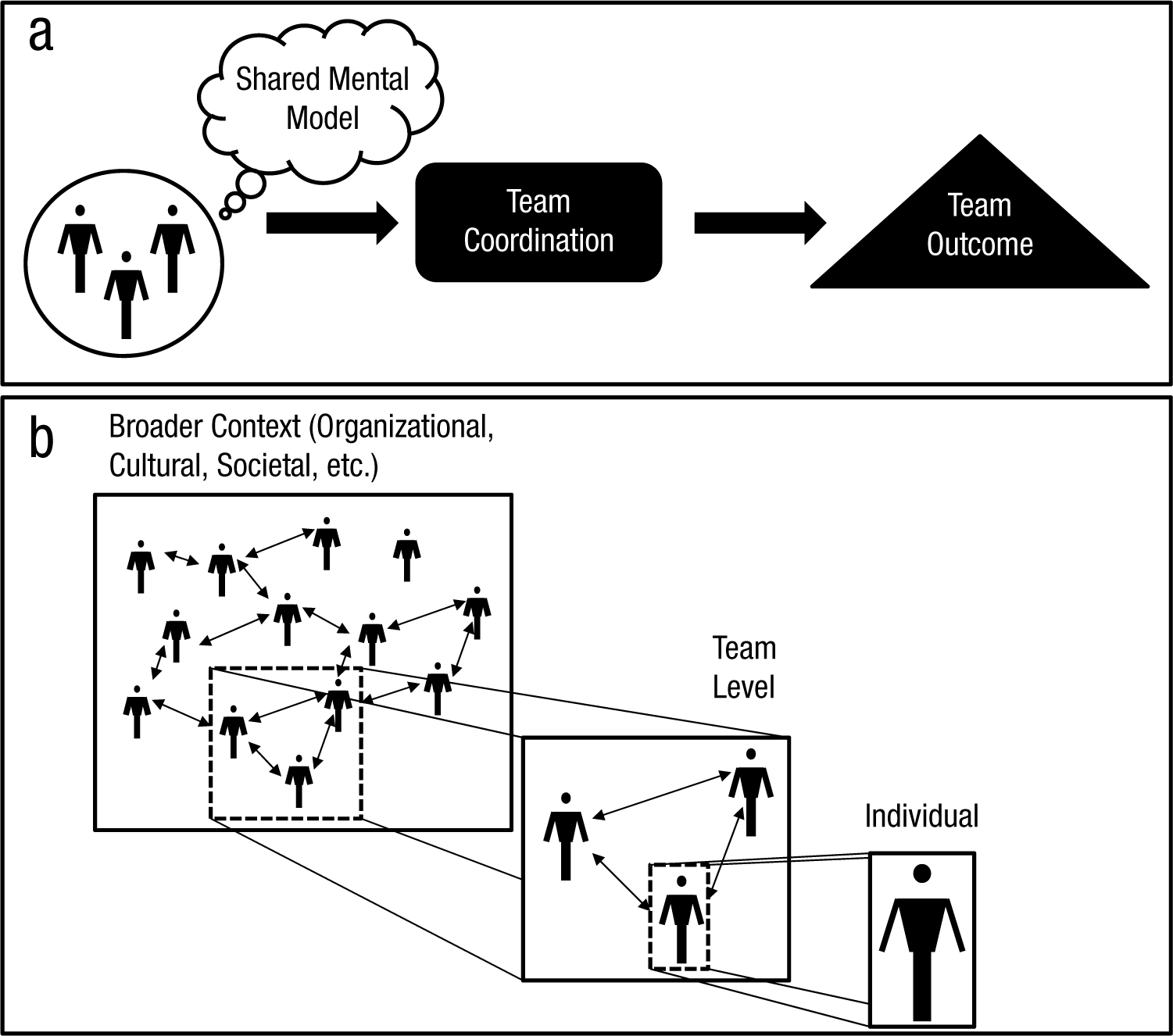
Schematics illustrating the shared-knowledge and dynamic approaches to team coordination. In the shared-knowledge approach (a), the causal basis of team coordination is thought to lie in the overlapping or complementary mental representations or knowledge structures within team members’ heads (e.g., a shared mental model), in which shared knowledge is linked to team outcomes through team coordination, which is commonly referred to as the input-process-output model. In the dynamic approach (b), the team level is simultaneously constrained by a broader context (cultural, societal, organizational, etc.) and is driven by interactions (indicated by arrows) between individuals. In this approach, the team level exerts downward causality on the individual, such that individuals’ thoughts and actions are constrained and modified by real-time team-coordination processes, giving rise to team-coordination effects.
In the shared-knowledge approach, team coordination is directly related to the degree of common (i.e., overlapping) or complementary knowledge within team members’ heads (DeChurch & Mesmer-Magnus, 2010; e.g., a shared mental model: Cannon-Bowers, Salas, & Converse, 1993). Whereas a mental model is a knowledge structure within an individual’s head that enables that person to describe, explain, and predict system behavior (Rouse & Morris, 1986), a “shared” (or “team”) mental model is one in which individual mental models either overlap or complement each other in terms of knowledge content and accuracy (Cooke, Salas, Cannon-Bowers, & Stout, 2000). Hence, shared mental models enable team members to describe, explain, and predict each other. A shared mental model facilitates team members’ ability to coordinate activities, which is directly related to team performance (Fig. 1a). The distinction between “compositional” and “compilational emergence” (Kozlowski & Klein, 2000) has greatly advanced the shared-knowledge approach by distinguishing between shared knowledge as a property of team members (e.g., shared mental models) and shared knowledge as it develops through team interaction (e.g., transactive memory).
Multiple studies have linked shared knowledge to team effectiveness through team coordination. Shared knowledge enables team members to anticipate each other (MacMillan, Entin, & Serfaty, 2004) and back each other up (Smith-Jentsch, Kraiger, Cannon-Bowers, & Salas, 2009) during team performance. Teams with shared knowledge communicate efficiently (Stout, Cannon-Bowers, Salas, & Milanovich, 1999) and coordinate implicitly (Rico, Sanchez-Manzanares, Gil, & Gibson, 2008), which frees up individuals’ mental resources, allowing teams to maintain peak effectiveness under novel or stressful conditions. In this way, shared knowledge enhances team coordination and, therefore, team effectiveness.
Though not directly related to team coordination, the joint-action approach (e.g., Knoblich & Jordan, 2003; Knoblich & Sebanz, 2006) is like the shared-knowledge approach in that it posits that coordination mechanisms are localized within the individual. For instance, joint-action research has shown how interpersonal coordination occurs through representational mechanisms, such as mental simulation and prediction of other’s actions.
Whereas shared-knowledge and representational approaches focus on inner mental processes and states as a foundation for coordination effects, the dynamic approach focuses on real-time coordination processes and how they shape both individual and team performance. Research on individual (Kelso, 1995) and interpersonal (M. J. Richardson, Marsh, & Schmidt, 2005; Schmidt, Carello, & Turvey, 1990) coordination dynamics has provided the theoretical underpinnings for a dynamic approach to team coordination. The difference is that concepts and methods of interpersonal coordination (often, dyads performing rhythmic tasks) are extended to multiple, heterogeneously skilled players.
A foundational assumption of the dynamic approach is that psychological processes always take place in a context of constraints (external conditions that reduce the ways in which cognitive, behavioral, and other processes might unfold) and that this context of constraints extends spatially and temporally to shape action possibilities (Juarrero, 1999). In teams, the context of constraints includes not only environmental and task conditions but also ongoing interactions among team members (Fig. 1b). As a subset of interaction patterns, team-coordination processes constrain the possibilities of individual thought and action as they relate to team performance. For example, when a soccer player kicks the ball to a place on the field, he or she does not do so “just because.” Though the soccer player has a priori knowledge of whom he or she should (or should not) kick the ball to, he or she will be compelled to kick it that way only after becoming aware of a teammate running toward that spot. From a dynamic approach, it is this real-time awareness, and not just a priori knowledge, that fundamentally underlies team coordination. Hence, the causal basis of team coordination from a dynamic perspective does not lie within the individual; it lies within real-time coordination processes as they unfold across individuals (Gorman, Amazeen, & Cooke, 2010). Recent research has demonstrated how these team-coordination dynamics can be manipulated to increase team effectiveness.
From a dynamic perspective, increasing the number of ways in which team members interact exercises the coordinative links that are fundamental to team performance. Hence, compelling team members to interact in novel ways during task acquisition increases team effectiveness by allowing teams to more fully explore the space of possible coordination patterns that could occur (Frank, Michelbrink, Beckmann, & Schollhorn, 2008).
Gorman, Cooke, and Amazeen (2010) provided empirical support for this principle by manipulating team-coordination patterns in a three-person UAV task (Cooke & Shope, 2005) using perturbation training. The idea behind perturbation training is to “exercise” team coordination by introducing brief external disturbances (i.e., perturbations) to coordinative links that force teams to organize new solutions to coordination problems. Under novel task conditions, perturbation-trained teams outperformed teams that were either trained on each other’s roles to increase shared knowledge (i.e., cross-trained; Blickensderfer, Cannon-Bowers, & Salas, 1998) or trained using a standard procedural protocol (perturbation- and cross-trained teams performed equally under routine conditions). Importantly, whereas cross-training led to significantly more shared knowledge, perturbation training had no effect on shared knowledge. Thus, the effects of perturbation training are not attributable to the development of “top-down” (i.e., knowledge-driven) coordination skill. This study revealed that exercising coordinative links, rather than building shared knowledge, leads to the development of “bottom-up” (i.e., not knowledge-driven) coordination skill that allows teams to perform at high levels under both routine and novel task conditions. From this viewpoint, coordination effects may be manifested in changes in real-time interaction processes rather than the development of shared knowledge.
This perturbation effect has also been observed in research manipulating team-member familiarity. From a shared-knowledge perspective, “familiar” team members, who have worked together, should have shared knowledge that “mixed” teams members, who have not worked together, do not. Alternatively, by working with different team members, mixed teams should be exposed to a wider range of team-coordination patterns. Using Cooke and Shope’s (2005) UAV task, Gorman, Amazeen, and Cooke (2010) found that mixed teams coordinated more flexibly than familiar teams, and this flexible coordination was correlated with the successful handling of unanticipated, novel coordination problems. Gorman and Cooke (2011) found that these mixed teams had higher-quality coordination behaviors and rapidly became just as proficient as familiar teams on objective measures of task performance. Though mixed-team advantages seem inconsistent with a shared-knowledge approach, they are intuitive from a dynamic approach.
Though team coordination has traditionally been viewed through the lens of shared knowledge, we have found that manipulating shared knowledge is unnecessary for enhancing team coordination and effectiveness. The dynamic proposition is that team coordination happens during the process of team interaction and so can never be reduced to collective team-member states (cf. DeChurch & Mesmer-Magnus, 2010). This is not to say that team members do not have inner mental properties that contribute to task performance, but rather that those properties do not play the central causal role typically attributed to them.
Issue 2: Levels of Analysis and “Cross-Level” Effects
Team-coordination effects are commonly observed at different levels of psychological analysis. Figure 2 shows a hypothetical relationship among levels of analysis commonly found in psychology, from the materially substantial (e.g., physiological) to the informationally abstract (e.g., cognitive), with arrows indicating the hypothesized interdependence between levels.
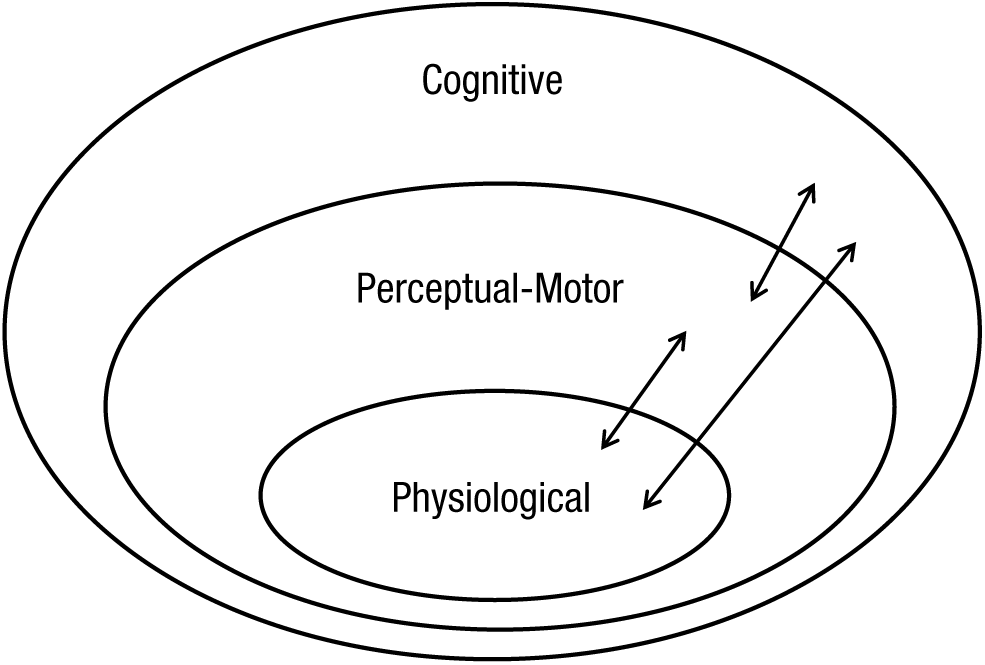
Schematic illustrating how team-coordination effects occur within and between different levels of psychological analysis. The arrangement of levels in this illustration is not meant to imply hierarchically causal relationships; rather, it is meant to indicate the hypothesized interdependence between more materially substantial (e.g., physiological) and more informationally abstract (e.g., cognitive) levels of analysis. The arrows connecting levels of analysis represent “cross-level” effects, wherein team coordination is simultaneously reflected across different levels of analysis.
Observations of people’s interpersonal perceptual-motor coordination as they converse about a topic have provided the basis for the hypothesis that levels interact as people coordinate. Research on “behavior waves” (Newtson, 1994), interpersonal postural synchronization (Shockley, Santana, & Fowler, 2003), speaker–listener eye movements (D. C. Richardson & Dale, 2005), and gaze coordination during conversation (D. C. Richardson, Dale, & Kirkham, 2007) has shown that variability at the cognitive level is reflected in variability at the perceptual-motor level. These cross-level effects suggest that team coordination may be simultaneously organized across different levels of analysis.
During team skill acquisition, changes in one level may become associated with changes in another as teams gain coordination experience. In the context of submarine-crew training, Stevens, Gorman, Amazeen, Likens, and Galloway (2013) found that less experienced crews (“novice” teams) exhibited different types of team electroencephalography (i.e., brain-wave) patterns, called neurodynamics, compared with more experienced crews (“expert” teams). In a follow-up study, Gorman, Martin, Dunbar, Stevens, and Galloway (2013) found that these teams also differed in their communication patterns and that communication patterns were temporally cross-correlated with neurodynamic patterns. Whereas novice-team communications were more locally correlated with neurodynamics (i.e., in the “here and now”), expert teams’ correlations extended forward and backward in time. These results suggest that cognitive-behavioral levels of analysis (e.g., communication) become interrelated with physiological levels of analysis (e.g., neurodynamics) as teams learn to coordinate. Because these interrelations become temporally extended (Gorman et al., 2013), understanding the origins of cross-level effects may provide insight into team-coordination dynamics.
Experiments on cross-level effects have primarily designated cognitive-task manipulations as independent variables and physio-motor effects as dependent variables. Consequently, the ontological status of cross-level effects (i.e., how and why they come into being) remains opaque. The ontological question is of the “which came first, the chicken or the egg?” variety: Does the establishment of cross-level effects causally precede coordinated performance, or does coordination need to be established on one level to bring up epiphenomenal (“incidental”) coordination on others? This question may be ill posed as one of efficient causality, however. Just as the formal causes of behavior sometimes precede the intention to act, and vice versa (Juarrero, 1999), it is also possible that mutual “pushing and pulling” between, for example, individuals’ physiological states and their intentions to coordinate as a team are two sides of the same coin, and you cannot have one without the other.
The next advance in cross-level research may come through a systematic study of whether “lower”-level (e.g., physiological) coordination effects induce “higher”-level (e.g., cognitive) coordination effects or vice versa. If there is a hierarchical arrangement of levels, such that coordination at one level causes coordination at another, then this would go a long way in suggesting that levels remain causally separate. However, if teamwork and coordination are mutually established across levels, then a general theory of team coordination need not be confined to a single (e.g., cognitive) level of analysis.
Toward a General Theory of Team Coordination
How might these different lines of coordination research be synthesized toward a general theory? From a shared-knowledge perspective, it seems that a general theory must involve intention and knowledge on the part of team members, but because dynamics and a context of constraints are fundamental to team coordination, it cannot be a purely internal, representational theory (DeChurch & Mesmer-Magnus, 2010; Knoblich & Sebanz, 2006). It must also account for how coordinative linkages structure thought and action when people work together (Marsh, Richardson, Baron, & Schmidt, 2006).
Has a theoretical impasse been reached? Perhaps one has, and it lies in an erroneous assumption that “inner” mental components (e.g., knowledge) and “outer” relations (e.g., coordinative linkages) exist separately, such that, for example, the former might “cause” the latter. If so, then the picture one gets (e.g., Fig. 1a) is illusory. When coordinative links are established, the ways in which individuals think and act are different than they would be if those links were absent. In this way, individual thought and action (e.g., decision making) depend on coordinative relations even as they contribute to them (Morgan, 2010), and the role of more enduring team-member states, such as attitudes and dispositions, might be understood in a similar way. The dynamic approach suggests a causal interplay between the team and the individual level rather than localizing team-coordination effects in inner mental components. The question of how individual thought and action are molded in the service of team-level constraints (e.g., Fig. 1b) is ripe for future research.
Measuring the establishment of coordination links will require measurement at the team (“systems”) level. We have accomplished this using dynamical-systems methods (Gorman, Amazeen, & Cooke, 2010; Gorman, Cooke, Amazeen, & Fouse, 2012). However, a systematic study of the dynamics by which coordinative links structure individual thought and action is still needed. Such research will lead not to laws concerning inner mental components but to mathematical relations that describe how team performance is organized beyond the individual through interactions (Cooke & Gorman, 2009; Van Orden, Holden, & Turvey, 2003). In this way, a general team-coordination theory should have implications for how individual thoughts, actions, and motivations—even in our daily lives—are meaningfully embedded in a broader universe of coordinative relations.
Footnotes
Acknowledgements
The author acknowledges Nancy J. Cooke, Polemnia G. Amazeen, Ronald H. Stevens, Melanie J. Martin, Trysha L. Galloway, Michael J. Crites, and Terri A. Dunbar for their contributions to ideas and research described in this article.
Declaration of Conflicting Interests
The author declared no conflicts of interest with respect to the authorship or the publication of this article.
Funding
Preparation of this article was supported by National Science Foundation Grant BCS 1257112 and Defense Advanced Research Projects Agency Subcontract W31P4Q-12-C-0166.