




Abstract
Entrepreneurship is one of the most effective means to alleviate poverty in developing countries. Effective entrepreneurship requires psychological approaches—in particular, active (i.e., agentic) approaches. We introduce an action-regulation training approach, focusing on self-regulation and active behavior in entrepreneurship as a bottom-up solution for poverty reduction. We present two different training interventions. The first focuses on enhancing personal initiative in entrepreneurs from developing countries. The second aims at boosting startup rates in these countries by enhancing participants’ entrepreneurial skills and motivation. We describe underlying theoretical assumptions, structures, and effects of both training interventions and discuss evaluation studies with randomized pretest-posttest control-group designs showing that action-regulation training is a successful means to promote entrepreneurship in developing countries.
Psychology has often shied away from participating in solving “grand” challenges because of its inherent orientation toward individuals. One such grand challenge is poverty reduction. Increasing the number and quality of entrepreneurs is probably one of the most helpful ways to reduce poverty because it creates employment and boosts the innovation and economic empowerment of individuals in poor countries with extremely high unemployment rates (Mead & Liedholm, 1998; Pick & Sirkin, 2010). Governments in these countries have increasingly acknowledged that entrepreneurship is an effective means to reduce poverty and have introduced several top-down programs to facilitate the creation of new firms. These top-down programs mainly involve changes in laws and regulations to make it easier to start and operate a business (World Bank, 2013). In contrast, bottom-up approaches attempt to support entrepreneurs either with financial resources (microcredits) or with better business knowledge (Drexler, Fischer, & Schoar, 2014; McKenzie & Woodruff, 2012). In particular, approaches that involve providing financial resources have received broad attention. Within the microcredit community, influential activist such as Nobel Prize winner Muhammad Yunus (Yunus, 1999) have argued that providing microcredits is enough to lift people out of poverty and no further training to enhance people’s skills is needed. Although both government programs and microcredits for the poor are necessary, these institutional and economic strategies have often failed because they did not pay enough attention to the psychological side (Chliova, Brinckmann, & Rosenbusch, 2015).
Recent scientific developments have led to new knowledge about the psychology of entrepreneurship (Baron, 2002; Baum, Frese, & Baron, 2007; Frese & Gielnik, 2014; Hisrich, Langan-Fox, & Grant, 2007). This literature has now been used to develop psychological training interventions to increase the number and quality of entrepreneurs in developing countries. We shall report on interventions that are psychological in nature and that aim to positively impact the number and quality of startups and their growth by enhancing the agency of entrepreneurs and undergraduate students.
The Centerpiece of Entrepreneurship: Agency Based on Self- and Action Regulation
We argue that the centerpiece of a psychology of successful entrepreneurship is the agentic nature of entrepreneurs who actively influence the environment, scan for opportunities, develop opportunities into viable products/services, plan goal achievement in appropriate detail and with a long-term orientation, put ideas into effect, and actively search for feedback to stay ahead of competitors (Frese, 2009). The theoretical underpinnings are action-regulation theory (Frese & Zapf, 1994; Zacher & Frese, in press) and self-regulation theories (Bandura, 1997; Baumeister, Bratslavsky, Muraven, & Tice, 1998; Lord, Diefendorff, Schmidt, & Hall, 2010).
Action-regulation theory holds that in order to be agentic, people have to carry out the following aspects of the action sequence: setting goals, developing knowledge about the environment, forming and executing action plans, monitoring the action, and seeking feedback. Furthermore, all these aspects of action should be based on personal initiative. Frese and Fay (2001) defined personal initiative as self-starting behavior with a long-term orientation and persistence when problems and opportunities appear.
Agency-Training Method
The agency training promotes being active through five training components (Frese & Zapf, 1994): First, the training combines knowledge acquisition with direct actions, requiring all participants to act as entrepreneurs. For participants who already run a firm, the action knowledge needs to be tied to their particular firms. For students without firms, the training requires that they start informal microfirms on the first day of the training.
Second, participants should acquire adequate operative mental models containing action-relevant knowledge. These operative mental models should be evidence-based and communicated through action principles (Glaub, Frese, Fischer, & Hoppe, 2014). These action principles are action-ready rules of thumb from which non-essential knowledge is stripped away (Drexler et al., 2014; Gielnik et al., 2015). For example, action principles inform participants about how to show personal initiative in goal setting, information and opportunity search, planning, and feedback seeking (e.g., “Use feedback to detect future problems and opportunities” describes how to show a long-term orientation in feedback seeking). Participants internalize the action principles through verbalization while acting. Furthermore, they develop the precise meanings of the action principles when practicing and applying them to their firms.
Third, action-regulation theory holds that actively practicing and repeating actions during the training is important for deep processing and routinization of the training content. Moreover, active practicing is key to transform theoretical (declarative) knowledge into practical (procedural) knowledge.
Fourth, the training emphasizes feedback, including negative feedback. Negative feedback provides participants with information about deficiencies in their actions and thus contributes to learning and the ability to deal with gaps in knowledge and experience. Negative feedback can also have a motivating function because it discloses a gap between the status quo and desired end states, prompting people to invest additional effort. A special form of negative feedback is making an error; action-regulation theory emphasizes the importance of making errors in the training. Meta-cognizing on errors (e.g., asking oneself what happened when the error was made, developing ideas, and running little experiments to test these ideas) and adopting a nonemotional, positive approach to errors lead to high action learning (Frese & Keith, 2015).
Fifth, participants develop a personal project (Little, 1983)—for example, introducing new products or services or using unconventional marketing techniques. The personal project facilitates the transfer of the knowledge gained in the training intervention to the context outside the training. Our approach includes stripping away nonessential material, and, therefore, face-to-face training time is limited to 24 to 36 hours.
Two Agency-Training Interventions
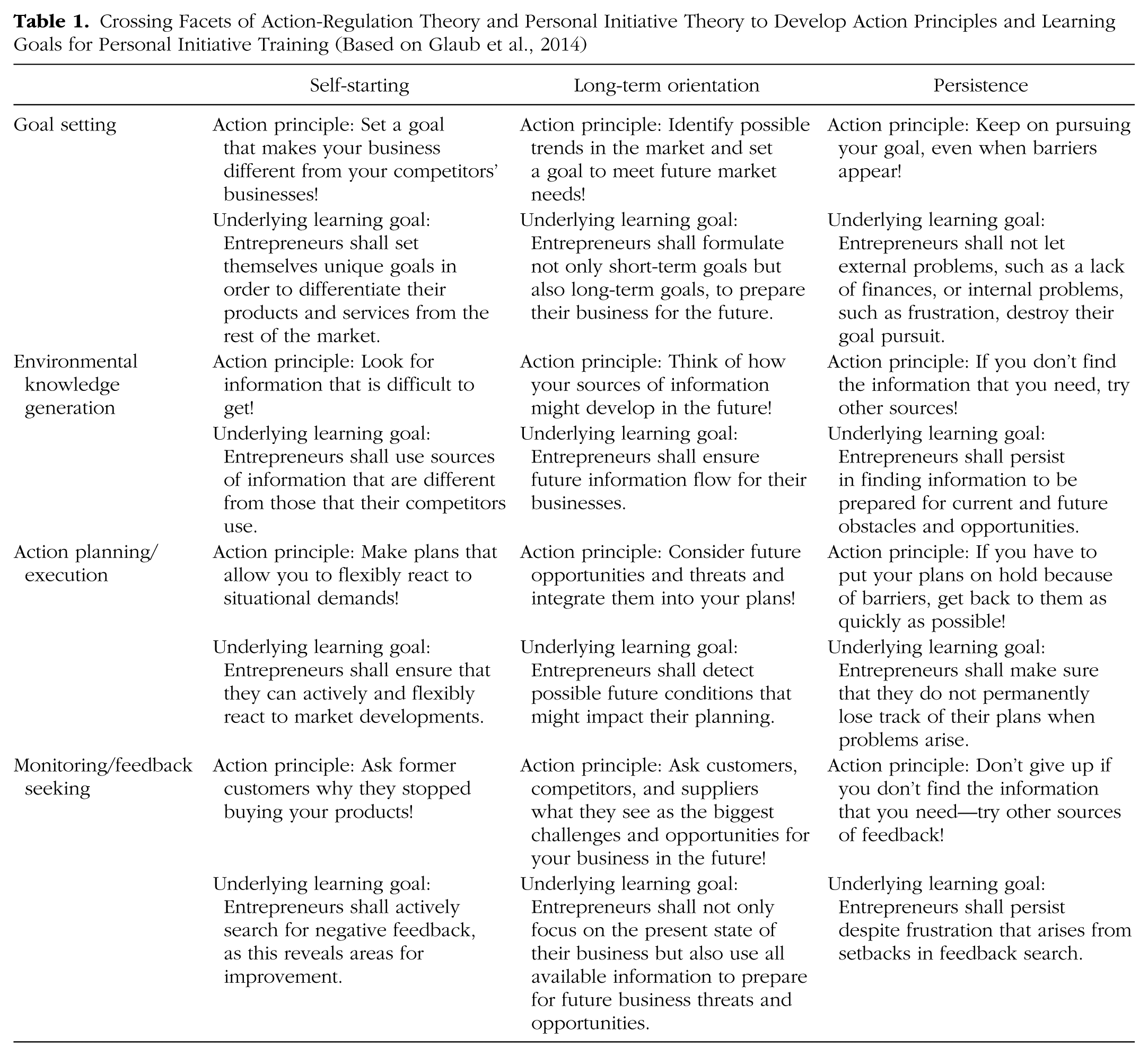
The first training intervention—personal initiative training—is oriented toward existing entrepreneurs. The second one—Student Training for Entrepreneurial Promotion, or STEP training—is oriented toward university, but also vocational school, students. The training intervention for existing entrepreneurs is based on action-regulation theory, with particular reference to the concept of personal initiative (Glaub et al., 2014). In developing the training material, we crossed the aspects of the action sequence (i.e., goal setting, scanning actively to understand the environment, action planning and execution, monitoring, and feedback seeking) with aspects of personal initiative (self-starting, long-term orientation, and persistence). This matrix resulted in action principles for all combinations of the facets of action-regulation theory and personal initiative. Table 1 depicts examples of action principles and underlying learning goals (for a more detailed table, see Glaub et al., 2014). The action principles guide entrepreneurs through the entrepreneurial action process and inform them about how to show personal initiative. We also used the matrix to develop exercises and case studies exemplifying positive and negative entrepreneurial actions.
Crossing Facets of Action-Regulation Theory and Personal Initiative Theory to Develop Action Principles and Learning Goals for Personal Initiative Training (Based on Glaub et al., 2014)
The second training intervention—STEP training—is aimed at developing an entrepreneurial mind-set in undergraduate students majoring in nonbusiness subjects (e.g., computer science, psychology, arts, or veterinary medicine). In one study, we also targeted vocational school students. The main objective of the STEP training is to prepare the students for their career and to encourage them to start and grow a firm. This training is based on self- and action regulation (Bandura, 1997; Frese, 2009). STEP focuses first on teaching action knowledge needed to perform activities related to starting a business. Action knowledge is provided by rules of thumb for the major content areas of entrepreneurship in developing countries, such as marketing, financial management, acquisition of starting capital, accounting, business planning, and legal issues. Second, one part of the STEP training deals with psychological areas of leadership, planning, creativity and opportunity identification, effective customer management, networking, and personal initiative. The training combines knowledge acquisition with action to produce true action knowledge, which contributes to successful entrepreneurial endeavors. Third, the training focuses on developing intentions to start a firm. However, one of the problems of goal intentions is that they are not necessarily implemented. Therefore, fourth, the training leads participants to generate plans that convert the intentions into actions. Action plans make it possible to implement an intention by specifying when, where, and how to perform actions; in this way, an implementation intention is produced (Gollwitzer, 1999). Fifth, by providing mastery experience in practical startup activities, the training also enhances entrepreneurial self-efficacy (Bandura, 1997). An important effect of self-efficacy is the increase of goal difficulty after goals are achieved (Phillips, Hollenbeck, & Ilgen, 1996). Sixth, a central point of entrepreneurship is to create and detect opportunities; therefore, we teach opportunity detection with two different approaches—one inspired by classic creativity training (DeTienne & Chandler, 2004) and one by effectuation (the idea that one should use one’s resources to try out approaches and to understand customers’ responses, and thus to slowly find one’s way into new ideas; Sarasvathy, 2001). All of this is supposed to lead to an increase in entrepreneurial actions, which, together with opportunity identification, leads to the creation of new startups (cf. Fig. 1 for the model and results of STEP training).
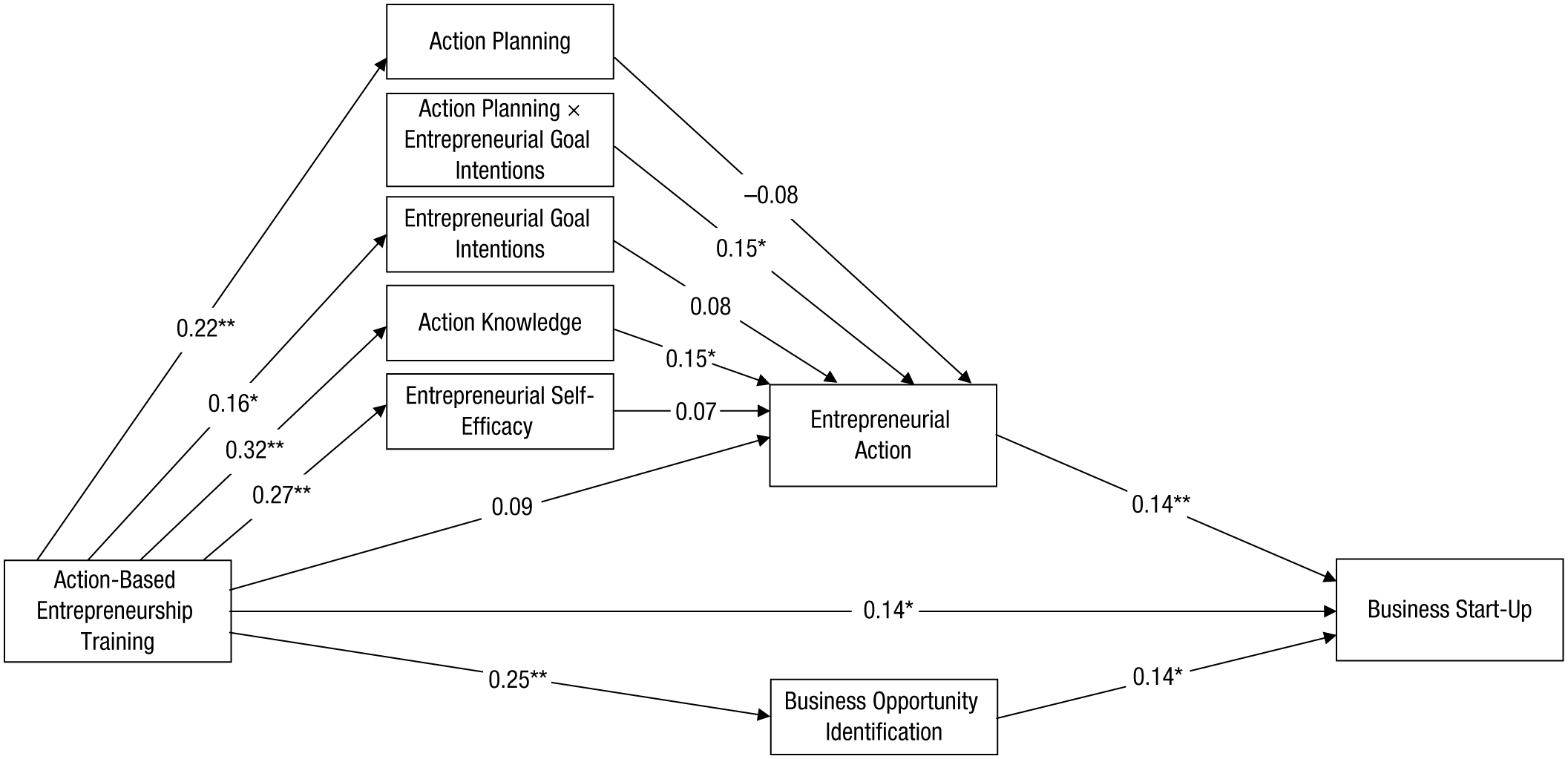
A theoretical and empirical model of the impact of Student Training for Entrepreneurial Promotion (STEP training; Gielnik et al., 2015). Values indicate standardized path coefficients. *p < .05; **p < .01.
Effects of Agency-Training Interventions for Entrepreneurship
The personal initiative training for existing entrepreneurs was evaluated with a 1-year study based on a randomized pretest-posttest control-group design in Uganda and showed a high degree of effectiveness (Glaub et al., 2014). The training increased participants’ personal initiative behavior, and this increase was responsible for higher business success after the training (full mediation). The sales level of training participants rose 27%, from 2.67 million Ugandan shillings before the training to 3.39 million Ugandan shillings 1 year later, and the number of employees per firm increased by 35%, from 7.88 to 10.67 employees per firm (these numbers decreased across the year for the waiting control group). Further randomized controlled experiments with thousands of entrepreneurs using different comparison groups are in progress. 1
One successful case is that of a Ugandan firm owner who produced cheap aluminum saucepans of low quality in a highly competitive market. As a result of the training, he attempted to switch to higher-quality production to target a better-paying customer group. He invested in testing his products at the Uganda National Bureau of Standards. Detailed feedback on deficiencies in quality allowed him to improve the production (e.g., by applying special tools) to be finally certified for good quality. With the quality certificate, he approached a wholesaler and succeeded in securing a large order that did not just keep his firm busy for more than a year but also three cooperating neighboring firms (Glaub et al., 2014).
The action-regulation training for undergraduate students was similarly tested with a long-term evaluation study using a randomized pretest-posttest design with a waiting control group. The evaluation study provided evidence for the positive impact of the training 1 year after the training intervention (Gielnik et al., 2015). The results showed that the number of startups grew from 16% to 51% and was 50.1% higher than in the control group. Even more impressive was the increase in job creation over time. After a year, training-group entrepreneurs created 1.06 jobs on average—twice as many additional jobs as business owners in the control group, who generated an average of 0.51 jobs in addition to their own. The positive effect on job creation became even more pronounced after 18 months, with an average of 2.82 jobs created by entrepreneurs in the training group versus 2.00 jobs created by entrepreneurs in the control group. The training also increased participants’ entrepreneurial self-efficacy, entrepreneurial goal intentions, action planning, and action knowledge, as well as opportunity detection, which mediated the effect of the training on firm creation (Gielnik et al., 2015). These findings hold across different developing countries (cf. Table 2). In Table 2, we present an overview of the STEP training interventions we have implemented and evaluated so far. The table also describes the impact of the training on startup creation after 1 year.
Overview of the Student Training for Entrepreneurial Promotion (STEP) Interventions That Have Been Implemented and Evaluated in Developing Countries
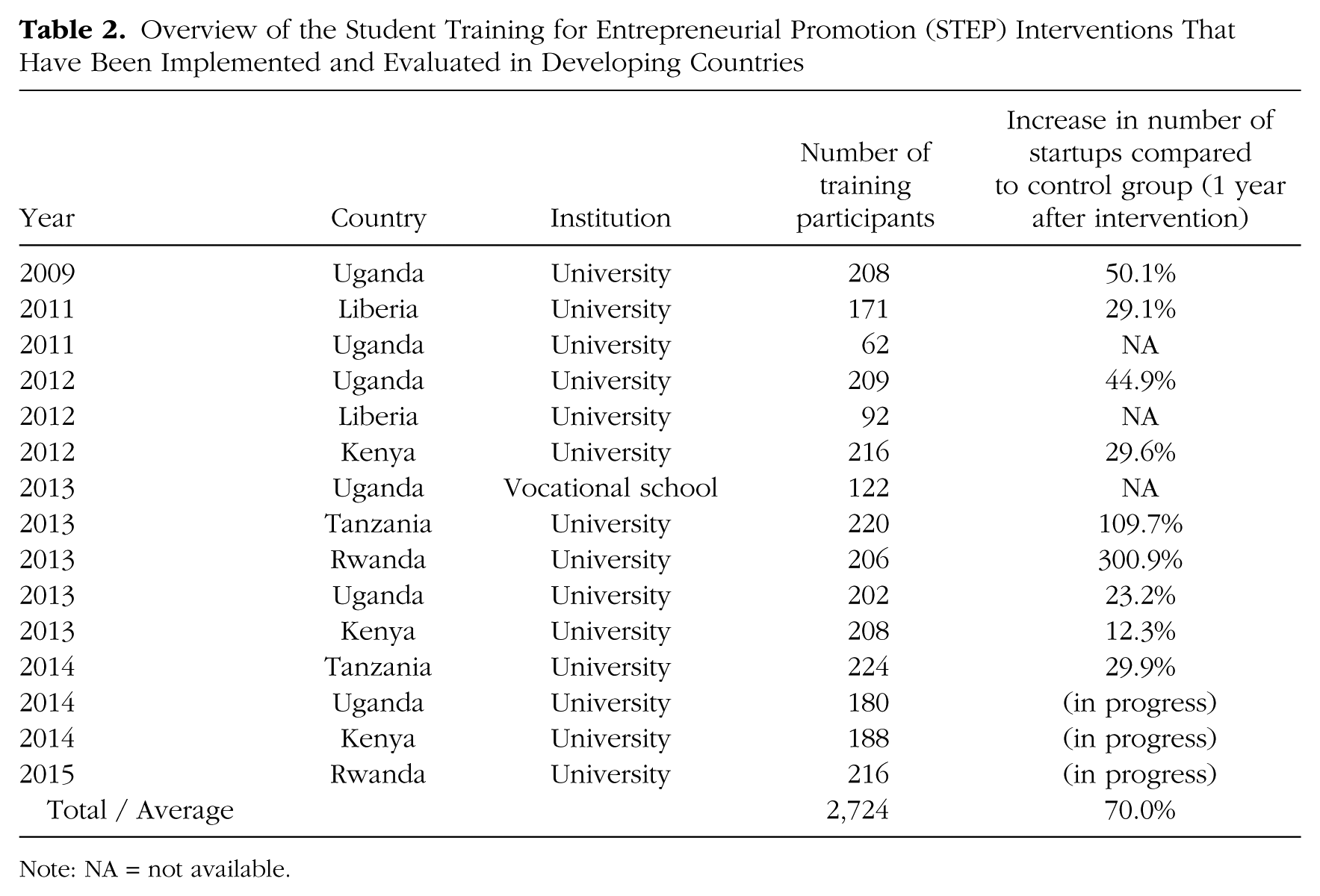
Note: NA = not available.
An example for the higher level of agency as a result of training is the case of Jane (Bischoff, Gielnik, & Frese, 2014). Jane—a computer-science major—was a young, unassertive, and nearly subservient participant in our training. After the training, she began to start several new firms—first a poultry farm, but later on also an ice cream parlor, an event-management company, and an IT consultancy. She generated substantial revenues and created jobs for five people. Jane is now a highly assertive and poised young woman and a prototype of a successful portfolio entrepreneur. She attributed her success to the training, which changed her attitude toward entrepreneurship and provided her with a can-do attitude toward grabbing opportunities, putting plans into action, and overcoming problems and failures (Bischoff et al., 2014). 2
Discussion and Conclusion
We think of our training interventions as being consistent with the tradition of short-term but “wise” interventions that are guided by theoretical psychological perspectives and influence important psychological and economic variables (Walton, 2014). The focus of our “wise” interventions is on action-based improvements and on the development of an entrepreneurial mind-set to start a firm. Although it is likely that entrepreneurship cannot be changed within a few hours, the interventions presented here can be completed within 24 to 36 contact hours—much shorter than most other interventions suitable for entrepreneurs in developing countries (Glaub & Frese, 2011), yet they had a strong impact on entrepreneurship. From a psychological perspective, it is important that the intended mediators (e.g., personal initiative behavior in the personal initiative training or the mediators described in Fig. 1 in the STEP training) were shown to indeed be operative in producing the positive effects on entrepreneurship.
We submit that our interventions should contribute to reducing poverty in developing countries. While there is no definitive study of entrepreneurship training’s effect on the economic activities of a whole country, there are data showing that higher numbers of entrepreneurs translate into positive net effects of employment in the economies of developing countries (Mead & Liedholm, 1998). We submit that our training interventions lead to a positive cycle of developing an agentic stance toward intentions and goals, scanning of the environment, planning, and feedback processing. This agentic stance then leads to effective activities, which help to secure entrepreneurial success, thus reinforcing a positive cycle of increasing agentic activities, more success, and continuous reinforcement. The agentic stance also includes dealing effectively and persistently with setbacks and barriers. Our emphasis on agency should reduce the frequent occurrence of entrepreneurs in developing countries “waiting” for donor money to help them (we explicitly deal with this issue in the training interventions by explicating that any good plan should not be based on components that make its execution overly dependent on outside forces). And, indeed, the effects of worries about lack of capital on startup creation is wiped out by the training (Bischoff, Dlugosch, Gielnik, & Frese, 2013).
One concern could be that the STEP training may create “unnatural” entrepreneurs, increasing the number of “misfits” poorly suited to the tasks of entrepreneurship in the intervention group because entrepreneurship was made to look too good or too easy to the participants. This could lead to more ineffective entrepreneurs in the intervention group than in the control group. However, this does not seem to be case. Not only did the STEP training significantly increase the number of entrepreneurs, but these entrepreneurs were more successful than those who appeared “naturally” without outside intervention in the control group. Another critical issue could be an attribute-treatment interaction, as our interventions may be more positive for certain groups of participants than for others (Gully, Payne, Koles, & Whiteman, 2002). We are currently researching this issue, but do not yet have relevant results.
Our approach was evidence-based in two important ways. First, we evaluated the interventions rigorously with randomized control-group design, and second, we based all concepts in the trainings on scientific literature (while also eliminating non-essential concepts). Our training interventions were psychological because they used an agentic approach based on psychological theories of action and self-regulation to increase understanding of and enhance entrepreneurship. This evidence-based and scientific psychological approach to “wise” interventions led to a significant increase in the number and quality of entrepreneurs in poor countries, thus helping them cope with one of the grand societal worldwide challenges—namely, poverty reduction.
Footnotes
Declaration of Conflicting Interests
The authors declared that they had no conflicts of interest with respect to their authorship or the publication of this article.
Funding
The work for this article was partially supported by Deutscher Akademischer Austausch Dienst (Grant A/07/26080), the German Commission for UNESCO and BASF Stiftung, the World Bank, and the National University of Singapore (MOE Grant AcRF Tier 1 R-317-000-084-133).