



Abstract
Children who have experienced environmental adversity—such as abuse, neglect, or poverty—are more likely to develop physical and mental health problems, perform poorly at school, and have difficulties in social relationships than children who have not encountered adversity. What is less clear is how and why adverse early experiences exert such a profound influence on children’s development. Identifying developmental processes that are disrupted by adverse early environments is the key to developing better intervention strategies for children who have experienced adversity. Yet much existing research relies on a cumulative-risk approach that is unlikely to reveal these mechanisms. This approach tallies the number of distinct adversities experienced to create a risk score. This risk score fails to distinguish between distinct types of environmental experiences, implicitly assuming that very different experiences influence development through the same underlying mechanisms. We advance an alternative model. This novel approach conceptualizes adversity along distinct dimensions, emphasizes the central role of learning mechanisms, and distinguishes between different forms of adversity that might influence learning in distinct ways. A key advantage of this approach is that learning mechanisms provide clear targets for interventions aimed at preventing negative developmental outcomes in children who have experienced adversity.
Few people dispute the notion that adverse environmental experiences in childhood—such as exposure to violence and chronic poverty—create a lasting imprint on emotion, cognition, behavior, and chances for success in adulthood. Children who have experienced adversity are more likely to develop psychopathology and chronic diseases, perform poorly at school, and have social and economic difficulties than children who have not encountered adversity (Felitti et al., 1998; Lansford et al., 2002; McLaughlin et al., 2012). What is less clear is how and why adverse early experiences exert such a profound influence on children’s development. Identifying the developmental processes that are disrupted by adverse early environments is the key to developing better intervention strategies to prevent the onset of problems in children who have experienced adversity.
Yet most current research is not designed in a way that can reveal mechanisms linking childhood adversity with developmental outcomes. We argue that the prevailing approach for conceptualizing and measuring childhood adversity is, at best, not suited for studying mechanisms and may, at worst, obscure them. We first describe current approaches to studying childhood adversity and the dominant perspective on stress as the central mechanism linking these experiences with downstream outcomes. Next, we advance an alternative model for studying mechanisms linking childhood adversity with psychopathology and other developmental outcomes. This novel approach conceptualizes adversity along distinct dimensions, emphasizes the central role of learning mechanisms, and distinguishes between different forms of childhood adversity that might influence learning in distinct ways. A key advantage of our approach is that learning mechanisms provide clear targets for intervention.
The Prevailing Approach: Cumulative Risk
Until recently, most research focused on single types of adversity, such as physical abuse, parental death, or poverty. A critical limitation of this approach is that it does not account for the fact that most children who have been exposed to one type of adversity have also experienced numerous others (Green et al., 2010; McLaughlin et al., 2012). When examining single types of adversity, it is impossible to determine whether a particular outcome (e.g., depression) is a consequence of the focal adversity of interest (e.g., physical abuse) or of other adversities the child experienced (e.g., poverty, neglect).
Recognition of the high co-occurrence of adversities led to a shift to the prevailing cumulative-risk approach. This approach tallies the number of adversities experienced to create a risk score (Evans, Li, & Whipple, 2013). For example, a child who experienced physical abuse, sexual abuse, and domestic violence would have a risk score of 3; a child who experienced poverty, neglect, and maternal depression would also have a risk score of 3. Cumulative risk thus focuses on the number of distinct adverse experiences rather than the severity or type of adversity (Evans et al., 2013).
The cumulative-risk approach has been widely adopted and has proved useful for highlighting the public-health importance of childhood adversity. Risk scores also can be used as a screening tool to identify children in greatest need of intervention. However, the cumulative-risk approach has significant limitations when used to identify mechanisms linking childhood adversity with developmental outcomes. Most notably, cumulative risk scores fail to distinguish between distinct types of environmental experience, implicitly assuming that all adverse experiences influence development through the same underlying mechanisms. In other words, risk scores assume that physical abuse, sexual abuse, and domestic violence influence children’s development in exactly the same way as poverty, neglect, and maternal depression. This assumption is highly tenuous.
Stress-response-system dysregulation as the central mechanism
Is it possible that the vastly different social and environmental experiences encompassed by the construct of childhood adversity each influence development through the same underlying mechanisms? Advocates of cumulative risk argue that disruptions in the regulation of stress-response systems represent this common mechanism (Evans et al., 2013). Specifically, allostatic load has been proposed as the process that explains how numerous forms of seemingly disparate adverse experiences influence the wide range of developmental outcomes associated with childhood adversity. The concept of allostatic load has been reviewed extensively elsewhere (McEwen, 2012; McEwen & Gianaros, 2010). Briefly, physiological regulatory systems—including the hypothalamic-pituitary-adrenal (HPA) axis and the autonomic nervous system (ANS)—respond to changing environmental demands, producing physiological changes that are adaptive in the short term but maladaptive in the long term. For example, chronic release of glucocorticoids leads to rapid improvements in immunity but maladaptive long-term changes in brain regions with high concentrations of glucocorticoid receptors, including the hippocampus, amygdala, and prefrontal cortex (McEwen, 2012). This long-term wear and tear resulting from chronic adaptation to stress is what is referred to as allostatic load. Extensive evidence suggests that adverse early environments disrupt stress-response system functioning (Gunnar & Quevedo, 2007). These disruptions are the central mechanism explaining downstream consequences of adversity in the cumulative-risk model.
Dysregulation in stress-response systems is clearly one pathway linking childhood adversity with developmental outcomes. But are stress pathways a universal mechanism? There are several problems with this assumption. First, associations of childhood adversity with stress-response-system functioning are inconsistent. Although numerous forms of adversity are associated with HPA-axis and ANS function, the specific nature of these associations varies widely across studies. The most commonly observed pattern involves blunted reactivity to environmental demands and globally reduced output (Gunnar & Vazquez, 2001; McLaughlin et al., 2015). However, numerous studies document the opposite pattern—elevated reactivity or globally increased output (Fries, Shirtcliff, & Pollak, 2008; Gunnar, Morison, Chisolm, & Schuder, 2001).
Second, stress-response-system dysregulation is inconsistently associated with developmental outcomes. Disruptions in stress-response systems are clearly involved in the onset of chronic physical health problems (Heim, Ehlert, & Helhammer, 2000). But they do not explain many disturbances in cognitive and social development commonly observed among children who have experienced adversity. For example, children exposed to neglect and poverty often have deficits in language abilities (Farah et al., 2006; Hildyard & Wolfe, 2002). There is no obvious link between stress-response-system dysregulation and language ability. Other mechanisms must be involved.
Finally, this pathway provides little in the way of intervention targets. How might we intervene to prevent the downstream consequences of childhood adversity based on the allostatic-load model, other than by attempting to prevent exposure to adversity in the first place? Although psychosocial interventions can influence cortisol regulation, the direction of these effects is remarkably inconsistent (Slopen, McLaughlin, & Shonkoff, 2014). Although the cumulative-risk approach has highlighted the importance of sensitive and responsive caregiving for adaptive development, it has provided few clues about how to intervene for children whose environments are characterized by an absence of such caregiving. Thus, although these models are useful in identifying children in need of intervention, they provide little guidance about how to intervene.
A Novel Approach: Dimensions of Adversity
We have proposed an alternative model to facilitate the identification of developmental processes disrupted by childhood adversity other than the frequently invoked stress pathways (McLaughlin, Sheridan, & Lambert, 2014; Sheridan & McLaughlin, 2014). Identifying these mechanisms is critical for intervention development.
Our approach attempts to distill complex adverse experiences into core underlying dimensions that cut across multiple forms of adversity. Here, we focus on two specific dimensions of adversity whose influences on emotional, cognitive, and neurobiological development are at least partially distinct. Specifically, our model differentiates between experiences of threat—experiences involving harm or threat of harm, and deprivation—experiences involving an absence of expected inputs from the environment (see Fig. 1). Each dimension encompasses numerous experiences that reflect the underlying dimension to varying degrees. Experiences involving threat include observing community violence, witnessing domestic violence, and being the victim of chronic physical abuse. These experiences vary in the severity of threat involved, but all involve harm or threat of harm. Examples of deprivation include poverty, neglect, and institutional rearing, each of which involve an absence of expected cognitive inputs (e.g., complex language), social stimulation, and consistent interactions with adults to varying degrees.
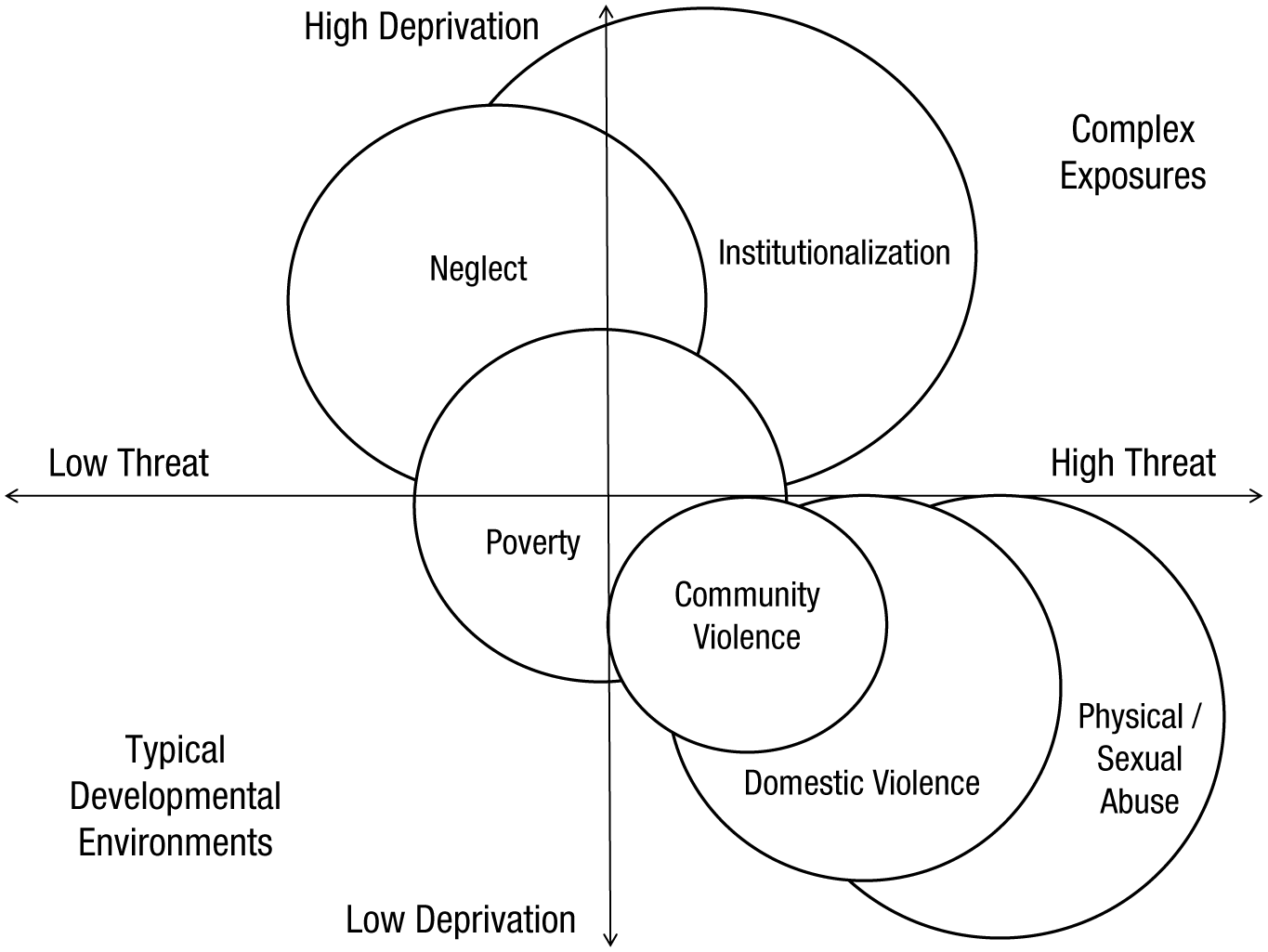
A dimensional model of childhood adversity involving two central dimensions of threat and deprivation. Examples of commonly studied forms of adversity are placed along these dimensions based on the degree to which each experience typically involves threat and deprivation. Larger circles indicate greater variance in the degree to which the experience reflects the underlying dimension.
Rather than counting the total number of adversities, our approach assesses the frequency and severity of experiences reflecting each dimension and examines them simultaneously in predicting developmental outcomes. This approach retains many benefits of cumulative risk and provides additional advantages. Most notably, it can identify developmental mechanisms that are specific to certain dimensions of adversity and not others and determine whether such mechanisms vary in relation to severity of exposure.
Beyond stress: The importance of learning
Our model focuses on the central role of learning in explaining myriad developmental consequences of adversity not fully accounted for by stress pathways. Learning is a central process through which the environment shapes emotion, cognition, and behavior. Emerging research shows that learning processes are influenced by childhood adversity, that at least some of these associations vary across types of adversity, and that disruptions in learning are a mechanism in the link between adversity and developmental outcomes.
Emotional-learning processes, including fear and reward learning, are particularly important mechanisms in this regard. Associative-learning processes detect environmental cues associated with threat and reward and shape emotion, behavior, and neurobiological responses to those cues. Fear-learning processes rapidly detect potential threats and mobilize resources to respond (Delgado, Olsson, & Phelps, 2006). These processes govern acquisition of fear responses to stimuli associated with threat, extinction of fear following repeated stimulus encounters in the absence of threat, and competition between fear and extinction memories based on context. Reward-learning processes track the probability and magnitude of rewards associated with particular cues and influence feelings of pleasure during the anticipation and receipt of rewards as well as actions toward future rewards (Berridge & Kringelbach, 2008).
These forms of learning share basic neurobiological pathways with other associative learning processes such as pattern learning. Pattern learning refers to the detection of regularities in the environment when these regularities are not linked with rewards or punishments (e.g., that cue A always follows cue B). Pattern learning plays a central role in language acquisition and expertise (Romberg & Saffran, 2010; Spencer, Kaschak, Jones, & Lonigan, 2015).
Higher-order learning processes such as long-term memory and executive functions are also important candidate mechanisms explaining downstream consequences of adversity. In contrast to associative learning, which involves automatic processes present from early in development, long-term memory and executive functions are explicit learning skills for which effort and strategy can be employed to improve performance and that develop throughout childhood and adolescence.
Childhood adversity influences learning
Accumulating evidence shows that childhood adversity influences learning and that disruptions in learning processes are associated with downstream developmental outcomes, including psychopathology.
Exposure to threat is a core dimension of our model. We argue that disruptions in fear learning are an important mechanism through which threatening environments influence later development. Recent findings from our labs are consistent with this prediction, showing atypical fear conditioning among children who experienced environmental threats, including abuse and domestic violence. Children exposed to threat demonstrate poor discrimination of threat and safety cues during fear conditioning (McLaughlin et al., 2016). Whereas children without adversity exposure exhibit stronger fear responses to a stimulus paired with threat compared to one paired with safety, children exposed to threat exhibit fear responses of similar magnitude to threat and safety cues (McLaughlin et al., 2016), reflecting either generalization of fear to the safety cue or a generalized problem with associative learning. This pattern is specific to threat exposure, is not observed following deprivation, and explains the association of threat exposure with externalizing psychopathology.
Atypical reward learning has also been observed in children exposed to adversity, particularly those who experienced deprivation. In reward-learning tasks, typically developing children are faster and more accurate in responding to cues associated with high reward; children raised in deprived institutional settings fail to show this pattern (Sheridan, McLaughlin, Fox, Zeanah, & Nelson, under review). Disruptions in the neural circuitry that supports reward learning have been found in institutionally reared children (Mehta et al., 2010) and in adolescents who experienced neglect (Hanson, Hariri, & Williamson, 2015). It is possible that disruptions in reward learning emerge after other forms of adversity. Atypical reward learning and atypical neural responses to rewards have been found following child maltreatment (Dillon et al., 2009; Guyer et al., 2006). Because these studies did not distinguish between abuse and neglect, however, it is unknown whether reward learning is influenced only by deprivation or also by threat. Across studies, disruptions in reward processing and underlying neural circuitry have explained the link between deprivation and depression (Hanson et al., 2015; Sheridan et al., 2015).
Finally, disturbances in pattern learning, language, and executive functions have been found in children exposed to deprivation. Deficits in language and executive functions have been observed consistently among children raised in poverty (Noble, McCandliss, & Farah, 2007) and in deprived institutional settings (Tibu et al., 2016; Windsor et al., 2011). These deficits explain the link between institutional rearing and attention-deficit/hyperactivity disorder (Tibu et al., 2016). Emerging evidence suggests that deprivation might also influence pattern learning (Sheridan et al., 2015) and long-term memory (Sheridan, How, Araujo, Schamberg, & Nelson, 2013), although greater work is needed in these areas.
Implications for intervention
What does a learning perspective provide that stress models do not? Perhaps the most important advantage is that it provides clear targets for intervention. Behavioral interventions directly targeting emotional learning have been developed, evaluated, and refined for decades. These intervention techniques form the backbone of most empirically supported psychosocial treatments for anxiety, depression, behavior problems, and substance abuse in youth (Chorpita & Daleiden, 2009). For example, exposure-based interventions for anxiety facilitate extinction learning when that process does not occur naturally (Waters & Pine, 2016). Behavioral activation for depression aims to increase motivation for reward through repeated engagement in pleasurable activities. Behavioral interventions thus target the precise learning mechanisms that appear to be disrupted following childhood adversity. The development of interventions to improve memory and executive functions is a burgeoning area of research (Shipstead, Redick, & Engle, 2012).
Although behavioral interventions are effective in treating psychopathology, little research has examined their utility in preventing the onset of psychopathology in children who have experienced adversity. However, a recent study highlights the promise of behavioral interventions in this regard. A brief intervention providing behavioral-skill training to children who experienced traumatic violence prevented the onset of posttraumatic stress disorder and anxiety 3 months later (Berkowitz, Stover, & Marans, 2011). Greater research on the efficacy of brief behavioral interventions in preventing psychopathology following childhood adversity represents a critical next step for the field.
Conclusion
There is little debate about the pervasive detrimental influence of childhood adversity on developmental outcomes. Similarly, broad consensus exists about the importance of developing effective interventions to prevent the downstream consequences of adversity. Although the prevailing cumulative-risk approach is useful for identifying children in need of intervention, it has done little to shed light on how to intervene. A dimensional approach focused on examining how specific types of adversity influence learning and other mechanisms may hold greater promise in this regard. This approach is likely to reveal that some mechanisms are common across multiple dimensions of adversity and some are unique to particular experiences. Identifying these mechanisms and their specificity to particular forms of adversity will be critical for informing the development of efficient, effective interventions to prevent the negative developmental consequences of childhood adversity.
Footnotes
Declaration of Conflicting Interests
The authors declared that they had no conflicts of interest with respect to their authorship or the publication of this article.
Funding
This research was supported by National Institutes of Health Grants R01-MH103291 and R01-MH106482, an International Mental Health Research Organization Rising Star Award, and an Early Career Research Fellowship from the Jacobs Foundation to Katie A. McLaughlin.