




Abstract
This article reviews the Electronically Activated Recorder (EAR) as an ambulatory ecological momentary assessment tool for the real-world observation of daily behavior. Technically, the EAR is an audio recorder that intermittently records snippets of ambient sounds while participants go about their lives. Conceptually, it is a naturalistic observation method that yields an acoustic log of a person’s day as it unfolds. The power of the EAR lies in unobtrusively collecting authentic real-life observational data. In preserving a high degree of naturalism at the level of the raw recordings, it resembles ethnographic methods; through its sampling and coding, it enables larger empirical studies. This article provides an overview of the EAR method; reviews its validity, utility, and limitations; and discusses it in the context of current developments in ambulatory assessment, specifically the emerging field of mobile sensing.
Keywords
Laypersons often think of psychologists as professional people watchers. It is ironic, then, that naturalistic observation, as a methodology, has a remarkably thin history in our field (Funder, 2009). In contrast to ethologists (and researchers working with infants), psychologists are in the privileged position to be able to obtain valuable data by simply questioning their subjects (Rozin, 2001). At the same time, there are clear limitations to what self-reports can assess. Experience sampling—also known as ambulatory assessment and ecological momentary assessment—was developed to address concerns around global and retrospective self-reports and constitutes the effective gold standard for measuring psychosocial factors in daily life (Bolger & Laurenceau, 2013; Reis & Gosling, 2010; Smyth & Stone, 2003; Trull & Ebner-Priemer, 2014). Yet the psychological scientist’s tool kit also needs a method to directly observe human behavior in daily life. Just as experience sampling brings self-report data collection to where moment-to-moment experiences naturally happen, naturalistic observation can bring behavioral data collection to where moment-to-moment behavior naturally happens.
What Is the EAR Method?
As an ecological behavioral observation method, the Electronically Activated Recorder (EAR) seeks to accomplish that (Mehl, Pennebaker, Crow, Dabbs, & Price, 2001; Mehl, Robbins, & Deters, 2012). Technically, it is a portable audio recorder that intermittently records ambient sound bites. Participants wear it while going about their days, unaware of when exactly the device is recording. By tracking the ambient sounds of their lives, the EAR yields acoustic logs of their days. In preserving a high degree of naturalism at the level of the raw data, it resembles ethnographic methods. Through its sampling, it protects privacy and enables large(r) empirical studies. The sampled recordings are transcribed and coded for aspects of participants’ momentary location, activities, interactions, and affect expressions. Since my initial development of the EAR in 1999 with James Pennebaker, it has evolved from a chip-triggered microcassette recorder into a smartphone app (Fig. 1). Currently, we are using a fourth-generation “iEAR” system that runs on iOS; an Android version will be available in 2017.
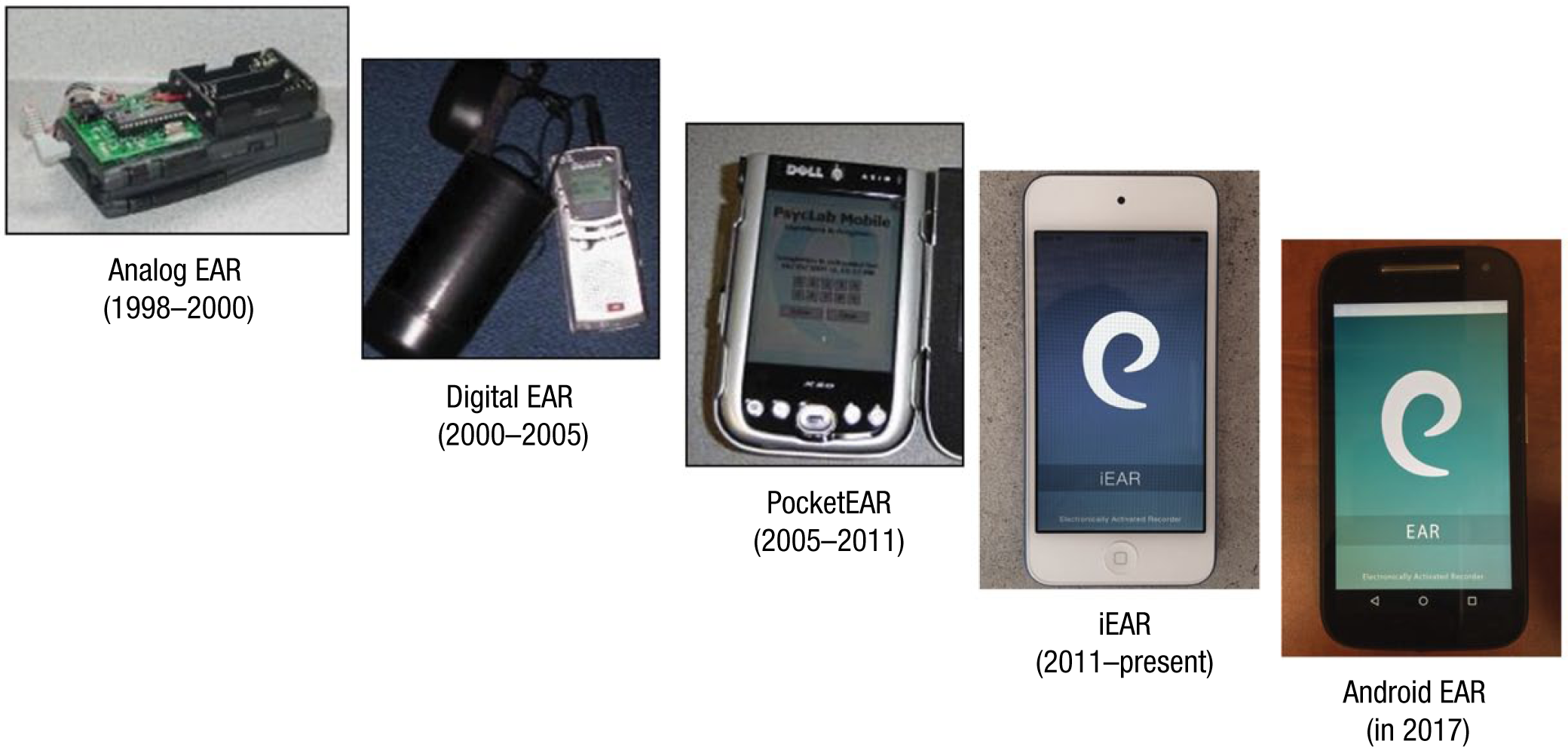
The evolution of the Electronically Activated Recorder (EAR).
Wearing the EAR is minimally bothersome (although it currently still requires carrying an extra mobile device), and it has been successfully used, with good acceptance and compliance, in age groups ranging from childhood to old age (3 years to 93 years; Alisic, Barrett, Bowles, Conroy, & Mehl, 2015; Bollich et al., 2016) and with different healthy (Holleran, Whitehead, Schmader, & Mehl, 2011; Slatcher & Robles, 2012) and clinical (Baddeley, Pennebaker, & Beevers, 2013; Brown, Tragesser, Tomko, Mehl, & Trull, 2014; Tobin et al., 2015) populations. Practical recommendations for how to use the EAR, including information about existing coding systems, are available at Megan Robbins’s Open Science Foundation (OSF) EAR Repository (https://osf.io/n2ufd/).
What Are Ethical Considerations Around Sampling Ambient Sounds?
Recording ambient sounds raises ethical and legal concerns. EAR studies generally implement several safeguards to protect the privacy of participants and conversation partners. First, the audio sampling limits the net recording to a small fraction of the day (e.g., 5% when sampling 30 seconds every 12 minutes). Second, the short recordings (e.g., 30 or 50 seconds) ensure that minimal personal information is captured beyond what is necessary for reliable coding. Third, participants can review their recordings and censor any they wish to remain private. Fourth, a “warning triangle” is placed visibly on the EAR device to alert conversation partners of the possibility of being recorded. Finally, most EAR studies in the United States are covered by a National Institutes of Health Certificate of Confidentiality to protect the data against forced third-party disclosure. The iEAR app further has an optional privacy button that can guarantee a prespecified period of nonrecording and an optional pitch transformation that renders voices unidentifiable prior to storing the audio. With these safeguards, EAR studies have been approved by various ethics committees.
What Research Speaks to the EAR’s Validity and Utility for Studying Daily Life?
Because of the paucity of naturalistic observation research in psychology, our initial research focused on the psychometrics of EAR-assessed behavior. In a series of studies, we used the method to show (a) that a broad spectrum of daily behaviors can be assessed reliably and with low levels of reactivity from the sampled ambient sounds (Mehl & Holleran, 2007), (b) that these behaviors show large between-person variability and good temporal stability (Mehl & Pennebaker, 2003), and (c) that they have good convergent validity with theoretically related measures such as the Big Five (Mehl, Gosling, & Pennebaker, 2006) and narcissism (Holtzman, Vazire, & Mehl, 2010).
The next studies, then, were aimed at clarifying the method’s utility and added value relative to existing methods. From this, three concrete ways have emerged in which naturalistic observation with a method such as the EAR can enrich psychological science.
It can provide ecological, behavioral criteria that are independent of self-report
In psychology, measuring behavioral “ground truth” is a vexing issue. Self-knowledge research struggles to measure self-insight without relying on self-reports of both self-perceptions and actual reality. Health research struggles to empirically tease apart the important conceptual distinctions between loneliness and social isolation and between perceived support and provided support. Morality research struggles to assess moral actions isolated from moral intentions. When it is critical to assess behavior ecologically and without self-report, the EAR can help achieve this.
For example, Vazire and Mehl (2008) tested the accuracy of self- and peer reports by comparing the predictive validity of participants’ self-ratings of daily behaviors (e.g., talking on the phone, laughing, watching TV) to similar ratings obtained from friends. The frequency with which the EAR captured participants engaging in these behaviors served as the accuracy criterion. Self- and peer ratings showed comparable validity but also uniquely predicted certain behaviors. Importantly, to avoid giving one perspective an undue predictive advantage, shared method variance with both had to be minimized. The EAR-derived behavior counts sought to accomplish this. Similarly, Ramirez-Esparza, Mehl, Alvarez-Bermudez, and Pennebaker (2009) studied Americans’ and Mexicans’ sociability and found that although American participants reported being more talkative than their Mexican counterparts, they talked significantly and substantially less—almost 20% less—in their daily conversations. Finally, Tobin and colleagues (2015) found that an EAR measure of family conflict predicted youth asthma symptoms over and above a diary measure of negative family interactions, suggesting that the method may capture unique variance particularly with evaluative behaviors (Bollich et al., 2016).
It can help study psychologically important subtle and habitual behaviors
In everyday life, many subtle and habitual behaviors do not pass the threshold of conscious recognition. For example, sighs or laughs and automatic aspects of language use such as pronouns or prepositions are often not consciously noticed and therefore inaccessible to self-report. Therefore, the study of these more elusive—yet psychologically nontrivial—aspects of our social lives can be enriched through naturalistic observation approaches such as the EAR.
For example, in one study, arthritis patients wore the EAR and completed measures of depression and physical symptoms (Robbins, Mehl, Holleran, & Kasle, 2011). Incidents of sighing were coded from the recorded sounds. Consistent with the idea that sighing can be more indicative of depression than of pain, sighing was more strongly related to patients’ depressive symptoms than to their experienced pain and flare days. In another study, arthritis and breast cancer patients wore the EAR to track their natural language use (Robbins et al., 2011). Information on how much participants were swearing was derived from automatic text analysis. Consistent with the idea that swearing can undermine support at the expense of psychological adjustment, swearing in the presence of others was related to decreases in emotional support and increases in depressive symptoms over time. Together, these findings suggest that naturalistic observation can help with studying subtle and automatic health behaviors that “fly below the radar” of self-report.
It can help calibrate psychological effects against frequencies of real-world behavior
Most measures in psychology use arbitrary metrics, which renders effect interpretations difficult. A better understanding of effect sizes can be obtained through the calibration of psychological effects against real-world behaviors (Sechrest, McKnight, & McKnight, 1996). The EAR’s binary coding (behavior present vs. absent) yields a non-arbitrary and intuitively meaningful metric, act-frequencies of daily behavior (e.g., a participant was talking in 40% of the recordings or for an estimated 40% of her wake time), and can thereby help make abstract effect sizes graspable.
In one study, for example, we found that greater well-being was related to having less small talk and more substantive conversations (Mehl, Vazire, Holleran, & Clark, 2010). The effect sizes showed that relative to the unhappiest participants in the sample (–2 SD), the happiest participants in the sample (+2.0 SD) had roughly twice as many substantive conversations (45.9% vs. 21.8%), r = −.33, and one-third of the small talk (10.2% vs. 28.3%), r = .31. Whereas the happiest participants had about four substantive interactions for every instance of small talk, the unhappiest ones sadly engaged in more small talk than substantive conversations. In another study, testing whether women are indeed much more verbose than men, we estimated that both men and women used about 16,000 words per day (Mehl, Vazire, Ramirez-Esparza, Slatcher, & Pennebaker, 2007). A gender difference of 546 words compared to a range of 46,000 words between the least and most talkative participant (695 vs. 47,016) illustrates the (trivial) effect size—and speaks powerfully to the magnitude of individual differences.
To summarize, naturalistic observation with a method such as the EAR occupies a methodological niche; it is not for everyone and everything. It is labor-intensive and thus requires careful consideration as to when it should be used instead of more economic methods. However, in providing ecological behavioral data that (a) are independent of self-report, (b) can capture subtle and automatic aspects of behavior, and (c) come in a non-arbitrary, highly intuitive, and real-world-relevant metric, it can yield valuable findings that are difficult to obtain otherwise, and it can in that way contribute to psychology as a strong behavioral science.
How Does the EAR Compare to Other Methods for Studying Daily Life?
As a method for studying daily life (Mehl & Conner, 2012), the EAR compares most directly to the highly established and widely used experience-sampling method (ESM). On the other hand, it can also be compared to emergent mobile-sensing methods (MSM) that use ubiquitous mobile devices, smartphones, and wearable technology to collect real-world behavior data via embedded sensor and interaction logs (Harari et al., 2016). Table 1 identifies similarities and differences between these methods. A comprehensive discussion can be found in Alisic et al. (2015) and Wrzus and Mehl (2015).
A Comparison of the Electronically Activated Recorder (EAR) Method With Related Methods for Studying Daily Life
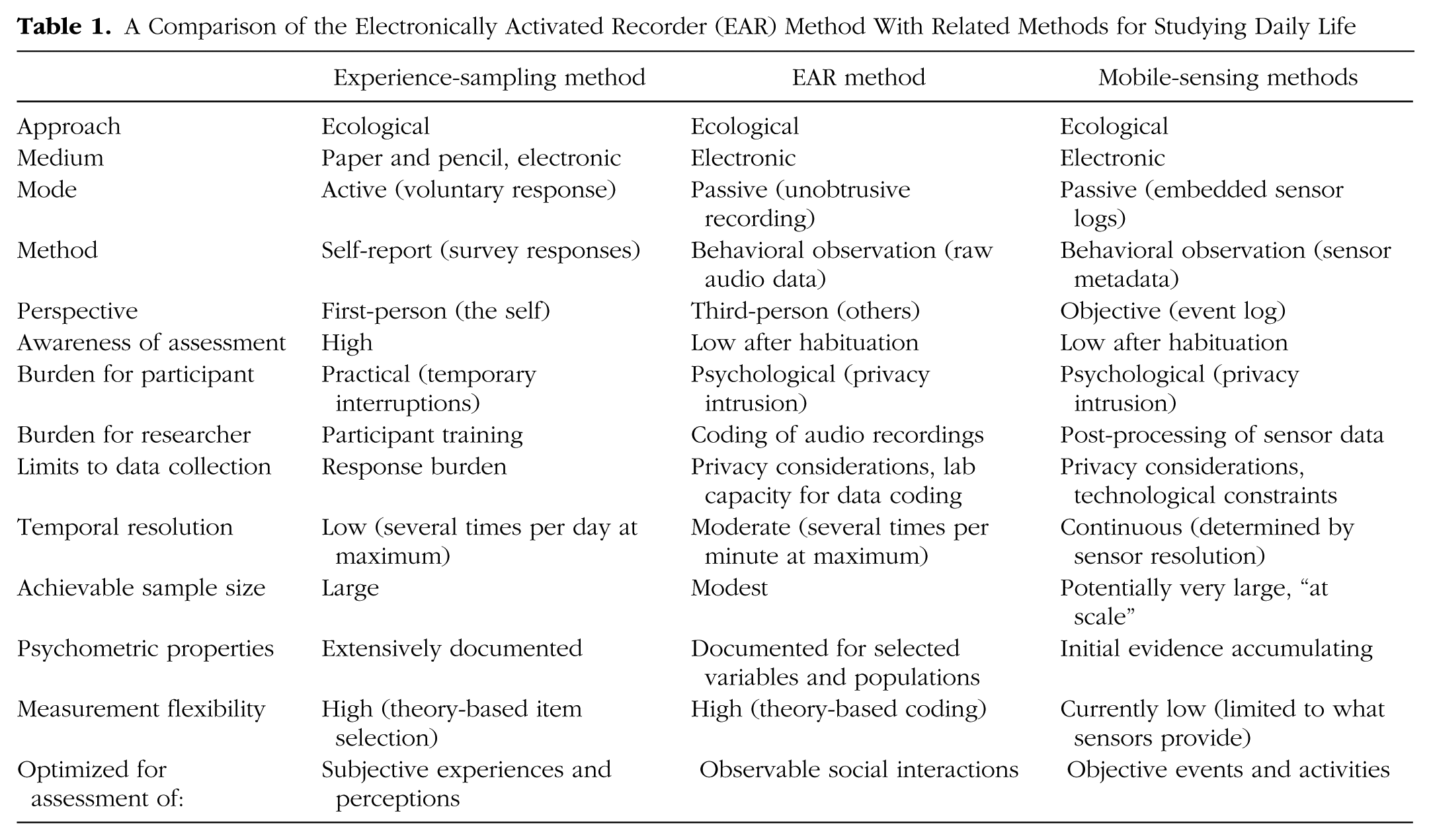
All three methods pursue an ecological approach. The most important conceptual difference between them lies in the fact that ESM is based on momentary self-reports whereas the EAR and MSM are based on momentary acoustic and sensor-based observations, respectively. They hence provide different assessment perspectives: ESM adopts the first-person perspective of the self, the EAR the third-person perspective of an observing bystander, and MSM an objective observational account derived from event log histories.
Whereas ESM requires an active user response, assessment happens passively and, after a habituation period, usually with low awareness with the EAR and MSM. This has implications for the temporal resolution that the methods can achieve. Whereas ESM is practically limited to around a dozen prompts per day, MSM allows (pseudo-)continuous tracking, with the EAR falling in between with its sampling rate of five to 10 recordings per hour. Because data are collected digitally in (electronic) ESM and MSM, they allow for larger sample sizes relative to the EAR, which requires manual coding. The psychometric properties of ESM have been extensively studied and are well documented. Adequate psychometric information exists for the EAR for selected variables and populations, but more evidence is needed, particularly with respect to the reliably of within-person variance. The psychometric properties of MSM are understudied, but initial evidence is emerging (Harari et al., 2016).
Additionally, a critical difference emerges with respect to measurement flexibility. Both ESM and the EAR can measure a range of constructs specifically and precisely through careful item selection or coding-category definition. With MSM, researchers are limited to those (few) psychological variables that can currently be extracted from sensor streams (e.g., physical activity from accelerometer; geographic location from GPS). Therefore, ESM and the EAR allow for the typical research approach in which measurement follows from theory, whereas MSM presently requires an inverse approach in which theory, or what can be studied, follows feasible measurement.
Taken together, the conceptual differences between the three methods suggest differential optimal domains of assessments. In capturing the agent’s first-person or “insider” perspective, ESM is optimized for assessing subjective experiences and perceptions (e.g., thoughts, feelings). In contrast, in capturing a third-person or “outsider” perspective, the EAR is optimized for assessing audible aspects of social interactions (e.g., verbal and paraverbal communication behavior). MSM, finally, through its use of smartphone and wearable-sensor logs, is optimized for the assessment of objective events and activities (e.g., space use, social media use).
The Future of the EAR as an Observational Ambulatory Assessment Method
Over the last 10 years, a mobile-device revolution has unfolded. The diffusion of smartphones into all pores of our lives has opened up powerful ways to assess objective daily-life information (Miller, 2012). As our social lives are increasingly digitally encoded in smartphones and wearables, MSM is “graduating” from early feasibility studies in computer science and engineering and is getting ready for mature large-scale implementation in psychology (Harari et al., 2016; Sandstrom, Lathia, Mascolo, & Rentfrow, 2016; Schmid Mast, Gatica-Perez, Frauendorfer, Nguyen, & Choudhury, 2015). The question at the EAR’s methodological coming of age then becomes what will happen to it in the future. Will it become obsolete as mobile-sensing platforms become more robust, validated, and researcher friendly? Will it “move in” with other ambulatory assessment methods—for example, in the form of a multimodal mobile research platform that merges experience, behavior, and location sampling? Or will it continue to exist and mature as a stand-alone naturalistic observation method?
My prediction is that it will likely live aspects of all three scenarios. Mobile sensing combined with the powers of behavioral signal processing will ultimately render the assessment of at least some behaviors automatic. Further, researchers have already begun incorporating elements of the EAR into their ambulatory assessment systems (e.g., a custom-made, battery-efficient wearable for the long-term tracking of ambient audio and GPS information and an experience-sampling platform that allows for time- or event-contingent audio recordings). From a practical perspective, an integrated, open-source multimodal ambulatory assessment system, akin to the legendary Experience Sampling Program (Barrett & Barrett, 2001), would seem to be an asset for the field. Finally, for the foreseeable future, there will likely continue to be a need for a stand-alone measurement tool that, along with other naturalistic observation tools such as wearable cameras (Doherty et al., 2013; Wettstein & Scherzinger, 2015), enables psychologists to indeed be professional people watchers and observers of human behavior.
Footnotes
Acknowledgements
The author thanks the graduate, postdoctoral, and visiting students of the Naturalistic Observation of Social Interactions (NOSI) lab, the research assistants who coded and transcribed the EAR data, and the participants who shared the sounds of their personal daily lives.
Declaration of Conflicting Interests
The author declared no conflicts of interest with respect to the authorship or the publication of this article.
Funding
This work was supported by National Institutes of Health Grants R03CA137975, R21HD078778, 3R01AT004698, 5R01AT004698, R01HD069498, R01MH105379, and R01MH108641 and by a grant from the Wake Forest University Character Project funded by the John Templeton Foundation.