




Abstract
Authenticity is a central concern in the evaluation of cultural products. But why do people judge some cultural products as more authentic than others? We provide a psychological explanation centered on the judgment of authenticity as a “truth-seeking” process. Observers evaluate whether the perceivable features of the cultural product truthfully capture cultural knowledge as well as the inferred agency control and intentionality of the producer as a conveyer of cultural knowledge. We argue that while no cultural product is inherently authentic, individuals rely on the same psychological processes when judging cultural products’ authenticity. We discuss how our approach applies to any cultural product, including art, architecture, cuisine, tourism, and sports.
A foreign tourist walks through the streets of Naples in search of the most authentic pizza. She reads a tour guide that explains how authentic pizza must possess only four ingredients and recommends a pizzeria that follows this rule. However, on arrival she sees a roomful of other foreign tourists, an English menu, and pizza-themed t-shirts for sale. Concerned about the pizzeria’s authenticity, she then seeks another pizzeria with no foreign patrons and no English on the menu. When she discovers an extensive list of pizza toppings, she begins to wonder again about the pizzeria’s authenticity but is reassured after a local patron vouches for its quality. She has made a judgment of authenticity, which she then uses to evaluate her meal.
The judgment of authenticity is a central concern in the evaluation of all cultural products, including art (Kreuzbauer, King, & Basu, 2015; Newman & Bloom, 2012; Phillips & Steiner, 1999), cuisine (Ebster & Guist, 2005), tourism (Cohen, 1988), and consumer goods (Grayson & Martinec, 2004; Kreuzbauer et al., 2015). But while there is wide recognition of authenticity’s importance, extent research has given scant attention to the psychological mechanisms underlying people’s own judgment of authenticity. Instead, researchers typically define authenticity as being “original” (e.g., Newman & Bloom, 2012) or being “true to the self or identity” (Vannini & Franzese, 2008). While these definitions provide a general conceptualization, judgments of authenticity are far more complex in practice (see Kreuzbauer et al., 2015, for a more detailed discussion). For example, a painting with an original motif created by a computer algorithm would be considered original but would unlikely be judged as authentic (see Kreuzbauer, 2016; Kreuzbauer et al., 2015). Meanwhile, the New York Public library and Beverly Hills mansions both have classical Greek-style columns. Although few people would believe that either building was from the ancient world, most people would likely judge the former as being more authentic than the latter.
So how do individuals judge authenticity? Recent research suggests that the judgment of authenticity is not a simple heuristic based on perceived originality or self-identity but an elaborate psychological process of “truth-seeking” (Grayson & Martinec, 2004; Kreuzbauer, 2002; Nöth, 1995). As we explain below, this includes an evaluation of whether the perceivable features of the cultural product truthfully capture a respective set of cultural knowledge as well as the inferred agency control and intentionality of the producer.
Some scholars have argued that judgments of authenticity are socially constructed interpretations of the object by the observer and not properties inherent to the object (Beverland, 2006; Grayson & Martinec, 2004; Rose & Wood, 2005). We agree that social and individual factors contribute to the observer’s judgment of authenticity, but we also recognize that there are underlying psychological processes involved in the judgment of authenticity that are consistent across individuals and populations of individuals. Therefore, there is nothing inherently authentic about a particular cultural product itself, but human beings tend to rely on the same psychological process when judging these products’ level of authenticity.
Our objective is to draw upon evidence from research about semiotics, anthropology, and recent work in experimental psychology to articulate a general psychological account of the judgment of authenticity of cultural products. Our approach can apply to any cultural product, including artwork, music, architecture, cuisine, tourism, and sports.
Judgments of authenticity as a psychological process of truth-seeking
Our account of authenticity is based on the premise that human beings have a natural ability to develop complex signs and sign-systems (e.g., Deacon, 1997). According to semiotic science (Grayson & Martinec, 2004; Kreuzbauer, 2002; Nöth, 1995, Peirce & Houser, 1998), a sign consists of a sign-vehicle and its related sign-object. The sign-vehicle (signifier) is the perceivable representation (e.g., portrait) and the sign-object (signified) is the entity or physical object (e.g., the person who has been depicted) that is represented. A judgment of authenticity is a psychological process where a perceiver determines whether a sign-vehicle truthfully represents its respective object (see the process model in Fig. 1). This representation can either be causal (indexicality: smoke to indicate fire) or based on a similarity relationship (iconicity: a portrait to represent the depicted person; Grayson & Martinec, 2004). For example, to determine whether a portrait (sign-vehicle) is an authentic representation of the depicted person (object), one engages in a psychological process of truth-seeking where a perceiver would, for example, compare the facial features from the portrait with the facial features from the real person. However, because cultural products are more complex signs that often represent multifaceted and abstract cultural entities, such simple feature comparisons are typically infeasible. Consequently, the process is supplemented with additional psychological procedures to examine the producer’s level of agency control and intentions.
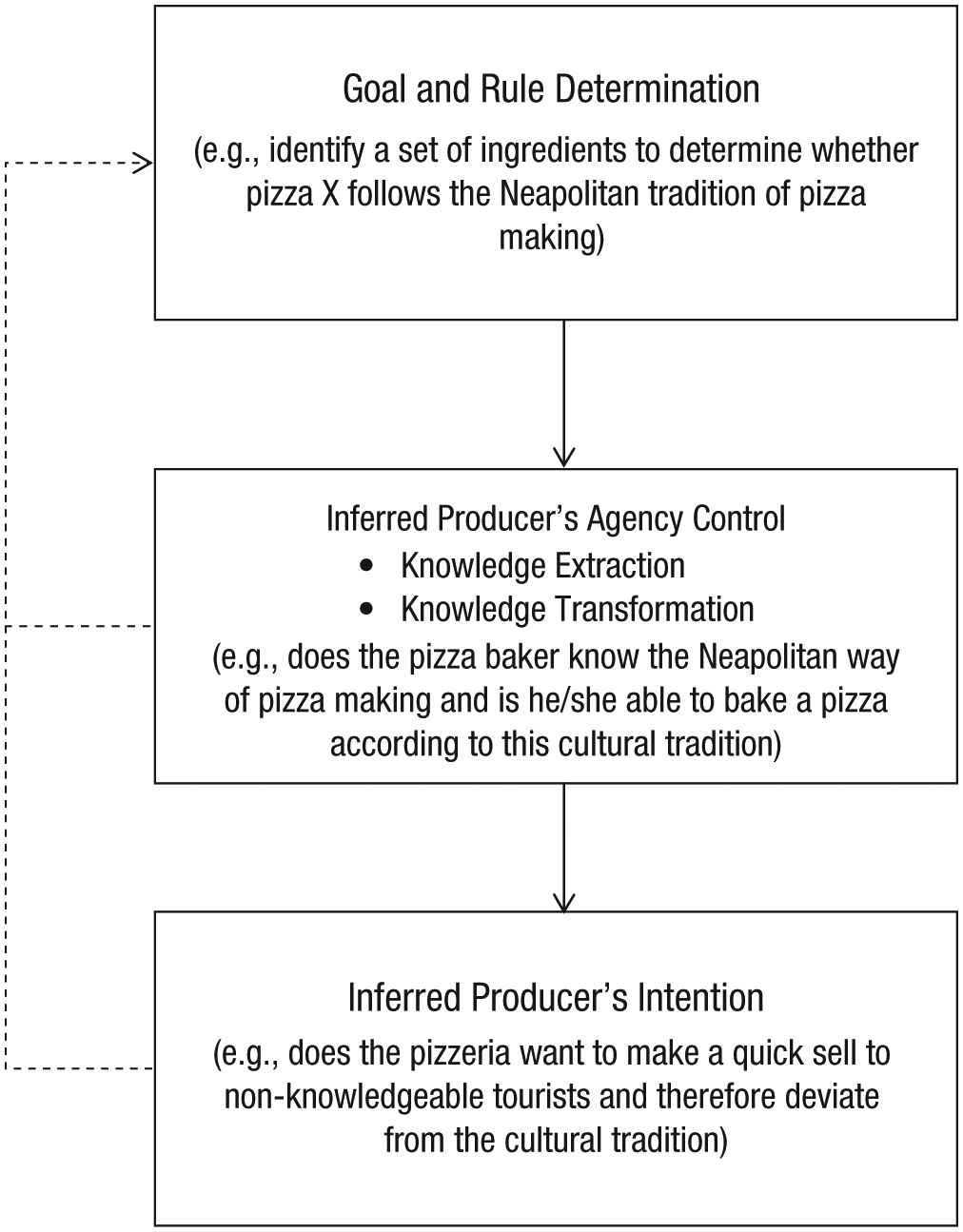
Process model of judgment of authenticity.
Determining the goal and rule for judging authenticity
What are these mechanisms? As we recall, the tourist in Naples described in the above example was inquiring about whether the pizza at a pizzeria was a true representation of the local pizza-making tradition. To find out, she could engage in a field study where she interviews a group of local pizza chefs, critics, or other people who might have rich cultural knowledge (e.g., grandmothers) about this tradition of food production. Subsequently she could identify some features of the pizza from the restaurant and compare them to information she received from the field study. The outcome would follow a typical categorization process (e.g., Barsalou, 1983; Medin & Atran, 2004) where the goal determines the rule for identifying relevant features to compare the sign-vehicle and the cultural entity. For example, the goal could be to determine whether the pizza and/or the pizzeria represent Neapolitan pizza making. Answering this question would require a rule-based comparison to identify certain ingredients (e.g., mozzarella cheese) or production procedures (e.g., wood-fire oven). This procedure would follow an iterative sequence, where the person may start with a first set of apparently relevant features (e.g., wheat flour, filtered water, fresh tomatoes, mozzarella cheese) and occasionally update them after further emersion into the local culture (e.g., learning new traditional wood-fire oven baking procedures).
Agency control over knowledge extraction and transformation
A problem, however, arises when this extensive search process is infeasible or economically taxing. Rather than an extensive first-hand search, individuals may instead try to gain further clarity by making subsequent inferences about the producer. For example, as illustrated in our example of pizzerias in Naples, the tourist might begin to doubt the authenticity of pizza made at a pizzeria that is part of a chain and the operator of the chain outlet is simply following instructions and has no “true” knowledge of local Naples pizza-making culture. In fact, even if the tourist knew the chain operator had such knowledge, she might still doubt the pizza’s authenticity because the streamlined production procedure of a chain restaurant may prevent the transfer of knowledge into the making of the pizza.
The importance of agency control during judgments of authenticity has been extensively researched by Kreuzbauer et al. (2015) as well as Kreuzbauer (2016). As they have shown in their empirical studies, original artwork has a higher perceived value than identical copies because it more accurately represents the materialization of the artist’s expression during the moment of creation (e.g., when a painting was drawn). This is because when producing an original piece of art, the artist maintains agency control over the artist’s own expression. Originality, itself, does not affect judgment of authenticity. In fact, objects with design-motifs, which were designed by a computer algorithm, were perceived as less authentic, despite having equal levels of uniqueness and scarcity as artist-created motifs.
Perceived agency control can also explain the importance of production procedures for judgments of authenticity (Kreuzbauer, 2016; Kreuzbauer et al., 2015). Artworks made by hand or an analog procedure are often favored over those produced by automatic machinery or involving digital processing. This is due to the fact that the former procedures are more likely than the latter procedures to ensure agency control over the accurate transformation of cultural knowledge into the final product. For example, automation and digitalization often standardizes the final product and therefore “wipes out” the unique expression that the artist, designer, or craftsman intended to embody in the final product (Kreuzbauer, 2016). However, automatic and digital procedures can still enable agency control when an equal number of motifs are transformed into individual material end-objects on a one-to-one basis. For example, a series of five digitally printed art-objects representing five uniquely different art-motifs are still judged as authentic (Kreuzbauer, 2016).
Inferred producer’s intention
The judgment of authenticity is also based on the inferred intentions of the producer. Individuals want to know whether the producer has altered the product in a way that deviates from the producer’s original expression to manipulate the audience or placate social expectations. For example, pizzerias that cater to tourists are more likely to be perceived as inauthentic because the patron is more likely to infer from the presence of tourists that the pizzeria owner either wants to change the recipe to be more palatable to tourists’ tastes to earn more money or to simply be nice to foreign guests. Such inferences about the producer’s intention (see Tomasello, Carpenter, Call, Behne & Moll, 2005) are not always easy to make when certain sign-vehicles can be referred to different sign-objects. For example, neither an ancient Greek-style Beverly Hills mansion nor an ancient Greek-style public library were built during antiquity. Yet unlike the Beverly Hills mansion, American observers of the public library may see the ancient Greek features of the building as a symbol of democracy and judge the building as authentic because they infer that the producer of the library wanted to incorporate democratic symbols.
Finally, because of the uncertainty involved in making inferences, perceivers often defer their judgment of agency or intentionality to others. For example, in one study, Kreuzbauer and Huang (2014) asked lay people to rate designs for the reconstruction of a culturally iconic building that had been destroyed during a war. The results showed that most people preferred the reconstructed building to have the same design as the original over a contemporary design or a hybrid between the two. However, these differences disappeared when they were told the design was proposed by a panel of experts.
Conclusion
As we have described above, judgments of authenticity of cultural products are fundamental psychological judgments to determine whether a cultural product’s sign-vehicle truthfully represents its respective sign-object. As illustrated in Figure 1, observers first try to judge the similarity between features of the sign-vehicle and the object. If uncertain, observers continue making inferences about the producer’s agency control over knowledge extraction and transformation as well as the producer’s intention to honestly signal cultural knowledge through the sign. The process is iterative, because during every stage, observers update their judgment process. For example, the tourist might first believe that ingredients are most important but then notice that production procedures are more relevant and thus begin comparing features related to production.
Our emphasis on the inferred agency control and intentionality of the producer in the judgment of authenticity of cultural products suggests new avenues for future research on the underlying psychological mechanisms that guide individuals’ relationship to cultural products. For example, previous research has found that cultural symbols can invoke emotional attachments to those who identify with the culture (Hong, Fang, Yang, & Phua, 2013; Yap, Christopoulos, & Hong, 2017). Future research can explore how the iconicity of cultural products (e.g., a pizza as a representation of Napoli culture) triggers emotional attachment and how the emotional attachment is contingent on the inferred agency control and intentionality of the producer. Previous research also points to cultural products as critical tools of cultural learning, as they convey knowledge of both instrumental action and cultural convention (Legare & Harris, 2016; Phillips, Seston, & Kelemen, 2012; Tomasello, 2016), such as a mug that conveys knowledge of liquid capturing and ceramic design. Future research can explore how the knowledge that the observer acquires depends on the inferred agency control and instrumentality of the producer as well as the observer’s attention to instrumental or conventional aspects of the product.
Finally, cultural evolutionary theories suggest that cultural products serve as instruments of cultural knowledge transfer across generations (Henrich, 2015; Sterelny, 2012). Because of the consistency in the psychological mechanisms used to assess cultural products, our understanding of judgments of authenticity may help illuminate how cultural knowledge is reliably transferred from one generation to the next.
Footnotes
Acknowledgements
Both authors equally contributed to this work.
Declaration of Conflicting Interests
The authors declared that they had no conflicts of interest with respect to their authorship or the publication of this article.