



Abstract
Although it is easy to assume that the psychology of parental care pertains only to parents and their children, this is not so. An emerging body of research on the parental care motivational system reveals implications for everyone. All normally developing human beings are characterized by evolved psychological mechanisms that regulate parental caregiving. These mechanisms are responsive to superficial cues and so (among nonparents as well as parents) can be triggered by the perception of young children or other childlike things. Once activated, these mechanisms precipitate protective and nurturant responses. These responses manifest in many different ways, with implications for a wide range of psychological phenomena (many of which might appear, superficially, to be unrelated to caregiving)—including risk-averse attitudes, aggression, intergroup prejudice, moral judgment, impression formation, and mate preferences. This article provides an illustrative overview of empirical research documenting these implications and identifies new directions for future research on the motivational psychology of parental care.
In his pioneering textbook on social psychology, William McDougall (1908) devoted dozens of pages to the “parental instinct” and speculated broadly about its many implications. These included not only obvious implications for parent–child interactions but also implications that transcend the family context entirely. McDougall wrote that the parental instinct “is the source, not only of parental tenderness, but of all tender emotions and truly benevolent impulses, is the great spring of moral indignation, and enters in some degree into every sentiment that can properly be called love” (McDougall, 1908, p. 275).
Since then, an extensive empirical literature on parenting has accumulated (e.g., Bornstein, 2002). That literature focuses on the subset of people who are actually parents and on their interactions with their children. Indeed, it might be easy to assume that the psychology of parental care pertains only to parents and to their children. That assumption would be wrong. There is an emerging body of research that draws on the conceptual principles that informed McDougall’s analysis over a century ago and reveals evidence consistent with his speculations about wide-ranging implications. This new body of research focuses not on parenting per se but instead on underlying psychological mechanisms that form a kind of parental care motivational system. This article provides an overview of this motivational system and its many implications—not just for parents and their children but for everyone.
The Parental Care Motivational System
The concept of a parental care motivational system follows from an evolutionary perspective on human motivation. Within an evolutionary framework, motivation refers not simply to subjective experiences (e.g., needs or goals) but instead to underlying regulatory systems—suites of mechanisms that evolved to regulate specific kinds of behavioral responses that, in ancestral populations, had implications for genetic reproduction (Schaller, Kenrick, Neel, & Neuberg, 2017; Tooby, Cosmides, Sell, Lieberman, & Sznycer, 2008). Some motivational mechanisms regulate responses that had implications for survival; other motivational mechanisms regulate responses that had implications for mating and the consequent production of offspring. But the mere production of offspring would have been a reproductive dead end unless those offspring survived to maturity and consequently produced offspring of their own. This is a nontrivial reproductive problem because humans are slow to mature to reproductive age. It is for this reason, it appears, that specific psychological mechanisms evolved to regulate parental caregiving behaviors (Geary, 2016; Preston, 2013; Rilling, 2013). These parental behaviors include protective responses that helped offspring to survive and additional nurturant responses that helped offspring to thrive.
If indeed a regulatory system of this sort evolved, then it must be considered part of a genetically endowed human nature. In other words, the parental care motivational system is not exclusive to people who actually are parents; its physiological bases—and psychological manifestations—would be expected to characterize all normally developing human beings.
Specific motivational systems are typically associated with specific emotional experiences (Beall & Tracy, 2017), and the parental care system is no exception. McDougall (1908) identified the characteristic emotion as tenderness. Empirical research suggests that tenderness is distinct from superficially similar affective experiences (e.g., empathy) and has many of the characteristics of a “basic” emotion (Kalawski, 2010).
Additionally, as with other evolved motivational systems, activation of the parental care system—as indicated by the arousal of tenderness and associated behavioral responses—is stimulated by the perception of functionally relevant things. Among parents, the most obvious such things are one’s own actual offspring. But other things can activate the system, too. Inferences about functional relevance are highly automatized and are often made on the basis of superficial cues. The parental care motivational system is responsive to superficial cues that are diagnostic of infancy—such as big eyes, small noses, and other babyish facial features that Lorenz (1943) referred to collectively as kindchenschema. Consequently—among parents and nonparents alike—the parental care system can be triggered by the perception of any young child (especially one who is subjectively perceived to be cuter; Glocker et al., 2009). It can also be triggered by the perception of juvenile nonhuman animals, such as kittens and puppies (Sherman, Haidt, & Coan, 2009), and even by the perception of baby-faced adults (Zebrowitz & Montepare, 2008).
Once activated, the parental care motivational system regulates behavioral responses toward the stimulus that triggered its activation. This general principle has proven useful in research testing specific hypotheses about the implications of the parental care system (discussed more fully below). Additionally, people differ in the extent to which relevant stimuli actually trigger the system and elicit a parental response. These individual differences are readily measurable with self-report measures such as the Parental Care and Tenderness (PCAT) questionnaire, which includes subscales assessing conceptually distinct protective and nurturant responses (Buckels et al., 2015; Hofer, Buckels, White, Beall, & Schaller, 2017). Parents generally have higher PCAT scores than nonparents, and women have higher scores than men; but even within these demographic categories, there are substantial individual differences. These measurable individual differences provide a further tool for testing hypotheses about the implications of the parental care system.
Empirical Research Documenting Implications for Parents and Nonparents
An important function of parental caregiving is the protection of vulnerable children from sources of threat (e.g., predators, infectious diseases). It follows, therefore, that activation of the parental care motivational system may predict hypervigilance to potential threats and also predict risk-averse attitudes of various kinds.
Consistent with this reasoning is evidence that, compared with nonparents, parents perceive potentially menacing men to be more formidable and threatening (Fessler, Holbrook, Pollack, & Hahn-Holbrook, 2014). But even among parents, the system may be activated especially strongly under some circumstances—such as when children are perceptually present or when other contextual cues make one’s parental role especially salient. This implies predictable context-contingent variation in parents’ inclinations toward hypervigilance and risk aversion, and there is evidence that this is so. For instance, following an experimental manipulation that made their parental role temporarily salient, parents expressed greater aversion to risk and reduced trust in strangers (Eibach & Mock, 2011).
Among nonparents, too, there is evidence linking the parental care motivational system to cautious behavior and risk-averse attitudes. In one set of experiments (Sherman et al., 2009), nonparents were randomly assigned to two conditions. In one condition, they viewed photographs of cute kittens and puppies (stimuli that arouse a parental emotional response); in the other condition, they viewed photographs of mature cats and dogs (which are less likely to elicit a parental response). All participants subsequently performed a task requiring careful motor movements. Results revealed that participants who saw kittens and puppies performed the task more successfully, indicating that activation of the parental care system inhibits recklessness, even among nonparents. Results from another set of experiments revealed that when one’s role as a parental caregiver was temporarily salient, people—both parents and nonparents—expressed especially negative attitudes toward a potentially threatening out-group (Gilead & Liberman, 2014; see Fig. 1 for details on one of these experiments and its results).
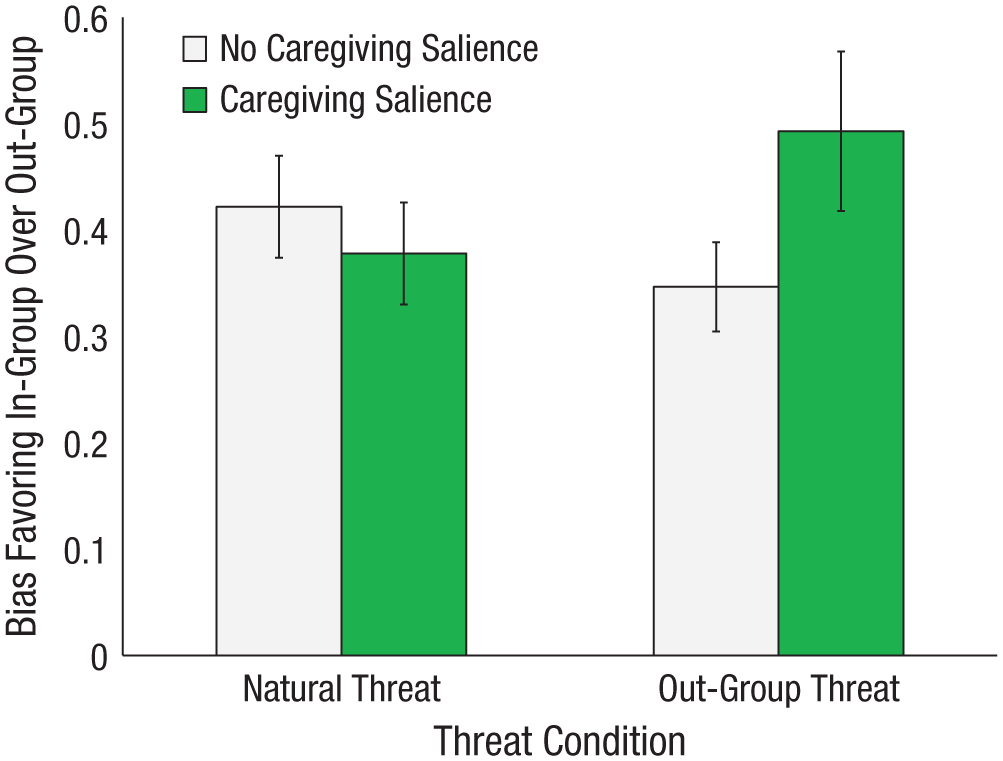
Results from a study in which 450 Americans—most of whom were nonparents—rated their prejudicial attitudes toward an ethnic out-group (Arab Americans). Mean ratings of prejudice are shown as a function of whether a threat was posed by the out-group or by a natural disaster and whether or not caregiving was made salient (i.e., the parental care motivational system had been activated). Results indicate that when an ethnic out-group is perceived to pose a threat, activation of the parental care system leads to increased prejudice. Error bars represent standard errors of the mean. (Figure based on results reported by Gilead & Liberman, 2014.)
These and other results (e.g., Hahn-Holbrook et al., 2011) suggest that while the parental care motivational system may indeed promote caring responses toward some things (including individuals’ own offspring; Preston, 2013), it also precipitates more aversive responses to other things (including other people) that are perceived to be a source of threat.
A conceptually analogous phenomenon occurs in the domain of moral judgment. Many behavioral norms mitigate dangers of various kinds, and so people who violate norms may be perceived to pose an indirect threat—not just to oneself but to offspring and to vulnerable children more generally. Therefore, just as activation of motivational systems regulating self-protective behavior can lead to harsher moral judgments of norm violations (e.g., Chapman & Anderson, 2014), activation of the parental care motivational system may also lead to harsher moral judgments. Results from multiple studies employing complementary methods indicate that this is so. When parents’ parental role was temporarily salient, they judged norm violations more harshly (Eibach, Libby, & Ehrlinger, 2009). When nonparents temporarily adopted a parental caregiving role, they too judged norm violations more harshly (Hofer, 2015). Additionally, nonparents who scored higher on a trait measure of parental care and tenderness (the PCAT questionnaire) also judged norm violations more harshly (Buckels et al., 2015). The latter effect held even when analyses controlled for conceptually related variables (e.g., empathic concern), indicating a unique effect of nonparents’ parental inclinations.
These findings provide empirical substantiation of McDougall’s (1908) suggestion that the parental instinct is “the great spring of moral indignation” (p. 275). But McDougall also observed that it is the source of “truly benevolent impulses.” It is with that observation in mind that it is important to note that the relation between PCAT scores and harsher moral judgments was specific to judgments about transgressions perpetrated by adults. When an identical transgression was perpetrated by a child, PCAT scores predicted more forgiving moral judgments instead, and whereas the former effect reflects an inclination to protect, the latter effect reflects an inclination to nurture (Hofer et al., 2017; for details, see Fig. 2).

Results from a study in which 410 adults—including both parents and nonparents—completed the Parental Care and Tenderness (PCAT) questionnaire, which consists of two subscales (Protection and Nurturance), and made moral judgments about transgressions perpetrated by either (a) adults or (b) children. The graphs depict moral judgments of participants who were low (–1 SD) and high (+1 SD) on each PCAT subscale. Analyses of effects for each PCAT subscale controlled for effects of the other PCAT subscale and for participants’ sex and parental status. Among other things, the results show that adults with a more parental disposition judged other adults’ transgressions more harshly, an effect entirely attributable to inclinations toward protectiveness; in contrast, more parental adults judged children’s transgressions less harshly, and this effect was entirely attributable to inclinations toward nurturance. (Figure based on results reported by Hofer, Buckels, White, Beall, & Schaller, 2017.)
Individual differences in activation of the parental care motivational system uniquely predict other social psychological phenomena, too. In the domain of close relationships, PCAT scores predict mate preferences, and these preferences are specific to one particular category of traits: More parental adults—both parents and nonparents—more strongly prefer mates characterized by traits connoting the potential to be a responsible partner or parent (Buckels et al., 2015). And in the domain of impression formation, PCAT scores predict the positivity of nonparents’ impressions of baby-faced men (Buckels et al., 2015).
Collectively, this body of evidence reveals that activation of the parental care motivational system has implications for a wide range of psychological phenomena—many of which might superficially appear to have nothing to do with parenting whatsoever. These results also show that the evolved psychology of parental care matters not just for parents and their children but for everyone.
New Questions and Emerging Research Directions
Although scientists have spent decades studying the evolutionary, physiological, and developmental bases of parenting behavior (Belsky, 2012; Rilling, 2013; Royle, Smiseth, & Kölliker, 2012), there is still a lot that we do not know about the parental care motivational system and its implications beyond the domain of parent–child interactions. The preceding summary focused especially on avoidance-oriented responses of various kinds (e.g., risk aversion, intergroup prejudice). There are, of course, implications for approach-oriented responses, too. Indeed, the evolved psychology of parental care may lie at the root of human capacities for compassion and altruism (Goetz, Keltner, & Simon-Thomas, 2010; Preston, 2013). It may be fundamental to other kinds of prosocial inclinations as well, such as generativity—which refers to a quasiparental concern for the well-being of future generations. Measured as an individual-difference variable, generativity not only predicts successful parenting practices but also is associated with civic engagement, life satisfaction, and other valued outcomes (McAdams, 2013). These speculations have implications—yet to be rigorously articulated or tested—for exactly how and when prosocial tendencies might manifest.
It will also be worthwhile to explore implications for additional behaviors that, in ancestral environments, might have helped offspring not merely to survive but to thrive. Consider, for instance, potential consequences for interpersonal communication. Humans are a highly social species. Fitness benefits accrued to offspring (and indirectly to their parents) to the extent that those offspring succeeded socially—by forging friendships, attaining social status, and attracting mates. In order to succeed, offspring needed to navigate complex arrays of social norms and cultural traditions. Parents likely served as key conduits for information about these norms and traditions and about how best to navigate them. The implication is that activation of the parental care motivational system may have consequences for specific kinds of information that people communicate to specific kinds of people.
Another promising direction for future research pertains to relations that the parental care system may have with other motivational systems. Recent empirical results reveal that activation of the parental care system temporarily inhibits interest in short-term mating, and, reciprocally, activation of a mating motive temporarily inhibits the typical tenderness response to infants (Beall & Schaller, 2017; for details, see Fig. 3). These results suggest a mutually inhibitory relationship between motivational systems that regulate behavior in the domains of mating and parenting—which is consistent with biological perspectives on the trade-off between mating effort and parenting effort (e.g., life-history theory; Del Giudice, Gangestad, & Kaplan, 2016). If indeed such a trade-off manifests at a psychological level of analysis, it may have many additional implications that remain to be discovered.

Results from two studies that tested whether activation of a parental care motive temporarily inhibited activation of a mating motive and vice versa. The graph in (a) shows results from the study assessing short-term mating orientation (N = 92, all nonparents), in which participants were shown images depicting either abandoned kittens and puppies (to arouse the parental care motivational system) or abandoned furniture (control condition). Mean ratings of short-term mating orientation are shown separately for each condition. Results show that the arousal of a parental care motive was associated with a temporary decrease in short-term mating orientation. The graph in (b) shows results from the study assessing the extent to which cute infants aroused feelings of tenderness, in which participants were led to imagine either an erotic encounter with an attractive stranger (to arouse a mating motive) or a walk through a suburban neighborhood (control condition). Mean ratings of tenderness toward infants are shown for each condition. Results show that the arousal of a mating motive was associated with a temporary decrease in parental tenderness responses. In both graphs, error bars represent standard errors of the mean. (Figure based on results reported by Beall & Schaller, 2017.)
Finally, it will be useful to probe more deeply into the underlying architecture of the parental care motivational system. Recent research supports a conceptual distinction between two different kinds of parental responses: protection and nurturance (Hofer et al., 2017). These different responses may reflect context-contingent manifestations of a single set of underlying mechanisms. Alternatively, they might plausibly reflect the operation of two distinct sets of underlying motivational mechanisms—one that regulates protective behaviors (which may represent a repurposing of mechanisms that originally evolved in the service of self-protection) and another that regulates nurturant behaviors (which may have evolutionary origins that are specific to the parent–offspring relationship). Different kinds of evidence—behavioral, neurochemical, phylogenetic—will be required to determine whether the parental care motivational system is best characterized as a single coherent regulatory system or whether it might more appropriately be characterized as a complementary pair of regulatory systems with distinct evolutionary histories, distinct physiological bases, and distinct implications for psychological phenomena.
Recommended Reading
Buckels, E. E., Beall, A. T., Hofer, M. K., Lin, E. Y., Zhou, Z., & Schaller, M. (2015). (See References). A representative empirical article that—across multiple studies involving both parents and nonparents—documents a wide range of psychological outcomes that are predicted by individual differences in activation of the parental care motivational system.
Hahn-Holbrook, J., Holbrook, C., & Haselton, M. G. (2011). Parental precaution: Neurobiological means and adaptive ends. Neuroscience & Biobehavioral Reviews, 35, 1052–1066. A review article that focuses on the protective tendencies that are fundamental to parental caregiving and that have implications for avoidant and antisocial behavior.
Preston, S. D. (2013). (See References). A review article that provides a detailed overview of evolved mechanisms that facilitate parental caregiving and explains how these mechanisms may underlie prosocial behavior more generally.
Schaller, M., Kenrick, D. T., Neel, R., & Neuberg, S. L. (2017). (See References). An overview of implications that follow from an evolutionary approach to human motivation, with illustrative research examples—including examples pertaining to the parental care motivational system.
Footnotes
Action Editor
Randall W. Engle served as action editor for this article.

Declaration of Conflicting Interests
The author(s) declared that there were no conflicts of interest with respect to the authorship or the publication of this article.
Funding
This work was supported by Insight Grant No. 435-2012-0519 from the Social Sciences and Humanities Research Council of Canada.