




Abstract
There is overwhelming evidence that age stereotypes have systematic effects on older adults’ development. Regarding the direction of these effects, two seemingly opposing phenomena can be observed. On the one hand, it has been shown that older adults engage in self-stereotyping and assimilate their self-views and behavior to commonly held age stereotypes, a process described as stereotype internalization. On the other hand, there is considerable evidence for age-group dissociation, showing that when confronted with negative age stereotypes, older adults tend to distance and dissociate themselves from this negative stereotype. In addition to reviewing evidence for both processes and their respective adaptivity, we propose an integrated model of age-stereotype internalization and dissociation to explain when and why older adults internalize or dissociate from negative age stereotypes.
We are aging from the moment we are born. Not surprisingly, age is one of the most salient social categories and is a fundamental aspect of how we perceive others and ourselves. We can anticipate growing older and transitioning through different age groups, eventually joining the group of the “elderly” (if we are lucky). However, in the second half of life, how we perceive this group can have fundamental consequences for our self-perception and well-being.
Such generalized beliefs about the characteristics, attributes, and behaviors of older persons are referred to as old-age stereotypes. Two seemingly opposing phenomena concerning their impact on older adults’ development can be observed. On the one hand, studies have shown that older adults engage in self-stereotyping and assimilate their self-views and behavior to their previously held age stereotypes, a process described as stereotype internalization. Accordingly, a body of research shows that holding more negative age stereotypes leads to lowered well-being, cognitive performance, physical functioning, health, and longevity (see Kornadt & Rothermund, 2015; Levy, 2009). On the other hand, there is considerable evidence for age-group dissociation; for example, 70% of older adults feel significantly younger than their age, and more than 80% implicitly prefer younger over older adults (Nosek et al., 2007; Rubin & Berntsen, 2006). When confronted with negative age stereotypes, older adults tend to distance and dissociate themselves from their same-age peers, thus protecting their self-concept and functioning from the impact of negative age stereotypes (Weiss & Freund, 2012; Weiss & Lang, 2012).
In this article, we review evidence of stereotype internalization and age-group dissociation as two key processes that describe the influence and outcomes of age stereotypes in the second half of life. Seemingly, the two processes lead to opposing consequences, namely assimilation versus contrast effects. Thus, age-stereotype internalization and dissociation (SIDI) have so far been investigated as opposing principles often studied in isolation, or at least not in orchestration. We argue that they might be reconciled and integrated to form a more comprehensive theory that specifies the preconditions and moderators of age-stereotype influence.
Internalization
Internalization of age stereotypes is the process by which age stereotypes are endorsed and integrated into a person’s self-concept in the long run. In turn, internalization of these stereotypes exerts a formative influence on the person’s own beliefs, self-esteem, and behavior (e.g., Levy, 2009; Rothermund & Brandtstädter, 2003; Wurm, Diehl, Kornadt, Westerhof, & Wahl, 2017). Self-stereotyping, defined as the incorporation of attributes associated with a social group into one’s self-concept (Turner, Oakes, Haslam, & McGarty, 1994), is a central process of internalization: Cognitive representations of the self are connected with connotations of the old-age stereotype, which leads to an assimilation of one’s self-views and behavior to the previously held stereotype (Rothermund & Brandtstädter, 2003).
The concept of internalization with reference to age stereotypes emerged several decades ago (Kuypers & Bengtson, 1973) and in recent years has become a cornerstone of stereotype-embodiment theory (Levy, 2009). It states that age stereotypes are learned and endorsed early in life. As people age and stereotypes become relevant to them, these internalized stereotypes are directed at the self and turn into self-fulfilling prophecies by evoking corresponding cognitive and behavioral responses. For example, thinking about older persons as less energetic makes lack of energy a likely attribute for one’s own older self and reduces motivation to engage in physical activity.
Evidence for the internalization of age stereotypes comes primarily from longitudinal and experimental studies that show the convergence of stereotypic content and self-ratings. Rothermund and Brandtstädter (2003) showed that individuals’ current self-views regarding a number of characteristics shifted in the direction of the ratings participants gave to older adults’ characteristics 8 years earlier, and this was mediated by their views of themselves in the future (Rothermund, 2005). More recently, Kornadt, Voss, and Rothermund (2017) identified conditions under which adults are most susceptible for internalization. Specifically, the strongest effects appeared in domains and age groups in which age-related changes were impending (e.g., changes in the work domain for middle-aged persons). Moreover, research also demonstrates that experimentally priming negative and positive old-age stereotypes has a strong impact on older adults’ self-concept, well-being, performance, and health (Levy, 2009). Taken together, the content of general age stereotypes seems to be internalized into the self-concept of older persons, manifesting in an assimilation of the self to the stereotypic content.
Adaptive and Maladaptive Effects of Internalization
Longitudinal studies show that people who held more positive rather than negative age stereotypes earlier in life experience better functional health, show better cognitive performance, and have decreased biomarkers of stress when they are older (Levy, 2009; Robertson, King-Kallimanis, & Kenny, 2016). Experimental research also shows positive effects of positive age stereotypes on participants’ self-perceptions of aging, as well as physical and memory performance (Levy & Leifheit-Limson, 2009). Conversely, the endorsement of negative stereotypes earlier in life has detrimental consequences in later life, such as increased depression (Rothermund, 2005), more memory impairments, and an increased likelihood of Alzheimer’s disease as people get older (Levy et al., 2016). Experimental research also demonstrates that when primed with negative as compared with positive age stereotypes, older adults show greater stress reactivity, lower cognitive performance, motivation, and physical function (e.g., Levy, Hausdorff, Hencke, & Wei, 2000; Marques, Lima, Abrams, & Swift, 2014), with effects of negative age stereotypes almost three times larger than those of positive age stereotypes (Meisner, 2012). Although individuals often hold both positive and negative stereotypes simultaneously (Kornadt & Rothermund, 2015), negative age-related expectations are more pervasive, making them more likely to be chronically activated than positive stereotypes. In addition, the co-occurrence of negative and positive age stereotypes (e.g., “doddering but dear”) often indicates a low social status of older adults leading to social devaluation (Fiske, Cuddy, & Glick, 2007). However, there is also reason to assume that stereotypes with a more positive connotation can have negative consequences for well-being and self-esteem when (unrealistic) positive expectations and standards go along with strong external pressure (“live with vitality and vibrant good health”) and a lack of means and resources (e.g., health) to actually realize these expectations (e.g., Fung et al., 2015).
Age-Group Dissociation
There is strong evidence, however, that older adults are motivated to maintain a positive self-image and do not always assimilate to the self-fulfilling nature of negative age stereotypes. Research on social identity has shown that people disidentify from groups that are negatively evaluated or have a low social status (Tajfel & Turner, 1979). Age-group dissociation is the “tendency to put psychological distance between oneself and similarly aged people” (see Weiss & Lang, 2012, p. 154). Older adults often perceive their same-age peers as being old but consider themselves as being much younger—they view themselves as exceptions rather than as typical members of the elderly (Bultena & Powers, 1978). In addition, older adults tend to show a strong implicit preference for young people and for being young themselves (Chopik & Giasson, 2017; Hummert, Garstka, O’Brien, Greenwald, & Mellot, 2002). Thus, although in-group favoritism is a well-documented phenomenon for many social groups, older adults show a diminished sense of favoritism for their age group (Chasteen, 2005). Moreover, older adults even downgrade their age peers, especially in domains in which losses and deficits are salient (Heckhausen & Brim, 1997), resulting in a younger subjective age (the age that people report that they feel like; Stephan, Chalabaev, Kotter-Grühn, & Jaconelli, 2013). Moreover, experiments demonstrate that when older adults were confronted with negative age stereotypes, they reported significantly lower levels of age-group identification and a younger subjective age (Weiss & Lang, 2012), directed their gaze away from photographs of older adults toward photographs of middle-aged adults, and indicated feeling more similar to these middle-aged adults (Weiss & Freund, 2012).
Taken together, converging evidence suggests that age-group dissociation is a phenomenon that manifests in the second half of life. Recently, effects on age-group dissociation were replicated and extended in longitudinal and cross-cultural samples. Consistent with previous findings, results showed that negative age-stereotypical perceptions elicit younger subjective age (participants report feeling younger) and greater distancing of oneself from the group of older people, especially in strongly stereotyped domains (e.g., work, health; Hess et al., 2017; Kornadt, Hess, Voss, & Rothermund, 2016).
Adaptive and Maladaptive Effects of Age-Group Dissociation
Previous research suggests that age-group dissociation can mitigate and counteract the detrimental consequences of negative age stereotypes. For example, when confronted with negative age stereotypes, older adults endorsed these stereotypes about their same-age peers but reported a more favorable self-perception (Pinquart, 2002). Dissociation is also reflected in the fact that older adults generally hold more positive expectations about their own aging than that of most other people (Heckhausen & Brim, 1997). There is also evidence that feeling younger buffers older adults’ well-being against the detrimental consequences of negative views of aging (Eibach, Mock, & Courtney, 2010). Furthermore, older adults who identify less strongly with their age group are less susceptible to the detrimental effects of negative age stereotypes on their memory performance (Armenta, Scheibe, Stroebe, Postmes, & Van Yperen, 2018; Kang & Chasteen, 2009; O’Brien & Hummert, 2006). Experimental research also demonstrates that when older adults engage in age-group dissociation, they experience fewer detrimental consequences of negative age stereotypes on their self-esteem, both implicitly and explicitly (Weiss, Sassenberg, & Freund, 2013). Finally, there is evidence that older adults can engage in selective self-stereotyping, such that they endorse positive age-stereotypical attributes for themselves and distance themselves from negative age-stereotypical attributes (Lin, Ankudowich, & Ebner, 2017).
However, dissociating from a negatively stereotyped age group might be psychologically harmful, as it may reject a crucial part of the self and may disconnect individuals from important developmental tasks that should take place in later life. For example, age-group dissociation may lead individuals to neglect preparing advanced directives or searching for integrity. In addition, there is evidence that older adults’ attempts to appear younger can backfire: Older adults who attempted to look younger (compared with those who did not) were more negatively evaluated by younger adults (Schoemann & Branscombe, 2011). Moreover, age-group dissociation might perpetuate ageism by reinforcing rather than challenging negative stereotypes about old age, thus undermining social change. For example, older adults often oppose programs that would benefit their own age group (e.g., increased funding for Meals on Wheels; see Levy & Schlesinger, 2005).
A Model of SIDI
We propose an integrated model of SIDI that links both processes and incorporates them into an overarching model on age-stereotype influence in the second half of life. In line with previous theories (e.g., Levy, 2009; Rothermund, 2005; Turner et al., 1994), we argue that the self-concept mediates the effects of age stereotype on well-being, performance, and health: The self-concept reflects definitions and evaluations of the self (e.g., self-esteem or self-perceptions of aging) that are a result of dynamic and context-dependent processes (here: internalization and age-group dissociation) elicited by age stereotypes. Both processes may become temporarily or chronically activated and thus shift momentarily (via priming) but can also manifest across time (e.g., across decades from midlife to old age).
As Figure 1 shows, the model further specifies moderating factors that trigger internalization or dissociation and thereby cause assimilation versus contrast effects. More specifically, we submit that internalization and age-group dissociation are moderated by contextual and individual factors. Thus, situational factors as well as an individual’s experience, motivation, and mind-set may influence whether age stereotypes elicit internalization or dissociation. Across time, changes in the self-concept elicited by age stereotypes via internalization or dissociation may again reinforce and change individual differences (e.g., heightened self-relevance, younger subjective age, more flexible beliefs about aging, identification with an alternative age identity) that may, in turn, moderate the impact of age stereotypes.

Schematic illustration of a model of age-stereotype internalization and dissociation (SIDI) that integrates assimilation and contrast effects.
Previous research provides evidence for our model, including the proposed moderating factors (see Table 1). A central contextual variable that predicts assimilation effects is whether age stereotypes are presented subtly rather than blatantly (Hess, Hinson, & Statham, 2004). When age stereotypes are presented more blatantly, older adults are less susceptible, as they can counteract their impact. Thus, the way in which age stereotypes become activated through situational cues can trigger either assimilation or contrast effects. Other factors that moderate the impact of age stereotypes are the content and structure of age stereotypes. For example, there is longitudinal evidence that internalization and dissociation effects are exaggerated or reduced depending on stereotype domain (e.g., work, health) and on whether a transition (e.g., midlife to old age) in the respective domain is anticipated versus having already been accomplished (Kornadt et al., 2017).
Moderating Factors That Influence Whether Age Stereotypes Elicit Internalization (Assimilation) or Dissociation (Contrast)
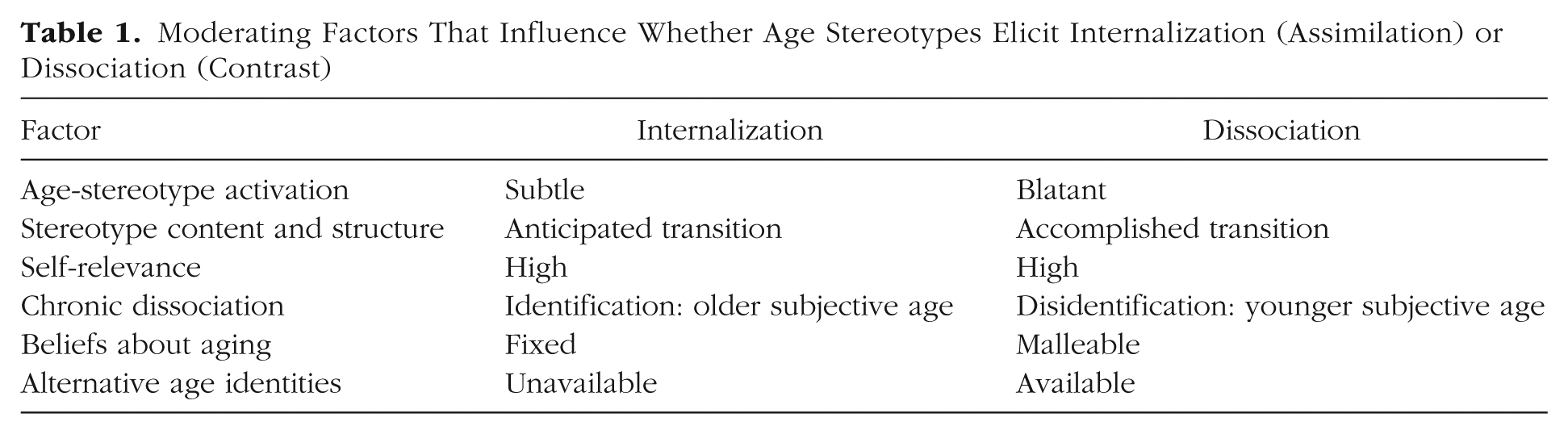
There is also solid evidence for age-stereotype priming effects in older, but not younger, adults (e.g., Hess et al., 2004; Levy, 2009) and for age-dependent longitudinal effects (Kornadt et al., 2017). These age-dependent effects are explained by the increasing relevance of age stereotypes as people age. However, another study showed that self-relevance also triggers age-group dissociation because only stereotypes that are experienced as a threat to the self will lead to contrast effects (Weiss & Freund, 2012). Thus, self-relevance represents a decisive condition in predicting both internalization and age-group dissociation. Moreover, studies suggest that if older adults show age-group dissociation on a chronic level (i.e., individual differences in identification and disidentification with older adults and a younger subjective age), they are less likely to self-categorize as old and less likely to show assimilation effects (Kang & Chasteen, 2009; O’Brien & Hummert, 2006; Weiss & Lang, 2009, 2012). Because aging does not come by surprise, people may engage in age-group dissociation when they anticipate growing older. Across time, dissociation may become enduring on an unconscious level, representing an implicit self-regulative process.
Additionally, research shows that the effects of negative age stereotypes may depend on older adults’ beliefs about the modifiability of aging (Weiss, 2018). Specifically, assimilation effects on cognitive performance and physiological reactivity appeared only for older adults who endorsed the belief that “aging is set in stone,” while those who believed that “age is just a number” showed contrast effects. Moreover, people who hold a more fixed mind-set about aging feel more threatened by aging-related changes and perceive their lifetime as more limited (Weiss, Job, Mathias, Grah, & Freund, 2016).
Finally, whether older adults exhibit internalization or dissociation may depend on the availability of positive and meaningful alternative age identities. For example, the model of dual-age identity (Weiss & Lang, 2009) shows that age-group dissociation is only adaptive if individuals can shift to alternative and more positive age identities such as membership in a specific generation (e.g., “the greatest generation,” “baby boomer”). Subsequent studies have shown that generation identity provides older adults with a sense of agency, continuity, and positive legacy, while age-group identity in the absence of a meaningful alternative age identity often elicits negative aspects (e.g., cognitive decline) of old age.
Conclusion and Future Directions
We hope that the research discussed here broadens the view of age stereotyping and encourages work aimed toward a complete understanding of SIDI. Both processes are highly flexible and context dependent, and they play a fundamental role in the aging process. Rather than thinking about internalization and dissociation as contradictory processes, it may be useful to think of these processes as different sides of the same coin. Moreover, each type of process can be elicited by various moderating factors, including both adaptive and maladaptive consequences. In order to achieve a positive and coherent self-concept, individuals may selectively assimilate to positive—and contrast themselves from negative—conceptions of old age. Therefore, we suggest that these two processes, along with their antecedents and consequences, should be studied in concert to gain a better understanding of the systematic effects of old-age stereotypes in the second half of life.
Future research should address the following questions, First what is the role of self-relevance of age stereotypes? When does self-relevance lead to stereotype internalization and when to dissociation? Second, can both internalization and dissociation operate implicitly as well as explicitly, and what are their consequences? For example, although distancing oneself from one’s age wards off age-stereotype internalization, there is also evidence that negative age views can lead to an older subjective age in the long run (Kornadt et al., 2016). Third, what are short-term versus long-term effects of internalization and dissociation? For example, can older adults maintain age-group dissociation throughout old age without suppressing their authentic self? Relatedly, how are internalization and dissociation integrated and manifested in the self-concept across time? Whether they are additive or whether one process prevails over the other remains an important open question; the answer might also depend on context or more stable individual differences. Fourth, what are the consequences of multiple-age stereotype domains regarding internalization and dissociation? For example, can positive age stereotypes in one domain (e.g., family) compensate for negative age stereotypes in another domain (e.g., health)?
To examine these questions, experimental and longitudinal studies are necessary to obtain a better understanding about the interplay of stereotype internalization and dissociation and their respective eliciting conditions. This knowledge is crucial to designing effective interventions that have the potential to improve healthy aging and older adults’ quality of life.
Recommended Reading
Kornadt, A. E., & Rothermund, K. (2012). Internalization of age stereotypes into the self-concept via future self-views: A general model and domain-specific differences. Psychology and Aging, 27, 164–172. An initial study that highlights the mediating role of future self-views in the process of age-based self-stereotyping.
Weiss, D., & Lang, F. R. (2012). (See References). Representative research that illustrates the phenomenon of age-group dissociation.
Zebrowitz, L. A., & Montepare, J. M. (2000). Too young, too old: Stigmatizing adolescents and the elderly. In T. Heatherton, R. Kleck, J. G. Hull, & M. Hebl (Eds.), Stigma (pp. 334–373). New York, NY: Guilford Press. A comprehensive overview of theory and research on age stereotyping across the life span.
Footnotes
Acknowledgements
The authors thank Thea and Noemi for their everlasting support.
Action Editor
Randall W. Engle served as action editor for this article.
Declaration of Conflicting Interests
The author(s) declared that there were no conflicts of interest with respect to the authorship or the publication of this article.