



Abstract
A belief about education that dates back several millennia is that in addition to imparting specific facts, it hones general cognitive abilities that can be leveraged for future learning. However, this idea has been a source of heated debate over the past century. Here, we focus on the question of whether and when schooling hones reasoning skills. We point to research demonstrating cognitive benefits of both broad and specific educational experiences. We then highlight studies that have begun to elucidate underlying mechanisms of learning. Given our society’s substantial investment in education, it behooves us to understand how best to prepare individuals to participate in the modern workforce and tackle the challenges of daily living.
A common assumption is that education prepares students for the challenges that lie ahead: that beyond imparting specific facts, it hones general cognitive skills such as reasoning, which can be deployed in new contexts to solve novel problems. This assumption dates back at least as far as Plato, who theorized around 380 BCE that math training could transfer to reasoning about politics and ethics (Burnyeat, 2000). He espoused what came to be known in the late 18th century as the doctrine of formal discipline, which holds that studying rigorous subjects disciplines the general faculties of the mind. This doctrine is at the core of many educational institutions to this day. But is this assumption correct? There has been a heated debate on and off for over a century regarding the extent to which learning transfers across contexts and tasks (e.g., Judd, 1908; Redick, 2019; Singley & Anderson, 1989; Thorndike & Woodworth, 1901).
Here, we make the case that the immersive, multifaceted, protracted experience of formal schooling taxes and therefore hones general cognitive skills that can support learning across multiple domains (Ceci, 1991). We argue that it is necessary to probe the cognitive and neural mechanisms of learning more deeply (Gabrieli, 2016; Lindenberger, Wenger, & Lövdén, 2017) in order to address the question of what transfers, how, and for whom (Barnett & Ceci, 2002; Judd, 1908; Katz, Shah, & Meyer, 2018). We propose that probing how the subtle learning effects that are evident on the order of weeks to months can provide mechanistic insights regarding the types of learning that take place across multiple years of schooling.
We focus below on the question of whether and how schooling can sharpen the capacity for reasoning. Common measures of reasoning, including those used in IQ tests, require relational reasoning, or the ability to compare or integrate the relations among disparate pieces of information. Relational reasoning is conceptualized as an all-purpose cognitive ability that enables us to compare the magnitudes of two fractions, derive logical conclusions from a set of premises, understand the analogies used to teach scientific concepts, and more (Alexander, 2016; Holyoak, 2012). Indeed, there is a large body of evidence that relational reasoning is an important predictor of scholastic achievement and other important life outcomes (Dumas & Dong, in press; Goldwater & Schalk, 2016). Although the abstract tasks used to probe relational reasoning predict learning across multiple domains, there is a fair degree of pessimism regarding whether students hone this purportedly domain-general ability through instruction or whether they instead learn to reason only about specific content matter (see Nisbett, Fong, Lehman, & Cheng, 1987).
Below, we briefly review the evidence that schooling can indeed hone relational reasoning (for in-depth reviews, see Ceci, 1991; Ritchie & Tucker-Drob, 2018). We then turn our attention to recent investigations probing how it does so. The three classes of studies discussed below have investigated the effects of (a) formal education writ large, or of pursuing a specific academic discipline; (b) curricula designed by researchers to explicitly teach reasoning skills; and (c) existing courses that were not developed by researchers but whose effects on reasoning have been studied.
Effects of Formal Education on Reasoning
How can we study whether schooling hones reasoning, short of randomly assigning children either to attend school or not attend school? One of several clever ways to get at this question leverages the fact that children of the same age can be in different grades, as a result of which it is possible to tease apart schooling-related and age-related improvements in cognitive performance (Morrison, Kim, Connor, & Grammer, 2019). A large study adopting this approach in over 12,000 Israeli children revealed a large effect of schooling on tests of reasoning across three grade levels (Cahan & Cohen, 1989). A more recent study showed better reasoning among first graders than kindergarteners of roughly the same age (Zhang et al., 2019).
Integrating the results of numerous and diverse studies, Ritchie and Tucker-Drob (2018) concluded that IQ scores (which are heavily based on reasoning-test performance) rise 1 to 5 points for every additional year of education. Other studies have distinguished between the types of reasoning emphasized in different disciplines. For example, one study showed that students in the social sciences improved more at statistical and methodological reasoning over the course of their undergraduate training than did those in the natural sciences or humanities (Lehman & Nisbett, 1990). This line of work suggests that students specializing in different fields learn to reason in different ways (Nisbett et al., 1987).
Reasoning Programs Designed by Researchers
In a second class of studies, researchers have developed and evaluated courses targeting various types of reasoning skills through explicit instruction. One example is a 10-lesson curriculum built on the observation that diverse reasoning tasks have a common element of comparing objects or relations among objects (Klauer, Willmes, & Phye, 2002)—what we refer to as relational reasoning. A review based on 74 studies involving nearly 3,600 children and adolescents suggested that this curriculum works as intended: After roughly 5 weeks of reasoning instruction, children showed improvements on other tests of reasoning, and the improvements lasted for months (Klauer & Phye, 2008). Another example is a gist-reasoning program designed to teach strategies for “glean[ing] deep meaning from texts through analysis and synthesis of information, inference of abstract concepts, prediction of outcomes, and relating what is presented in text to one’s own background knowledge” (Gamino et al., 2014, para. 2). This program consists of 8 to 12 sessions administered over 1 to 2 months. It has been shown to improve gist reasoning across multiple populations (Chapman & Mudar, 2014), including adolescents from a wide range of socioeconomic backgrounds (Gamino et al., 2014). The results of these curricula are promising, although it remains to be seen whether the effects on reasoning are evident across a broad range of tasks.
Courses That Tax Reasoning Skills
In a third class of studies, researchers have examined the effects of completing a specific course that exists “in the wild” rather than having been developed in the lab. This scientific approach falls somewhere between (a) the broad, real-world “intervention” of schooling as a whole and (b) focused, well-controlled interventions: It has real-world relevance and is experimentally tractable. In the 1980s, this approach was adopted to test for effects of computer programming instruction on reasoning; findings were mostly negative or inconclusive (Salomon & Perkins, 1987). There are many plausible explanations, including the possibility that such far transfer is not possible (Singley & Anderson, 1989). However, newer studies have the advantage of several additional decades of refinement of cognitive theory and methodology and are well positioned to revisit this question. For example, we can ask whether completing a specific course promotes the application of newly learned rules and strategies (Halpern, 2001), changes the way we represent a problem (Cetron et al., 2019), or improves the efficiency of domain-general cognitive processes that undergird reasoning (Guerra-Carrillo & Bunge, 2018).
Preparing for a law-school entrance exam
In our lab, we have leveraged several methods to evaluate whether and how preparation for the Law School Admission Test (LSAT) hones relational reasoning. The LSAT was our curriculum of choice because a full two thirds of the test focuses explicitly on teaching strategies for different types of reasoning; the remaining third focuses on reading comprehension. In our first study, we compared prelaw students who had just enrolled in a 3-month LSAT preparation course with a passive control group of well-matched prelaw students. The course included 70 hr of explicit reasoning instruction and practice.
Using functional MRI (fMRI), we found that taking the LSAT course was associated with changes in brain regions associated with reasoning (Fig. 1a; Mackey, Miller Singley, & Bunge, 2013; Mackey, Whitaker, & Bunge, 2012). Specifically, we found changes in measures of brain anatomy and brain function that are thought to reflect the strength of communication among regions in a network. Thus, the course had an impact on the neural machinery that has been implicated in a wide range of reasoning tasks. These findings lend credence to the idea that learning to solve LSAT problems could lead to improvements on other reasoning tasks.
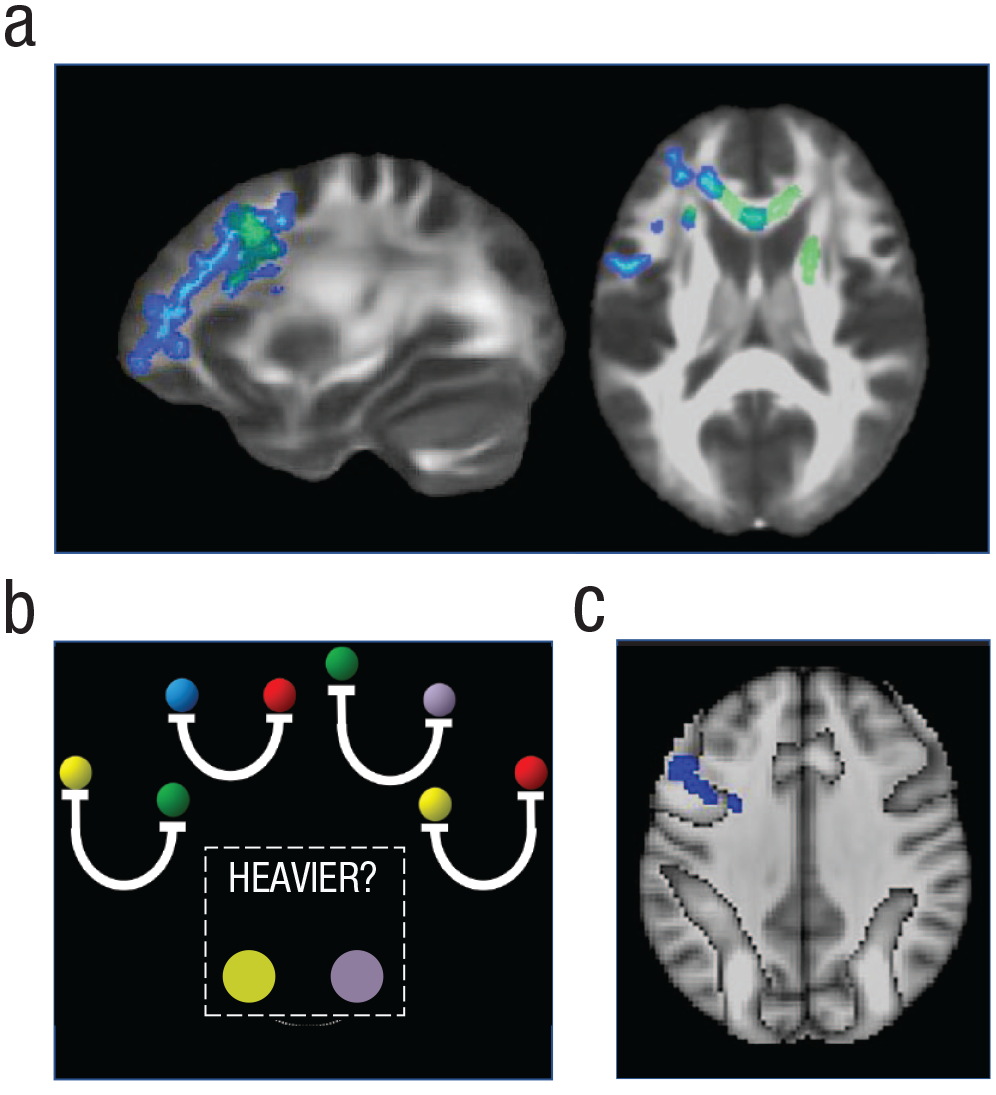
Changes in brain structure and functional activity as a result of completing a Law School Admission Test (LSAT) course. The green and blue clusters in the two slices of the brain (a) show white-matter changes associated with LSAT course completion, as measured with diffusion-tensor imaging. The slices show the left hemisphere from the side (front of the brain on the left) and the brain from above (front of the brain at the top). Effects were observed in regions that have been implicated in reasoning, including left prefrontal cortex and the bundle of fibers that connects the left and right prefrontal cortex (the anterior corpus callosum), as well as parietal cortex (not shown). These results support the hypothesis that reasoning instruction led to increased white-matter connectivity. (Panel adapted from Mackey, Whitaker, & Bunge, 2012.) A sample problem from a transitive-inference task that measures relational-reasoning ability is shown in (b). In this problem, participants have to encode that the purple ball is heavier than the green one and that the green ball is heavier than the yellow one in order to determine that the purple ball is heavier than the yellow ball. After LSAT training, participants completed this task more accurately and more quickly—even though this task looks nothing like the LSAT problems. The slice of the brain from above (c) shows changes in brain activation associated with reasoning instruction, as measured with functional MRI. The gray areas outlined in black are the regions engaged during performance of the transitive-inference task shown in (b). Shown in blue is a region in dorsolateral prefrontal cortex that exhibited a decrease in activation after participants took the LSAT course. A decrease in activation suggested that participants in the LSAT group were able to perform the transitive-inference task more efficiently. (Panel adapted from Mackey, Miller Singley, Wendelken, & Bunge, 2015.)
We also found changes in behavioral performance and brain activation measured with fMRI while participants performed a relational-reasoning task (Fig. 1b). These abstract problems bear no resemblance to the text-based LSAT problems (see Fig. 2a), but they both require reasoning about relations between different pieces of information. Compared with the control subjects, the LSAT students showed a larger improvement in both accuracy and response times. Moreover, fMRI analyses indicated that they relied less on the dorsolateral prefrontal cortex, a brain region that is consistently engaged during performance of challenging tasks, which suggests that they found the task easier (Fig. 1c; Mackey, Miller Singley, Wendelken, & Bunge, 2015). This study provides evidence of moderate transfer of learning from a real-world-reasoning curriculum to a laboratory-based test of reasoning.
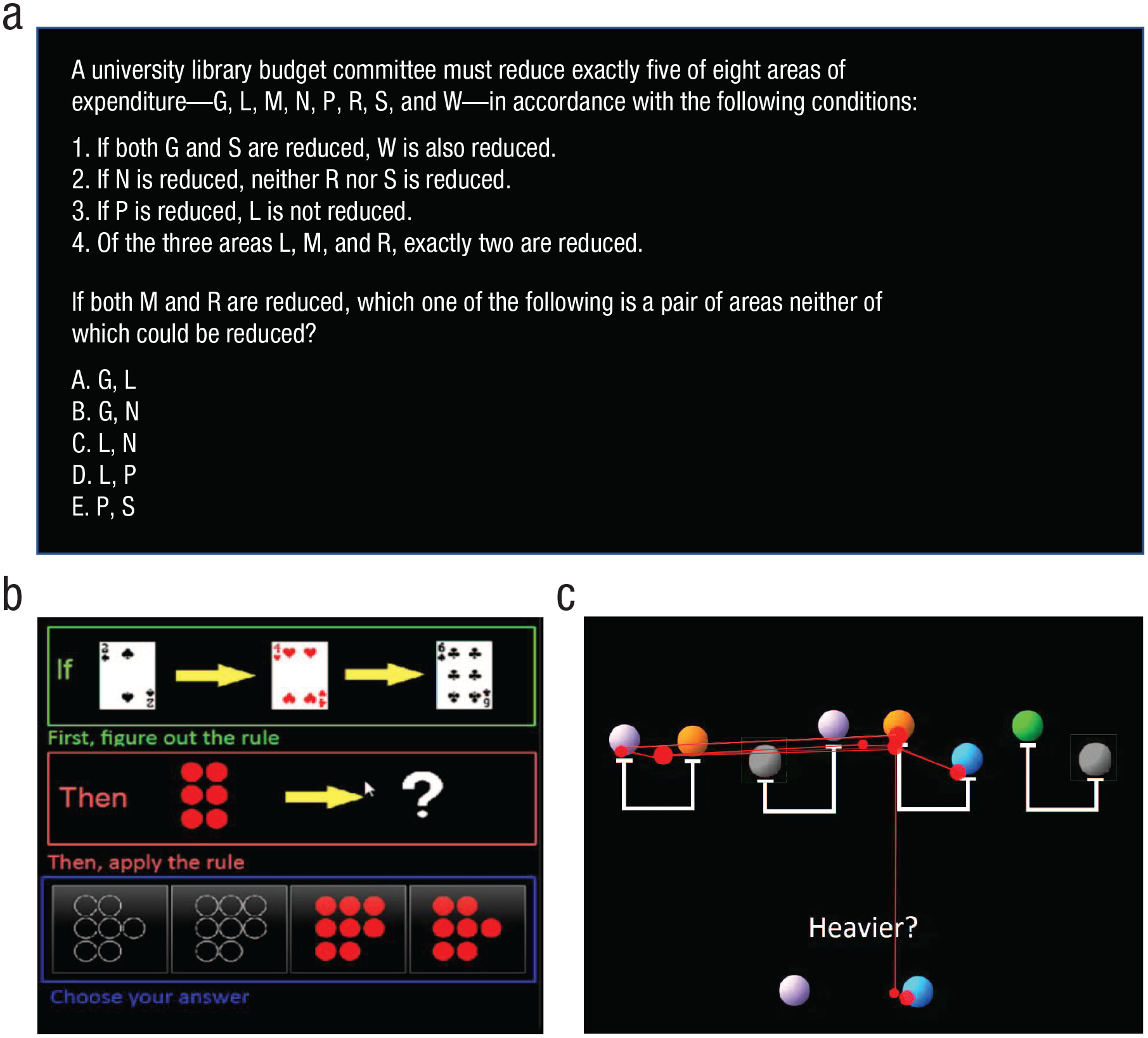
Sample question from the Law School Admission Test (LSAT), problem from a reasoning battery, and test taker’s eye-movement patterns. A sample LSAT Analytical Reasoning question from the Law School Admission Council website (www.lsac.org) is shown in (a). The correct answer is C. Participants completed four reasoning tests (one of which is shown in (b) before and after the online LSAT course (either Analytical Reasoning or Reading Comprehension) to test for transfer from the online course to reasoning skills. In the task shown in (b), participants must first induce the rule from the cards and then apply it to a novel problem. (Panel adapted from Guerra-Carrillo & Bunge, 2018.) A single participant’s eye-gaze pattern during completion of a transitive-inference problem (c) is shown for the period just before the response was made. On average, participants made 23 eye movements in the 7 s it took to solve these problems. Participants in the Analytical Reasoning group improved in speed on this task. Examining this group’s gaze patterns revealed that this improvement was not due to participants becoming faster at initially identifying the relevant relations but rather to their spending less time looking at the relevant relations after identifying them, which suggests that the efficiency of their relational thinking improved. Further, the degree to which an individual participant improved on the task was most strongly related to the magnitude of change on this ocular measure (Guerra-Carrillo & Bunge, 2018).
By contrast, we did not find transfer to any of four standardized cognitive measures, including two other tests of relational reasoning. This discrepancy highlights the need for a better taxonomy of reasoning tasks to assess the overlap in cognitive demands between a curriculum and outcome measures (Klauer & Phye, 2008). We have adopted eye tracking with a view to pinpointing cognitive processes that are affected by an intervention and understanding why transfer to other tasks succeeds or fails. Eye movements, which are among the fastest movements that the human body makes, reflect shifts in attention that are associated with thought processes. The location and sequence of eye-gaze fixations provide a rich source of data that goes beyond what researchers can get with accuracy or response times. In conjunction with behavioral data, eye tracking has the potential to provide novel insights regarding learning (Eckstein, Guerra-Carrillo, Miller Singley, & Bunge, 2017).
In a follow-up to the LSAT study, we used eye tracking to probe transfer effects more deeply. We randomly assigned prelaw students to take a 6-week online course focused on either the Analytical Reasoning section of the LSAT (text-based reasoning problems; Fig. 2a) or the Reading Comprehension section of the LSAT (Guerra-Carrillo & Bunge, 2018). We observed an effect of reasoning instruction on a composite score of four relational-reasoning tests that were visually distinct from the LSAT problems (e.g., Fig. 2b) but not on other cognitive measures. These results support moderate transfer of learning.
Reasoning instruction also led participants to perform the transitive-inference problems more quickly while maintaining high accuracy. We analyzed changes in how participants’ eyes moved around the computer screen as they examined these problems. The eye-gaze data allowed us to adjudicate between several possible mechanisms of learning by providing evidence that increased efficiency of relational thinking was the most important change (for details, see Fig. 2c). The eye-gaze data revealed that the individuals who showed the biggest improvements on the transfer task showed the biggest change in our eye-tracking measure of relational thinking. Thus, we gained insights that could be used to evaluate whether a particular program taxes the target cognitive processes, whether it might be necessary to extend or modify the program to maximize behavioral benefits, and what works best for whom.
Emerging findings
Other exciting findings are beginning to emerge. For example, Adam Green and colleagues have as-yet-unpublished data (Green et al., 2019) showing that a year-long high school geoscience course that taxes spatial reasoning is associated with improvements on both spatial and nonspatial reasoning tests alongside changes in brain activation in regions implicated in relational reasoning. Another study shows that the brains of undergraduates who have developed expertise in mechanical engineering register correspondences between objects that despite being visually dissimilar, share deeper physical properties (Cetron et al., 2019). These new approaches help to demystify when and how transfer of learning occurs. In the United States, current educational standards emphasize scientific reasoning; this presents an opportunity to investigate whether or to what extent standards-aligned curricula hone reasoning across scientific disciplines and beyond.
Broader Considerations
One critical question is whether there is a particular window in development when schooling is most likely to hone general cognitive skills. Improvements in reasoning and in the underlying anatomical connections are most pronounced during the elementary school years (Wendelken et al., 2017); thus, this may be a time when this neurocognitive system is particularly malleable. There is a great need for further research examining schooling effects on child brain development (see Brod, Bunge, & Shing, 2017).
Another critical question is how long one could reasonably expect schooling effects to last. We anticipate long-lasting benefits only if students continue to leverage the skills they have honed or if there has been a fundamental change in the way they represent information (Lövdén, Bäckman, Lindenberger, Schaefer, & Schmiedek, 2010). Earlier studies suggested that children’s IQ scores drop over long summer holidays and that this “summer slide” is particularly large for students from socioeconomically disadvantaged backgrounds (Ceci, 1991). These results warrant replication because they have important implications for reducing the achievement gap.
We have posited that the time in life when many individuals are at their peak level of cognitive functioning is while they are still in school, practicing thinking skills and acquiring knowledge at breakneck speed. In a large online study, we found differences not only in the level of cognitive performance across educational brackets but also—more compellingly—in the age at which peak cognitive performance was observed within each educational bracket (Guerra-Carrillo, Katovich, & Bunge, 2017). Although we did not have the opportunity to follow the participants over time, it is intriguing that peak functioning within each group was observed around the typical time of completion of that degree. We posit that schooling effects could explain why cognitive performance tends to rise quickly during childhood and adolescence, peak in the early 20s, and then decline slowly throughout adulthood (McArdle, Ferrer-Caja, Hamagami, & Woodcock, 2002).
Conclusion
In closing, there is evidence that the process of educating ourselves can equip us to reason about novel problems. This article is by no means a comprehensive review; there are certainly many counterexamples of approaches that have been ineffective (e.g., see Singley & Anderson, 1989). The most promising curricula are likely those that aim to teach for transfer by encouraging deep understanding, explicitly teaching thinking skills using a variety of examples, and drawing attention to the structural features of a problem (Chi & VanLehn, 2012; Halpern, 2001; Willingham, 2007). Here, we call for deeper exploration of such curricula, both via replication studies and individual-differences analyses.
Given our significant investment in education as individuals and families and as a society, we must continue to assess the claim that Plato made 2,400 years ago, asking ourselves how we can best prepare students for future learning (Bransford & Schwartz, 1999). Good reasoning skills are needed to master new job requirements as needed to keep pace with rapid technological advances (World Economic Forum, 2018) and to make sound decisions in all aspects of our lives. Finding ways to more effectively cultivate reasoning could therefore have profound and far-reaching consequences for society at large.
Recommended Reading
Dumas, D., & Dong, Y. (in press). (See References). A chapter that gives a detailed overview of relational reasoning and thinking—including historical background, theory, and measurement—and reviews empirical findings.
Guerra-Carrillo, B. C., & Bunge, S. A. (2018). (See References). An experiment in which eye tracking was used to investigate the mechanisms of learning associated with completion of a course that taxes relational reasoning.
Klauer, K. J., & Phye, G. D. (2008). (See References). An analysis of a large number of studies evaluating the effectiveness of a curriculum designed to teach reasoning strategies.
Ritchie, S. J., & Tucker-Drob, E. M. (2018). (See References). An analysis of a large set of studies that found evidence for consistent and positive effects of education on cognitive abilities.
Footnotes
Acknowledgements
We thank Shyama Yallapragada for assistance with a broad literature search and Monica Ellwood-Lowe, Micah Goldwater, David Kraemer, and several reviewers for helpful suggestions on an earlier draft of this manuscript.
Transparency
Action Editor: Randall W. Engle
Editor: Randall W. Engle
