




Abstract
Psychologically “wise” interventions can cause lasting improvement in key aspects of people’s lives, but where will they work, and where will they not work? We consider the psychological affordance of the social context: Does the context in which the intervention is delivered afford the way of thinking offered by the intervention? If not, treatment effects are unlikely to persist. Change requires planting good seeds (more adaptive perspectives) in fertile soil in which those seeds can grow (a context with appropriate affordances). We illustrate the role of psychological affordances in diverse problem spaces, including recent large-scale trials of growth-mind-set and social-belonging interventions designed specifically to investigate heterogeneity across contexts. We highlight how the study of psychological affordances can advance theory about social contexts and inform debates about replicability.
Brief psychologically “wise” interventions address how people make sense of themselves, other people, and social circumstances. They can produce lasting improvement in diverse areas of people’s lives (see Walton & Wilson, 2018; for a meta-analysis, see Lazowski & Hulleman, 2016; see also Cohen & Sherman, 2014; Dweck & Yeager, 2019; Harackiewicz & Priniski, 2018; Walton & Crum, in press; Yeager & Walton, 2011). How can we understand where these interventions will be more and less effective?
This question informs both efforts to address social problems and basic theory. Mapping how ecologically valid social contexts respond to psychologically precise manipulations (i.e., interventions) can shed light on contexts (Lewin, 1952; see also Bronfenbrenner, 1977). Furthermore, these efforts inform debates about replication.
We argue that the success of wise interventions depends on features of contexts that make an adaptive perspective possible, what we call psychological affordances (cf. Diekman, Brown, Johnston, & Clark, 2010; Kruglanski, Chernikova, Rosenzweig, & Kopetz, 2014; Reis, 2008; Steele & Sherman, 1999). As Gibson (1977) theorized, physical spaces afford particular behavioral opportunities. For a person, a solid surface affords standing upon; a small round object affords throwing. Such objective affordances permit behaviors. Yet social contexts also afford psychological opportunities. They make possible, or they foreclose, particular ways of experiencing, interpreting, and responding to events. If the context does not afford a proffered perspective, benefits are unlikely to persist. Consider three examples based on recent research:
Green beans in a dining hall are labeled “sizzling,” so you try some. But if they tasted like mush, would you eat more of them (Turnwald et al., 2019)?
You learn that intelligence can grow if you persist on challenging tasks. But if the norm in your school means that you would sacrifice your social status if you chose harder school work, would you hold on to this belief? Would you still pursue challenges (Yeager et al., 2019)?
You learn that it is normal, at first, to worry whether you belong in college and that this gets better with time. But if your college offers limited opportunities for people “like you” to belong, would this perspective help you navigate college successfully (Walton, Murphy, et al., 2019)?
Objective affordances are relative to an actor; thus, water affords walking to a water bug but not to a person. So it is with psychological affordances. An all-male club may afford belonging to men but not to women.
Wise interventions offer people a perspective (termed a mind-set, narrative, construal, or belief ) for understanding circumstances they face (Walton & Wilson, 2018). People may then try out that perspective. Is it legitimate for me here? Does experience confirm it? And is it useful? Does it help me achieve my goals here? To what extent can the perspective fit with and live authentically for a person in the context?
To afford a perspective is not to have it or even to facilitate it; it is to permit it and, thus, if introduced, to allow that way of thinking to persist and guide people’s behaviors and responses. According to this view, effective interventions require planting a high-quality seed (an adaptive belief system) in fertile soil where that seed can grow (a context that affords the proffered belief system; see Yeager et al., 2019).
To date, research has focused on other sources of treatment-effect heterogeneity, that is, factors that cause treatment effects to be smaller or larger (Weiss, Bloom, & Brock, 2014). These include pragmatic factors, such as whether people attend to intervention materials and their quality and relevance (Yeager et al., 2016) and objective (or “structural”) affordances, such as the quality of instruction (Dee, 2015). Such factors are important but represent preconditions for the study of psychological affordances. If an intervention initiates psychological change and objective opportunities for improvement are present, we can learn how the intervention message is afforded in the context or how it is not.
Only recently, with large-scale, multisite trials and disciplined preanalysis plans, have researchers been able to examine psychological affordances directly and convincingly. Turnwald and colleagues (2019) developed an intervention to give vegetable dishes indulgent labels (e.g., “Creamy Homestyle Cauliflower Mash”). Across several university dining halls (185 days, 137,842 diner decisions), this increased the selection and consumption of those dishes, with the strongest gains being in dining halls that had the tastiest vegetables (see Woolley & Fishbach, 2016). Yeager and colleagues (2019) tested a growth-mind-set intervention in a nationally representative sample of 65 U.S. high schools (N = 12,486 students). The greatest gains in the primary outcome—ninth-grade grade point average—arose in schools in which peers sought out academic challenges; students attending schools with weaker challenge-seeking norms showed smaller benefits. Walton, Murphy, and colleagues (2019) tested a social-belonging intervention among students entering 21 diverse colleges and universities (N = 26,406 students). The greatest gains in full-time first-year completion rates arose for students whose Race × First-Generation Status group experienced greater levels of belonging in their college over the first-year in the absence of treatment—that is, in contexts that afforded more opportunities to belong.
A psychological intervention offers people a way of making sense of daily experience. People test out that perspective almost as a hypothesis (Walton & Brady, 2017). If the hypothesis is supported and helps people navigate daily life, lasting improvement may follow. But if the hypothesis is not supported—if it feels inauthentic or misfitting—its impact may whither and fade.
Social Contexts as Opportunities for Theory Development in Psychology
A focus on psychological affordances recalls classic field theory (Lewin, 1952). Rather than understanding a psychological process only in isolation—what was taught in the intervention—we can understand what psychologies contexts afford.
Psychological research often begins by attending only indirectly to contexts. In classic laboratory experiments, researchers create an optimal context in which to observe a causal relationship of interest (“Does X affect Y?”). The broader context is treated secondarily, as something to get right to observe this relationship—a matter of practical wisdom relevant only to experimental design. Only later may researchers subject the context to formal theory and inquiry, exploring conditionality (e.g., Noah, Schul, & Mayo, 2018; Zanna & Fazio, 1982).
Initial field experiments are similar. A researcher who has shown that X can affect Y in the lab may ask whether the same relationship can hold in the field. The researcher now has the luxury of selecting a field setting—presumably one that will serve as an optimal environment in which to observe the focal relationship.
Both kinds of studies are demonstration studies. They show that X can affect Y, in the lab or the field, under some (usually underspecified) set of conditions (Bryk et al., 2013). Although this is valuable, if we stop there, we leave basic questions such as where and with whom the psychological process can hold unanswered (e.g., Thoman, Muragishi, & Smith, 2017). We do not learn what psychological states people could have in contexts.
Further, from an applied perspective, if we take social problems seriously, we cannot choose our contexts. We must study the world as it comes to us. In extending an intervention to diverse populations, especially to those most afflicted by a problem, we must ask in what kinds of contexts an intervention will be effective and in what kinds of contexts it will not. This means contending with the complicated root causes that made the problem appear in the first place; sometimes these may be remedied through psychological intervention and sometimes not.
Vulnerability and Opportunity
A theory of psychological affordances can resolve an ongoing puzzle: Will wise interventions be more effective in negative contexts, where outcomes are worst? Or in positive contexts that reinforce more adaptive mind-sets?
We suggest that even as people entertain perspectives that undermine their outcomes, contexts can afford more adaptive ways of thinking. It is at this intersection of vulnerability and opportunity that wise interventions may be most potent. Concretely, this means we should predict effects for individuals at risk of negative perspectives that could undermine their outcomes in contexts that afford more adaptive perspectives.
When cultural contexts evoke negative ways of thinking, people ask whether those views hold in their local circumstance (Dweck & Yeager, 2019; Walton & Brady, 2017; Walton & Wilson, 2018). If local settings do not effectively rule them out, negative views may become entrenched.
Why are indulgent food labels important? In part this is because common cultural products (e.g., restaurant menus) fail to label healthy foods in attractive ways (Turnwald, Jurafsky, Conner, & Crum, 2017), thereby linking health to bad taste (Raghunathan, Naylor, & Hoyer, 2006). Why are growth-mind-set interventions needed? Because we live in a world with reinforcing fixed-mind-set influences, such as instructors who overemphasize talent (Leslie, Cimpian, Meyer, & Freeland, 2015) and parents who praise children for their abilities rather than their processes (Gunderson et al., 2013). Why are belonging interventions important? Because a history of race-based exclusion permeates education (Walton & Brady, in press). In each case, the sociocultural context raises a worrisome prospect: “The green beans might be yucky.” “I might be dumb at math.” “People like me might not belong in college.”
People then use that prospect to interrogate their experience: “Is this [negative view] true here?” (Walton & Brady, 2017). Often, the context is ambiguous in this regard. Contexts, unlike interventions, are rarely designed with a narrative purpose in mind, so people must go beyond the information given to infer answers to foundational questions. This ambiguity allows wise interventions to work. In the absence of intervention, hypothesis-confirming processes can allow people to perceive daily experience as confirming a feared view, undermining outcomes over time (Dweck & Yeager, 2019; Walton & Brady, in press). Maladaptive cycles may be most potent when characteristics of contexts evoke threatening cultural narratives, such as school settings in which a disadvantaged group is most underrepresented or performs least well (Hanselman, Bruch, Gamoran, & Borman, 2014; Walton, Logel, Peach, Spencer, & Zanna, 2015).
Wise interventions interrupt this process and help people realize the psychological potential already present in the context. The green beans may be tasty, but if they are not labeled “sizzling,” I might not try them. Peers may seek out challenges, but if I am worried that I am dumb, I will not pursue challenges or realize the gains in learning that could result. My college may offer opportunities for people like me to belong, but if I see feelings of homesickness or academic struggles as meaning that I do not belong, I will not pursue these opportunities.
This theory was developed from recent large-scale trials of growth-mind-set and social-belonging interventions designed specifically to study heterogeneity (see Table 1). These trials feature large samples of students within schools randomly assigned to condition (12,486 and 26,406, respectively), large numbers of school sites intentionally sampled to permit cross-site comparisons (65 and 21, with the latter further divided into 365 Race × First-Generation Status × College × Cohort groups), and preregistered hypotheses and analyses. Such precautions are necessary because heterogeneity findings can be unreliable (Bloom & Michalopoulos, 2013), especially with small samples (Sherman & Pashler, 2019). Moreover, each intervention was homogenously persuasive across sites, as assessed by manipulation checks. The interventions sowed new ways of thinking across sites; heterogeneity in outcomes could then reflect the soil in which those seeds were planted.
A Sweet Spot for Intervention: Psychological Vulnerabilities and Affordances of Growth-Mind-Set and Social-Belonging Interventions
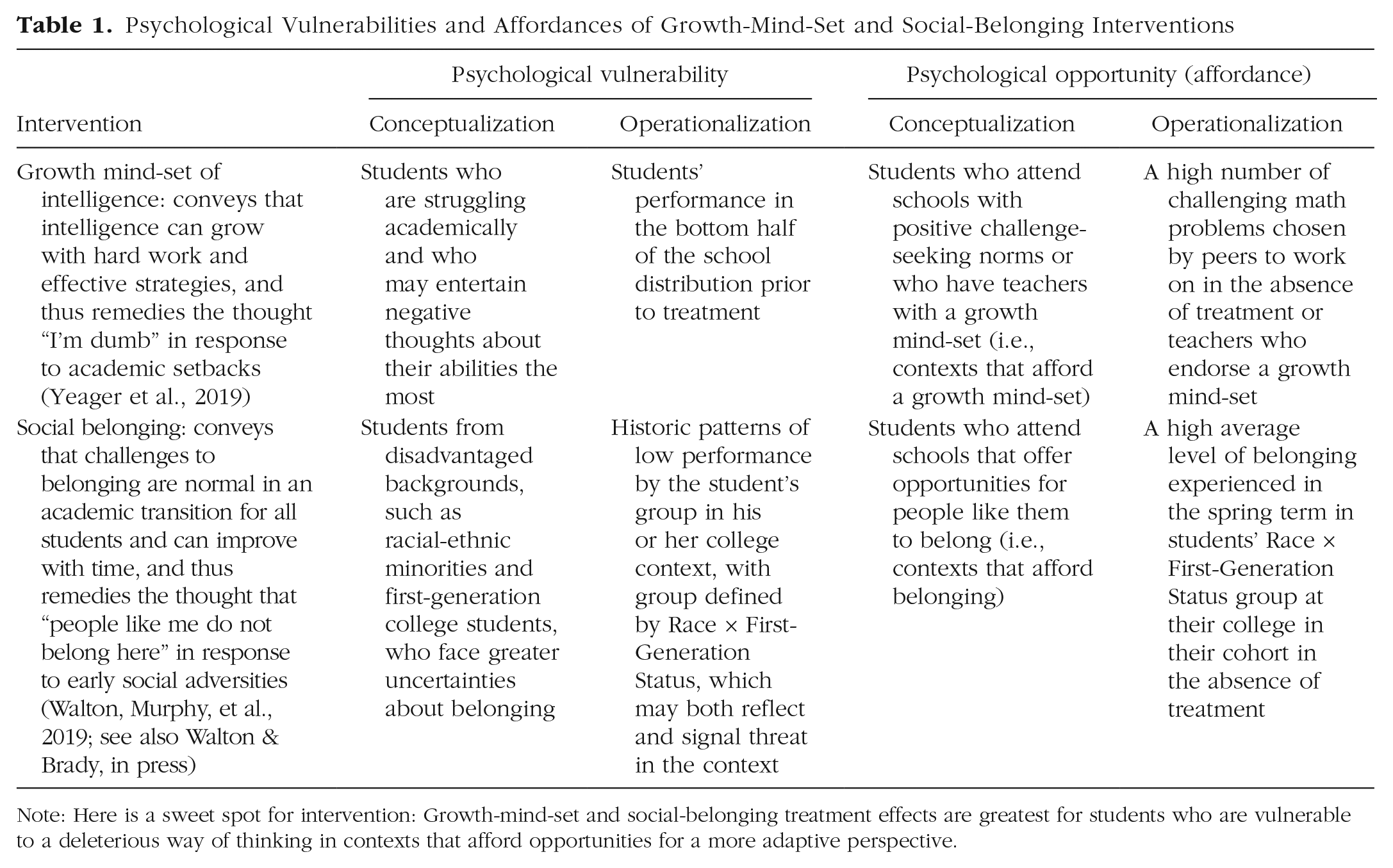
Note: Growth-mind-set and social-belonging treatment effects are greatest for students who are vulnerable to a deleterious way of thinking in contexts that afford opportunities for a more adaptive perspective.
Defining vulnerability and opportunity
Although both belonging and growth-mind-set interventions illustrate the intersection between psychological vulnerabilities and opportunities, they do so in different ways that reflect social-psychological theory. The belonging intervention arose from research on how negative stereotypes can place people’s social standing at risk (i.e., stereotype- and social-identity threat; Steele, Spencer, & Aronson, 2002). It mitigates the inference, “People like me might not belong.” Because stereotypes are applied to groups, vulnerability and opportunity are assessed at the group level (i.e., group-level historic performance, group-level experienced belonging). By contrast, growth-mind-set interventions developed from learned helplessness. Because the vulnerability is at the individual level (“I might be dumb”), individual students’ prior performance is assessed to identify struggling students at risk for fixed failure-induced thoughts, and the opportunity to realize a more adaptive mind-set is assessed at the school level (e.g., school-wide challenge-seeking norms).
These definitions emerged from basic theory, pilot studies, and disciplined preanalysis plans. They are to be distinguished from definitions that are defined post hoc, which risk chasing noise in data. The theory of psychological affordances is not a license to fish for statistically significant but ultimately spurious subgroup effects (Tipton, Yeager, Iachan, & Schneider, 2019). It is a call to understand the general principles that underlie psychological vulnerabilities and affordances and the best ways to measure these (Yeager, Hanselman, Muller, & Crosnoe, 2020).
Changing contexts
Sometimes it will be necessary to complement a wise intervention with a change in the context to make the proffered way of thinking legitimate and useful. As Lewin (1952) emphasized, manipulating a system is a powerful way to learn about its causal structure. Context × Individual factorial field experiments, and related quasiexperiments, complement efforts to measure affordances across contexts (see Fig. 1).

Psychological interventions in context. Change requires planting good seeds in fertile soil.
One experiment found that a wise intervention to promote a purpose for working hard on learning tasks did not improve performance unless students also received an ostensibly independent note from their teacher affirming this purpose (Reeves et al., 2019). Going beyond a one-time affordance, another study with adolescents reentering school from juvenile detention found that helping them consider how developing a relationship with an adult in school could help them achieve their goals only modestly improved students’ outcomes. But when a letter asking for support was also delivered to an educator in the student’s school of their choosing, recidivism dropped sharply (Walton, Okonofua, et al., 2019). Such studies illustrate the causality of a receptive context.
Correspondingly, it may be necessary to complement structural reforms with wise interventions that help people take advantage of opportunities. If a student receives high-quality academic feedback but thinks this feedback reflects bias, it may go unused (Yeager et al., 2014).
Generalizability and Heterogeneity, Not Replicability or Average Effect Size
Recent methodological debates in psychology have focused on replicability: Can you produce the same effect again? Typically, these debates have centered on laboratory experiments and the quality of the manipulation or procedures (e.g., Noah et al., 2018). Further, multilab replications have yielded results that seem to contradict the contentions in this article, producing no evidence that differences in contexts explain variations in effects (Klein et al., 2018). But these studies are more like tests of a manipulation check in a wise intervention; they ask whether a treatment can initiate a psychological process moments later. Well-conducted wise interventions begin there. Indeed, in the examples above, there was no contextual heterogeneity for manipulation checks.
Our focus is on additional issues that arise in field contexts over time. Any study in which most or all of the behavior that constitutes the outcome of interest happens months or years after the experimental session will depend on that broader context. In field settings, the question of whether an effect replicates, posed as it is without regard for the social context and without specifying whether it refers to the initial psychological process or a downstream outcome, is essentially nonsensical. Instead, the question is whether an intervention can reliably produce meaningful benefits in a defined population and context of interest using the same or similar methods (Tipton & Olsen, 2018). Likewise, an exclusive focus on materials becomes myopic. We must also consider whether a given intervention is needed and sustainable in a context.
These questions have direct implications for experimental design—implications that, to date, have received little attention. Multisite replications have been conducted in an ad hoc fashion, allowing teams anywhere to contribute data without scientific sampling (Klein et al., 2018). But to learn about heterogeneity, it is necessary to carefully construct heterogeneous samples. Usually, this means recruiting contexts and populations in which an intervention is expected to produce lesser effects, for instance, through stratified random sampling from a defined population (Tipton et al., 2019). Inevitably such efforts will produce smaller average effect-size estimates, but they allow for the identification of boundary conditions and reliable estimates within populations and contexts of interest. Indeed, a robust model of context heterogeneity raises the question of what value, if any, an estimate of average treatment effects in arbitrary samples has for basic theory or for application.
What would a literature on interventions look like without a theory of affordances? It would be cursed with average effect sizes, with some observations so large as to court skepticism and others disappointingly small. The intervention might seem like magic—either a magic bullet to be used everywhere (promoting overuse) or invalid (never used; Yeager & Walton, 2011). The more we can move from adversarial conversations about whether an effect is real toward research that predicts where an effect holds and where it does not (Gelman, 2015), the better our theoretical models and the more powerful our applications will be.
Conclusion
Psychological interventions are done with people, not on people, and these people live in dynamic and diverse social contexts. To predict intervention effects and to advance theory, application, and replicability, we need to understand where and when people will accept the way of thinking put forth by the intervention and be able to use it in their lives and where and when they will not.
Recommended Reading
Bailey, D., Duncan, G. J., Odgers, C. L., & Yu, W. (2017). Persistence and fadeout in the impacts of child and adolescent interventions. Journal of Research on Educational Effectiveness, 10(1), 7–39. A review of child and adolescent interventions aimed at skill building and models of how they achieve lasting change, including the role of sustaining environments.
Gibson, J. J. (1977). (See References). An introduction to objective affordances, including how physical spaces and objects afford behavioral opportunities and how these opportunities can differ for different actors.
Harackiewicz, J. M. & Priniski, S. J. (2018). (See References). A review of targeted psychological interventions in higher education, different types of interventions, and issues of process, replication, and moderation.
Walton, G. M., & Wilson, T. D. (2018). (See References). A comprehensive review of psychologically “wise” interventions that address how people make sense of themselves, other people, and social situations, including how deleterious meanings arise from contexts and can be changed to help people flourish over time in diverse areas of their lives.
Yeager, D. S., Hanselman, P., Walton, G. M., Murray, J., Crosnoe, R., Muller, C., . . . Dweck, C. S. (2019). (See References). A seminal test of a growth-mind-set intervention delivered to ninth-grade students in a nationally representative sample of 65 U.S. high schools with a focus on where and with whom the intervention improves students’ achievement.
