



Abstract
Humanity faces twin problems of adaptation—natural environmental challenges of climate change and global humanitarian challenges of ensuring well-being for all—that pose a dilemma for sustainable development. One way forward is to develop cultures of sustainability that highlight and reward the ideas and practices that will help us transition to a sustainable lifestyle. Although institutional responses are necessary and multidisciplinary approaches are required, individual citizens can also participate in cultural dynamics—the process of cultural formation, maintenance, and transformation—to craft cultures of sustainability, and psychological science can point to potential mechanisms for effecting this cultural change. Informed by the niche-construction perspective, I suggest that the critical ingredients of cultures of sustainability include (a) conceptions of human–nature connectedness, (b) conceptions of human–artifact relation, (c) interpersonal conversations about sustainability norms within social networks, and (d) visions of an achievable utopia for a sustainable future. Further research and action are called for.
Humanity faces twin challenges in the 21st century. On the one hand, we need to adapt to the changes in the natural environment due to global warming. Extreme weather events (e.g., super tropical cyclones, extreme heat) and natural disasters (e.g., floods, bushfires) will become more frequent and disrupt societal functioning well into the future (The Core Writing Team, Pachauri, & Meyer, 2014). On the other hand, there is the challenge of ensuring well-being for all. Despite increasing global wealth, there are still widespread economic deprivations—two thirds of the world’s population live on incomes of less than $10 per day, and 11% are undernourished (Roser & Ortiz-Ospina, 2019; Roser & Ritchie, 2013). Against the background of the growing human population (10.9 billion by 2100), inclusive economic growth is needed to eradicate poverty and hunger (United Nations Department of Economic and Social Affairs Population Division, 2019a). Yet human economic activities driven by fossil fuels are the main driver of greenhouse gas emissions and climate change (The Core Writing Team et al., 2014). How then can humanity’s sustainability be ensured?
I believe there is hope if humanity can craft cultures of sustainability, namely, cultures that highlight and reward the ideas and practices that help reduce our environmental impact while sustaining global human well-being.
Niche Construction, Planetary Boundaries, and a Culture of Human–Nature Disconnect
Although unprecedented, climate change is, arguably, a contemporary variant of the challenges humanity has always faced. Homo sapiens evolved in East Africa through a period of climate variability and dispersed during the Upper Pleistocene. However, the Earth’s climate has been unusually stable during the last 11,700 years. Called the Holocene Optimum, the condition has been remarkably suitable for human development. Even throughout this period, however, the planetary climate has fluctuated, challenging human populations to adapt to the changing natural environment (e.g., Little Ice Age in the 13th century CE; Brooke, 2014).
Just like any other living things, humans adapt to the natural environment by constructing a niche (Laland, Odling-Smee, & Feldman, 2000). Like a beaver building its nest and dam (a beaver-made environment, if you will), humans build the human-made environment—not only the built environment such as houses and roads but also the social environment, including social networks and social institutions such as governments (see Fig. 1). What enables this human niche construction is culture (Laland et al., 2000). Culture, here, means the collection of any nongenetic information socially transmitted from people to people, which can potentially influence human psychological processes (Kashima, Bain, & Perfors, 2019). It includes ideas (e.g., “democracy”) and practices (e.g., how to vote). It includes technical knowledge, such as how to build a car, and institutional knowledge, such as legislature, government, and jurisprudence. Even Internet memes are part of our culture.
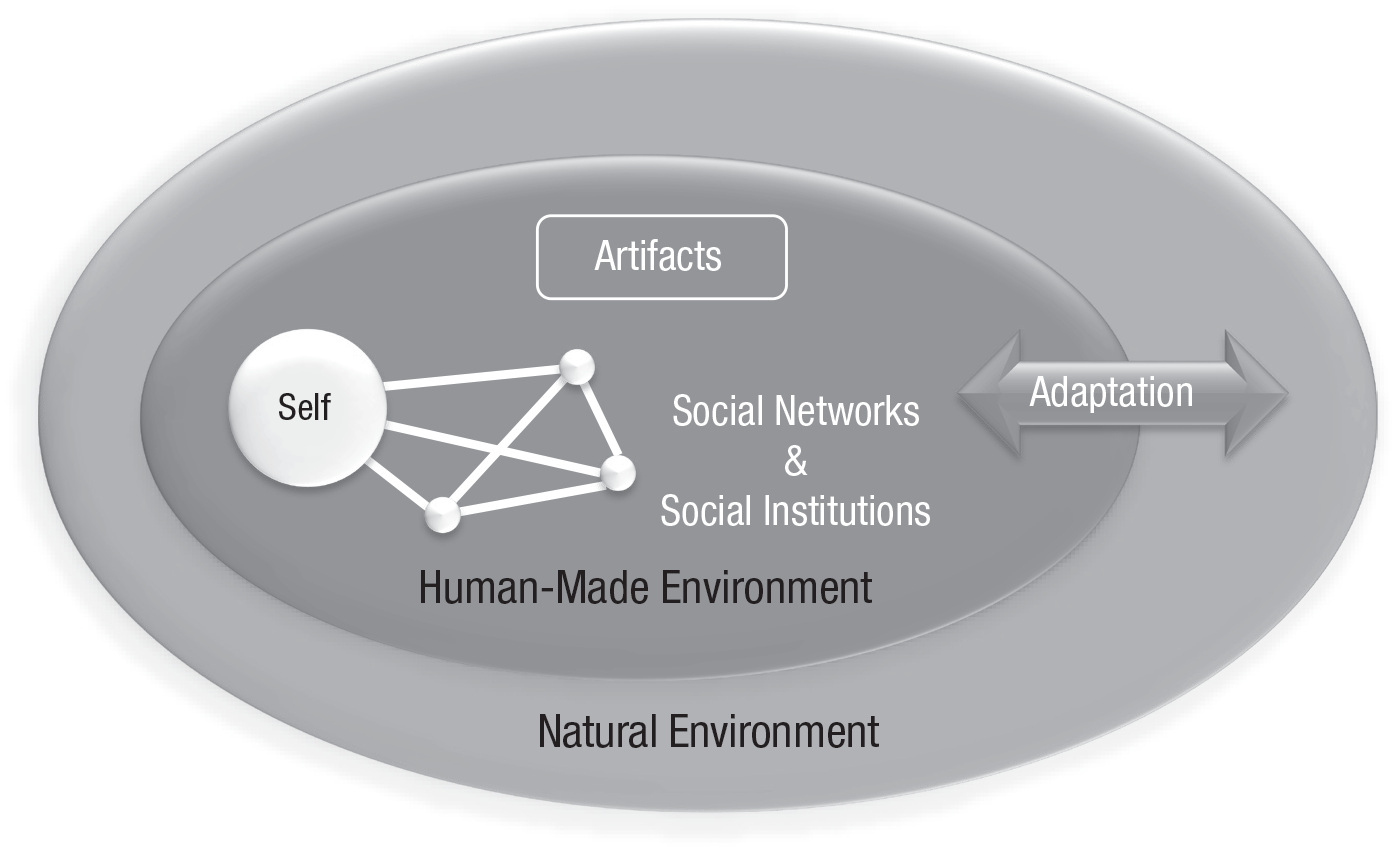
Schematic depiction of adaptation between the human-made environment—encompassing the relation between the self and others, social networks and institutions, and human-made artifacts—and the natural environment.
Biological evolution has endowed humans with the capacity to individually learn by interacting with the objects in the world as well as the capacity to socially learn by interacting with other humans (Richerson & Boyd, 2005). Leveraging the latter, humans transmit cultural information from one generation to the next (e.g., teacher to students), within the same generation (e.g., between colleagues), or even from younger to older generations (e.g., digital natives teaching social media). The dual inheritance of genetic and cultural information has made it possible for humans to construct their niches to adapt to diverse environments and spread across all continents on the Earth (Laland et al., 2000).
Earth, however, is an ecosystem with certain capacity limits, which environmental scientists call planetary boundaries (Rockström et al., 2009). These include biodiversity, fresh water, the stratospheric ozone layer, optimal ocean acidification, and appropriate global temperature. If humans stay within these boundaries, the planet’s biophysical processes can maintain the Holocene Optimum—“the safe operating space for humanity” (Rockström et al., 2009). If they are crossed, however, the biosphere may undergo a major, potentially catastrophic, change.
For most of human history, the impact of human niche construction was largely contained within the planetary boundaries. Humans may have a genetically hardwired affinity with nature (i.e., biophilia; Wilson & Kellert, 2013), which may have helped human populations to develop cultures that are adaptive in their local ecosystem. In traditional indigenous communities, such as the Itza’ people of Guatemala, rich and well-adapted folk ecology—ordinary people’s cultural ideas about ecology—has often kept human activities in balance with the local ecosystem (Atran et al., 2002).
However, the Industrial Revolution, fueled by coal and oil, initiated explosive economic growth and concomitant urbanization. A majority of human populations are now living in urban rather than rural areas (United Nations Department of Economic and Social Affairs Population Division, 2019b), cocooned in the human-made environment and largely surrounded by human-made artifacts. One apparent cultural consequence is a human–nature disconnect. In the Oxford English Dictionary, the prevalence of tree-related words has declined since the 19th century (Wolff, Medin, & Pankratz, 1999). Nature-related words (e.g., bird, tree, and flower names) have appeared less and less in English fiction, popular songs, and film story lines since the 1950s (Kesebir & Kesebir, 2017).
Over the millennia, human cultures have enabled human populations to construct niches and adapt to natural environments. These cultures may now hinder the thriving of not only humans but also other life forms as our globalized activities begin to breach some of the planetary boundaries (Rockström et al., 2009).
How can humanity move forward?
Participating in Cultural Dynamics for Sustainability
Cultures are not fixed entities but dynamic processes (Kashima et al., 2019). If culture enables a human population to adapt to its environments, now is the time when cultural dynamics are likely most active in response to the challenges of climate change, new pathogens, and changing geopolitics. The status quo may be maintained or transformed; new cultures may form. If a culture of human–nature disconnect has emerged over the 20th century, cultures of sustainability may emerge over the 21st. If so, what will they look like, and how can we bring them about? I suggest that the following ingredients are critical: (a) conceptions of human–nature connectivity, (b) conceptions of human–artifact relation, (c) interpersonal conversations about sustainability norms within social networks, and (d) visions of achievable utopia for a sustainable future.
What it means to be human: conceptions of human–nature relations
Culture embeds ways of conceptualizing the human–nature relation, that is, how humans and the rest of nature are related. Some cultures regard humans as part of and continuous with nature, whereas others treat humans as distinct and outside of nature (Descola, 2013). For example, Ngöbe people of Panama are more likely to say animals, plants, and abiotic entities (clouds, rocks) have psychological capacities (e.g., thought, communication) than U.S. college students are (ojalehto, Medin, & Garcia, 2017). In contrast, European American adults’ activities are less connected to nature than those of Native Americans living in an adjacent area. Menominee people reported more cultural practices that foregrounded nature (e.g., forest walks) and endorsed holistic and spiritual values of nature than European Americans did (Bang, Medin, & Atran, 2007).
From available cultural ideas and practices, individuals selectively appropriate different subsets and form their environmental identity (Clayton, 2012), that is, how individuals think of their own relations with nature. Environmental identity is informed by how people think of human–nature relations (Kashima, Paladino, & Margetts, 2014) and is shaped by how they value nature (van der Werff, Steg, & Keizer, 2013). People who include nature as an important part of themselves tend to engage in a host of proenvironmental behaviors, including waste reduction, water and energy conservation, and “green” shopping and food choice (e.g., Kashima et al., 2014; van der Werff et al., 2013; Whitmarsh & O’Neill, 2010). Some people internalize the idea of environmental protection so much that they regard it as an aspect of their personal striving, an important life goal that they pursue (Kashima et al., 2014). These personalized environmental strivings drive their willingness to transition to a lifestyle with a lower carbon footprint, which has been shown to be correlated with actual energy use in Australian households (O’Brien et al., 2018).
An important part of crafting a culture of sustainability is to make available cultural ideas and practices of human–nature connectedness and to encourage their appropriation through enculturation.
How people relate to the human-made environment: human–artifact relations
City-dwelling humans are largely surrounded by cultural artifacts—human-made objects that populate our human-made environment. Human economic activities—production, consumption, and waste management—affect nature indirectly through people’s interactions with these artifacts. Cultural leverage may be found in folk theories of artifact creation (Judge, Fernando, Paladino, & Kashima, 2020)—people’s tacit assumptions about how artifacts are made. The Western folk theory, reflected in contemporary consumer culture, conceptualizes artifact making as an imposition of the creator’s intention on the material by the creator’s physical labor. This view regards the integration of the mind and body as critically important in artifact making (mind–body complementarity). During industrialization, however, a division emerged between mental and physical labor, the latter of which was increasingly associated with or replaced by the mechanized production system (e.g., assembly line).
To many consumers in industrialized countries, art and craft embody the mind–body complementarity because one single individual is typically the creator and physical maker. However, mass-produced products, with their manufacturing processes distributed across brands, designing teams, and production systems, lack the discernible individual creator. Indeed, American consumers tend to value and preserve art and craft more than manufactured goods (Judge, Fernando, Paladino, Mikolajczak, & Kashima, 2020). Mass production is part and parcel of the linear economy, in which material resources are extracted from nature, transformed into industrial products, used by humans, and disposed of in nature “out of sight, out of mind.” In contrast, art and craft objects may invite greater attention to the material origins of products, which may help facilitate the circular economy. That is, the material used in the human-made environment is recycled and circulated back to the next cycle of artifact re-creation.
The linear conception of artifact creation as production-consumption-waste disposal may now need to be recrafted to a circular conception of artifact re-creation reimagined as bricolage, the assembling of any material available, recycled and reconfigured (Judge, Fernando, Paladino, & Kashima, 2020).
How the human sphere interacts with the ecosystem: the commons dilemma
The globalized human sphere interacts with the rest of nature, thus constituting a complex social-ecological system. The tragedy of the commons (Hardin, 1968) is a simplified, if pessimistic, model of this process. Imagine a common pasture open to all herders who wish to graze their cattle. For each herder, it is rational to add one animal to gain more income because any drawback is negligible. But if everyone does so, the pasture will be overgrazed beyond its capacity and eventually collapse. This clash of public interest and individual rationality is called a commons dilemma. Although Hardin (1968) suggested that government regulations or privatization of the commons could solve this dilemma, Ostrom (1990) suggested an alternative solution backed up by evidence from field research around the world: Institutions that have indigenously evolved within a self-organizing community can sustain the commons. Central to Ostrom’s institutional analysis are the community’s rules that are indigenously generated, implemented, and enforced and the norms that its members abide by (Bodin, 2017; Ostrom, 2009). Local cultural dynamics interacting with government regulations and economic incentives can affect sustainable outcomes.
A stable global climate is humanity’s commons. All countries and all individuals have an incentive to keep growing their economy and doing what they enjoy and benefit from, but doing so likely breaches the planetary boundaries. However, citizens can play a role in managing the global commons. According to Stern (2011), individual and household activities have a larger aggregate climate impact than any other economic sector in the United States. Governments’ economic policies, such as energy price increases and financial incentives, do help reduce energy use, but not as much as economic models predict. Citizens’ noneconomic motives matter. Encouragingly, people (such as German university students in one study) are willing to pay some personal cost for climate-change mitigation (Milinski, Semmann, Krambeck, & Marotzke, 2006).
Cultural dynamics can further help resolve the climate-change dilemma. Recent work points to norm talks as a potential way forward (Shank et al., 2018). Norm talks are verbal reminders of social norms in local social networks—an informal mechanism of social regulation that often occurs in a self-organizing community without a centralized government or economic policies. In the experiments carried out by Shank et al., U.S. residents were recruited from Amazon Mechanical Turk to repeatedly play an online game that simulates a commons-dilemma-like situation. In some conditions, participants had opportunities to exchange norm talks, namely, messages about the norm of cooperation (i.e., to cooperatively resolve social dilemmas by contributing to public goods) and potential reputational damages that their violations may bring (i.e., gossip). These participants managed to sustain cooperation if norm talks occurred with enough frequency and regularity, although cooperation declined among participants who did not have the opportunity for a norm talk.
Friendly reminders may go some way toward crafting cultures of sustainability if they become part of everyday interaction.
How humans orient themselves toward the future: utopia and ideology
Cultural dynamics can generate conflicting currents when new adaptational challenges emerge. Mannheim (1936) suggested that cultural ideas can be an ideology that preserves the status quo or a utopia that potentially helps usher in a new world. Indeed, there is an ideological motivational orientation (system-justification motive) to maintain the status quo (Jost, Federico, & Napier, 2009). In contrast, utopianism is a psychological orientation that can motivate citizens toward social change (Fernando et al., 2018). Nevertheless, ever since Thomas More’s (1516/2014) playful coinage of the term—utopia = eutopia (good place) + outopia (no place)—utopia has been an ambivalent cultural concept. It can mean an inspired vision for the future or an unrealistic fool’s dream. Levitas (1990) suggested that it can encourage people to be critical of the current society by helping them to contrast their current state of affairs with a better possibility or even motivate them to change and bring about a better future. However, it can also act as an escape that compensates for an unbearable dread of the status quo.
Following this line of thinking, Fernando et al. (2018) found that both utopianism (liking of and frequent engagement with an imagined ideal society) and anti-utopianism (disdain of dreaming about utopia) influence societal engagement. Whether utopianism is measured as an individual difference or manipulated by temporarily priming a vision of an ideal society, it tends to decrease people’s satisfaction with society and system-justifying tendencies while strengthening their intentions to engage in citizenship behaviors for social change (e.g., speaking to friends and families, donating money, or volunteering time to organizations). However, utopians have an escapist streak—they seem to wish to wallow in their idealized world. In contrast, anti-utopians are not escapists but tend to be satisfied with and motivated to maintain the status quo.
Intriguingly, Green Utopia, a vision for an environmentally sustainable society of the future, can motivate proenvironmental behaviors by enhancing participative efficacy—people’s beliefs that ordinary citizens such as themselves can participate in the realization of utopia—when people evaluate it positively (Fernando, O’Brien, Burden, Judge, & Kashima, 2020). This is another way in which citizens can contribute to the global climate commons. Individuals can engage with legitimate societal processes by performing citizenship behaviors such as grassroots “green talks” about sustainable ideas and practices, writing letters to politicians, making donations to relevant organizations, and participating in public demonstrations. Visions for sustainable and attainable utopias may need to be crafted to orient humanity toward a sustainable future.
Concluding Comments
Individual citizens can participate in the global cultural dynamics for sustainability. Here are some suggestions for each of us. First, think of yourself in relation to nature and how your actions foreground, connect with, and interact with nature. Second, think of your relationship with the human-made environment and how you interact with its artifacts, keeping their reconfiguration in the circular economy in mind. Third, discuss your thoughts about human–nature and human–artifact relations in your conversations with people you know, and engage in environmental-norm talks to remind each other about the need for sustainability in your local social networks. Fourth, think and talk about your utopian vision for the future, but make sure to act on it by participating in citizenship activities and societal processes. Although an individual’s impact is minute, there is strength in numbers. Participation in cultural dynamics may have belonged to an exclusive few in the past, but Web 2.0 has greatly lowered the bar for anyone with a mobile phone and Internet access to participate in his or her own ways.
It is a monumental task to manage the complex human–climate system while remaining within the planetary boundaries and ensuring the well-being of all humanity. Recall the crowded public space of international climate negotiations (e.g., United Nations Framework Convention on Climate Change), domestic climate-change politics, and economic analyses of the costs and benefits of climate mitigation and adaptation (Nordhaus, 2019), let alone people’s personal wishes to have affordable and comfortable living conditions in their private sphere. To construct sustainable human niches, we need to grow an appropriate human-made environment. The built environment can be designed to foreground human–nature connectedness (Kellert, 2005). Multidisciplinary approaches are obviously needed to shape coordinated institutional responses. Psychology researchers need to consult with experts in the fields of jurisprudence, economics, political science, sociology, anthropology, and international relations, just to name a few.
Nonetheless, what makes such niche constructions possible is a culture of sustainability. Requisite cultural changes can occur through a dynamic interplay between macrolevel institutional processes and microlevel individual activities (Kashima et al., 2019). Citizens’ societal engagements shape governmental policies, especially in representative democracies but even in autocratic political regimes. In turn, citizens’ acceptance of institutional interventions determines their effectiveness—without the support of the citizenry, even well-designed public policies will fail. Citizens’ readiness for a sustainable future will encourage and afford more coordinated and effective institutional responses. Today’s active engagement with sustainability can generate a dynamic norm—an anticipated changing norm of tomorrow, which influences behavior above and beyond the norm of today (Sparkman & Walton, 2017). After all, it is citizens’ thoughts, feelings, and actions—their participation in cultural dynamics—that will shape the cultures of the future. Whether humanity can craft cultures of sustainability is in part its own doing.
Recommended Reading
Clayton, S. (2012). (See References). A recent review of environmental identity.
Fernando, J. W., O’Brien, L. V., Judge, M., & Kashima, Y. (2019). More than idyll speculation: Utopian thinking for planetary health. Challenges, 10(1), Article 16. doi:10.3390/challe10010016. An article on utopianism and sustainability.
Judge, M., Fernando, J. W., Paladino, A., & Kashima, Y. (2020). (See References). An article on human–artifact relations.
Laland, K. N., Odling-Smee, J. F., & Feldman, M. W. (2000). (See References). An article on niche constructionism.
Raworth, K. (2017). Doughnut economics. London, England: Penguin. An article on the circular economy.
Footnotes

References
Supplementary Material
Please find the following supplemental material available below.
For Open Access articles published under a Creative Commons License, all supplemental material carries the same license as the article it is associated with.
For non-Open Access articles published, all supplemental material carries a non-exclusive license, and permission requests for re-use of supplemental material or any part of supplemental material shall be sent directly to the copyright owner as specified in the copyright notice associated with the article.
