




Abstract
For years, psychologists have wondered why people who are highly skilled in one cognitive domain tend to be skilled in other cognitive domains, too. In this article, we explain how attention control provides a common thread among broad cognitive abilities, including fluid intelligence, working memory capacity, and sensory discrimination. Attention control allows us to pursue our goals despite distractions and temptations, to deviate from the habitual, and to keep information in mind amid a maelstrom of divergent thought. Highlighting results from our lab, we describe the role of attention control in information maintenance and disengagement and how these functions contribute to performance in a variety of complex cognitive tasks. We also describe a recent undertaking in which we developed new and improved attention-control tasks, which had higher reliabilities, stronger intercorrelations, and higher loadings on a common factor than traditional measures. From an applied perspective, these new attention-control tasks show great promise for use in personnel selection assessments. We close by outlining exciting avenues for future research.
For years, psychologists have wondered why people who are highly skilled in one cognitive domain tend to be skilled in other cognitive domains, too. What accounts for the positive and statistically significant correlations among broad cognitive abilities, such as fluid intelligence, working memory capacity, and sensory discrimination? Today, we know that some of this shared variance is attributable to attention control. Attention control allows us to pursue our goals despite distractions and temptations, to deviate from the habitual, and to keep information in mind amid a maelstrom of divergent thought (Engle, 2018). More specifically, attention control refers to the domain-general ability to regulate information processing in service of goal-directed behavior. It is also referred to as cognitive control (Botvinick, Braver, Barch, Carter, & Cohen, 2001), executive control (Baddeley, 1996), and executive attention (Engle, 2002), and it shares many similarities with the executive-functions framework of Friedman and Miyake (2017). Simply put, attention control is a common thread linking performance on many complex cognitive tasks, particularly those requiring active goal maintenance and conflict resolution. However, we do not view attention control as the only element important to intelligence but rather one cognitive function underpinning different higher-order cognitive abilities that has important real-world implications.
Our interest in attention control stems from the close relationship between working memory—the cognitive system responsible for the temporary maintenance of information in a highly accessible state (Baddeley & Hitch, 1974)—and fluid intelligence—the ability to solve novel problems and adapt to new situations (Engle, Tuholski, Laughlin, & Conway, 1999). Thirty years ago, the discovery that scores on fluid intelligence and working memory tests were strongly correlated led some researchers to suggest they might be manifestations of the same underlying cognitive construct (Kyllonen & Christal, 1990). Others hypothesized that working memory might support fluid intelligence via the maintenance of problem-relevant information (Carpenter, Just, & Shell, 1990). Although both possibilities might have seemed plausible at the time, a growing body of evidence has shown that fluid intelligence and working memory are strongly correlated but distinct (Engle et al., 1999) and possibly even opposing abilities, a point we return to below.
Our view is that one of the reasons working memory capacity and fluid intelligence are strongly correlated is because they both require attention control. By way of example, consider the cognitive demands of the operation span task, a popular complex span task used to measure working memory capacity (Unsworth, Heitz, Schrock, & Engle, 2005). Like all complex span tasks, operation span challenges participants to perform two tasks consecutively. During the task, participants must build and maintain a short list of letters in memory while solving simple equations such as “Does (4/2) + 2 = 6?” People who are better able to “keep the plates spinning”—in other words, to flexibly allocate attention between the two tasks so as not to “drop” a letter or miss a math problem—score higher.
From this standpoint, performance on working memory tests largely reflects the ability to focus on task-relevant information and resist distraction rather than individual differences in the number of items one can keep track of per se. Indeed, working memory capacity may be a misnomer inasmuch as it implies the construct’s equivalence with “number of items.” To be clear, working memory is classically defined as short-term storage plus a domain-general central executive (Baddeley & Hitch, 1974). Our argument, termed the executive-attention theory (Engle, 2002), is that individual differences in the central executive component primarily account for correlations between scores on working memory tests and higher-order cognitive functions.
Support for the executive-attention view is provided by strong correlations between working memory capacity and performance on attention-control tests, which do not require maintaining large amounts of information. For example, in the antisaccade task (Hallett, 1978), performers must inhibit a reflexive response—do not look at the bold, flickering asterisk—and instead look in the opposite direction. It is a simple task, but it is devilishly difficult. Millions of years of evolution have primed us to look toward things that move, because things that move can eat us, or we can eat them (Engle, 2010). Clearly, the antisaccade task does not require keeping track of lots of information. The primary cognitive burden is to resist the automatic eye movement cued by the flickering asterisk and to force an eye movement to the opposite direction. Nevertheless, performance on the antisaccade task and other simple but difficult attention-control tests predicts working memory capacity and, furthermore, explains the relationship between working memory capacity and fluid intelligence. That is, after attention control is accounted for, the once-strong relationship between working memory capacity and fluid intelligence all but disappears (Draheim, Tsukahara, Martin, Mashburn, & Engle, 2020). Importantly, short-term storage does not explain working memory capacity’s relationship with fluid intelligence (Engle et al., 1999), which suggests that attention control primarily drives working memory capacity’s power to predict a wide range of cognition and real-world behavior.
Maintenance and Disengagement
Whereas attention control primarily supports performance on working memory tasks via the maintenance of goal-relevant information, it plays a different role in fluid intelligence tests. Specifically, problem solving in fluid intelligence tests requires disengagement from no-longer-relevant information (Shipstead, Harrison, & Engle, 2016). For instance, re-retrieving a possible solution known to be incorrect is counterproductive to efficient search of the problem space and harmful under time constraints. Thus, an important function of attention control during problem solving is to inhibit or block retrieval of disconfirmed hypotheses or flag them for nonretrieval—a function largely opposite to maintenance.
Empirically, attention control predicts individual differences in the ability to disengage from no-longer-relevant information. For example, in verbal fluency tests, people are asked to name as many different animals as possible in a few minutes. Try it. Performance depends heavily on the ability to avoid recalling animals that have already been named or perseverating on semantic clusters (e.g., “zoo animals”) that have already been exhausted. Work from our lab has shown that attention control—not working memory capacity—accounts for substantial variance in verbal fluency scores (Shipstead et al., 2016).
Our position is that working memory and fluid intelligence tests both require maintenance and disengagement to some extent but that each type of task demands more of one than the other, helping to explain their strong relationship but why it falls short of unity. Working memory tasks require information maintenance, but they also require disengagement from old information. Fluid intelligence tests require disengagement from faulty hypotheses, but they also require maintenance of goal-relevant information in service of reasoning. Because attention control plays a role in both maintenance and disengagement, it provides a link between tasks requiring these cognitive functions (Fig. 1).
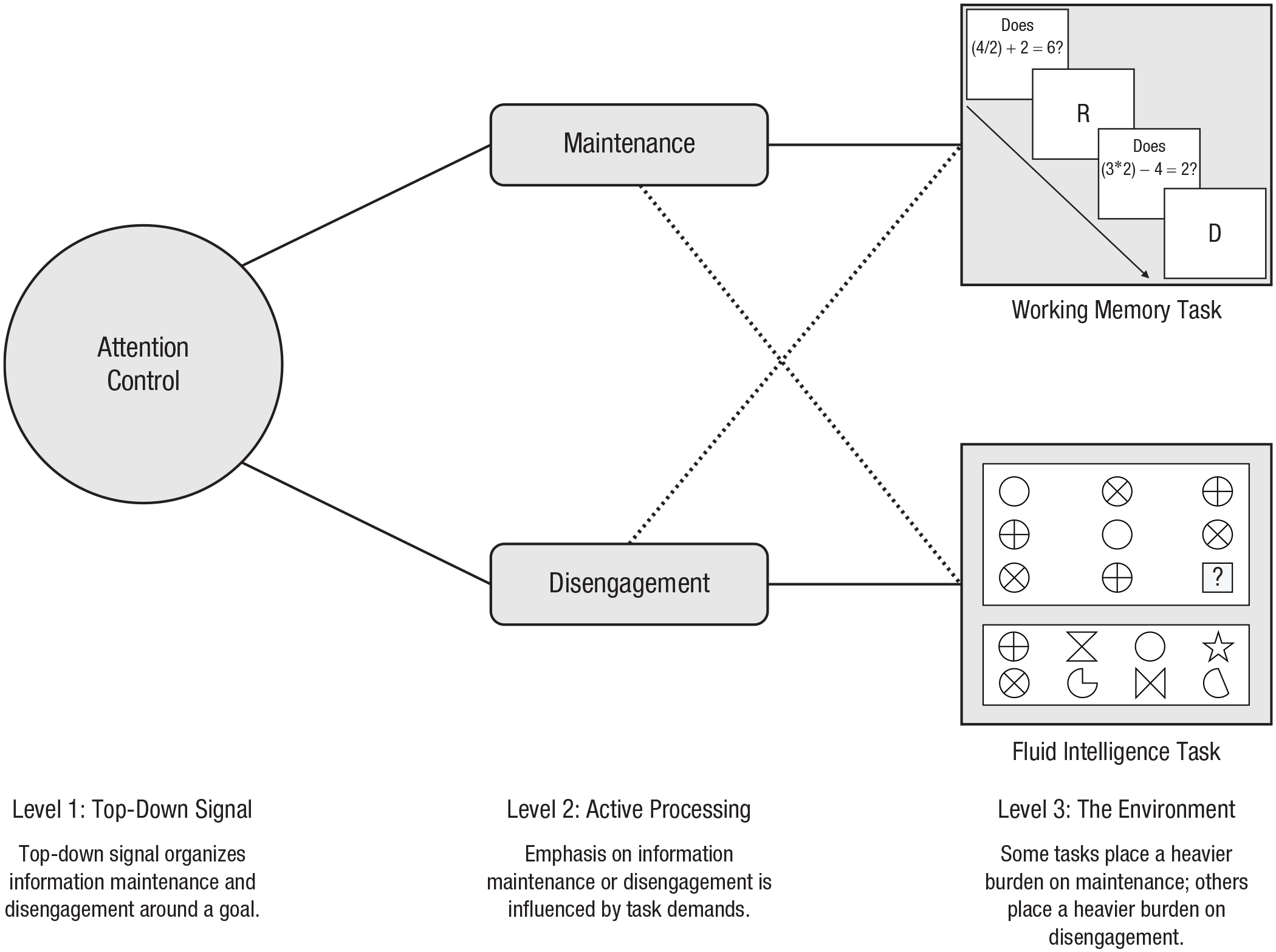
Schematic showing how attention control supports information maintenance and disengagement in service of complex cognition (Shipstead, Harrison, & Engle, 2016). For example, in a working memory task, participants must solve math equations while remembering letters. Information maintenance is critical to keep track of the letters (indicated by the solid line). Disengagement appears to play less of a role (indicated by the dotted line); however, participants must disengage from letters from prior trials. As another example, in a fluid intelligence task, participants are shown a 3 × 3 grid of symbols with the symbol in the bottom right corner missing. They must select from a set of options the symbol that best completes the pattern. Disengagement from faulty hypotheses is critical to successfully solve the problem (indicated by the solid line). Maintenance appears to play less of a role (indicated by the dotted line); however, participants must keep track of information to generate novel hypotheses. In the schematic, Levels 1 and 2 represent cognitive processes that might be reflected in task performance. Level 3 represents the specific tasks that a person might be trying to perform.
The Link Between Sensory Discrimination and Intelligence
Working memory and fluid intelligence are not the only broad cognitive abilities in which attention control is important. Attention control also plays a role in sensory discrimination—the ability to make fine perceptual judgments about visual, auditory, and other sensory stimuli. In one sensory discrimination task, two tones are presented sequentially, and the listener must determine which tone has a higher pitch. Musicians will recognize that this taps a similar skill to tuning a stringed instrument. A recent project from our lab revealed that attention control correlated very strongly with auditory and visual sensory discrimination ability and explained its relationships with fluid intelligence and working memory capacity (Fig. 2; Tsukahara, Harrison, Draheim, Martin, & Engle, 2020). That is not to say attention control tells the whole story as to why individuals differ in sensory discrimination ability. It does, however, appear to explain why sensory discrimination has strong associations with seemingly unrelated higher-order cognitive functions. On a theoretical level, we think attention control supports sensory discrimination by boosting the signal-to-noise ratio during the encoding of sensory stimuli and by preventing interference from distraction.
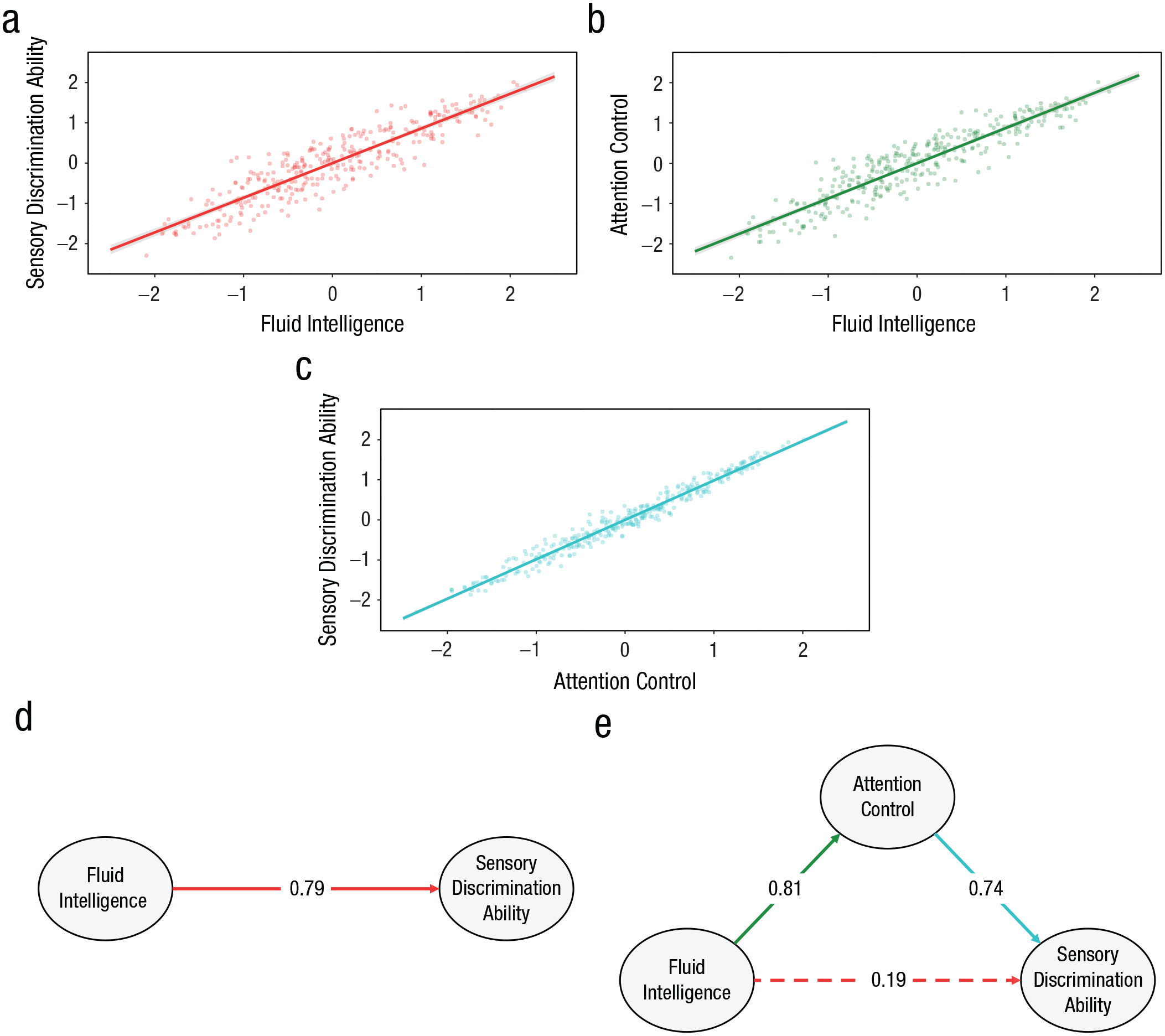
Results from a study on attention control and auditory and visual sensory discrimination ability (N = 331; Tsukahara, Harrison, Draheim, Martin, & Engle, 2020). The scatterplots (with best-fitting regression lines) show the relation between (a) fluid intelligence and sensory discrimination ability, (b) fluid intelligence and attention control, and (c) attention control and sensory discrimination ability. Points represent estimated scores on latent factors; the gray band around each best-fitting regression line represents 95% confidence intervals. As can be seen in (a), (b), and (c), strong relationships were found between fluid intelligence, sensory discrimination ability, and attention control. The path models show relationships between latent factors (ovals) representing fluid intelligence and sensory discrimination ability, both (d) without and (e) with attention control included as a mediator. Values shown are standardized coefficients. In (e), solid arrows indicate significant paths, and the dashed arrow indicates a nonsignificant path. The direct relationship between fluid intelligence and sensory discrimination ability (d) was significant, but after attention control was accounted for (e), the path from fluid intelligence to sensory discrimination ability was no longer significantly different from zero. In other words, attention control fully mediated the relationship between fluid intelligence and sensory discrimination ability.
What’s the Use?
From an applied perspective, attention control has important implications for real-world performance and personnel selection assessments. Until recently, however, most individual-differences measures of attention control were unreliable, which stymied their use not only in applied contexts but also in theory development. Briefly, the crux of the unreliability problem was the use of difference scores—the subtraction of performance in one condition from performance in another. Using the Stroop task as an example, one would take the difference between someone’s average reaction time on congruent and incongruent trials. Unfortunately, as the correlation between performance in each condition increases, the reliability of the difference score decreases, and this is exacerbated by the extent to which the condition scores are less than perfectly reliable (Draheim, Mashburn, Martin, & Engle, 2019; Hedge, Powell, & Sumner, 2018). Given reasonable assumptions, such as acceptable reliability for the condition scores and a strong correlation between them, the unreliability of their difference score can be so severe that less than 10% of its variance reflects the construct of interest; the rest is noise. Because unreliability attenuates the upper-bound correlation between variables, traditional individual-differences measures of attention control hardly predicted anything, including other measures of the same construct (for a discussion, see Paap & Sawi, 2016).
With this in mind, our lab recently developed new and improved attention-control tasks that had higher reliabilities, stronger intercorrelations, and higher loadings on a common factor than traditional measures (Draheim et al., 2020). 1 We circumvented the difference-score problem by using a thresholding approach—the tasks get easier or harder depending on the participant’s performance but are programmed to converge on the same critical accuracy rate for each participant. The measure of performance is not accuracy or a reaction time difference score across conditions but, instead, the task difficulty level at which the participant could maintain the critical accuracy rate (Fig. 3).

The Stroop adaptive-deadline task used to measure attention control. The participant’s task is to indicate the color of the word, not the color the word refers to. The difficulty of the task is determined by the adaptive-duration response deadline. In this example, the participant is first shown the word “RED” printed in green (an incongruent trial because the word name and its color do not match). The participant must press a button on the keyboard corresponding to the color green within 960 ms of the presentation of the word “RED.” A correct response causes the task to become more difficult; the adaptive-duration response deadline gets shorter (from 960 ms to 870 ms), requiring quicker responses. After an interstimulus interval (duration randomly determined), the participant is shown the word “BLUE” printed in blue (a congruent trial because the word name and its color match). If the participant does not respond before the response deadline of 870 ms, they are alerted that they did not respond quickly enough and are encouraged to respond faster. The measure of performance is the duration of the response deadline at the conclusion of the task.
Putting these new attention-control tasks to use, we found that they predicted multitasking performance above and beyond scores on the Armed Services Vocational Aptitude Battery, the standardized test taken by all personnel enlisting in the U.S. military (Martin, Mashburn, & Engle, 2020). If attention-control measures can improve the prediction of real-world performance, they can increase job fit and training retention rates, capitalizing on individuals’ strengths and reducing the likelihood of costly selection errors. As a follow-up to this in-lab study, we are now administering our attention-control tests to pilots and air traffic controllers in training to determine whether attention control predicts individual differences in complex skill acquisition. Because our new attention-control tasks demonstrate strong test-retest reliability, are quick to administer, and require little culturally derived knowledge, they show promise for use in applied contexts and have the possible additional benefit of less bias against culturally disadvantaged groups.
Domain General or Task Specific?
There is currently a great deal of interest in whether individual differences in attention control are domain general or task specific. Could someone be adept at controlling their attention in some situations but susceptible to distraction and interference in others? By extension, could attention-control training mitigate cognitive limitations and improve overall functioning? First, we maintain that attention control is a domain-general ability but that measures of attention control are influenced by task-specific factors. For example, individuals differ in the strategies they use when performing attention-demanding tasks. Some strategies are more effective than others, yet strategy choice is largely unrelated to individual differences in ability (Irons & Leber, 2020). We recommend that researchers collect multiple measures of constructs and perform latent variable analyses when possible to extract variance shared across tasks and reduce task-specific effects on overall estimates of ability. Second, although strategy use may be a trainable aspect of task performance, the overwhelming conclusion to emerge from “brain-training” research is that improvements on trained tasks do not transfer to global improvements in cognitive functioning (Simons et al., 2016).
A Piece of the Puzzle
At the outset, we stated that attention control is a common thread linking many higher-order cognitive functions, but it is not necessarily the only common thread. What else might contribute? Cognition is nothing if not complex, and single-variable explanations rarely, if ever, fully account for all phenomena of interest. Therefore, research using a multifactorial approach is well suited to identify the overlapping and independent contributions of different explanatory mechanisms to higher-order cognition and behavior. Beyond this multifactorial approach, a deeper, more unified understanding will come from the confluence of methods of inquiry, namely, experimental and correlational psychology (Cronbach, 1957).
Conclusion
More than a century ago, William James (1899) argued that “Ninety-nine hundredths or, possibly, nine hundred and ninety-nine thousandths of our activity is purely automatic and habitual, from our rising in the morning to our lying down each night” (p. 33). We would argue that the remainder, to a certain extent, requires attention control. Although research on attention control shows great promise in theoretical and applied contexts, important issues remain unaddressed. For example, in future work, we hope to further disentangle the scope and intensity of attention—metaphorically, the former can be thought of as the size of the attentional spotlight, whereas the latter is how bright the spotlight shines. We are also interested in determining whether attention-control tasks are a viable option for reducing gender and racial test bias in assessments used for personnel selection. Finally, we hope to bridge gaps between clinical, educational, and cognitive psychology because research on attention control stands to inform each of these diverse areas of study.
Recommended Reading
Draheim, C., Tsukahara, J. S., Martin, J. D., Mashburn, C. A., & Engle, R. W. (2020). (See References). Description of the development of new attention-control tasks.
Engle, R. W. (2018). (See References). Further discussion of attention control and its role in working memory and fluid intelligence.
Kane, M. J., & Engle, R. W. (2002). The role of prefrontal cortex in working-memory capacity, executive attention, and general fluid intelligence: An individual-differences perspective. Psychonomic Bulletin & Review, 9, 637—671. Presents an executive-attention framework for organizing the cognitive-neuroscience research on working memory capacity, fluid intelligence, and prefrontal cortex function.
Shipstead, Z., Harrison, T. L., & Engle, R. W. (2016). (See References). A review of the contribution of information maintenance and disengagement to higher-order cognition.
