



Abstract
In engineering, form follows function. It is therefore difficult to understand an engineered object if one does not examine it in light of its function. Just as understanding the structure of a lock requires understanding the desire to secure valuables, understanding structures engineered by natural selection, including emotion systems, requires hypotheses about adaptive function. Social emotions reliably solved adaptive problems of human sociality. A central function of these emotions appears to be the recalibration of social evaluations in the minds of self and others. For example, the anger system functions to incentivize another individual to value your welfare more highly when you deem the current valuation insufficient; gratitude functions to consolidate a cooperative relationship with another individual when there are indications that the other values your welfare; shame functions to minimize the spread of discrediting information about yourself and the threat of being devalued by others; and pride functions to capitalize on opportunities to become more highly valued by others. Using the lens of social valuation, researchers are now mapping these and other social emotions at a rapid pace, finding striking regularities across industrial and small-scale societies and throughout history.
In engineering, structure is narrowly dictated by the desired function—roads for traveling, locks for locking up valuables, chromatographers for analyzing mixtures, and so on. This principle can be exploited in reverse, that is, when an engineered object is before you and your task is to characterize it. Reverse engineering in light of candidate functions is illuminating also when it comes to emotion systems and other complex products of natural selection. The social emotions—gratitude, pride, anger, shame, guilt, envy, jealousy, and others—evolved because they each orchestrated physiology, cognition, and behavior in ways that tended to solve challenges and exploit opportunities posed by the social interactions human ancestors engaged in. A central function of these emotions appears to be the recalibration of social evaluations in the minds of self and others (Sznycer, Cosmides, & Tooby, 2017; Tooby & Cosmides, 2008).
Being valued by others is a critical resource for humans (Baumeister & Leary, 1995). When other people value you, they are inclined to attend to you, to associate with you, to come to your aid when you are in need, to side with you in conflicts with third parties, and to refrain from exploiting you. And when other people do not value you, they are not so inclined.
The fact that people can value and have concern for the welfare of other people is not trivial. Valuing others often carries costs (e.g., lost resources, forgone opportunities), which the valuer’s genes must somehow recoup, on average, if the psychology of valuation is to persist in the brain over the generations. Nor is the human psychology for valuing others common across species. For example, most nonhuman primates seldom confer benefits on genetically unrelated individuals, and when they do, it is often a response to coercion.
Over the past 60 years, evolutionary biologists have modeled the narrow set of conditions in which it pays to benefit another individual, even (within limits) at a personal cost. To this mathematical mix, anthropologists, archaeologists, and behavioral ecologists have added findings relevant to the social ecology of early humans (e.g., caring for the sick in the hominin lineage; Sugiyama, 2004). Together, these models and knowledge have informed the study of the human psychology of social valuation. This psychology appears to compute the social value of each fellow group member (with reference to the self, the focal individual) on the basis of available cues relevant to the various biological games that determine social value among humans (e.g., value of individual x as kin, value of individual x as ally; Tooby et al., 2008).
The evolution of the human psychology of social valuation would have led, in turn, to novel adaptive problems of valuation. By hypothesis, the social emotions evolved because they solved these problems reliably. For example, the anger system functions to incentivize the target of one’s anger to value one’s welfare more highly when one deems the target’s current level of valuation insufficient. Gratitude functions to jump-start and maintain a cooperative relationship with another individual when there are indications that the other values one’s welfare. Shame functions to minimize the spread of discrediting information about oneself and the threat of being devalued by others. Pride functions to capitalize on opportunities to become more highly valued and respected by others. And so on.
This form-function approach can account for many known features of the social emotions (Table 1). In addition, this approach can be used deductively, to predict and guide the search for heretofore unknown features of social emotions. Next, we briefly review anger, gratitude, shame, and pride to illustrate this approach. (For an evolutionary approach emphasizing the phylogeny of human emotions, see, e.g., Weisfeld & Dillon, 2012.)
Elicitors, Adaptive Functions, Modulating Factors, and Outputs of the Anger, Gratitude, Shame, and Pride Systems
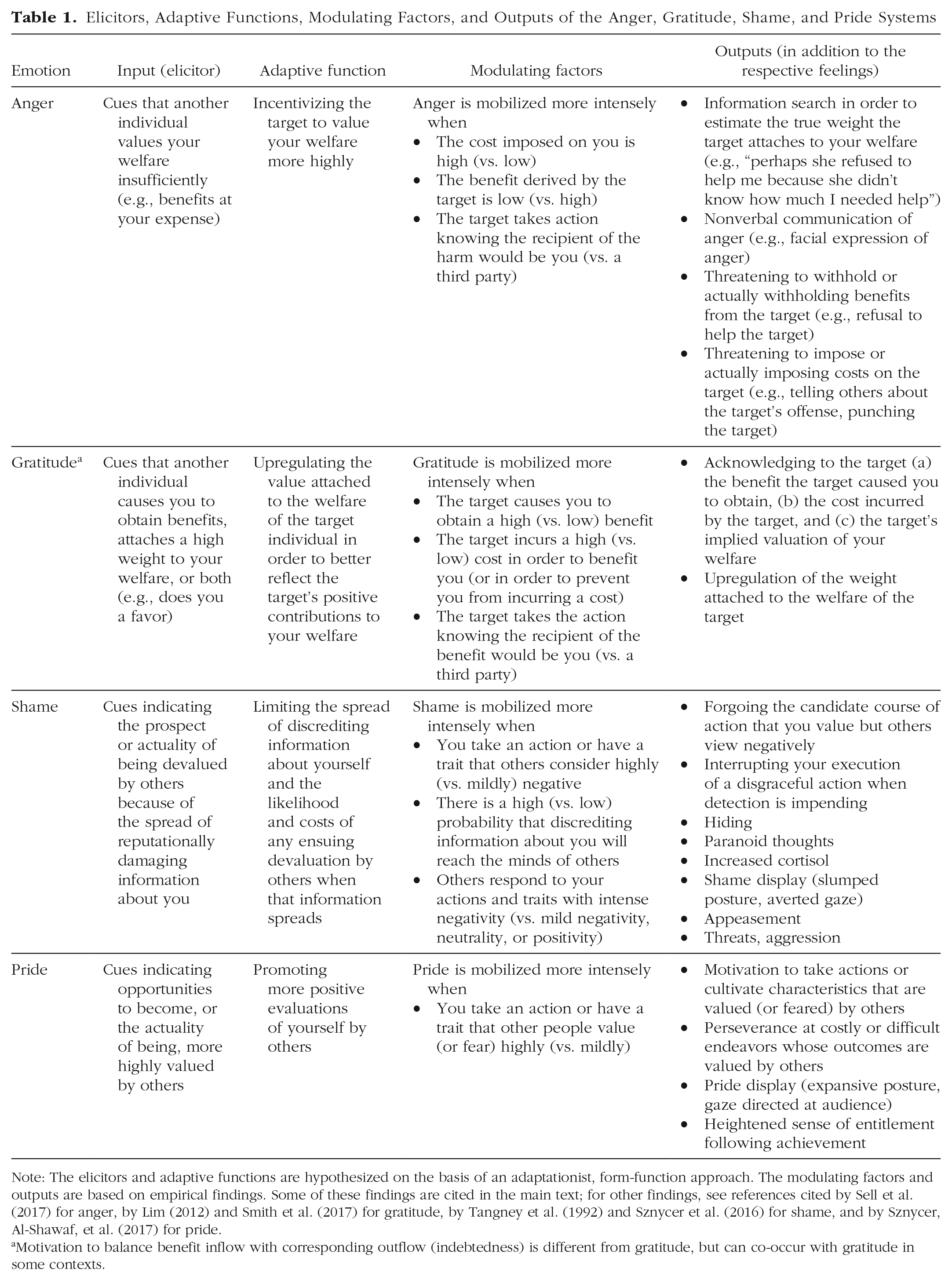
Note: The elicitors and adaptive functions are hypothesized on the basis of an adaptationist, form-function approach. The modulating factors and outputs are based on empirical findings. Some of these findings are cited in the main text; for other findings, see references cited by Sell et al. (2017) for anger, by Lim (2012) and Smith et al. (2017) for gratitude, by Tangney et al. (1992) and Sznycer et al. (2016) for shame, and by Sznycer, Al-Shawaf, et al. (2017) for pride.
Motivation to balance benefit inflow with corresponding outflow (indebtedness) is different from gratitude, but can co-occur with gratitude in some contexts.
Anger
It is a problem for you when other individuals attach insufficient weight to your welfare—less weight than what you can cost-effectively enforce from them. When people value you insufficiently, they will impose costs on you even when they stand to gain little, they will fail to help you when you are in need, they will pay little attention to your predicaments, and so on (Sell et al., 2017). The adaptive problem of being valued insufficiently would have selected for neurocognitive machinery that functions to incentivize the undervaluer to place more value on the focal individual. It has been argued that anger is this mechanism (Sell, 2011; Sell et al., 2009).
Anger is triggered when cues indicate that another individual undervalues you. Note that mere disregard of your welfare is insufficient to elicit anger if you do not expect the target individual to value you in the first place (e.g., a refusal to help you move to your new apartment might elicit less anger in you if the refuser is a mere acquaintance than if the refuser is a close friend of yours). Harm, too, is insufficient to elicit anger if the harm is not diagnostic of insufficient valuation (e.g., your friend ruined your scarf by using it as a tourniquet to save her daughter’s life).
Research findings indicate that an offender’s action reliably elicits anger in the victim when the offender (a) knows the identity of the victim ahead of taking the action, (b) imposes large costs on the victim, and (c) derives small benefits from the action (Sell et al., 2017). For example, if your friend ruins your scarf, you might feel more anger at her if (a) you learn that your friend knew the scarf was yours, (b) it was an heirloom silk scarf, and (c) your friend used the scarf to wipe her mouth after a meal, and you might feel less anger at her if (a) you learn that your friend mistakenly thought the scarf was someone else’s, (b) the scarf was a cheap one, and (c) your friend used the scarf as a tourniquet to save a life. Anger can also be triggered by insulting beliefs, such as when someone thinks that you are ungenerous, weak, or unskilled. Those factors determine how much humans value other humans, and so indications that someone underestimates your value on those factors augur poor treatment.
Once triggered, the anger system deploys tactics to incentivize the target of the anger to value the angry individual more highly. These tactics carry the implicit message “Pay the cost of valuing me more highly (e.g., help me next time), or I will exact an even higher cost from you.” One type of anger tactic involves threatening to withhold or actually withholding benefits. Another type of anger tactic involves threatening to impose or actually imposing costs through aggression. The increases in heart rate, blood pressure, and respiration rate that accompany anger (Siegel et al., 2018) suggest preparation for combat. The aggression deployed by anger—when it is deployed at all—increases in measured steps and is terminated by indications that the target has recalibrated his or her valuation appropriately (see Sell, 2011). Thus, the aggression of anger is designed to bargain for better treatment rather than to eliminate the target.
The form-function approach raises questions that are invisible to other perspectives. For example, why does the anger face look the way it does? Using this approach, researchers have hypothesized that the facial expression of anger was engineered by natural selection to enhance cues of physical formidability in the face in ways similar to how nonhuman animals aggrandize their body size or weaponry during aggression (e.g., by erecting their hair or baring their fangs). Consistent with this hypothesis, research has shown that each of the seven muscle contractions that constitute the anger face increases participants’ perception of the expresser’s physical strength (Sell et al., 2014).
The form-function approach has also been used to understand the content of the verbal arguments made by offenders and their angry victims. When anger in a victim is triggered by, for example, an offender benefiting at the expense of the victim, the offender can defuse that anger if the victim can be convinced that, in reality, (a) the cost incurred by the victim was small, (b) the benefit derived by the offender was large, or (c) the offense was not directed specifically at the victim. That is, the anger of a victim is switched off if the victim encounters clarifying information that the offense does not actually indicate insufficient valuation on the part of the offender. Research conducted by Sell et al. (2017) has provided support for these predictions and also shown that offenders capitalize on their implicit knowledge of the logic of anger: Offenders choose to make precisely those verbal arguments that mollify anger in victims. These findings were obtained in five industrial nations and one hunter-horticulturalist population of the Ecuadorian Amazon.
Gratitude
The existence and actions of other people have effects on the focal individual that can range from highly detrimental to highly beneficial. Some of these effects are simple side effects of other people’s activities (e.g., dumping trash in a common area); other effects are intended (e.g., helping). In general, people have a stake in the well-being of those individuals whose existence and actions cause them to benefit (Tooby & Cosmides, 1996). This evolutionarily recurrent situation would have selected for machinery to identify individuals from whom one derives benefits, to correspondingly upgrade how much one values those individuals (and thus to make investments in their continued existence and well-being), and to signal one’s upgraded valuation to those individuals. These functions appear to be realized by the gratitude system (Lim, 2012).
Gratitude is a complex emotion. Everything else being equal, the more a benefactor values your welfare, the more that benefactor will go out of his or her way to benefit you, and the more you will derive benefits from him or her—and therefore the more gratitude you will feel and the more your valuation of the benefactor will be increased. Everything else is not always equal, however. Some individuals cause you to benefit as a side effect of their actions even when they do not value your welfare particularly highly. Other individuals value your welfare highly, but their actions cause you to obtain benefits that are modest in size. Both benefactor types contribute to your welfare, and so both may elicit gratitude and enhanced valuation of their welfare on your part. However, they may warrant somewhat different modes of gratitude.
Indeed, this emotion appears to be sensitive to different kinds of information relevant to different benefactor types. Gratitude is sensitive to the benefits delivered by a benefactor (Forster et al., 2017; Tesser et al., 1968). This would allow the gratitude system to not miss benefactors who cause you to benefit as a mere side effect of their actions. In addition, gratitude is sensitive to cues of how much the benefactor values your welfare, including how much the benefactor intended to benefit you (Tesser et al., 1968; Tsang, 2006; see also Smith et al., 2017) and how much cost the benefactor incurred to benefit you by a given amount (the ratio of costs to benefits; Lim, 2012). This would allow the gratitude system to not miss benefactors who value your welfare and who will therefore tend to benefit you reliably, even if modestly.
Gratitude and increased valuation directed at a person who provides a benefit tend to give that person a stake in the well-being of the focal individual. This dynamic can lead to a cycle of mutual escalating valuation, which can result in, for example, friendship (Algoe et al., 2008; Tooby & Cosmides, 1996). Gratitude is thus a key emotion in jump-starting and maintaining cooperative relationships.
Shame
Humans devalue and shun individuals who are poor social partners. This would have selected, on the recipient’s end, for adaptations to solve the adaptive problem of being devalued. Shame appears to be a primary defense against this adaptive problem (Gilbert, 1998; Sznycer et al., 2016).
Shame is triggered by the prospect or actuality of being devalued by others. Once active, the shame system mobilizes a host of responses geared to minimizing the likelihood and costs of being devalued. Shame is associated with depression, anxiety, and paranoid ideation (Tangney et al., 1992), which may prepare the focal individual to face a less benign social landscape. Shame is also associated with increased cortisol and increased pro-inflammatory cytokine activity (Dickerson et al., 2004); the latter might be advantageous if devaluation is followed by aggression and injury or infection.
The behavioral repertoire of shame is broad. From the perspective of the disgraced or to-be-disgraced individual, a trait (e.g., incompetence) or course of action (e.g., theft) that fellow group members view negatively can be shielded from others’ censure at each of various junctures: imagination, decision making, action, information diffusion within the community, and audience reaction. Shame appears to have authority over devaluation-minimizing responses relevant to each of these junctures. For example, shame can lead people to turn away from courses of actions that might lead others to devalue them, to interrupt their execution of discrediting actions, to conceal and destroy reputationally damaging information about themselves, and to hide. When an audience finds discrediting information about the focal individual and condemns or attacks that individual, the shamed individual may apologize, signal submission, appease, cooperate, obfuscate, lie, shift the blame to others, or react with aggression. These behaviors are heterogeneous from a tactical standpoint; some even work at cross-purposes if mobilized concurrently. But each of these behaviors appears to have the strategic potential to limit the threat of devaluation in certain contexts, combinations, or sequences.
Such shame-inspired behaviors as hiding, scapegoating, and aggressing are undesirable from the standpoint of victims and third parties. This has led to the view that shame is an ugly and maladaptive emotion (Tangney et al., 1996). However, note that those behaviors can enhance the welfare of the focal individual, who is pressed to escape detection and minimize or counteract devaluation by others. Whereas the consequences of social devaluation are certainly ugly for the individual being devalued, the form-function approach suggests instead that shame is an elegantly engineered system that transmits bad news of the potential for devaluation to the array of counter-devaluation responses available to the focal individual.
It is a common view that shame occurs when the focal individual attributes a negative outcome (e.g., a failure) to a defect of the global self (Tangney et al., 2007). However, being devalued by numerous or powerful others elicits shame even when the devalued individual knows propositionally that he or she did not cause a negative outcome (Robertson et al., 2018).
The form-function approach has been used to understand how shame is modulated. The intensity of anticipatory shame that people feel regarding a given potential action that others view negatively (e.g., theft) tracks the precise degree to which fellow group members devalue those individuals who take that specific action. This allows the shame system to be mobilized cost-effectively: to activate neither insufficiently nor excessively relative to the magnitude of the devaluative threat. These findings were obtained consistently across three industrial societies (Sznycer et al., 2016) and 15 traditional small-scale societies highly different from one another in their languages, belief systems, and subsistence bases (Sznycer, Xygalatas, Agey, et al., 2018). Shame even tracks the evaluations of lawmakers from ancient, culturally foreign societies: The intensity of shame that laypeople report they would feel if they committed offenses excerpted from ancient Mesopotamian and Chinese laws tracks the actual punishments provided for those offenses by those ancient laws (Sznycer & Patrick, 2020). These findings raise questions about theories positing massive cultural differences in shame (e.g., Benedict, 1946) and suggest instead that shame is part of a universal human nature.
Pride
Becoming more highly valued by others results in a greater inflow of benefits, and the brain may have been selected to exploit the relevant opportunities. The pride system appears to be the resulting adaptation. A system realizing this function is expected to (a) motivate the pursuit of achievements or the cultivation of traits that are valued (or feared) by others, (b) motivate the advertisement of achievements, and (c) motivate the achiever to profit from the increased valuation by others.
Findings about pride are consistent with these hypotheses. Pride is triggered by acts, traits, and events indicative of the focal individual’s enhanced capacity to confer benefits (e.g., job promotion) or impose costs (e.g., winning a fight) on others (Lewis et al., 1992; Tracy, 2016). The feeling of pride is highly pleasant and rewarding. This feeling motivates the individual to persevere and to invest in courses of action necessary to bring about further achievement (Gilchrist et al., 2018).
Once attained, achievements are advertised with a full-body display featuring erect and expansive posture and gaze trained at the audience. The pride display develops in the absence of visual input: Congenitally blind individuals produce the pride display when they succeed (Tracy, 2016). Adults across cultures perceive the pride display as an indication that the displayer is successful or physically formidable (Tracy, 2016).
Pride motivates the focal individual to profit from the enhanced social landscape that follows achievement. Pride leads people to pursue new challenges previously beyond reach. In addition, the enhanced capacity to confer benefits or impose costs on others—elicitors of pride—leads the focal individual to expect others to value him or her more highly (Sznycer & Cohen, 2021), and to become angry when that expectation is not met (Sell et al., 2009).
The form-function approach has been used to understand how pride is modulated. As in the case of shame, pride tracks the values of audiences. More specifically, the intensity of anticipatory pride regarding a given achievement is modulated to match the precise degree to which fellow group members value those individuals who attain that specific achievement. These findings were observed in 16 industrial societies (Sznycer, Al-Shawaf, et al., 2017; Sznycer & Lukaszewski, 2019) and in 10 traditional small-scale societies (Sznycer, Xygalatas, Alami, et al., 2018). Similar modulation relative to social value was observed in other social emotions as well (Sznycer & Lukaszewski, 2019; Fig. 1).
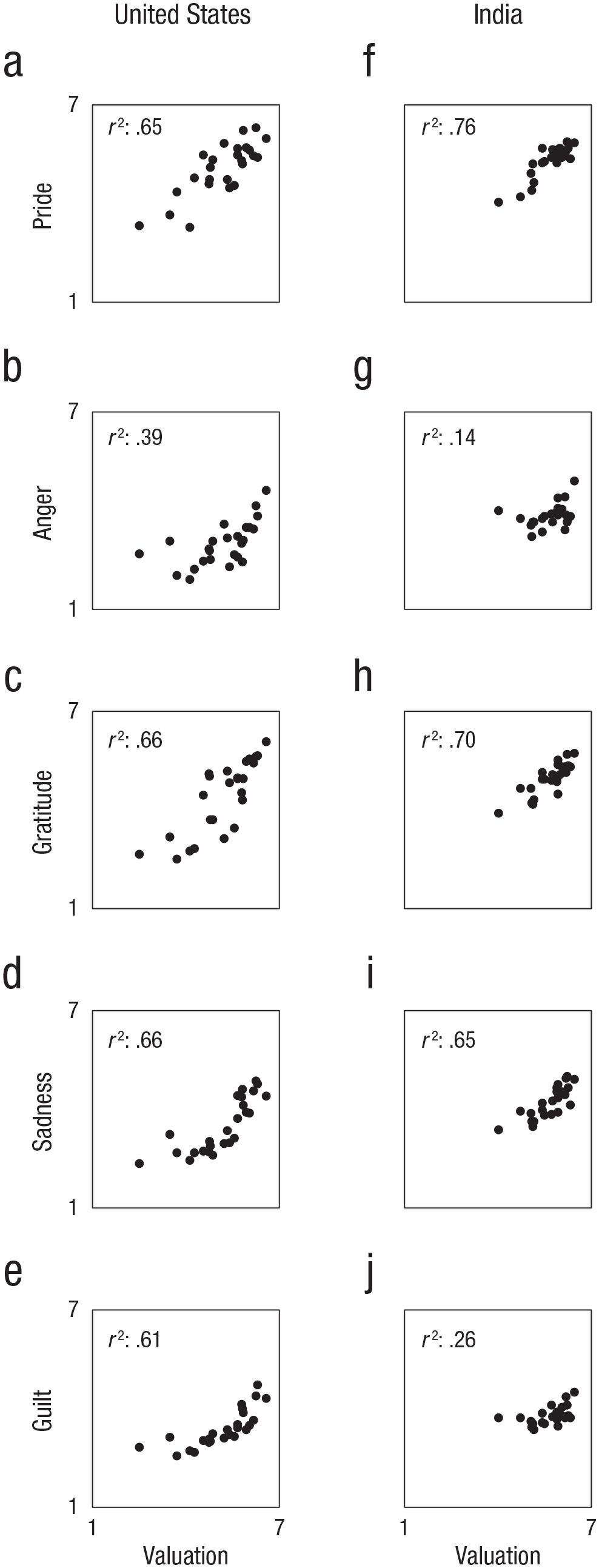
Linkage of social emotions to a common psychology of social valuation. The scatterplots show the association between people’s valuation of 25 positive personal characteristics in others (e.g., trustworthiness, bravery, ambitiousness, good table manners) and the anticipated intensity of a focal individual’s pride (for having those characteristics), anger (toward someone who fails to acknowledge that the focal individual has those characteristics), gratitude (toward someone who convinces others that the focal individual has those characteristics), sadness (if someone who had those characteristics dies), and guilt (for harming someone who has those characteristics). Each point in each panel represents the mean valuation rating and mean emotion rating of one personal characteristic. Ratings of valuation, pride, anger, gratitude, sadness, and guilt were given by different participants (between-participants design). The data in (a) through (e) are from the United States, and the data in (f) through (j) are from India. From “The Emotion–Valuation Constellation: Multiple Emotions Are Governed by a Common Grammar of Social Valuation,” by D. Sznycer and A. W. Lukaszewski, 2019, Evolution and Human Behavior, 40(4), p. 399. Copyright 2019 by Elsevier. Reprinted with permission.
Concluding Remarks
The human psychology of social valuation is highly complex and specialized. This psychology likely constitutes the environment that selected for the social emotions over evolutionary time and that social emotions target in their moment-to-moment operation. These conjectures help explain the ways people feel, think, and act when under the spell of anger, gratitude, shame, pride, guilt, envy, and other emotions. These conjectures also help identify the things over which people feel anger, gratitude, shame, pride, guilt, envy, and other emotions. The form-function approach appears to be a powerful framework for dissecting the social emotions.
Recommended Reading
Lieberman, D., Tooby, J., & Cosmides, L. (2007). The architecture of human kin detection. Nature, 445(7129), 727–731. A landmark study showing cue-based estimation of genetic relatedness and downstream calibration of altruism and sexual disgust toward siblings.
Sznycer, D. (2019). Forms and functions of the self-conscious emotions. Trends in Cognitive Sciences, 23(2), 143–157. An extended analysis of the fit between form and function in pride, shame, and guilt.
Tooby, J., & Cosmides, L. (2008). (See References). An early proposal of the view that emotions have orchestrating and recalibrating functions.
Supplemental Material
sj-pdf-1-cdp-10.1177_09637214211007451 – Supplemental material for Forms and Functions of the Social Emotions
Supplemental material, sj-pdf-1-cdp-10.1177_09637214211007451 for Forms and Functions of the Social Emotions by Daniel Sznycer, Aaron Sell and Debra Lieberman in Current Directions in Psychological Science
Footnotes

References
Supplementary Material
Please find the following supplemental material available below.
For Open Access articles published under a Creative Commons License, all supplemental material carries the same license as the article it is associated with.
For non-Open Access articles published, all supplemental material carries a non-exclusive license, and permission requests for re-use of supplemental material or any part of supplemental material shall be sent directly to the copyright owner as specified in the copyright notice associated with the article.
