




Abstract
Market exchange and the ideologies that accompany it pervade human social interaction. How does this affect people’s beliefs about themselves, each other, and human nature? Here we describe market cognition as social inferences and behaviors that are intensified by market contexts. We focus on prosociality and two countervailing ways in which market cognition can affect it. On the one hand, marketplaces incentivize individuals to behave prosocially in order to be chosen as exchange partners—thereby generalizing cooperation and trust beyond group boundaries. On the other hand, markets encourage a view of people as self-interested and can thus taint people’s interpretation of prosocial actions and erode more communal forms of cooperation. We close by considering how market cognition can become self-fulfilling, altering relationships, communities, and cultural norms.
Economics are the method; the object is to change the heart and soul.
Market exchange—in which people trade goods and services according to norms of pricing, supply, and demand—is a defining feature of modern life. Recent and steady deregulation has intensified the role of markets in politics, environmental management, and health care across much of the world (Harvey, 2007). Likewise, the ascendance of “sharing” and “gig” economies means that individuals increasingly place their homes, cars, and time directly into the market. Summarizing these trends, the philosopher Michael Sandel (2012) argued that these trends have fundamentally reshaped society, such that “market values seep into every aspect of human endeavor . . . [and] social relations are made over in the image of the market” (p. 10).
Neoliberalism and other free-market ideologies hold that a market society is aspirational. In the interview quoted at the opening of this review, Thatcher described a psychological goal of the neoliberal project: to shift people’s “hearts and souls” toward individualism and personal advancement. Other observers, including Sandel (2013), have argued that markets can be psychologically corrosive, because commodification corrupts society’s oldest and dearest social contracts.
How do markets affect cognition and behavior? Synthesizing previous work, we use the term market cognition to encapsulate the psychological effects of engaging with—and thinking about—market exchange as a primary form of human interaction. A wellspring of recent research has probed the effects of neoliberalism on concepts of the self, well-being, and attitudes toward inequality (Adams et al., 2019; Bettache & Chiu, 2019; Hartwich & Becker, 2019). Here, we focus primarily on how market cognition alters prosociality: behaviors that help other people, including cooperation and altruism.
Characterizing Market Cognition
It would be awkward to ask for the check at a friend’s dinner party, and illegal to leave a restaurant without paying, instead thanking the chef and offering to have him or her over next week. Contexts shift how people behave and what they expect of each other; market cognition refers to such shifts that occur in the context of market-based interactions.
Crucially, this definition does not require that a behavior or cognition arise only in market contexts. It can—and more often does—refer to behaviors and cognitions that are intensified, dampened, or altered during market exchange. Prosocial behaviors, for instance, long preceded market exchange and commonly occur outside of it, but markets nonetheless affect both people’s tendency to behave prosocially and their interpretations of each other’s prosociality.
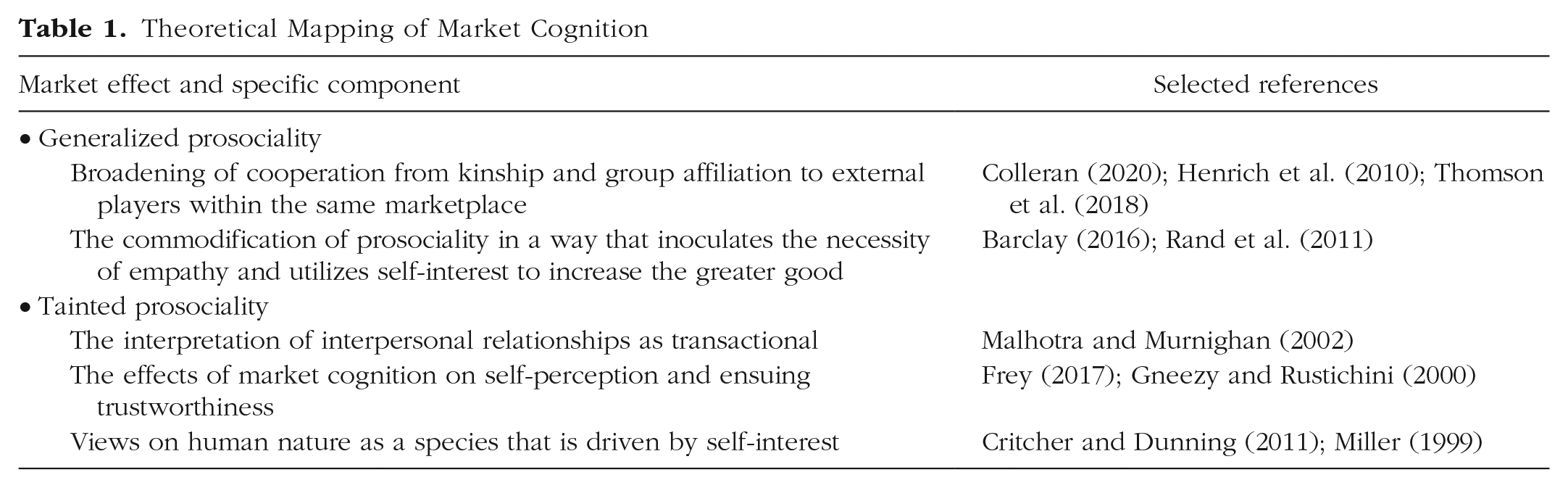
Here we explore two key ways in which these effects occur: (a) by generalizing prosocial behavior beyond kin and social groups and (b) by tainting interpretations of prosocial acts (see Table 1 for a summary).
Theoretical Mapping of Market Cognition
The Light Side: Generalized Prosociality
A core tenet of capitalist philosophy holds that markets catalyze collective well-being by incentivizing people to help one another—for instance, by producing goods others need and exchanging them fairly. Crucially, this means that people will act prosocially even absent a prosocial motive. Adam Smith (1776/2002) famously wrote, “It is not from the benevolence of the butcher, the brewer, or the baker that we expect our dinner, but from their regard to their own self-interest” (p. 16).
In other words, marketplaces can align self-interest and the common good. One advantage of this combination is that it might generalize prosocial tendencies. Nonmarket sources of prosociality, such as empathy, can be biased toward people who share one’s kinship or social identity, and thus lead to parochial prosociality that favors in-group members (Bruneau et al., 2017). By contrast, a market setting might focus individuals on the value of cooperating with anyone who takes part in that marketplace, including strangers and out-group members—a form of market cognition that could encourage prosocial behavior beyond group boundaries.
At least some data suggest that participation in markets does generalize prosociality. In a series of classic studies by Henrich et al. (2005, 2010), individuals from numerous cultures took part in simple economic games. The market integration of a given culture—for instance, the proportion of individuals’ calories that they purchase rather than produce themselves—predicted the prosociality and trust toward strangers exhibited by members of that culture during the games. More recently, Baldassarri (2020) left thousands of “lost letters” on the sidewalk areas of 188 Italian communities, which varied in their market integration. Letters left in communities with higher market integration were more likely to be returned, another sign of generalized prosociality.
One way exchange norms generalize prosociality is by creating a social marketplace. When people have choices about whom they interact with, individuals are incentivized to signal their honesty and trustworthiness in order to be chosen as partners (Barclay, 2016). Market cognition could thus induce prosociality by turning it into a form of social advertisement.
Consistent with this idea, studies have demonstrated that individuals are more likely to act prosocially in the context of social marketplaces than outside of them. In iterated economic games, people cooperate more when individuals can choose partners from round to round rather than have their partners assigned (Rand et al., 2011), or when their actions are visible to other players who will later choose partners (Barclay, 2016). In social marketplaces, people even engage in prosociality “arms races,” competing to act more generously than others in order to be chosen as partners (Barclay & Willer, 2007).
If market cognition generalizes prosociality, it should also increase expectations that other people will act prosocially in market contexts, because it is in their best interest to do so. Consistent with this idea, a study of 39 countries found that nations with high relational mobility—where people report fluid relationships and high levels of choice about interaction partners—were also characterized by generalized trust in others (Thomson et al., 2018).
Economic and social marketplaces appear to go hand in hand. One recent study examined 22 Polish villages that were transitioning from primarily subsistence farming to more market-dependent economies. Across communities, market integration tracked the diversification of social connections, away from kin networks to broader ones based more on friendships chosen by the individual (Colleran, 2020). Similar differences arise across economic status. In the United States, individuals with higher socioeconomic status spend less time with family and more with friends, and are more likely to see relationships as expressions of individual choice (Adams et al., 2019; Bianchi & Vohs, 2016).
In sum, market cognition marries self-interest and prosociality in two ways. First, it redraws the boundaries of cooperation away from kin and social group and toward any participant in a market. Second, it commodifies prosocial behavior as an ante that individuals pay in order to signal their value as social partners.
The Dark Side: Tainted Prosociality
The economist Charles Schultze once praised the social effects of markets as follows: “Market-like arrangements reduce the need for compassion, patriotism, brotherly love, and cultural solidarity” (cited in Bowles, 2016, p. 220). But what are the costs of minimizing these human qualities in vast swaths of human interaction? As we have discussed, markets incentivize people to act prosocially even absent prosocial motives. But to people on the receiving end of those acts, motives matter, and self-interested kindness can appear shallow, inauthentic, or manipulative—a form of market cognition we refer to as tainted prosociality.
In one set of studies, observers rated generous acts accompanied by market incentives—such as tax breaks for charitable donations—as nonprosocial, and in some cases more selfish than not helping other individuals at all (Carlson & Zaki, 2018). People are aware of this, and in some cases purposefully avoid incentives so as to signal the authenticity of their own prosocial behaviors (Kirgios et al., 2020).
Likewise, in market contexts, individuals typically trust strangers to hold up their end of a bargain so long as it is in their best interest. But these very same norms might limit people’s trust outside the marketplace. In one study, participants in a trust game were given an option to select binding contracts that would penalize individuals for defecting. Contracts increased trust at first, but after they were removed, people trusted each other less than if no contract had ever been put in place, potentially because they interpreted the relationship as transactional (Malhotra & Murnighan, 2002).
Market cognition can also alter people’s interpretation of their own prosocial behaviors. Individuals given market incentives to act kindly might interpret their own actions as motivated by self-interest and decide to abandon prosociality when those incentives are gone. This phenomenon is known in psychology as overjustification (Lepper et al., 1973) and in economics as crowding out (Frey, 2017).
In one classic study, Israeli preschools exacted fines from parents who picked up their children late. This ironically led to a substantial increase in late pickups, presumably because parents reconstrued their motivation to be on time as a selfish desire to save money, possibly traded off against the convenience of picking up their children late (Gneezy & Rustichini, 2000). In a laboratory study, participants indicated the smallest financial incentive they would require to breach a partnership agreement. They were more willing to violate a promise when the contract included a damage clause (Wilkinson-Ryan, 2010), which suggests that market incentives made them view their own commitments to the relationship in more transactional terms. Likewise, in workplaces, certain incentives can cause employees to reinterpret their effort as purely incentive based and reduce their overall performance (Frey, 2017).
Market incentives might also diminish people’s sense of connection to one another. As Sandel (2013) wrote, “the money that would buy the friendship dissolves the good I seek to acquire” (p. 121). Research across cultural anthropology and social psychology accords with Sandel’s view. Fiske (1991) described four key forms of social relations, including communal sharing, in which closely bonded individuals do not monitor their contributions to a relationship. Clark and Mills (2011) applied a similar framework to personal ties, describing communal relationships as marked by tight social connection and an absence of social “score keeping.”
Communal relationships and norms are fundamental to well-being, in part because they generate a sense of unconditional social connection and acceptance. They are also fundamentally inconsistent with exchange norms. Thus, even when markets increase prosociality, they might limit its power to build lasting community, connection, and solidarity. This could occur through at least two mechanisms: (a) tainting inferences about prosocial motives and (b) causing even prosocial acts to be viewed as competitive within the social marketplace.
Little work has probed this effect directly, but in one fascinating set of studies, individuals were asked to imagine a near future defined by intensified neoliberal market norms, such as hyperindividualism and deregulation. After participating in this exercise, people experienced lower well-being and greater loneliness, in part because they were more likely to report a competitive stance toward others (Becker et al., 2021).
Finally, market cognition might taint people’s view of human nature writ large. A self-interested view of humanity is so central to economics that it has imagined a new species: homo economicus, characterized by a (mostly) singular quest to maximize personal utility. Homo economicus is surprisingly difficult to locate in the wild (Miller, 1999; Sen, 1977), but the image of this species has nonetheless colonized lay theories about human nature (Boyer & Petersen, 2018).
The notion of homo economicus aligns tightly with cynicism, or the view that people are fundamentally selfish and thus cannot be trusted. Cynics overestimate the role of self-interest in driving behavior (Miller, 1999) and explain away other people’s prosociality as veiled selfishness (Critcher & Dunning, 2011; Kaplan et al., 2004). Much as neoliberalism is associated with loneliness and decreased well-being, cynicism tracks deleterious health outcomes (Bunde & Suls, 2006) and corrodes social interaction. For instance, people who are more cynical are less likely to trust other people’s motives, and thus less likely to seek or offer social support (Kaplan et al., 2004).
Little research that we know of has directly tied cynicism to market exchange. Yet as our review has indicated, market contexts and incentives can induce a number of cynical appraisals of prosocial actions. A crucial direction for future work on market cognition will be to conduct cross-cultural or experimental studies to empirically examine whether exposure to market norms increases people’s likelihood of making cynical attributions.
One intriguing and related set of findings concerns the field of economics itself. Numerous studies have found that training in economics affects students’ behaviors and inferences—for instance, making them more likely to defect in economic games and lowering their expectations that other people will act prosocially (Etzioni, 2015). It is difficult to pinpoint exactly what drives these effects, but prolonged exposure to the cynical worldview of homo economicus seems a plausible culprit.
Market Cognition’s Self-Fulfilling Prophecy
Thus far, we have examined how market cognition alters individuals’ inferences and behaviors. But market norms and beliefs can also propagate across people, becoming self-fulfilling prophecies.
When people believe that others are inauthentic or untrustworthy, this can alter their own social behavior—for instance, inducing them to act selfishly to preempt others’ ability to take advantage of them. These behaviors, however, might color cynics’ interactions and relationships. In a recent daily-diary study, Stavrova et al. (2020) found that cynicism predicted individuals’ tendency to behave disrespectfully, which in turn predicted other people’s disrespect toward them, thus producing the very social conditions that confirmed and reinforced the cynics’ expectations.
Similar norms can also exert broader cultural effects. Economic theories—for instance, the idea that people are driven by self-interest and that markets are thus the most efficient way to promote cooperation—are framed as purely descriptive. But they are also used as the basis for government and organizational policies. Leaders often rely on exchange-based incentives and punishments to coerce prosociality out of self-interested actors, in what David Hume called “a constitution for knaves” (cited in Bowles, 2016, pp. 2, 63).
As indicated by our review, such policies might produce intended consequences—for instance, when market exchange broadens cooperation and trust. But they might also backfire. For example, they may limit the depth of social relationships, inducing people to conceive of themselves and each other in more cynical ways, or they may encourage the very self-interest they are meant to tame (Bowles, 2016; Sandel, 2012).
Moving forward, a key goal of research on market cognition should be to sharpen scientific understanding of when market norms generate “light” versus “dark” effects on social behavior, as well as how and why these differential effects arise. For instance, in contexts of relative abundance, it is possible to “enlarge the social pie” through trade, and the benefits of generalized prosociality might be maximized. By contrast, in times of relative scarcity, market norms might promote competition, taint social inferences, and corrode social bonds. Likewise, when markets create lopsided outcomes—such as soaring inequality across much of the world in recent decades—they also produce cynicism, resentment, and mistrust (Hartwich & Becker, 2019).
Another goal for future work on this topic should be to investigate the role of research itself in generating market cognitions. Social scientists typically frame themselves as observers, but the process of observation can alter its target. For instance, researchers frequently draw broad inferences about trust, fairness, and altruism using economic games, but the very presence of monetary incentives might prime people to think in exchange terms, and thus express more market-driven actions and inferences than they would otherwise (Zaleskiewicz & Gasiorowska, 2017). Similarly, psychological research tends to highlight individualistic models of well-being and experience, recasting human nature in neoliberal terms (Adams et al., 2019). Social scientists should be cautious about differentiating between the social tendencies they want to study and those their experiments might produce in vitro.
Our description of market cognition is preliminary, and we hope it will pave the way for future research on market cognition and exploration of related topics. As markets continue to dominate people’s lives, it is vital to gain a clearer understanding of the effects they have on people’s minds.
Recommended Reading
Barclay, P. (2016). (See References). A review article outlining evidence that individuals select prosocial cooperation partners, and thus that social marketplaces incentivize prosocial signaling among people who want to be selected as partners.
Becker, J. C., Hartwich, L., & Haslam, S. A. (2021). (See References). An empirical article presenting a recent set of studies showing—using correlational and experimental methods—that exposure to neoliberal market norms increases loneliness and decreases well-being, in part through a focus on interpersonal competition.
Henrich, J., Ensminger, J., McElreath, R., Barr, A., Barrett, C., Bolyanatz, A., Camilo Cardenas, J., Gurven, M., Gwako, E., Henrich, N., Lesorogol, C., Marlowe, F., Tracer, D., & Ziker, J. (2010). (See References). A classic cross-cultural examination using economic games to demonstrate that market integration generalizes prosocial behavior to nonkin.
Sandel, M. J. (2013). (See References). A summary, from a philosophical perspective, of the moral consequences of expanding market norms into classically nonmarket social domains.
