




Abstract
Academic and lay interest has accrued over recent years with respect to how people develop a purpose in life. However, few theoretical models exist for understanding this developmental process as well as how to connect one’s overarching purpose in life to their daily feelings of purposefulness. The current article presents the PATHS (Purpose As Trait, Habit, and State) model, borrowing from clinical and personality development literatures. This framework allows researchers to consider purpose as a more enduring life direction (trait level), as an automatized routine acting in accordance with one’s goals (habit level), and as a more momentary reflection or feeling that one is engaged in purposeful pursuits (state level). Using this framework provides researchers with a valuable tool toward explaining how people progress toward purpose, via natural development or intervention, as well as the potential influences in this process.
I’m gonna find my purpose. Could be far, could be near. Could take a week, a month, a year. Maybe more.
A prominent theme in the award-winning musical Avenue Q is a protagonist’s search for a purpose in life. Throughout the narrative, the character explores different options for his direction in life, a search that involves talking with his friends, reflecting on life events, trying new activities, and understanding who he is as a person. In the referenced song, the character notes that this process takes an indeterminate time with trial and error across situations as he considers which aspects of life are personally meaningful, from individual situations (“a pottery class”) to consistent routines (“at a job”). This conversation is motivated by two points emphasized in the song: that finding a purpose is important (“it keeps you going strong like a car with a full tank of gas”) and that people want one (“everyone else has a purpose”).
Individuals who have a greater sense of purpose—the perception one has a direction and aim in life that leads to life engagement (Ryff, 1989; Scheier et al., 2006)—experience better health and wellness outcomes across the life span (Kim et al., 2019; Pfund & Lewis, 2020). These findings scaffold the oft-promoted need to “find” a purpose in life—a principal, self-defining aim directing one’s life (McKnight & Kashdan, 2009). We are inundated with advertisements for companies with purposeful missions, universities encouraging students toward a purpose, and popular psychology books on the topic. Yet, despite what self-help books might say, there are no easy steps to finding a purpose, as Avenue Q exemplifies. Given that people commit to myriad purposes, and find them through myriad pathways, it proves challenging to construct a framework to provide generalizable insights for purpose development across individuals.
Toward this end, we present the PATHS (Purpose As Trait, Habit, and State) model, which takes an existing theoretical framework for personality trait change (Allemand & Flückiger, 2017) and applies it to the study of purpose. Using this framework, we describe how purpose is best viewed as three separate yet interactive hierarchical levels, which vary regarding time course, changeability, and situational dependency. Previous efforts have been made to conceptualize the components of purpose (e.g., McKnight & Kashdan, 2009), determine how purpose fits within broader constructs (e.g., Martela & Steger, 2016), or explain why purpose yields positive outcomes (Hill et al., 2019). However, these models do not account for if, when, and why purpose changes. Our model addresses this key gap by providing a framework for considering purpose development and fluctuations over the short and long terms. The purpose of our model is to help researchers answer the question we get most frequently from the public: How do I develop a purpose over time?
Figure 1 provides an overarching representation of the model. At the trait level, we consider what most refer to as purpose in life, or the overarching life aim component of purpose that is most enduring over time and fluctuates least due to the environment. At the habit level, we consider the “in-between” aspect of purposeful living, or the patterns of automatic purposeful thoughts and behaviors, which serves as a bridge networking between the more enduring and momentary components. At the state level, we describe the most situation-dependent component of purpose, or the fluctuations surrounding feelings of purposefulness, with the most ephemeral time course. Given the numerous people experiencing the same struggle as Avenue Q’s protagonist, our goal with the PATHS model is to describe how having purposeful experiences in a week can lead to purposeful habits for a month and, ultimately, a purpose in a year or maybe more.
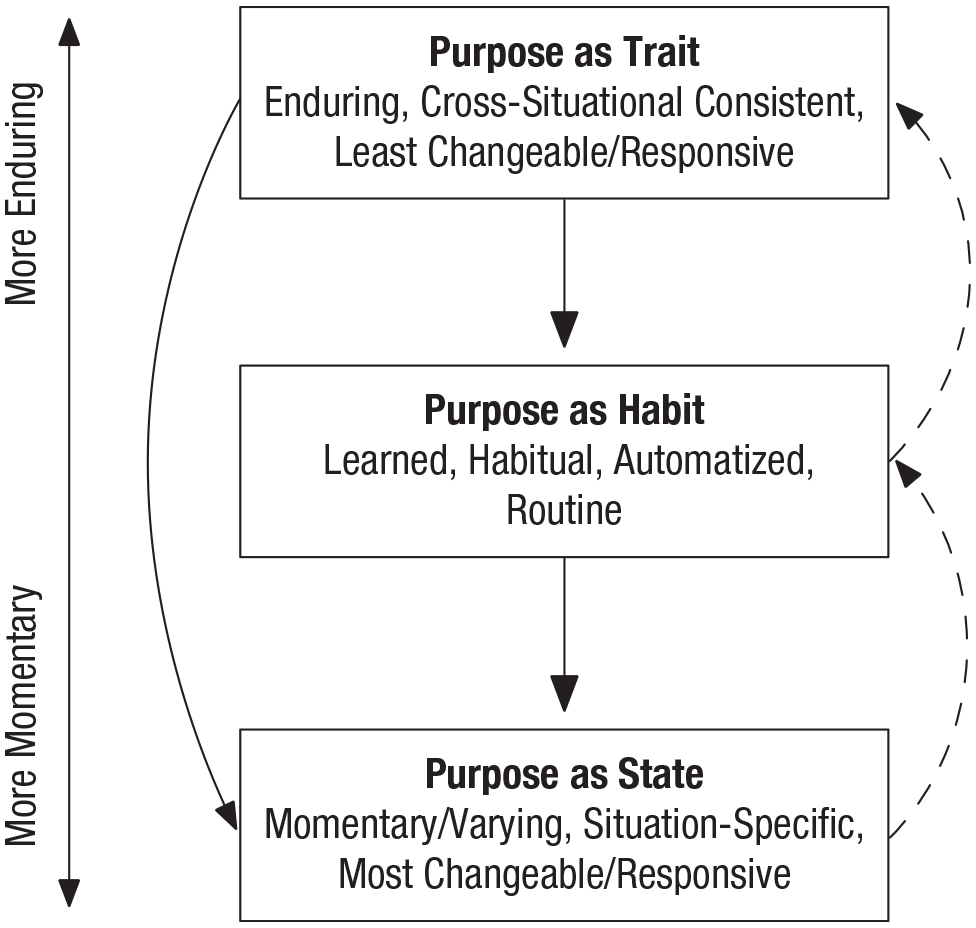
Representation of the Purpose As Trait, Habit, and State model to purpose development. The solid lines refer to top-down processes, and the dashed lines refer to bottom-up processes.
Could Be Far: Purpose as a Trait-Like Aim
Starting at the most consistent, least situation-dependent level of the model, purpose in life is a more trait-like construct, with conceptual similarities to goals, motives, and even personality traits. Personality psychology speaks to how traits are relatively consistent tendencies that impact one’s thoughts, feelings, and behaviors across situations (Roberts, 2009). These criteria all suit the discussion of a purpose in life as well. When people (like the protagonist) discuss finding a purpose, they typically are describing purpose as their enduring life aim. A purpose in life has been described as a self-defining aim that directs an individual toward shorter-term goals and activities (McKnight & Kashdan, 2009). It is what you strive toward throughout life. Given its prominence in self-help books (and musicals), it may be surprising that little research measures purpose at this broadest level. This paucity of work tends to occur for two reasons: (a) People often have difficulty describing what their purpose is, even if they have “found” one, and (b) researchers have difficulty categorizing people’s purposes.
Both of these points are critical for understanding what trait-level purpose is and why it may be more enduring than habit- or state-level purpose. Just as personality stability is reinforced by people selecting into environments that allow them to manifest their dispositions (Roberts et al., 2008), what an individual’s trait-level purpose is will have a top-down influence on choosing roles and settings that cultivate purposeful actions to align with that purpose. As noted in the song earlier, one such environment may be an individual’s occupation. People often choose jobs that reflect what is important to them, and one commonly held purpose is that people are motivated toward occupational progress (Hill et al., 2010). That said, one should not conflate occupational progress with occupational success from an outsider’s perspective. Work suggests that obtaining a job viewed by others as prestigious may not promote a sense of purpose (Weston et al., 2021); instead, as people’s job satisfaction increased, so, too, did their sense of purpose. These findings point to a central tenet of the PATHS model: Purpose at each level is inherently personal. Though fellow employees may seem to have a purpose, because they are punctual and motivated to complete their work, a naive observer will not know whether those habits are reflective of their specific purpose in life. Several consistencies in our behavior have little to do with whether we have a purpose (e.g., taking the same bus to work, eating yogurt every morning). However, a key to unlocking the potential of purpose is identifying those consistencies that are relevant, as purpose-driven people will select environments and roles that allow them to habitually act in purposeful ways.
In Between Far and Near: Purpose as a Habit
When one has identified a purpose, it provides the opportunity to live in accordance with this life direction. At the habit level, purpose looks like what is typically referred to as a “purpose-driven” life. From the earliest insights into habitual action (Hull, 1930), researchers have suggested that individuals show their purposive intent through consistent, automatized, and mannered responses to stimuli. Building from this work, we suggest a building block of purpose is developing routinized approaches to the world. Again, having a purpose allows one to organize shorter-term goals and motives (McKnight & Kashdan, 2009). People with a prosocial purpose in life would not deliberate on whether to help someone in distress—they act in accordance with their habitual tendency to do so. Purposeful habits do not capture what purpose one has but rather whether one’s behavioral repertoire reflects a purpose. In this respect, habit-level purpose is better demonstrated in the existing sense of purpose measures than trait-level purpose, though sense-of-purpose scales do not capture frequency and consistency. Habit-level measurement could resemble how researchers have considered self-concordant behavior (e.g., Sheldon & Elliot, 1999), by capturing how consistently individuals act in accordance with their purpose. Of the three levels, the habit level presents the most novelty to the field, and work thus is needed to develop measures on this front, which likely will be more behavioral in nature than self-report.
The habit level reflects the idea that people are doing things “automatically on purpose.” The purpose-driven life often is viewed as a mostly deliberative process, in which one plans, organizes, and regulates activities (e.g., Lewis, 2020). However, the habit level allows for how individuals routinely engage in purposeful behaviors without taxing cognitive resources. This level has been largely ignored by the purpose literature, although recent work on “life crafting” has recognized the importance of considering habits when developing a more fulfilling and purposeful life (Schippers & Ziegler, 2019); namely, that work points to how individuals need to identify their current habits and then consider the extent to which habits do and do not reflect their aims and identity. These habitual activities are then influenced by positive or negative reinforcement. Positive reinforcement promotes purposeful habitual actions through encouraging people to keep with their life direction, yielding success across life domains and promoting well-being. Negative reinforcement of purposeful habits can result from people seeking to avoid future failures, idleness, and guilt from not acting in a purpose-concordant manner. Habitual engagement in purpose-relevant activities will partially be driven by a desire to avoid feeling guilty for not acting regularly in a purpose-concordant manner.
Could Be Near: Purpose as a State Manifestation
In the moment, an individual may feel purposeful on the basis of their actions, thoughts, or environments. Using daily self-report assessments, research has demonstrated that people show fluctuations in purposefulness from day to day, in samples ranging from adolescence (Kiang, 2012) to older adulthood (Pfund et al., 2022). When predicting this daily variability, important factors to consider are those linked to whether people are engaging in personally meaningful activities and potential barriers to doing so. For instance, having positive social interactions (Pfund et al., 2022) and engaging with family roles (Kiang, 2012) helps some feel more purposeful that day; on the other hand, dealing with stressors beyond one’s control interferes with the ability to follow through with purposeful aims (Hill et al., 2022).
In connection with the other levels, it is important to note that these studies still find between-person differences in reports of state purposefulness: Even if variability exists from day to day, some individuals tend to be higher on average across days than other individuals (e.g., Hill et al., 2022; Pfund et al., 2022). This point provides insight into how the PATHS levels may be interconnected from the top down; namely, people with a committed purpose are more likely to engage with purpose-driven habits, which in turn manifests in differences observed in daily life with respect to being in more situations that yield state purposefulness. Purpose at a trait level also allows for multiple habits related to that purpose, which lead to even more numerous opportunities for state-level purpose. These interactions between levels yield two important consequences. First, people with a clear trait-level purpose will more frequently feel purposeful because they have more chances to do so, leading to these between-person effects. Second, the notion that one has more purposeful habits than traits, and more states than habits, suggests why this model provides greater opportunities for bottom-up purpose development.
Moving up the chain with a bottom-up approach is perhaps more integral to understanding the benefits of this new framework. In line with theoretical frameworks on purpose (e.g., Moran, 2020; Pfund, 2020), purpose may be “found” through recognizing and reflecting upon a time when one feels purposeful. This state of purposefulness enables individuals to take stock of their current moment and realize how it aligns with a personal purpose, whether or not they have currently defined one. For instance, if one feels purposeful during a pottery class, one can build upon this experience by returning to class on a regular basis (purpose as a habit) and ultimately commit to a broader purpose aligned with artistic pursuits (purpose as a trait). One reason why researchers have been focused on measuring sense of purpose is that individuals can report on it regardless of whether they have a trait-level purpose; the PATHS model showcases why that finding is critical insofar as states can provide the building blocks of purpose.
Benefits of the PATHS Model for Intervention
This example points to the primary benefit of the PATHS framework: It helps researchers and laypeople recognize how purpose can manifest and develop across a week, a month, or a year (and maybe more). People are currently inundated with calls to find a purpose in life, and this pressure can be overwhelming. Research finds that individuals who report high levels of trying to explore and find their purpose in life tend to report greater negative affect and anxiety (Sumner et al., 2015), which may be brought on by the belief that they need to focus at the trait level. Instead, the PATHS model emphasizes that the path to purpose can begin from the bottom up rather than from the top down.
The personality-change literature (Allemand & Flückiger, 2017, 2022) suggests it is easier to intervene at the state rather than trait level. One may expect the same to hold for purpose as well: Few people are going to instantaneously nominate their long-term direction for life without recognizing the short-term experiences that are personally defining and meaningful to them. Building from the personality-change literature (Allemand & Flückiger, 2017, 2022), we wish to alert the reader to two critical points. First, the motivation to change matters. People will not act on state purposefulness if unmotivated to build up to a broader, trait-level purpose in life. As noted at the habitual level, the PATHS model requires an intention, and purpose development is not a passive process. Second, multiple counseling protocols advocate the need for people to act in ways aligned with their values or what they want to get out of life (e.g., Dimidjian et al., 2011). Purpose interventions can build on similar lines by requiring people to write about times they felt purposeful and then organize their lives around habitually acting in these ways.
Researchers have noted that the field is severely lacking with respect to evidence-based purpose interventions (e.g., Pfund & Lewis, 2020). A prominent reason again is that most models of purpose have sought to address more about what purpose is and where it fits (e.g., Martela & Steger, 2016; McKnight & Kashdan, 2009) rather than how to actually change it. One of the few replicated efforts to promote sense of purpose, the Lighten UP! Program (Friedman et al., 2017, 2019), in fact accords with several aspects of the PATH model. This program intervenes on all components of psychological well-being (Ryff, 1989), which includes sense of purpose, and it has shown success in modestly increasing sense of purpose over a relatively short time frame. In the first session, individuals are asked to record what happens in daily life and identify activities that bring positive affect (state level). Later sessions involve a discussion of individuals’ automatized thoughts and reactions as well as how to restructure them to promote well-being (habit level). The program does not try to directly intervene on the trait level of purpose, but the final sessions encourage participants to understand that they can accomplish larger goals and to define what it means to have a purpose at the trait level.
As such, this program aligns with key recommendations of the PATHS model. First, interventions need to address how the nature of purpose differs temporally, helping individuals acknowledge their more ephemeral, state-like reactions to an event or activity as well as reconsider their longer-term habits and automatic responses. Second, in most cases, it will be easier to address purpose development from the bottom up by finding purpose through what momentarily makes people feel purposeful, rather than requiring people to start by articulating and defining what their purpose is, likely a more burdensome and anxiety-producing question for participants. Third, that said, these “lower levels” are reflective of some broader, perhaps undefinable purpose in life. As such, identifying and promoting purposeful states and habits may help people recognize they hold some broader life aim.
In this way, the PATHS model also builds from past models of what purpose is. For instance, the conceptualization proposed by McKnight and Kashdan (2009) points to three components of purpose: scope (how broadly purpose impacts one’s life), strength (how powerfully purpose influences action), and awareness (whether one recognizes and can articulate a purpose guiding their life). The PATHS model provides a way of bridging these components in an effort to motivate purpose development. Namely, a strong purpose will be more visible to its holder at the state and habit levels; moreover, a purpose broad in scope may yield more frequent states of purposefulness, insofar that the purpose impacts multiple life domains. The added value of the PATHS model is that it can explain how this visibility and frequent feelings of purposefulness can lead people to an awareness of their purpose. Moreover, the PATHS model presents the opportunity to allow the components to motivate purpose development. If people are aware of their purpose, it will allow them to change habits to be more aligned with that purpose, increasing the felt purposefulness and making for stronger purpose-action linkages. In turn, seeing this impact in daily life holds a bottom-up impact on reifying or clarifying one’s awareness of one’s purpose.
Summary
In sum, the top-down approach suggests that people committed to a purpose should engage with their purpose in life habitually, which is reinforced by momentarily feeling purposeful. Alternatively, the bottom-up approach emphasizes that a spark of purposefulness during a given activity may encourage people to keep acting in similar ways and providing them with insights into what their purpose in life is. In this respect, the PATHS model provides a critical opportunity to connect the currently disparate literatures that focus on either what one’s purpose in life is or whether one feels a sense of purpose. Measures of the latter (e.g., Ryff, 1989; Scheier et al., 2006) ask individuals the extent to which their days are filled with and directed by purposeful engagements, suggesting that these traditional measures can be viewed as capturing dispositional tendencies toward purposeful habits and states.
However, work is needed to investigate the permeability and interactivity of these PATH model layers. To realize the intervention opportunities made possible by the PATHS model, we need more process-oriented studies of purpose to capture how it unfolds in daily life and personalized programs that help people identify which environments, contexts, and social relationships in which they feel purposeful. Finally, we need to incorporate all this work in measurement-burst designs that capture state fluctuations in purposefulness and pair them with longer-term habitual changes as well as more glacial shifts in an individual’s stated purpose in life. All these efforts can be taken up immediately to provide theoretically informed efforts to help people develop a purpose and keep the field going strong, like a car with a full tank of gas.
Recommended Reading
McKnight, P. E., & Kashdan, T. B. (2009). (See References). A helpful theoretical foundation for what it means to have a purpose in life and how it can influence seemingly every aspect of an individual’s life.
Pfund, G. N., Hofer, M., Allemand, M., & Hill, P. L. (2022). (See References). A recent intensive longitudinal study that showcases the value of examining between- and within-person fluctuations in sense of purpose over days and months.
Ryff, C. D. (1989). (See References). A foundational paper discussing the most widely employed measure for sense of purpose, which first showcased the value of sense of purpose for well-being and development.
