




Abstract
Executive-function (EF) skills are a set of attention-regulation skills that provide a neurocognitive foundation for adapting to changing circumstances across the life span; EF skills measured in childhood are associated with important real-world outcomes (e.g., school and job success). Although training can improve EF skills, the benefits of training frequently fail to transfer to these outcomes. We argue that EF skills are associated with outcomes such as school success only to the extent that they first contribute to intermediate-level EF-based life skills that are more directly instrumental in achieving key outcomes. These intentional intermediate-level skills are configurations of specific EF skills and non-EF skills that are used when reasoning and solving problems in a variety of domains. We further argue that an effective way to bridge the gap between specific EF skills and real-world outcomes is by training these EF-based life skills that people need to function effectively in society. We propose that this can best be achieved using a civic-scientific approach, engaging citizens (e.g., children, youth, parents, teachers) in the design process from the beginning so that interventions are responsive to perceived needs and address perceived obstacles to success and sustainability.
Keywords
Executive-function (EF) skills are a set of attention-regulation skills that support the conscious control of thought, action, and emotion. These skills depend on metacognitive reflection (i.e., noticing uncertainty, wondering, pausing, considering context, monitoring) and vary along a continuum of motivational significance from “hot EF” to “cool EF” (e.g., Zelazo, 2020). Cool EF skills such as working memory, inhibitory control, and cognitive flexibility are assessed in relatively emotionally neutral contexts and rely more on neural networks involving lateral parts of the prefrontal cortex (PFC). Hot EF skills are needed in motivationally significant situations; they involve the representation of incentive value and the reversal of strong approach-avoidance tendencies (e.g., forgoing a second chocolate bar despite one’s desire) and depend on the orbitofrontal cortex (e.g., Rolls, 2004). Together with metacognitive reflection, these cool and hot EF skills provide an essential foundation for goal-directed problem-solving, flexible adaptation to changing circumstances, effective social functioning, and intentional learning. Whereas cool EF is more strongly associated with academic outcomes, including math and reading, poor hot EF is more strongly associated with problem behaviors in school (e.g., inattentive and overactive behavior; Willoughby et al., 2011). The development of hot and cool EF skills is associated with changes in specific networks involving the PFC (e.g., Zhang et al., 2021).
EF skills continue to develop into adulthood, and the protracted development of these skills provides a long window of opportunity for environmental influences (Zelazo, 2020). Research with children indicates that EF skills can be strengthened by providing individuals with repeated opportunities to use these skills under supportive conditions—that is, with scaffolding that supports children’s developing sense of agency and autonomy by being encouraging, calibrating the difficulty level of the challenges that children face (without causing undue stress), and offering choices (e.g., Carlson, 2023). A comprehensive review predicted that effective EF interventions will (a) challenge EF skills continually in new and different ways, (b) be personally meaningful, (c) be guided by a committed mentor, and (d) elicit joy, reduce stress, and inspire confidence (Diamond & Ling, 2020). The results of behavioral research on interventions ranging from computer-based training to school curricula are consistent with evidence from developmental neuroscience indicating that the repeated activation of specific neural pathways changes those pathways, rendering them more efficient through experience-related modulations of many different neural processes (e.g., Zatorre et al., 2013).
Despite evidence that individual differences in EF skills are associated with a range of positive developmental outcomes (e.g., school success; Robson et al., 2020) and that the benefits of training EF skills can transfer to these outcomes (e.g., Marzocchi et al., 2020), it is also clear that most efforts to train specific EF skills do not transfer to real-world outcomes (e.g., Diamond & Ling, 2020). Indeed, meta-analyses have found that most studies fail to show transfer even to other EF skills, let alone to the more complex sets of skills necessary for real-world outcomes (e.g., Kassai et al., 2019; Takacs & Kassai, 2019).
Why does EF skill training not more reliably and robustly lead to far transfer to relevant outcomes? First, EF skills are often trained in a limited set of situations, and sometimes only in a single context (e.g., the context of a video game); this can cause new skills to be relatively context-dependent, limiting generalization (e.g., Smith, 1982). To promote far transfer, EF skills need to be practiced in real-world settings such as schools, suggesting why school-based interventions show more transfer than efforts to train specific EF skills in the laboratory (Diamond & Ling, 2020).
Second, EF skills are rarely trained in ways that explicitly encourage prospective and retrospective reflection on what is learned. Prospective reflection—thinking carefully before responding—is important because it interrupts automatic processing, allowing for the consideration of goals and top-down control in light of them. A longitudinal study of 5- and 6-year-old children (N = 425) showed cross-lagged associations from slower reaction times to subsequent (1 year later) improvements in accuracy on the same measure of EF skill (Dumont et al., 2022), which was taken as evidence that children first learn to pause, which allows them to engage their developing EF skills and strengthen relevant neural networks, and only thereby do children subsequently increase their accuracy. Retrospective reflection on what is learned is also important because it can help children and youth understand how and when to apply their trained skills in new situations. The addition of a metacognitive component to EF training has been shown to produce far transfer (e.g., Espinet et al., 2013; Pozuelos et al., 2019).
A third possible reason for the lack of far transfer is that EF skills per se are only indirectly linked to real-world outcomes; that is, fundamental attention-regulation skills such as cognitive flexibility (shifting attention to different aspects of a stimulus or situation) are associated with real-world outcomes such as school success only to the extent that they first contribute to intermediate-level EF-based life skills that are more directly instrumental in achieving those outcomes. These intentional intermediate-level skills build on core EF skills and include what have been described as higher level EF skills (Diamond & Ling, 2020), such as reasoning and planning, but also include meaningful goals (e.g., to foster social relationships), non-EF skills (e.g., language), and the deliberate application of strategies (e.g., making lists), all of which jointly allow for real-world success. We argue that one way to promote the far transfer of component EF skills is to train them in the context of life skills so that the learning and application of trained skills to key outcomes are more direct.
EF-Based Life Skills
There is growing recognition that the use of core EF skills always occurs in person-environment contexts that influence how those skills are used (e.g., Diamond & Ling, 2020; Doebel, 2020; Niebaum & Munakata, 2023). At the same time, however, there are relatively domain-general skills, such as perspective taking, that are used across a wide range of contexts (Zelazo & Carlson, 2023). These intermediate-level configurations of EF and non-EF skills are used intentionally, and with effort, to pursue meaningful goals (e.g., to foster social relationships) across a range of situations and problems, albeit typically within particular cultural contexts. These EF-based life skills are broader and more widely applicable than specific goal-directed activities (e.g., cleaning up when playtime is over; Doebel, 2020), but they are also more targeted and constrained than the full array of skills required for many real-world activities themselves (e.g., achievement in school; Diamond & Ling, 2020). It is possible, for example, to use perspective taking (an EF-based life skill) in the context of peer, family, and nonfamily social relationships or in the context of many different kinds of work settings. Well-developed perspective-taking skills in adolescence have been associated with higher friendship quality and both prosocial and civic behaviors, whereas perspective-taking difficulties have been associated with higher levels of loneliness and peer rejection (Crone & Fuligni, 2020).
Task analysis indicates that perspective taking requires metacognitive reflection (to consider perspectives in contradistinction) and EF skills to (a) inhibit attention to one’s own perspective when considering someone else’s (inhibitory control), (b) hold multiple perspectives in mind while also updating and integrating this information as the situation unfolds (working memory), and (c) switch flexibly between different perspectives on the same situation (cognitive flexibility; Galinsky, in press). Perspective taking might also require hot EF to regulate one’s emotions, as when seeking to understand someone’s point of view during a heated argument.
Further work is required to identify useful intermediate-level life skills—and these could well vary across cultural or socioeconomic contexts (e.g., Gaskins & Alcalá, 2023; Miller-Cotto et al., 2022), but research to date has established numerous links between core EF skills and particular EF-based life skills. For example, core EF skills are strongly associated with flexible perspective taking (e.g., Wang et al., 2016), and training reflection and EF skills has been shown to improve perspective taking both in early childhood (e.g., Espinet et al., 2013) and adolescence (Van Lissa et al., 2017). Further research is also needed to determine whether EF-based life skills mediate relations between EF skills and real-world outcomes.
We believe it is these intermediate-level configurations of EF and non-EF skills, not component EF skills in isolation, that are invoked and applied across real-world situations and adaptive challenges. Training skills at this intermediate level could be more effective in producing far transfer than training specific EF component skills, training specific goal-directed activities (e.g., cleaning up), or training real-world activities themselves (e.g., particular sports) because life skills are neither too specific nor too general.
Effective communication, the process of conveying information, ideas, or feelings between individuals or groups, is a closely related intermediate-level EF-based life skill. Working memory is thought to influence the degree to which individuals manage the cognitive demands of holding information in mind while forming clear statements or interpretations of communicative intent (Galinksy, in press), and in adolescence, better working memory has been found to be associated with greater accuracy when interpreting statements on the basis of another speaker’s perspective (Nilsen & Bacso, 2017). Cognitive flexibility likely facilitates adaptation to various communication contexts and understanding of diverse perspectives and allows for nonliteral interpretations, consistent with research showing that cognitive flexibility is positively correlated with complex irony interpretation in adolescence, even after controlling for vocabulary, nonverbal reasoning, and relevant knowledge related to the ironic videos presented (Zajączkowska & Smith, 2020).
Another EF-based life skill predictive of academic and occupational success is critical thinking (Fong et al., 2017). Critical thinking requires individuals to actively engage with the information being processed, question assumptions, and weigh evidence in a systematic manner and is therefore a deliberate and effortful cognitive process. Research has shown that reflection and cool EF skills are positively correlated with critical-thinking skills, even after controlling for fluid intelligence and self-reported critical-thinking dispositions (Li et al., 2021).
The embedding of reflection and core EF skills into EF-based life skills, and the subsequent application of these life skills to achieve important developmental outcomes, is illustrated in Figure 1. By training EF-based life skills directly, it should be possible to reduce the need for far transfer because the intermediate-level skills being trained are closer to the actual configuration of skills needed for real-world outcomes. For example, training life skills such as perspective taking, communication, and critical thinking should result in improvements in these life skills, which might then be more likely than trained EF skills to be used when building social relationships and performing in school or in the workplace. Importantly, however, because EF-based life skills involve constituent core EF skills, training these life skills will inevitably exercise core EF skills as well. When these EF skills are used repeatedly in the context of different EF-based life skills and practiced in a variety of situations, these EF skills themselves will likely be improved in a generalizable way, and this might, in turn, facilitate the acquisition of additional EF-based life skills.
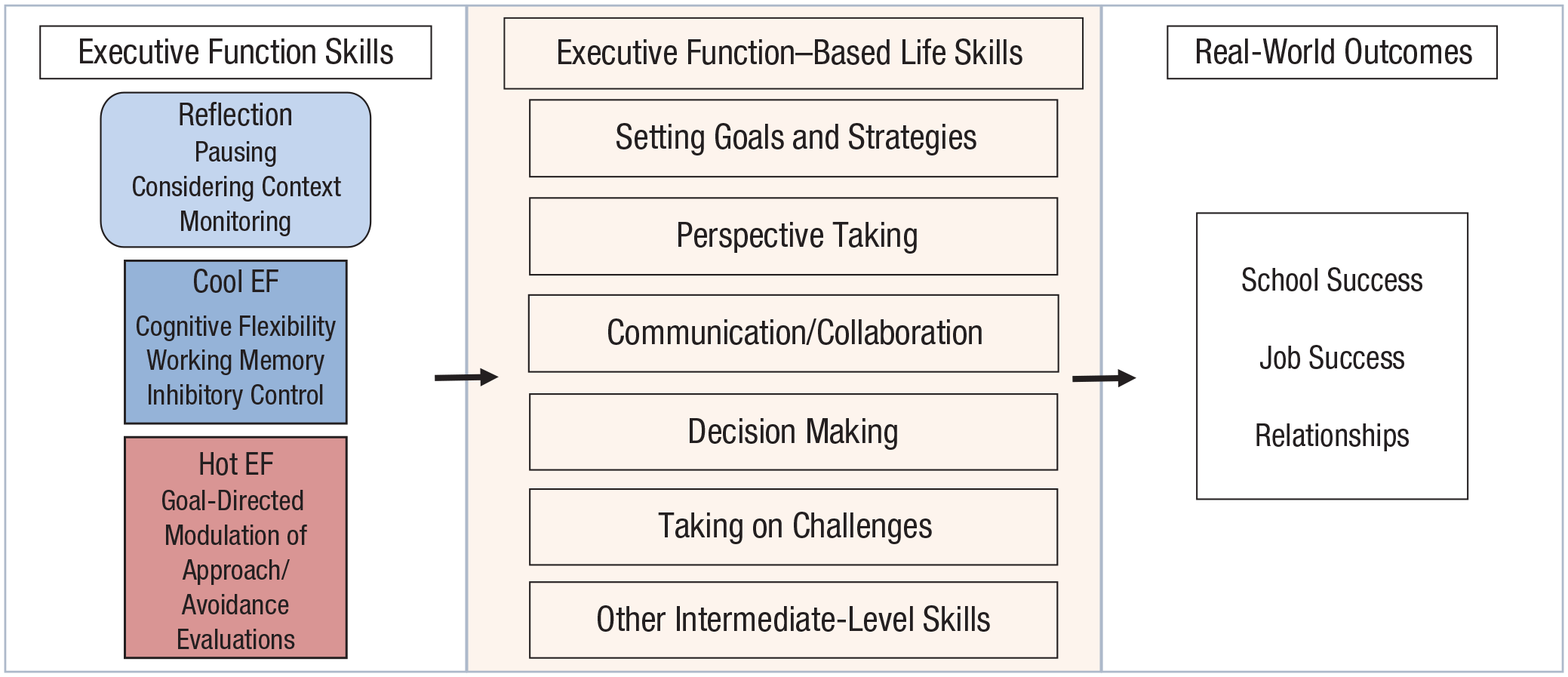
Metacognitive reflection, together with cool and hot EF, provide an essential foundation for intermediate-level EF-based life skills that in turn are directly instrumental in achieving important developmental outcomes. Color is used to distinguish between relatively cool and hot EF skills. EF = executive function.
Moreover, whereas EF skills are relatively abstract and often measured in decontextualized ways, EF-based life skills are used for self-determined purposes. Compared with component EF skills, EF-based life skills are more obviously relevant to real-world contexts and activities and more likely to elicit engagement during training (e.g., Diamond & Ling, 2020; Doebel, 2020; Niebaum & Munakata, 2023).
As additional intermediate-level EF-based life skills are identified, some authors might disagree about whether candidate exemplars are actually better classified as core EF skills. One example is relational reasoning, which refers to seeing the connections/patterns in the information being considered. Relational reasoning has been positively associated with students’ learning and achievement in various academic domains, including science, technology, engineering, and mathematics (Alexander, 2017). Improvements in EF skills have been found to support relational-reasoning development, and multiple studies have revealed positive correlations between performance on EF tasks and relational-reasoning skills (e.g., Simms et al., 2018). Is relational reasoning best viewed as an EF-based life skill or as an additional core EF skill, as some authors have argued (Starr et al., 2023)?
Civic-Scientific Approach to Intervention Design
Successful supports for the development of EF-based life skills will be more effective if they are well received, well adapted to particular contexts (communities and social systems), and sustainable. Civic science offers a solution. Civic science, which is similar in many ways to community-based participatory research (e.g., Alegría et al., 2022), is an approach to scientific inquiry that highlights scientists’ responsibility as citizens (a) to use science to assess and respond to problems faced by fellow citizens, (b) to draw on the lived experience of these citizens, and (c) to engage these citizens in the scientific process from the beginning. Science is a pragmatic human activity, and although it uses a method (i.e., the scientific method) designed to yield valid logical inferences based on reliable empirical evidence, the application of this method, like the application of EF skills, always occurs within a context of values and assumptions. Civic science recognizes this context dependency, is responsive to citizens’ perceived needs, supports citizens’ autonomy and self-determination, and engages citizens in collective scientific collaboration. It is an inherently educational and democratic approach to science (Abbott et al., 2014).
Indeed, as a shared practice of systematic scientific inquiry into shared problems, civic science could serve as a central feature in a robust, evidence-based democracy. Opening scientific inquiry up to include citizens’ perspectives and voices while maintaining scientific rigor has the potential to encourage popular appreciation of scientific evidence and accelerate scientific innovation through an iterative fast-cycle research and development (R&D) process (e.g., Shonkoff & Fisher, 2013). Whereas traditional intervention research typically aims to conduct independent evaluations of the efficacy of fully developed programs using a randomized controlled design, civic science aims to maintain scientific standards while generating practical, locally relevant solutions to people’s perceived needs through collaboration, fast-cycle innovation, and the use of participatory methods.
In particular, civic science has considerable potential to advance inquiry into and intervention regarding complex (so-called wicked) problems that are systemic and multidimensional—issues such as socioeconomic status (SES)-related differences in academic achievement (Reardon, 2013). One proximal cause of the income achievement gap appears to be SES differences in EF skills. Children from lower SES families receive less environmental support for EF skills (e.g., fewer opportunities to play games that require attention regulation; Korucu et al., 2019), and EF skills have been found partially to account for the relation between SES and school success (better than IQ or language; e.g., Lawson et al., 2017). Supporting EF skills in children and youth facing disadvantages has the potential to mitigate the achievement gap because EF skills serve as a protective factor against the academic risks associated with poverty. Despite being more likely than other children to perform poorly in school, for example, homeless children with good EF skills succeed in school despite being homeless, showing evidence of resilience (Masten et al., 2012).
Civic science provides a promising approach to cultivating EF skills in children and youth as well as their families and the professionals who work with them within existing social systems, including culturally and economically diverse communities and schools. In civic science, the participants in studies or the recipients of training are involved from the beginning, co-creating and evaluating the materials and determining how these materials can best be distributed and sustained.
When interventions are designed with and not for communities, and thus are responsive to their needs and reflective of their values, it is more likely that community members will be receptive to support, open to the possibility of change, and committed to training. For example, youth might advocate for an intervention targeting collaboration or perspective taking, as opposed to an intervention targeting cognitive flexibility per se (e.g., by practicing task switching), and be more likely to adhere to something they value. The more obvious relevance of EF-based life skills to personally meaningful outcomes, such as relationship success, should increase the likelihood of transfer. Furthermore, when communities take part in identifying obstacles to practice and co-creating ways to surmount them, it is more likely that these interventions will be well suited to particular contexts and sustainable within those contexts. In addition, when communities determine the best ways to disseminate the intervention, the reach of the intervention can be enhanced. Finally, understanding evidence for the efficacy of life-skill training should further increase individuals’ motivation, engagement, and participation.
Examples of civic-scientific approaches to supporting healthy development are emerging and generally involve establishing partnerships with stakeholders to identify targets for intervention, strategies, and meaningful (culturally appropriate) outcomes (e.g., Draper et al., 2023; Galinsky et al., 2017). Working collaboratively with Head Start families, for example, Semenov & Zelazo (2019) created a flexible 8-week intervention program called Ready4Routines in which parents choose which particular family routines they and their children will work together to promote (Semenov & Zelazo, 2019). Daily family routines can include systematic practices around mealtimes, transition periods, and bedtimes, among other things, and the scope and pace of change are self-determined. Facilitators work with parents to design goals around personalized routines that contain activities beneficial for EF skill development (e.g., mindfulness practice), and the process of reflecting on, discussing, and intentionally setting goals and changing routines supports these skills. Routines can also help create a more stable and predictable environment (e.g., allowing for more consistent sleep patterns, thereby reducing negative bottom-up influences on reflection and EF skills; Hahn et al., 2012).
Next Steps
Our efforts to support the development of EF-based life skills using a civic-scientific approach are underway, and we are working with AASA, the School Superintendents Organization, to identify cohorts of teachers, principals, superintendents, learning specialists, and youth to co-develop training and tools and integrate them into teachers’ daily activities. Relevant outcome measures, which go beyond tests and grades and include school engagement, hoped-for futures, and well-being, were identified on the basis of a large, nationally representative survey of youth and their families as well as follow-up interviews (Galinsky, in press). Using an R&D approach, we will conduct fast-cycle evaluations and continue to improve practices and their implementation in ways that benefit children’s and adults’ learning and thriving.
Conclusion
We believe it is through EF-based life skills that component EF skills lead to important developmental outcomes. It follows that one way to increase the likelihood of far transfer of trained EF skills is to train them in the context of EF-based life skills. It is also important, however, to train EF skills in a way that is valued by children, youth, families, and professionals who support children’s development. Rather than imposing interventions on people, we believe it is important to co-create supports for EF skills with the individuals and communities who might benefit from them so these supports can be meaningfully and sustainably embedded into existing systems. Civic science offers an opportunity to accelerate scientific inquiry in a way that educates citizens and scientists, benefits society, supports participation in an evidence-based democracy, and contributes to the solution of wicked problems such as the achievement gap. Engaging citizens in the iterative design of interventions to promote EF-based life skills has the potential to reduce achievement gaps and contribute to educational justice.
Recommended Reading
Galinsky, E., Bezos, J., McClelland, M., Carlson, S. M., & Zelazo, P. D. (2017). (See References). Provides two examples of civic-scientific initiatives designed to support healthy development.
Marzocchi, G. M., Usai, M. C., & Howard, S. J. (Eds.). (2020). (See References). Provides examples of effective EF interventions that show evidence of far transfer.
Schaeffner, S., Chevalier, N., Kubota, M., & Karbach, J. (2021). Metacognitive training. In T. Strobach & J. Karbach (Eds.), Cognitive training: An overview of features and applications (pp. 255–270). Springer Nature Switzerland AG. https://doi.org/10.1007/978-3-030-39292-5_18. Provides a comprehensive review of the benefits of metacognitive reflection training for far transfer of EF skills.
Zelazo, P. D., & Carlson, S. M. (2023). (See References). Presents a developmental-systems view of EF skills that reconciles a domain-general characterization of EF skills with evidence that these skills are context-dependent.
