



Abstract
The late linguist M.A.K. Halliday described the last paragraph of Darwin’s Origin of Species, with its description of a tangled bank, as one of the most remarkable paragraphs in the whole of literature. Yet it appears marred by an obvious grammatical mistake. In this article, we seek to show that the apparent mistake is actually the vestige of a now extinct form of paragraph in which the structure we now reserve for a single sentence could be extended over a whole paragraph or even many paragraphs. We first zoom out to show that the final sentence makes sense in the context of the paragraph as a whole, and then zoom out again to show that the modern paragraph itself is still a work in progress. Finally, we use a comparison between English and Farsi to try to show that all such grammatical choices mediate between humans and their environment. This relationship too is a work in progress in which the grammar of a language has an important role to play.
1. Introduction
When he at last published his Origin of Species, Darwin could not yet rely on the vast corpus of empirical evidence or the mighty expanse of theory which supports it today. Instead, he had to depend on his own far-flung data sets—and his very considerable rhetorical skills. Both of these come together in the very last word of the very last sentence of the very last paragraph: There is grandeur in this view of life, with its several powers, having been originally breathed into a few forms or into one; and that, whilst this planet has gone cycling on according to the fixed law of gravity, from so simple a beginning endless forms most beautiful and most wonderful have been, and are being, evolved.
It is the first time in the entire book that Darwin uses the verb by which the whole theory will come to be well known. The late British linguist Michael Halliday said he could think of no parallel to this finale in literature—although, as we shall see, he did find a close parallel in nonverbal art (1990/2002: 185). Curiously, despite being one of the most encyclopedic grammarians of our epoch, Halliday did not remark an apparent glaring mistake—or perhaps a glaring apparent mistake—lying right in Darwin’s concluding sentence. What exactly is ‘and that’ doing there?
Haspelmath (1998: 279) tells us that the evenhanded conjoining structure ‘(A) and (B)’, which we would see if Darwin were conjoining two units of the same rank, is a property of Standard Average European. Darwin’s ‘and that’ is preceded by a semicolon, which likewise suggests that somehow the subsequent subordinate clause must be paired with some other subordinate clause in the same sentence. No such clause, however, can be found, and today, that ‘and that’ would render Darwin’s whole earthshaking climax syntactically ill-formed, not to say semantically bathetic. Yet Darwin evidently did not regard it as an error either, for it appeared in the very first edition of the book and stands uncorrected in the fifth revised edition, which was the last to appear in Darwin’s own lifetime. Some grammatical questions are best answered by narrowing the scope of the inquiry and making the question more delicate, while others are best addressed by vastly expanding its sweep.
In this article, we do the latter. First, we will examine what Halliday and Matthiessen (2014: 68) would call the ‘logogenetic’ evolution of this apparently faulty subordinate clause by looking at the way it is adapted to the ecology of Darwin’s whole paragraph rather than simply to the wording of the final sentence. Second, we will examine what we might call the ‘sociogenetic’ evolution of the paragraph in general, reviewing the history of what are today called paragraphs and capping the review with two important essays Halliday wrote on how Victorian verbal art and Victorian verbal science adapted to each other to produce this remarkable hybrid in Darwin. Finally, we will compare the grammar of English with that of an Indo-European cousin, Farsi, in order to consider what Darwin himself called the ‘phylogenetic’ environment: how grammar helps or hinders humans as a species among other species in adapting to the natural environment of which, despite their best efforts, they still form an inalienable part.
2. Logogenesis: Untangling the tangled bank
Let us begin by zooming out just a little, the better to take in the preceding three sentences. Because some of the paragraph is of doubtful grammaticality, at least by modern standards, we define these sentences orthographically, as units which begin with a capital letter and end in a full stop. For ease of discussion, we insert numbers in parentheses at the outset of each sentence. (1) It is interesting to contemplate a tangled bank, clothed with many plants of many kinds, with birds singing on the bushes, with various insects flitting about, and with worms crawling through the damp earth, and to reflect that these elaborately constructed forms, so different from each other, and dependent upon each other in so complex a manner, have all been produced by laws acting around us. (2) These laws, taken in the largest sense, being Growth with reproduction; Inheritance which is almost implied by reproduction; Variability from the indirect and direct action of the conditions of life, and from use and disuse; a Ratio of Increase so high as to lead to a Struggle for Life, and as a consequence to Natural Selection, entailing Divergence of Character and the Extinction of less improved forms. (3) Thus, from the war of nature, from famine and death, the most exalted object which we are capable of conceiving, namely, the production of the higher animals, directly follows. (4) There is grandeur in this view of life….
We will start with an analysis of that last sentence and work backwards. The logico-semantic notation we will use is that of Halliday and Matthiessen (2014: x, xi). In this notation, the symbol ||| indicates the boundaries of a clause-complex, the symbol || indicates the boundaries of a clause, and the symbol | indicates the boundaries of a phrase (e.g. a prepositional phrase like ‘from use and disuse’) or word group (e.g. a nominal group like ‘a tangled bank’). Accordingly, [[[…]]], [[…]], and […] mark, respectively, clause complexes, clauses, and phrases or groups which have been ‘rankshifted’ to serve as an element within an element of lesser rank, where a nominal group serves as a Qualifier in another nominal group (e.g., ‘of life’ in ‘this view of life’). Arabic numbers like 1, 2, 3, and 4 indicate that elements are of equal rank (e.g., ‘have been’ and ‘are being’), while Greek letters like α and β indicate that element β is subordinate to element α, as in ‘whilst this planet has gone on cycling’ and ‘endless forms…evolved.’ We use = to indicate the logico-semantic relationship of elaboration, for example, an appositive gloss or exemplification. We use + to indicate the logico-semantic relationship of extension, in which elements are simply added in a list, and we use x to indicate the logico-semantic relationship of enhancement, which provides time or place, cause or consequence, manner or means. Single or double inverted commas are used to indicate the logico-semantic relationship of projection, in which a locution (“) or an idea (‘) is projected by a mental or verbal process such as thinking or saying.
This somewhat elaborate notation allows us to take in the elegant logico-semantic structure of Sentence (4) at a single glance. The notation also has the advantage of making the anomaly in question stick out.
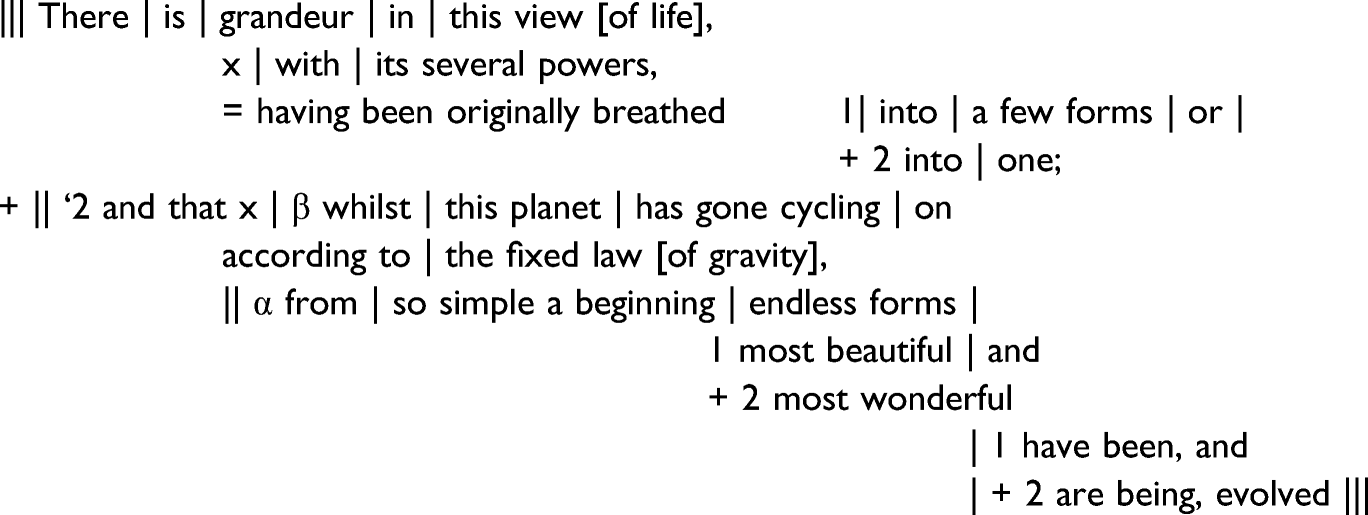
But is this anomaly error or deliberate stylistic foregrounding? For Halliday, the logico-sematic structure we have annotated here is really only a small part of one metafunction—the ideational. This ideational metafunction is a collection of linked functions that realize the logical but also the experiential content of clauses, and it includes transitivity, all those verbal groups that realize processes and the nominal groups that realize the participants in those processes. There are two other metafunctions to consider before we can get a well-rounded and well-founded understanding of what clauses are doing. There is the interpersonal metafunction: the cluster of functions which help us give and get either information or goods and services. Central to this metafunctional cluster is the function of mood—whether a clause is an imperative or indicative, and if indicative, declarative or interrogative, and if interrogative, yes/no or wh-, etc. The ideational and the interpersonal metafunction are integrated, and the clause is integrated into a text, by the textual metafunction, and central to this metafunctional cluster is the function of Theme, or starting point, the most directive and least definitive moment of the clause which orients us towards the least directive and most definitive culmination. We take these three metafunctions in turn. Interpersonally, we can say this is a declarative rose with a persuasive sting: Darwin declares something objective and scientific but he does so with a subjective and even artistic twist. That is one reason why ‘and that’ sticks out a little: it suggests a reported speech without any obvious reporter. Ideationally, we have a major clause which is existential (‘There is…’) but a projected clause which is a material process in the passive voice. And textually, we have a puzzle: ‘There is’ conjoined with ‘and that.’
Let us work our way backwards, to the beginning, by examining the penultimate sentence next.
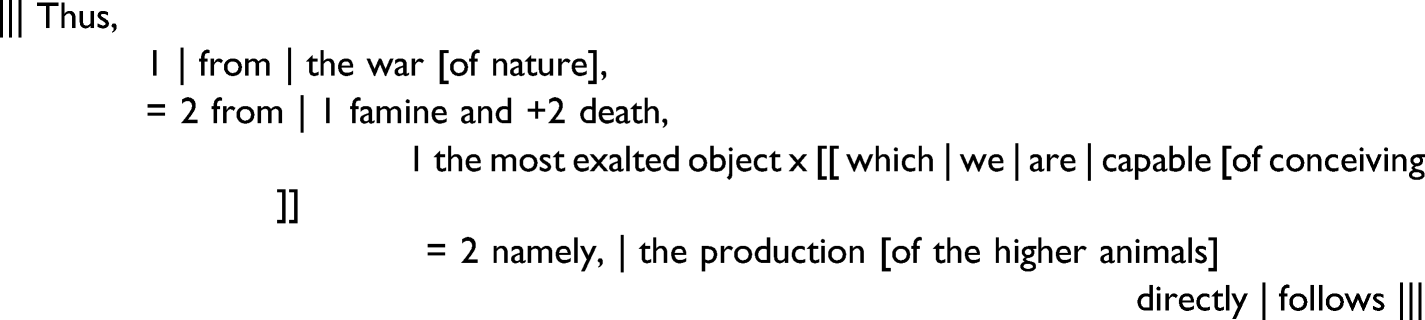
Interpersonally, Sentence (3) is indicative-declarative: the author is telling us something. Ideationally, the twin Circumstances precede the Actor, followed by the Process. Thus, from two parallel, paratactic Circumstantial Adjuncts (‘from…from…’) an elaborated nominal group in which we are slyly incorporated as conceivers and as higher animals, directly follows. Theme is typically a grammatical Subject, but this sentence is atypical: we find ‘Thus’, a purely textual theme, marking the previous clause-complex as cause and the present one as its consequence. Just as ‘Thus’ relays the previous wave of the semantic energy in the form of a Conjunctive Adjunct, the two paratactic topical themes convey the ‘laws’ of Sentence (2).
Like Sentence (4), Sentence (2) challenges our sense of well-formedness: there is no Finite verb operator (that is, no tensed verb agreeing with the Subject).
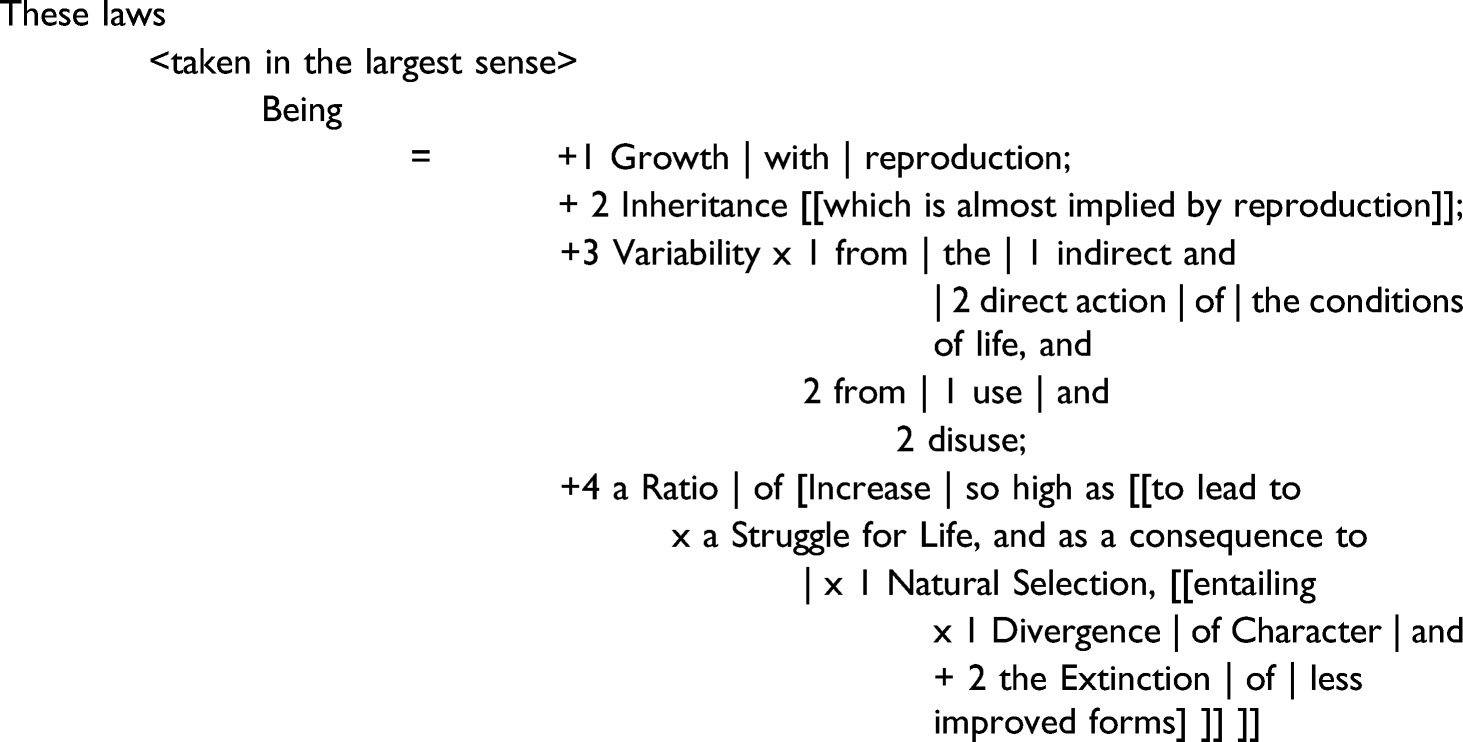
Sentence (2) is not a sentence at all; it is a nonfinite clause (‘These laws <<taken in the largest sense>> being’) elaborated as a list of four nominal groups variously post-modified. Today this would simply be a list appended to the previous clause complex by a colon. Since there is no ranking clause, it is interpersonally, ideationally, and even textually dependent on (1).
We turn, therefore, to the meta-Theme of the whole paragraph—Sentence (1).
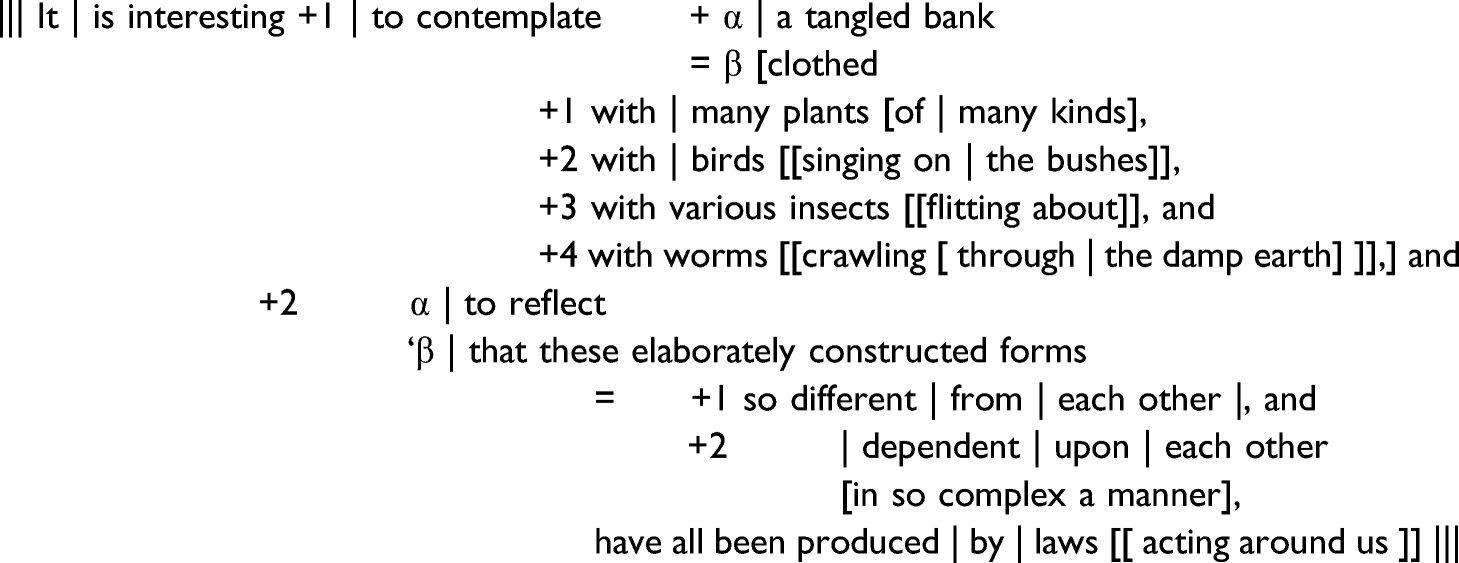
So, interpersonally (that is, considering the mood), it is indicative-declarative, but it is the declaration of a personal point of view. This is why, ideationally, we have the relational clause ‘to be’ and the attribute ‘interesting’, followed by two mental processes, ‘contemplate’ and ‘reflect.’ Thematically, we just have ‘It’, a place holder for all that follows—first, contemplation of the tangled bank (‘tangled’ is then extended in parallel postmodifying prepositional phrases with embedded clauses) and next, reflection on how it was produced (‘elaborately constructed’ likewise extended by postmodifiers).
Taking in, as we must, the paragraph as a whole, we see that in Sentence (1), we are invited to perform a process (‘contemplate’) upon an entity realized by a nominal group (‘a bank’), whose epithet (‘tangled’) is elaborated with an embedded clause and four prepositional phrases. We are also invited to do perform another mental process (‘reflect that’), and this mental process projects a wording. But Sentence (2) is neither a clause nor a clause complex; it is merely an elaboration of the four prepositional phrases that elaborated the entity (‘tangled bank’) into ‘laws’ realized by nominal groups. This is then followed by Sentence (3), the logical consequence of those laws. Could it be that the very last part of Sentence (4) is merely a continuation of the projected wording in Sentence (1), a renewed reflection on the tangled bank? Darwin’s meaning, taking the paragraph as a single wording rather than as four separate syntactic constructions, would then be something like ‘It is interesting (…) to reflect that these (…) have all been produced by laws acting around us (...) and that (…) from so simple a beginning endless forms most beautiful and most wonderful have been, and are being, evolved.’
3. Sociogenesis: The paragraph as a work in progress
When Halliday calls sentences like (1) above a meta-Theme, rather than, as is common in high school English classes, a ‘topic sentence’, he has already drawn our attention to one way in which paragraphs might have been derived from the expansion of the sentence. In this section, on the sociogenesis of the paragraph, we will put it to you that the kind of stylistic foregrounding we see in ‘and that’ is more of a vestigial limb than a promising new mutation. The reason for using the rather cumbersome term ‘sociogenesis’ here is simply to stress that, just as the logogenesis of Darwin’s book now forms a short part of our literary history, the history of literature and language and the history of human society as a whole form only one short part of our natural history; we shall argue that it risks being very short indeed, in part due to some key flaws in the way our grammar has evolved. But in the final section on phylogenesis, we will suggest that the human story is not quite finished and that there are some promising varieties right in our midst.
Some of the earliest written texts were stone monuments in dead languages; as Voloshinov remarks (1929/1973: 72), these give us material for the first modern philological analyses. But these do not even mark the spaces between words, let alone place spaces between paragraphs. Aristotle (1926) certainly uses the term παραγραφή, but Aristotle’s ‘paragraph’ it is literally a ‘para-writing’, or a side note which indicates a change of speaker (Cope, 1877). It is tempting to attribute this side-writing—usually a short underline—to parsimony and the scarcity of suitable writing materials. But this explanation does not sit well alongside the extravagance of a good deal of ancient calligraphy. For example, in the earliest manuscript of Beowulf (Anonymized Beowulf in the Nowell Codex, 1981), written somewhere around 975–1025, we find units that would be paragraphs today set off by larger characters, something we can see at the beginning of the historical documents such as the Declaration of Independence, the US Constitution, and even some articles in popular magazines today. Such were the external, orthographic, trappings of the modern paragraph.
But how and why did the internal structure of the paragraph—as a unit composed of one or more sentences—evolve? Like the external structure, it must have evolved slowly—but not necessarily linearly. As with evolution writ large, the slowness of the evolution of the paragraph can be deduced from the persistence of endless forms of great antiquity as living fossils today. We can still observe the remnants of this ancient lineage in formal resolutions with motivating paragraphs that begin with ‘Whereas…’. These dependent clauses—still referred to as ‘clauses’ for legal purposes—may be written as separate paragraphs, and the entire text as whole—often many paragraphs and even many pages—may be written as a single clause-complex. The King James Bible has more than one verse in its rendition of the three clause-complexes that make up the ten verses of Ephesians, Chapter Two.
Likewise, we may deduce the nonlinearity of the evolution of the paragraph from the traces of mass extinctions; that is, potentially ‘endless forms’ of literary expression which nevertheless did come to an abrupt ending: cave paintings, tomb murals, palimpsests on velum, monastic annals, dynastic chronicles, and—to our great loss—epic poetry which tackles scientific issues of the day and scientific prose of great artistic merit and consequently wide popular appeal. In a pendant pair of essays in Linguistic Studies of Text and Discourse, Halliday (2002) pays homage to the grammatical intricacy of these last two text types and—more importantly—links their grammatical intricacy to what Brown (1997) calls a ‘turning point’ in the history of cultural expression, namely, the re-confluence of verbal art and verbal science divided, in the Renaissance, by secularism. This moment—which Halliday exemplifies by the effect of the earliest forms of evolutionary theory on poetry and vice versa—has certainly been broached from the point of view of plot content (Beer, 1983/2000). But Halliday discerns two different types of form, and he shows that they are complementary.
In ‘Poetry as Scientific Discourse’ (1987/2002), Halliday introduces the notion of instantiation. Hjelmslev described any single text as an ‘instance’ of the whole language system, just as any interpersonal situation is always an instantiation of the set of situations made possible by a culture, and a single day’s weather is an instantiation of the set of weathers we call a climate. Halliday shows how Tennyson’s poem In Memoriam stretches a single clause complex over many verses—just as the King James Bible had done—but it does so using the ‘choreographic’ complexity of spoken language rather than the crystalline density of writing, using long strings of subordinated clauses such as ‘We trust that…’and ‘The wish that….’ In LIV, Tennyson, mourning the death of an individual friend, first consoles himself with the thought that nature, which unlike God is careless of the single life, is ‘careful of the type’, that is, the species. But in LV, Nature answers ‘I care for nothing, all shall go!’ Tennyson then, in LVI, contemplates the extinction of humans as an entire species: ‘…. And he, shall he,’. This comma raises enjambment to a new level: it is followed not by a line break but by the poetic equivalent of a paragraph break, namely, a whole new stanza. Man, her last work, who seemed so fair, Such splendid purpose in his eyes, Who rolled the psalm to wintry skies, Who built him fanes of fruitless prayer, Who loved, who suffer’d countless ills, Who battled for the True, the Just Be blown about the desert dust, Or seal’d within the iron hills?
Interpersonally, it is a dialogue in which the poet questions Nature and ventriloquates her unfeeling answers (‘What am I?’, ‘All must go!’). Ideationally, it is a cataclysm of catastrophe (‘cast’, ‘cleave’, ‘shrivel’, and ‘fail’) and negation (‘nothing’, ‘not one life’, ‘not a moth’, ‘not one worm’, and ‘no life’). Textually, the Theme, defined as the stretch of language from the first word to its first ideational element ‘And he, shall he’ is separated from its Rheme by several stanza breaks, just as the projected Rheme was separated, in the ‘tangled bank’ paragraph, from its Theme by several sentence breaks.
At the same time, Halliday introduces the Whorfian notion that semantic patterns in a language are often not made explicit in the grammar; for example, gender is explicit in English pronouns but not in family names and not reliably so even in our given names. Contrary to what Prague School linguists like Jakobson (1987) and Mukařovský (1944/1976) argued, Halliday says that none of the functions we observe in Tennyson’s poem can be said to be purely esthetic. Instead, Tennyson uses ordinary spoken language concatenated in an extraordinary way. However, with just a little analysis, we can uncover a semantic pattern of English which was largely hidden in the timeless writing of religious and mathematical discourse that characterized the previous century (2002: 165). Approaching this Whorfian ‘cryptotype’ of meaning potential from the angle of verbal science rather than verbal art, Halliday ends his study of In Memoriam with a long passage of Darwin’s Origin of Species in which many of the same ideas are presented as a clear instantiation of written rather than spoken language.
In ‘The Construction of Knowledge and Value in the Grammar of Scientific Discourse’ (1990/2002), pendant to his study of Tennyson, Halliday shows us how the crystalline density of written verbal science developed—logogenetically, in the work of Newton, and then sociogenetically, in verbal science generally. Take, for example, this complex argument from Newton’s Opticks: …(T)here is an original Difference in the Rays of Light, by means of which some Rays are (….) constantly refracted after the usual manner, and others constantly after the unusual manner. For if the difference be not original, but arises from new Modifications impress’d on the Rays at their first Refraction, it would be alter’d by new Modifications in the three following Refractions, whereas it suffers no alteration, but is constant (…).
Newton follows this with: The unusual Refraction is therefore perform’d by an original property of the Rays (see Halliday, 2002: 170–171).
Halliday notes that ‘The unusual Refraction’ is able to take the preceding complex argument as what Gestaltists of Vygotsky’s time called ‘ground’ and use it to project a new figure—just as Darwin uses the whole of his book to project the word ‘evolve’. Halliday borrows the idea of deviation as foregrounding: a Theme foregrounding a New, where ‘Theme’ is realized by being placed first in the clause and New is realized by receiving spoken stress. This is what Lemke (1990: 87–93) calls the pattern of thematic progression, and it is still typical of science discourse today. A clause commences with a given Theme and moves on to a Rheme which is, in its unmarked form ‘New’. Halliday draws our attention to the ‘iconic’ quality of this flow of discourse but also to its uneven rhythm: ‘to refract’ is repackaged as ‘refraction’ and relators like ‘by’ and ‘therefore’ are repackaged as verbs like ‘to cause’ or ‘to perform’. So there is a regular rhythm of ‘freezing’ a process as an entity, and then moving it to the background, from which a new process springs forth, foregrounding a new nominalization which becomes background in turn, ad infinitum.
Halliday traces the sociogenesis of semiotic systems through three great shifts. The first great shift, according to Halliday, was settlement, which saw a shift from hunting and gathering to herding and farming in economic production and a shift from the purely spoken mode to writing in semiotic production. The second great shift was this subsistence-farming based economic production to Iron Age cultures that stretched from China to Europe and saw the development in Greek, Chinese, and Sanskrit of abstractions and generalizations like ‘movement’, ‘force’, and of course ‘growth’. This was merely the beginning: the third great shift was from this ‘classical’ culture into a capitalist one based on the factory production of commodities, which saw the rise of the kinds of grammatical metaphors of the sort pioneered by Newton and eventually applied to historical time by Darwin (2001: 181–182). But…what of Tennyson’s nightmare? That is, what if this new, teleological form of time, which was lying hidden as mere potential in Newton and which has been and is still being evolved by Darwin, is directed not towards endless forms but rather toward the formal end of life on earth?
4. Phylogenesis: Four problems with a factory-based grammar
By zooming out still more, we can now understand a little better how these great shifts in semiohistory reflect phylogenetic changes—that is changes not merely in human history but in natural history itself; the kinds of changes that Darwin and Tennyson were explaining and complaining of. Human settlement, for example, was the result of literally super-natural efforts: one part of nature attempting to escape from adapting to the natural laws that Darwin described in Origin of Species and trying to force the rest of the natural environment to adapt accordingly. Language was not the smallest of these small attempts.
Halliday cites four ways in which modern grammar, particularly the grammar of what Whorf called the Standard Average European languages (SAE) can aid and abet this process: the uncountability of mass nouns, the unmarked goodness of growth, the grammatical passivity of the natural environment, and the assumption of a human monopoly on sentience (Whorf 1956: 138). To these we must add a fifth: the tendency of this grammatical syndrome to spread to non-SAE languages around the world, through translation, through calquing, and finally through semantic transformation. As Halliday points out, these tendencies are merely semiotic potentials, which may or may not be realized by a given language. In what follows, our main comparison will be with Farsi (modern Persian), but we will draw on other languages where these might illuminate our path. Just as SAE languages have transformed non-European languages, the non-European languages may yet in turn transform the European.
The first problem was noted by Whorf himself in his comparison with Hopi: in Standard Average European, resources are typically realized as mass nouns: air, water, soil, coal, iron and of course the ‘earth’ that we see in Darwin’s paragraph are in their unmarked form not limited (1956: 140). Units of measurement are not mandatory, as they are in Chinese, so when we use English, the units of measurement such as cubic meters, hectares, and metric tons must be added when we wish to trade. Farsi is different. When we are speaking of environmental assets in Farsi, the nouns are countable when they mean different types and kinds, but unlike English we do not use mass nouns that suggest inexhaustibility. ‘āb-hā-ye zirzamini underground waters gāz-hā-ye golxāne’i greenhouse gasses ‘emsāl niyāz dārim naft-e bištari sāder konim We need to export many oils/more oil this year Mardom dar moqāyese bā sāl-e gozašte āb-e bištari masraf mikonand. People are using many waters/more water compared with last year.
Unlike English, Farsi does not distinguish between mass and countable nouns in plurality—there is, therefore, no intrinsic suggestion of limitless quantity.
The second problem is an apparent bias: bigger is better. In English, most gradable adjectives (e.g. ‘big’ vs ‘small’; ‘short’ vs ‘tall’) have an implicit bias towards growth. Growth itself is a life process, and yet we impute it to values (height, weight, age, price, rent, interest, and of course incomes can all grow, just like plants and children. Farsi, too, applies a word equivalent to growth to both organic and material processes, and it is generally considered a good thing. However, Farsi does differ from English in questions. In English, we ask ‘How old are you?’ rather than ‘How young are you?’ and we measure how tall people are rather than how short they are—but, other languages, such as Farsi, are more neutral in the way they pose these questions. Čand sāl dārid? How many/much year do you have? Čand sāle hastid? ‘How many-years are you?’ Qadd-e šomā čand (sāntimetr) ‘ast? How many (centimeter) is your stature? Qadd-e šomā čeqadr ‘ast? How much is your stature?
Unlike the usual English choices for these language functions, Farsi questions do not systematically bias towards growth, though of course such a bias is available, just as unbiased questions are possible in English.
The third problem can be described as the grammatical passivity of the natural environment. In English, active subjects are typically human, while the environment is passive: as Halliday points out, when we ask ‘What is that forest doing?’ the implication is not that it is transforming light into energy and oxygen. On the contrary, out of context, the implication of ‘What is that forest doing?’, precisely because it is anomalous, seems to suggest to Halliday that the forest is not in the right place and ought to be removed (Halliday, 2001: 197). Arabic and Farsi, in contrast, insist on the agency of God—future tenses are often qualified or conditioned by the will of Allah. Be xāst-e xodā giyāh-ān rošd mikonand va bād mivazad. With God’s desire the plants grow and the wind blows. Tabi’at mehrabān bud va bārān-e ziyād-i be mā dād. The sky was kind and gives us much rain. Bārandegi xub ‘ast. The rainfall is good.
Finally, according to Halliday, English grammar makes it rather difficult to impute rational self-regulation or self-control to anything except consciousness; English grammar does not typically allow us to impute consciousness to a forest, a mountain, or even a collective of human beings. We cannot ask what the environment is ‘thinking’ or even ‘feeling’ except in a purely metaphorical way.
Islam is a strictly monotheistic religion, and it arose in an atmosphere of competition with and eventual exclusion of animism, fetishism and idolatry. Nevertheless, both Arabic and Farsi allow many expressions which allow God to delegate his power to other creatures, and in fact human sentience is seen as one instance of this delegation.
Xodāvand tabi’at rā dar ‘extiyār-e mā qarār dāde ‘ast tā bā motāle’e-ye ‘ān be qodrat-e ‘eu pey bebarim.
God has given us nature to understand his power by studying it. Heyvān-āt va ‘ensān-hā ‘ehsās mikonand. Animals and humans feel.
Just as this syndrome of grammatical features does not exist in all languages equally, it was not always present in English. We saw that Halliday segments human semiohistory with three great shifts; he has also referred to three epochs he calls the forest, the farm, and the factory (2013: 253). Living in the forest, humans expressed the abstract relation with causal forces in the environment in largely interpersonal terms, as a relationship to family, kin, and gods who were almost kindred or neighbors. Living on farms, humans developed accounting practices, including the husbandry and cultivation of natural resources. Only with factory life did language shoulder the responsibility of the commodification of nature and the syndrome of grammatical features.
With Farsi, we are immediately struck by the presence of what Halliday would call pre-factory elements and even pre-farming features. This is clear enough in the English translations, but it is more obvious still in the grammar of Qur’anic Arabic: the mass/countable distinction does not really exist (singular nouns are always both countable and uncountable and plurals are only countable); we often find an emphasis on balance, particularly in discussing the relationship between organisms and their environment; human agency is sharply qualified and nature, which is an emanation of Allah, is given a more active role and even conscious role. By the time of Spinoza, the Persian scholar Mollah Sadra (Shirazi and Ibrahim, 1990: 305) was reminding humans that ‘there is no independence or belonging except the existence of a single law; beings are nothing but the evolution of that law’. It would take another three centuries for Darwin to put that idea into English and write it out as the theory of evolution.
In sum, English, and by extension Standard Average European, can present us with a looking-glass world. With nouns, cultivated and renewable resources are presented in the grammar as nonrenewables: fruit and vegetables such as apples and cabbages are count nouns, and even wheat and rice is carefully measured out in farming societies. In contrast, extracted, exhaustible resources are grammatically framed as inexhaustible: gas and air, water and oil, and land and soil. With adjectives, the bias of gradable adjectives is generally towards unsustainable growth: bigger is better, tall and not small is beautiful, and more is preferable to less. While it is grammatically possible for nature to take the subject position in an English sentence (‘rising sea levels are causing havoc’), it is unusual, and often negative, and of course there is a nearly exclusive attribution of full sentience to humans. For reasons that are historical as well as theological, these four aspects are largely or entirely absent from Qur’anic language and from Farsi, although they are making themselves more and more felt.
This looking-glass world of uncountable resources, bias towards boundless growth, a passive nature pliable to human interventions, and the monopoly of consciousness and even sentience by humans is even present in Darwin’s tangled bank. ‘The damp earth’ could easily be construed as uncountable and unlimited, as it must seem from the point of view of the worms crawling through it. The phrases ‘Growth with Reproduction’ and ‘Ratio of Increase’ certainly naturalize a bias towards growth, as their author must have intended. ‘To contemplate’ and ‘to reflect’ do not have any explicit human subject, but such is very clearly implied, and the presentation of higher animals as ‘the most exalted object which we are capable of conceiving’ is another instance of the human monopoly on consciousness.
But Darwin’s tangled bank, like the grammar of Farsi, has alternative semantic possibilities as well. For example, the bushes in which the birds sing are indubitably countable and limited, and even ‘the damp earth’ refers to the tangled bank itself, which is a countable and limited resource to its inhabitants. ‘Growth with Reproduction’ may be tied to ‘Ratio of Increase’ (and these are capitalized as laws) but the latter leads ineluctably to ‘famine and death’ (not capitalized). ‘The external conditions of life’ are presented as endowed with the power of ‘indirect and direct’ action. ‘To contemplate’ and ‘to reflect’ are certainly attributed to ‘the most exalted object which we are capable of conceiving’, namely, ourselves, but we are clearly classed with ‘the higher animals’, and our production ‘directly follows’ from the same laws that produced our most humble ancestors and our meanest brethren.
5. Conclusion
The abrupt, apparently inexplicable, appearance of and that’ in the very last clause of Darwin’s paragraph can be explained if we zoom away and take in the whole paragraph as a whole, with its projecting clause ‘It is interesting to contemplate (…) and to reflect that’. This ability to extend a single clause-complex over a whole paragraph is a semiotic option that does not exist in modern English, except in linguistic fossils such as Biblical verses and acts of Congress, but it was available to Darwin writing a work of popular science. We do not need to mourn overmuch over its extinction; it was only a small part of a much grander view of language and literature. These and many more of the grammatical choices made by Darwin come from a vast menu reflecting virtually all everyday choices in speech and in thinking in a speech community. As Halliday (2001: 197) puts it, The system itself is constantly open to change, as each instance slightly perturbs the probabilities; where such perturbations resonate with changing material and social conditions the system is (more or less gradually) reshaped.
This ability of grammar to reshape material and social conditions is much easier to see if, like Halliday, we consider grammar as a vast continuum, extending from an individual use of language through different types of texts to the shared system of meaning potential belonging to the whole speech community. At the individual use end of the continuum, one can in fact make deliberate changes of language and, whether we are conscious or not, the use of a phrase like ‘social distancing’ or ‘groundwaters’ makes another use, either by the speaker or by the interlocutor, more likely. At the very least we may apply this to our grammar, and start thinking of oil, water, and air as plural and differentiable and not simply as an unlimited and undifferentiated mass.

Although the paragraph as a whole is a little bit like the tangled bank it describes in complexity, it is also like the bank it describes in that it is a coherent and cohesive system. It is interesting to reflect that the ‘and that’ which jars upon our ears today is a kind of vestigial organ, like the whale’s foot bone, of poetic and even Biblical versification. And that, like the tangled bank, the written paragraph is still a work in progress that has been and is being evolved.
Footnotes
Declaration of conflicting interests
The author(s) declared no potential conflicts of interest with respect to the research, authorship, and/or publication of this article.
Funding
The author(s) disclosed receipt of the following financial support for the research, authorship, and/or publication of this article: The work of Somaye Aghanjani Karkhoran was supported by the Hankuk University of Foreign Studies Research Fund for 3031.
