




Abstract
Publishers are increasingly employing sensitivity readers to assess and advise on potentially problematic content in authors’ manuscripts, either pre- or post-publication. In this article I provide an analysis of the impact of making changes to an author’s already-published manuscript, with a view to determining whether sensitivity reading actually works to reduce potential hurt and offence to readers. My case study is of Roald Dahl’s short novel for children, George’s Marvellous Medicine (1981). I compare the original version of the novel with a revised version published in 2022. I focus on answering four questions: (i) What proportion of the original text has been revised in the 2022 edition?; (ii) What are the functions of the textual revisions?; (iii) Are the revisions primarily to narration or to non-narration (e.g. dialogue)?; and (iv) Are the revisions successful in reducing potential hurt or offence to readers? To answer these questions, I begin by cataloguing the changes made to the revised text and quantifying the nature of these. I then identify eight types of revision. My results suggest that while the underlying aims of sensitivity reading may be laudable, in practice the revisions to Dahl’s manuscript do little to reduce the potential for hurt and offence. In some cases this is because the changes made to the 2022 text have been applied inconsistently. In others, it is because to remove problematic issues would necessitate altering the plot and narratological structure of the novel as opposed to making minor amendments to the language of the text.
1. Introduction
The term ‘sensitivity reading’ has become prominent over the last few years as a description of the practice of reviewing and in some cases making alterations to an author’s manuscript in order to avoid the content of that manuscript causing hurt or offence to readers. Lawrence (2020: 30) defines sensitivity reading specifically as ‘the practice of reviewing advance manuscripts for inaccuracies in their portrayal of marginalized persons’, though there are also examples of publishers employing the services of sensitivity readers to suggest changes to already published books (Clanchy, 2022, is a case in point), as well as taking a broader view of the remit of sensitivity reading. Brouillette (2023), for example, defines the practice more generally as ‘reading for aspects of cultural representation’ (2023: 292) and notes specifically that sensitivity readers help authors ‘to be rigorous and careful in their writing’ (2023: 291).
While some writers welcome the process, others have been more critical about its value. The novelist Anthony Horowitz, for example, writes that it ‘just feels wrong to be told what to write by an outside party, however well-meaning’ (Horowitz, 2023), while Lionel Shriver (2023) offers a deliberately provocative response by imagining how her 2003 novel We Need to Talk About Kevin would fare at the hands of sensitivity readers. But such criticisms often misrepresent the practice of sensitivity reading. For example, Inclusive Minds, an organisation that works with publishers of children’s books to improve authentic representations, is at pains to point out that they do not edit or rewrite texts. Indeed, they reject the term ‘sensitivity reader’ completely, preferring the term ‘Authenticity Advocate’ 1 . And as Brouillette (2023: 291) points out, sensitivity readers are ‘predominantly freelance editorial workers’. In this respect they have no power to make alterations to a manuscript themselves. The most they can offer are suggestions of revisions that they believe ought to be made. Whether and how these points are addressed is a matter for the author of the manuscript in question and/or their publisher. Nonetheless, it is sensitivity readers who are often on the receiving end of public ire when changes to an author’s work are made by publishers. And predictably, the process of sensitivity reading often provokes outrage from both authors and the press (see, for example, Clanchy, 2022; Graham and Oliver, 2021; Knight, 2023). This was certainly the case when the revised versions of Roald Dahl’s children’s books were published in 2022.
Dahl’s work was revised in the light of a consultancy process commissioned by his publishers, Puffin Books (an imprint of Penguin Books under which children’s fiction is published). In the frontispiece to all the revised editions can be found the following statement from the publisher: Words matter. The wonderful words of Roald Dahl can transport you to different worlds and introduce you to the most marvellous characters. This book was written many years ago, and so we regularly review the language to ensure that it can continue to be enjoyed by all today. Puffin Books would like to thank Inclusive Minds for introducing us to its network of Inclusion Ambassadors.
Following publication of the revised editions of Dahl’s books, most press coverage of the issue focused only on reporting either the revisions themselves or reactions to them. For instance, Vernon (2023), writing in The Guardian, notes that ‘Augustus Gloop in Charlie and the Chocolate Factory is now described as “enormous” [as opposed to “fat”]. In The Twits, Mrs Twit is no longer “ugly and beastly” but just “beastly”’. Cotterill’s (2023) article for the MailOnline, meanwhile, focuses primarily on reporting the outrage that the revised versions were met with: ‘Furious Brits have slammed efforts by “woke” sensitivity gurus to rewrite and censor Roald Dahl’s beloved children’s books, removing “offensive” language, branding it “horrific” and “ridiculous”’. Few articles on the topic give any consideration to the actual impact of the revisions. One rare exception is an article by Bett (2023), who quotes a so-called confidence coach as making the pertinent point that ‘having an overweight boy who can’t control his appetite for sweets reinforces the harmful stereotype that all larger people are greedy – and calling Augustus Gloop “enormous” instead of “fat” doesn’t change this’. This consideration of the potential effects of the revisions, however, was notably uncommon.
My purpose in this article is not to argue either in favour of or against the process of sensitivity reading (though I comment on this issue in the conclusion). Rather, my aim is to investigate the stylistic impact of making changes to an author’s manuscript in the service of broader cultural representation and of minimising potential hurt and offence to readers. To explore this issue, I examine two versions of Roald Dahl’s short novel for children, George’s Marvellous Medicine (Dahl, 1981). The story is a third-person narration, filtered through the point of view of the child protagonist George. I chose to focus on this text for several reasons. First, George’s Marvellous Medicine was one of the texts that was edited to address potentially offensive content, following Puffin Books’ consultation of Inclusive Minds. Second, from a practical perspective, the length of the novel makes it a viable object of study for qualitative analysis, unlike longer Dahl novels. Third, I wanted to test out a means of automatically retrieving data from the text while also being able to check this data extraction technique manually (see section 3). This is with a view to determining an analytical method that might be applied to longer texts in the future. Again, the shortness of the novel makes this possible.
Originally published in 1981, George’s Marvellous Medicine tells the story of eight-year-old George who is left at home one morning with his much-despised Grandma. To teach her a lesson (though for what exactly remains unclear; I return to this issue in section 7), George mixes a ‘medicine’ for Grandma that consists of almost every liquid, oil and unguent he can find in the house. On drinking the medicine, Grandma first of all grows enormously tall before later shrinking until she becomes so tiny that she disappears completely. To investigate the impact of the revisions made to the 2022 edition of the story, I focus on answering four research questions. These are: 1. What proportion of the original text has been revised in the 2022 edition? 2. What are the functions of the textual revisions? 3. Are the revisions primarily to narration or to non-narration (e.g. dialogue)? 4. Are the revisions successful in reducing potential hurt or offence to readers?
My answer to research question (RQ) 4 necessarily involves a degree of subjectivity, since evaluating success in this case is dependent on a definition of hurt and offence that may vary among readers. For this reason, I use my answers to RQs 1-3 to marshal evidence to support the claims that I make in answer to RQ4.
I begin by considering extant work on the process of rewriting and what it might have to offer to an account of textual revisions that are made as a result of sensitivity reading. I then describe the process of identifying textual revisions to George’s Marvellous Medicine before going on to consider the stylistic impact of these.
2. Text style, rewriting and the nature of authorship
The complexities of the publication process mean that it is rarely the case that an author is wholly responsible for the version of their manuscript that makes it into print, even in cases that do not involve sensitivity reading. This has always been the case. Culpeper and Archer (2020: 194), for instance, point out that many modern editions of Shakespeare’s plays contain text with no historical antecedent, being collations of various editions, often with changes to whole lines and speeches made at the whim of the editors. Such changes can often have considerable effects.
Clark (2012) discusses the interesting case of Raymond Carver’s so-called minimalist style and the extent to which this was as a result of the interventions of his long-time editor, Gordon Lish. Through an analysis of the original and the edited versions of Carver’s short story ‘One more thing’, Clark (2012) demonstrates how Lish’s extensive editing of the author’s work impacts on the reader’s pragmatic inferencing, primarily by increasing the range of weak implicatures (Sperber and Wilson, 1995; see also Clark, 2013) that it is possible to make. Consider, for instance, Clark’s discussion of the following two extracts from ‘One more thing’ (the first is Carver’s original text; the second is Lish’s edited version, which, among other features includes a change of character name from Bea to Rae): (i) “This has nothing to do with astrology, Dad,” Bea said. “You don’t have to insult me.” Bea hadn’t attended high school for the past 6 weeks. She said no one could make her go back. Maxine had said it was another tragedy in a long line of tragedies. (Stull and Carroll, 2009: 949, quoted in Clark 2012:165) (ii) “This has nothing to do with astrology,” Rae said. “You don’t have to insult me.” As for Rae, she hadn’t been to school for weeks. She said no one could make her go. Maxine said it was another tragedy in a line of low-rent tragedies. (Stull and Carroll, 2009: 323, quoted in Clark 2012:166)
In the revised text (ii), the new paragraph may be interpreted as free indirect speech as opposed to narration, the change from ‘go back’ to simply ‘go’ may be seen as better reflecting Rae’s point of view, and the lack of the vocative ‘Dad’ makes the relationship between Rae and her addressee less clear. As Clark (2012: 166) puts it, ‘The inferences we reach are likely to point towards a fairly general representation of the interactions of these characters rather than focusing on what is happening at this time.’
Some authors do not need the interventions of an editor to engage in rewriting. In her extensive study of the novelist and serial rewriter, George Moore, Chapman (2020) notes that his propensity for constantly revising his novels was not born out of a desire to address changes in novelistic fashion or to make money from new editions. Rather, his efforts were focused entirely on improving his storytelling. Chapman identifies a number of tendencies in Moore’s rewriting that appear to work in the service of this. These include: an increased focus on the experience of the perceiving individual rather than on the vision of an omniscient narrator: a removal of authorial intervention and exegeses: an emphasis on the content rather than the presentation of speech and thought. (Chapman, 2020: 218)
Like Clark (2012), Chapman also observes a tendency in Moore’s revisions to err towards conveying information through implicature as opposed to explicitly. Chapman (2020: 147) illustrates this via the following examples from Moore’s novel, Esther Waters: (i) Esther trembled lest he might ask her again if she were fond of reading. She could not read, and she was ashamed of her ignorance. (Esther Waters, 1894: 5) (ii) Esther trembled lest he might ask her again if she were fond of reading; she could not read. (Esther Waters, 1899: 7) (iii) Esther trembled lest he might ask her again if she were fond of reading, for she could not read[.] (Esther Waters, 1926: 5–6)
Discussing the impact of Moore’s revisions, Chapman utilises Horn’s (1984) neo-Gricean concept of the Q and R principle. In Horn’s revision of Grice’s (1975) Co-operative Principle, the Q (i.e. Quantity) principle and R (Relation) principle hold each other in check. That is to say, the Q principle licenses speakers to say as much as they can, while the R-principle requires that they say no more than they need to. Referring to the extracts from Esther Waters above, Chapman explains that: In neo-Gricean pragmatic terms, the information that Esther was ashamed is part of what is explicitly said in the first edition, but is recovered as an R-implicature in later versions; it is the most likely or stereotypical explanation of her response to William’s questioning. (Chapman, 2020: 148)
This shift from explicit statement to implicated meaning is very much in line with the aphorism found in many creative writing handbooks to show rather than tell the reader about the thoughts, feelings and behaviour of characters (see, for example, Scott, 2019).
Another author with a reputation as a rewriter is John Fowles, the subject of a quantitative study by Ho (2011). Ho compares the original and revised versions of Fowles’s novel The Magus, finding, like Clark (2012) and Chapman (2020), that the revision utilises implicature far more than the original text. Additionally, she notes a shift in the revised version towards a more apparent representation of the internal psychological viewpoint of the main character, Nicholas, as a result of which he is characterised as more rational and contemplative than in the first edition (Ho, 2011: 189). What Ho also notices is a tendency in the revised edition towards an elaborated use of particular conceptual metaphors (e.g. L
Clearly, novels like Esther Waters and The Magus are significantly longer and more complex in literary terms than George’s Marvellous Medicine. But the revisions made by the authors of these novels give an indication of the main concerns of writers when revising their work. What the above examples also point towards is the centrality of rewriting to the creative process. Authors routinely take on board the advice of editors and consider the impact of their work on readers, so the fact that sensitivity reading requires writers to do this explicitly cannot in itself be the prime factor to which some writers object. Instead, I would suggest that there are two reasons in particular that begin to explain the objection that many writers have towards addressing the concerns of sensitivity readers.
The first of these reasons is that while authors habitually rewrite, this is primarily in the service of the story. Consider, for example, Chapman’s (2020) explanation of George Moore’s obsession with revision, namely that this was entirely focused on improving his storytelling. The same tendency can be seen in John Fowles’ revisions to The Magus and Gordon Lish’s revisions to Raymond Carver’s work. By contrast, rewriting in response to a sensitivity reader’s report is not done in the service of improving the story but with a view to improving aspects of cultural representation (the latter, of course, can impact on the former).
The second reason concerns the nature of authorship and the fact that rewriting in response to a sensitivity reading may well be seen by some authors as downgrading this role. This can be explained using Goffman’s (1981) concept of participant roles. In considering the nature and structure of conversation, Goffman (1981) explains that the terms speaker and hearer do not fully capture the range of roles that conversational participants can occupy. We can, for example, make a distinction between the person who articulates a message (the animator, in Goffman’s terms), the person who composes that message (the author) and the person with overall responsibility for the message (the principal). In many cases, all three of these roles are taken by the same person and the term speaker therefore encompasses these distinctions. But this is not always the case. An exemplar is a politician making a speech in defence of a policy that he or she does not personally agree with. The speech itself may have been written by a speechwriter (the author, in Goffmanian terms) on the instructions of the political party to which the politician belongs (i.e. the principal). The politician in this case is simply the animator (i.e. the person articulating the message). Applying Goffman’s participation framework to the case of sensitivity reading, sensitivity readers may be characterised by some writers as taking on an aspect of the authorship role, consequently reducing the novelist to something closer to an animator, while the publisher occupies the principal role. That is to say, the novelist is required to relinquish some degree of control over their work. While this requirement is readily accepted by writers when revisions serve the story, there is a greater tendency to push back when revisions are in the service of some broader political agenda. I return to these issues in the conclusion.
3. Identifying textual revisions to George’s Marvellous Medicine
To record the textual revisions to George’s Marvellous Medicine, I annotated an electronic version of the 1981 edition using XML-conformant tags to include information about material that was replaced, deleted or added in the 2022 edition. I use the term replacement to refer to text in the 2022 edition that is different from the 1981 text but which occupies the same syntactic slot. In some cases, the propositional content of the replacement text is the same as that of the 1981 edition but expressed differently; in other cases, it is different. Deletion refers to text from the 1981 edition that has been removed from the 2022 edition. And addition refers to text that is present in the 2022 edition but not in the 1981 edition. I considered all changes to the text except those at the level of graphology. While the 2022 edition of the novel has wider line spacing, chapter numbers and makes use of graphological deviation for emphasis (e.g. to suggest that certain elements of direct speech are shouted), it did not seem to me that these graphological revisions had any bearing on sensitive language issues and so my analysis does not take account of these changes to the 2022 text.
The structure of the tags that I employed can be seen in Figures 1 to 3. Each tag consists of an element (rev, short for ‘revision’) and four attributes: type (indicating the type of revision; i.e. whether it is a replacement, a deletion or an addition), unit (indicating the linguistic unit of revision), cont (i.e. ‘content’, indicating the content of the revision) and dptype (i.e. ‘discourse presentation type’, indicating the structural location of the revision; that is to say, whether the revision is to narration or to non-narrative aspects of the story). For example, the tag in Figure 1 indicates a revision that is a replacement of text from the 1981 edition with a shorter linguistic unit. In this case, the noun phrase ‘George and Mr Kranky’ is replaced by a single noun, ‘Everyone’, and this revision is to narration (as opposed, say, to dialogue). Figure 2 indicates a revision that involved deleting the clause ‘Mrs Kranky was washing up in the kitchen, and’, while Figure 3 indicates the addition of the prepositional phrase ‘, from years of frowning’. Revision tag marking replacement. Revision tag marking deletion. Revision tag marking addition.


In effect, the process of annotating the text functioned as preliminary analysis of the data. By marking up the text in this way, I ended up with a single text file that incorporated both the original 1981 text and the revisions that were made to it in the preparation of the 2022 edition. At this stage, I also prepared raw text files of both the 1981 and 2022 editions by removing the tags and incorporating the revisions into the 2022 text. I then used MS Word to count the tokens in each file. Following this, I then returned to the tagged files and used ChatGPT 4.0 to extract all the tags and the text between them. I did this using a simple prompt, shown in Figure 4. Tag extraction prompt to ChatGPT 4.0.
I applied the prompt to each chapter in turn, checking the results manually
2
, and then exported the results to Excel for further qualitative analysis. I then read through all of the revisions and assigned each of them to categories based on the type of revision that had been made. In the process of doing this, I identified eight categories that accounted for all of the revisions to the text. The eight categories are as follows: 1. Revision that involves a shift to non-derogatory language 2. Revision that involves a shift to gender-neutral language 3. Revision that involves a shift to non-discriminatory language 4. Revision that involves removal of references to violence 5. Revision that involves removal of archaisms 6. Revision that involves removal of potentially ambiguous terms 7. Linguistic repair 8. No obvious rationale
I describe these categories in detail in section 5 and the results of this stage of my analysis can be found in the Appendix 3 to this article. In the sections that follow, I outline my answers to the four research questions posed in section 1.
4. Proportions of revised text
Text length of the 1981 and 2022 editions.

Types of revisions to the 2022 text.

As can be seen from Table 1, the percentage difference in length between the two texts is small: a 1.27% reduction in word count in the new version of the text. The fact that the revisions provoked such fury in the press, then, is unlikely to be as a result of the number of revisions and is more likely to be explained by the nature of them. Table 2 begins to indicate this. The most dominant type of revision is replacement, which involves the rewriting of Dahl’s words. The fact that the 2022 text is shorter than the 1981 text while deletion is only the second most frequent revision type is explained by the fact that, in most cases, replacement involves substituting a shorter linguistic unit for a longer one (e.g. replacing a noun phrase with a single word, as in Figure 1). Even cases of replacement, then, involve the removal of at least some of Dahl’s words, despite the fact that the propositional content often remains generally the same.
5. Functions of the textual revisions
RQ2 asks what the functions are of the textual revisions. In effect, these functions are described by the names of the eight categories to which I assigned the revisions to the text. In this section, then, I take each category in turn, providing examples of each and discussing the stylistic impact of the changes that were incorporated into the 2022 edition. This necessarily involves a degree of evaluation. As Semino and Short (2008: 118-19) explain, ‘The evaluation of any human activity or its product must be related to its purpose(s) or function(s), and to properly understand the functions of particular texts we must already have interpreted them.’ Stylistic analysis, then, offers a particularly useful method for determining the relative value of two comparable texts. This does not mean that we are bound to find one text preferable in every way to another. Referring to the analysis of poetry, Semino and Short (2008: 120) point out that ‘We can rate very highly particular lines or stanzas of one particular poem about the horror of war (or indeed one extant manuscript version of one poem, for example Wilfred Owen’s ‘Anthem for Doomed Youth’) while still preferring overall another poem on the same theme, even though it may have no lines as outstanding as those we picked out in the first text.’ By the same token, in comparing two versions of Dahl’s novel we are not precluded from rating one more highly than the other, even if we value aspects of one version in particular as being especially good. I return to the issue of evaluation in the conclusion.
The proportional distribution of the categories is summarised in Figure 5, which shows that the most dominant revision type (i.e. that which involves a shift to non-derogatory language) is made to address what might be termed sensitive aspects of the original text. Shifts to gender-neutral language also make up a large proportion of the revisions, though the second most frequent revision type is linguistic repair, which I explain in section 5.7. Nonetheless, collectively, the four categories that address sensitive language issues (non-derogatory language, gender-neutral language, non-discriminatory language, and removal of references to violence) make up the bulk of the revisions (68%), suggesting that sensitivity was the primary motivation of the publishers for revising Dahl’s text. Proportional distribution of the eight categories of revision (%).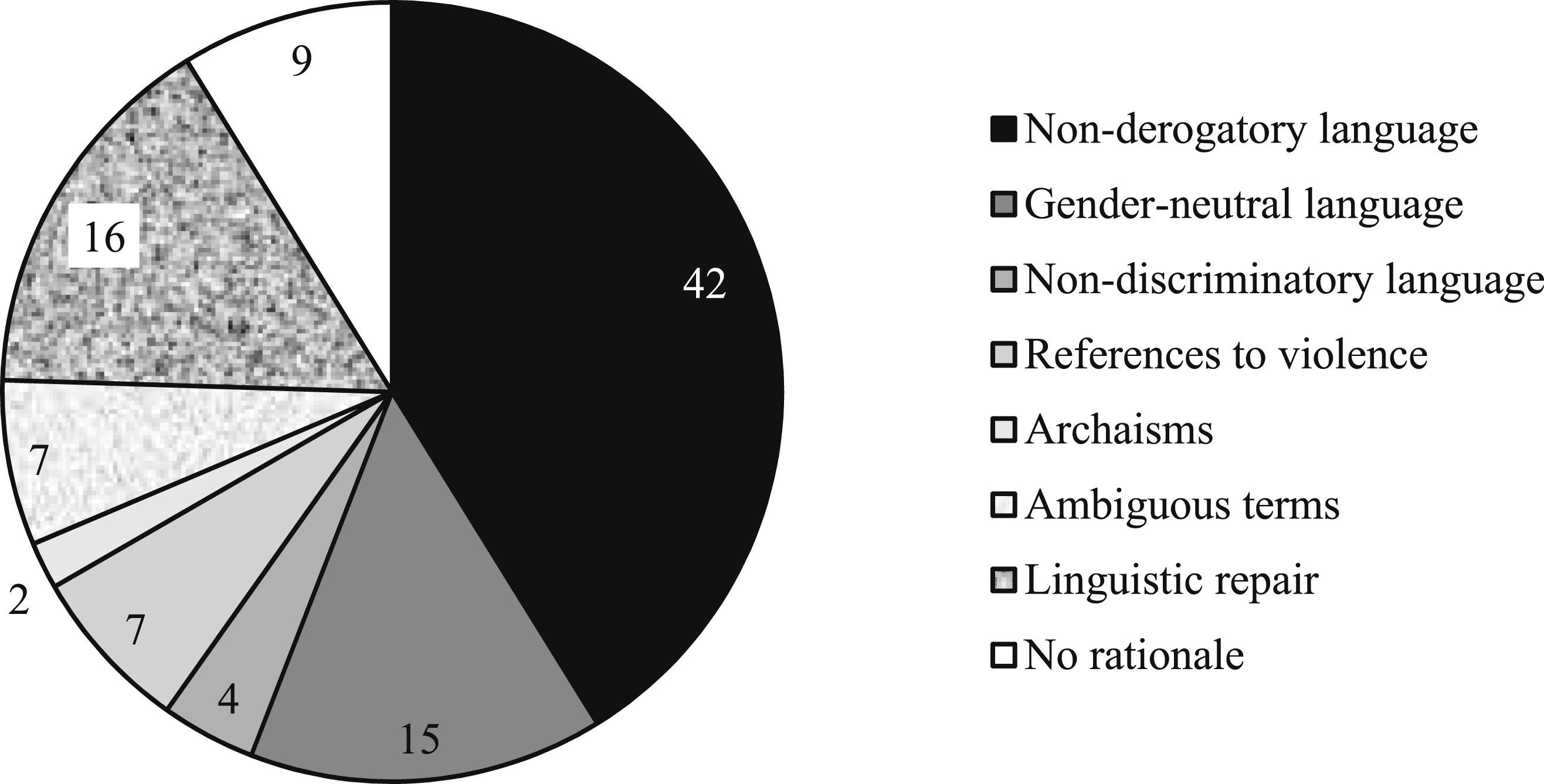
5.1. Shift to non-derogatory language
42% of the revisions made to the 2022 edition of George’s Marvellous Medicine fall into the category of a shift to non-derogatory language. This is illustrated by comparing example (1a), the original 1981 text, with example (1b), the revised 2022 text. (N.B. the revised element of the text is indicated in bold):
In this case, lady has been substituted for hag most likely on the grounds that the latter is disparaging towards women, with its connotations of being old, ugly, frightening, malicious and immoral. (Although hag could in earlier times be used to describe a man, according to the Oxford English Dictionary this usage is unattested after around 1700). It is clear, then, that the revision has been made in an effort to remove derogatory references from the text. However, not all of the revisions in this category achieve this aim successfully. Consider examples (2a) and (2b): (2a) He found another aerosol can, NEVERMORE PONKING DEODORANT SPRAY, GUARANTEED, it said, TO KEEP AWAY UNPLEASANT BODY SMELLS FOR A WHOLE DAY. (2b) He found another aerosol can, NEVERMORE PONKING DEODORANT SPRAY, GUARANTEED, it said, TO KEEP AWAY UNPLEASANT BODY SMELLS FOR A WHOLE DAY.
In (2a), the implicature (derived from a flout of Grice’s 1975 maxim of manner) is that George’s grandma has an unpleasant body odour. Crucially, though, while the revision in (2b) increases the number of weak implicatures that may be inferred (in line with Clark’s 2012 argument), it does not remove the implicature that Grandma smells unpleasant, which is the same in both cases. In essence, (2a) is closer to a generalised implicature while (2b) is a particularised implicature, requiring more context to recover.
Sometimes, revisions to the text not only do not solve the problem that the publisher appears to have identified, they also create subsequent problems. Examples (3a) and (3b) illustrate this point:
In (3a), the premodifying adjectives ‘pale’ and ‘brown’ are used to give a sense of what Grandma’s teeth look like. I suspect that in the case of the revision in (3b), then, the publishers are responding to the fact that (3a) is an explicit reference to appearance, and that it has been assumed that this is something to be avoided on the grounds that people do not always have control over what they look like. It would also seem that (3b), by contrast, has been assumed to offer a more objective, fact-based description. The problem with this assumption is that ‘pale’ and ‘brown’ do not necessarily implicate ‘rotting’ and the adjective that replaces them in (3b) is not only descriptive but negatively evaluative too. Overall, then, if we assume that (3a) contains problematic language, (3b) only exacerbates this. It is also the case that (3b) contains an additional post-modifying prepositional phrase, seemingly designed to soften (by explanation) a derogatory reference to the appearance of Grandma’s mouth. But it is difficult to see how frowning (even for a prolonged period) can result in a mouth that is puckered. The problem here is contextual rather than linguistic but it is a problem nonetheless. The revision in (3b) also causes problems of cohesion later on in the text, when the narrator states that ‘The old woman grinned, showing those pale brown teeth.’ (This line is retained in the 2022 edition). The problem here is that since the noun phrase ‘pale brown teeth’ has been deleted, there is no longer an antecedent for the demonstrative ‘those’ to refer back to, making the reference harder to interpret.
5.2. Shift to gender-neutral language
15% of the revisions belong to the category of a shift to gender-neutral language. This involves changing references to a person’s sex where this is not required by the narrative. For example, at one point in the story, George’s father hires a crane. In the 1981 edition, it is described as having two ‘men’ in it. In the 2022 edition, this description is changed to ‘people’ and the ‘crane men’ described instead as ‘crane operators’. These changes have no bearing on the story itself and simply reflect the reality that such industries are no longer the preserve of men (which was probably the case in 1981 too, though perhaps to a lesser extent than now). It is thus difficult to see why anyone might object to this revision unless (i) they are unashamedly sexist or (ii) they object to the revision of an author’s work on principle (I say more about this latter point in section 8).
In some cases, revisions in this category lead to a streamlining of the story. Consider (4a) and (4b):
In the 1981 text, the omitted information, recoverable via a Q-implicature in Horn’s (1984) and Chapman (2020) terms, is that George’s mother was not a farmer. This implicature is arguably strengthened when, at a crucial moment in the plot, where George and his father are described as running around getting excited, George’s mother is described as being in the kitchen washing up. This fact has no relevance to the story. Additionally, given the realities of farming, it would be highly unlikely for both parents not to be involved in the running of the farm. I would argue, therefore, that this revision is a successful one, not only because it addresses a sexist representation of character but because it does so by removing irrelevant information, thereby streamlining the plot.
Elsewhere, efforts have been made by the publisher to remove sexist generalisations. For example, at the beginning of the story, George’s mother announces that she is going shopping and implores George to ‘be a good boy and don’t get up to mischief.’ She then leaves him alone with Grandma. (George’s father’s absence from the house at this point is unexplained. Many readers would perhaps infer from this that he is at work, somewhat undermining the change to the representation of Mrs Kranky described above). The text that follows Mrs Kranky’s direct speech has been revised in the 2022 edition:
(5b) appears to be an effort to avoid the implicature that only boys engage in mischief-making. This implicature is present in Grandma’s later exhortation that ‘Boys who grow too fast become stupid and lazy’, though we might note that this is character speech as opposed to narration (and is retained in the 2022 edition). This raises the issue of whether the revisions that involve sensitive language issues are predominant in narration rather than non-narration. I return to this question in section 6.
5.3. Shift to non-discriminatory language
Relatively few of the revisions to the 2022 text involve shifting to non-discriminatory language – just 4%. Examples (6a) and (6b) illustrate this category:
This instance of direct speech is from George and is directed to Grandma after she stands up without aid following her first taste of George’s medicine. The change in the 2022 text is likely explained by the fact that (6a) has been seen by the publishers as potentially putting forward a patronising view of old people (i.e. that old people need to use walking sticks). However, this does not take account of the contextual information we have about Grandma, which is that she spends all day sitting in her chair (implicating a difficulty with walking). Prior to the example in (6a), in the 1981 text George says ‘You haven’t stood up like that for years!’ This is excised from the 2022 text. In both cases, George’s statement is specifically directed at Grandma as opposed to being a generic comment about old people, though the publishers have not taken account of this fact in making the decision to revise these aspects of the text.
5.4. Removal of references to violence
Dahl’s fiction, including that for children, is widely acknowledged to be dark (Mehmi, 2014). It is perhaps not surprising then that his publishers saw it as necessary to remove some of the violent references in George’s Marvellous Medicine. 7% of the revisions belong in this category, which is illustrated by the examples in (7a) and (7b), which are instances of direct speech from Grandma, who at this point in the story has just jumped on to the back of George’s pony:
The revision in (7b) is clearly intended to tone down the reference to violence in (7a). The explicit reference to death is removed entirely and the verb of motion is replaced with a verb which references the outcome of the action in (7a) as opposed to the action itself. The problem, though, is that the revision rests on a misinterpretation of the original text as literal rather than hyperbolic. Added to this is the fact that events in the fictional world are so clearly unrealistic that even if (7a) were intended literally, it would be unlikely to invoke fear in the reader. Moreover, the revision once again does not solve the problem that the publisher has identified. The threat of violence in (7b) is more indirect than in (7a) since it is conveyed by implicature rather than outright statement – but it is still conveyed.
This is not to say that all of the revisions to the 2022 text are flawed. Consider (8a) and (8b), for instance, which describe Grandma’s reaction on taking George’s medicine for the first time: (8a) Grandma yelled ‘Oweeeee!’ and her whole body shot up whoosh into the air. It was exactly (8b) Grandma yelled ‘Oweeeee!’ and her whole body shot up whoosh into the air. It was
I would argue that the incongruity in the revision (of an old lady in an ejector seat) is greater than the incongruity in the original (of an old lady in an electric chair), hence more cartoon-like and in-keeping with the events in the fictional world – and funnier as a result.
5.5. Removal of archaisms
There are a number of instances of what might be described as archaic language in the 1981 version of George’s Marvellous Medicine. Some of these (2% of all revisions) are amended in the 2022 edition, as in (9a) and (9b):
However, there is substantial inconsistency with regard to these kinds of revisions. For example, George uses the exclamative ‘By gum’, which would have been archaic for an eight-year-old in 1981. Nonetheless, this is retained in the 2022 text. It is also the case that all the weights and measures referenced in the novel are imperial rather than metric (e.g. ‘The label said simply DARK BROWN GLOSS PAINT ONE QUART’), and none of these were revised for the 2022 edition.
5.6. Removal of potentially ambiguous terms
7% of the revisions involve the replacement of potentially ambiguous terms. Some of these are as a result of semantic change (e.g. ‘strange’ is substituted for ‘queer’, given the diachronic shift in the predominant meaning of the latter). Elsewhere, some of the changes seem to stem from a desire to avoid sexual connotations. Examples can be seen in (10a) and (10b), and (11a) and (11b): (10a) ‘Come closer to me, little boy,’ she said, beckoning to him with a (10b) ‘Come closer to me, little boy,’ she said, beckoning to him with a (11a) ‘[…] we’ve made Grandma feel (11b) ‘[…] we’ve given Grandma
In both cases the revised version loses the element of foregrounding present in the original. (10b) is lexically conventional while (11b), although retaining alliteration as in (11a), replaces the novel simile with a conventional conceptual metaphor. Consequently, some of the artistry of Dahl’s language is lost.
5.7. Linguistic repair
A relatively large proportion of the revisions (16%) fall into a category I have termed linguistic repair. Linguistic repair encompasses two types. The first is revisions that the publishers have made to Dahl’s grammar, illustrated in (12a) and (12b):
It is apparent that (12a) has been considered by the publishers to constitute a run-on sentence (likely a misinterpretation of the fact that ‘all colours, black, green, red, pink, white and brown' is a loose appositional noun phrase that postmodifies ‘cans'). Hence, the comma after ‘colours’ is replaced by a dash in (12b). There is an inconsistency to this type of repair though, which can also be seen in (12a). The second comma has been revised but following the logic of this, the first would also need to replaced, either by ‘of’ or by a colon. It is also the case that Dahl’s original grammar might be interpreted as reflecting spoken discourse – a stylistic trait that is readily observable in his narration but one which has apparently not been considered by his publishers.
On occasion, a change to the 1981 text necessitates further revisions as a consequence. I have also categorised this type of revision as linguistic repair and it is illustrated by examples (13a) and (13b). Immediately preceding (13a), George’s mother comments on the fact that Grandma (her own mother) was rather a nuisance, to which George’s father agrees. But in the 2022 text, these two stretches of direct speech are deleted (see examples 79-81 in the Appendix). Because of this, the narration in response – ‘George didn’t say a word’ – no longer makes sense, and is consequently also deleted. This necessitates a second change, from the personal pronoun ‘he’ to the proper noun ‘George’, in order to ensure that the revised text is cohesive.
5.8. No obvious rationale
The final category, which accounts for 9% of the revisions, is reserved for those instances where I could not see any obvious rationale for the revision that has been made. Examples (14a) and (14b) illustrate this: (14a) Up she went like a jack-in-the-box…and she didn’t come down…she stayed there…suspended in mid-air…about two feet up…still in a sitting position…but rigid now… (14b) Up she went like a jack-in-the-box…and she didn’t come down…she stayed there…suspended in mid-air…about two feet up…still in a sitting position…but rigid now…
While it is possible that the deletions have been made on logical grounds (Grandma cannot be frozen if she is also quivering), this seems unsatisfactory as an explanation. The more likely interpretation of the original is that the frozen element of Grandma’s form is her sitting position – and within this position her body as a whole is quivering.
6. Structural location of the revisions
Structural location of the revisions.

56 revisions are to the narration, 21 to direct speech, one each to direct thought and direct writing, and three result in free indirect thought as opposed to the narration of the original. This raises a further question, namely does discourse type (i.e. narration or non-narration) influence the distribution of the eight categories of revision? The reason this question is worth pursuing has to do with the fact that George’s Marvellous Medicine is a third-person narration. And as Short (1996) points out, in such texts readers sometimes conflate author and narrator, assuming the latter be a textual instantiation of the former. I would argue that this is very likely for the child reader of George’s Marvellous Medicine, for a number of reasons. First, Dahl’s narrative voice is often reflective of his own personality. Indeed, Dahl’s editor, Virginia Fowler, was not enamoured of what she saw as the author’s propensity to incorporate authorial comment into his narrative (Treglown, 1994: 142). Relatedly, Treglown (1994: 142) discusses the similarity between the narrator and the character of Mr Wonka in Charlie and the Chocolate Factory (Dahl, 1964), further suggesting a blurring of Dahl’s authorial and narratorial/character roles: It would be naïve to say that Mr Willy Wonka ‘is’ Roald Dahl, but they have a lot in common – for example, in the similarity between Dahl’s third-person narrative voice and Mr Wonka’s own hectic, exaggerated way of talking[.] (Treglown, 1994: 142)
Second, the 2022 edition is prefaced by a page titled ‘Introducing the characters’, featuring line drawings by the illustrator Quentin Blake of the main characters in the story, along with a short description of who they are. On the preceding page, both Dahl and Blake are also introduced, as the author and illustrator respectively, with drawings of them in the same style as those of the characters. A potential effect of this design choice is to suggest that Dahl the author is as much a character as George and the protagonists in the story. The distinction between the real-life author and his narrator persona is thereby blurred, increasing the possibility of the child reader assuming that the narrator’s voice is Dahl’s own.
Contingency table for chi-square test (Jamovi, 2024).
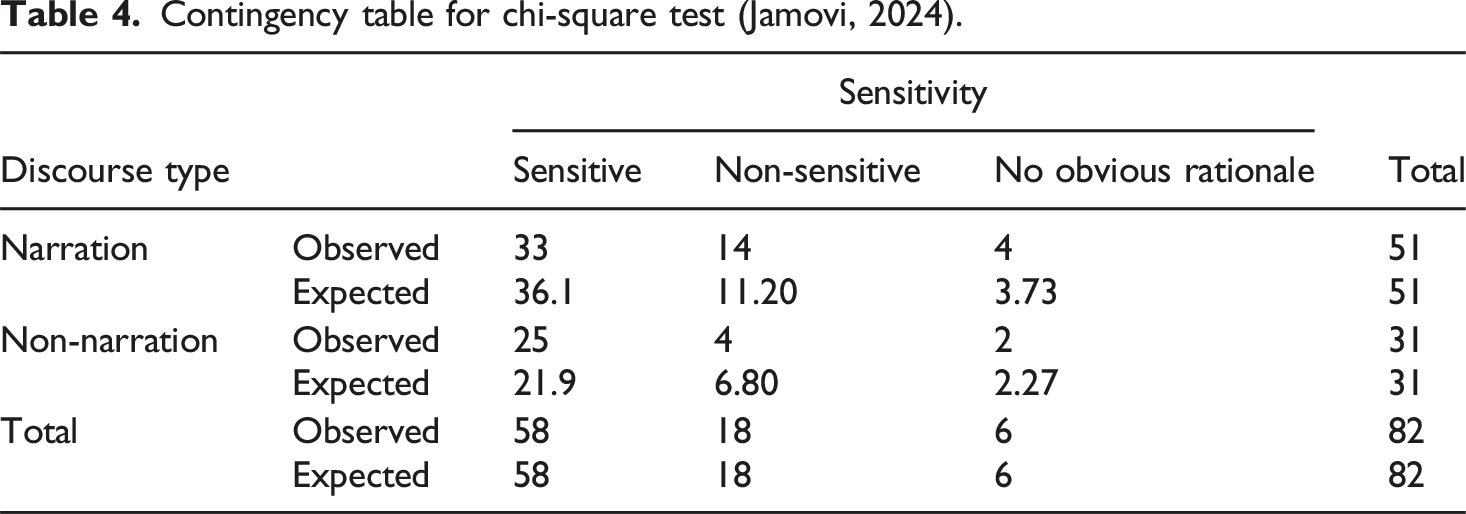
What the chi-square test reveals is that there is no statistically significant association between the sensitivity parameter and discourse type, i.e. narration as opposed to non-narration: χ2(2) = 2.60, p = .272 5 . This is an interesting result in so far as it suggests that the publisher of the 2022 edition was not especially concerned with making revisions to the narrative voice. It would seem, then, that the revisions to the 2022 text were not informed by any particular narratological strategy.
7. Relative success of the revisions
RQ4 asks whether the revisions to the 2022 edition of George’s Marvellous Medicine are successful in reducing potential hurt or offence to readers. As stated in section 1, any answer to this question is to some degree necessarily subjective, given the potential for varying interpretations of what it means to hurt or offend. Nonetheless, on the basis of the analysis presented in sections 4 and 5, it is possible to offer some evidence-based commentary on the relative success of the revisions, while acknowledging that these remain open to discussion.
First, I would argue that the revisions to the text which are focused on creating gender-neutral language work relatively well in that they address a problematic aspect of characterisation in the original novel while not impacting negatively on the story itself. This is in line with a statement from Dahl’s literary estate, The Roald Dahl Story Company, that explains, ‘Our guiding principle throughout has been to maintain the storylines, characters, and the irreverence and sharp-edged spirit of the original text.’ (Vernon, 2023). For instance, the 2022 text states that both of George’s parents were farmers. In the 1981 edition, only George’s father is described as such. This original characterisation is problematic for a number of reasons. It backgrounds George’s mother for no obvious reason, it implicates that women’s roles in life are less important than men’s, and it is unrealistic given the demands of farming (of course, the story itself is unrealistic, given its magical element – but this latter component depends for its effectiveness on being contrasted with a generally realistic presentation of the world). The revision to the 2022 text not only addresses these problems, it streamlines the narrative. For example, the reference in the 1981 text to George’s mother washing up in the kitchen (while George and his father are testing new versions of the medicine) serves no purpose in plot terms. In the 2022 text, it is excised. (Of course, it may also be argued that this erases the historical context of when the book was written, though strict adherence to such a position would inhibit any changes to a text at all).
However, the revisions to the 2022 text are inconsistent. For example, while some archaisms have been removed, others remain. And while some shifts to gender-neutral language have been enacted, other problematic aspects of characterisation endure. For instance, George’s father is given a first name (Killy) – but not his mother. It would be possible, of course, to argue that neither of George’s parents should receive a first name, since this would better reflect the fact that the point of view in the story is filtered through George. But neither is this something that has been taken account of in the revised edition. More generally in terms of characterisation, we can note that the antagonist in the story is George’s grandmother as opposed to his grandfather.
It is also the case that the revisions to the 2022 edition are not necessarily less potentially offensive than the original text. The shift from describing Grandma’s teeth as ‘pale brown’ to ‘rotting’ exemplifies this problem. And while violent references may be toned down in the 2022 text, these are still present, albeit conveyed by implicature rather than direct statement. Sometimes it would also appear that the revisions are informed by misinterpretations of the original text (see, for instance, the discussion in 5.4 of the removal of the reference to Grandma’s threat to trample onlookers to death).
In general, then, the revisions to the 2022 text are not unproblematic. But perhaps the biggest problematic aspect of the story from a stylistic perspective is that the crimes of Grandma do not merit the punishment that George metes out to her. She is described as selfish, miserable and a grouch but we are offered no significant basis for this characterisation and we never find out why George hates her so much. To address this issue, of course, revisions would be needed at the level of plot and narratological structure. Perhaps, for example, George could have made the medicine in a misguided attempt to help Grandma. Or perhaps the story would be improved by exacerbating the cartoonish element from the very beginning, to emphasise the outlandishness of George’s actions. While such revisions might feel more intrusive than adaptations to the language of the text, it should be noted that Dahl himself was not averse to making plot changes on the advice of his editor; see, for example, Treglown’s (1994: 224-5) discussion of the changes made to The Witches (Dahl, 1983) following notes from Stephen Roxburgh.
There is a caveat to this notion of George’s treatment of Grandma being problematic, and it is one noted by Dahl’s biographer, Jeremy Treglown. Discussing George’s apparent malice, he makes the pertinent point that this is tempered somewhat by Quentin Blake’s illustrations to the text: Blake lightens things by visually reminding the reader both how small George is and, as he wanders around the house looking for ingredients for his medicine, how lonely and innocent. His actions come across as prompted more by curiosity than cruelty. (Treglown, 1994: 212)
This reminder that the text is a multimodal object is important, and is something that both the publishers of the revised edition and the critics of that version appear not to have considered. And while it is beyond the scope of this article, it would be possible to treat Treglown’s claim as a hypothesis to be tested via a multimodal stylistic analysis of the original text.
8. Conclusion
Both the 1981 and 2022 editions of George’s Marvellous Medicine are prefaced with a warning to readers that states: ‘Do not try to make George’s Marvellous Medicine at home. It’s likely to be extremely dangerous.’ Given the toxicological analysis of George’s concoction offered by Johnson and Davies (2020), this is something of an understatement 6 . But it emphasises the fact that, taken literally, the whole concept of the narrative is problematic. The only way around this problem for the reader is to suspend our normal assumptions about what is acceptable and enjoy the transgressive nature of the story. This makes the novel a difficult one for revising in the light of a sensitivity reading, since revisions to the language of the text can never solve the underlying problems with it (though it is likely that this is also the case for many novels that have been revised for sensitive language issues).
What I have attempted to do in this article is assess the likely impact of the textual revisions that were implemented by Puffin Books in the 2022 version of Dahl’s novel, notwithstanding the problems inherent in any attempt to revise the book for sensitive language issues. And since the impact of the textual revisions has been my focus, I have up until now avoided direct comment on whether sensitivity reading is to be regarded as a good or bad thing. This is largely because this question is not my main concern but also because it is not a question that can be answered directly through stylistic analysis, and any answer based on the analysis of one revised novel alone will necessarily be partial. I also suspect that it would be all but impossible to change the minds of those readers who are firmly of the opinion that an author’s work is sacrosanct (though it is interesting to note that such views tend not to be so vehement about editions that take liberties with Shakespeare’s work, suggesting that it is the particular agenda driving the revision process that is the real issue). Nonetheless, I would argue that the results of the stylistic analysis presented here offer insights into the practice of sensitivity reading that might be used to support an evaluation of its relative merits. Before doing this, though, one caveat needs to be considered: my analysis in this article is of a book that has been subject to sensitivity reading and revised accordingly after its original publication, and after its author’s death. While the revisions were supported by Dahl’s literary estate (Vernon, 2023), this is clearly a very different set of circumstances to those where an author and publisher have the opportunity to deal with recommendations from sensitivity readers prior to publication. Studying the latter type of sensitivity reading would obviously be a more difficult task, given the generally confidential nature of the reports produced by such readers. But it would be instructive to be able to compare the revision process that emerges as a result of sensitivity reading from both pre- and post-publication perspectives.
I would suggest that two main points about sensitivity reading emerge from my analysis in this article. The first is that addressing sensitive language issues through textual revision is fraught with difficulty. While some of the revisions to George’s Marvellous Medicine made by the publishers are relatively successful (e.g. the shift to gender-neutral language, certain changes in similes), others are just as problematic as the original text. Indeed, in some cases, problems are exacerbated by the revisions, which in general are clumsy, inconsistent and give rise to problems of cohesion. In analysing the revisions that were made, it is also interesting to note that few of the tendencies discussed in section 2, above, are in evidence in the 2022 version of George’s Marvellous Medicine. While there are some examples of the broader use of weak implicatures (cf. the revision strategies of George Moore, John Fowles and Gordon Lish), these rarely solve the problem that the publisher appears to have identified with the original text. No attention is paid in the revisions to issues of point of view, and no consideration is given to how the representation of interpersonal relations between characters might have been improved. Generally, then, and notwithstanding some successfully revised elements, I would argue that the 2022 version of George’s Marvellous Medicine is an inferior text to the original.
The reason for this is explained by the second point that emerges from my analysis, which is that sensitivity reading requires linguistic expertise. This is not to dismiss the importance of the lived experience offered by sensitivity readers. But it is to suggest that any revisions to a text need to be grounded as much in stylistic and narratological theory as socio-cultural concerns. Where sensitivity readers and publishers lack this expertise themselves, it would be beneficial to the revision process to seek advice from those able to offer an informed linguistic perspective on the issues at hand. In a statement supportive of Puffin Books’ revisions to Dahl’s work, the author’s literary estate claimed that ‘Any changes made have been small and carefully considered’ (Vernon, 2023). But small changes can have big effects, as we have seen. And while it is impossible to challenge the claim that the revisions were carefully considered, it is perhaps not too contentious to suggest that they were not considered carefully enough. 7
Given the difficulties of revising an author’s work post-publication, then, this raises the question of whether such attempts should even be made. Certainly, revising a text in such a way as to satisfy all potential readers is an impossibility. One strategy, then, would simply be to leave the texts as they are and let their popularity with readers be the deciding factor concerning whether they remain in print. As the children’s author Philip Pullman put it when asked about the revisions to Dahl’s books, if we are offended by his language, the answer is to ‘read better writers’ (Nugent, 2023). This is a compelling view and one that I would be inclined towards myself were it not for two complicating factors. The first concerns context of reading. It is one thing for a parent to decide they are happy for their child to read books now deemed from some quarters to contain problematic material, especially given that reading at home affords the opportunity for parent-led discussion; it is quite another for a child to encounter such work in a school setting where it may be read aloud to a whole class – especially if the child has a characteristic that is not treated sensitively within the text. In such a scenario, I cannot see a justification for causing a child (particularly a very young child) hurt or embarrassment, especially if no contextualising discussion is had of the book. My second reason for not being wholly accepting of Pullman’s argument is a more pragmatic one. Faced with the enormous commercial value of a writer like Dahl (see note 7), it is no surprise that publishers choose not to adopt the strategy of leaving it to the reading public to decide when his books should be allowed to slip quietly out of print. Dahl, then, is likely to continue to feature heavily in children’s early reading experiences for some time to come. While parents and teachers may indeed choose to ‘read better writers’ to the children in their care, we cannot assume that this will always be the case, nor that publishers will cease to aggressively market Dahl’s work. It is unrealistic, then, to imagine that Dahl’s work will go out of print any time soon. And if revising his work is what it takes to continue to be able to profit from it, then this is what publishers will do. Sensitivity reading, then, is here to stay. If this is the case, and if publishers are to revise the works of long-dead authors, we ought at the very least to hold them to account with regard to handling such revisions carefully and consistently.
Sensitivity reading and its impact on the publishing process remains a controversial issue. One of the reasons why is undoubtedly that it is difficult to evaluate sensitivity reading as a process without a better sense of what is involved and how its outcomes are acted upon. In the absence of this information, what stylistic analysis offers is a way of reducing the temperature of the debate, paving the way for a more nuanced and evidence-based discussion of the pros and cons of the practice.
Footnotes
Acknowledgements
I am extremely grateful to Professor Chris Butler for advice on statistics and for assistance in carrying out the test reported in section 6.

Funding
The author received no financial support for the research, authorship, and/or publication of this article.
Declaration of conflicting interests
The author declared no potential conflicts of interest with respect to the research, authorship, and/or publication of this article.
Notes
Author biography
Appendix
Summary of revisions to George’s Marvellous Medicine. N = narration; DS = direct speech; FIT = free indirect thought; DW = direct writing; DT = direct thought.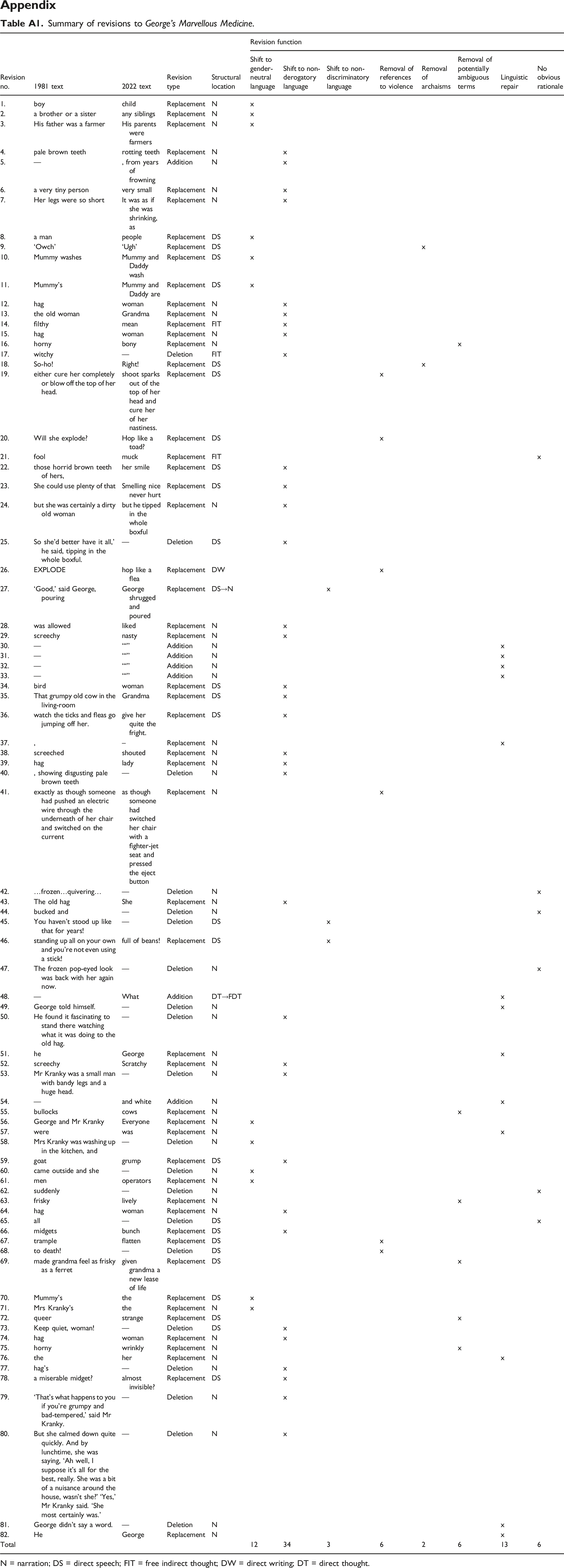
Revision no.
1981 text
2022 text
Revision type
Structural location
Revision function
Shift to gender-neutral language
Shift to non-derogatory language
Shift to non-discriminatory language
Removal of references to violence
Removal of archaisms
Removal of potentially ambiguous terms
Linguistic repair
No obvious rationale
1.
boy
child
Replacement
N
x
2.
a brother or a sister
any siblings
Replacement
N
x
3.
His father was a farmer
His parents were farmers
Replacement
N
x
4.
pale brown teeth
rotting teeth
Replacement
N
x
5.
─
, from years of frowning
Addition
N
x
6.
a very tiny person
very small
Replacement
N
x
7.
Her legs were so short
It was as if she was shrinking, as
Replacement
N
x
8.
a man
people
Replacement
DS
x
9.
‘Owch’
‘Ugh’
Replacement
DS
x
10.
Mummy washes
Mummy and Daddy wash
Replacement
DS
x
11.
Mummy’s
Mummy and Daddy are
Replacement
DS
x
12.
hag
woman
Replacement
N
x
13.
the old woman
Grandma
Replacement
N
x
14.
filthy
mean
Replacement
FIT
x
15.
hag
woman
Replacement
N
x
16.
horny
bony
Replacement
N
x
17.
witchy
─
Deletion
FIT
x
18.
So-ho!
Right!
Replacement
DS
x
19.
either cure her completely or blow off the top of her head.
shoot sparks out of the top of her head and cure her of her nastiness.
Replacement
DS
x
20.
Will she explode?
Hop like a toad?
Replacement
DS
x
21.
fool
muck
Replacement
FIT
x
22.
those horrid brown teeth of hers,
her smile
Replacement
DS
x
23.
She could use plenty of that
Smelling nice never hurt
Replacement
DS
x
24.
but she was certainly a dirty old woman
but he tipped in the whole boxful
Replacement
N
x
25.
So she’d better have it all,’ he said, tipping in the whole boxful.
─
Deletion
DS
x
26.
EXPLODE
hop like a flea
Replacement
DW
x
27.
‘Good,’ said George, pouring
George shrugged and poured
Replacement
DS→N
x
28.
was allowed
liked
Replacement
N
x
29.
screechy
nasty
Replacement
N
x
30.
─
“‘”
Addition
N
x
31.
─
“‘”
Addition
N
x
32.
─
“‘”
Addition
N
x
33.
─
“‘”
Addition
N
x
34.
bird
woman
Replacement
DS
x
35.
That grumpy old cow in the living-room
Grandma
Replacement
DS
x
36.
watch the ticks and fleas go jumping off her.
give her quite the fright.
Replacement
DS
x
37.
,
–
Replacement
N
x
38.
screeched
shouted
Replacement
N
x
39.
hag
lady
Replacement
N
x
40.
, showing disgusting pale brown teeth
─
Deletion
N
x
41.
exactly as though someone had pushed an electric wire through the underneath of her chair and switched on the current
as though someone had switched her chair with a fighter-jet seat and pressed the eject button
Replacement
N
x
42.
…frozen…quivering…
─
Deletion
N
x
43.
The old hag
She
Replacement
N
x
44.
bucked and
─
Deletion
N
x
45.
You haven’t stood up like that for years!
─
Deletion
DS
x
46.
standing up all on your own and you’re not even using a stick!
full of beans!
Replacement
DS
x
47.
The frozen pop-eyed look was back with her again now.
─
Deletion
N
x
48.
─
What
Addition
DT→FDT
x
49.
George told himself.
─
Deletion
N
x
50.
He found it fascinating to stand there watching what it was doing to the old hag.
─
Deletion
N
x
51.
he
George
Replacement
N
x
52.
screechy
Scratchy
Replacement
N
x
53.
Mr Kranky was a small man with bandy legs and a huge head.
─
Deletion
N
x
54.
─
and white
Addition
N
x
55.
bullocks
cows
Replacement
N
x
56.
George and Mr Kranky
Everyone
Replacement
N
x
57.
were
was
Replacement
N
x
58.
Mrs Kranky was washing up in the kitchen, and
─
Deletion
N
x
59.
goat
grump
Replacement
DS
x
60.
came outside and she
─
Deletion
N
x
61.
men
operators
Replacement
N
x
62.
suddenly
─
Deletion
N
x
63.
frisky
lively
Replacement
N
x
64.
hag
woman
Replacement
N
x
65.
all
─
Deletion
DS
x
66.
midgets
bunch
Replacement
DS
x
67.
trample
flatten
Replacement
DS
x
68.
to death!
─
Deletion
DS
x
69.
made grandma feel as frisky as a ferret
given grandma a new lease of life
Replacement
DS
x
70.
Mummy’s
the
Replacement
DS
x
71.
Mrs Kranky’s
the
Replacement
N
x
72.
queer
strange
Replacement
DS
x
73.
Keep quiet, woman!
─
Deletion
DS
x
74.
hag
woman
Replacement
N
x
75.
horny
wrinkly
Replacement
N
x
76.
the
her
Replacement
N
x
77.
hag’s
─
Deletion
N
x
78.
a miserable midget?
almost invisible?
Replacement
DS
x
79.
‘That’s what happens to you if you’re grumpy and bad-tempered,’ said Mr Kranky.
─
Deletion
N
x
80.
But she calmed down quite quickly. And by lunchtime, she was saying, ‘Ah well, I suppose it’s all for the best, really. She was a bit of a nuisance around the house, wasn’t she?’ ‘Yes,’ Mr Kranky said. ‘She most certainly was.’
─
Deletion
N
x
81.
George didn’t say a word.
─
Deletion
N
x
82.
He
George
Replacement
N
x
Total
12
34
3
6
2
6
13
6